Hawaiian Monarchy Timeline: Every Monarch From Kamehameha I to Liliʻuokalani

For just under a century, Hawaiʻi was a kingdom: a sovereign nation with its own monarchs, constitutions, treaties, and a palace that still stands in downtown Honolulu. The Hawaiian monarchy timeline runs from Kamehameha I, who forged the kingdom in war, to Queen Liliʻuokalani, who lost it in 1893 without a battle. Between them came eight monarchs, four constitutions, international recognition, and a transformation of Hawaiian life so rapid that a single lifetime could span the old kapu world and the age of electricity at ʻIolani Palace.
This is the complete timeline in one place: every monarch with reign dates, the turning points that mattered, from unification in 1795 and 1810 to the overthrow of 1893 and the forced abdication of 1895, plus what visitors most often get wrong and where to stand in the story today. For the society the kingdom grew out of, start with the classes and land system in Hawaii facts and the fuller picture in Hawaiʻi’s history before statehood.
The Monarchs at a Glance
| Monarch | Reign | Defining mark on the timeline |
| Kamehameha I | 1795 to 1819 | Founded the kingdom, completed unification in 1810 when Kaumualiʻi of Kauaʻi ceded his island |
| Kamehameha II (Liholiho) | 1819 to 1824 | Ended the kapu system in 1819, opening the kingdom to rapid change |
| Kamehameha III (Kauikeaouli) | 1825 to 1854 | Longest reign: first constitution in 1840, international recognition in 1843, the Māhele land division of 1848 |
| Kamehameha IV | 1855 to 1863 | Founded Queen’s Hospital with Queen Emma, strengthened the kingdom against annexation pressure |
| Kamehameha V (Lot) | 1863 to 1872 | Promulgated the Constitution of 1864, last monarch of the Kamehameha line |
| Lunalilo | 1873 to 1874 | First elected king, chosen by the legislature after a popular vote |
| Kalākaua | 1874 to 1891 | Built ʻIolani Palace in 1882, revived hula and Hawaiian culture, signed the 1887 Bayonet Constitution under pressure |
| Liliʻuokalani | 1891 to 1893 | Last monarch: overthrown on January 17, 1893, formally abdicated on January 24, 1895 |
Before the Kingdom: An Island World of Chiefs
The monarchy did not appear from nowhere. For centuries before 1795, each large island, and sometimes parts of islands, formed its own chiefdom under an aliʻi nui whose authority rested on genealogy, kapu, and control of land and warriors. Rival chiefdoms fought, allied, and intermarried across the channels, and a few rulers came close to island wide or multi island power before Kamehameha. What changed in his generation was scale and contact. Foreign ships arriving after 1778 brought iron, firearms, and new diseases, and ambitious chiefs raced to control the trade. Kamehameha won that race on Hawaiʻi Island first, defeating his rivals by 1791, then turned outward with a fleet of war canoes and foreign advisors at his side. The kingdom was born because one chief combined traditional legitimacy, new weapons, and an unmatched talent for absorbing rivals into his service rather than simply destroying them, a pattern that set the tone for the century that followed.
1795 to 1819: Kamehameha I Founds a Kingdom
The timeline starts in war. In 1795, the Hawaiʻi Island chief Kamehameha won the Battle of Nuʻuanu on Oʻahu, bringing Maui, Molokaʻi, and Oʻahu under his rule and establishing the Hawaiian Kingdom. Only Kauaʻi and Niʻihau remained outside. In 1810, their chief Kaumualiʻi negotiated a peaceful cession, becoming a vassal of Kamehameha and making him sole sovereign of the island chain. Kamehameha governed from shifting royal centers, enforced the kapu order he had inherited, traded with foreign ships on his own terms, and issued the famous Law of the Splintered Paddle, protecting the weak from robbery on the roads. When he died on May 8, 1819, the kingdom passed intact to his son Liholiho.
1819 to 1825: The Kapu Falls and the World Arrives
Kamehameha II, Liholiho, reigned barely five years, but one act in his first year rewired Hawaiian society. In late 1819, influenced by the powerful queen regent Kaʻahumanu and his mother Keōpūolani, he sat down and ate with women, publicly breaking the ʻai kapu eating restrictions. The old religious order was overturned in the event called the ʻAi Noa. Months later, in 1820, the first American Protestant missionaries arrived in a kingdom that had just dismantled its own priestly system, and literacy, Christianity, and Western law poured into the opening. Liholiho and Queen Kamāmalu traveled to London in 1824 to negotiate with Britain, and both died there of measles, a devastating early lesson in the diseases that were shrinking the Native Hawaiian population.
1825 to 1854: Kamehameha III and the Constitutional Kingdom
Kamehameha III, Kauikeaouli, came to the throne as a child and reigned nearly 30 years, the longest of any Hawaiian monarch. His reign turned a chiefly kingdom into a constitutional state. On October 8, 1840, he granted the kingdom’s first constitution. In 1843 the kingdom survived two shocks: a five month seizure by a British captain, reversed by his admiral, and then, on November 28, 1843, joint recognition of Hawaiian independence by Britain and France, a date still honored as Lā Kūʻokoʻa, Hawaiian Independence Day. The Māhele of 1848 divided land among king, chiefs, and government and opened the door to private and foreign land ownership, with consequences Hawaiians still debate. Honolulu became the permanent capital in 1845, and the king who had inherited an oral nation left behind courts, schools, treaties, and a government that the world’s powers treated as a peer. He died on December 15, 1854.
1855 to 1872: Kamehameha IV and Kamehameha V
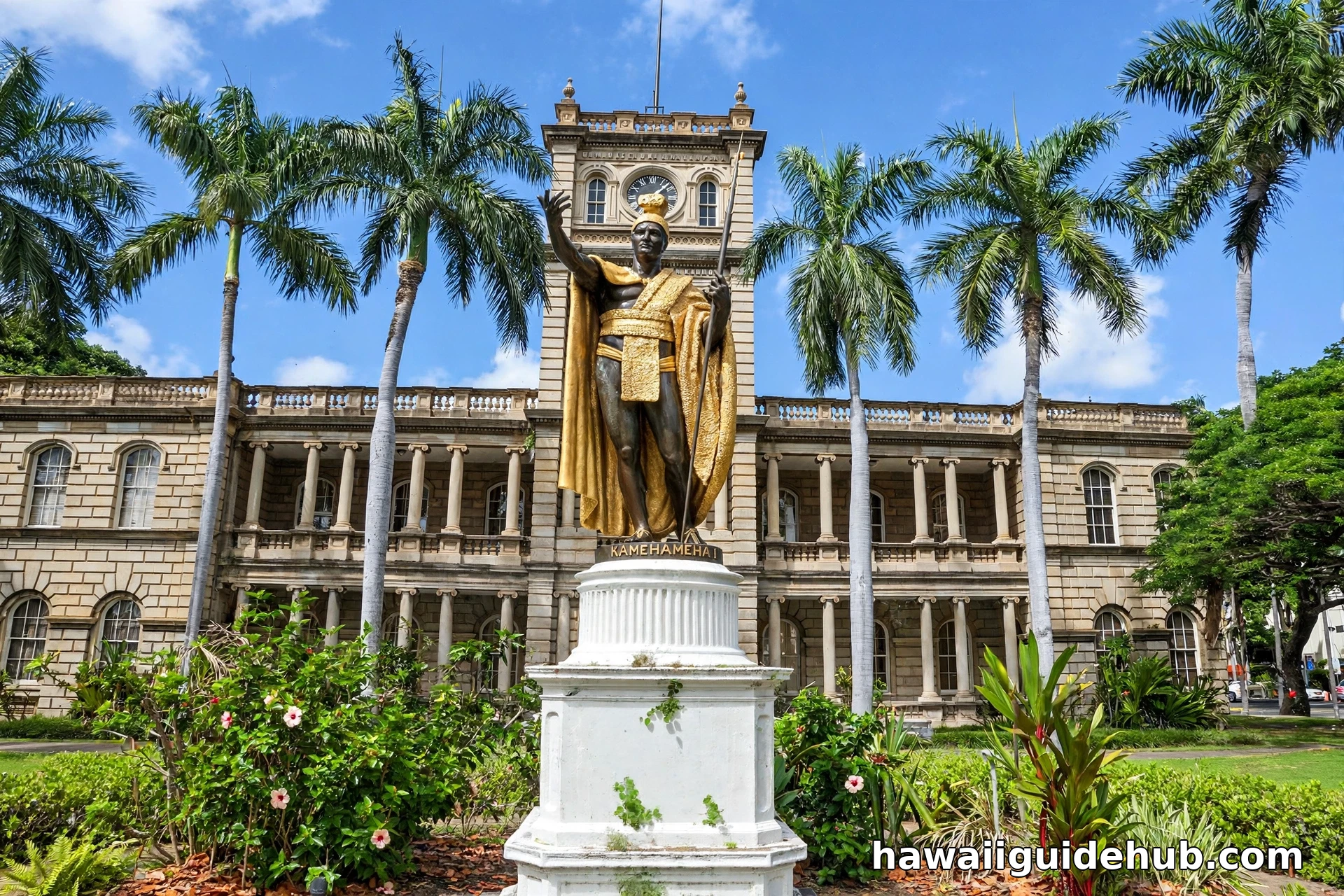
Kamehameha IV, Alexander Liholiho, took the throne on January 11, 1855. Educated and wary of American expansion, he and Queen Emma founded the hospital now known as Queen’s Medical Center in 1859, personally raising funds door to door, and they championed education and the Anglican Church of Hawaiʻi. The death of their young son, Prince Albert, in 1862 shadowed the reign, and the king died in 1863 at only 29. His brother Lot became Kamehameha V. Judging the 1852 constitution too liberal, Lot refused to swear to it and in 1864 promulgated a new constitution that strengthened the monarchy. He promoted Hawaiian culture, licensed hula again, and ordered the building of Aliʻiōlani Hale as a palace, though it finished as a government building. When he died on December 11, 1872, without naming an heir, the Kamehameha dynasty ended, and the constitution’s provision for an elected king took over.
1873 to 1891: Elected Kings, a Palace, and Rising Pressure
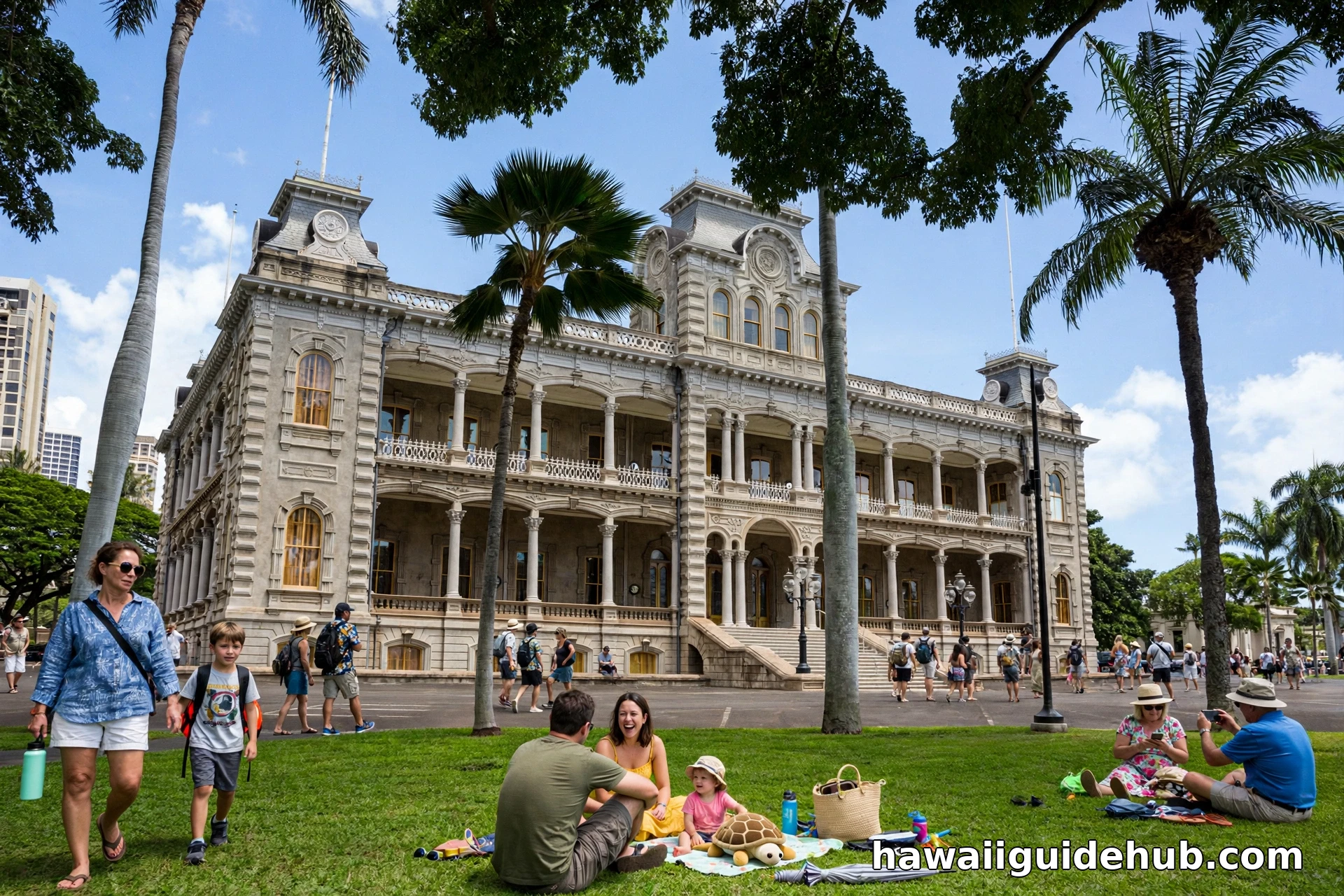
Lunalilo, a popular high chief, won the kingdom’s first royal election and took the throne on January 8, 1873. His reign lasted barely a year before tuberculosis killed him in February 1874, but he left a lasting mark by willing his lands to establish Lunalilo Home for elderly Hawaiians. The legislature then elected David Kalākaua over Queen Emma in a vote that sparked a courthouse riot. Kalākaua, the Merrie Monarch, answered with a cultural revival: hula returned to court, the Iolani Palace rose on the old palace grounds, completed in 1882 with electric light and telephones before the White House had them, and the king sailed around the world in 1881, the first reigning monarch of any nation to do so. Yet his reign also signed the Reciprocity Treaty giving the United States Pearl Harbor rights, and in 1887 an armed league of businessmen forced him to sign the Bayonet Constitution, stripping the monarchy of much of its power and disenfranchising many Native Hawaiian voters. Kalākaua died in San Francisco on January 20, 1891.
1891 to 1895: Liliʻuokalani and the Overthrow
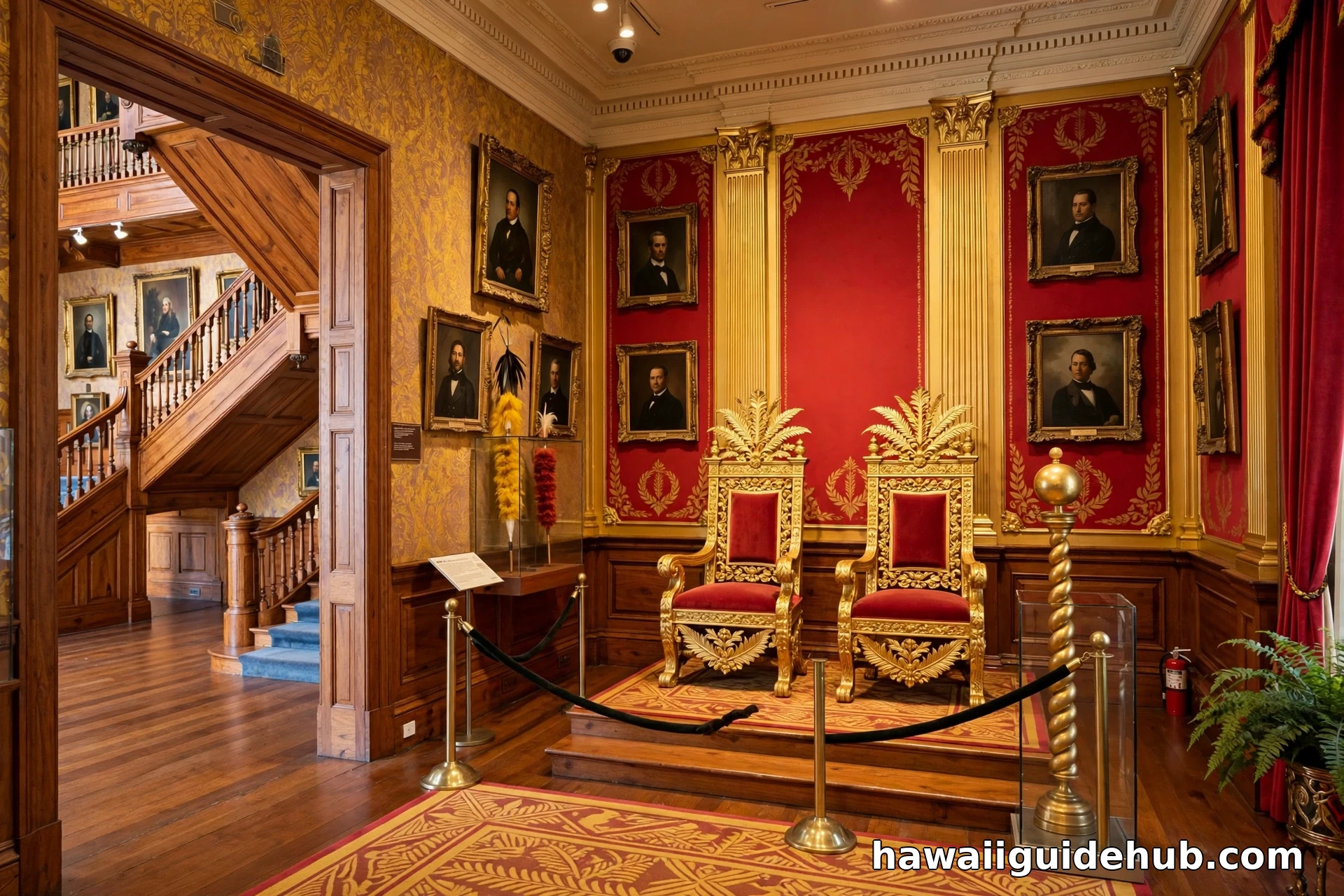
Queen Liliʻuokalani succeeded her brother on January 29, 1891, the kingdom’s only queen regnant. A composer of more than 150 songs, including Aloha ʻOe, she worked to restore the monarchy’s authority and Native Hawaiian political power, and in January 1893 she prepared to proclaim a new constitution. Before she could, on January 17, 1893, a committee of mostly American and European businessmen, backed by the landing of United States troops, overthrew the kingdom and proclaimed a Provisional Government. To avoid bloodshed, the queen yielded under protest to the authority of the United States, expecting Washington to reverse the act. It did not. A republic followed in 1894, annexation came in 1898, and after a failed counter revolt in 1895 the queen was imprisoned in her own palace and formally abdicated on January 24, 1895, to spare her supporters from execution. She spent her remaining years seeking justice for her people and died in 1917. A century later, on November 23, 1993, the United States Congress passed the Apology Resolution, Public Law 103-150, acknowledging the American role in the overthrow.
After 1895: Republic, Annexation, and the Long Echo
The timeline’s formal end was not its historical end. The Republic of Hawaiʻi governed from 1894, and annexation followed in 1898 during the Spanish American War, when the islands’ strategic harbor value outweighed the failed annexation treaty that Hawaiian petitions had helped defeat the year before. Hawaiʻi became a United States territory in 1900 and the fiftieth state in 1959. Royal institutions adapted rather than vanished. The trusts founded by royalty and high chiefs, including the Queen Liliʻuokalani Trust, Kamehameha Schools under Princess Bernice Pauahi Bishop’s will, and Lunalilo Home, still serve Native Hawaiian children and elders with lands the monarchs set aside. ʻIolani Palace, emptied and used as a capitol for seven decades, was restored and reopened as a museum in 1978, and the Hawaiian Renaissance of the 1970s returned the monarchy’s music, language, and navigation traditions to the center of island life. The 1993 Apology Resolution, passed a century after the overthrow, placed the United States on record acknowledging its role, ensuring that the last dates on the timeline are read alongside the first ones.
Common Misconceptions About the Timeline
Three points on this timeline are often told wrong. First, Kamehameha did not unify the islands in a single year: 1795 brought most islands under his rule, but full unification dates to 1810. Second, the kingdom was not a vague chiefdom but an internationally recognized constitutional state with treaties, diplomats, and a national legislature, which is precisely why its overthrow remains contested. Third, the monarchy did not simply fade away. It was overthrown in 1893 by a small committee with foreign support, against the stated opposition of most Native Hawaiians, whose mass petitions against annexation in 1897 gathered more than 21,000 signatures. Dates matter here because the story is one of law as much as of loss. For planning a visit around these sites, our Oʻahu travel guide and Hawaii itinerary guide both give downtown Honolulu the time it deserves.
Video: Inside ʻIolani Palace
A look at the palace Kalākaua built and Liliʻuokalani lost, and at the rooms where the last chapter of the monarchy played out.
Frequently Asked Questions
Who was the first king of Hawaiʻi?
Kamehameha I was the first monarch of the Hawaiian Kingdom. He established the kingdom in 1795 after victories on Maui, Molokaʻi, and Oʻahu, and completed unification in 1810 when Kaumualiʻi of Kauaʻi ceded his island peacefully.
Who was the longest reigning Hawaiian monarch?
Kamehameha III reigned from 1825 to 1854, nearly 30 years. His reign produced the first constitution in 1840, Anglo French recognition of independence in 1843, and the Māhele land division of 1848.
Who was the last monarch of Hawaiʻi?
Queen Liliʻuokalani, who reigned from January 29, 1891, until the overthrow of the kingdom on January 17, 1893. She formally abdicated on January 24, 1895, while imprisoned after a failed attempt to restore the monarchy.
When did the Hawaiian monarchy end?
The monarchy ended in practice on January 17, 1893, when the Provisional Government replaced the queen, and in law on January 24, 1895, when Liliʻuokalani signed her formal abdication. Hawaiʻi then passed through a republic, annexation in 1898, territorial status, and statehood in 1959.
Can you visit the palace of the Hawaiian monarchs?
Yes. ʻIolani Palace in downtown Honolulu, completed in 1882, served as the official residence of Kalākaua and Liliʻuokalani. After decades as a government building it was restored and opened to the public as a museum in 1978. It is the only official royal palace in the United States.
The Hawaiian monarchy lasted less than a hundred years, but it carried a Polynesian nation into the modern world on its own terms: unifying by 1810, writing constitutions, winning recognition from empires, and building a palace lit by electricity in the middle of the Pacific. Its timeline ends in 1893 and 1895, but the story does not. It continues wherever the Hawaiian flag flies over Lā Kūʻokoʻa celebrations and wherever a schoolchild learns the names in order: Kamehameha, Liholiho, Kauikeaouli, and on to the queen who never stopped insisting that the timeline be told truthfully.