Nene Goose: Hawaii’s State Bird and Its Remarkable Comeback

The nene, also spelled nēnē and known worldwide as the Hawaiian goose, is the rarest goose story with a happy turn. This endemic Hawaiian bird once filled the islands in flocks, crashed to about 30 wild birds by the middle of the 20th century, and has climbed back to several thousand through one of the most determined recovery programs in conservation. It is Hawaiʻi’s state bird, a descendant of Canada geese that reached the islands hundreds of thousands of years ago, and a goose that largely gave up water for lava fields and mountain grasslands.
This guide covers the nene goose in Hawaii completely: how to identify it, where it lives and where to see it responsibly, what it eats, how it raises goslings on land, why it nearly vanished, how it was saved, what still threatens it, and the rules that protect it. If you meet one on a trail or beside a parking lot, this page explains both the wonder and the etiquette.
How to Identify a Nene
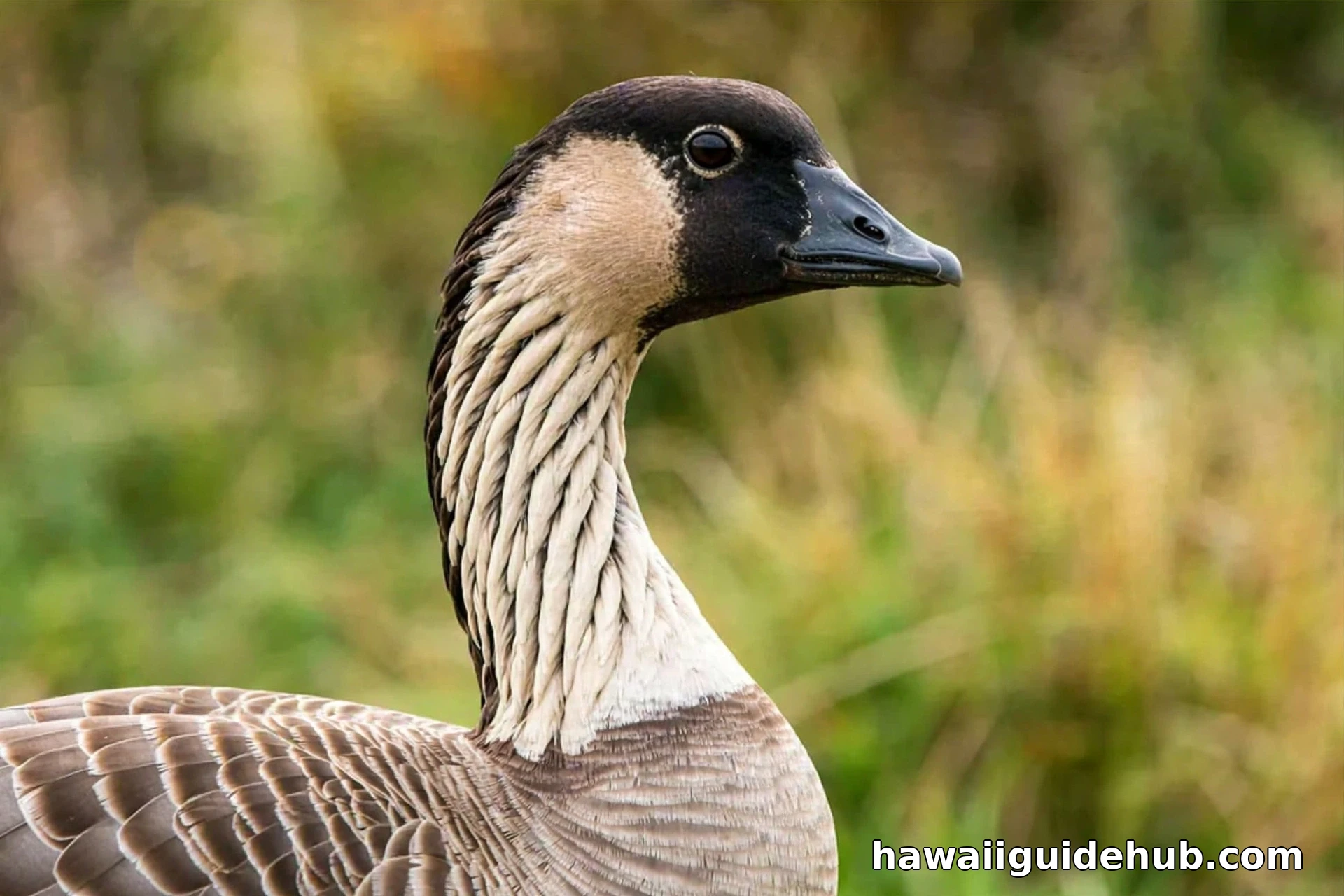
A nene is a medium sized goose, roughly 16 to 18 inches tall and about 24 to 28 inches long, with a soft, muted elegance rather than bright color. The head and the back of the neck are black, the cheeks are a warm buff or cream, and the neck carries striking diagonal furrows of cream and dark feathers that look almost braided. The body is gray brown with neat dark barring across the belly and back, the rump is white, and the tail is dark. The bill, legs, and feet are black.
| Field mark | What to look for |
| Head pattern | Black crown and face with a clear buff cheek patch on each side |
| Neck | Deep diagonal furrows of cream and black feathers, unique among geese |
| Body | Gray brown above, fine dark barring below, white rump, dark tail |
| Feet | Black, long legs, toes only partly webbed, an adaptation for walking on lava |
| Voice | Soft calls that give the bird its name, including gentle nay nay sounds and a low moo like call |
| Flight | Strong flier despite its land based life, often seen crossing valleys between feeding and nesting areas |
Those partly webbed feet tell the bird’s evolutionary story at a glance. Nene evolved from Canada goose ancestors that arrived around half a million years ago, and in Hawaiʻi they adapted to life on dry lava flows and upland slopes rather than ponds. Their feet lost much of their webbing, their toenails grew stronger for gripping rock, and they became the most terrestrial goose on Earth. Males and females look alike, though males average slightly larger. The Hawaiian name nēnē is said to echo the bird’s soft call.
Where Nene Live in Hawaii
Nene are endemic, found in the wild only in Hawaiʻi. Fossil evidence shows they once lived across nearly all the main islands, and today wild populations are established on Hawaiʻi Island, Maui, Kauaʻi, Molokaʻi, and Oʻahu. According to the Hawaiʻi Division of Forestry and Wildlife, the nene is federally listed as threatened and state listed as endangered. Kauaʻi holds the largest share of the population, around 60 percent in recent surveys, thanks to the absence of the mongoose on that island. The 2022 statewide survey estimated 3,862 birds.
Their habitat surprises people who expect a goose to hug the water. Nene favor open country: native shrubland, grassland, lava fields with pockets of vegetation, golf course edges, pasture, and the slopes around Hawaiʻi Volcanoes National Park and Haleakalā. Historically, flocks moved seasonally between high elevation feeding grounds and lowland breeding areas. Today many birds live year round in protected refuges and national parks, and hikers meet them in places as different as the trails described in our Pihea Trail guide and the volcanic coast near Green Sand Beach.
Behavior, Diet, and Family Life
Nene are grazers and browsers. They clip grasses and sedges and strip leaves, seeds, flowers, and berries from at least 50 native and nonnative plants, with favorites including ʻōhelo berries and the seeds and leaves of native shrubs. This varied plant diet lets them live far from wetlands, though they drink and bathe where fresh water is available and they swim perfectly well when they choose to. By moving seeds through the landscape, nene help shape the plant communities of the young volcanic slopes where they feed.
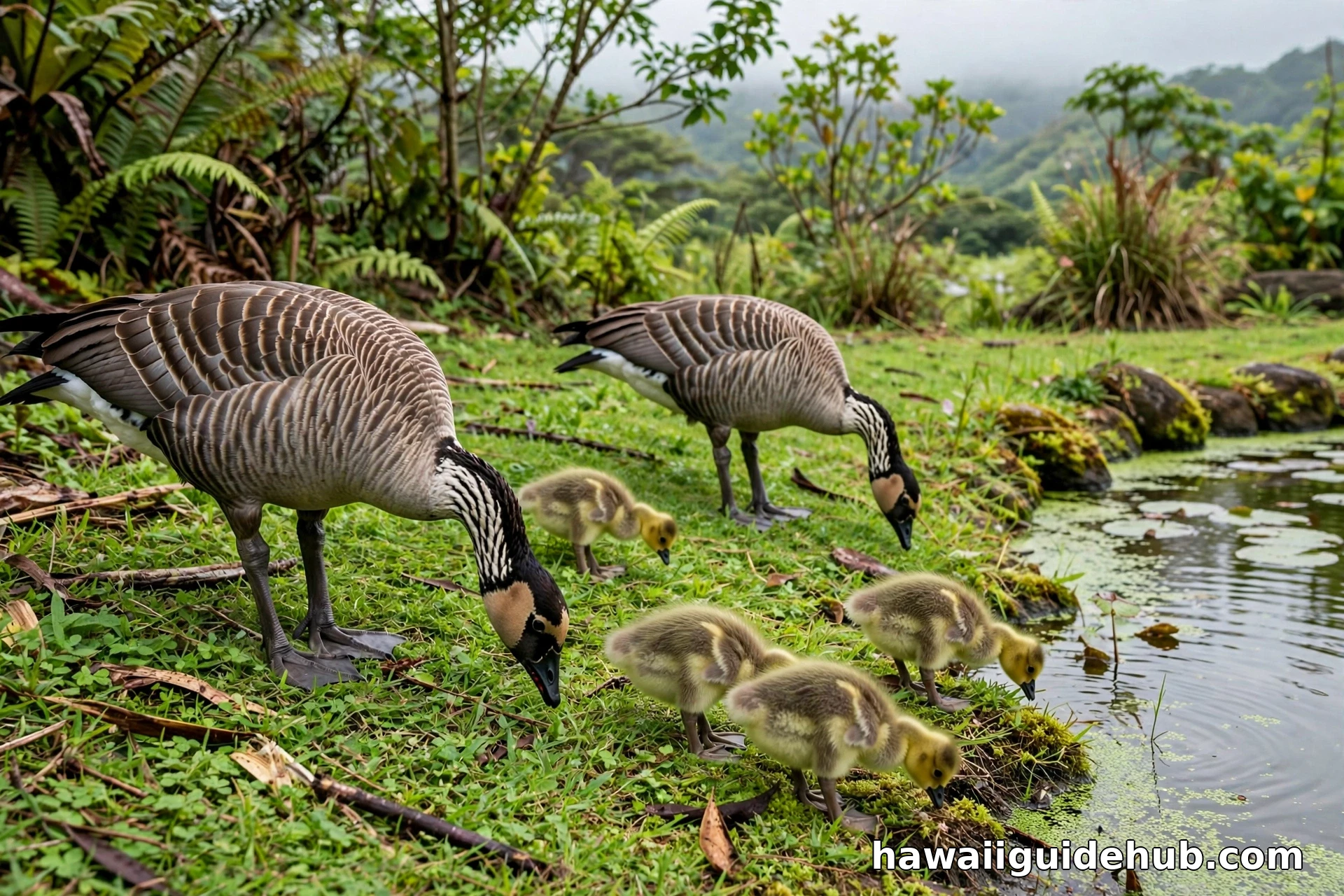
Pairs bond for the long term, often for life, and the breeding season runs mainly from October through March, with most clutches laid from October through December. Unlike almost every other goose, the nene nests on land, in a shallow ground scrape hidden under vegetation, where the female lays an average of three eggs and incubates them for about 30 days while the male stands guard. Goslings can walk and feed themselves soon after hatching, stay close to both parents, and remain with the family for roughly a year. Adults molt after breeding and cannot fly for several weeks, a vulnerable season when the whole family stays on the ground.
The Crash and the Comeback
The nene’s decline was fast and human driven. Hunting after Western contact was intense, eggs and goslings fell to introduced rats, pigs, dogs, cats, and the mongoose, and lowland habitat was converted to farms and towns. A bird that may have numbered in the tens of thousands before 1778 was reduced, by the early 1950s, to an estimated 30 wild birds, all on Hawaiʻi Island. It became a symbol of how quickly island species can unravel.
The comeback is one of conservation’s landmark efforts. Captive breeding began in Hawaiʻi and, famously, at the Wildfowl Trust in Slimbridge, England, where birds bred from a small rescued flock were flown home for release. The nene was designated Hawaiʻi’s state bird on May 7, 1957, listed under the United States Endangered Species Act in 1967, and protected by habitat management, predator control, and releases on Maui, Kauaʻi, and Molokaʻi. Progress was steady enough that in 2019 the species was downlisted federally from endangered to threatened, though it remains endangered under state law. Recovery continues, and every September 26, Nēnē Awareness Day marks the effort. The scale of work behind stories like this is a recurring theme in Hawaii facts about the islands’ native species.
The Comeback in Numbers
| Moment | Where the nene stood |
| Before 1778 | Abundant across the islands, with early accounts and fossils suggesting a population in the tens of thousands |
| Early 1950s | About 30 wild birds remained, all on Hawaiʻi Island, the species at the edge of extinction |
| 1957 | Designated the official bird of the State of Hawaiʻi |
| 1967 | Listed as endangered under United States federal law |
| 2019 | Downlisted federally to threatened after decades of captive breeding, releases, and predator control |
| 2022 | Statewide survey estimated 3,862 birds, with about 60 percent on mongoose free Kauaʻi |
Numbers alone miss what made the recovery unusual. The nene was saved partly by birds raised an ocean away, in the waterfowl collection at Slimbridge in England, where a small group descended from rescued Hawaiian birds bred successfully when the wild population was at its lowest. Offspring of those English reared geese were flown back across two oceans and released in Hawaiʻi, a homecoming few species ever get. Reintroductions also returned nene to islands they had vanished from, including a modern population established on Oʻahu, where wild birds were absent for centuries. Each release site paired the birds with managed habitat and predator control, because a goose that nests on the ground cannot outrun the 19th century’s imported mammals on its own.
How the Nene Differs From Other Geese
Visitors who know Canada geese from mainland parks notice the family resemblance first: the long neck, the black head pattern, the grazing walk. Then the differences stack up. A nene is far more at home walking than swimming, crossing rough lava that would shred the feet of a pond goose, and it calls softly where its mainland cousins honk. It nests in the middle of the Hawaiian winter rather than spring, timed so goslings grow as the wet season greens the slopes. Even its molt sets it apart in timing, leaving whole families flightless on the ground for weeks. Ornithologists rank it among the most distinctive goose species on Earth, a reminder that isolation in Hawaiʻi did not just decorate its wildlife. It rebuilt it.
What Still Threatens the Nene
Recovery is not the same as safety, and wildlife managers describe the nene as a conservation reliant species. Vehicles are a leading cause of adult deaths inside Hawaiʻi Volcanoes National Park, where birds grazing near roads are struck by cars. Predators still take eggs and goslings, and drought, disease, and severe weather hit ground nesting birds hard. Human feeding is a quieter danger: birds fed by people learn to approach cars, parking lots, and cat feeding stations, where they eat unnatural food and meet the very hazards managers work to keep them from. Development continues to press on the lowland habitat the growing population needs.
How to Watch Nene Responsibly
Seeing a nene well takes patience, not proximity. Watch from a respectful distance and never approach a nesting pair: the guarding bird’s lowered head and warning calls mean you are already too close. Never feed nene, which is harmful to the birds and illegal. Drive slowly in known nene areas, especially at dawn, dusk, and during the October to March nesting season, and stop and wait if a family crosses the road rather than honking or edging forward. Keep dogs leashed and cats indoors, since loose pets remain a real threat. Reliable places to look include Hawaiʻi Volcanoes National Park, the Haleakalā summit area, and Kauaʻi refuges and reservoirs, where patient observers scanning grassland edges often spot pairs grazing in the open. Birders building a Kauaʻi day around wildlife will find the trail context in our Kauaʻi hiking roundup useful.
The Nene in Hawaiian Culture
The nene is woven into Hawaiian tradition as well as modern law. Tradition remembers the bird as a guardian presence, and its seasonal movements between mountain and coast made it a symbol of connection between the uplands and the sea. As the state bird, protected by Hawaiʻi Revised Statutes section 5-17, it appears on conservation license plates, park signs, and school murals across the islands. Few species carry a state’s identity the way the nene does, partly because its rescue was a shared public project that generations of Hawaiʻi schoolchildren have grown up hearing about.
Video: Nene at Hawaiʻi Volcanoes
Nene grazing in Hawaiʻi Volcanoes National Park, where roadside signs remind drivers that this recovering species shares the landscape.
Frequently Asked Questions
Is the nene the Hawaii state bird?
Yes. The nene, or Hawaiian goose (Branta sandvicensis), was designated the official bird of the State of Hawaiʻi on May 7, 1957, and is established in Hawaiʻi Revised Statutes section 5-17.
Are nene endangered?
The nene is federally listed as threatened, after being downlisted from endangered in 2019, and it remains listed as endangered by the State of Hawaiʻi. From about 30 wild birds in the 1950s, the population has recovered to several thousand, with the 2022 survey estimating 3,862 statewide.
Where can I see nene in Hawaii?
The most reliable places are Hawaiʻi Volcanoes National Park and the Haleakalā area on Maui, plus Kauaʻi, which holds the largest population, where birds appear at refuges, reservoirs, and open grasslands. Watch quietly from a distance and never feed them.
Why do nene live on lava fields instead of lakes?
Nene evolved from Canada goose ancestors into a land goose. Their feet have reduced webbing for walking on rough lava, and they feed on grasses, leaves, and berries in open country, drinking and bathing at ponds but nesting and grazing on dry ground.
What should I do if a nene approaches me?
Back away calmly and give it space. Do not offer food, even if the bird seems tame, because fed birds gather near roads and people and are more likely to be struck by cars or harmed by predators and pets.
The nene’s story compresses the whole drama of Hawaiian nature into one bird: dazzling evolution, sudden collapse, and a rescue built on patience. That the world’s rarest goose now grazes openly beside park roads, raising striped goslings under the watch of two parents, is not an accident of luck. It is the result of seventy years of people deciding the bird mattered. Meeting one quietly, on its own terms and at its own distance, is among the most rewarding wildlife moments Hawaiʻi offers.