Hawaiian Slang and Pidgin: Phrases Visitors Should Know

You will be standing in line at a poke counter on Oʻahu when it happens. The guy behind the register turns to his coworker and says something that sounds like English put through a blender. You catch maybe every third word. Everyone else in line nods like it was the most normal sentence in the world. Welcome to Hawaiian Pidgin, the local language of the islands, and one of the most misunderstood parts of visiting Hawaiʻi.
Visitors often call it slang. Locals mostly just call it Pidgin. Linguists call it Hawaiʻi Creole English. Whatever name you use, it is a real language with its own grammar, its own history, and a few hundred thousand speakers. This guide explains what Pidgin is, where it came from, the phrases you will actually hear, and how to handle it respectfully as a guest in the islands.
What Hawaiian Pidgin Actually Is
Let us clear up the biggest misconception first. Pidgin is not broken English. It is not lazy English, bad English, or English spoken by people who never learned the rules. It is a creole language, which means it started as a simplified contact language between people who shared no common tongue, and then children grew up speaking it as their first language. That process, called creolization, gave it a full grammar of its own. It has consistent rules for tense, aspect, and sentence structure. They are simply different rules from the ones you learned in school.
Linguists estimate that roughly 600,000 to 700,000 people in Hawaiʻi speak Pidgin, which makes it one of the most widely spoken creole languages under the American flag. You will hear it in grocery stores, on local radio, in comedy shows, at backyard parties, and in the state legislature. It lives alongside standard English the way many Hawaiʻi residents live: switching back and forth depending on who is in the room. A person might write a business email in perfect standard English at 4 p.m. and be deep in Pidgin with friends by 5.
That code-switching is worth understanding, because it tells you something important. Pidgin is not a marker of education or intelligence. It is a marker of belonging. Speaking it says you grew up here, or at least that you learned to listen here. For many local families it carries the sound of home in a way no other language can.
How Pidgin Was Born on the Plantations
The story starts in 1835, when the first commercial sugarcane plantation opened in Hawaiʻi. The industry exploded in the decades that followed, and plantation owners needed far more workers than the islands could supply on their own. So they recruited laborers from China, Portugal, Japan, Korea, the Philippines, Puerto Rico, and several other countries. Picture the scene: thousands of workers from half a dozen language backgrounds, supervised in English, working fields where Hawaiian was still widely spoken. Nobody shared a language with everybody else.
Out of that necessity came a jargon, a stripped-down mix of Hawaiian, English, Portuguese, Cantonese, and whatever else was at hand. Workers used it to get through the day. Then something remarkable happened. In the 1870s, immigrant families began arriving in larger numbers, and children were born on the plantations. Those children heard the jargon from their parents, heard English at school, heard Hawaiian from neighbors, and their brains did what young brains do: they turned the raw material into a complete language. By the turn of the century a new Hawaiʻi Pidgin English had emerged, and by the 1920s it was the everyday language of the majority of the islands’ population.
This is why calling Pidgin “slang” misses the point so completely. Slang is decoration on top of a language. Pidgin is the language itself, built from scratch by working people and their children. The plantation era is long over, but the language it produced is still going strong. If you want the deeper historical backdrop, our guide to Hawaii before the 50th star covers the kingdom era that set the stage for everything that followed.
ʻŌlelo Hawaiʻi vs. Pidgin: Don’t Mix Them Up
Here is a distinction visitors get wrong constantly, so let us be precise. ʻŌlelo Hawaiʻi, the Hawaiian language, is the indigenous Polynesian language of the islands. It is one of the two official languages of the state of Hawaiʻi, alongside English. It was nearly driven to extinction after the overthrow of the monarchy, when it was effectively pushed out of schools and public life, and it has been undergoing a powerful revival since the 1970s through immersion schools and university programs.
Pidgin is something else entirely. It is an English-based creole that developed a half century after ʻŌlelo Hawaiʻi was already in decline. Many Pidgin words come from Hawaiian, which is why the two get confused. When someone says “pau” (finished) or “ʻono” (delicious), those are Hawaiian words living inside Pidgin sentences. But the grammar, the vocabulary base, and the history are different. Think of it this way: ʻŌlelo Hawaiʻi is the native language of the Hawaiian people; Pidgin is the homegrown language of Hawaiʻi’s multicultural working class. Both deserve respect, and they are not interchangeable.
Is Pidgin an Official Language?
This is where things get interesting. The U.S. Census Bureau recognizes Hawaiian Pidgin as a distinct language, and census forms have included it as a language option. That recognition matters, because for most of the twentieth century the official attitude toward Pidgin ranged from dismissive to openly hostile. Children were punished for speaking it in schools. Employers treated it as a sign of poor education. The message was clear: real success meant leaving Pidgin behind.
That attitude has been slowly reversing for decades. Linguists at the University of Hawaiʻi have documented and defended Pidgin as a legitimate language since the 1970s. Local comedians, musicians, and writers use it proudly. In 2015, the Hawaiʻi State Legislature even heard testimony in Pidgin. There is still debate, and you will still meet people with strong opinions on both sides, but the direction is unmistakable. Pidgin went from something schools tried to stamp out to something the census counts. That arc tells you a lot about how Hawaiʻi sees itself.
Pidgin Phrases You’ll Actually Hear
Enough background. Here is the practical part: the words and phrases you are most likely to encounter on your trip, what they mean, and how they sound in real sentences. Read through them once and the next conversation you overhear will start making a lot more sense.
Greetings and everyday talk
Howzit (how-zit). The standard local greeting, somewhere between “how’s it going” and “what’s up.” You will hear it everywhere: “Howzit, brah?” The expected answer is something easy, like “Howzit” right back, or “Good, howzit with you?”
Brah (bra). Short for braddah, brother. A casual, friendly way to address a man, related or not. “Eh brah, you know where da beach park?” Sistah is the equivalent for women. Auntie and uncle are respectful terms for older women and men, even complete strangers. If an older local woman helps you with directions, calling her auntie is not just allowed, it is appreciated.
Talk story. To chat, hang out, share news. “We stay talk story at da beach.” This is not idle gossip. Talk story is how relationships are built in Hawaiʻi, and being willing to slow down and talk story marks you as someone who gets the pace of the islands.
Shoots. The most versatile word in the language. It means OK, agreed, sounds good, and goodbye, depending on context. Someone offers you a plate: “Shoots, thanks.” You are leaving a party: “Shoots, see you later.” Learn this one word and you will use it daily.
Food words (you’ll use these constantly)
Grindz (grindz). Food, a meal. “We going grind” means we are going to eat. You will see hand-painted signs advertising “ono grindz” outside lunch wagons, and now you know exactly what they are promising.
Broke da mouth. Extremely delicious. This is the highest compliment local food can receive. “Auntie’s laulau broke da mouth.” If someone says this about a meal you cooked, take the rest of the day off. You have peaked.
ʻOno (oh-no). Delicious, tasty. A Hawaiian word that lives comfortably inside Pidgin. “Dat poke stay ʻono.”
The famous ones
Da kine. The legendary all-purpose word. It means “that thing,” “whatchamacallit,” or whatever the speaker cannot quite name at the moment. “Pass me da kine.” “We went to da kine place.” Context does all the work, and somehow it always does. There is even a famous Hawaiʻi apparel brand named Dakine, which tells you how deeply this phrase sits in local identity.
Pau (pow). Finished, done. A Hawaiian word, fully adopted. “I’m pau work” means I’m done with work. Pau hana means finished with work for the day, and by extension, the after-work hours themselves. “Pau hana drinks” is happy hour, local style.
Choke (choke). Plenty, a lot. “We get choke food” means there is more than enough. It comes from the idea of something so abundant it chokes.
Slippahs (slippahs). Flip-flop sandals. The official footwear of the islands. You will be told to leave your slippahs at the door when entering someone’s home, and you should.
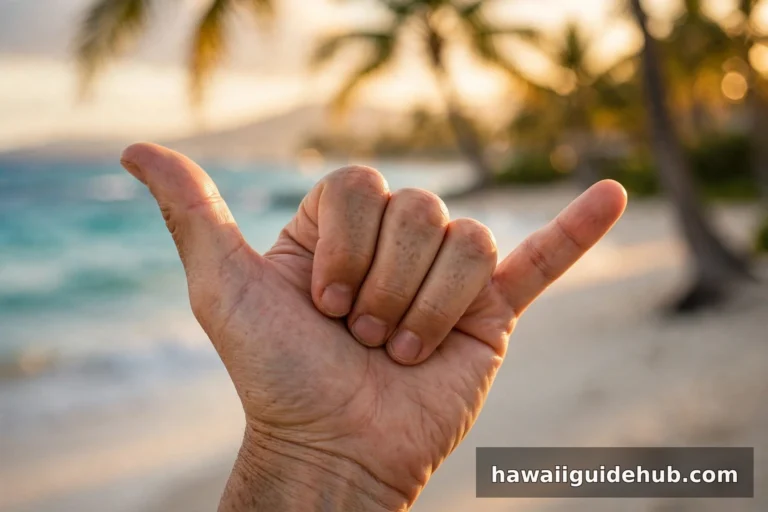
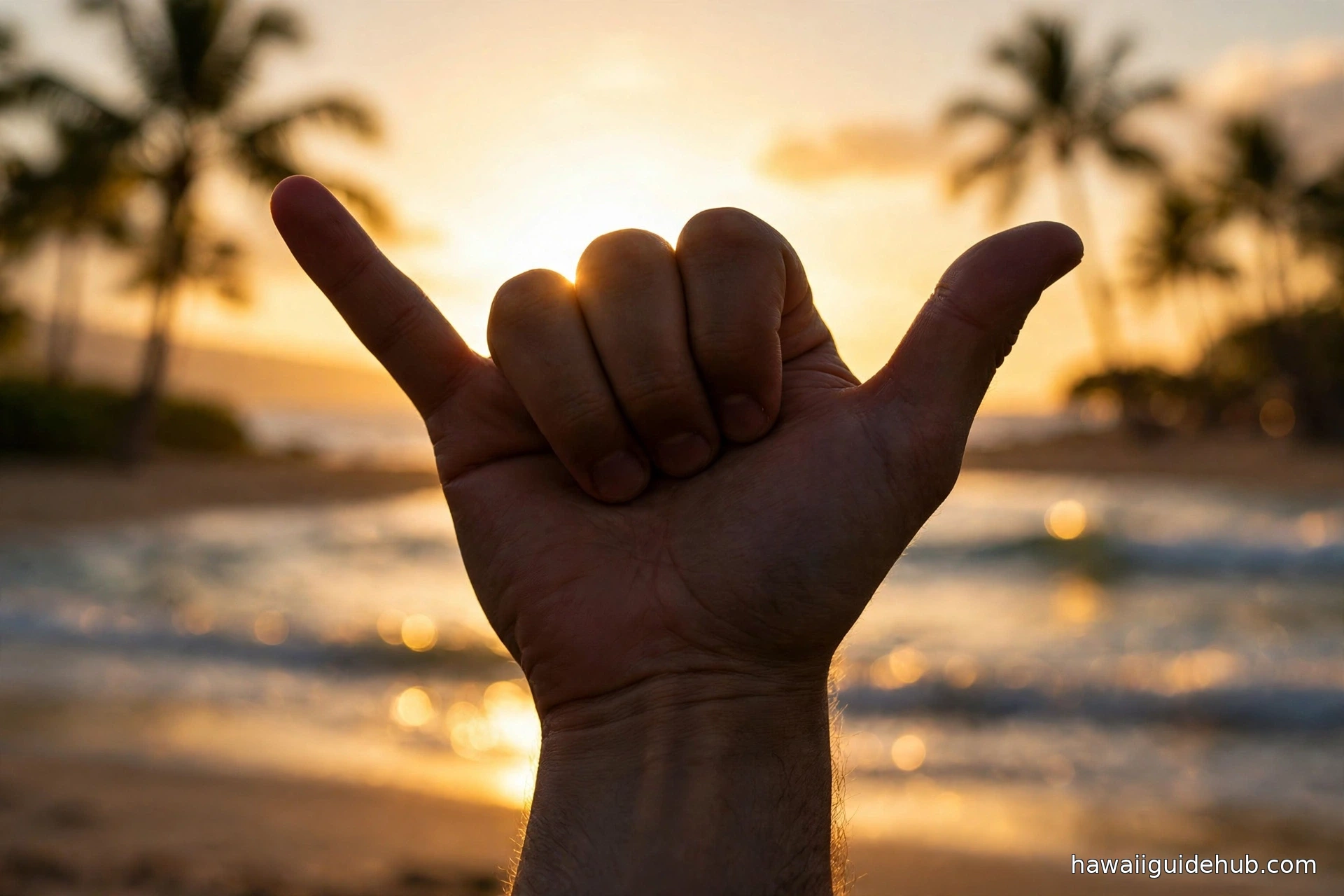
Shaka. The hand gesture, thumb and pinky extended, that means hello, goodbye, thanks, or all good. Visitors love the shaka, and locals are generally happy to see visitors use it, as long as it is genuine and not performed like a party trick.
A few more for the road
Mo’ bettah. Better, preferred. “Da beach mo’ bettah in da morning.” Bumbai (bum-bye). Later, or else, depending on tone. “Bumbai you goin’ get it” is a warning; “we go bumbai” just means later. Chicken skin. Goosebumps, usually from something emotional or eerie. “That story gave me chicken skin.” Talk stink means to badmouth someone, and stink eye is the dirty look that goes with it. Hana hou (ha-na ho) means “do it again,” the local version of encore. And hele on (heh-leh on) means let’s go, get moving.
Where You’ll Hear Pidgin
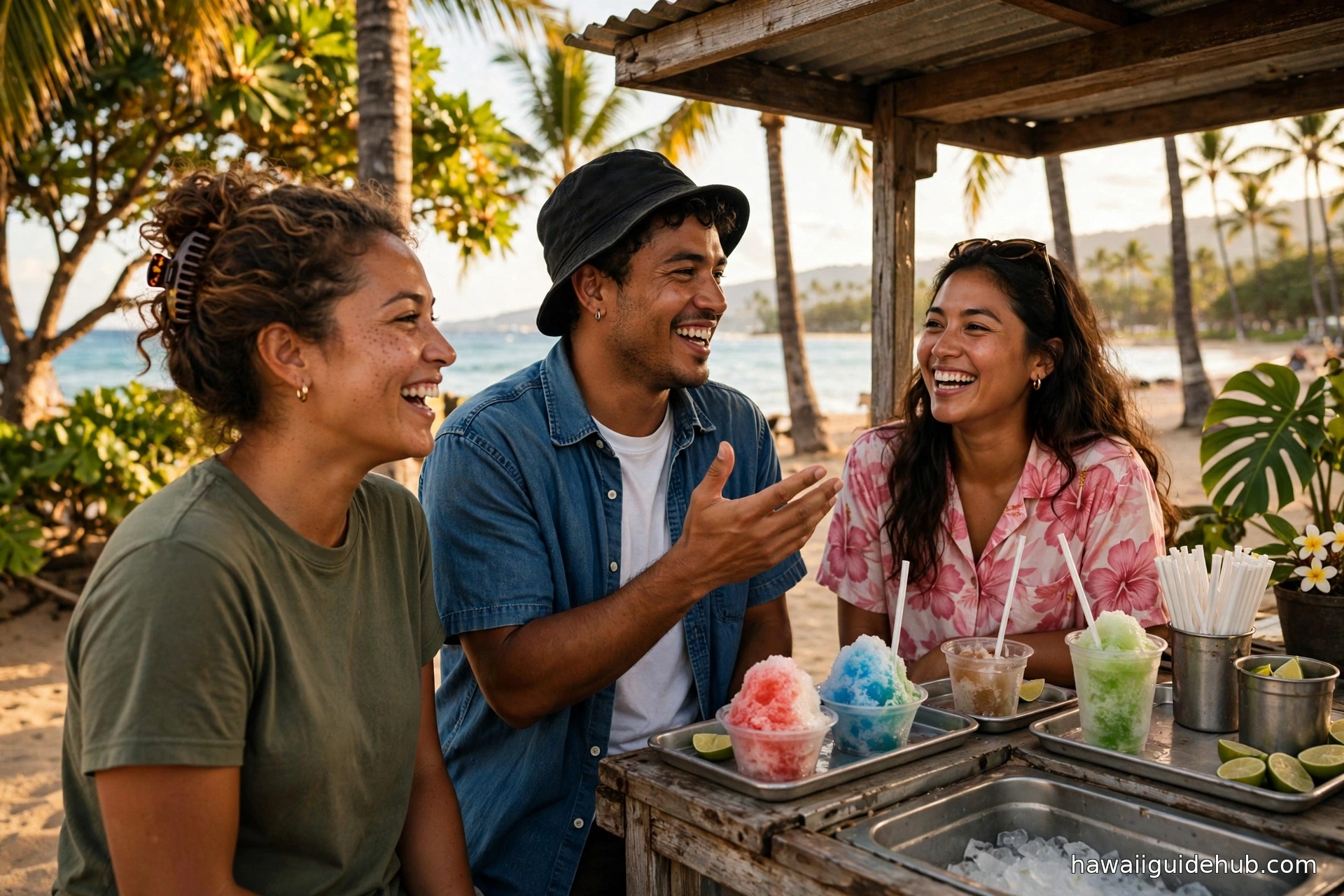
Pidgin is not a tourist attraction you go looking for. It is simply the background sound of local life, and you will run into it doing ordinary things. Farmers markets are prime territory, especially when vendors are joking with regulars. Food trucks and lunch wagons run on Pidgin. Local radio stations switch into it between songs. You will hear it at the beach park on a Sunday, in the bleachers at a high school football game, and in line at the grocery store. These everyday moments are part of the broader cultural experiences that make Hawaii unique.
What you probably will not hear is someone speaking heavy Pidgin directly at you, a visitor, unless the conversation turns friendly. Most Pidgin speakers are fluent code-switchers. They will default to standard English with you and slide into Pidgin with each other. If someone does talk story with you in Pidgin, take it as a compliment. It means you have been accepted, at least for the length of the conversation, as someone worth talking to for real.
How to Handle Pidgin as a Visitor
This section matters, so read it carefully. Pidgin belongs to the people who grew up speaking it. As a visitor, your job is to appreciate it, not to perform it. Here is how to get it right.
Listen first. The single best thing you can do is pay attention. When you hear a phrase you don’t know, enjoy figuring it out from context. Most Pidgin is highly contextual, and you will be surprised how much you understand by the end of a week.
Don’t mock it. This should go without saying, but imitating an accent for laughs is one of the fastest ways to offend people in Hawaiʻi. Pidgin has been mocked by outsiders for over a century. Don’t add to that history.
Don’t force it. Dropping “da kine” and “brah” into every sentence on your second day will not make you sound local. It will make you sound like you are trying too hard. A simple “howzit” or “shoots” used naturally is plenty. Let the rest come if it comes.
Ask with genuine curiosity. Most people are happy to explain a phrase if you ask respectfully. “I keep hearing people say ‘pau hana,’ what does that mean exactly?” is a great conversation starter. It shows you are listening, which is the whole point.
For more on the cultural values underneath the language, read our guide to the role of aloha in Hawaiian culture and the significance of ʻohana. The words make more sense once you understand the worldview behind them.
Why Pidgin Matters
Languages carry history in a way nothing else can. Every time someone says “da kine,” they are echoing the plantation camps where Chinese, Japanese, Portuguese, Filipino, and Hawaiian workers hammered out a way to understand each other. Every “broke da mouth” carries the memory of shared meals in a place where sharing was survival. Pidgin is not a curiosity for visitors to collect. It is the sound of Hawaiʻi figuring out how to be Hawaiʻi.
So the next time you are in that poke line and the conversation turns into something you half-understand, don’t tune it out. You are hearing a language that was built from nothing, by ordinary people, in about two generations. Few places on earth can say that. Listen for a while. You might even catch yourself saying “shoots” on the way out.