The Christmas Wrasse: Hawaiʻi’s Red and Green Reef Fish

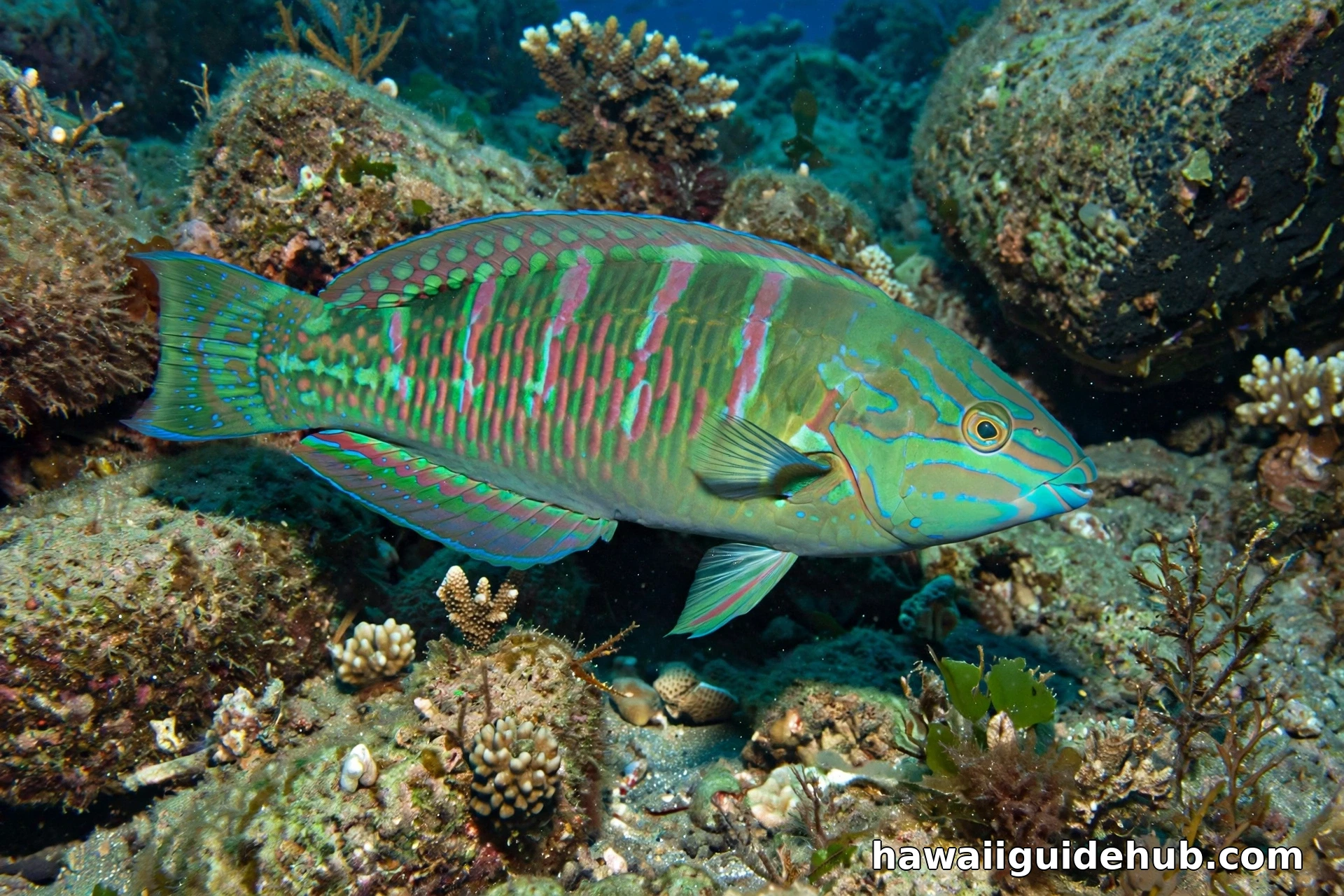
The first time you see a Christmas wrasse, you understand the name before anyone explains it. The fish cruising the shallow reef in front of you is green, unmistakably green, crossed with bars and markings in red and pink, as if the reef had decorated itself. In Hawaiian it is called ʻawela, and it is one of the largest, boldest, and most commonly seen wrasses in Hawaiʻi, a fish that snorkelers meet again and again without ever learning what it was.
This is the complete guide to the Christmas wrasse in Hawaii. It covers what the fish is, why it carries two names and a borrowed holiday, how to tell the brilliant terminal males from the muted, spotted females, how it can change sex during its life, what it eats and how it crushes shells it has no business swallowing, where it lives, how to separate it from the very similar surge wrasse, and where you can reliably see one on your next snorkel.
What Is a Christmas Wrasse?
The Christmas wrasse, scientific name Thalassoma trilobatum, belongs to the wrasse family, Labridae, one of the most common and varied families of reef fish in Hawaiian waters. The Waikīkī Aquarium counts 43 wrasse species reported in Hawaiʻi, 13 of them endemic, found nowhere else on earth. The Christmas wrasse is not one of the endemics. It ranges across the tropical Indian Ocean and western Pacific, from East Africa to the Pitcairn Islands, and Hawaii sits comfortably inside that wide map.
Like all wrasses, it has an elongated, spindle shaped body, thick lips hiding canine teeth, and a distinctive way of swimming: it rows itself along with its pectoral fins in an up and down flying motion, using its tail mostly for bursts of speed. It is among the largest and heaviest bodied of the Hawaiian wrasses, reaching about 11 to 12 inches in length. Its other English names, ladder wrasse and green-barred wrasse, describe the same pattern the Christmas name celebrates, the rungs of color across a green body.
| Hawaiian name | ʻAwela |
| Scientific name | Thalassoma trilobatum, family Labridae |
| Size | Up to about 11 to 12 inches |
| Habitat | Shallow reefs and rocky bottoms, surface to about 33 feet |
| Diet | Crabs and other crustaceans, mollusks, brittle stars |
| Range | Indo-Pacific, East Africa to Pitcairn, including Hawaiʻi |
| Status | Abundant in Hawaiʻi; listed as Least Concern |
One Fish, Two Color Lives: Females, Initial Males, and Terminal Males
Most snorkelers who meet this species meet it twice without knowing. The smaller fish, muted green with dark lines along the body and a spotted head, is a female or a young initial phase male. The big, almost glowing fish, with a pinkish red background washed in green and blue, ladder like stripes, and a head shaded in orange, brown, or blue, is a terminal male. They are the same species at different stations of the same life.
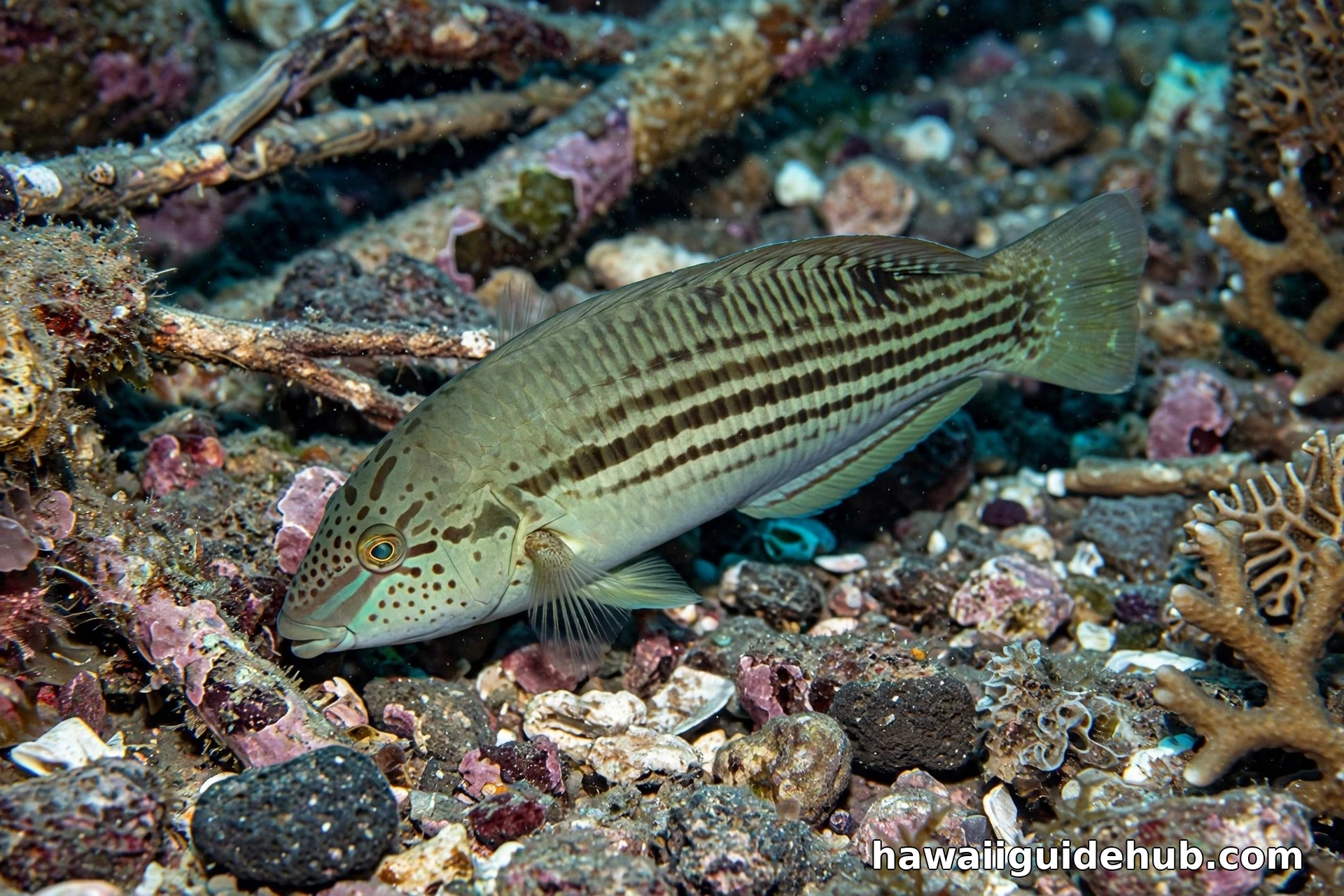
Wrasses are famous for sex change, and the Christmas wrasse follows the family pattern. Individuals begin life female, and the largest, most dominant fish can transform into males, changing color, behavior, and reproductive role as they do. A terminal male may hold a small group of females, and if the dominant male disappears, a large female can change sex and take his place. Initial phase males keep female like colors, and one of their marks is a diagonal dark red line below the eye. During spawning, which happens in daylight, terminal males intensify in color and display by swimming back and forth, waving their pectoral fins.
Christmas Wrasse or Surge Wrasse? The Two Minute Identification
The fish most often confused with the Christmas wrasse is its close cousin the surge wrasse, Thalassoma purpureum, which shares the green and red palette and haunts the same wave washed shallows. Three marks separate them. Female Christmas wrasses have spotted heads, while female surge wrasses do not. The surge wrasse carries a dark V shaped mark on its snout, and the Christmas wrasse lacks it. And in terminal males, the head coloring differs, with the Christmas wrasse showing that shifting mix of orange, brown, and blue. Check the head first, and the identification usually falls into place before the fish cruises off.
A second confusion lives in the aquarium trade, where the name Christmas wrasse is also attached to smaller Halichoeres species, including Hawaiʻi’s endemic ornate wrasse. Those are different fish from different genera wearing a shared nickname. On a Hawaiian reef, when divers and fish guides say Christmas wrasse, they mean the big Thalassoma trilobatum in this guide. Knowing the scientific name is the only reliable way to keep the family straight, which is why local fish identification cards print it under the ʻawela’s photograph.
Where Christmas Wrasses Live and What They Eat
Look for this fish where the reef meets rock, in the shallows from the surface down to about 33 feet. It favors reefs and rocky bottoms, including the energetic surge zone at the reef edge, and it is a daytime fish through and through. All day it patrols its patch, turning over its attention from crevice to crevice. At night, like other wrasses, it shelters in reef crevices or buries itself in sand patches and sleeps out of sight, which is why dawn snorkelers sometimes watch the reef repopulate as the light builds.
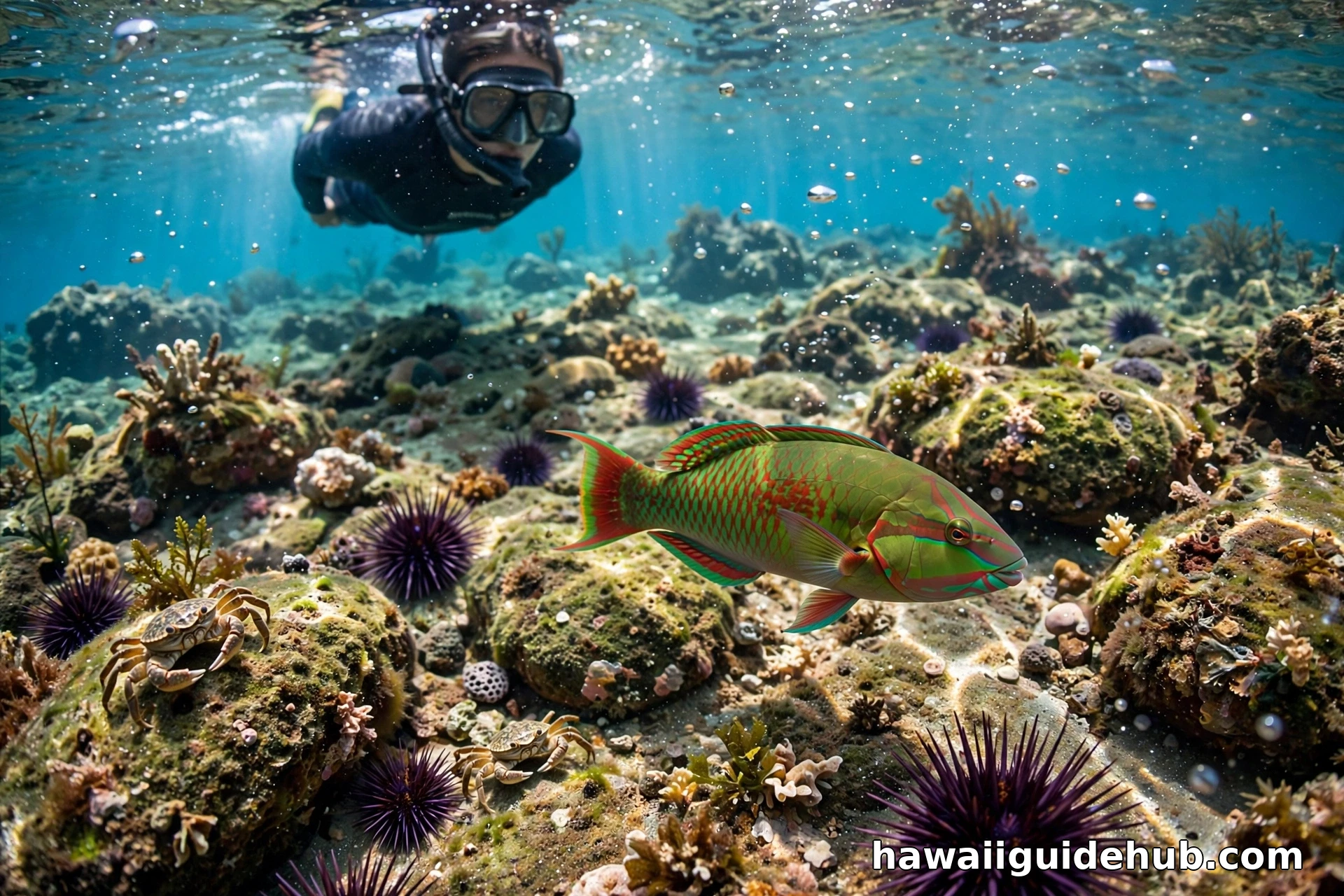
Its menu is the hard shelled small print of the reef: crustaceans above all, especially crabs, along with mollusks and brittle stars, and now and then a small fish. The equipment matches the menu. Prominent lips conceal canine teeth in both jaws for plucking prey off the rock, and a second set of bones in the throat, the pharyngeal bones, works as a built in crusher for shells. It is an efficient, slightly ruthless arrangement, and it makes the Christmas wrasse one of the reef’s working predators rather than one of its ornaments, whatever its colors suggest. The species is abundant, is listed as Least Concern, and is taken only in small numbers by fishers, with more of its human story written by the aquarium trade than by the dinner table.
How the Fish Moves and Hunts
Watch an ʻawela for five minutes and its personality shows. Wrasses are alert fish, and the Waikīkī Aquarium notes their eyes are constantly moving, scanning the reef and their surroundings even as the body cruises. The Christmas wrasse works a home patch of reef the way a good fisher works a shoreline, methodically, returning to productive cracks and ledges, investigating, then moving on. Its pectoral fin rowing gives it precise control in surge, letting it hold position in water that is pushing everything else around, and hover head down over a crevice while it decides whether what hides inside is food.
Juveniles start life drabber than their parents, in greens and browns that blend with rubble and algae, and they stay close to shelter. Size brings color and confidence together: the bigger the fish, the bolder the pattern and the more openly it patrols. That is why the terminal males are the ones snorkelers remember. They are not just the most colorful individuals on the reef. They are the oldest, largest, and least shy, and their daily circuits often pass the same coral heads at roughly the same times, which patient observers at a favorite snorkel spot learn to anticipate.
Threats, Rules, and the Fish’s Future in Hawaiʻi
The Christmas wrasse is in no danger of disappearing. It is widespread, abundant, and officially listed as Least Concern, and in Hawaiʻi it benefits from the same protections that shelter reef life generally: marine life conservation districts where fishing is restricted or prohibited, statewide rules for aquarium collection that have tightened in recent years, and a growing norm among snorkelers of watching rather than touching. Its real pressures are the reef’s pressures: warming water, coral loss, and runoff that clouds the shallows it hunts by sight. A reef with structure, crabs, and clear water is an ʻawela reef, so the fish works as a small green and red indicator. Where you find Christmas wrasses hunting confidently in daylight, the shallow reef is usually in decent health.
For visitors, the practical rules are the ones already covered above, repeated because they matter: do not feed it, do not chase it, do not stand on the reef it hunts, and use the reef safe sun protection Hawaii law and custom now expect. Photographers should let the fish approach on its own circuit rather than cornering it against the rocks. The ʻawela has tolerated human neighbors on Hawaiian reefs for a very long time, and a little restraint from each new generation of watchers keeps that arrangement working.
The Hawaiian Name: ʻAwela
In Hawaiian, this fish is ʻawela, one of the named wrasses in a language that named reef life with great precision, since those names carried knowledge about where a fish lived, how it behaved, and whether it was worth a fisher’s time. Wrasses as a group are hīnālea, a word woven into old songs and sayings as an image of something beautiful and hard to catch. When you learn the name ʻawela, you are learning the fish the way generations of Hawaiian fishers knew it: not as a holiday decoration, but as the big green and red hunter of the shallow rocky reef. Visitors who enjoy this layer of the islands will also like our guide to Christmas in Hawaii, which covers the season this fish’s English name borrows, a season the ʻawela, busy all year, pays no attention to at all.
Where to See a Christmas Wrasse in Hawaii
You do not need a boat or deep water. Any healthy shallow reef with rock and surge can hold this fish, on any of the main islands. Hanauma Bay on Oʻahu is a classic classroom for it, since the protected bay concentrates reef fish in calm, clear shallows where a slow snorkeler can watch an ʻawela work a whole boulder. Snorkel beaches and rocky coves statewide offer the same chance: the calmer snorkeling areas near Waikīkī Beach, the protected waters at Turtle Beach on Oʻahu, and the reefy edges of beaches like Lanikai Beach all sit in the fish’s preferred depth and habitat.
Watch like a naturalist and the fish rewards you. Move slowly, hover rather than chase, and pick one busy individual to follow at a respectful distance as it hunts. Males are bolder and more visible; females stay closer to the bottom and the rubble. Morning light shows the colors best, before wind and crowds cloud the shallows. The etiquette is simple and strict: look, do not touch, do not corner the fish for a photograph, and never feed reef fish, which changes their behavior and is prohibited in Hawaii’s marine life conservation districts. Give the ʻawela its working space and it will largely ignore you, which is the highest compliment a wild fish pays.
Video: All About the Christmas Wrasse
This overview shows both color phases side by side, which makes the female to terminal male transformation far easier to grasp than any description.
Frequently Asked Questions
What is the Hawaiian name for the Christmas wrasse?
ʻAwela. Wrasses as a family group are called hīnālea in Hawaiian, and ʻawela is the specific name for this green and red species, Thalassoma trilobatum.
How big do Christmas wrasses get?
About 11 to 12 inches at most, which still makes the species one of the largest and heaviest bodied wrasses found in Hawaiian waters.
Are Christmas wrasses rare in Hawaii?
No. The Waikīkī Aquarium describes the species as abundant on reefs and over rocky bottoms in Hawaiʻi, and it is listed as Least Concern across its wide Indo-Pacific range.
How can I tell a Christmas wrasse from a surge wrasse?
Check the head. Female Christmas wrasses have spotted heads, the species has no V shaped mark on the snout, and terminal males show shifting orange, brown, or blue head coloring. The surge wrasse carries the V mark and an unspotted female head.
Do Christmas wrasses change sex?
Yes. Like many wrasses, they begin life as females, and dominant individuals transform into males, changing color and behavior as they do. If a dominant male is lost, a large female can change sex and replace him.
What do Christmas wrasses eat?
Mostly hard shelled prey: crabs and other crustaceans, mollusks, and brittle stars. Canine teeth pluck the prey, and throat bones crush the shells.
The Christmas wrasse asks for nothing from the people who watch it, and gives a full performance anyway: the green and red patrol, the crab crunching, the slow transformation written in color from female to terminal male. Learn its name, ʻawela, learn its spotted females and its ladder barred males, and the shallow Hawaiian reef stops being scenery. It becomes a neighborhood, and this bright, busy hunter is one of its best known residents.