
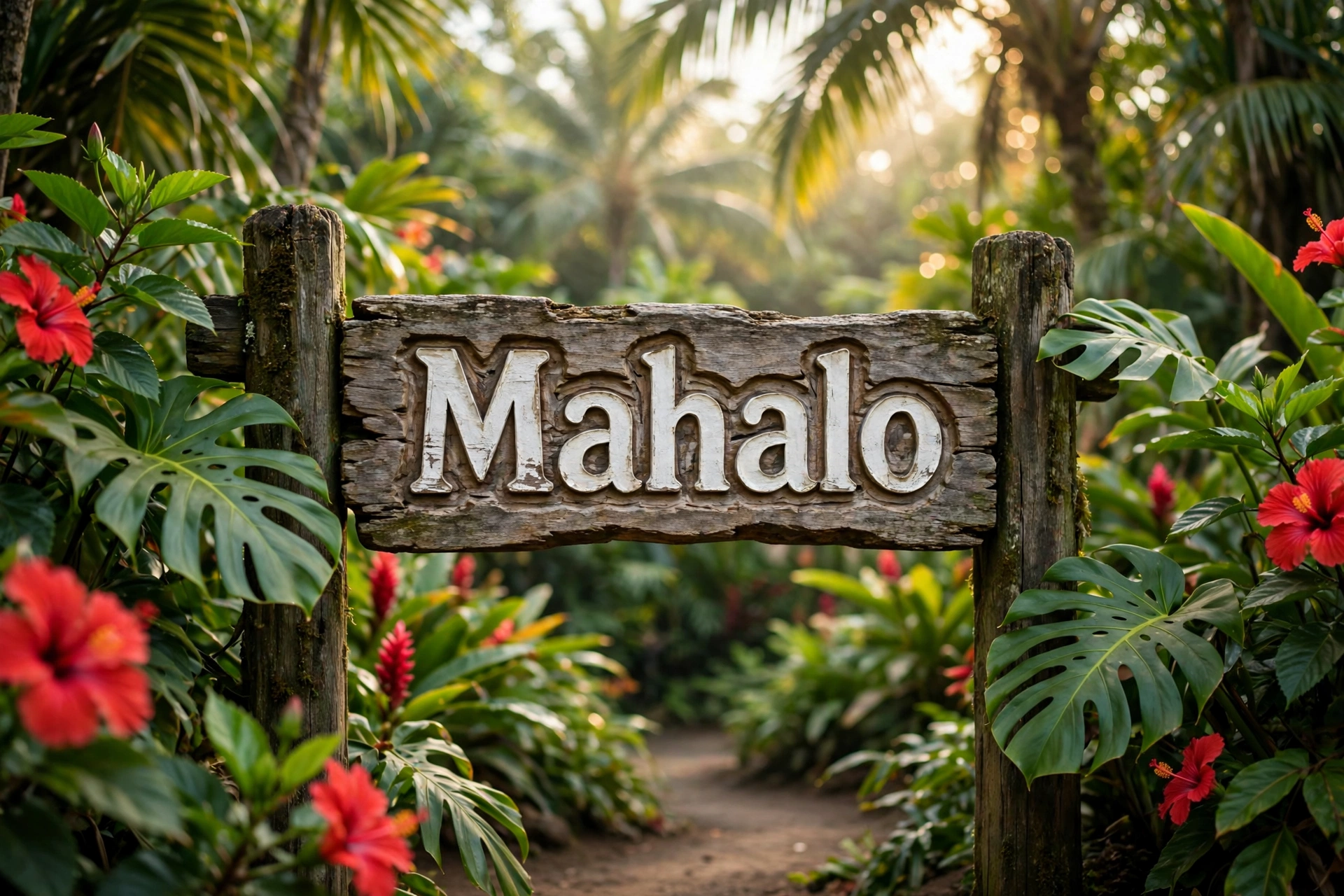
What Does Mahalo Mean?

You will see the word mahalo a hundred times before your first Hawaiian sunset. It is printed on the trash cans at the airport, stamped on shopping bags in Waikīkī, painted on the side of shrimp trucks on the North Shore, and spoken by almost everyone you meet, from flight attendants to surf instructors. Within a day, most visitors figure out the basic translation: thank you.
That translation is correct, and it is also incomplete. Mahalo carries a second layer of meaning that the dictionaries spell out plainly and that visitors often miss. Understanding both layers is the difference between using the word as a souvenir and using it the way it deserves to be used.
What Does Mahalo Mean?
Start with the dictionary, because the dictionary is more interesting than you might expect.
The Hawaiian language dictionaries maintained by the University of Hawaii define mahalo first as “thanks, gratitude; to thank.” That is the meaning you already know, and it is the one you will use most. When the cashier hands you your change, when a stranger holds a door, when a tour guide goes out of their way, mahalo is the word.
But the entry keeps going. A second definition reads “admiration, praise, esteem, regards, respects; to admire, praise, appreciate.” The same word that thanks a server can also convey genuine respect. The dictionary offers the example “ʻO wau nō me ka mahalo,” a formal sign-off meaning roughly “I am, yours respectfully.” Nobody ends a quick text message that way, but the fact that the language allows it tells you something about the word’s range.
Linguists trace mahalo to the Proto-Polynesian masalo, and the older recorded senses of the word center on admiration and praise rather than simple thanks. The “thank you” meaning is the modern everyday usage, the one you will hear dozens of times daily across the islands. Both senses live inside the word at once. That is why mahalo can sound breezy in a coffee shop and weighty in a ceremony, sometimes within the same afternoon.
The Deeper Meaning: Gratitude as a Cultural Value
To understand why mahalo feels larger than “thanks,” it helps to see where gratitude sits in Hawaiian culture.
In the Hawaiian worldview, people, land, and ancestors are bound together, and acknowledging what others do for you is not just good manners. It is part of how relationships stay healthy. Saying mahalo does two things at once: it names the kindness, and it tells the other person you noticed. That act of noticing carries real weight.
This is where mahalo overlaps with the aloha spirit, the Hawaiian ethic of kindness, harmony, and mutual respect that is recognized in Hawaii state law. Aloha is usually translated as love, but it also names a way of moving through the world with patience and generosity. Mahalo is gratitude expressed inside that same ethic. When someone in Hawaii says mahalo and means it, they are not just being polite. They are taking part in a shared value that treats thankfulness as something that holds a community together.
For a visitor, this is the useful insight. Mahalo is not local color to sprinkle over a vacation. It is a small act of participation in the culture you traveled so far to experience. Used sincerely, it says you understand you are a guest in someone’s home, not just a customer passing through. If you want to understand the ethic behind the word, start with the role of aloha in Hawaiian culture.
How to Pronounce Mahalo
Pronunciation is where most visitors stumble, and getting it right is one of the simplest forms of respect you can offer.
Break the word into three syllables: mah-HAH-loh.
Hawaiian has no silent letters, and every vowel gets its full sound. The a sounds like the a in “father.” The o sounds like the o in “go.” Give each syllable its space instead of rushing the middle one into a mumble, which is the most common mistake. “Muh-hah-loh” and the clipped “mahlo” both signal that the speaker never slowed down to learn the word.
Three details worth knowing. The h is soft, a gentle breath rather than a harsh burst. There is no ʻokina, the glottal stop that appears in so many Hawaiian words, so do not insert a catch in your throat anywhere. And while English-friendly guides put the stress on the middle syllable, your real goal is even, unhurried syllables rather than a performed accent.
One more pattern unlocks the whole language. Hawaiian vowels never glide together the way English vowels do. Each one keeps its own full sound, which is why spellings like “muh-HAH-loh” mislead more than they help. The same rule explains why “a hui hou” has four clean beats and why “ʻaʻole” never collapses into a single syllable. Once your ear catches that rhythm, every Hawaiian word gets easier, from Līhuʻe to Haleakalā.
The fastest way to get it right is to hear it. The short lesson in the video below walks through the pronunciation, and ninety seconds of listening will teach your ear more than any written breakdown.
What Does Mahalo Nui Loa Mean?
Some moments call for more than a standard thank you, and Hawaiian has a ready-made answer: mahalo nui loa.
The phrase breaks down cleanly. Mahalo means thanks. Nui means big or great. Loa means long or far-reaching. Together they land as “thank you very much,” with a warmth the English version sometimes lacks. The University of Hawaii dictionary lists “Mahalo nui loa” as its own example under the mahalo entry, which tells you how standard the phrase is.
Say it mah-hah-loh noo-ee loh-ah, with every vowel sounded and no shortcuts.
Reach for this phrase when the gratitude is genuinely large: the hotel employee who spent half an hour untangling your reservation, the local who sketched you a hand-drawn map to a beach you would never have found alone, the family-run restaurant that made an ordinary dinner feel like an occasion. A sincere mahalo covers everyday thanks. Mahalo nui loa says this one truly mattered.
You will also hear the shorter mahalo nui, which sits between the two in intensity. All three forms are correct. The only mistake is inflating the big phrase for trivial things until it starts to sound hollow.
How to Use Mahalo as a Visitor
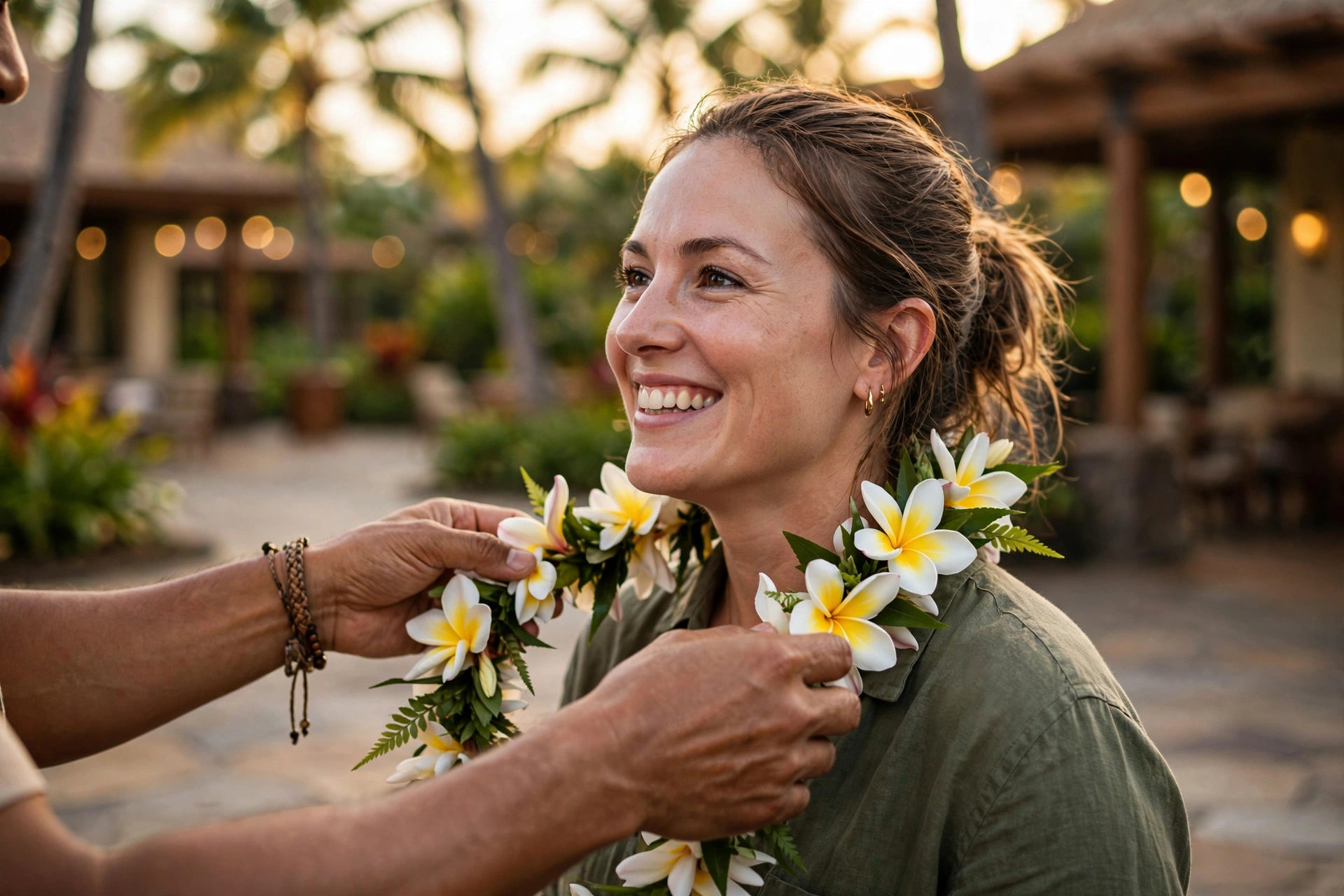
In practice, using mahalo is straightforward. Say it wherever you would say thank you at home, because that is exactly what it is. Thank the server who brings your plate, the shopkeeper who wraps your purchase, the shuttle driver who handles your bags, the hiker coming down the trail who tells you the waterfall is worth the last half mile. Mahalo suits casual and formal moments alike, and no local will find it odd coming from a visitor. Most will appreciate the effort.
Let your face match the word. Make eye contact, smile, and pause for half a second instead of tossing mahalo over your shoulder as you walk away. Genuine connection matters in Hawaiian culture, and the word lands differently when your expression backs it up.
The word works in writing as well. A thank-you note to a guide, a thoughtful review of a small business, or a gracious email can all carry a sincere mahalo. For a slightly more formal touch, “me ka mahalo” means “with gratitude” and makes a fine sign-off.
When someone says mahalo to you, a warm “you’re welcome” is a complete and correct response. If you would like to answer in Hawaiian, “ʻaʻole pilikia” (ah-oh-leh pee-lee-kee-yah) means “no problem” and serves as a friendly “you’re welcome.” Use it naturally or not at all. Forced Hawaiian impresses no one.
Mistakes Visitors Should Avoid
A few missteps come up often enough to be worth naming.
The trash can confusion is the classic. Visitors spot “Mahalo” printed on public waste bins and decide the word must mean trash. It does not. The bins are thanking you for keeping the area clean. Gratitude, not a label.
Do not use mahalo as a greeting. Hellos and goodbyes belong to aloha, which also carries the meanings of love and compassion. Mahalo is for thanks. Swapping them marks you as someone who learned Hawaiian from a keychain.
Skip the theater. You do not need an accent, three drawn-out syllables, or ten mahalos per conversation to prove you know the word. A plain, sincere mahalo always beats a performed one. And never use it sarcastically. In a culture that treats gratitude as a genuine value, an ironic mahalo lands badly.
Above all, remember that Hawaiian is a living language. Real people speak it, teach it to their children, and fought hard to keep it alive. Using mahalo with that awareness is what separates respect from costume. Learning how to move respectfully through Hawaiian cultural experiences will serve you far beyond a single word.
Hawaiian Words That Belong With Mahalo
Mahalo rarely travels alone. A handful of related words covers most of what a visitor needs, and each one opens a small window into the culture.
Aloha (ah-loh-hah): love, affection, compassion, and the standard hello and goodbye. If mahalo is gratitude, aloha is the warmth surrounding it. The two are the twin pillars of everyday courtesy in Hawaii. Aloha’s full meaning runs deeper than any single translation.
A hui hou (ah hoo-ee hoh): “until we meet again.” A farewell with hope built into it rather than finality. You will hear it at the close of tours, luaus, and genuine goodbyes.
ʻAʻole pilikia (ah-oh-leh pee-lee-kee-yah): “no problem,” doing the duty of “you’re welcome.” Useful when someone thanks you first.
E komo mai (eh koh-moh mah-ee): “welcome, come in.” Posted at doorways across the islands, and the spirit in which most mahalos are received.
ʻOhana (oh-hah-nah): family in the widest sense, including chosen family and close community. Much of the gratitude expressed in Hawaii is gratitude toward one’s ʻohana, which explains why thanks here can feel so communal. Read about the significance of ʻohana in Hawaiian society to understand the community behind the word.
Five words, said like you mean them, will carry you further than any phrasebook.
ʻOlelo Hawaii: A Language That Refused to Disappear
The words above survive because people fought for them. After the overthrow of the Hawaiian Kingdom, an 1896 law made English the required language of instruction in island schools, and Hawaiian began a long decline. Within a few generations, the number of fluent speakers had fallen to a fraction of what it once was. The story of Hawaii before the 50th star gives the fuller picture of what the language lived through.
The turnaround is one of the great language revival stories anywhere. Families, teachers, and activists built Hawaiian immersion schools, pushed the language back into public life, and raised new generations of speakers. Today ʻolelo Hawaii is an official language of the state of Hawaii, taught from preschool through the university, heard in music and media and everyday conversation. Hawaiian traditions of hula, chanting, and storytelling carried the language through its hardest decades.
That history gives your mahalo a little extra weight. Every visitor who learns even a few words with genuine respect becomes part of keeping the language alive instead of letting it fade into decoration. Say the words carefully, learn what they mean, and pass them on correctly. It is a small effort, and it counts for more than it looks.
Hear It Spoken: Mahalo in Hawaiian
Hearing the rhythm of the word locks in the pronunciation in a way that text cannot. This two-minute lesson breaks down mahalo clearly, and it is worth the short watch before your trip.
Mahalo starts as a simple translation, thank you in Hawaiian, and grows into something larger the longer you sit with it: a habit of noticing what others give you and saying so out loud. The dictionary hands you the definition. The culture hands you the reason. Say it to a server in Waikīkī, write it at the bottom of a thank-you note, or think it quietly while the sun drops into the Pacific. The word does its real work whenever it is sincere. That has always been the whole meaning, and it has always been enough.