
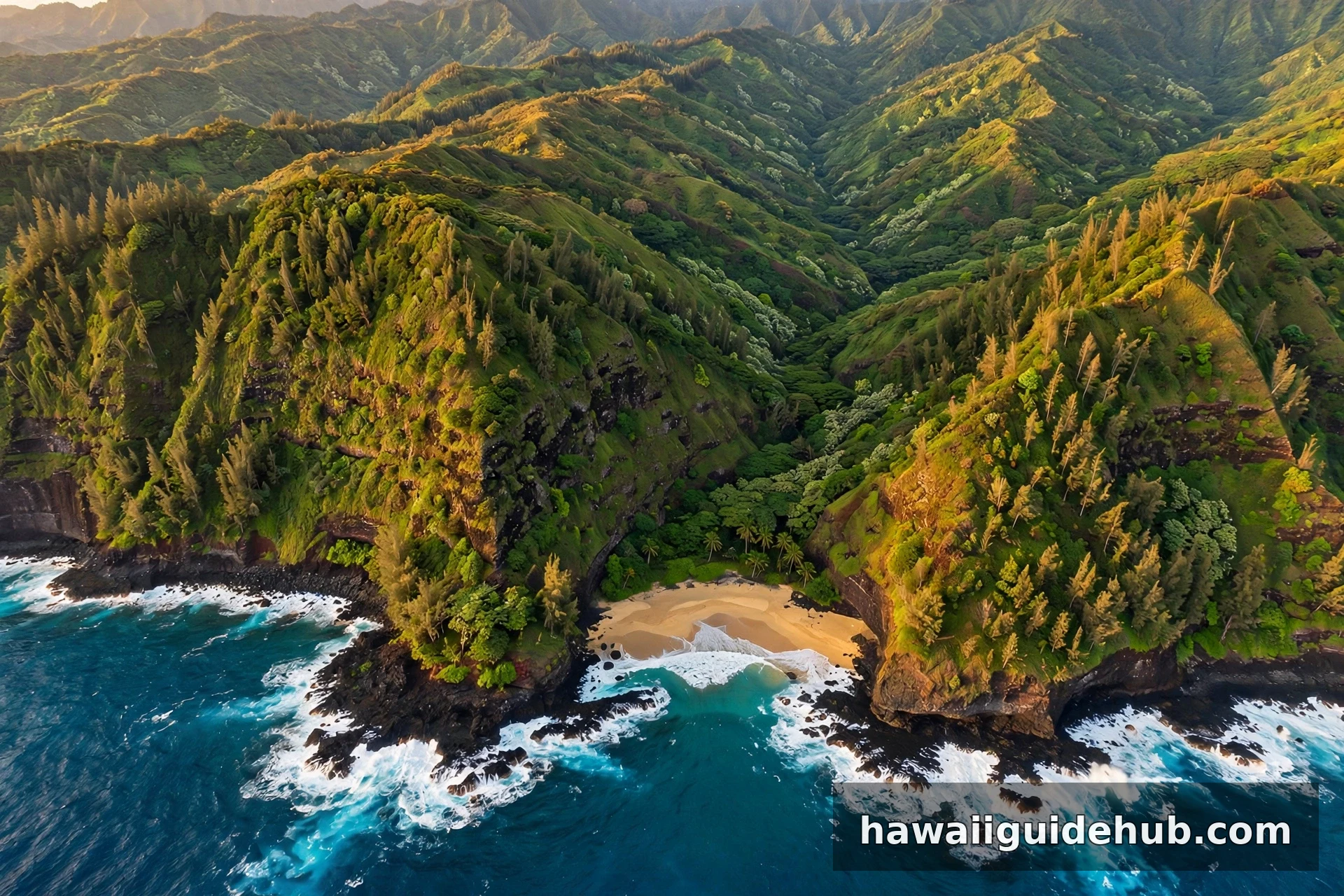
Fascinating Facts About Hawaii

Ask a random person what they know about Hawaii and you will hear about beaches, surfing, and luaus. All true, but barely the surface. The real story is stranger and richer: the only American state with a royal palace, the only one in the tropics, and the only one where owning a snake can land you in prison. Its tallest mountain beats Everest when measured honestly, one peak drowns in about 450 inches of rain a year, and its history runs from Polynesian voyagers to a kingdom, an overthrow, and statehood.
This page is the single home for Hawaii facts on this site, covering the geography, history, culture, nature, and everyday quirks that make the islands unlike anywhere else.
Geography Facts: An Outlier in Every Direction
The only US state in the tropics
Most people know Hawaii is warm, but few realize it is the only American state located entirely within the tropics. The Tropic of Cancer sits at 23.5 degrees north latitude, and every main Hawaiian Island lies south of that line. That position shapes everything: the trade winds, the year-round growing season, the coral reefs, and the strange reality that snow can fall on Mauna Kea while people swim in Honolulu at 80 degrees.
Related to that, Ka Lae, also called South Point, on the Big Island sits at roughly 18.9 degrees north latitude, making it the southernmost point of land in the entire United States. Key West, Florida sits at about 24.5 degrees north, which means the southern tip of the Big Island reaches more than five degrees closer to the equator than the southernmost point of the continental states.
Eight main islands, 137 islands in total
The Hawaii most people picture is the eight main islands: Hawaiʻi (the Big Island), Maui, Oʻahu, Kauaʻi, Molokaʻi, Lānaʻi, Niʻihau, and Kahoʻolawe, running from northwest to southeast. But the full archipelago stretches about 1,500 miles across the Pacific and includes 137 islands, islets, and atolls in total, from the Big Island to Kure Atoll in the far northwest. Most are tiny uninhabited fragments, many protected inside the Papahānaumokuākea Marine National Monument. If you are planning a first trip, our guide to choosing the best island in Hawaii for first-time visitors breaks down what each main island does best.
The most isolated population center on Earth
Honolulu sits roughly 2,390 miles from California. Japan is about 3,850 miles away and China about 4,900. There is no driving to Hawaii, no train, no bridge. As a former Hawaii governor once put it, “We are the most isolated community on the planet.” That isolation explains a great deal: it is why the islands evolved thousands of species found nowhere else, why the culture developed so distinctly, and why everyday goods, from milk to building materials, cost noticeably more here than on the mainland.
Mauna Kea is taller than Everest when measured fairly
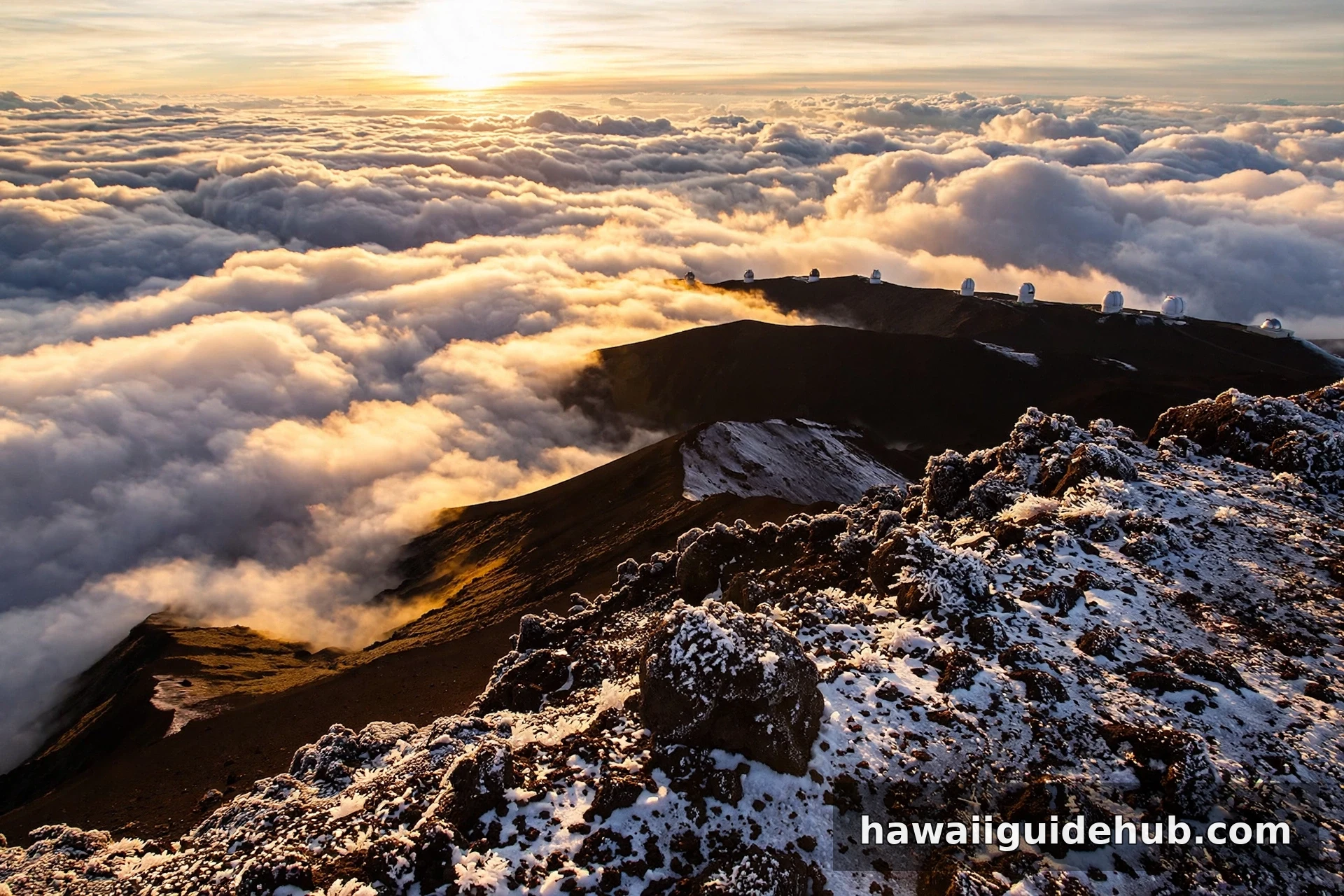
Mauna Kea’s summit stands 13,803 feet above sea level, which sounds modest next to Everest’s 29,032 feet. But mountains do not start at sea level. Measured from its base on the Pacific Ocean floor, Mauna Kea rises about 33,500 feet from base to summit, which beats Everest by thousands of feet and makes it the tallest sea mountain on Earth. The US Geological Survey still classifies Mauna Kea as an active volcano, one likely to erupt again someday, although its last eruption was 4,000 to 6,000 years ago.
One of the rainiest spots on the planet
Mount Waiʻaleʻale on Kauaʻi, whose name means rippling or overflowing water, collects roughly 450 inches of rain in an average year according to NOAA data, with some years topping 600 inches. Moist trade winds slam into its steep cliffs and squeeze out nearly every drop. The result is the Alakaʻi Wilderness, a high-elevation bog so wet that trails barely survive it. Drive about ten miles west and you land in the dry country around Waimea Canyon, which tells you everything about how violently Hawaii’s microclimates change across short distances.
History Facts: From Kingdom to Statehood
Settled by the greatest navigators in human history
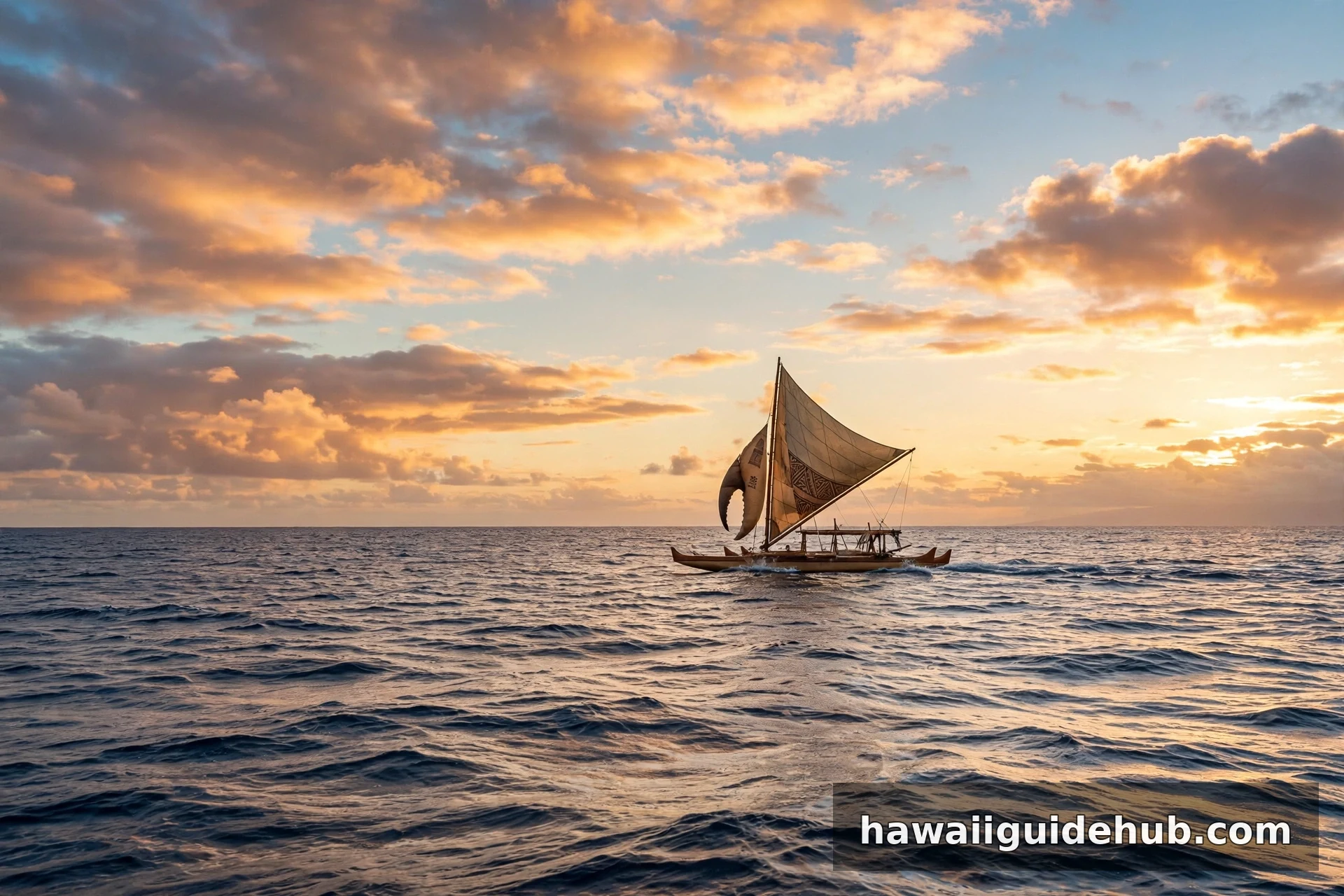
Long before Europeans crossed the Atlantic with compasses, Polynesian voyagers were crossing thousands of miles of open Pacific in double-hulled canoes, navigating by stars, ocean swells, wind patterns, and the flight of birds. They reached Hawaii more than a thousand years ago and built a complex society with its own religion, land system, agriculture, and oral literature. Modern canoes such as Hōkūleʻa have retraced those routes using only traditional navigation, proving the old knowledge was real.
A unified kingdom by 1810
Kamehameha I united the islands under one rule in 1810, founding the Kingdom of Hawaiʻi. The kingdom was no backwater: it had a written constitution, a legislature, courts, public schools, diplomatic recognition from major world powers, and its own currency. For most of the 19th century, Hawaii was a recognized sovereign state, not a colony.
America’s only royal palace
ʻIolani Palace in downtown Honolulu is the only official royal residence in the United States. Completed in 1882 under King Kalākaua, it had electric lighting before the White House did, along with indoor plumbing and a telephone system. After the monarchy fell it served as a government building for decades before its full restoration.
The overthrow and annexation
On January 17, 1893, a group of American and European businessmen, backed by US Marines, overthrew Queen Liliʻuokalani, the kingdom’s last reigning monarch. A provisional government gave way to the Republic of Hawaiʻi in 1894, and the United States annexed the islands through the Newlands Resolution, signed July 7, 1898, with the formal ceremony at ʻIolani Palace on August 12, 1898. The islands became a US territory in 1900. In 1993, Congress passed the Apology Resolution acknowledging the American role in the overthrow.
Pearl Harbor and the road to statehood
On the morning of December 7, 1941, Japanese forces launched a surprise attack on the US naval base at Pearl Harbor, killing 2,403 service members and civilians and injuring 1,178 more, according to the National Park Service. The battleships USS Arizona and USS Utah were sunk permanently, and 188 aircraft were destroyed. The attack pulled the United States into World War II the next day. Today the site is the Pearl Harbor National Memorial, and visiting Pearl Harbor on your own remains one of the most meaningful things to do on Oʻahu.
Hawaii’s road to statehood took far longer than the war. After a 1959 referendum in which nearly 94 percent of voters said yes to statehood, President Dwight D. Eisenhower signed the proclamation admitting Hawaii as the 50th state on August 21, 1959. The first bill for Hawaiian statehood had been introduced in Congress forty years earlier, in 1919.
A president was born here
Barack Obama, the 44th president of the United States, was born in Honolulu on August 4, 1961, just two years after statehood. He is the only US president born in Hawaii, and his island childhood, which he wrote about in his memoir, shaped his perspective growing up between cultures.
Language and Culture Facts
The ʻokina is a real consonant
The Hawaiian alphabet has just 13 letters: five vowels (a, e, i, o, u), seven consonants (h, k, l, m, n, p, w), and the ʻokina, the glottal stop written as a reversed apostrophe. It is not decoration. Hawaiʻi with the ʻokina and Hawaii without it are different words, and dropping it can change meanings entirely. The ʻokina is a genuine consonant sound, the brief catch in the throat you hear in the middle of “uh-oh.”
Two official languages
Hawaii is the only US state with two official languages: English and ʻŌlelo Hawaiʻi, the Hawaiian language. The state constitution recognizes both. After the language was suppressed for generations and nearly died out, immersion schools and university programs brought it back from the edge. Its revival is one of the great language comebacks in American history.
Aloha means far more than hello
Aloha is usually translated as love, affection, or compassion, and it doubles as both a greeting and a farewell. But in Hawaiian thought it carries the weight of a whole ethic: how to treat people, land, and community. The aloha spirit is even written into state law as a reminder of the values Hawaii asks of everyone who lives in and visits the islands.
Hula is a language, not just a dance
Hula is Hawaii’s state dance, but calling it a dance undersells it. Ancient hula preserved genealogy, mythology, and history in movement and chant at a time when the culture had no written language. Every hand gesture and footstep carries meaning. The Merrie Monarch Festival, held each spring in Hilo, is the most prestigious hula competition in the world. For more, read our guide to hula, chanting, and storytelling in Hawaiian culture.
Surfing was born here
Ancient Hawaiians invented surfing, which they called heʻe nalu, or wave sliding. Chiefs demonstrated rank on massive wooden boards, and surf breaks were ranked by social class. The sport might have stayed local if not for Duke Kahanamoku, the Honolulu-born Olympic swimming champion whose gold medals in 1912 and 1920 made him world famous. Duke spent decades demonstrating surfing around the globe and is remembered as the father of modern surfing.
The state fish has the longest name in the business
Hawaii’s state fish is the humuhumunukunukuāpuaʻa, the reef triggerfish. The name roughly translates to “the fish that grunts like a pig,” for the sound it makes when threatened. First designated in the 1980s and permanently reinstated in 2006, it is the longest fish name you will ever have to pronounce. Locals say it without blinking.
The flag carries a Union Jack
Hawaii’s state flag is the only one in America that includes the British Union Jack. King Kamehameha I commissioned the design in the early 1800s as a gesture of friendship toward Britain, and it flew over the kingdom for decades before annexation. The eight stripes represent the eight main islands.
Lei Day is a real holiday
May 1 is Lei Day in Hawaii, a celebration of the lei and the culture of giving around it. Each island has its own official flower and color. Giving a lei is a gesture of affection, respect, and welcome, and custom says never to refuse one offered in kindness.
Volcano and Nature Facts
Two volcanoes are active right now
The US Geological Survey lists two active volcanoes in Hawaii: Kīlauea and Mauna Loa, both on the Big Island. Kīlauea ranks among the most active volcanoes on the planet, repeatedly reshaping the island’s southeast coastline within living memory. Mauna Loa is the largest active volcano on Earth by volume, and it erupted in 2022 after a 38-year quiet stretch. To see this landscape up close, start with our guide to the best things to do in Hawaiʻi Volcanoes National Park.
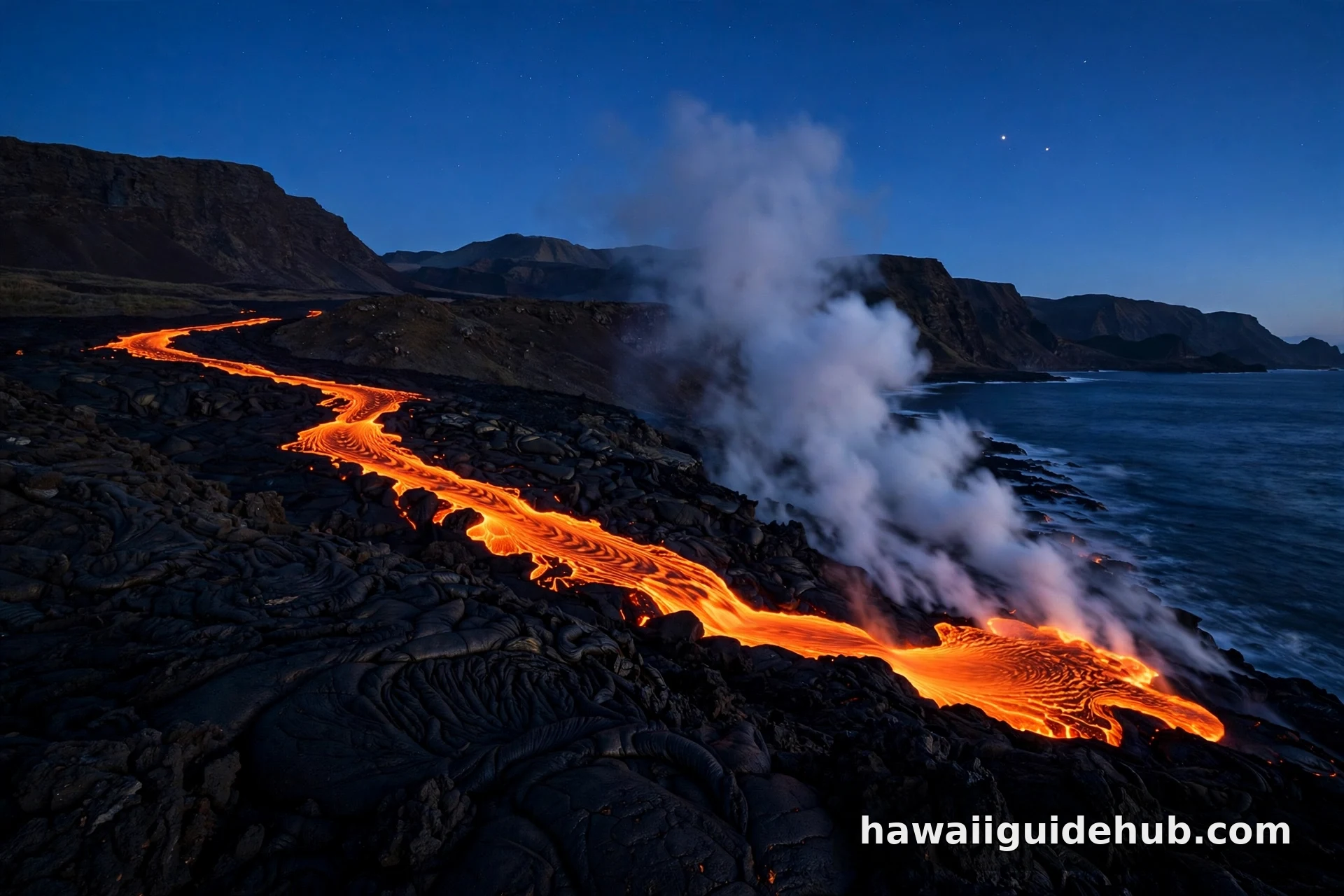
The Big Island is still growing
Hawaiian volcanoes do more than erupt, they build. When lava reaches the ocean it cools into brand-new land, and the Big Island has gained significant new acreage in recent decades from Kīlauea’s flows. The island is the youngest in the chain and still rising over the volcanic hotspot, while the older northwestern islands slowly erode and sink. See our guide to the best things to do on the Big Island to explore the island still under construction.
The endangered species capital of the world
Hawaii’s isolation produced an explosion of unique life: about 90 percent of its native plants and animals exist nowhere else on Earth. That same isolation makes them fragile, and the islands hold more endangered species per square mile than anywhere else in the United States, earning the nickname the endangered species capital of the world. The Hawaiian monk seal and the nēnē, Hawaii’s state bird and the world’s rarest goose, are found only here.
No rabies, no snakes, strict borders
Hawaii is the only US state with no rabies, which is why arriving pets face quarantine rules that surprise many visitors. Snakes are flatly illegal: the Department of Agriculture notes that possessing or transporting one can bring a class C felony charge, fines of up to $200,000, and three years in prison, because a single breeding pair could devastate native birds that evolved with no predators. Only zoos may keep snakes under tight permits.
Quirky Laws and Everyday Surprises
No billboards, by law, since 1927
Hawaii was the first US state to ban billboards, and it did so in 1927, more than three decades before statehood. The law, still on the books, simply forbids erecting or maintaining billboards. Only Vermont, Maine, and Alaska ever followed. Drive the islands today and the views stay clean: coastline, mountains, and sky with no advertising in between.
Hawaii ignores daylight saving time
Hawaii runs on Hawaii-Aleutian Standard Time, ten hours behind Coordinated Universal Time, and it never springs forward. Only Arizona joins Hawaii in skipping daylight saving entirely. This close to the equator, day length barely changes through the year, so shifting the clocks would accomplish nothing.
The only state that grows coffee commercially
Kona coffee is not a marketing gimmick. Hawaii is the only US state with the climate to grow coffee commercially, and the Kona district’s volcanic soil, sunny mornings, and cloudy afternoons produce one of the most prized coffees in the world. Coffee has grown on these slopes since the early 1800s.
Two islands you cannot just visit
Niʻihau, the westernmost main island, is privately owned by the Robinson family and closed to outsiders, earning it the name the Forbidden Isle. Kahoʻolawe is uninhabited: the US military used it as a bombing range for decades, and today it is a protected reserve being restored with native plants. Of the eight main islands, six welcome visitors freely and two keep their distance.
Why These Facts Matter
Hawaii rewards the curious. From 30,000 feet it looks like a simple beach destination, but on the ground it is a former kingdom with two official languages, living volcanoes, the tallest sea mountain on Earth, and laws shaped by 2,400 miles of ocean in every direction. The facts above are a starting point. The islands themselves are the full story.


