Stairway to Heaven Oahu: Why It’s Closed, Legal Views & Alternatives

The Stairway to Heaven, Oʻahu’s famous Haʻikū Stairs, is the most mythologized hike in Hawaii: nearly 4,000 steel steps climbing the Koʻolau Range above the clouds. It is also closed, illegal to climb, and being dismantled by the City and County of Honolulu. If you came here looking for how to hike it, here is the honest truth first: you cannot, and attempting it risks a $1,000 fine, arrest, and serious injury. This guide covers what the stairs were, why they are gone, where the legal viewpoints are, and the status of the demolition.
What Was the Stairway to Heaven?
The Haʻikū Stairs were built by the U.S. Navy in 1942-43 to service a top-secret radio station in Haʻikū Valley. The valley’s natural amphitheater shape made it ideal for the enormous antennae needed to transmit to Navy ships across the Pacific. The original wooden ladder was replaced with metal steps and ramps in the mid-1950s: by one count, 3,922 steps climbing 2,800 feet up the Koʻolau ridgeline. The Coast Guard allowed public access in the 1970s, but closed the stairs in 1987 after injuries, overcrowding (a Magnum P.I. appearance supercharged visitation), and neighborhood complaints.
Why It’s Closed and Being Removed
Three forces killed the stairs. Safety: the structure deteriorated over decades of disuse, and rescues of injured trespassers became routine and expensive. Trespassing: thousands ignored the closure yearly, cutting through a quiet Kāneʻohe neighborhood at all hours and enraging residents. Liability: the city faced the cost of either rebuilding to modern code or removing. In 2021 the Honolulu City Council voted to remove the stairs. In April 2024 the city announced deconstruction would begin at month’s end; a June 2024 joint DLNR/City news release closed all access to the surrounding forest reserve during demolition. The Friends of Haʻikū Stairs sued to stop it: demolition was paused mid-2024 pending litigation, and as of late 2025 the case was still moving through the courts after a judge denied the city’s bid to dismiss the appeal. The stairs’ future remains legally uncertain, but public access is not.
Legal vs Illegal: Your Actual Options
| Option | Legal? | What it involves | The catch |
| Climbing the stairs from Haʻikū | No | Trespassing through private land and a closed site | Up to $1,000 fine, arrest, HPD patrols |
| Moanalua Valley Trail to the summit | Yes, when open | Long ridge hike to the top of the stairs area | Closed during deconstruction; touching stairs still illegal |
| Viewing from below (Haʻikū Valley) | Yes | Seeing the ridge from public roads | Distant; stairs may be gone |
| Other Koʻolau ridge hikes | Yes | Olomana, Kuliʻouʻou, Wiliwilinui | Different views, equally stunning |
The “Legal Way”: Moanalua Valley Trail
For years, the Moanalua Valley Trail (the “back way”) was the legal route to the top of the stairs: a grueling 9-plus-mile round trip through muddy valley and along the Middle Ridge to the summit above Kāneʻohe. Important: even on this trail, stepping onto the stairs themselves was never legal, and HPD officers waited at the bottom. During the deconstruction, DLNR closed the entire Moanalua section of the forest reserve, so even the back way has been off-limits. Check DLNR’s current closure notices before planning anything in the area.

What You’ll See from the Top (When Accessible)
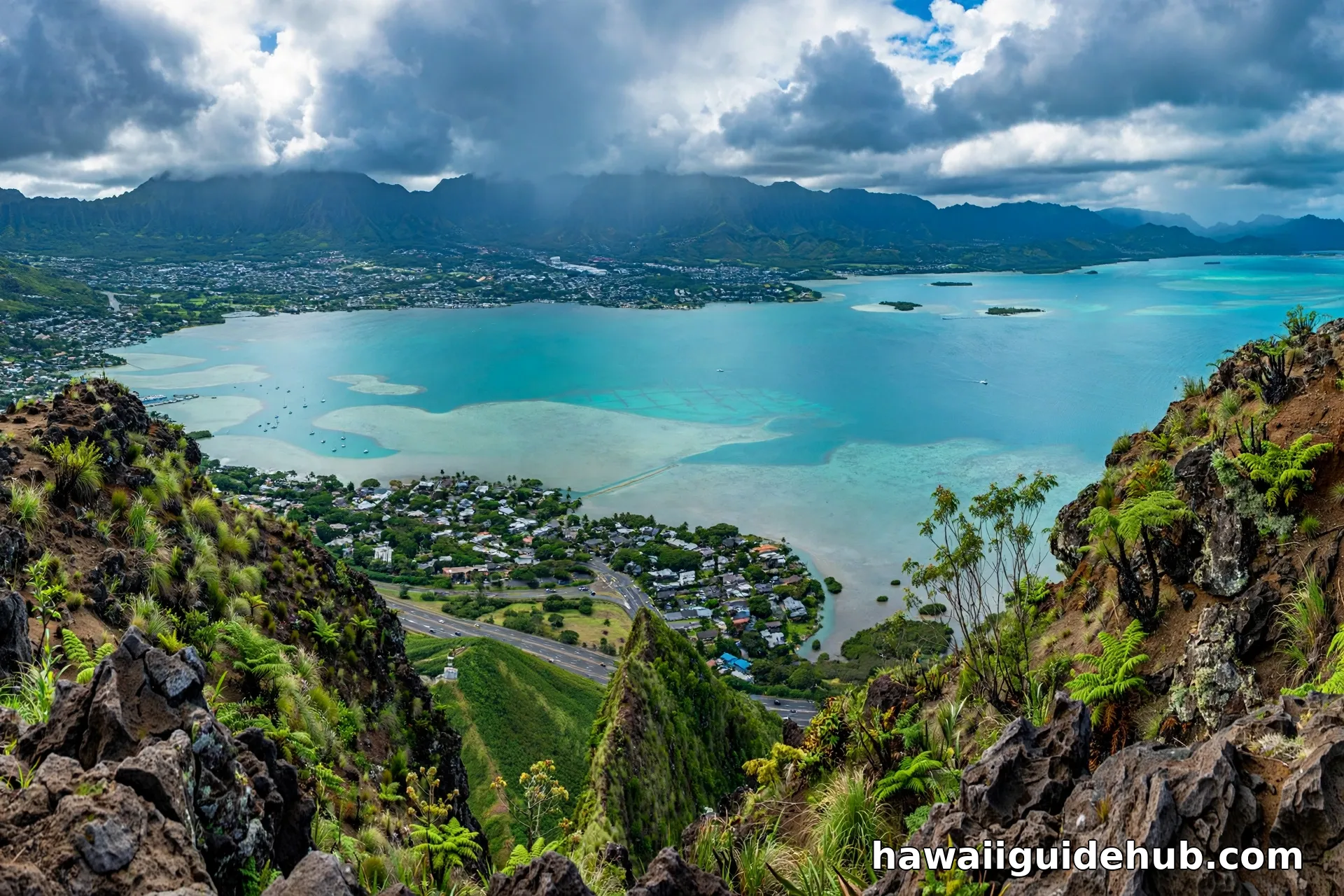
The reward was always the view: Kāneʻohe Bay’s turquoise sweep 2,800 feet below, the windward coast stretching to Chinaman’s Hat, and on clear mornings a cloud inversion that made the stairs feel like they truly led to heaven. That panorama belongs to the Koʻolau summit generally, not to the stairs specifically, which is why the legal ridge hikes below deliver 90 percent of the magic with none of the legal risk.
Legal Alternatives with the Same Thrill
Olomana (Three Peaks): windward Oʻahu’s most dramatic ridge hike, with knife-edge sections and sweeping views. Not for beginners, and the third peak demands climbing skills. Kuliʻouʻou Ridge: a maintained trail to a summit with panoramic views over Waimānalo and the windward coast. Wiliwilinui Ridge: a ridge walk above the city with stunning leeward-to-windward vistas. For Kauaʻi-style canyon hiking on a different island, see the Waimea Canyon hiking guide. For a gentler version of the “above the clouds” feeling, the Hawaii outdoor adventures guide covers Oʻahu’s best legal trails. And for Kāneʻohe Bay views without the climb, the Oʻahu guide points to the best windward lookouts.
Timeline: 1942 to Today
1942-43: U.S. Navy contractors build the Haʻikū Radio Station and its access ladder in just weeks; the station is commissioned in 1943 with a massive Alexanderson alternator for low-frequency transmissions to the Pacific fleet. Mid-1950s: wooden stairs replaced with metal steps and ramps. 1970s: Coast Guard (which inherited the site) allows public access; a Magnum P.I. episode turns it into a phenomenon. 1987: station and stairs closed to the public. 2000s-2010s: trespassing explodes with social media; rescues and neighborhood conflicts mount. 2021: Honolulu City Council votes to remove the stairs. April 2024: city announces deconstruction to begin end of month; Nākoa Companies wins the contract. June 2024: DLNR and city close all surrounding access during demolition after hikers ignore partial closures. Mid-2024: demolition paused pending Friends of Haʻikū Stairs litigation. Late 2025: judge denies the city’s bid to dismiss the appeal; the case continues.
How Social Media Loved It to Death
The stairs were a local secret for decades, then Instagram made them global. Aerial-style photos above the clouds, tagged #StairwayToHeaven, drew tens of thousands of visitors to a quiet residential valley with no parking, no facilities, and no legal access. Residents endured headlights at 3 AM, strangers cutting through yards, and trash on the trails. The city spent heavily on guards and rescues. It is the purest case study in Hawaii of overtourism destroying the thing tourists came to see: the attention did not save the stairs, it signed their demolition order.
The Neighborhood’s Side
Talk to Kāneʻohe residents near the trailhead and you hear exhaustion, not nostalgia. Years of midnight hikers, car break-ins, noise, and confrontations turned a community against the landmark in its backyard. This matters because it explains the politics: the removal vote was not just about safety engineering, it was about a neighborhood that had asked for relief for thirty years. Any future for the stairs, advocates concede, must solve the access problem first: no neighborhood cut-through, no unmanaged crowds.
What Happens If You’re Caught
HPD and DLNR’s Division of Conservation and Resources Enforcement patrol the area and issue citations: dozens were written during the 2024 closures alone. Penalties run up to $1,000 in fines, with arrest possible. Beyond the legal risk, the physical risk is real: the structure has deteriorated, sections are unstable, and helicopter rescues from the ridge are routine enough that first responders know the drill by heart. There is no version of sneaking up that is safe, legal, or respectful.
Could the Stairs Ever Reopen?
The Friends of Haʻikū Stairs, a nonprofit, has long proposed the alternative: repair the stairs to code and run them as a managed, ticketed attraction with controlled access that bypasses the neighborhood. Their lawsuit argues the demolition permit process was flawed. Supporters point to managed-access precedents worldwide. The city counters with cost, liability, and neighborhood opposition. As of late 2025 the courts had not resolved it. Honest assessment: reopening would require money, political will, and a neighborhood solution that has eluded everyone for decades. Do not plan a trip around it.
Video: The Legal Way Before Removal
The Moanalua Valley back way, filmed in the last week before deconstruction began.
Frequently Asked Questions About the Stairway to Heaven
Where is the Stairway to Heaven in Hawaii?
In Haʻikū Valley above Kāneʻohe on Oʻahu’s windward side, climbing the Koʻolau Range. Access is closed and the site is under deconstruction.
Is the Stairway to Heaven illegal?
Yes. Accessing the stairs is trespassing, punishable by fines up to $1,000 and arrest. HPD and DLNR officers patrol and issue citations.
Is there a legal way to see the Stairway to Heaven?
The Moanalua Valley Trail was the legal back way to the summit area, but it was closed during deconstruction. Touching or climbing the stairs was never legal from any direction.
How many steps does the Stairway to Heaven have?
By one count, 3,922 metal steps and ramps, climbing about 2,800 feet along the Koʻolau ridgeline.
Has the Stairway to Heaven been demolished?
Partially. Deconstruction began in 2024, was paused mid-year pending a lawsuit by the Friends of Haʻikū Stairs, and the case was still active in late 2025. The stairs’ ultimate fate is undecided, but they remain closed regardless.
What is at the top of the Stairway to Heaven?
The Puʻu Keahiakahoe summit area with panoramic views over Kāneʻohe Bay and the windward coast: the same panorama reachable by legal ridge hikes.
Haʻikū Valley Beyond the Stairs
The valley itself deserves better than its fame as a trailhead. Haʻikū Valley is a natural amphitheater of near-vertical Koʻolau cliffs, one of the most dramatic landscapes on Oʻahu, with native forest in its upper reaches and the historic radio station ruins below. The Board of Water Supply manages much of the land. When access restrictions eventually lift, the valley’s legal trails and the summit ridge will remain worth visiting on their own terms: the stairs were always just one feature of a spectacular place.
Can you still see the Stairway to Heaven?
From a distance, yes: the ridge line is visible from Kāneʻohe and the windward coast, though deconstruction has removed sections. Close access of any kind is prohibited.
How long is the Stairway to Heaven hike?
The stairs themselves climb about 2,800 feet over 3,922 steps. The legal Moanalua back way was a 9-plus-mile round trip. Neither is currently accessible.
Why is it called the Stairway to Heaven?
The nickname comes from the experience of climbing above the cloud layer: from the ridge, the stairs appear to ascend into the sky. The official name is the Haʻikū Stairs (or Haʻikū Ladder).
The Radio Station: What the Stairs Were Actually For
The stairs were never built for hiking: they were industrial access for one of the most powerful radio transmitters of World War II. The Haʻikū Radio Station used an Alexanderson alternator, a room-sized electromechanical generator producing very-low-frequency signals that could reach Navy ships across the entire Pacific. The antennae needed height and span, so the Navy strung cables across Haʻikū Valley’s natural amphitheater, with the stairs giving technicians access to the anchor points on the ridge. After the war, the Coast Guard used the site for an Omega navigation station. When you look at photos of the stairs, you are looking at a Cold War communications relic that accidentally became a hiking icon.
Photographing the Stairs Legally
You can photograph the ridge without trespassing. The Koʻolau ridgeline is visible from Kāneʻohe town, from the H-3 freeway viewpoints, and from Kualoa-area lookouts across the bay: a telephoto lens compresses the ridgeline dramatically. Drone flight is restricted near the military installations and the forest reserve, so check airspace rules. And if you hike a legal ridge like Olomana, you will look across at the Haʻikū ridgeline from the summit: the stairs’ silhouette against the clouds is still photogenic from a mile away.
Did anyone die on the Stairway to Heaven?
Yes. Over the decades of illegal use there were injuries, helicopter rescues, and at least one widely reported fatality, a reminder that the deteriorated structure and exposed ridge are genuinely dangerous.
What replaced the Stairway to Heaven?
Nothing yet. The demolition leaves the ridge to return to forest. Advocates hope for a managed-access future; the city has not committed to any replacement attraction.
The Stairway to Heaven’s story is a cautionary one: a beloved landmark loved to death by the very attention that made it famous. Respect the closure, hike the legal ridges, and let the Koʻolau summit views, which never needed stairs to be utterly spectacular on their own, be the reward.