Brown Violin Spider in Hawaii: Identification, Bites & The Truth

Here is the most important sentence in this article: the brown recluse spider is not established in Hawaii. If you were bitten by something in Hawaii and someone called it a brown recluse bite, the spider was almost certainly something else. What Hawaii does have is a close relative, the brown violin spider (Loxosceles rufescens), plus a widespread habit of blaming every mysterious skin lesion on a spider. This guide sorts fact from fear: identification, the real bite risk, what to do, and Hawaii’s actual spiders.
Brown Recluse vs Brown Violin Spider: The Crucial Distinction
The brown recluse (Loxosceles reclusa) lives in the south-central United States, roughly from Nebraska to Texas to Georgia. Despite rumors, it has not established populations in Hawaii, California, Florida, or anywhere outside its native range: intercepted hitchhikers do not become colonies. Hawaii’s “brown violin spider” is Loxosceles rufescens, the Mediterranean recluse, a related species introduced to the islands long ago. It carries the same violin marking and similar venom chemistry, but it is less studied, less commonly encountered, and bites are rarely documented. When Hawaiʻi doctors reference recluse spiders, per University of Hawaiʻi pediatrics teaching materials, this is the species they mean.
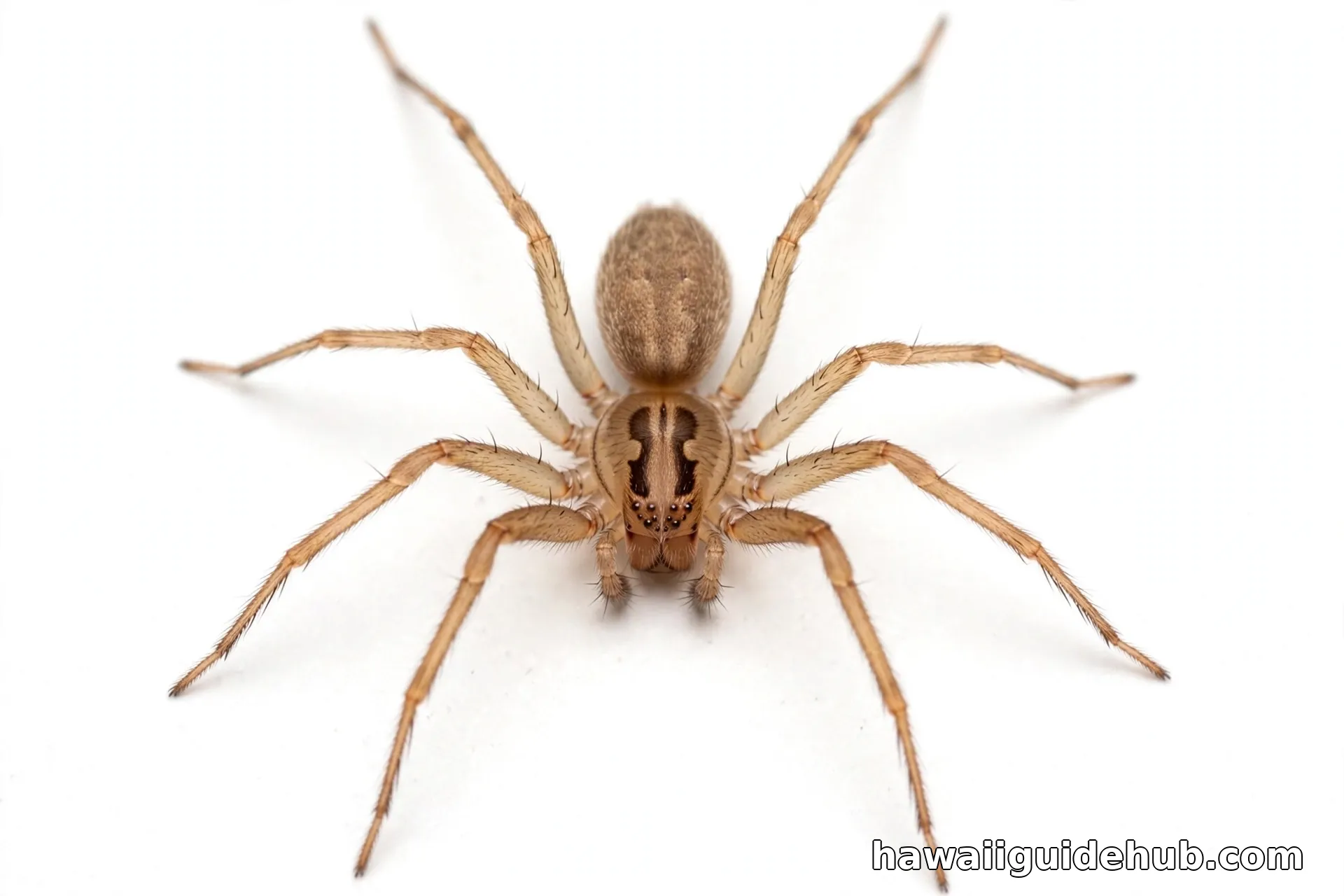
How to Identify a Violin Spider
Three features together, not one: the violin or fiddle marking on the cephalothorax (the front body section), with the neck pointing toward the abdomen; six eyes in three pairs arranged in a semicircle (most spiders have eight); and uniformly colored tan-to-brown legs with no stripes, bands, or spines. Size is about a quarter including leg span. The violin marking alone is worthless for identification: many harmless spiders have vaguely violin-ish marks, and some true recluses have faint ones. If you cannot count the eyes, you cannot confirm the ID. When in doubt, photograph it and ask an entomologist, not the internet.
Recluse or Not? Hawaii’s Brown Spiders
| Spider | Violin mark? | Eyes | Danger in Hawaii | How common |
| Brown violin spider (L. rufescens) | Yes | 6 in 3 pairs | Low; bites rarely documented | Uncommon |
| Brown recluse (L. reclusa) | Yes | 6 in 3 pairs | N/A: not established here | Effectively absent |
| Spitting spider | Sometimes vaguely | 6 | None | Common in homes |
| Woodlouse hunter | No | 6 | None to humans | Common in gardens |
| Cane spider (huntsman) | No | 8 | None; big and scary-looking | Very common |
The usual suspects in a Hawaii “recluse” scare are spitting spiders (which even share the six-eye arrangement) and woodlouse hunters. Both are harmless. The big cane spider that sprints across your wall is a huntsman: terrifying, harmless, and excellent cockroach control.
What a Real Recluse Bite Does
For the record, since the question comes up: a true recluse bite is usually painless for the first 3 to 8 hours, then becomes red, swollen, and tender. A minority develop a necrotic ulcer: the center pales, a red ring forms (the “bull’s-eye”), and tissue dies over days, healing over weeks to months with scarring. Most bites, even from true recluses, heal on their own. Severe systemic reactions are rare. But in Hawaii, the far more likely story behind a necrotic-looking sore is a staph or MRSA skin infection, which doctors misattribute to spiders with notorious frequency. A wound that will not heal deserves a culture, not a spider hunt.
What to Do If You Suspect a Bite
Wash with soap and water, apply ice, and keep it clean and covered. Do not squeeze, cut, or apply heat. Photograph the lesion daily to track changes. See a doctor promptly if: redness spreads rapidly, you develop fever or red streaks, the center turns dark or ulcerates, or pain becomes severe. Tell the doctor you want the wound cultured: in Hawaii, bacterial infection is statistically the likelier culprit. If you caught the spider, bring it (safely contained) for expert identification: a confirmed ID changes everything.
Where They Hide and How to Prevent Encounters
Violin spiders are reclusive by nature: the name is honest. They rest in quiet, undisturbed places by day and roam at night. Indoors: closets, storage boxes, behind pictures and baseboards, under beds, in shoes and folded clothes, attics, and garages. Outdoors: under rocks and bark, in woodpiles and sheds. Bites happen when a spider is pressed against skin: putting on clothes it slept in, rolling onto one in bed, or reaching into clutter. Prevention is glorified tidiness: declutter storage areas, shake out shoes and clothes, store items in sealed plastic rather than cardboard, seal baseboard gaps, and keep beds away from walls.

For Visitors: Should You Worry?
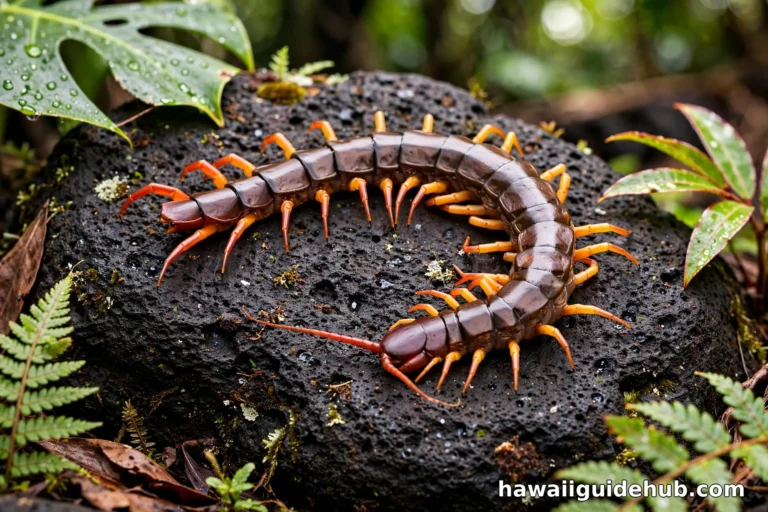
No. Tourists essentially never encounter violin spiders: hotels and maintained vacation rentals are cleaned too often to harbor them, and the spiders avoid human activity. The only scenario worth a moment’s thought is a long-term rural rental with a cluttered garage or storage shed: shake out shoes left outside, as you would for centipedes anyway. Your realistic Hawaii arthropod concerns are mosquitoes, centipedes in garden-level units (shake your shoes), and sunburn. Do not lose sleep over recluses: there is no established brown recluse population, and the violin spider wants nothing to do with you. If you are still planning the trip, the best island for first-time visitors guide will help you choose where to stay.

The Misdiagnosis Epidemic
Here is the part most articles skip: the majority of diagnosed “brown recluse bites” in places without brown recluses were never spider bites at all. In a landmark study, Californians submitted 581 spiders they believed were brown recluses; exactly one was. Physicians, pest operators, and patients routinely misidentify harmless spiders, and necrotic skin lesions get blamed on spiders when the actual culprits are MRSA and other bacterial infections, fungal infections, or vasculitis. This matters in Hawaii because it changes the treatment: a bacterial infection needs antibiotics and a culture, not spider advice. If a doctor diagnoses a recluse bite in Hawaii without a spider in a jar, get a second opinion and a wound culture.
Hawaii’s Real Spider Lineup
Hawaii’s spiders are almost entirely introduced, and nearly all harmless. The stars: the cane spider or huntsman (Heteropoda venatoria), a palm-sized sprinter that eats cockroaches and terrifies newcomers; the spiny orb weaver (Gasteracantha), a tiny jewel of a spider in gardens; the happy face spider (Theridion grallator), a tiny endemic species with a smiley pattern on its abdomen, found only in Hawaiian rainforests and a local celebrity. The brown widow (Latrodectus geometricus) is established statewide but shy, and its venom is far less potent than its black widow cousin’s: bites are rare and mild. There is no spider in Hawaii that should change your plans.
What to Do If You Find a Violin Spider Indoors
First, confirm before you panic: photograph it from above and check the three ID features. If it matches, do not handle it: trap it under a jar, slide paper underneath, and release it well away from the house, or call pest control. Then find out why it was there: check the room for clutter, cardboard, and entry gaps. One spider is an accident; repeated sightings mean habitat. Sticky traps along baseboards tell you whether you have a population or a wanderer. In nearly all Hawaii cases, the “violin spider” turns out to be a spitting spider or woodlouse hunter, and the correct response is a jar and a garden release.
When to Call Pest Control
Call a professional if you have a confirmed violin spider population (multiple sightings, shed skins in undisturbed areas), if anyone in the home is immunocompromised, or if bites of unknown origin recur. A good operator identifies first and treats second: perimeter and crack-and-crevice treatment plus a clutter and exclusion plan. Be skeptical of anyone who diagnoses your spider over the phone or sells a monthly spray as the whole answer. And remember the hierarchy of Hawaii arthropod risk: centipedes first, mosquitoes second, spiders a distant third.
Video: Violin Spider Identification and Safety
How to identify a violin spider and keep your home inhospitable to it.
Frequently Asked Questions About Brown Violin Spiders in Hawaii
Are there brown recluse spiders in Hawaii?
No established population. Hawaii has the related brown violin spider (Loxosceles rufescens), but the true brown recluse (L. reclusa) is not found here.
Is the brown violin spider dangerous?
Potentially, like all Loxosceles, but bites in Hawaii are rarely documented and the species is uncommon. Most suspected “recluse bites” turn out to be bacterial skin infections.
What does a brown violin spider bite look like?
True Loxosceles bites start painless, then redden and swell over hours; a minority ulcerate. But most necrotic-looking sores blamed on spiders are actually staph/MRSA infections: get the wound cultured.
How can you tell a violin spider from other brown spiders?
All three together: violin marking with neck pointing rearward, six eyes in three pairs, and uniformly colored legs without bands or spines. The marking alone proves nothing.
What spiders in Hawaii are actually dangerous?
None, realistically. Hawaii has no native dangerously venomous spiders. The black widow is not established; the brown widow (Latrodectus geometricus) is present but its bites are mild and rare. Centipedes, not spiders, are the arthropod to respect.
Should tourists worry about spiders in Hawaii?
No. Spider encounters of any medical significance are vanishingly rare for visitors. Mosquitoes and sunburn are the real concerns.
The Six-Eye Test: A Practical Walkthrough
Caught a suspect spider? Here is the amateur entomologist’s checklist. Step 1: size. A violin spider’s body is about 3/8 inch, legs spanning a quarter: if yours is much bigger, it is not one. Step 2: color. Uniform tan to brown, no stripes on the legs, no spines: banded or spiny legs rule it out. Step 3: the marking. Look for the darker violin on the cephalothorax with the neck toward the rear: but remember, this alone proves nothing. Step 4: the eyes. This is the decider: six eyes in three pairs in a semicircle, visible with a magnifying glass or a good phone macro. Eight eyes in two rows means a different spider entirely. All four must agree. Three out of four is not a violin spider.
Why Hawaii Has No Native Dangerous Spiders
It is not luck, it is biogeography. Hawaii’s native fauna arrived via rare long-distance dispersal over millions of years: only organisms that could survive a 2,500-mile ocean crossing founded lineages here. The spiders that made it were small, harmless colonizers like the ancestors of the happy face spider. Dangerously venomous spiders never won that lottery, and the native spider fauna evolved without them. Every spider of medical interest in Hawaii today, violin spider and brown widow included, arrived with humans in the last two centuries. The islands’ original spider community is as gentle as it gets.
Can a violin spider bite kill you?
Deaths from any Loxosceles bite are extraordinarily rare and typically involve severe systemic reactions in vulnerable individuals. In Hawaii, where the species is uncommon and encounters rarer still, the risk is negligible compared to everyday hazards like driving or swimming.
Do I need to worry about spiders when hiking in Hawaii?
No. Trail spiders are orb weavers and other harmless species. The animals to respect on Hawaii trails are centipedes under rocks, wild pigs in the distance, and the terrain itself. See the Waimea Canyon hiking guide and Hawaii outdoor adventures guide for what actually matters on the trail.
Are there black widows in Hawaii?
The black widow is not established in Hawaii. Its relative the brown widow is present statewide but shy, and its bites are mild and rarely reported. Neither should concern travelers.
Hawaii is one of the safest places on earth as far as spiders go: no established brown recluse, an uncommon and shy violin spider, and no native dangerous species at all. Learn the three ID features, keep the clutter down, shake your shoes for the centipedes instead, and enjoy the islands without a second thought: the spiders here are among the gentlest you will meet anywhere in the world, and that is one Hawaii worry you can permanently cross off the list.