Hawaiian Honeycreepers: The Birds of the High Forest

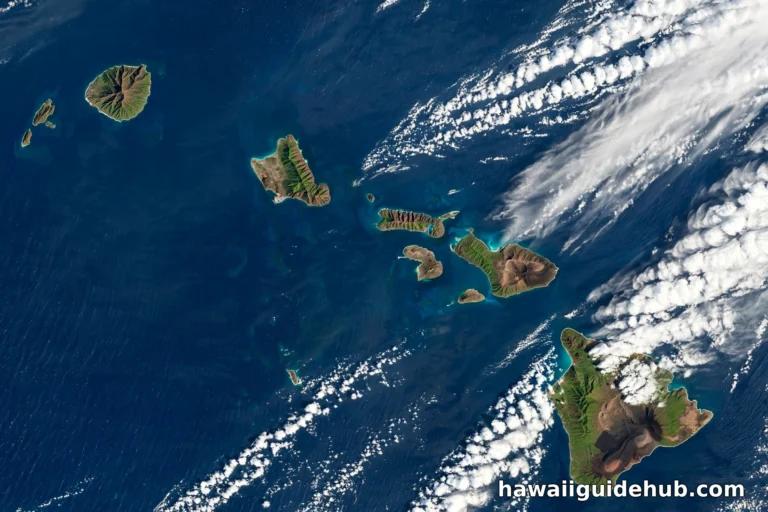
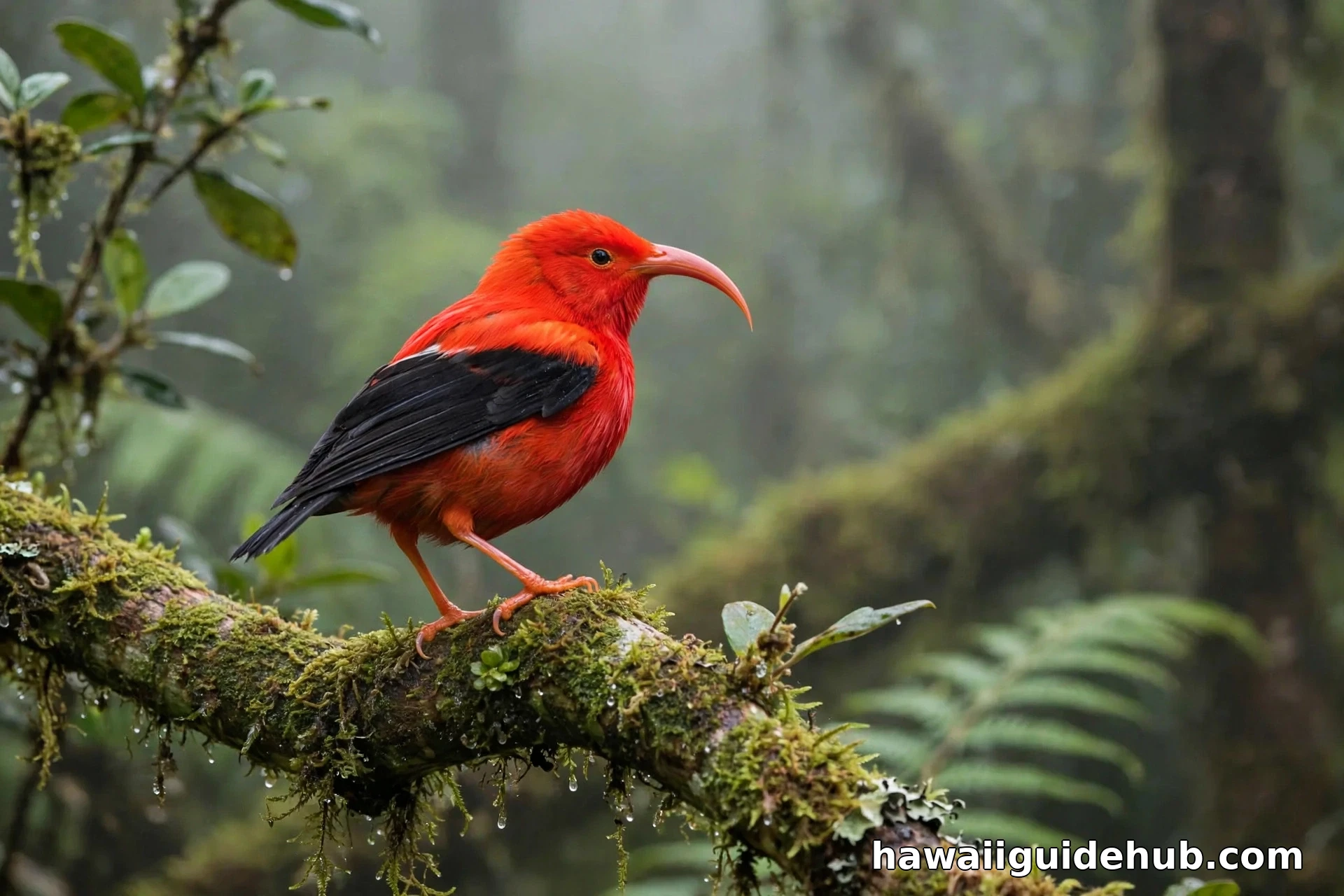
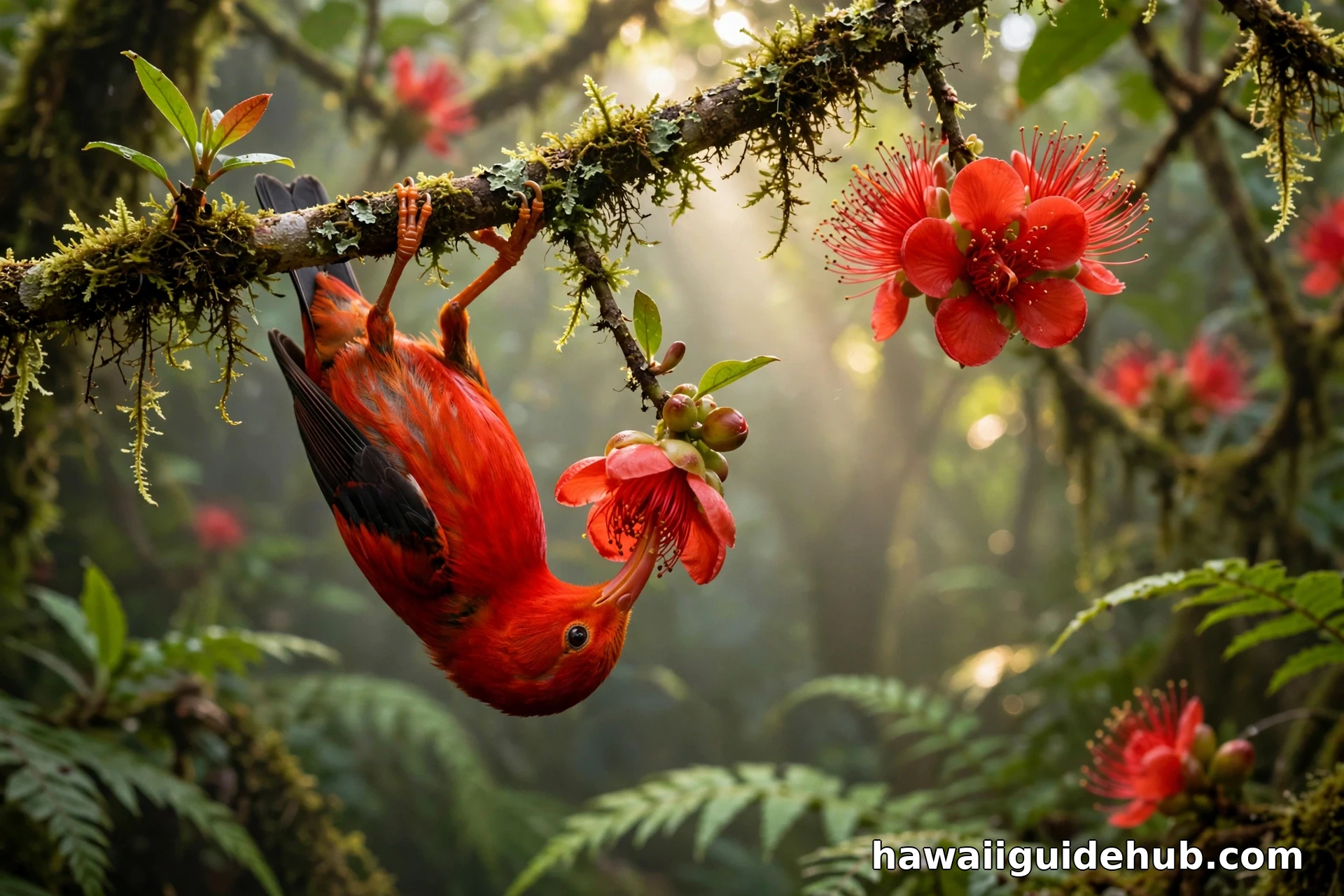
High in the misty ʻōhiʻa forests of Maui and the Big Island, a flash of scarlet darts between the blossoms. The ʻiʻiwi hangs almost upside down, its long salmon-pink bill curving deep into a tubular flower for nectar. It is one of Hawaii’s honeycreepers, a family of birds found nowhere else on Earth, and its family tree is one of the most remarkable stories in evolution. From a single finch ancestor, more than 50 species radiated across the islands, filling every role from seed-cracker to nectar-drinker. Today, only 17 remain, and most of those are in a fight for survival.
This is the single complete guide to Hawaiian honeycreepers. It covers what these birds are, the most famous species, why so many have disappeared, the mosquito-borne disease threatening the survivors, the ambitious science trying to save them, and where visitors can see them responsibly. If you have been searching for anything about Hawaiian honeycreepers, the answers are all here on this one page.
Hawaiian Honeycreepers at a Glance
| The bird | Endemic family of songbirds, descended from one finch ancestor; pollinators of ʻōhiʻa, seed dispersers, insect control |
| The numbers | More than 50 species described; 17 survive today; 11 of the 17 listed as threatened |
| The threat | Avian malaria spread by introduced mosquitoes; habitat now mostly native forest above 4,000 feet |
| Where to see them | Hakalau Forest NWR (Big Island), Hosmer Grove (Maui) |
| The cultural role | Feathers used in ʻahu ʻula (cloaks); messengers of gods |
What Honeycreepers Are
Hawaiian honeycreepers are a group of songbirds in the finch family that evolved in the Hawaiian Islands in isolation over millions of years. Genetic studies trace them all back to a single ancestor, a finch-like bird that arrived from Asia and radiated into dozens of forms. It is the same evolutionary pattern as Darwin’s finches in the Galapagos, played out on a grander scale. Bill shapes tell the story: the ʻiʻiwi’s long curved bill probes tubular flowers, the palila’s thick bill cracks the hard seeds of the māmane tree, and the ʻakiapōlāʻau’s strange two-part bill pries bark off koa trees to reach insects, like a woodpecker’s tool built into a songbird.
This diversity is why biologists call the honeycreepers a textbook example of adaptive radiation. Each island, and sometimes each mountain, grew its own set of species shaped to its forests. Some were brilliant red and gold, some olive green and plain. Many were already gone before scientists could study them, known only from bones in lava tubes and sinkholes. Of the more than 50 species described from fossils and museum specimens, just 17 survive, and most of those are declining.
The Most Famous Honeycreepers
A handful of species do most of the ambassador work for the family, and visitors have a real chance of seeing them on the right trail. These are the ones to know.
ʻIʻiwi (scarlet honeycreeper)
The star of the family. The ʻiʻiwi is a brilliant scarlet bird with black wings and a long, salmon-colored, downcurved bill built for sipping nectar from ʻōhiʻa lehua blossoms. Its feathers were prized for royal ʻahu ʻula, feather cloaks, and mahiole, feather helmets. The ʻiʻiwi is exceptionally vulnerable to avian malaria: a single bite from an infected mosquito can kill it. It is listed as threatened under the Endangered Species Act and has vanished from more than 90 percent of its former range.
ʻApapane
A crimson bird with black wings and tail, the ʻapapane is the most abundant and widespread surviving honeycreeper, and the one visitors are most likely to see. It has some resistance to avian malaria, which is a large part of why it persists where others have fallen. Its loud, whistling song is a constant presence in high forests.
ʻAmakihi
Small, olive-green, and unassuming, the ʻamakihi is a quiet success story. On some islands, populations have evolved measurable resistance to avian malaria, letting them survive at lower elevations where mosquitoes are thick. Scientists study the ʻamakihi for clues about how birds might adapt to the disease.
ʻAkiapōlāʻau
Found only on the Big Island, the ʻakiapōlāʻau has the strangest bill of any Hawaiian bird: a long curved upper bill and a short straight lower one, used together to strip bark and hammer like a woodpecker. It is endangered, with only a few hundred birds estimated to remain.
Kiwikiu (Maui parrotbill)
The kiwikiu lives only in the high forests of East Maui and is one of the rarest birds in the world, with estimates in the low hundreds. A captive-care program is working to build an insurance population while mosquitoes are controlled in its habitat.
Palila
A Big Island bird tied almost entirely to the māmane-naio forests of Mauna Kea, where it feeds on māmane seeds. The palila is endangered, and its fate is tied to protecting that single, fragile forest type.
How Honeycreepers Shape the Forest
Honeycreepers are not just residents of the native forest; they are among its builders. As ʻiʻiwi and ʻapapane move from blossom to blossom drinking nectar, they carry pollen between ʻōhiʻa trees, keeping the forests vigorous and genetically healthy. Fruit-eating species disperse the seeds of native understory plants, and insect-eating birds like the ʻakiapōlāʻau and Hawaiʻi ʻamakihi pick pests off leaves and bark, protecting the canopy. Remove the birds, and the forest itself begins to thin. Biologists call this an extinction cascade: lose the pollinators, and the trees set fewer seeds; lose the trees, and the watershed that feeds farms and cities below begins to fail. Protecting honeycreepers is therefore not only about saving beautiful birds. The native forests they maintain are the living sponge that captures rain for Hawaii’s water supply.
The cultural bond runs just as deep. Honeycreeper feathers were among the most precious materials in old Hawaii, gathered by skilled bird catchers who released many of the birds unharmed after taking a few feathers. The brilliant red of the ʻiʻiwi and the gold of the now-extinct mamo colored the ʻahu ʻula, feather cloaks, and mahiole, feather helmets, worn by aliʻi, chiefs, as symbols of rank and divine protection. In chant and story, forest birds appear as messengers of the gods. When conservationists talk about losing these species, they are talking about losing a living thread of Hawaiian culture, not just a name on a list.
Why So Many Are Gone
The honeycreepers’ troubles began the moment isolation ended. Polynesian settlers cleared lowland forests for farming and brought rats. European contact added far more: cattle and pigs that trampled forests, rats that ate eggs, and diseases the birds had never met. But the single greatest killer arrived in 1826, when mosquitoes were accidentally introduced to the islands, almost certainly on whaling ships. The southern house mosquito, Culex quinquefasciatus, carries avian malaria and avian pox, diseases to which Hawaiian birds had no immunity at all.
The result was an extinction wave. According to the U.S. Fish and Wildlife Service, 39 honeycreeper species are already extinct, and lowland forests emptied of their native songbirds. The Kauaʻi ʻōʻō, whose haunting flute-like call was recorded in one of the most famous wildlife recordings ever made, fell silent in the 1980s. More recently, the Kauaʻi species ʻakikiki and ʻakekeʻe have collapsed toward extinction as warming temperatures pushed mosquitoes higher into their last refuges. In 2022, conservationists feared some species had disappeared from the wild entirely.
The Mountain Refuge, and Why It Is Shrinking
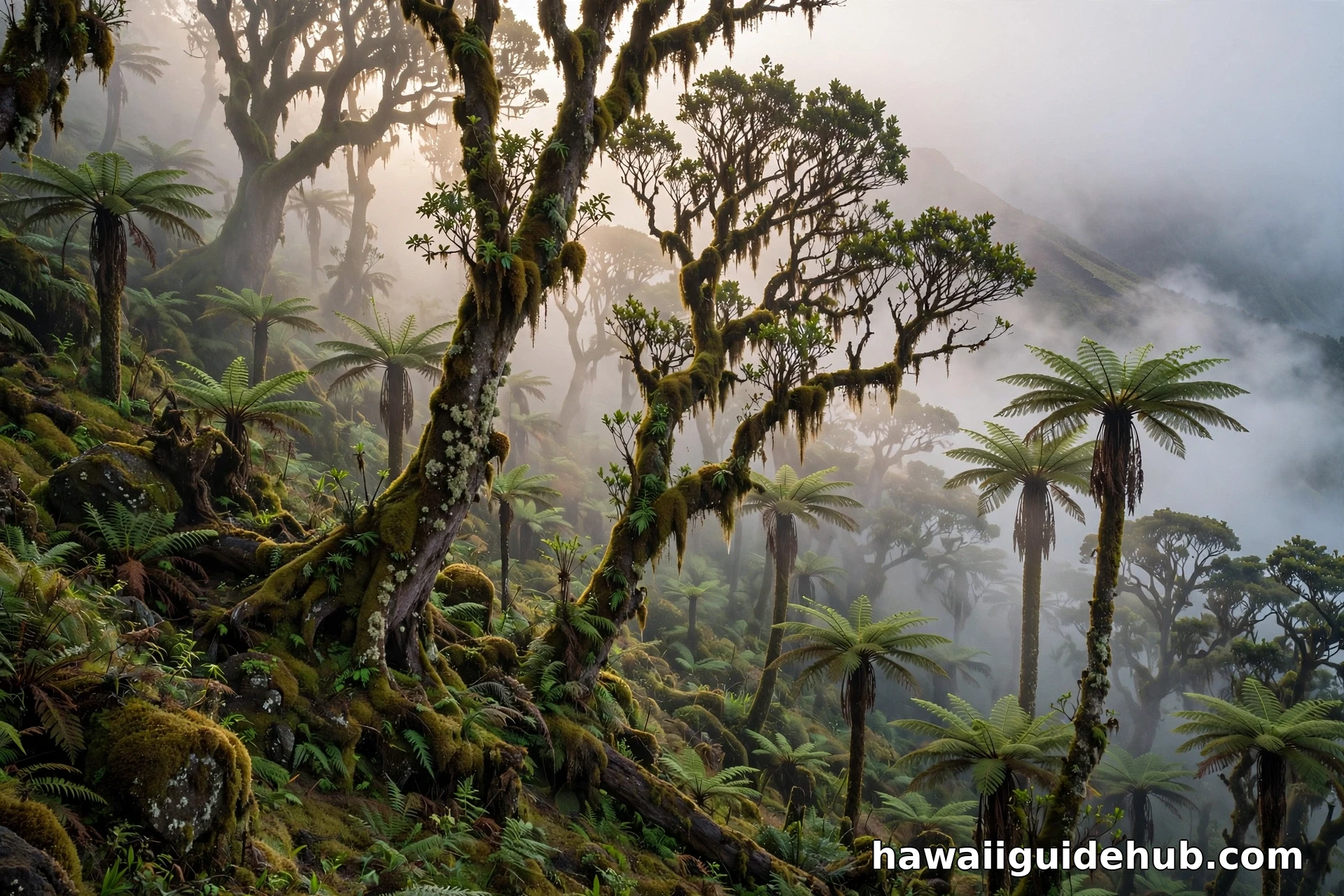
For more than a century, elevation was the honeycreepers’ shield. Mosquitoes cannot thrive in cold air, so forests above roughly 4,000 to 5,000 feet stayed largely malaria-free. Birds that had lost everything below retreated upslope into these high refuges on the Big Island, Maui, and Kauaʻi. That is why the best places to see honeycreepers today are all high: Hakalau Forest National Wildlife Refuge on the slopes of Mauna Kea, Hosmer Grove in Haleakalā National Park at 6,500 feet, and the Alakaʻi Wilderness on Kauaʻi.
Climate change is dismantling that shield. As temperatures rise, mosquitoes climb higher each year into forests that were once too cold for them, and the U.S. Geological Survey has modeled exactly this: malaria transmission expanding upslope and intensifying at lower elevations through the century. On Kauaʻi, where the mountains are lower and the refuge is thinner, the invasion has already been devastating. The birds are, as one conservationist put it, running out of mountain.
Fighting Back: Mosquito Birth Control
The most ambitious rescue effort is also one of the strangest: fighting mosquitoes with mosquitoes. Through the Birds, Not Mosquitoes partnership, biologists are releasing millions of lab-raised male mosquitoes carrying a naturally occurring bacterium called Wolbachia. When these males mate with wild females, the eggs never hatch. Because male mosquitoes do not bite birds or people, the releases harm nothing but the next generation of mosquitoes. Packets of the insects have been dropped by drone and helicopter over the forests of Maui and Kauaʻi, suppressing mosquito numbers and giving birds a chance to recover.
It is not the only tool. Feral pig control reduces the wallows where mosquitoes breed. Predator-proof fencing protects nest sites from rats and cats. Captive-care programs hold insurance populations of the rarest species. And hunters are asked to report bird sightings, since knowing exactly where the last birds live shapes where every dollar of conservation goes. The work is slow and expensive, but it is the first strategy that attacks the disease cycle itself rather than just managing its damage.
Where to See Honeycreepers Responsibly
Seeing a honeycreeper in the wild takes effort, and that is part of what makes it special. The single best experience is a guided tour of Hakalau Forest National Wildlife Refuge on the Big Island, where ʻiʻiwi, ʻapapane, ʻakiapōlāʻau, and ʻākepa feed in old-growth koa and ʻōhiʻa. Access is by permit or with authorized guides, which keeps disturbance low. On Maui, Hosmer Grove in Haleakalā National Park offers a self-guided half-mile loop where ʻiʻiwi, ʻapapane, and ʻamakihi are regulars at 6,500 feet. On Kauaʻi, the trails of Kōkeʻe State Park and the Alakaʻi Swamp can produce ʻapapane and ʻamakihi, though the rarest species there are nearly gone.
Follow the same etiquette birders use everywhere, with extra care because these forests are fragile. Stay on marked trails, since off-trail walking crushes the understory and can spread the fungus that causes Rapid ʻŌhiʻa Death. Clean your boots before and after hikes. Never play recorded bird calls to lure birds out, it stresses them and disrupts feeding. Keep your distance, keep your voice down, and bring binoculars rather than expecting close views. For photography, patience and a long lens beat proximity, and the general principles of wildlife photography apply to forest birds just as they do to whales.
Watch: The ʻIʻiwi in Its Forest
Frequently Asked Questions
Are Hawaiian honeycreepers endangered?
Many are. Of the 17 surviving species, 11 are listed as threatened or endangered. Several more, including the Kauaʻi ʻakikiki and ʻakekeʻe, are on the brink of extinction in the wild.
Why are Hawaiian honeycreepers dying?
The main killer is avian malaria, spread by introduced mosquitoes that arrived in 1826. Native birds evolved without mosquitoes and have almost no immunity. Habitat loss, introduced predators, and climate change pushing mosquitoes to higher elevations compound the problem.
What is the most famous Hawaiian honeycreeper?
The ʻiʻiwi, or scarlet honeycreeper, with its brilliant red plumage and long curved bill. Its feathers were used in royal Hawaiian cloaks, and it is the bird most visitors hope to see.
Where can I see honeycreepers in Hawaii?
Hakalau Forest National Wildlife Refuge on the Big Island (guided access), Hosmer Grove in Haleakalā National Park on Maui, and the high trails of Kōkeʻe State Park on Kauaʻi. All are above 4,000 feet, where mosquitoes are scarce.
Can tourists help save honeycreepers?
Yes. Stay on trails, clean boots to prevent spreading ʻōhiʻa disease, never feed or lure birds, report sightings to refuge staff For more off-the-beaten-path nature, see our guide to Hawaii’s hidden outdoor gems., and support the refuges and conservation groups doing the work. Visiting responsibly shows these forests have value worth protecting.
The honeycreepers are a reminder of what isolation can build and how quickly it can be unraveled. A single finch became more than 50 species; a single mosquito is undoing them. But the forests of Hakalau and Hosmer Grove still ring with ʻapapane song at dawn, and the ʻiʻiwi still flashes scarlet through the ʻōhiʻa. With the mosquito-control work underway, there is a real chance the next generation of visitors will see them too.