Pueo: Hawaii’s Native Owl

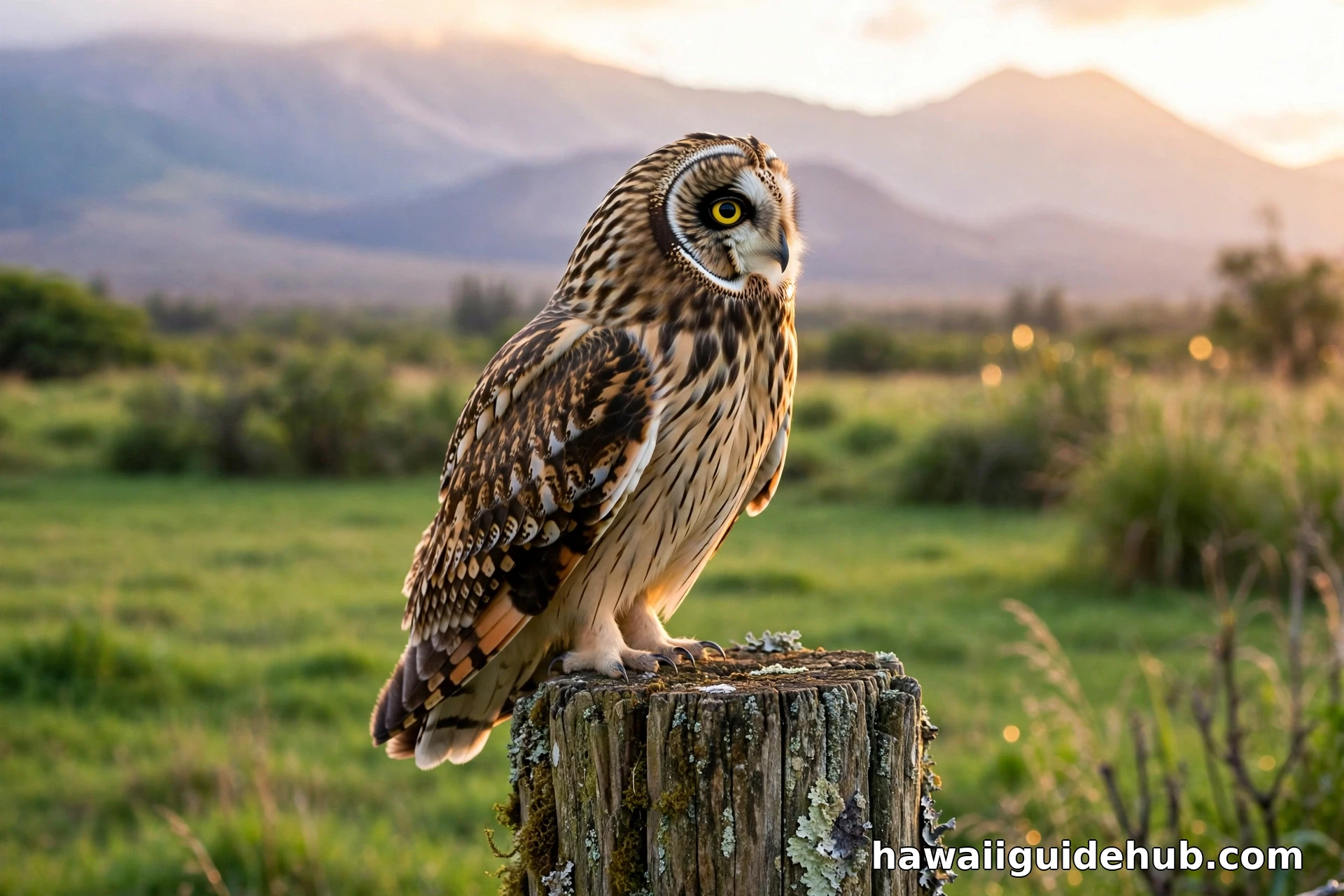
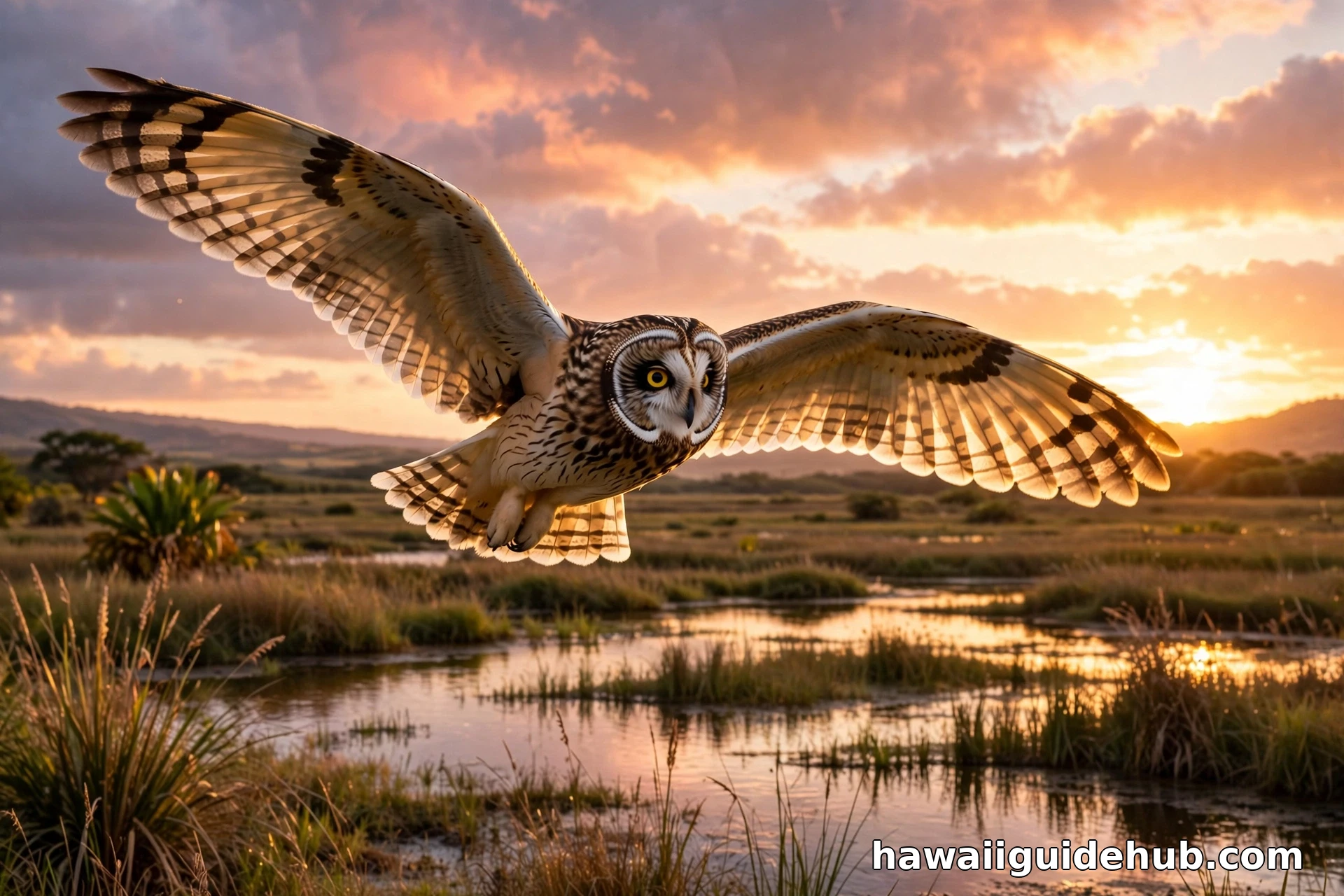
A pueo lifts off from a fence post at the edge of a Maui pasture just before sunset, gliding low over the grass with slow, mothlike wingbeats. Most visitors who see one assume it must be a visitor too, a mainland owl that somehow found its way to the islands. It is not. The pueo is Hawaii’s own owl, an endemic subspecies of the short-eared owl found nowhere else on Earth, and for many Native Hawaiians it is something far more personal: an ʻaumakua, a family guardian whose appearance can feel like a message from ancestors.
This is the single complete guide to the pueo, the Hawaiian owl. It covers how to identify one, where it lives in the islands, why it hunts in daylight when most owls do not, the threats that have made it endangered on Oahu, its deep place in Hawaiian culture, and how visitors can see one responsibly. If you have been searching for anything about the pueo Hawaiian owl, the answers are all here on this one page.
Pueo at a Glance
| THE BIRD | |
| Common name | Pueo (Hawaiian short-eared owl) |
| Scientific name | Asio flammeus sandwichensis |
| Size | About 13 to 15 inches tall, wingspan around 3 feet |
| Range | All main Hawaiian islands, sea level to 8,000 feet |
| Diet | Rodents, insects, small birds |
| THE SURPRISE | |
| Active | Mostly diurnal: hunts daytimes, especially dawn and dusk |
| Nests | On the ground, in shallow scrapes in grass |
| THE STATUS | |
| Endemic status | Endemic subspecies of the short-eared owl |
| Conservation | Endangered on Oʻahu under state law |
| THE CULTURE | |
| Cultural role | ʻAumakua (family guardian) in Hawaiian culture |
What a Pueo Is
The pueo is a subspecies of the short-eared owl, a species that circles the globe across North America, Europe, Asia, and the Pacific. The Hawaiian form, Asio flammeus sandwichensis, split from its mainland relatives after a small number of owls reached the islands, likely carried in by storms. Fossil and genetic evidence suggests they established themselves in Hawaii after the first Polynesians arrived, which is remarkably recent in evolutionary terms, and the pueo is now found nowhere else in the world.
In the field, a pueo is a medium-sized, chunky owl with mottled brown and buff plumage, pale streaking on the chest, bright yellow eyes, and a rounded facial disk marked by dark patches around the eyes. It flies with deep, buoyant wingbeats, often hovering briefly like a kestrel before dropping onto prey. The most useful clue for telling a pueo from the barn owl, the other owl you may see in Hawaii, is behavior and build. Barn owls were introduced to the islands in the late 1950s and early 1960s as a form of rodent control for sugar plantations, and they are now common. The barn owl is slimmer, paler below, with a heart-shaped white face and a habit of hunting at night. The pueo is darker, stockier, hunts by day, and shows those dark eye patches. If you see an owl cruising over a pasture in broad daylight, it is almost certainly a pueo.
Where Pueo Live: Habitat and Range
Pueo are remarkably flexible birds. They occupy grasslands, shrublands, pastures, agricultural fields, open forest, and even urban edges from sea level up to about 8,000 feet, and they have been recorded on all of the main Hawaiian Islands except Niʻihau. The strongest populations are on the Big Island and Maui, where wide-open grasslands and ranch country give them ideal hunting ground. On Oahu, the population has shrunk sharply, with The Pueo Project, a study run by the University of Hawaii at Manoa together with the state Department of Land and Natural Resources, estimating roughly 807 individual birds on the island.
For visitors, the best-known pueo watching spots are the lowland wetlands and pastures. On Maui, Kanahā Pond State Wildlife Sanctuary near Kahului has hosted nesting pairs that researchers have studied for years, and Keālia Pond National Wildlife Refuge on the south shore is another reliable place to scan the skies at dawn and dusk. On the Big Island, the open ranchlands along Saddle Road between Mauna Kea and Mauna Loa regularly produce daytime sightings. On Oahu, where the birds are scarce, patient watchers sometimes find them over the grasslands of Kalaeloa or the central plateau. Early morning and late afternoon, when prey is active, are the best times.
Daytime Hunters: Behavior and Diet
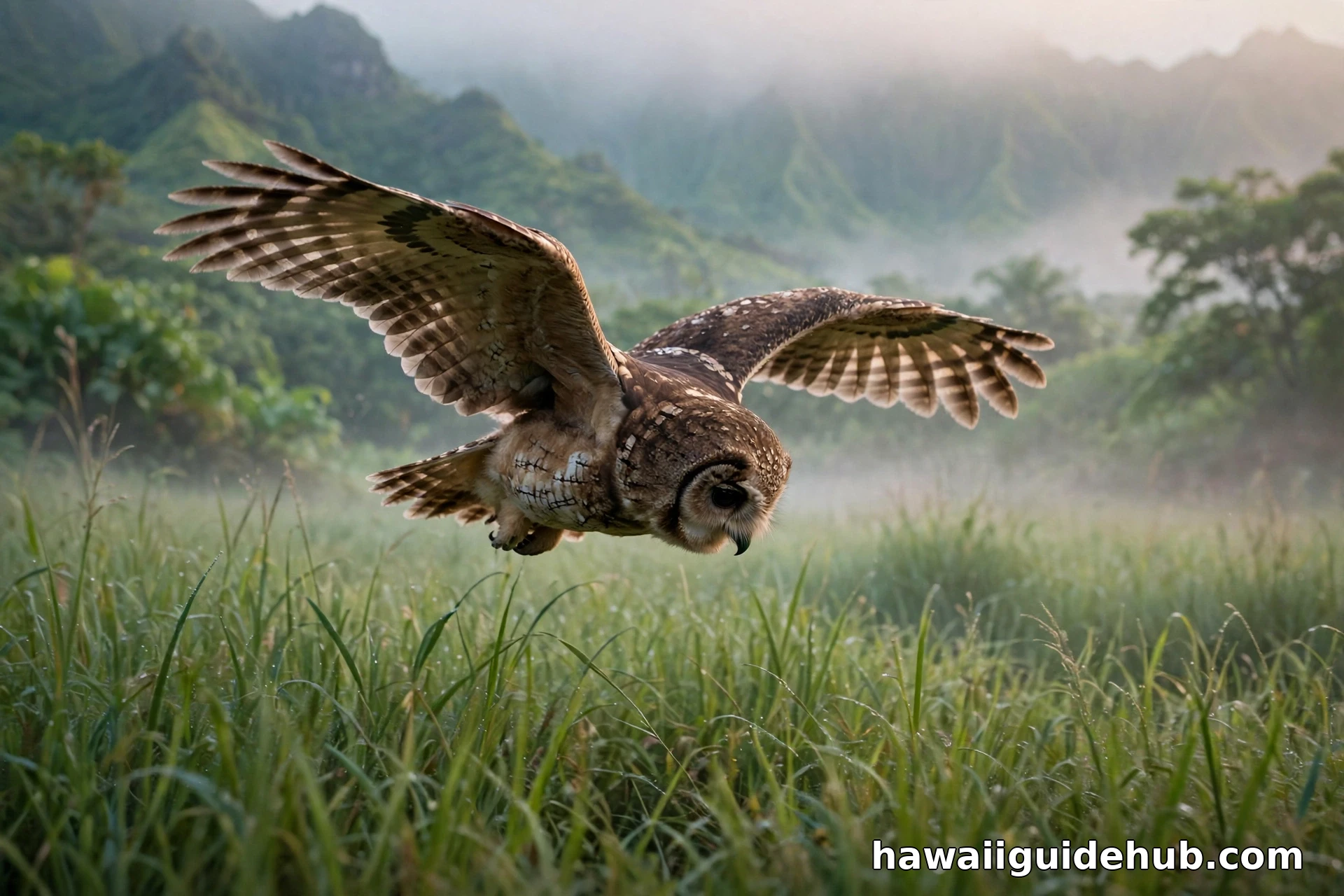
Unlike most owls, pueo are primarily diurnal, meaning they hunt in daylight. This habit is one of the easiest ways to find them: look for a large bird quartering low over a field, wings raised in a shallow V, pausing to hover before dropping. Studies of pueo pellets and nests show a varied diet of introduced rats and mice, insects, and small birds, with some researchers noting they may also take the native Hawaiian hoary bat and small reptiles. As the only native raptor breeding on most of the islands, the pueo fills an important ecological role, keeping rodent numbers in check across grasslands and farms.
That role comes with competition. The introduced barn owl hunts the same rodents but at night, and researchers have found that the two species can compete for nest sites and food. Vehicle collisions are another serious hazard: a statewide assessment published in the Journal of Field Ornithology in 2026 found that traffic strikes are a leading cause of pueo deaths, with owls foraging along roadsides where rodents are easy to catch. Some birds also showed signs of parasites, emaciation, or suspected exposure to rodenticides, reminding researchers that pueo mortality is complex and that systematic study is still needed.
Breeding: Ground Nests Hidden in the Grass
A pueo nest is almost invisible by design. The female builds a simple scrape on the ground, lining it with grasses and soft feather down, and tucks it into dense grass or low shrubs. Nests have been found in every month of the year, though most breeding happens in the spring and summer. She typically lays three to six eggs, which hatch asynchronously over several days, and she does all the incubating and brooding. The male feeds her and defends the nest, and both parents feed the chicks for roughly two months after they fledge.
Before nesting, males put on one of the most entertaining courtship displays in the bird world. In what researchers call a sky dance, the male climbs high and then plunges downward, clapping his wings together with audible snaps, then rising again to repeat the routine. If you are watching grasslands in the spring and see an owl suddenly launch into acrobatic dives, you are watching a pueo advertising for a mate.
Conservation: Endangered on Oahu
The pueo’s conservation story is split by island. Statewide, the subspecies is ranked as imperiled by NatureServe, and in 2005 the state listed it as endangered on Oahu under Hawaii Administrative Rules, where development has eaten into the open grasslands the owls need. On the Big Island and Maui, populations are thought to be healthier, though no statewide population estimate has been completed and researchers call a full assessment a critical next step.
The threats are a familiar list for Hawaiian wildlife. Habitat loss to development and dense invasive grasses is the largest long-term pressure. Ground nests are vulnerable to feral cats, dogs, rats, and mongooses, which take eggs and chicks. Vehicles kill foraging owls along roadsides. Historically, shooting also took a toll. Federal listing under the Endangered Species Act has been requested by the state legislature but has not happened, so the pueo’s legal protections come from state law, which prohibits harming the birds or disturbing their nests.
Conservation work focuses on the practical: protecting open grassland habitat, managing predators around known nest sites, and studying the birds better. The Pueo Project’s radio-tracking and survey work on Oahu gave managers their first real picture of where the island’s remaining birds roost, forage, and nest, and community reporting of sightings continues to feed that picture. For travelers, the takeaway is simple: staying on trails and roads, keeping dogs leashed in grassland areas, and reporting sightings to researchers all genuinely help.
Pueo in Hawaiian Culture
No animal in Hawaii carries more personal meaning than the pueo. In Native Hawaiian tradition, the pueo is one of the best-known forms taken by ʻaumākua, ancestral guardians who watch over their families. An encounter with a pueo can be read as guidance, protection, or a warning, and many families tell stories of a pueo appearing at moments of danger or grief. The bird is woven through chants and legends, including the moʻolelo of Pueo-Nui-Akea, an owl deity believed to restore life to wandering souls, and the Maui legend of Pueonuiokona, who rescued two boys from a sorcerer at Keālia Pond.
This reverence is why the pueo feels different from other wildlife in Hawaii. Seeing one is often treated as a spiritual event rather than a birding tick. Visitors should respect that. Admire from a distance, keep your voice down if others are watching quietly, and understand that for the people around you, this may be a family guardian, not just a photo opportunity. The cultural significance of animals in Hawaiian tradition runs deep across many species, and the pueo sits at the heart of it.
How to See a Pueo Responsibly
You do not need a tour or a special permit to see a pueo. Drive the open ranch country of the Big Island or Maui in the hour after sunrise or the hour before sunset, pull safely off the road, and scan the fence lines and pasture edges. Pueo often perch on fence posts, dead trees, and low mounds between hunting flights. At wildlife refuges like Keālia Pond or Kanahā Pond, stay on the marked trails and use the viewing platforms.
A few rules keep your sighting safe for the owl. Never approach a nest or flush a bird from a perch; ground-nesting owls are easily stressed, and a flushed bird may reveal its nest to predators. Keep dogs leashed anywhere near grassland. Drive slowly on rural roads at dawn and dusk, since vehicle strikes are a documented killer of pueo. If you photograph one, a long lens and patience beat getting close, and wildlife photography basics like steady support and quiet movement apply just as well to owls as to whales.
Watch: Pueo Hunting in Hawaii
Frequently Asked Questions
Is the pueo native to Hawaii?
Yes. The pueo is an endemic subspecies of the short-eared owl, Asio flammeus sandwichensis, found only in Hawaii. Evidence suggests it colonized the islands after the first Polynesians arrived, making it one of the most recently established native birds in the archipelago.
Are pueo endangered?
The pueo is listed as endangered on Oahu under state law, where its population has declined to an estimated 807 birds. On other islands, such as the Big Island and Maui, populations appear healthier, but no complete statewide census exists.
What is the difference between a pueo and a barn owl?
The pueo is Hawaii’s native owl: darker, stockier, with dark patches around yellow eyes, and it hunts in daylight. The barn owl was introduced in the late 1950s and early 1960s for rodent control, is slimmer and paler with a heart-shaped white face, and hunts at night.
Where is the best place to see a pueo?
The open grasslands and ranch country of the Big Island and Maui offer the best odds, especially at dawn and dusk. Kanahā Pond and Keālia Pond on Maui are well-known viewing spots. On Oahu, sightings are rare because the population is small.
What do pueo eat?
Pueo eat mainly introduced rats and mice, along with insects and small birds. As the only native raptor on most islands, they play an important role in controlling rodent populations.
Why is the pueo important in Hawaiian culture?
The pueo is one of the most famous forms of ʻaumakua, ancestral family guardians, in Hawaiian culture. Encounters with pueo are often seen as guidance or protection from ancestors, and the bird appears in many chants and legends.
The pueo is one of those Hawaiian animals that rewards a slower pace. Slow down on a country road at golden hour, keep your eyes on the fence posts, and you may be met by yellow eyes looking back. Whether you read it as a wildlife sighting or a visit from a guardian, it is a moment most visitors remember long after they leave the islands.