Hawaii’s Cloud Forest Ecosystem: Where the Forest Drinks Fog

High in Hawaii’s mountains there is a forest that drinks fog. The trade winds pile clouds against the peaks, and the trees comb the mist out of the air: water condensing on leaves and moss, dripping to the forest floor in a rain that never falls from the sky. This is the montane cloud forest, one of the rarest ecosystems on Earth, and in Hawaii it is the last refuge of the honeycreepers, the stronghold of the ohia, and the birthplace of the islands’ fresh water.
This is the single complete guide to Hawaii’s cloud forest ecosystem. It explains what a cloud forest is, how fog drip works, the Alakai and other cloud forests, the vertical layers, the birds and plants, the threats, visiting responsibly, and FAQs. Everything about Hawaii’s cloud forest ecosystem lives on this one page.
What a Cloud Forest Is
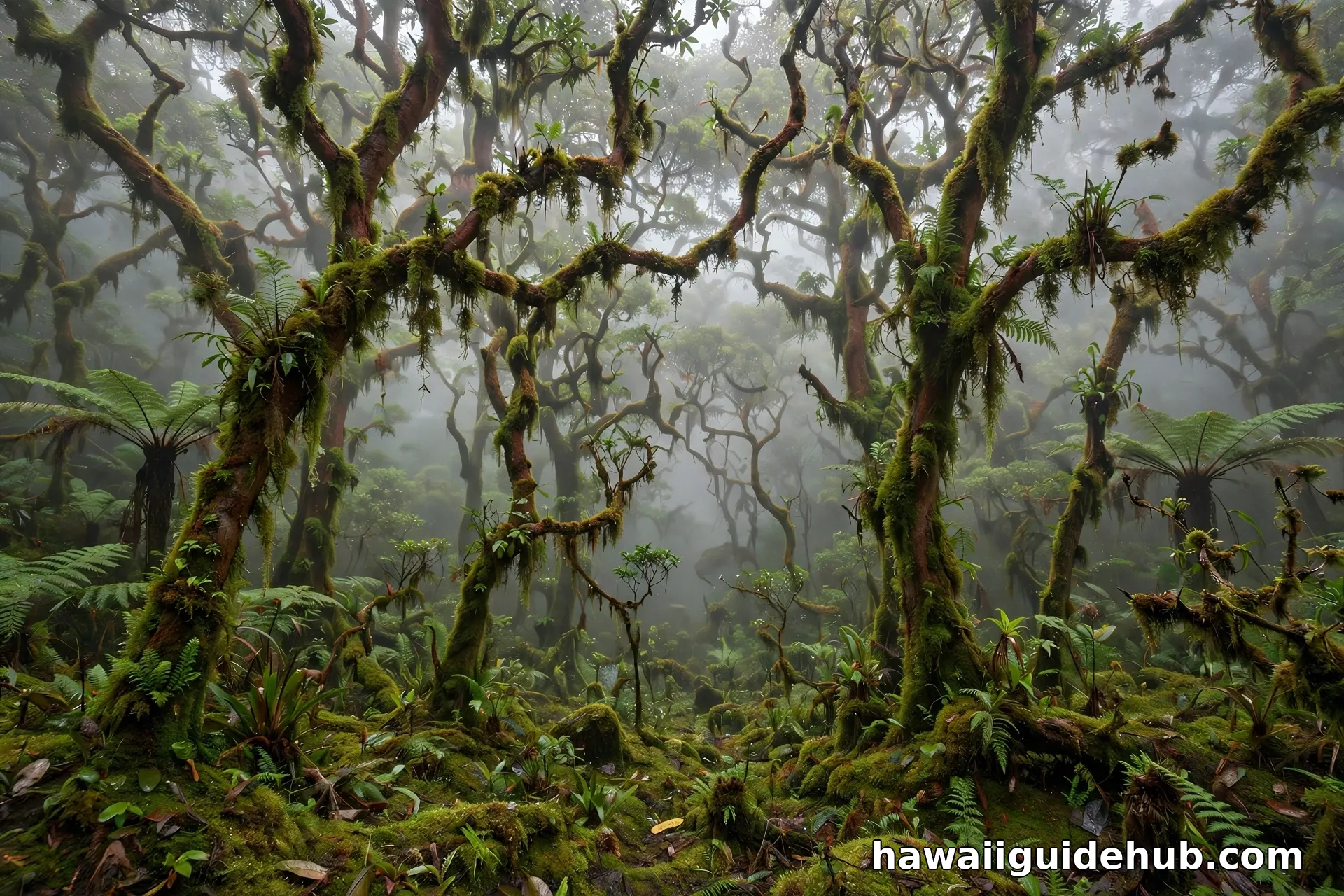
A cloud forest is a high-elevation tropical forest wrapped in persistent fog. In Hawaii they form where the trade-wind clouds stack against the mountains, roughly 3,000 to 5,500 feet: the Alakai Wilderness Preserve on Kauai, the summit plateau of Mt. Kaala on Oahu, the windward slopes of Haleakala and West Maui, and the Hamakua and Kohala mountains on the Big Island. Cloud forests cover less than 1 percent of Earth’s land surface, and Hawaii’s are among the most isolated examples: entire communities of mosses, ferns, and birds that exist on one island and nowhere else.
Fog Drip: Rain That Never Falls
The signature process is cloud-water interception. As fog moves through the canopy, droplets collide with leaves, branches, and moss, coalesce, and drip to the ground: measurable precipitation that no rain gauge in the open would catch. In some Hawaiian cloud forests, fog drip contributes a substantial fraction of total water input, effectively increasing rainfall by a fifth or more during the drier months. The forest is a giant comb, and the mosses are the teeth: sphagnum and other mosses hold many times their weight in water, releasing it slowly. This is why the old Hawaiian saying runs that the rain follows the forest: remove the trees, and the fog passes through uncombed, and the streams below run dry.
Cloud Forest Layers: A Vertical Tour
| Layer | What lives there | What it does |
| Emergent ohia crowns | Tallest ohia, 60-80 ft, wind-sculpted | First fog contact; honeycreeper foraging |
| Canopy | Ohia, koa, lapalapa | Main fog comb; shades the layers below |
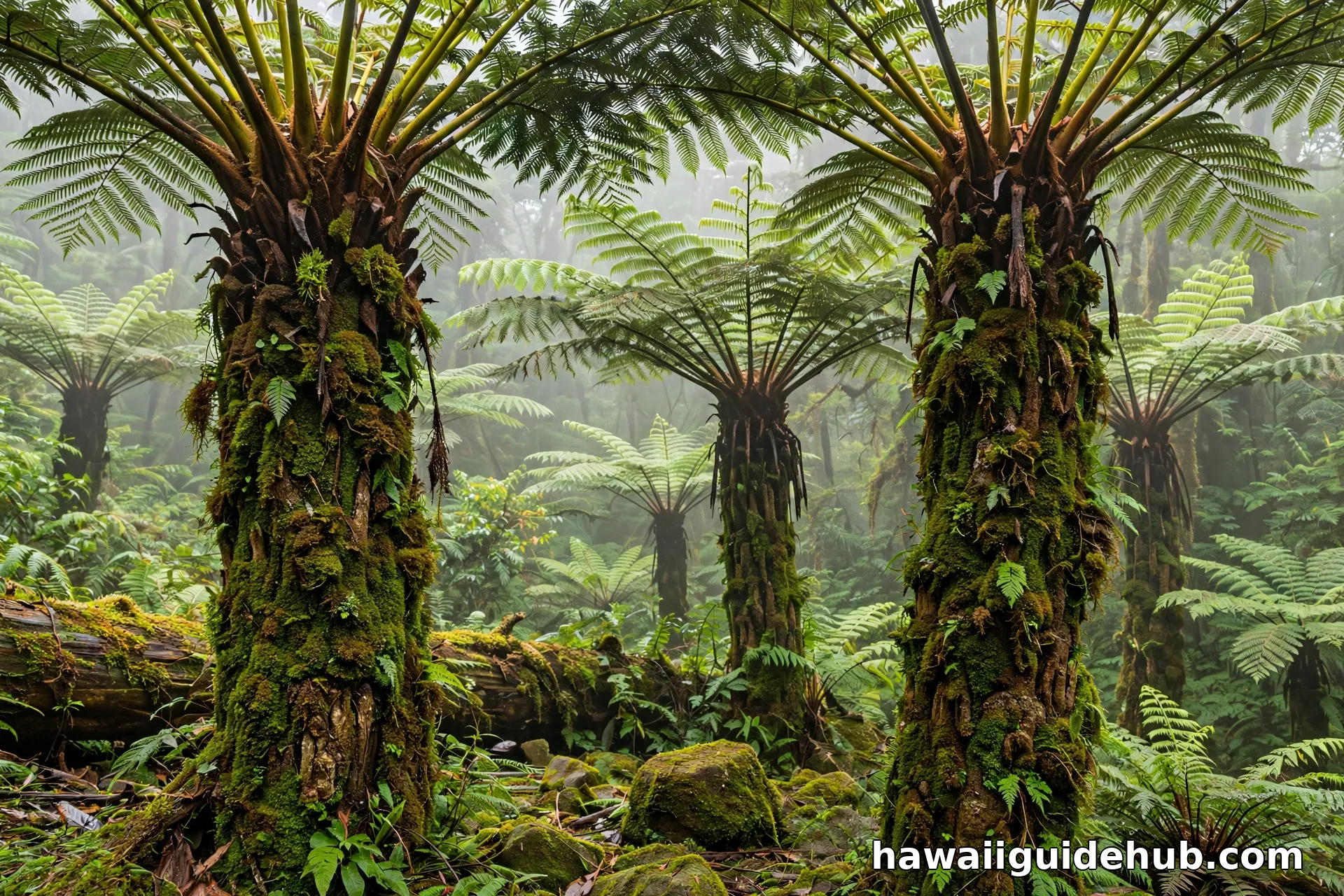
| Hapuu midstory | Hawaiian tree ferns, 10-30 ft | Trunk-fiber sponges; fern nurseries for seedlings |
| Epiphyte zone | Mosses, liverworts, filmy ferns on bark | Water storage; snail and insect habitat |
| Forest floor and bog | Sedges, sundews, dwarf ohia in bogs | Slow-release reservoir feeding the streams |
The Alakai: The Greatest of Them
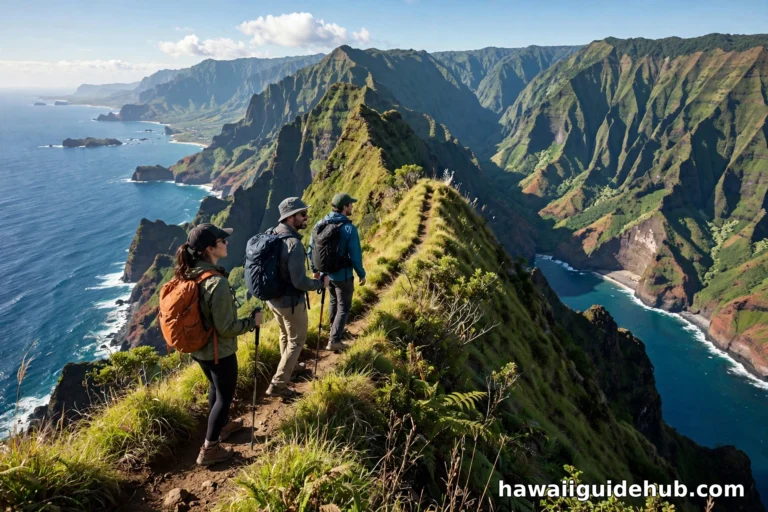
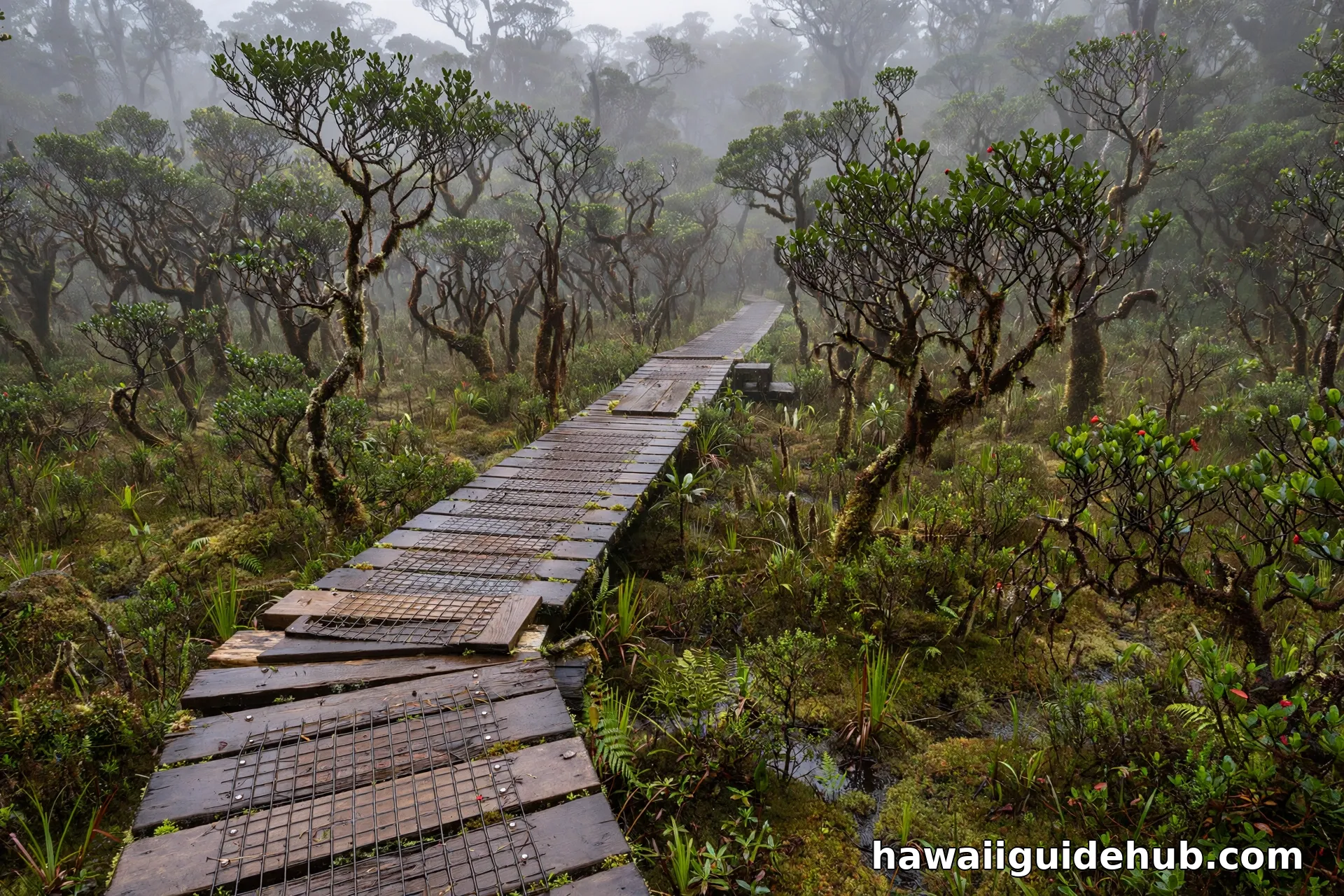
The Alakai Wilderness Preserve on Kauai, some 10,000 acres of plateau atop the island’s ancient shield, is Hawaii’s finest cloud forest and one of the wettest places on Earth: Mt. Waialeale, at its edge, averages around 450 inches of rain a year, among the highest recorded on the planet. The Alakai is a mosaic of stunted ohia forest, bogs dotted with carnivorous sundews, and stream corridors, and it holds the densest surviving populations of Kauai’s honeycreepers: apapane, iiwi, amakihi, anianiau, and the critically endangered akikiki and akekee. The Pihea-Alakai boardwalk trail lets visitors walk through it without sinking: a wooden path over the bog, with views to the Na Pali coast. Our Waimea Canyon guide covers the trailhead logistics.
Birds in the Mist
The cloud forest is the honeycreepers’ fortress. Avian malaria rules the lowlands, so the surviving birds live where the mosquitoes cannot: the cool, misty heights. The apapane’s scarlet flashes through the ohia blossoms; the iiwi’s curved bill probes the flowers; the tiny anianiau gleans insects. Dawn in the Alakai is a chorus found nowhere else on Earth. But the fortress is shrinking: warming pushes the mosquito line uphill, and the birds have no higher ground left on some islands. The cloud forest is not just beautiful; it is the last defensible terrain in an extinction war.
Threats: Pigs, Guava, and a Fungus
Feral pigs are the bulldozers: rooting churns the moss, spreads weeds, and creates mosquito-breeding wallows in the forest interior. Strawberry guava forms impenetrable thickets that shade out natives. And Rapid Ohia Death, the fungal disease killing ohia statewide, threatens the canopy tree the whole system is built on: lose the ohia, and the fog comb breaks, the birds lose their flowers, and the watershed loses its engine. Management is fences, pig removal, guava control, and strict boot-cleaning to slow the fungus. The cloud forest’s threats are all, ultimately, about disconnection: breaking the links between fog, tree, bird, and stream.
Visiting the Cloud Forest
Go prepared: this is not a beach hike. Trails are muddy year-round, temperatures run 50 to 65 degrees, and rain is the default weather: bring waterproof boots, rain gear, and warm layers. The Alakai’s Pihea trail and boardwalk are the classic experience on Kauai; on Oahu, the Mt. Kaala boardwalk; on the Big Island, the Makaula-Ooma Trail near Kona winds through hapuu cloud forest. Stay on the boardwalks and trails: the bog vegetation is fragile and the moss takes decades to recover from a footprint. Clean boots before and after: you are walking through the watershed that supplies the islands’ drinking water. For more Kauai planning, see our Kauai guide and Manoa Falls guide for a lower-elevation rainforest contrast.
The Bogs: Carnivorous Plants at 4,000 Feet
Inside the Alakai, the forest opens into bogs: flat, waterlogged clearings where the ohia shrink to bonsai and the ground belongs to specialists. Hawaiian sundews glisten with sticky traps, digesting insects to supplement the bog’s poor nutrients. Sedges and dwarf shrubs form a springy mat that quakes underfoot, which is why the boardwalk exists. These montane bogs are among the rarest plant communities in Hawaii, and they are exquisitely sensitive: a single off-trail footstep compresses the peat and damages decades of slow growth. Walk the boards, look closely at the sundews, and step nowhere else.
Mt. Kaala: Oahu’s Cloud Forest Island
Oahu’s highest peak, Mt. Kaala at 4,025 feet, holds the island’s best cloud forest: a summit plateau of stunted ohia, native lobelioids, and bog, reached by a steep 7-mile round-trip trail with a boardwalk at the top. It is a sky island in miniature, an entire cloud forest ecosystem compressed onto one summit, with species found nowhere else. The military installation at the summit shares the plateau, a strange juxtaposition of radar domes and rare plants. For Oahu visitors who cannot reach Kauai, Kaala is the cloud forest experience: mist, moss, and the feeling of standing on top of the trade-wind clouds.
The Watershed Math: Why Forests Are Infrastructure
Hawaii’s fresh water begins in the cloud forest, and the economics are staggering. The forests receive, filter, and store the water that feeds every stream, well, and faucet: studies of Hawaiian watersheds consistently show that forested watersheds yield far more reliable water than deforested ones. The DLNR’s watershed partnerships, which fence and manage the upland forests across the islands, exist because protecting the forest is cheaper than replacing the water: desalination or new wells cost orders of magnitude more than fencing pigs out of the Alakai. When the film says the rain follows the forest, it is describing a water utility that runs on moss and fog, and every hiker’s boots are walking through the treatment plant.
Rapid Ohia Death: The Fungus in the Room
The cloud forest’s canopy tree is under attack. Rapid Ohia Death, caused by two Ceratocystis fungi, kills ohia quickly: crown browning, then death, sometimes within weeks. First detected on the Big Island, it has spread to Kauai, Maui, and Oahu. In the cloud forest the stakes are existential: ohia is the fog comb, the honeycreeper’s flower, the watershed’s engine. There is no cure; management is containment: do not move ohia wood, clean tools and boots, and report dying ohia. The disease is why every trailhead now has boot-brush stations, and why your five minutes with the brush genuinely matters.
A Cloud Forest Morning: What to Expect
Arrive at the Alakai trailhead by 8 AM, when the birds are loudest and the mist is thinnest. The Pihea Trail drops and climbs along the rim with Na Pali views, then the boardwalk section crosses the bog proper: stunted ohia, sundews, silence except for water and birdsong. You will be damp within minutes regardless of rain: the fog condenses on everything. Temperatures hover in the 50s and 60s; the wind is constant. Bring twice the water you think you need, because the humidity deceives. And when the clouds part for a moment and the Kalalau Valley drops away below the bog, you will understand why people call this the finest walk in Hawaii.
The Mosses: The Forest’s Hidden Majority
Visitors look at the trees; botanists look at the moss. Hawaii’s cloud forests host extraordinary bryophyte diversity: mosses, liverworts, and hornworts coating every trunk, branch, and rock, many of them endemic. The moss layer is the fog comb’s finest mesh, the water battery, and the nursery: ohia and lobelioid seedlings germinate in moss mats on fallen logs. Some Hawaiian mosses are found on a single mountain. They are the least studied and most threatened layer of the forest, sensitive to drying as the climate warms. The cloud forest’s famous birds get the documentaries; the mosses do the plumbing.
Why the Cloud Forest Feels Prehistoric
There is a reason the cloud forest feels like a lost world: in evolutionary terms, it nearly is. The lineages here diverged millions of years ago and survived while their lowland relatives vanished; the hapuu ferns are ancient, the lobelioids are relicts, the honeycreepers are the last of a radiation. Walking the Alakai is walking through a community that assembled before humans existed and is now held together by conservation wire: fences, boot brushes, mosquito control. It feels prehistoric because it is a survivor, and like all survivors, it deserves more than admiration. It deserves the watershed partnerships, the funding, and the clean boots.
Watch: The Rain Follows the Forest
Hawaii Cloud Forest FAQs
Where is Hawaii’s cloud forest?
The finest is the Alakai Wilderness Preserve on Kauai, plus Mt. Kaala on Oahu, upper Haleakala and West Maui, and the Hamakua/Kohala mountains on the Big Island. All sit roughly 3,000 to 5,500 feet, where the trade-wind clouds pile up.
What is fog drip?
Water the forest harvests directly from fog: droplets collide with leaves and moss, coalesce, and drip to the ground. It is real, measurable precipitation that never fell as rain, and in some cloud forests it adds substantially to the water budget.
Why do honeycreepers live in the cloud forest?
Mosquitoes carrying avian malaria cannot survive the cool high elevations, so the cloud forest is a disease-free refuge. Warming is pushing mosquitoes uphill, shrinking the refuge: the birds’ last stronghold is under siege.
Can beginners hike the Alakai?
The boardwalk section is manageable for fit beginners, but it is muddy, cool, and remote: 3.8 miles round trip with 800 feet of gain on the Pihea route. Waterproof boots and rain gear are essential, not optional.
What is the wettest place in Hawaii?
Mt. Waialeale on Kauai, at the edge of the Alakai, averaging around 450 inches of rain per year: among the wettest spots ever measured on Earth. The summit itself is usually hidden in cloud.
The Forest That Makes the Water
Hawaii’s cloud forest is infrastructure disguised as wilderness: every faucet on the islands runs, eventually, on fog combed out of the air by ohia leaves and moss. It is also the last address of birds that exist nowhere else, and a bog full of carnivorous plants at the wettest place on Earth. Walk the Alakai boardwalk in the mist, listen for the apapane, and remember the saying: the rain follows the forest. Protect the forest, and the water follows. It is the simplest and most important equation in Hawaii.