Hawaii’s Dry Forest Ecosystem: The Endangered Other Half

When people picture Hawaiian forest, they see rainforest: dripping green, waterfalls, mist. But half of Hawaii’s original forest was the opposite: dry, open woodland of strange bottle-shaped trees with orange flowers, growing on young lava in the rain shadow. The Hawaiian dry forest is among the most endangered ecosystems in the United States, with an estimated 90-plus percent of it gone. This guide explains what it is, what lives in it, why it nearly vanished, and the restoration projects bringing it back.
This is the single complete guide to Hawaii’s dry forest ecosystem. It covers what defines a dry forest, the signature trees, dry forest versus rainforest, why it collapsed, the Auwahi and Kaupulehu restoration projects, where to see remnant dry forest, and FAQs. Everything about Hawaii’s dry forest ecosystem lives on this one page.
What Makes a Dry Forest
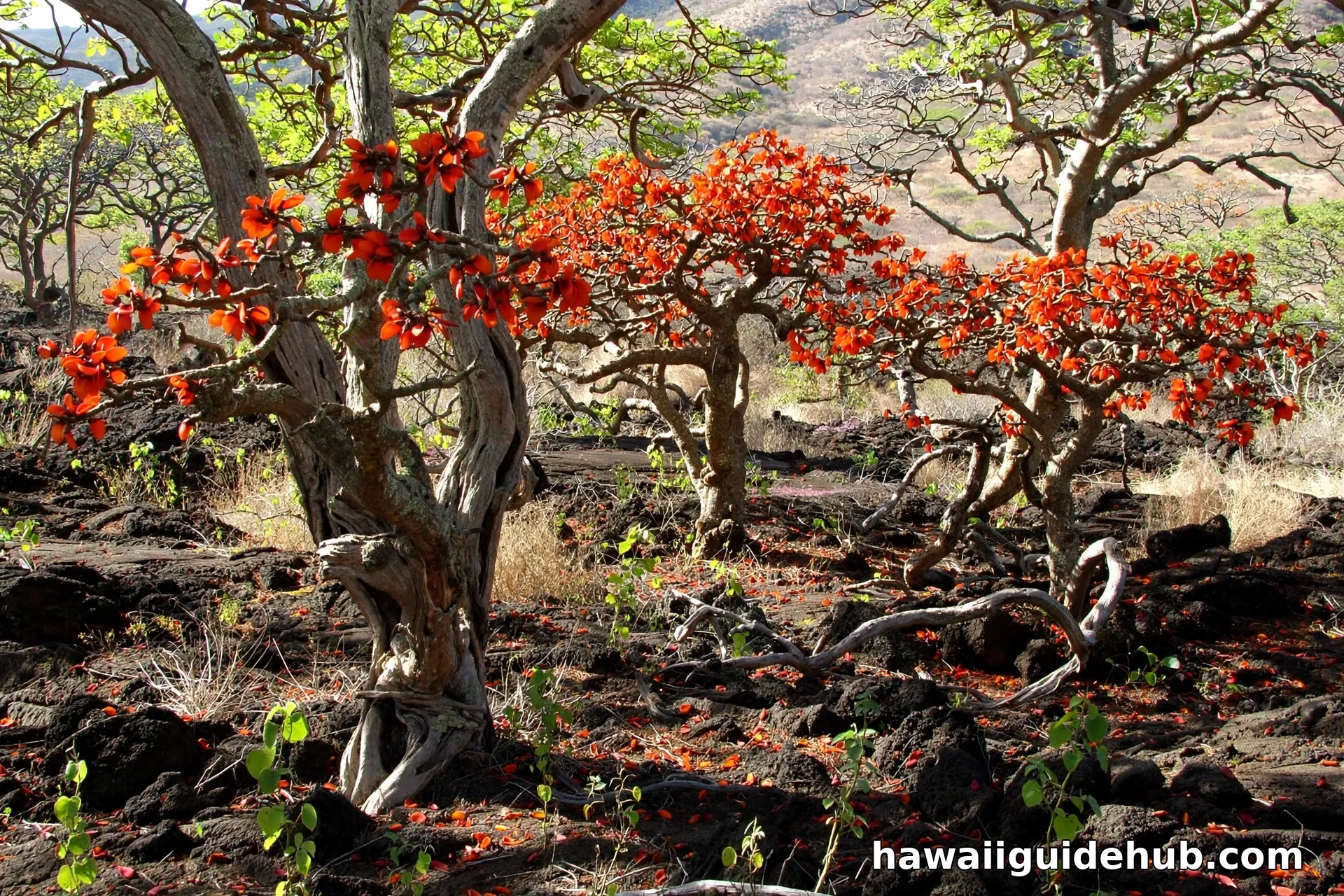
Dry forests grow where the rain shadow wins: leeward slopes receiving as little as 10 to 25 inches of rain a year, on porous young lava that drains fast. The trees adapt with swagger: the wiliwili (Erythrina sandwicensis) swells its trunk to store water, drops its leaves in drought, and erupts in orange-red flowers on bare branches. Lama (Diospyros sandwicensis), olopua, alahee, and the fragrant iliahi (sandalwood) fill out the canopy, which stays open and sun-dappled rather than closed and dark. The ground layer is sparse native shrubs and grasses, or at least it was before the invaders arrived.
Dry Forest vs Rainforest: The Other Hawaii
| Feature | Dry forest | Rainforest |
| Rainfall | 10-25 in/yr, leeward slopes | 100-400 in/yr, windward slopes |
| Canopy | Open, 15-40 ft, sun-dappled | Closed, 60-100 ft, dark floor |
| Signature trees | Wiliwili, lama, olopua, iliahi | Ohia, koa, tree ferns |
| Fire | Natural cycle; now catastrophically frequent | Historically rare |
| Remaining | ~5-10% of original, per conservation estimates | Far more intact, though fragmented |
| Where to see it | Auwahi (Maui), Kaupulehu (Big Island) | Manoa, Alakai, windward valleys |
How 95 Percent Disappeared
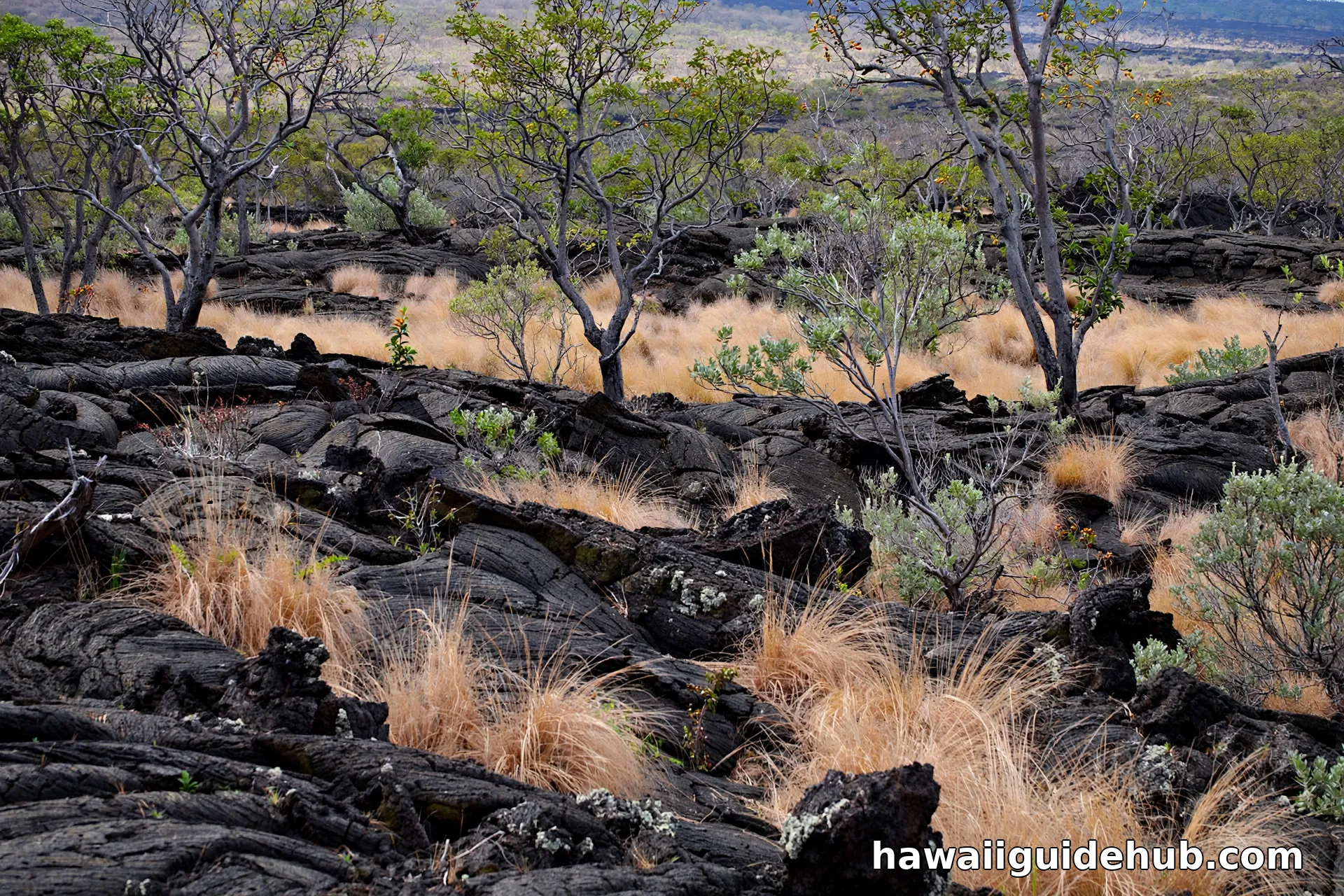
The collapse had four drivers. First, clearing: sandalwood was harvested to near-extinction in the early 1800s for the China trade, and cattle ranching converted vast dry forest to pasture. Second, ungulates: goats, pigs, sheep, and axis deer eat seedlings and strip bark, preventing any regeneration; a forest that cannot recruit seedlings is a forest with an expiration date. Third, fire: fountain grass, introduced as an ornamental, creates a continuous fuel bed that burns hot and often, and native dry-forest trees are not fire-adapted. Fourth, development: low-elevation dry forest sits exactly where resorts and subdivisions want to be. On Maui, an estimated 95 percent of the dry forest was destroyed, per conservation surveys; statewide, roughly a tenth or less remains, much of it on young aa lava flows that were too harsh to ranch or build on.
Auwahi: The Forest Coming Back
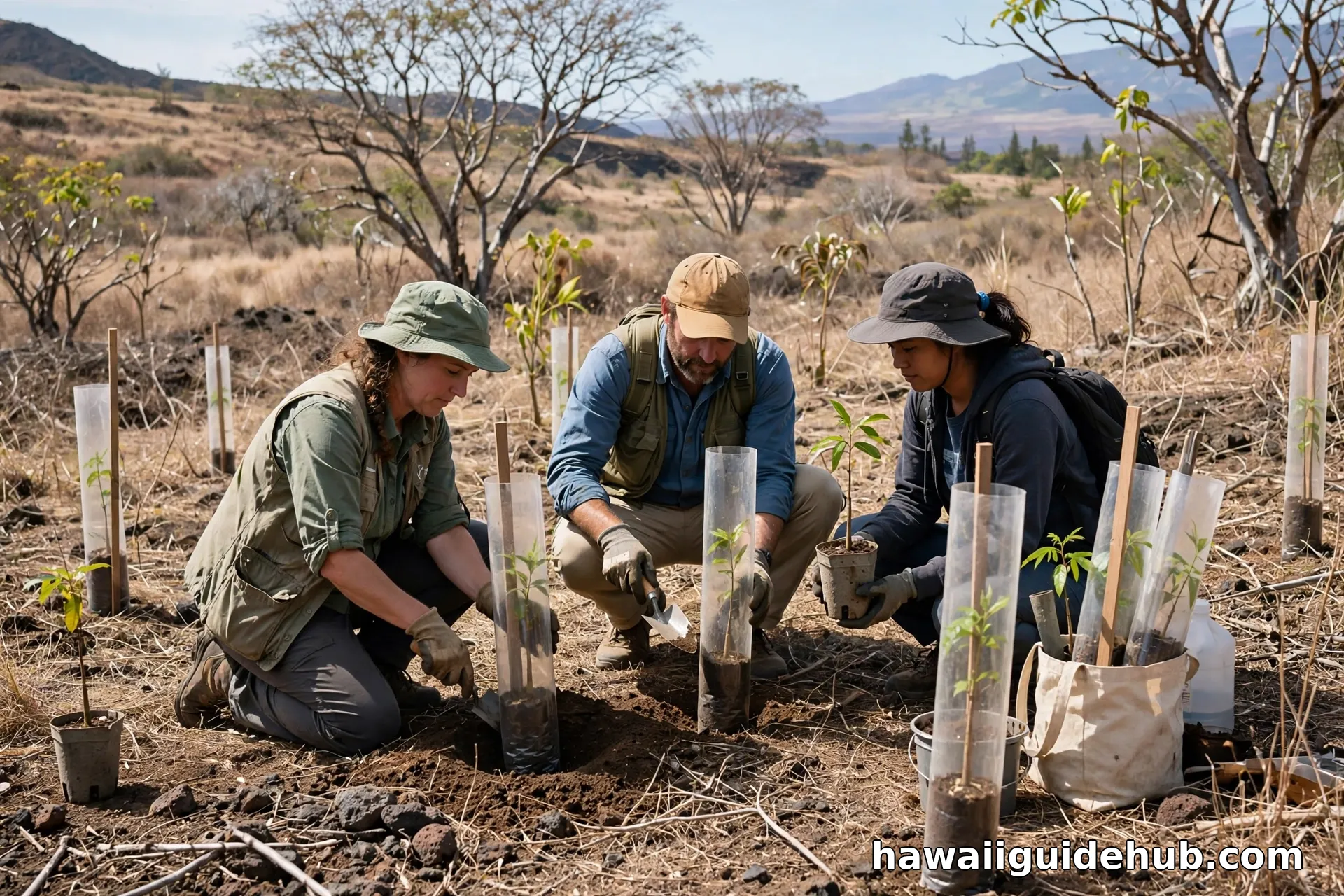
On the leeward slopes of Haleakala at Ulupalakua Ranch, the Auwahi Dryland Forest Restoration Project has spent over two decades proving dry forest can return. The method: fence out the ungulates, remove the invasive grasses, plant aalii as a nurse species to shade out weeds, then interplant dozens of native species. Monthly volunteer workdays plant saplings and gather seed. More than 50 native species grow in the Auwahi region, including endangered ones, and the project has become the model for dry forest restoration statewide. It is also a cultural project: linking Hawaiian crafts, silviculture, and watershed restoration. Visitors can join workdays: it is the most hands-on conservation experience in Hawaii.
Kaupulehu and Waikoloa: The Big Island Strongholds
On the Big Island’s Kona coast, the Kaupulehu dry forest reserve has been the research home of dry forest science for decades: USDA Forest Service studies there showed that fountain grass invasion, not just native planting, determines restoration success, and that fire control is the prerequisite for everything else. Nearby, the Waikoloa Dry Forest Preserve has restored 275 acres of endemic dryland forest and runs public tours. Together they protect some of the finest remaining lowland dry forest in the state: wiliwili groves, lama stands, and the endangered plants that grow nowhere else. Combine a visit with the volcano parks for the full Big Island ecology arc.
Fire: The New Normal
The 2023 Lahaina fire burned through former dry forest and agricultural land, and it was not an anomaly: the grass-fire cycle is intensifying across the leeward sides. Fountain grass cures in the dry season into perfect tinder; each fire kills more native trees and opens more ground for grass, a ratchet that only turns one way without intervention. Restoration now means firebreaks, fuel management, and replanting with fire-resilient natives. For visitors, the practical notes are simple: obey all fire restrictions, never park on dry grass, and report smoke immediately. The dry forest’s future will be decided as much by fire management as by planting.
The Trees: Meet the Dry Forest Cast
Learn the cast and the forest starts to read like a story. Wiliwili is the show-off: swollen water-storing trunk, orange bloom on bare branches, wood so light Hawaiians carved it into surfboards and floats. Lama is the quiet one: dark, dense, sacred wood, once used for temple construction, now one of the commonest survivors. Olopua has hard, dark wood prized for digging sticks and weapons. Alahee bears fragrant white flowers. And iliahi, the sandalwood, is the ghost: harvested nearly to extinction in the early 1800s when chiefs traded it to American and European ships for the China market, its sweet oil worth fortunes. The sandalwood rush stripped the dry forests first and taught the islands what overexploitation looks like, a century before the word existed.
Birds of the Dry Forest
The dry forest was bird country too. Before the mosquitoes, honeycreepers and other forest birds ranged from the mountaintops to the sea, and the leeward dry forests were part of their world. The Auwahi project explicitly aims to bring birds back: its goals include hosting native birds that retreated to the rainy windward forests to escape avian malaria. As restoration matures and mosquito control advances, the dry forest could become bird habitat again. Imagine the wiliwili blooming with iiwi working the flowers, as they did for millennia before the ships came. That is the long game the restoration is playing.
Sandalwood: The Trade That Started the Collapse
The iliahi story deserves its own telling because it was Hawaii’s first resource boom and bust. In the 1810s and 1820s, sandalwood was Hawaii’s currency: chiefs levied commoners to cut it, ships filled their holds, and the fragrant wood sailed to Canton. Within two decades the accessible stands were gone, the labor demands had disrupted taro farming, and the islands had their first lesson in extraction economics. The dry forest never recovered its sandalwood component; iliahi persists as scattered individuals, and restoration plantings are slowly reintroducing it. When you see a young iliahi in a restoration tube at Auwahi, you are looking at a species being replanted two centuries after it was cashed in.
The Fire-Grass Cycle, Explained
The mechanism killing the dry forest is a feedback loop, and it is worth understanding because it operates across the leeward islands. Step one: fountain grass and other invasive grasses invade open ground. Step two: they cure in the dry season into continuous fine fuel. Step three: ignition, human or lightning, starts a grass fire far hotter and more frequent than anything the native trees evolved with. Step four: the fire kills native trees and shrubs but the grass re-sprouts within weeks. Step five: more grass, more fuel, more fire. Each cycle ratchets the ecosystem toward pure grassland. Breaking it requires removing the grass, replanting natives dense enough to shade it out, and maintaining firebreaks: exactly what Auwahi and Kaupulehu do, acre by acre.
How to Help: Beyond the Workday
Joining a workday is the best option, but not the only one. Donate to the restoration organizations: fencing, herbicide, and seedlings cost real money, and the projects run on grants and gifts. If you own or manage land in the dry zone, plant natives: wiliwili, aalii, and lama are all available from native plant nurseries and make spectacular, drought-proof landscaping. Report wildfires immediately and respect all burn bans. And spread the word that Hawaii has a dry forest at all: most visitors never learn it exists, and an ecosystem nobody knows about is an ecosystem nobody defends.
The Understory: What the Grass Replaced
Before the grasses, the dry forest floor was a garden of natives: pili grass, the thatch grass Hawaiians used for houses; shrubs like aalii with its winged seed capsules; and a carpet of ferns and herbs after rains. The native ground layer was discontinuous, patchy enough to starve fires of fuel. That patchiness was the fire defense, and the invasive grasses destroyed it by filling every gap. Restoration’s unglamorous core is re-creating that patchiness: planting aalii and shrubs densely enough to shade out grass, then letting the native ground layer reassemble. It is slow, weedy, hands-and-knees work, and it is the difference between a forest and a fuel bed.
A Dry Forest Itinerary
Plan a dry forest day on Maui: morning at Auwahi for a volunteer workday or guided walk, lunch in Ulupalakua, afternoon descending to the leeward coast to see remnant wiliwili on old lava flows. On the Big Island: morning at the Waikoloa Dry Forest Preserve tour, afternoon at Kaupulehu’s coastline, sunset over the dry forest’s ocean edge. Go in the dry season for the stark beauty, or after winter rains when the forest briefly greens and the wiliwili prepare to bloom. Either way, you will see the Hawaii almost nobody sees: the other half of the islands’ forests, hanging on and coming back.
Watch: Ola Ka Honua, the Auwahi Story
Hawaii Dry Forest FAQs
What is a wiliwili tree?
Erythrina sandwicensis, the signature tree of Hawaiian dry forests: a swollen-trunked tree that stores water, drops leaves in drought, and blooms orange-red on bare branches. Its light wood was used for surfboards, fishnet floats, and outrigger canoe parts.
How much Hawaiian dry forest is left?
Conservation estimates put it around 5 to 10 percent of the original extent, making it one of the most endangered ecosystems in the United States. Most survivors cling to young lava flows too harsh for ranching or development.
Can you visit a dry forest restoration project?
Yes. Auwahi on Maui runs monthly volunteer workdays open to the public, and the Waikoloa Dry Forest Preserve on the Big Island offers tours. Both are working restoration sites: you plant, weed, and learn, not just look.
Why does fountain grass matter?
It is the ecosystem’s arsonist: an introduced grass that forms continuous fuel beds, burns far hotter and more often than native vegetation, and re-sprouts after fire while native trees die. Research at Kaupulehu identified it as the largest current threat to the dry forest.
Is the dry forest worth seeing compared to the rainforest?
Absolutely, and it is rarer. The rainforest is lush and easy to love; the dry forest is strange, subtle, and nearly gone. Seeing wiliwili bloom on black lava, with almost no other visitors around, is one of Hawaii’s most distinctive nature experiences. For the island context, see our Kauai guide and Haleakala guide.
The Forest That Refuses to Die
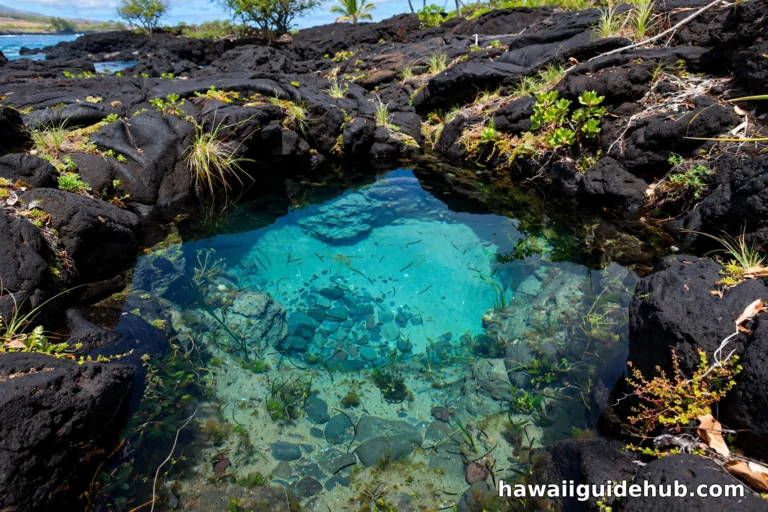
Hawaii’s dry forest survived the sandalwood trade, the cattle, the goats, the grass, and the fires, reduced to fragments on lava too harsh to use. Now, on fenced and weeded acres at Auwahi and Kaupulehu, it is coming back: wiliwili blooming, seedlings recruiting, birds returning to places they had abandoned. It will never be what it was; too much is gone. But the restoration proves the ecosystem remembers how to be a forest, given fences, fire control, and people willing to plant. Go see it while it is still rare, and consider joining a workday. The dry forest does not need your admiration. It needs your hands. Restoration crews plant native seedlings in protective tubes across the lava fields, and every surviving tree is a small victory against centuries of grazing.