Hawaii Beach Access Laws: Your Right to Every Shore

There are no private beaches in Hawaii. It does not matter how expensive the resort is, how tall the fence looks, or how confident the security guard sounds: every beach in Hawaii is public seaward of the shoreline, and you have a legal right to walk along it. This is one of the most visitor-friendly laws in America, and it is rooted in the Hawaii Constitution, state statutes, and more than a century of court decisions. This guide explains Hawaii’s beach access laws in plain language: where the public beach starts and ends, how you are allowed to reach it, what counts as illegal blocking, and what it all means for your trip.
A quick note on confidence: this article summarizes public laws and court rulings for travelers. It is not legal advice, and if you are in a genuine dispute with a landowner, the right move is to contact the county or the DLNR rather than argue on the sand.
The Short Answer: Every Beach Is Public
In Hawaii, the land from the water up to the shoreline belongs to the public, held in trust by the state for everyone’s use. That means you can swim, sunbathe, fish, and walk along the beach in front of any hotel, resort, or private home. Nobody can own the beach itself, and nobody can charge you to stand on it. What private owners do own is the land behind the beach, and that distinction is where most confusion, and most conflict, comes from.
This is very different from many mainland states, where private ownership can run all the way to the waterline and “private beach” signs carry real legal weight. Visitors arriving from the mainland often assume the same rules apply in Hawaii and obediently turn away from a guard’s wave. Understanding the law before you go means you will never surrender a beach that is rightfully yours to enjoy.
Where the Public Beach Starts and Ends
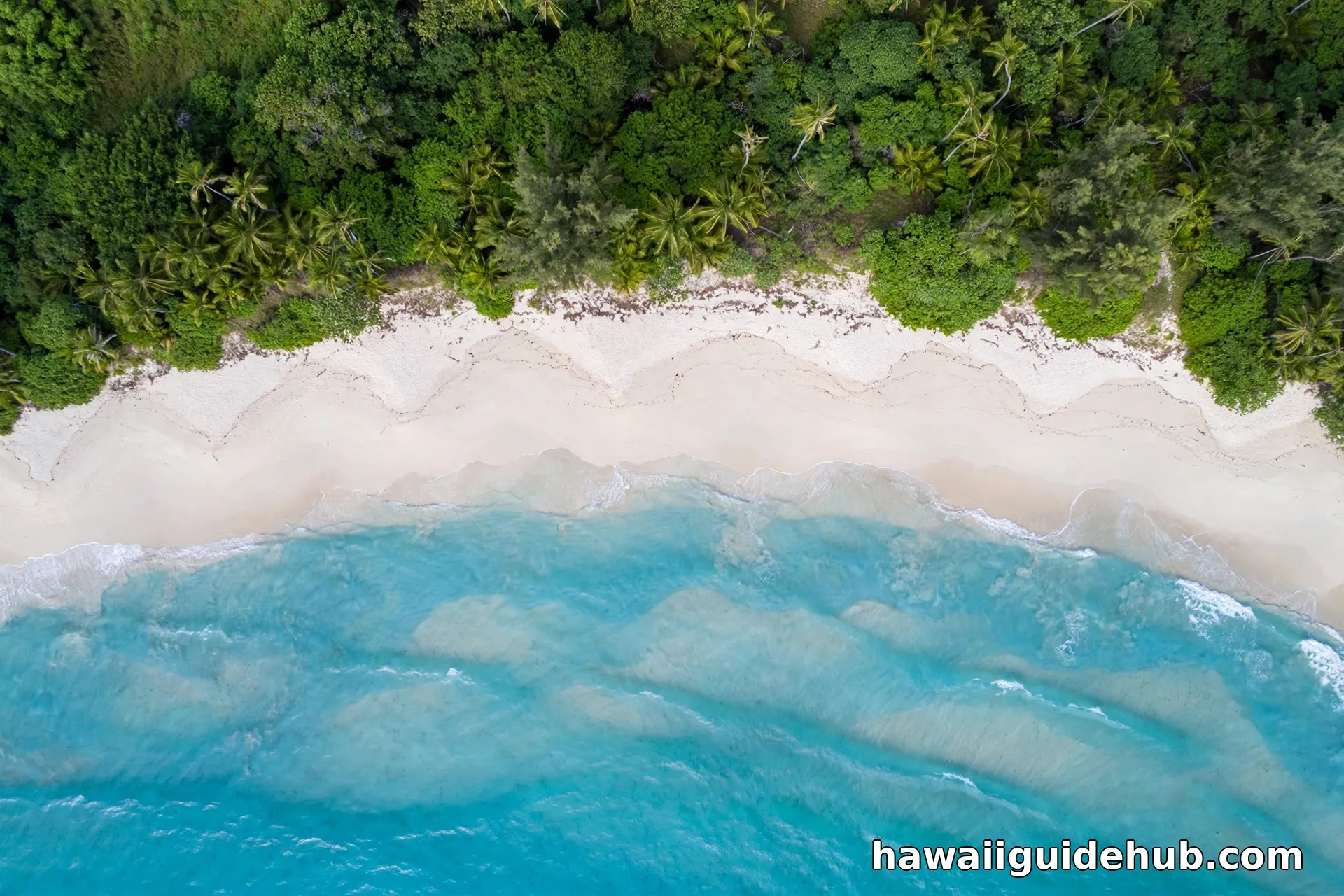
The legal boundary is called the shoreline, and Hawaii defines it by nature, not by a surveyor’s line. Under state law, the shoreline is the upper reaches of the wash of the waves at high tide during the season of the highest surf, usually shown by the edge of vegetation growth or the upper line of debris left by the waves. In practice, that is the line where the sand meets the plants. Everything makai, or seaward, of that line is public. Everything mauka, or inland, of it can be private.
This definition was not invented by legislators. It grew out of Hawaii’s courts, which held as far back as the 1960s that long public use of the beaches had ripened into a customary right, and that public policy favors extending public ownership of the shoreline as far as reasonably possible. The Hawaii Constitution now enshrines the public trust doctrine: the state holds these lands in trust for the people, and it cannot give that trust away. Land seaward of the shoreline belongs to all of us, permanently.
In practice, the exact shoreline for a given property is settled by a certified shoreline survey, reviewed by the DLNR, because coasts move. Erosion eats beaches, storms redraw them, and sea level rise is steadily pushing the vegetation line inland, which means the public beach is slowly growing at the expense of private lots. Landowners have fought this for decades, including a notable court battle over newly accreted land in Maunalua Bay, where the courts confirmed that new beach land belongs to the public. For visitors, the takeaway is simple: when in doubt, the vegetation line is your guide, and the tie goes to the public.
Your Right to Walk the Entire Shoreline
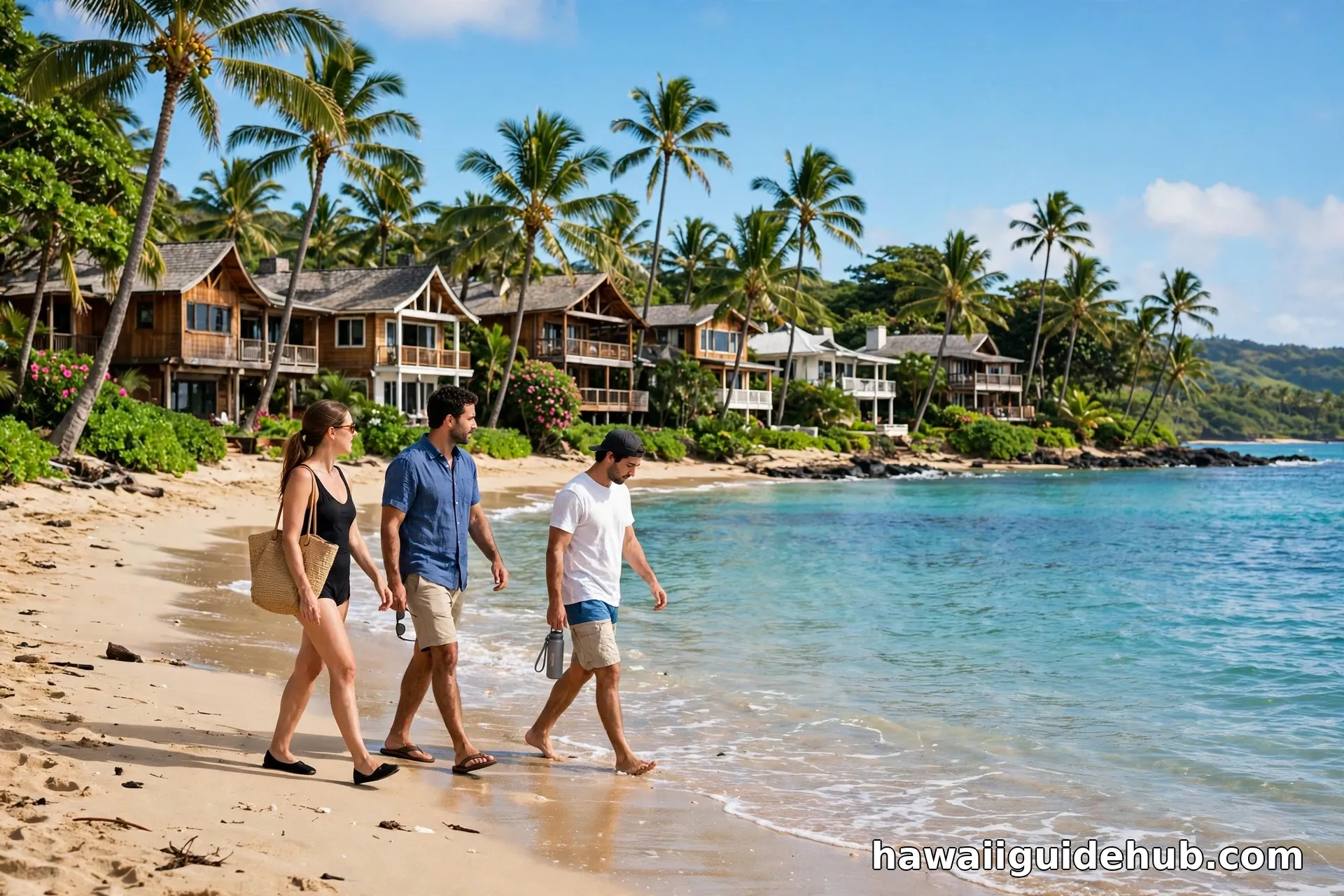
Your rights do not stop at swimming and sunbathing. Hawaii law expressly guarantees the right of transit along the shoreline: you may walk the full length of the coast, passing in front of resorts, condos, and private estates, as long as you stay seaward of the shoreline. The law calls this strip the beach transit corridor, and it exists along the entire shore. A guard who tells you the beach in front of a hotel is “for guests only” is describing a policy the law does not recognize.
Where cliffs or terrain make it unsafe to walk below private property lines, the counties can establish public transit corridors along the inland edge of those properties, at least six feet wide. That six-foot minimum is the only place Hawaii law puts a number on your right of way, and it exists precisely so that no stretch of coast becomes a dead end.
How You Are Allowed to Reach the Beach
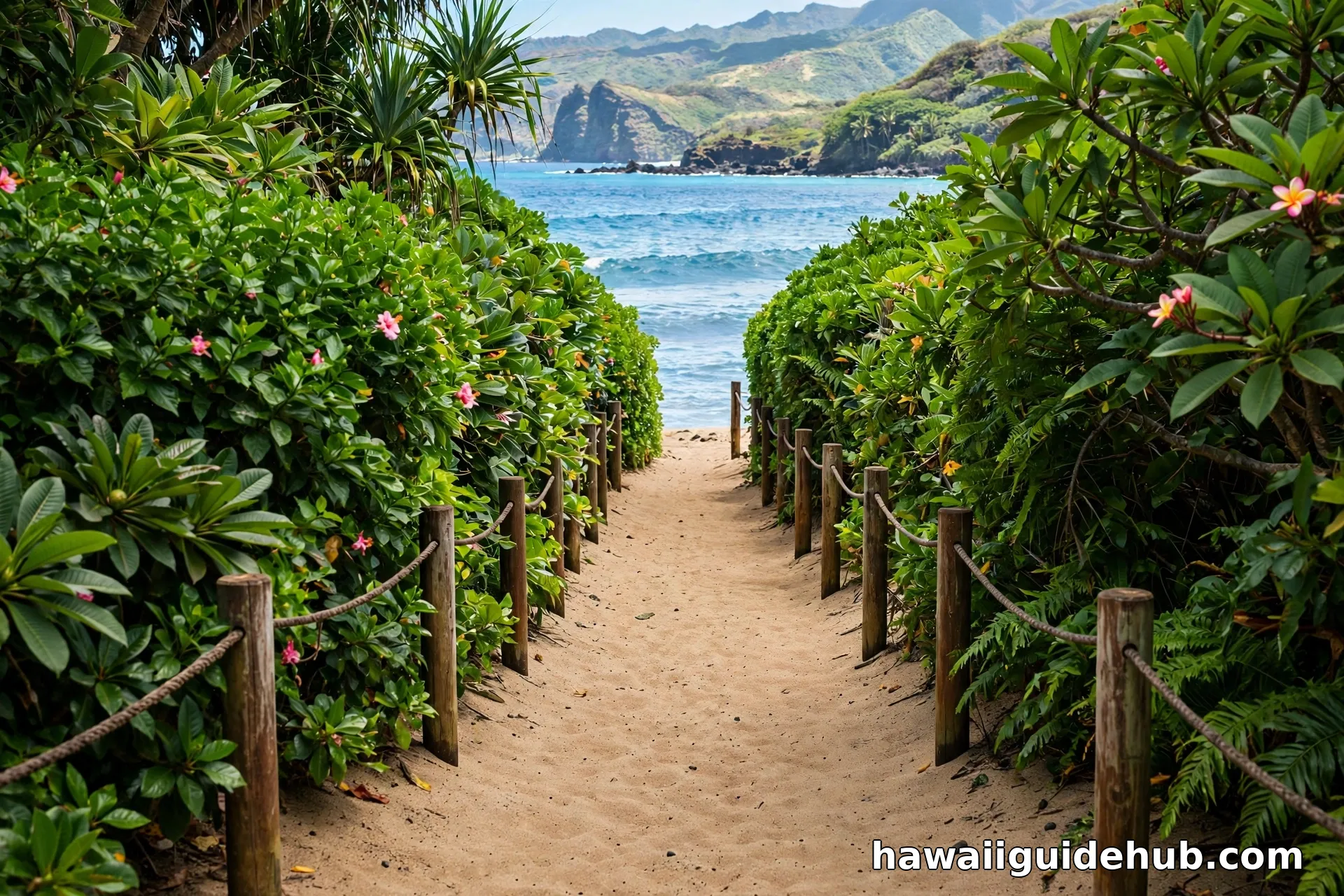
Here is the part visitors most often get wrong. Your right to be on the beach does not include a right to cross private land to get there. You cannot cut through a resort lobby, a condo parking lot, or someone’s yard to reach the sand. Instead, Hawaii requires the counties to provide public rights-of-way to the shoreline at reasonable intervals, and to buy land for access paths where none exist. In practice, this means marked public beach access paths, like the sandy trail in the photo below, that thread between properties to the shore.
When you arrive at an unfamiliar beach, look for the access signs rather than improvising. Counties maintain these paths, and using them keeps you clearly within your rights. Parking is the other half of access: a beach can be legally public but practically unreachable if there is nowhere to leave your car, so check parking before you commit to a remote stretch of coast. Our Poʻipū guide and Hanalei Bay guide both note where the public access points are on Kauaʻi.
What Counts as Illegal Blocking
Hawaii does not just declare your rights; it criminalizes interfering with them. Under state law, a person commits the offense of obstructing access to public property if they intentionally prevent the public from crossing a right-of-way, a transit area, or a beach transit corridor to reach the sea or shoreline. The law lists examples: gates, fences, walls, constructed barriers, rubbish, security guards, and guard dogs. It also covers visual intimidation, such as “no trespassing” signs meant to suggest the beach is private, and even a landowner’s overgrown vegetation that creeps across the corridor.
Vegetation deserves special attention because it is the most common quiet form of blocking. Some landowners plant dense hedges right up to, or past, the shoreline to make the public corridor impassable. The law answers this directly: the DLNR can require an abutting landowner to remove vegetation that interferes with a beach transit corridor. And enforcement is not left to the state alone. Hawaii gives any aggrieved person a private right of action to sue for an injunction against blocked access, with attorney’s fees for the prevailing party, after giving the responsible party thirty days’ written notice.
None of this means you should personally confront a landowner. If you encounter a blocked access path or a guard turning people away from a public beach, document it calmly and report it to the county planning department or the DLNR. They are the agencies with the authority to act, and public reports are how blocked paths get reopened.
What This Means for Your Trip
For most visitors, these laws translate into simple, happy facts. You can walk the beach in front of any Waikīkī hotel. You can snorkel the reef in front of a luxury resort on the North Shore and sit on the sand there afterward. You can stroll for miles along a coastline that passes nothing but private estates and never once trespass. The beach is yours as much as anyone’s, and that is true on every island.
A few courtesies keep the system working. Stay seaward of the vegetation line so you are unambiguously on public land. Do not set up camp chairs or coolers on private lawns above the beach. Keep noise down near homes in the early morning. And remember that some shorelines sit inside military bases, wildlife refuges, or cultural sites with their own access rules; the public-trust shoreline right does not override a closed federal installation or a protected nesting area. When a beach has an official closure sign from a government agency, respect it.
It also helps to know what the law does not give you. Nobody owes you parking, restrooms, or lifeguards on a remote public beach. Commercial activity on the sand, like surf schools and chair rentals, is regulated separately, and recent enforcement in Waikīkī has cracked down on vendors who preset rows of empty chairs to claim space. If a vendor tells you to move from a spot on the public sand, you are within your rights to stay, but a calm word beats a confrontation every time. Finally, drones, dogs, and campfires each have their own rules on the beach, so check those before you combine activities.
A Short History of Beach Access Fights
These rights were not handed down peacefully. On Kauaʻi, the county council has repeatedly confronted developers over blocked paths to beaches like Anini. On Oʻahu, luxury homeowners have planted vegetation walls and posted guards, and in Waikīkī the state has issued cease-and-desist orders against hotels whose commercial setups swallowed public sand. Each fight has ended the same way: the law reaffirmed, the path reopened, the beach returned to everyone. The pattern is worth knowing because it tells you how seriously Hawaii takes this. When a landowner tests the boundary, the boundary holds.
Beach Access FAQs
Are there any private beaches in Hawaii?
No. Every beach in Hawaii is public seaward of the shoreline. A resort can own the land behind the beach, but never the beach itself.
Can a hotel stop me from walking past it on the beach?
No. Hawaii law guarantees the right of transit along the shoreline, and the beach transit corridor in front of any hotel is public.
Can I cut through a resort to reach the beach?
No. Your rights cover the beach, not the private property behind it. Use the marked public beach access paths instead.
What should I do if someone blocks my access to a beach?
Do not argue on the spot. Note the location, take photos if it is safe, and report it to the county planning department or the DLNR, which can order the obstruction removed.
Where exactly does the public beach end?
At the shoreline: the upper reach of the waves at high tide, usually marked by the vegetation line or the debris line. Stay seaward of it and you are on public land.
Can landowners build seawalls that shrink the beach?
Seawalls and shoreline hardening are heavily regulated under the coastal zone management law precisely because they destroy public beaches. New seawalls on the shoreline face strict scrutiny, and illegal ones have been ordered removed.
Does the law protect access on all four main islands?
Yes. HRS Chapter 115 applies statewide, and every county must provide shoreline access. The same rules protect you on Oʻahu, Maui, Kauaʻi, and the Big Island.
Watch: The Fight for Public Beach Access
This report covers the real-world fight over beach access on Kauaʻi, where county leaders took on landowners blocking the public’s path to the shore.
The legal backbone is Hawaiʻi Revised Statutes Chapter 115, which guarantees the public’s right to access beaches and shorelines, reinforced by the state constitution’s protection of traditional and customary Native Hawaiian practices. Counties add their own layer: Maui’s shoreline rules, for example, require new coastal developments to preserve public pathways to the sea. When a landowner blocks a historic route, the county can enforce the public’s right of way, and courts have repeatedly sided with access.
Hawaii’s beach access laws are among the strongest public-access protections in the United States, and they exist because generations of residents insisted the shoreline belongs to everyone. As a visitor, you inherit those rights the moment you step onto the sand. Walk the whole coast, swim in front of the grandest resorts, and know exactly where you stand: on public land, held in trust for you.