Galapagos Sharks in Hawaii: The Bold Reef Shark

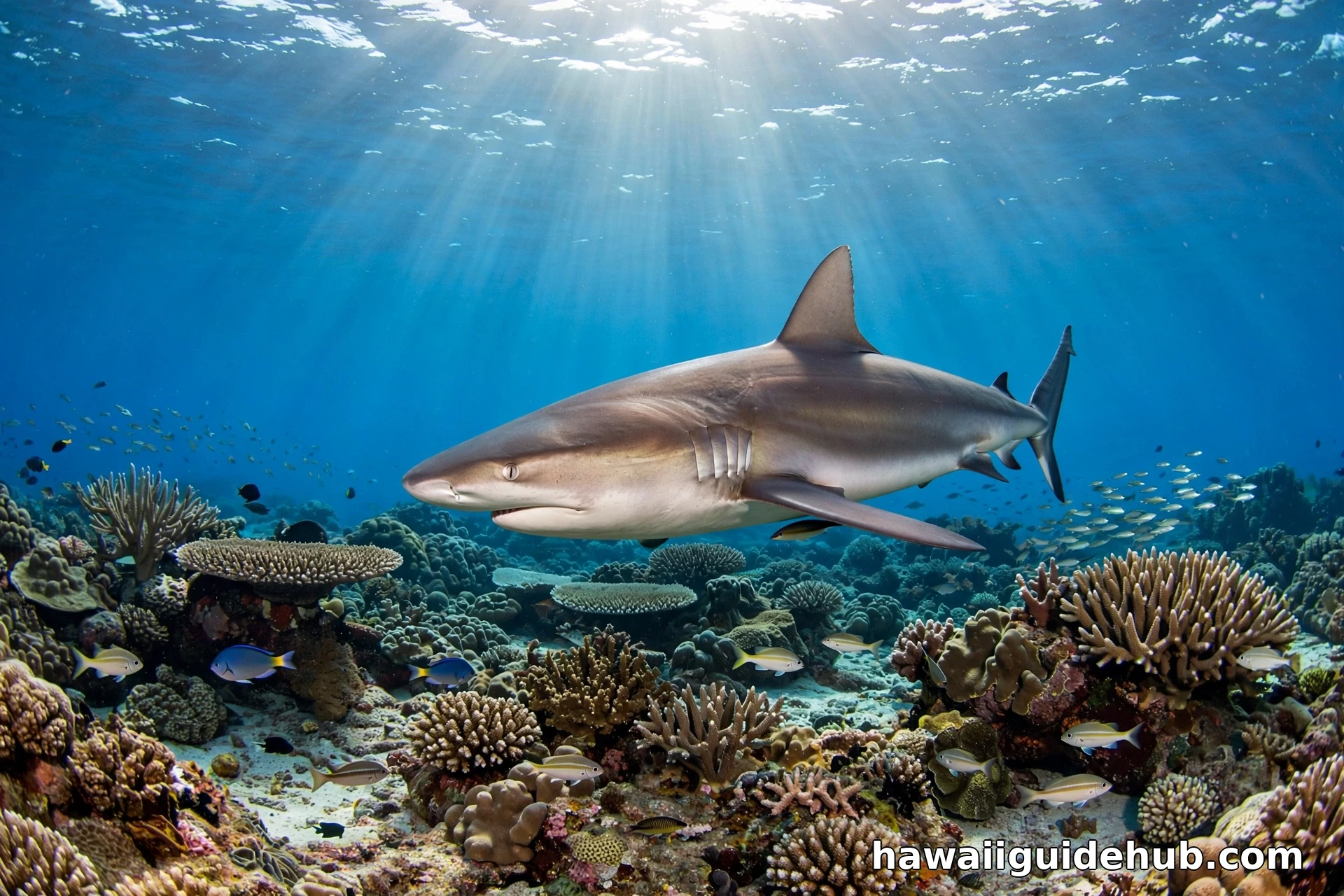
Of all the sharks a visitor might meet in Hawaii, the Galapagos shark is the most likely to come over and say hello. Seven to ten feet of plain gray curiosity, it is the shark that circles divers, investigates cameras, and, when it feels crowded, performs one of the ocean’s most dramatic warning displays: back arched, pectorals dropped, swimming in stiff figure-eights. Despite the misleading name, this is a Hawaiian animal through and through, pupping in island shallows and patrolling reefs from the main islands to French Frigate Shoals.
This is the single complete guide to Galapagos sharks in Hawaii. It covers what they are and how to identify them, Hawaii’s pupping and nursery grounds, their famously bold behavior around divers, how to read their threat display, the “turf wars” research that revealed their secret lives, their safety record, and what cage-free shark diving is like. If you have been searching for anything about Galapagos sharks in Hawaii, the answers are all here on this one page.
What Galapagos Sharks Are
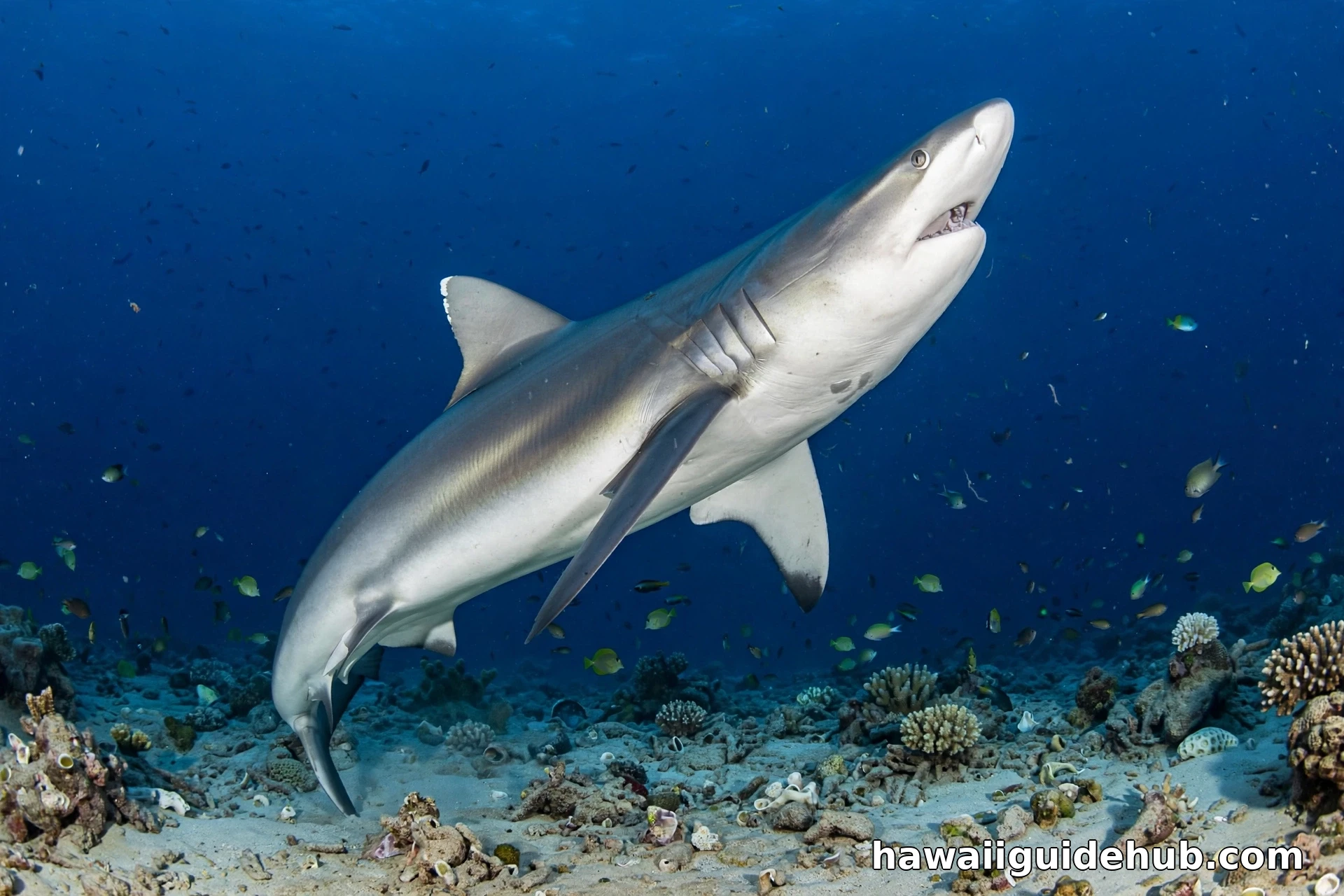
The Galapagos shark, Carcharhinus galapagensis, was first described in 1905 from specimens collected in the Galapagos Islands, and the name stuck even though the shark lives at tropical islands in every ocean. Adults reach 9.8 to 11.5 feet and up to 430 pounds. Identification is straightforward once you know the marks: a wide, rounded snout, a tall first dorsal fin, and a plain brownish-gray body with no spots, bars, or fin tips to speak of. In Hawaiian waters they are most easily confused with gray reef sharks, but Galapagos sharks grow larger and carry themselves with a noticeable boldness.
That boldness is the species’ signature. Where reef sharks flee from divers, Galapagos sharks approach, circle, and investigate. Researchers consider them one of the more assertive reef sharks in Hawaii, a trait that makes them thrilling to encounter and demands genuine respect. They hunt near the bottom for bony fish, eels, octopus, and squid, but large individuals will take sea lions, marine iguanas elsewhere in their range, and even other sharks.
One of the strangest documented behaviors belongs to this species: the Galapagos shark can evert its entire stomach, turning it inside out through its mouth to rinse it, then retract it. Researchers have caught the act on camera, and it is thought to help the shark expel indigestible items, parasites, or the mucus lining after a rough meal. It is a vivid reminder that even familiar-looking reef sharks carry alien biology under the skin, and one more reason these animals reward close, respectful observation over fear.
Hawaii’s Pupping Grounds
Hawaii is a nursery for this species. Mating and birth occur early in the year in Hawaiian waters; females bear litters of 6 to 16 pups, each 60 to 80 centimeters long, in shallow nursery habitat. The pups stay in the shallows for a reason: adult Galapagos sharks will eat them. Females breed only every two to three years, and sharks do not mature until around 10 years of age, a slow life history that makes island populations vulnerable to fishing pressure even though the species is listed as Least Concern globally.
A Hawaiian aging study that counted vertebral growth rings put the maximum documented age at 24 years, with the true maximum probably nearer 30. Males mature at 6 to 8 years, females at 7 to 9. Those numbers matter for management: a shark that takes a decade to start reproducing cannot be fished hard and recover quickly. Since November 2023, all requiem sharks have been listed on CITES Appendix II, and the species is protected in Hawaiian state waters and Papahanaumokuakea Marine National Monument, one of the largest strongly protected areas on the planet.
The Bold Ones: Behavior Around Divers
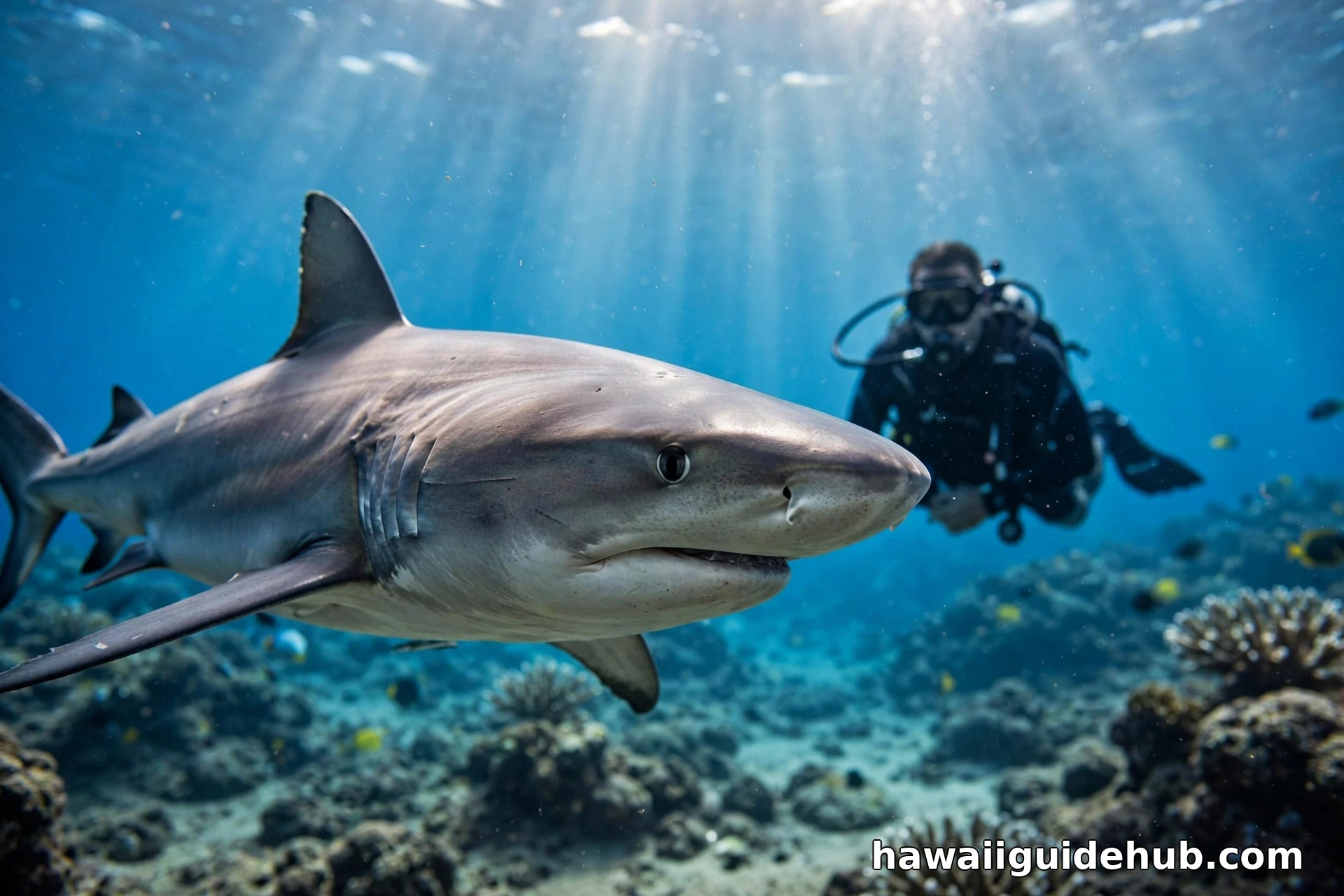
In places where Galapagos sharks are common, they are famously attracted to divers, sometimes becoming an obstacle to the dive itself. Aggressive reactions from divers tend to excite them rather than deter them, which is why the standard advice is the opposite of what instinct suggests: stay calm, hold your position, and let the shark satisfy its curiosity. The risk rises sharply around spearfishing and bait, where food in the water switches the shark from curious to competitive.
The threat display is the behavior every diver should know. When a Galapagos shark feels crowded, it arches its back, lowers its pectoral fins, raises its snout, and swims in stiff, exaggerated loops, sometimes figure-eights. If the intruder keeps approaching, the shark may rush and bite. Divers who stop advancing and withdraw slowly normally see the display end within seconds. The table below decodes the body language.
| What you see | What it means | What to do |
| Slow circling, close passes | Curiosity; the shark is investigating you (per shark behavior research) | Stay calm; keep the shark in sight; enjoy the encounter |
| Back arched, pectorals dropped | Threat display; the shark feels crowded (per ISAF species account) | Stop advancing; withdraw slowly; do not turn your back |
| Stiff figure-eight swimming, snout raised | Escalated warning; a rush may follow (per ISAF) | Leave the water calmly; alert the divemaster |
| Multiple sharks converging fast | Feeding excitement, often around speared fish (per diver reports) | End spearfishing; exit with catch secured away from body |
| Shark bumps you and leaves | Exploratory contact; sampling, not predation | Exit the water; report to lifeguards |
Turf Wars: What the Seabird Study Revealed
One of the most elegant recent findings in Hawaiian shark science came from French Frigate Shoals, where UH’s Hawaii Institute of Marine Biology Shark Lab tagged 128 sharks and tracked them for two years. Published in the journal Ecosphere, the study found that the annual summer arrival of fledgling seabirds concentrates tiger sharks around small islands, and the tigers’ presence forces gray reef and Galapagos sharks to drastically shift their habitat use, changing where and when they swim to avoid being eaten or outcompeted.
It is a remarkable indirect connection between land and sea: baby birds falling from nests reshape the movements of an entire apex predator community. Galapagos sharks, the study found, shift to different times or zones within the atoll rather than abandoning the area entirely, a flexible response that shows how finely these animals read their social landscape. For visitors, the takeaway is that shark behavior in Hawaii is dynamic and seasonal, not a fixed backdrop.
Galapagos Sharks and People
The safety record is reassuring. Per Hawaii DLNR data summarized in recent reviews, Galapagos sharks account for very few incidents, and the International Shark Attack File attributes only a single fatal attack on a swimmer to the species, in the Virgin Islands, not Hawaii. The real-world risk concentrates around spearfishing, where food changes the equation. For snorkelers and divers who follow the standard guidance, swimming with a buddy, avoiding murky water and dawn or dusk sessions, Galapagos sharks are wildlife to be watched with pleasure, not feared.
That boldness has made them the stars of Oahu’s cage-free shark diving, where boats run a few miles off the North Shore and snorkelers float at the surface while Galapagos sharks, and sometimes tigers, circle below. The experience is the inverse of a cage dive: no bars, just protocol, briefing, and respect. If you go, choose an operator with a long safety record and a research or conservation ethos, listen to the briefing as if your safety depends on it, because it does, and keep your hands to yourself. The guide to ocean wildlife behavior is useful background for reading any animal you meet out there.
And if the shark statistics ever unsettle you, remember the broader cast: the whales you can watch responsibly each winter and the animals at the heart of Hawaiian tradition share these same waters, and the ocean rewards the calm and the prepared.
Where to Encounter Them in Hawaii
Galapagos sharks are creatures of clear water and island slopes. Around the main Hawaiian Islands, divers encounter them most reliably on outer reef slopes and offshore pinnacles, particularly off Oahu’s North Shore and the Kona coast, where the cage-free shark snorkeling boats operate a few miles out. The Northwestern Hawaiian Islands are the species’ stronghold: at French Frigate Shoals, researchers have photographed Hawaiian monk seal pups warily watching Galapagos sharks patrol the shallows of Trig Island, a scene that captures the whole food web in a single frame.
Snorkelers should calibrate expectations. Unlike whitetip reef sharks, which rest under ledges in the lagoons tourists frequent, Galapagos sharks prefer deeper, clearer water and are less common on the standard snorkel circuit. Your realistic options are a dedicated shark snorkel off the North Shore, where Galapagos sharks are the main attraction, or a deep outer-reef scuba dive where a curious individual may come to investigate. Either way, the encounter will be on the shark’s terms, which is exactly as it should be.
A Slow Life in a Fast Ocean: Why Protection Matters
The Galapagos shark’s life history is a study in patience. A decade to maturity, a year of gestation, litters every two to three years, and a lifespan of perhaps 30 years: this is an animal built for stability, not for absorbing losses. Island populations are small and isolated, and history shows they can be fished out quickly even when the global species looks secure. Hawaii recognized this early. The shark is protected in state waters, and the federal protections of Papahanaumokuakea give the Northwestern Hawaiian Islands population one of the largest marine reserves on Earth as a refuge.
The CITES Appendix II listing of all requiem sharks in 2023 added an international layer, regulating the trade that once moved fins with little oversight. For a species whose Hawaiian population is also a research treasure, home to the vertebral-aging study, the photo-ID catalogs, and the turf-war tracking, protection pays double dividends: every protected shark is both a functioning predator and a data point in one of the world’s longest-running shark science programs.
Watch: Cage-Free Diving with Galapagos Sharks off Oahu
Frequently Asked Questions
Are Galapagos sharks dangerous?
They are bold and curious, and potentially dangerous if provoked or around food, but unprovoked incidents in Hawaii are very rare. Respect their space and read their body language.
Why are they called Galapagos sharks if they live in Hawaii?
The species was first described from Galapagos specimens in 1905. It lives at tropical islands worldwide, and Hawaii is one of its strongholds.
How big do Galapagos sharks get?
Adults reach 9.8 to 11.5 feet and up to 430 pounds.
What is the Galapagos shark threat display?
An arched back, lowered pectoral fins, raised snout, and stiff figure-eight swimming. It means back off; withdraw slowly and the display usually ends in seconds.
How do you tell a Galapagos shark from a gray reef shark?
Galapagos sharks grow larger (to 11.5 feet vs. about 6 feet for gray reefs) and have a wider, rounder snout and a taller first dorsal fin. Behavior helps too: Galapagos sharks are bolder around divers.
Do Galapagos sharks live in Hawaii year-round?
Yes. They are resident in Hawaiian waters, with mating and pupping early in the year and juveniles using shallow nurseries. Some individuals shift habitat seasonally, as the French Frigate Shoals research showed.
Can you swim with Galapagos sharks in Hawaii?
Yes. Cage-free shark snorkeling off Oahu’s North Shore routinely encounters Galapagos sharks. Choose an experienced operator and follow the briefing exactly.
The Galapagos shark is Hawaii’s most personable predator: a 10-foot investigator that would rather circle you than flee from you, a devoted parent of shallow-water nurseries, and a flexible strategist that rearranges its life around tiger sharks and seabird seasons. Learn its warning signs, give it space when it asks, and it becomes what it should be: the highlight of the dive, not the hazard. In an ocean full of animals that flee, the shark that swims toward you is a rare gift, if you are prepared to receive it properly.