Whitetip Reef Sharks in Hawaii: The Shark That Naps

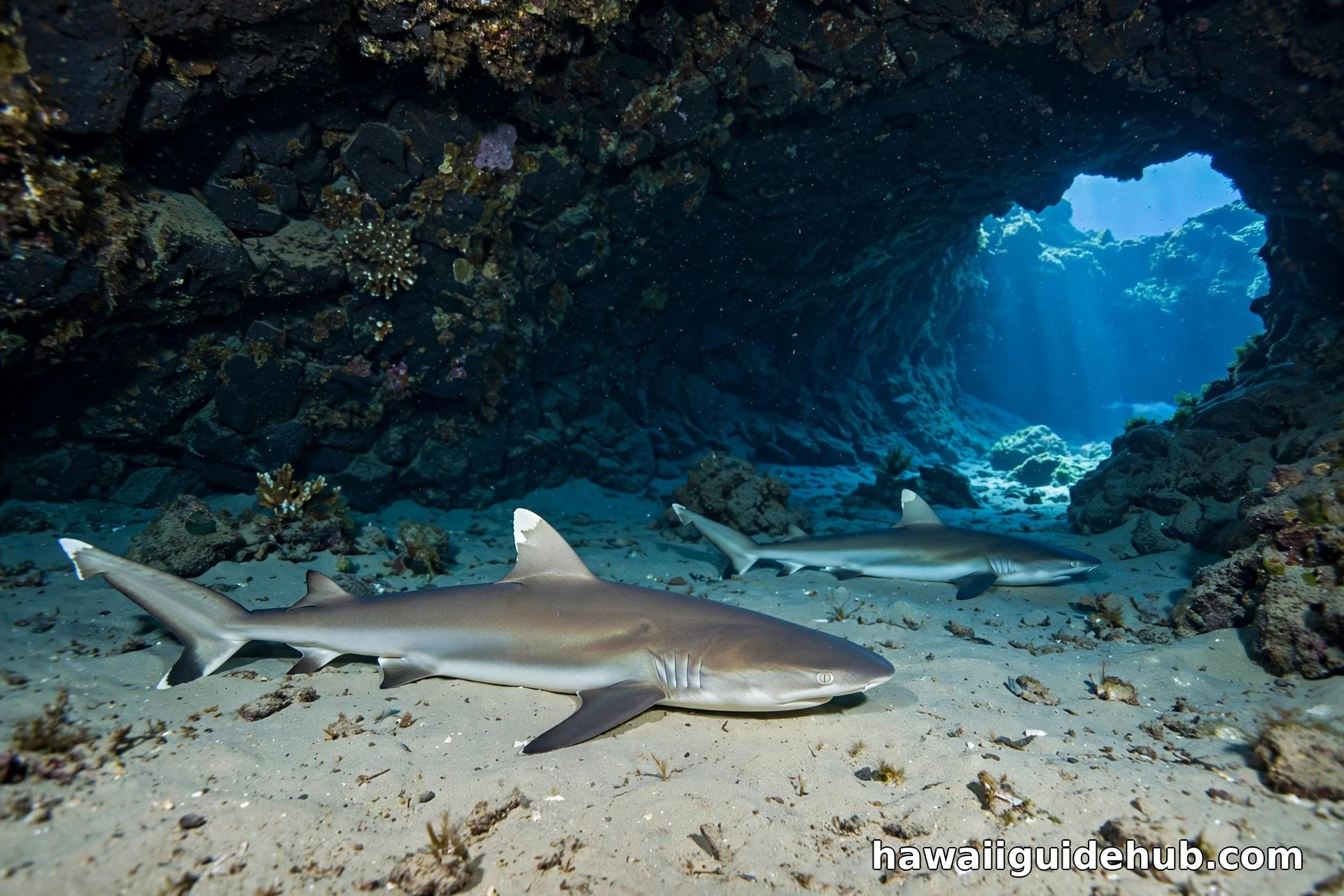
There is a shark sleeping in a lava tube off Kona right now. It has been there since sunrise, motionless on the sand in a pile of its neighbors, and it will not move until dark. This is the whitetip reef shark, Triaenodon obesus, the shark Hawaii snorkelers are most likely to meet and the least likely to fear: a five-foot nocturnal specialist that spends its days napping in caves and its nights vacuuming sleeping fish out of coral crevices.
This is the single complete guide to whitetip reef sharks in Hawaii. It covers what they are and how to identify them, the remarkable breathing trick that lets them sleep on the bottom, a full 24-hour timeline of their day, their extreme site fidelity, their night-hunting techniques, reproduction, their safety record, and where snorkelers can see them. If you have been searching for anything about whitetip reef sharks in Hawaii, the answers are all here on this one page.
What Whitetip Reef Sharks Are
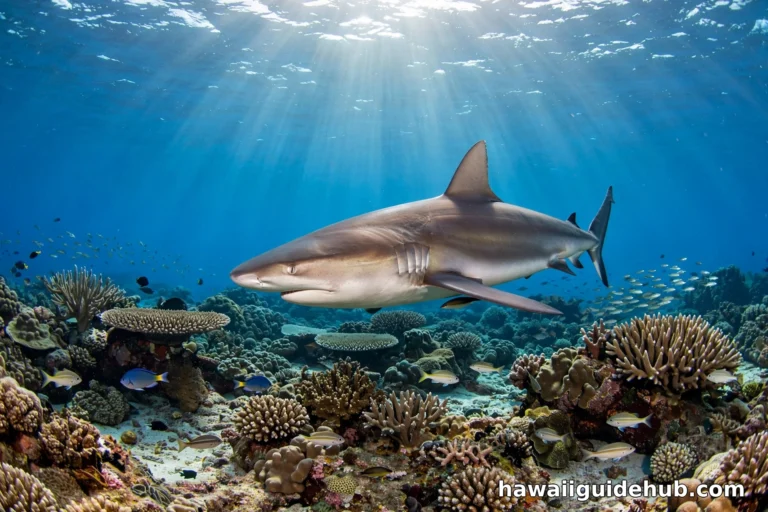
The whitetip reef shark is one of the three most common reef sharks of the Indo-Pacific, alongside the blacktip and gray reef sharks. Adults commonly measure 4 to 5.5 feet, with a maximum around 7 feet. Identification is easy: a slender gray-brown body with bright white tips on the first dorsal fin and the upper lobe of the tail, like the shark was dipped in paint. The scientific name Triaenodon obesus translates roughly to “fat trident-toothed shark,” a reference to teeth with three points like Neptune’s trident. In Hawaiian, the shark is manō lālākea, and it has been part of island reef life, and island culture, for over a thousand years.
Unlike the tigers and Galapagos sharks that roam the archipelago, whitetips are homebodies. They live on coral and rocky reefs in clear water 25 to 130 feet deep, favoring caves, ledges, and, in Hawaii, underwater lava tubes. They do not migrate, they do not range widely, and an individual may spend years on the same small patch of reef.
The Shark That Naps: Breathing Without Swimming
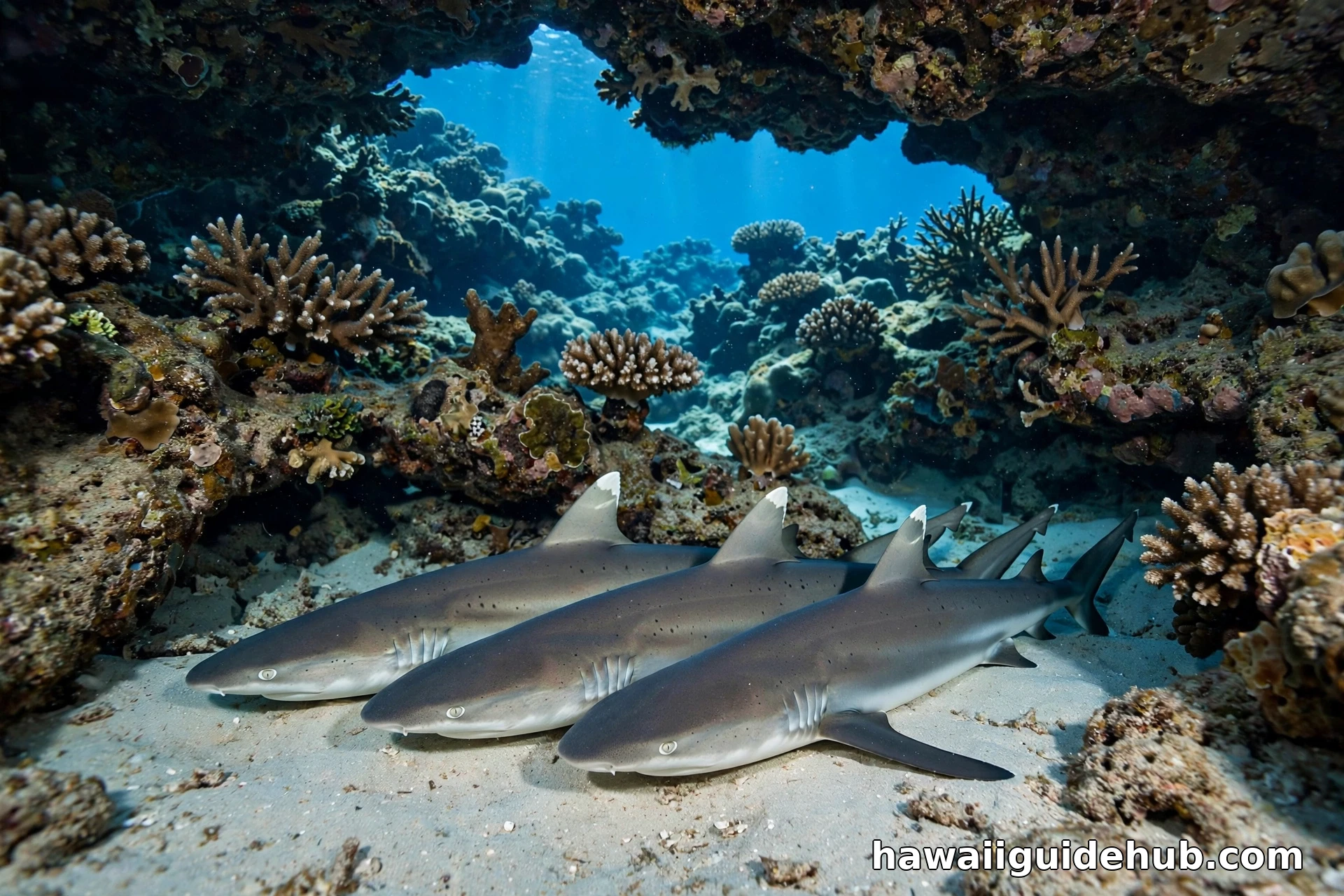
Most requiem sharks must keep swimming to breathe, forcing water over their gills by ram ventilation. The whitetip reef shark broke that rule. It can pump water over its gills with its mouth and cheek muscles, a technique called buccal pumping, which means it can lie perfectly still on the bottom and breathe. This single adaptation defines the species’ entire lifestyle: by day, whitetips rest inside caves singly or in small groups, arranged in parallel or stacked atop one another like cordwood, conserving energy for the night hunt.
In Hawaii, divers regularly find them piled in lava tubes and under ledges, sometimes ten animals in a cave the size of a bedroom. They are not territorial and share resting spots peacefully; researchers have watched the same individuals return to the same cave for months or years. Approach quietly and they will let you watch them sleep, an intimacy few wild sharks permit.
24 Hours With a Whitetip: Day Shift vs. Night Shift
The whitetip’s day is split cleanly in two, and the two halves barely overlap. The table below follows one shark through a full cycle, with the science behind each phase.
| Time | What the shark is doing | Where | Range |
| Sunrise-noon | Deep rest in cave; buccal pumping (per shark physiology studies) | Same lava tube or ledge, often stacked with others | ~0.05 sq km daytime range (per tracking studies) |
| Afternoon | Light dozing; occasional repositioning within the cave | Same shelter; individuals return for months to years | Johnston Atoll study: none moved >3 km in a year |
| Dusk | Emerges; activity peaks at slack tide and nightfall | Reef slope and edge near home cave | Night range expands to ~1 sq km |
| Night | Group hunting; forces into crevices to extract hidden prey (per diet studies) | Patrols reef, probing holes with blunt snout | Rangiroa study: 40% still on same reef after 3+ years |
| Pre-dawn | Returns to the same shelter before light | Home cave; strong site fidelity | Day range shrinks back to 0.05 sq km |
Homebodies of the Reef
The site fidelity numbers are extraordinary for a shark. At Johnston Atoll, not one tagged whitetip moved more than 3 kilometers from its capture site over a full year. At Rangiroa Atoll in French Polynesia, 40 percent of tagged sharks were still on the same reef more than three years later. The daytime home range of an individual is about 0.05 square kilometers, roughly a few city blocks, expanding to about 1 square kilometer at night. These are not wanderers that happen to visit Hawaii; they are residents with addresses.
That residency is why Hawaii’s dive sites have “their” whitetips. The sharks sleeping in the lava tube at a Kona dive site this week are very likely the same sharks that were there last month and will be there next year. It also makes them vulnerable: a shark that never leaves a small reef cannot escape local fishing pressure or habitat damage, one reason the IUCN assesses the species as Vulnerable globally (2023 assessment; some older sources list it as Near Threatened, reflecting the earlier 2005 assessment).
Hunting by Feel in the Dark
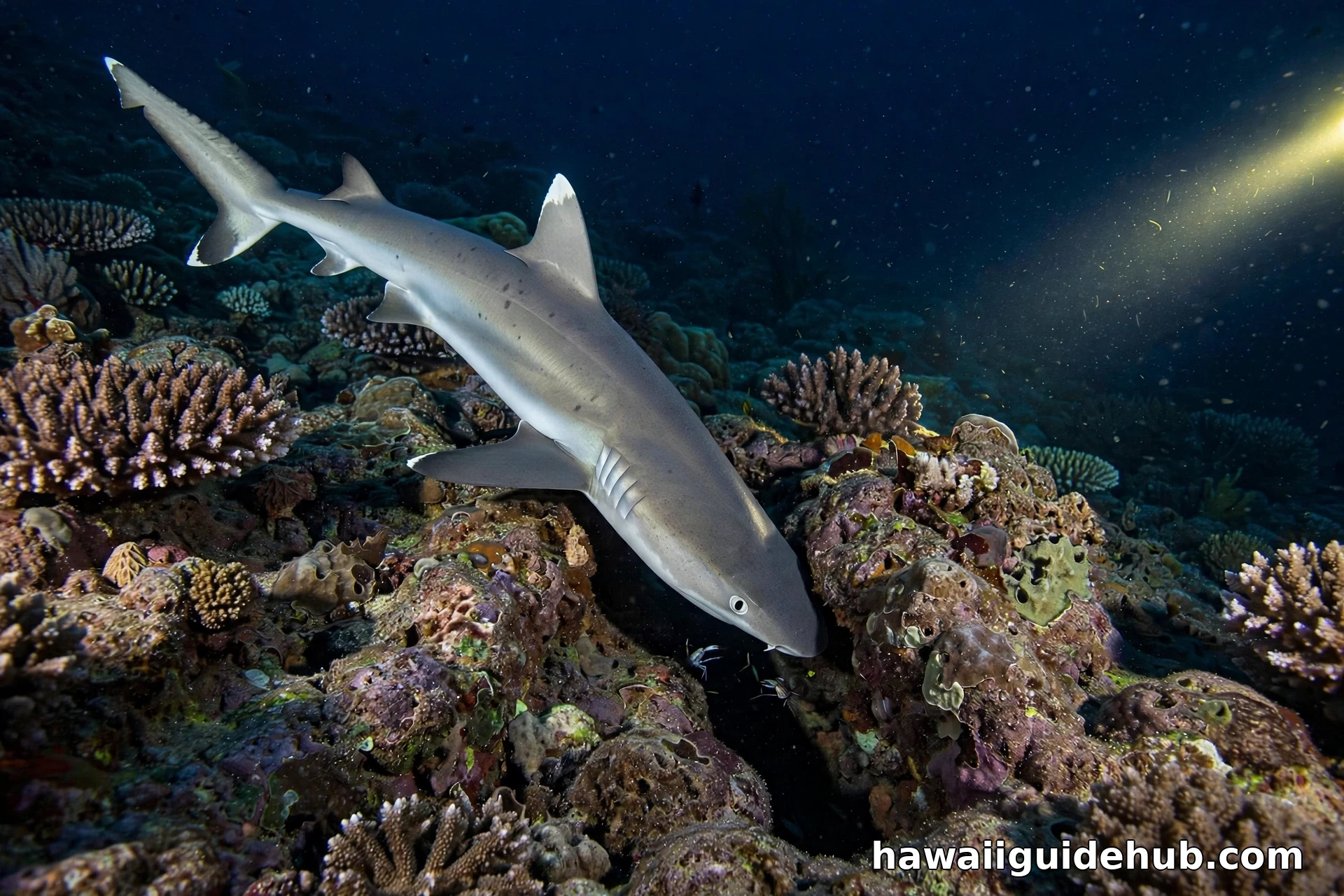
Night is when the whitetip earns its living. Emerging from the cave, often in loose groups, it patrols the reef probing crevices with its blunt snout, extracting squirrelfish, snappers, goatfish, parrotfish, and moray eels that shelter in holes by night, plus octopus, spiny lobsters, and crabs. Its slender, flexible body lets it force its way into cracks that would stop a bulkier shark. It rarely chases fish in open water; it does not need to, since its prey is asleep.
Whitetips are also opportunists with a talent for learning. At Cocos Island in the Pacific, they have learned to follow divers’ lights, using the beams to spot prey the light startles. It is a clever trick, and a reminder that “resting by day” does not mean simple. Behind those large, low-light-adapted eyes is a capable nocturnal predator running a precise nightly trapline over a reef it knows better than any diver ever will.
Babies Every Other Summer
Whitetip reproduction is slow even by shark standards. Mating has been observed in the wild, one of the few sharks for which that is true: males follow receptive females and grasp a pectoral fin to maneuver into position. After a gestation of 10 to 13 months, the female gives birth to just 1 to 5 pups, commonly 2, each about 20 to 24 inches long, in shallow reef flats and lagoons during the summer months. Females breed every other year. Pups mature at around 3.5 feet and five years old. With litters that small and cycles that slow, populations recover from depletion at a crawl.
The Shark Snorkelers Actually Meet
If you see a shark while snorkeling in Hawaii, statistics say it is probably this one. Whitetips are the most common shark swimmers encounter, and they are harmless in every way that matters: the incident database holds only three minor cases attributed to the species between 2005 and 2013, all involving spearfishing or a grabbed shark, none fatal. Bites happen when a whitetip competes for a speared fish or is seized by a diver, never as predation on people. They will let divers approach their caves and watch them sleep, though the ethical move is to keep your distance, never block a cave exit, and never touch.
Good places to meet manō lālākea include the lava tubes and ledges off Kona, the outer reef edges at popular Oahu snorkel sites, and the caves of Kauai’s north shore reefs. Go with a reputable snorkel or dive operator, ask the guides where the resident whitetips sleep, and bring the calm the encounter deserves. The guide to ocean wildlife behavior covers how to read the animals you meet, and the responsible wildlife watching guide applies just as well below the surface. These sharks were protected in Hawaiian culture for a thousand years as ‘aumakua, family guardians, a history worth remembering when you find yourself floating above a sleeping pile of them, as described in Hawaii’s traditions of ocean reverence.
Why Whitetips Matter to the Reef
Hawaiian divers have a saying: whitetips are the ocean’s garbage collectors. A whitetip cannot swim fast enough to catch a healthy fish, so it eats the sick, the injured, and the dying, along with the occasional dead animal washed out to sea in a storm. Without a good population of these sharks, the logic goes, Hawaiian reefs would be littered with dead fish. It is folk ecology with a solid core: by removing weakened animals, whitetips slow the spread of disease and recycle nutrients back into the reef food web every night.
They also structure the behavior of everything around them. Reef fish sleep in tighter crevices and school more warily on reefs with resident whitetips; octopus and lobsters time their foraging around the sharks’ nightly patrols. Remove the whitetips and the reef does not just lose a predator, it loses a rhythm. That is the deeper argument for their protection, beyond the IUCN listing: a reef without its night shift is a different, poorer reef.
Night Diving With Whitetips
The definitive whitetip experience is a night dive. As your group descends after dark, the reef you snorkeled at noon is transformed: the sleeping sharks are gone from their caves, and white-tipped silhouettes glide through your light beams, working the coral with methodical patience. Kona’s night dives are famous for manta rays, but the whitetips are the quiet co-stars, and many divers remember them just as vividly.
Night-dive etiquette matters more than by day. Keep your light movements slow and avoid shining beams directly into a shark’s eyes. Stay with the group and the divemaster, maintain neutral buoyancy so you do not crash into the coral the sharks are hunting over, and never try to touch or feed a shark. A reputable Kona or Oahu dive operator will brief all of this before you enter the water; listen as if the reef’s health depends on it, because in a small way, it does.
Watch: Whitetip Reef Sharks (Shark Academy)
Frequently Asked Questions
Are whitetip reef sharks dangerous?
No. They are among the least dangerous sharks in Hawaii, with only three minor incidents on record, all involving spearfishing or provocation. They do not prey on people.
Why do whitetip reef sharks lie still on the bottom?
They pump water over their gills with their mouth muscles instead of swimming to breathe, so they can rest motionless in caves during the day.
How big do whitetip reef sharks get?
Commonly 4 to 5.5 feet, with a maximum around 7 feet.
Where can I see whitetip reef sharks in Hawaii?
In lava tubes and caves off Kona, on outer reef edges at Oahu snorkel sites, and in Kauai’s north shore reef caves. They sleep by day and are easiest to find with a local dive guide.
Do whitetip reef sharks sleep with their eyes open?
Essentially yes. Resting whitetips keep their eyes open and remain aware of their surroundings even while motionless. Divers who approach quietly can watch them for minutes, but sudden movements or touching will send the shark gliding out of the cave.
Are whitetip reef sharks endangered?
The IUCN assesses them as Vulnerable globally (2023), driven by fishing pressure across their range; they are protected in Hawaiian waters.
The whitetip reef shark is proof that the best shark encounters are the quiet ones: a pile of sleeping sharks in a lava tube at noon, the same animals out working the reef at midnight, year after year, on the same few acres of coral. Learn to spot the white-tipped fins, give the caves their space, and Hawaii’s most common shark becomes what the old Hawaiians knew it was: a neighbor, not a threat.