Tiger Sharks in Hawaii: The Sharktober Discovery and Real Risk

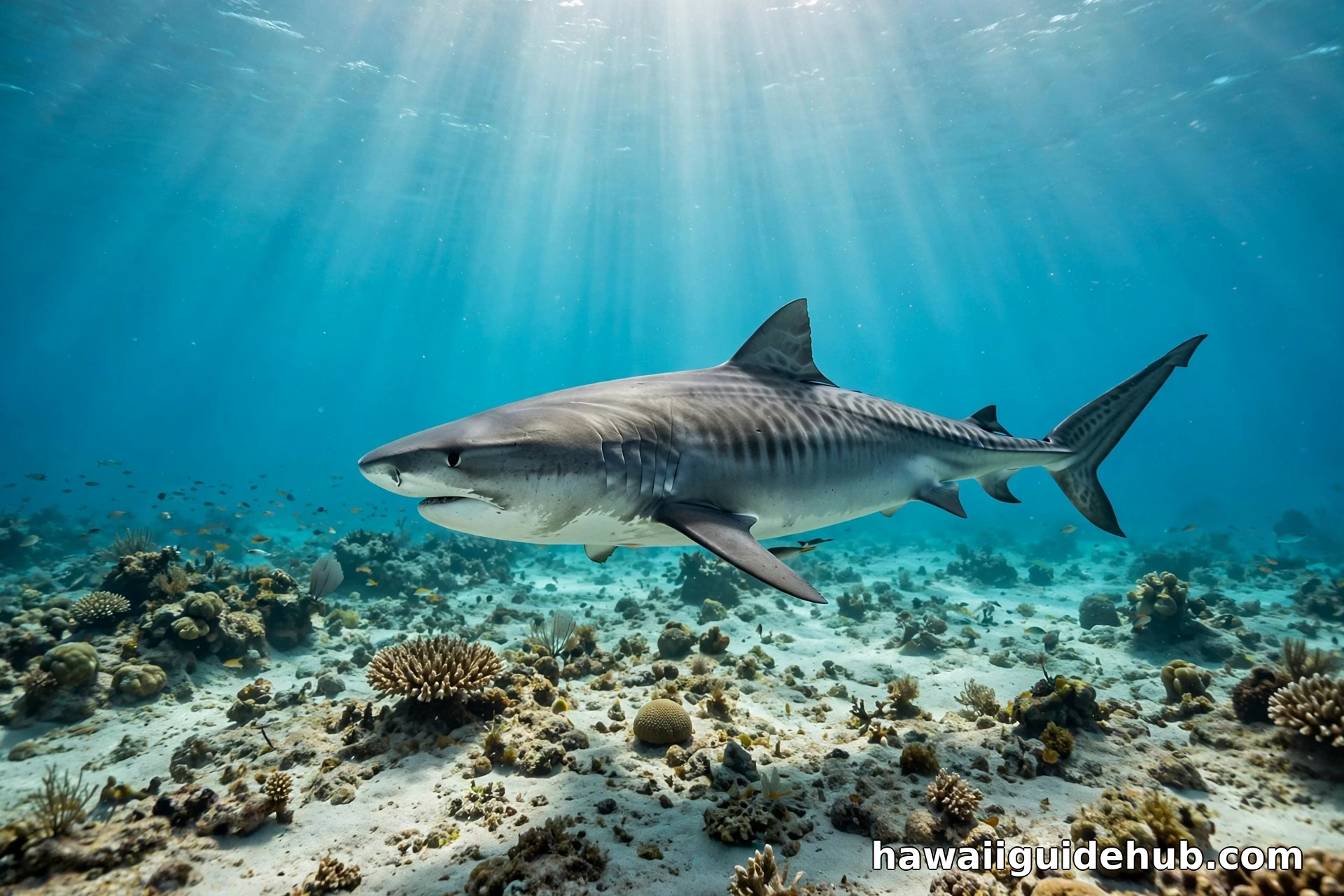
Ask a Hawaii lifeguard which shark worries them most and you will get the same answer every time: the tiger shark. At 10 to 14 feet long, with dark vertical stripes and a reputation for eating almost anything, Galeocerdo cuvier is the species behind nearly half of Hawaii’s recorded shark bites. It is also the subject of one of the most interesting marine discoveries of 2025: a University of Hawaii study that finally explained why October is Hawaii’s most dangerous month for shark encounters.
This is the single complete guide to tiger sharks in Hawaii. It covers what these animals are, the “Sharktober” discovery and what the numbers actually show, how tiger sharks use Hawaiian waters, why bites happen and how rare they really are, the official safety guidance, and the conservation debate. If you have been searching for anything about tiger sharks in Hawaii, the answers are all here on this one page.
What Tiger Sharks Are
Tiger sharks are named for the dark vertical bars that fade as they age, camouflage that breaks up their outline when seen from above. Adults commonly reach 10 to 14 feet in Hawaii, and the species has one of the broadest diets in the ocean: sea turtles, monk seals, seabirds, fish, squid, and famously, garbage. License plates, tires, and unopened cans have all been found in tiger shark stomachs, earning them the nickname “garbage cans of the sea.” Their teeth are the key to that diet: broad, serrated, and curved, built to saw through turtle shells and bone.
Unlike reef sharks that hug the coral, tiger sharks are wanderers. Satellite and acoustic tagging by University of Hawaii researchers has shown them cruising between islands and out to the open Pacific, using the whole archipelago as their range. They give birth to live young, with litters among the largest of any shark, and Hawaii’s main islands serve as important pupping grounds in late summer and autumn.
The “Sharktober” Discovery
In 2025, UH shark researcher Carl Meyer published a study in Frontiers in Marine Science analyzing 30 years of Hawaii shark-bite data, from January 1995 to October 2024. The finding was striking: of 165 unprovoked bites, 32 of them, about 20 percent, happened in October alone, two to four times the frequency of any other month. Tiger sharks accounted for 77 bites (47 percent) across the whole period and at least 63 percent of the October incidents. The study linked the spike to tiger shark reproduction: pupping occurs in the September to October window, and mature females migrate roughly 1,000 miles from the Northwestern Hawaiian Islands, particularly around French Frigate Shoals, back toward the main islands in autumn.
Two mechanisms work together, per the study. First, there is a temporary increase in large adult females in nearshore habitats during pupping season. Second, giving birth to a large litter is energetically exhausting, likely leaving postpartum females in poor nutritional condition and highly motivated to forage. Crucially, the researchers found no evidence of increased water recreation in October, so the pattern is driven by shark biology, not by more swimmers. The table below breaks down the seasonal pattern.
| Season | Share of recorded bites | Expected if even | What the science points to |
| Oct-Dec | ~35% (per DLNR-DAR data via Meyer et al. 2025) | 25% | Post-pupping females return from NWHI; hungry, nearshore |
| Jul-Sep | ~23% | 25% | Peak visitor water use; pupping begins late summer |
| Apr-Jun | ~22% | 25% | Calm water; hammerhead pupping (different species) |
| Jan-Mar | ~20% | 25% | Large swells; fewer swimmers |
| October alone | 20% of all bites, 1995-2024 | ~8% | 2-4x any other month; tigers = 63%+ of October bites |
Scale matters more than the pattern. An extra 10 percentage points of incident share across three months translates to roughly one additional bite per autumn statewide. The overall risk remains extremely low: millions of people swim in Hawaiian waters each year, and unprovoked bites number in the single digits annually. Nobody should reorganize a trip around Sharktober; weather, surf, and pricing are far more decisive factors in choosing when to visit.
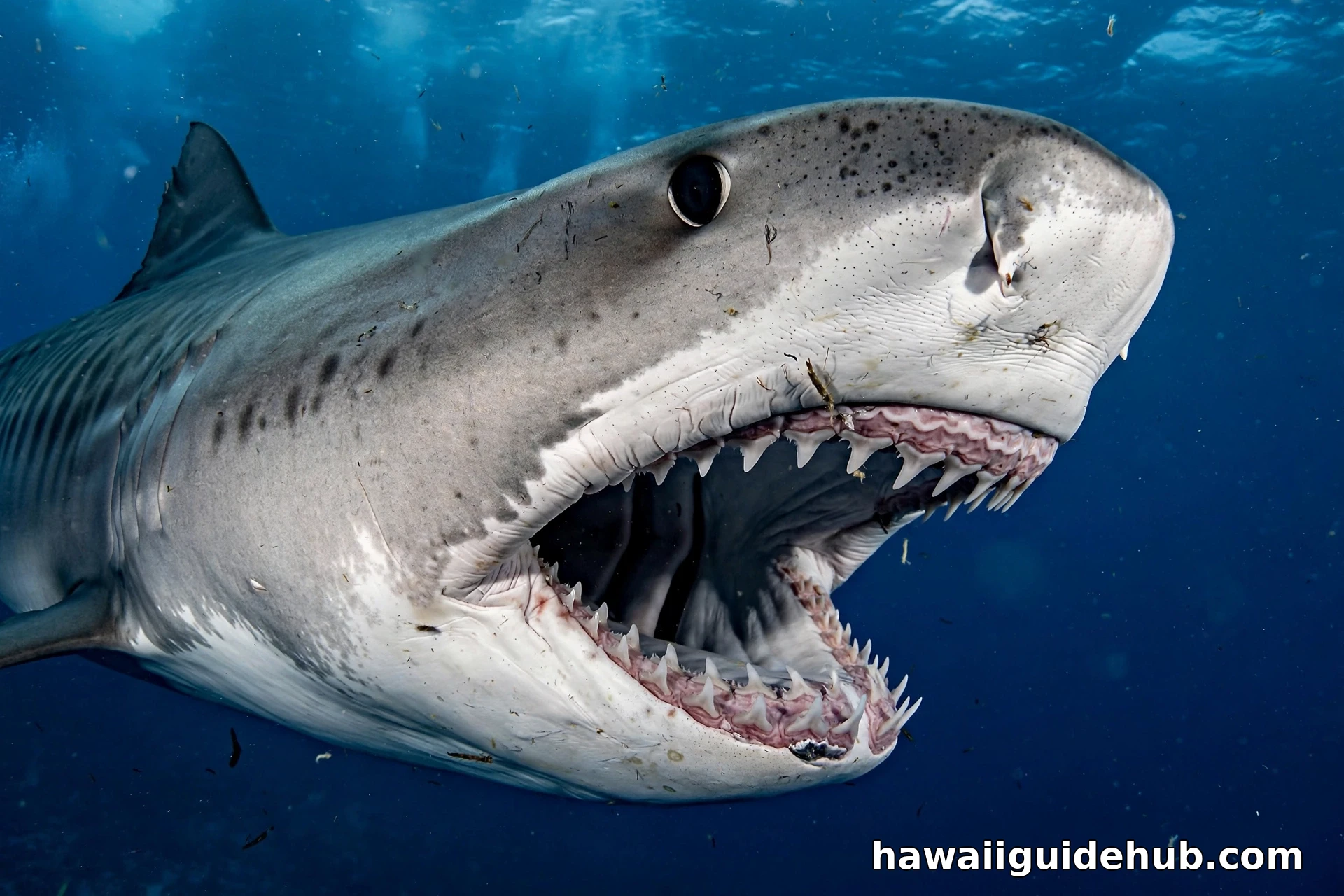
Which Shark Was That? Tiger vs. Hawaii’s Other Sharks
Most sharks spotted from a Hawaiian beach are not tigers. Whitetip and blacktip reef sharks, scalloped hammerheads, and Galapagos sharks all share these waters, and misidentification runs rampant in beach chatter. Knowing the differences keeps the fear proportional: a 4-foot reef shark cruising the shallows is scenery, not a threat.
| Shark | Size in Hawaii | Field marks | Temperament note |
| Tiger shark | 10-14 ft adults; 3-4 ft juveniles | Dark vertical bars (bold in young); blunt snout; tall dorsal fin | Bold generalist; responsible for 47% of recorded bites (per Meyer et al. 2025) |
| Whitetip reef shark | To ~6 ft | White-tipped dorsal and tail fins; rests on bottom by day | Docile; bites only when harassed |
| Blacktip reef shark | To ~5 ft | Black fin tips; timid in shallow lagoons | Shy; flees from swimmers |
| Scalloped hammerhead | To ~12 ft | Unmistakable hammer head; schools in summer | Pelagic; rarely near swimmers |
| Galapagos shark | To ~10 ft | Plain gray; tall first dorsal; no markings | Curious and bold; treat with caution |
The rule of thumb: stripes plus serious size equals tiger. A plain gray shark with no markings is more likely a Galapagos or reef species. Juvenile tigers confuse people most, since their bold stripes and small size read as a different animal entirely. When in doubt, treat every large shark with respect and distance, and let the lifeguards make the call.
How Tiger Sharks Use Hawaiian Waters
Tagging data has redrawn the map of tiger shark life in Hawaii. Mature females make long seasonal migrations between the main islands and the Northwestern Hawaiian Islands, while males and juveniles show their own movement patterns. The main Hawaiian Islands are important pupping grounds, and nearshore habitats see more large females in autumn. Outside pupping season, tiger sharks range widely, following prey like turtles and monk seals and scavenging whatever the ocean offers. They are as comfortable in 10 feet of water over a reef as they are miles offshore.
Juveniles tell a different story. Young tiger sharks spend their early years in shallower, sheltered habitats, growing quickly on a diet of fish and squid before graduating to the turtle-and-seal menu of adulthood. This is why a small, striped 4-foot shark spotted in the surf is almost always a juvenile tiger: the stripes are boldest in the young, and the nursery areas overlap with the beaches people love. Researchers believe shallow, turbid nearshore waters offer pups some protection from larger predators, including adult tiger sharks themselves, which are not above cannibalism.
Feeding behavior shifts with age as well. Adults are patient scavengers as much as hunters: a dead whale, a floating carcass, or a discarded catch will draw tiger sharks from considerable distances, and they will gorge until the food is gone. This scavenging habit is one reason tiger sharks are so often the first large predators on the scene at whale carcasses off Kona, where drone footage has captured multiple tigers and whitetips feeding together on a single sperm whale fall. For the ecosystem, they are the cleanup crew, converting the ocean’s largest corpses back into the food web.
Why Bites Happen (and Why They Are Rare)
Most shark bites are not predation; they are investigation. A tiger shark explores the world with its mouth, and a surfer’s silhouette or a swimmer’s splash can read as “possible food” to an animal that eats almost anything. Poor visibility is the great multiplier: murky water after rain, dawn and dusk low light, and areas near stream mouths where baitfish gather all raise the odds of a mistaken-identity encounter. Spearfishers carrying struggling fish are in a special risk category, the blood and vibration advertising dinner.
And yet the denominator is enormous. Hawaii’s beaches host millions of ocean entries every year, and the annual count of unprovoked bites is typically in the single digits, with fatalities rarer still. Statistically, the drive to the beach is far more dangerous than the swim. The fear tiger sharks inspire is real and understandable, but the math says the ocean remains one of the safer places in a Hawaii vacation.

Staying Safer: The Official Guidance
Hawaii DLNR’s Division of Aquatic Resources publishes shark safety guidance that every ocean-goer should know. Swim, surf, or dive with other people and stay close together. Avoid the water at dawn, dusk, and night, when sharks are most active and visibility is worst. Stay out of murky water, especially near stream mouths and harbor entrances after rain. Do not swim where people are fishing or where dead fish and bait are in the water. If you see a shark, leave the water calmly and quickly, and alert a lifeguard. Do not harass or provoke any shark; besides being dangerous, it is illegal.
For snorkelers and divers, the guide to ocean wildlife behavior adds useful context on reading animal body language. And if the shark statistics have you rethinking ocean time entirely, remember that Hawaii’s reefs host an extraordinary cast of harmless residents, from the whales you can watch responsibly in winter to the animals woven into Hawaiian tradition that remind us the ocean is a shared home.
Conservation: Why Hawaii Does Not Cull
After high-profile bites, culling is often proposed and consistently rejected by scientists. The research is clear: indiscriminate shark fishing does not reduce bite risk, because tiger sharks roam so widely that removed animals are quickly replaced, and it damages an ecosystem where apex predators keep turtle, seal, and fish populations in balance. Hawaii’s approach is monitoring, research, and public education: the tagging programs that revealed the Sharktober pattern are the same tools that let lifeguards and officials understand risk in real time. Tiger sharks are not currently the target of any directed fishery in Hawaii, though they are caught as bycatch in longline fisheries, and their global population faces pressure from finning and bycatch worldwide.
There is also a cultural layer that science alone does not capture. In Hawaiian tradition, sharks are ‘aumakua, family guardians, and the tiger shark in particular appears in stories as both protector and warning. That dual view, reverence alongside caution, is arguably the healthiest possible attitude toward a 14-foot predator: respect the animal, learn its patterns, and share the water on its terms.
Watch: Tiger Sharks in Hawaii, Myths vs. Truth
Frequently Asked Questions
Are tiger sharks dangerous in Hawaii?
They are the species behind most Hawaii shark bites, but bites are extremely rare: single digits per year against millions of swimmers. Follow DLNR safety guidance and the risk is minimal.
What is Sharktober?
The nickname for October, Hawaii’s statistically most bite-prone month. A 2025 UH study of 30 years of data found 20 percent of unprovoked bites occurred in October, driven by pupping female tiger sharks migrating back to the main islands.
How big do tiger sharks get in Hawaii?
Adults commonly reach 10 to 14 feet. Females grow larger than males.
What do tiger sharks eat?
Almost anything: sea turtles, monk seals, seabirds, fish, squid, and garbage. Stomach contents have included license plates and tires.
What should I do if I see a tiger shark while swimming?
Stay calm and leave the water smoothly and quickly, keeping the shark in sight. Do not splash or swim away frantically. Alert a lifeguard once ashore. Most sightings end with the shark cruising past, uninterested.
Should I cancel a Hawaii trip because of sharks?
No. The seasonal pattern amounts to roughly one extra bite per autumn statewide. Standard precautions make ocean recreation very safe.
The tiger shark is Hawaii’s most formidable resident: a 14-foot generalist with the widest diet in the sea and a reproductive cycle that now explains October’s statistics. Understanding the animal replaces fear with respect. Swim with others, stay out of murky water, heed the lifeguards, and the ocean that the tiger shark patrols remains what it has always been: the best part of a Hawaii trip, shared on the shark’s ancient terms.