Coconut Rhinoceros Beetle in Hawaii: The War for the Islands’ Palms

It is two inches long, black, horned, and it is killing Hawaii’s palm trees. The coconut rhinoceros beetle, first found at Pearl Harbor in 2013, bores into the crowns of coconut palms and feeds on the sap, leaving V-shaped cuts in the fronds and dead trees in its wake. On Oʻahu it is now established across the island; on Kauaʻi, Maui, and Hawaiʻi Island, rapid-response teams are fighting to eradicate it before it takes hold. The coconut palm is not just scenery in Hawaii: it is food, culture, and the silhouette of the islands themselves.
This is the single complete guide to the coconut rhinoceros beetle in Hawaii. It covers what the beetle is and how it kills palms, the island-by-island battle plan, the mulch problem that spreads it, how to tell it from harmless look-alikes, what the official response looks like, and what you can do. If you have been searching for anything about the coconut rhinoceros beetle in Hawaii, the answers are all here on this one page.
The Beetle With a Horn
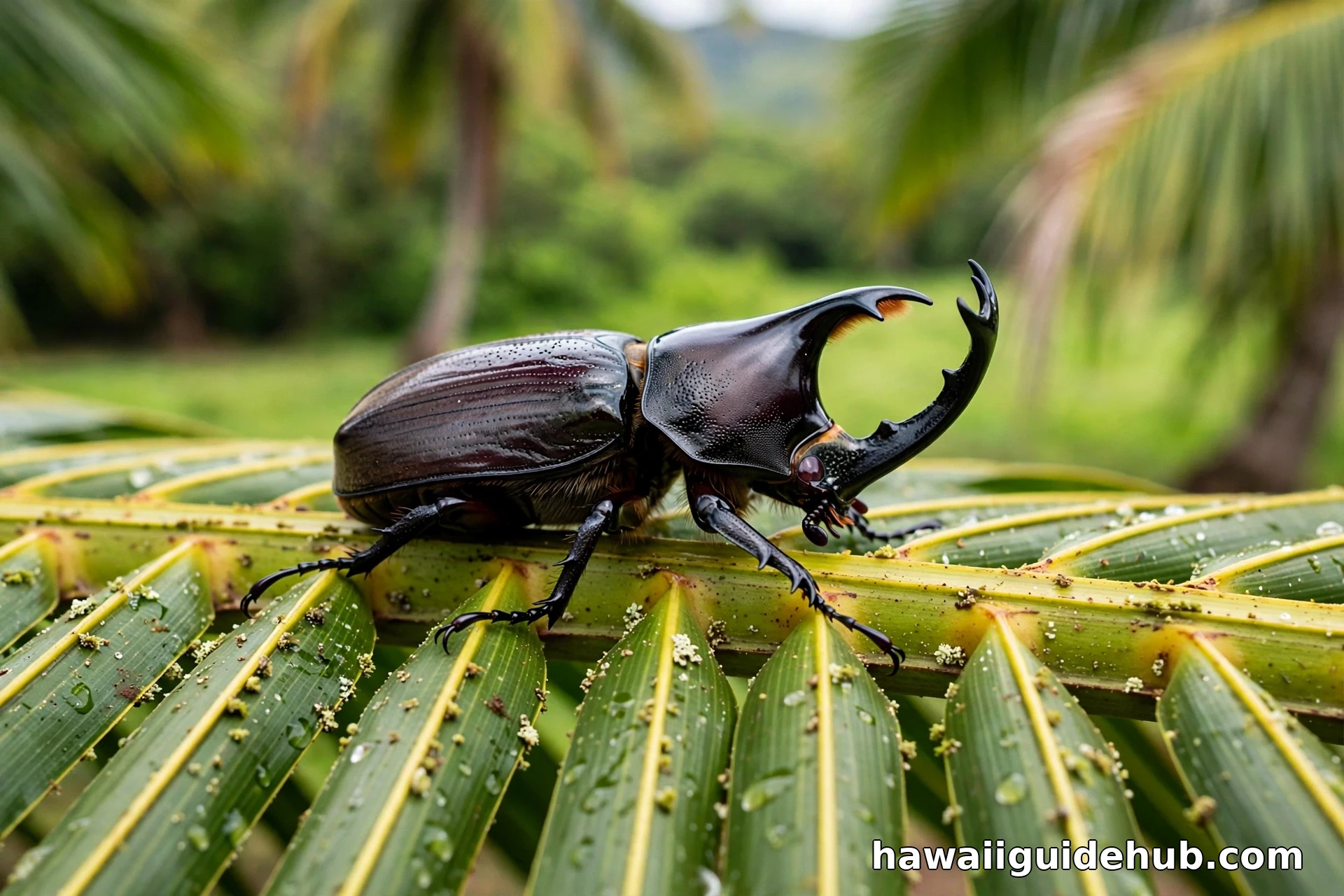
The coconut rhinoceros beetle (Oryctes rhinoceros), native to Southeast Asia, is unmistakable: a glossy black beetle about two inches long with a curved horn on its head. Adults are nocturnal and can fly up to two miles searching for food. Females lay 50 to 140 eggs in their four-to-nine-month lifetimes, depositing them in moist, rotting organic matter. The larvae are fat white C-shaped grubs up to three inches long, living in mulch, compost, and green waste, which is why moving those materials moves the beetle.
It does not bite people, though the CRB Response program advises handling specimens with care since they live in dirt and mulch. What it attacks is palms: coconut above all, but also royal, date, fan, and the native loulu palms, plus hala, taro, banana, pineapple, and sugarcane when palms are unavailable.
How It Kills a Palm
The adult beetle flies to a palm at night, bores into the crown, and feeds on the sap. The signature damage appears as the fronds unfurl: geometric V-cuts where the beetle chewed the folded leaf. A single attack can kill a tree if the growing point is destroyed; wounds also invite secondary fungal and bacterial infections. Reported tree mortality after attack ranges from 10 to 50 percent. Dead palms then become hazards, their rotted trunks liable to fall on people and property.
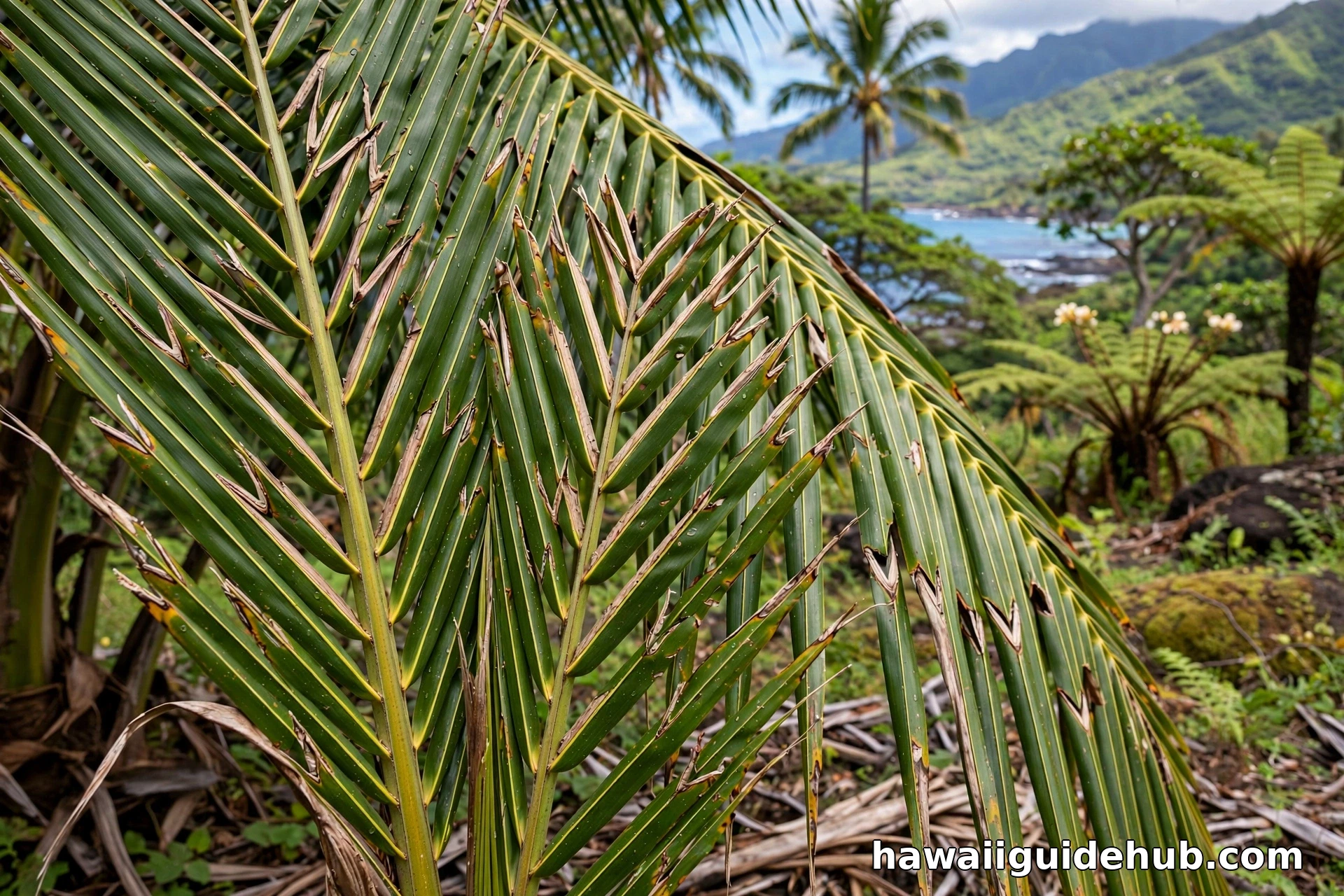
Reading a damaged frond is a skill anyone can learn, and it is the single most useful thing a resident or visitor can do. Look at newly opened fronds, not old ones: the V-cuts appear where the folded leaf was chewed, so they show up as symmetrical notches once the frond unfurls. Bore holes in the crown, visible as dark tunnels in the trunk top, confirm active feeding. Photograph both, note the location, and call it in. A sharp-eyed walker has the same detection power as a pheromone trap, and covers ground no crew can reach. In the CRB war, every pair of eyes on the trail is a sensor, and every report is intelligence that could save an entire island from permanent, costly, landscape-changing infestation for good.
Island by Island: Eradicate or Contain?
Hawaii’s CRB war is fought differently on each island, and the strategy table below shows why.
| Island | Status (per HDOA/DLNR) | Strategy |
| Oʻahu | Established since 2013; spread island-wide | Containment: 3,000+ traps, detector dogs, palm injections; USDA ~$2M/year |
| Kauaʻi | Detected May 2023 near Līhuʻe; now Hanalei to Kekaha | Eradication: island-wide surveys, priority traps, green-waste fumigation |
| Maui | Dead adult in Oʻahu compost, fall 2023; no established population | Early detection: port traps, pathway review |
| Hawaiʻi Island | First larvae Oct 2023; Waikoloa detection since (6 larvae, 5 adults total) | Early detection + monitoring with BIISC and volunteers |
The Mulch Problem
The beetle’s superpower is its nursery: any moist, rotting organic matter. Green waste, compost, mulch piles, manure, sawdust, decaying stumps. Larvae develop invisibly inside these materials, and every load moved is a potential invasion. In March 2026, an Oʻahu woman found 60 CRB larvae in a bag of soil bought at a Waipahu store, a reminder that the pathway runs through ordinary commerce.
This is why the state restricted movement of CRB host material, entire trees, green waste, compost, mulch, trimmings, and palm stumps, first with a July 2022 interim rule and expanded penalties after the Maui detection: fines from $100 to $10,000, and up to $25,000 for repeat violators, who must also pay cleanup and eradication costs. Residents on all islands are urged to check compost bins and green waste for the fat white grubs.
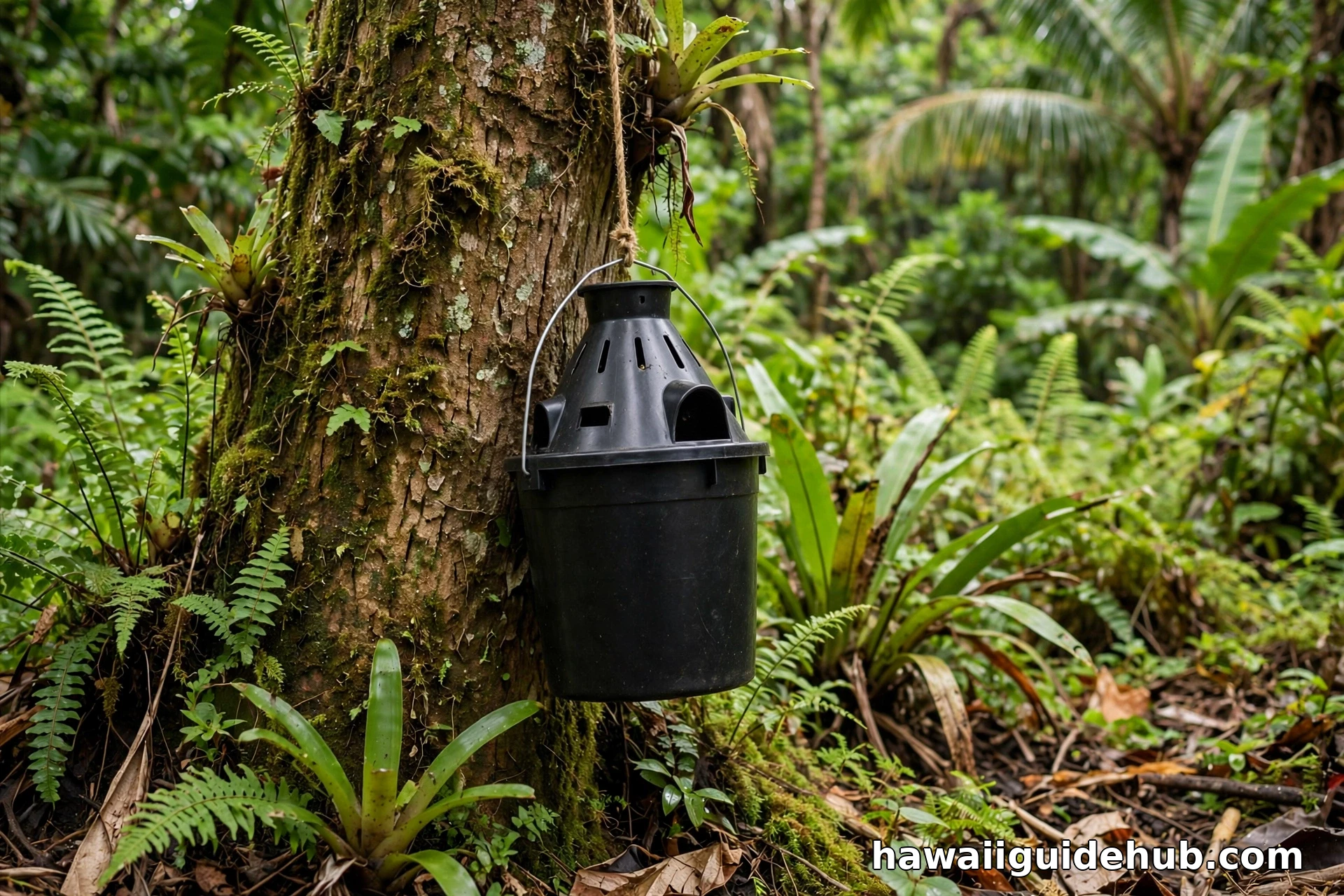
If you spot one of these black bucket traps hanging in a park or along a trail, leave it alone: it is baited with pheromone lures and serviced on a schedule, and each trap’s catch data feeds the island-wide map that guides the response. More than 3,000 of them hang across Oʻahu, a silent grid listening for beetles. The trap in the photograph is doing its job just by hanging there, and so are you, by knowing what it is.
CRB or Look-Alike?
Before you report, check: two common beetles resemble CRB. The Oriental flower beetle is widespread, feeds on fruit and nectar rather than boring into palms, and has no control program. The black dung beetle, intentionally introduced for ranching, is solid black and sometimes horned but only about 1.5 centimeters long, far smaller than CRB’s two inches, with a rigid wing case. True CRB signs on palms are the giveaway: bore holes in the crown and V-cuts in new fronds. When in doubt, photograph and report to 643-PEST rather than handling.
What the Response Looks Like
The CRB Response is a partnership of the University of Hawaiʻi, USDA, the Hawaiʻi Department of Agriculture, and others. Field crews service more than 3,000 traps across Oʻahu; canine crews sniff out beetles and breeding sites; a UH Mānoa lab researches new controls; a data team analyzes trap, mulch-survey, and tree-damage data; outreach teams work with businesses on compliance agreements. The Army’s natural resources program monitors traps on military lands. It is the largest insect response in state history, and it runs on public reports: every detection outside known areas starts with someone who noticed.
The economics sharpen the urgency. The Hawaiʻi legislature has found that the beetle threatens palm species foundational to the state’s agricultural economy, cultural heritage, and ecosystems, and the response draws about $2 million a year in USDA funding plus state appropriations. Coconut palms shade Waikīkī’s beaches, frame its hotels, and appear in nearly every image that sells Hawaii to the world; their loss would be an economic wound as well as an ecological one. The beetle does not distinguish between a resort palm and a wild loulu, and neither can the response.
The Larva in Your Compost
The adult beetle gets the attention, but the larva does the traveling. Fat, white, C-shaped grubs up to three inches long live for months in compost bins, mulch piles, and green waste, invisible to anyone who does not dig. Every load of mulch delivered, every bag of soil bought, every truck of green waste hauled between sites is a potential troop transport. The March 2026 discovery of 60 larvae in a retail bag of soil proved the pathway reaches into ordinary shopping.
What to look for: creamy-white grubs curled in a C shape, larger and chunkier than ordinary beetle larvae, in any moist organic material. If you find suspects, do not spread the material. Photograph, contain, and report to 643-PEST. Composting is good; composting rhinoceros beetles is not.
Guam’s Warning
To see Hawaii’s possible future, look at Guam, where the coconut rhinoceros beetle has killed palms by the thousands and transformed coastlines. Dead coconut trees stand like gray skeletons where groves once shaded beaches; the island’s response has cost millions and still has not eradicated the beetle. The Pacific islands that lost the early-detection window, Guam, Palau, parts of Samoa, now manage permanent infestations at permanent cost.
Hawaii’s advantage is that it knows exactly what losing looks like, because Guam shows it. The eradication campaigns on Kauaʻi, Maui, and Hawaiʻi Island are explicitly designed to avoid Guam’s fate: find every beetle early, or pay for them forever. Oʻahu, where the beetle established before the response scaled up, is the cautionary tale at home.
The Detector Dogs
Among the response’s most effective tools are dogs. CRB-detector dogs, funded in part by $350,000 a year in USDA support, sniff out adult beetles and, crucially, breeding sites hidden in mulch and green waste that human inspectors would miss. A dog can clear a mulch pile in minutes; a crew with shovels would take hours and still miss grubs.
The dogs work ports, nurseries, green-waste facilities, and response sites, and they are part of why new detections on the neighbor islands have been caught while still eradicable. It is a distinctly modern form of conservation: ancient canine noses deployed against an ancient Asian beetle, on Pacific islands neither evolved for.
Palms at Stake Beyond Coconut
Coconut palms dominate the headlines, but the beetle’s menu threatens rarer treasures. On Hawaiʻi Island, five endemic loulu palm species (Pritchardia beccariana, P. gordonii, P. lanigera, P. schattaueri, and others) grow nowhere else on Earth, and the beetle poses a serious threat to them. These are not beach ornamentals but ancient Hawaiian forest species, some already endangered, now facing a predator they never evolved with.
The secondary host list widens the risk further: hala, taro, banana, pineapple, sugarcane. The beetle prefers palms, but hunger makes it flexible. Protecting the coconut groves of Waikīkī matters for tourism; protecting the loulu of remote valleys matters for evolution. The response has to cover both.
What You Can Do
Learn the V-cut. Check your mulch, compost, and green waste for white C-shaped grubs. Do not move green waste, mulch, or palm material between islands, or within Oʻahu in violation of the interim rule. Buy soil and compost from reputable sources and inspect it. Report suspect beetles, grubs, or palm damage to the CRB Response Team at (808) 679-5244 or the state’s Pest Hotline at 643-PEST. On Kauaʻi, Maui, and Hawaiʻi Island, where eradication is still possible, your report could be the one that stops an island-wide invasion.
For more on Hawaii’s invasive species battles, the guide to Hawaiian cultural traditions adds the human dimension, while responsible travel practices and the guide to Hawaii’s natural environments cover visiting fragile places with care.
Watch: Coconut Rhinoceros Beetle in Hawaiʻi
Frequently Asked Questions
What is the coconut rhinoceros beetle?
A two-inch black horned beetle from Southeast Asia that bores into palm crowns to feed on sap. First found in Hawaiʻi in December 2013.
Does the coconut rhinoceros beetle bite?
No. It does not bite people, but handle specimens with care as they live in dirt and mulch and may carry disease.
How do you identify CRB damage?
Look for bore holes in the palm crown and V-shaped cuts in newly opened fronds. Severe attacks kill the growing point and the tree.
Which islands have coconut rhinoceros beetles?
Oʻahu has an established population. Kauaʻi, Maui, and Hawaiʻi Island have detections under eradication or early-detection response.
How do you report CRB in Hawaii?
Call the CRB Response Team at (808) 679-5244 or the state Pest Hotline at 643-PEST (7378).
The coconut palm is Hawaii’s silhouette: the leaning tree over the beach, the fronds in every postcard, the source of food and fiber for a thousand years of island life. The rhinoceros beetle is small, but the stakes are the landscape itself. Learn the V-cut, check your mulch, and report what you find. The islands’ palms are counting on it, from the resort rows of Waikīkī to the last wild loulu in a remote valley, and the time to act is while eradication is still on the table.