Hawaii Airports: Complete Guide by Island

Almost every trip to Hawaii starts the same way: with a boarding pass and a question. Which airport do you actually fly into? The answer depends on which island you are visiting, and getting it wrong can cost you an extra inter-island flight, a long drive, or both. Hawaii has one major international gateway and a handful of smaller airports spread across six islands, and each one serves a different corner of the state.
This guide covers every commercial airport in Hawaii by island, what each one is called, which airlines use it, and how to pick the right arrival point for your trip. If you are still deciding which island fits a first visit, sort that out first, because the island choice determines the airport.
Hawaii’s Main Airport: Daniel K. Inouye International (HNL)
The Daniel K. Inouye International Airport in Honolulu is Hawaii’s primary airport and the one most visitors use. It sits about three miles northwest of downtown Honolulu on the south shore of Oahu, and it handles more passengers than every other airport in the state combined. Federal records put it at over 10 million boardings in a recent year, which makes it a large-hub airport by FAA classification.
The airport was renamed in 2017 for Senator Daniel K. Inouye, the Honolulu native and Medal of Honor recipient who represented Hawaii in the U.S. Senate for nearly 50 years. Before that it was known as Honolulu International Airport. The three-letter code stayed HNL, so your ticket and baggage tags still say the same thing they always have.
HNL is the main hub for Hawaiian Airlines and serves as the state’s connection point to the U.S. mainland, Asia, and the South Pacific. If you are flying to Hawaii from outside the islands, there is a good chance this is where you land. The airport has four runways, including one built offshore on a reef, and two main terminals connected by the Wiki Wiki shuttle bus.
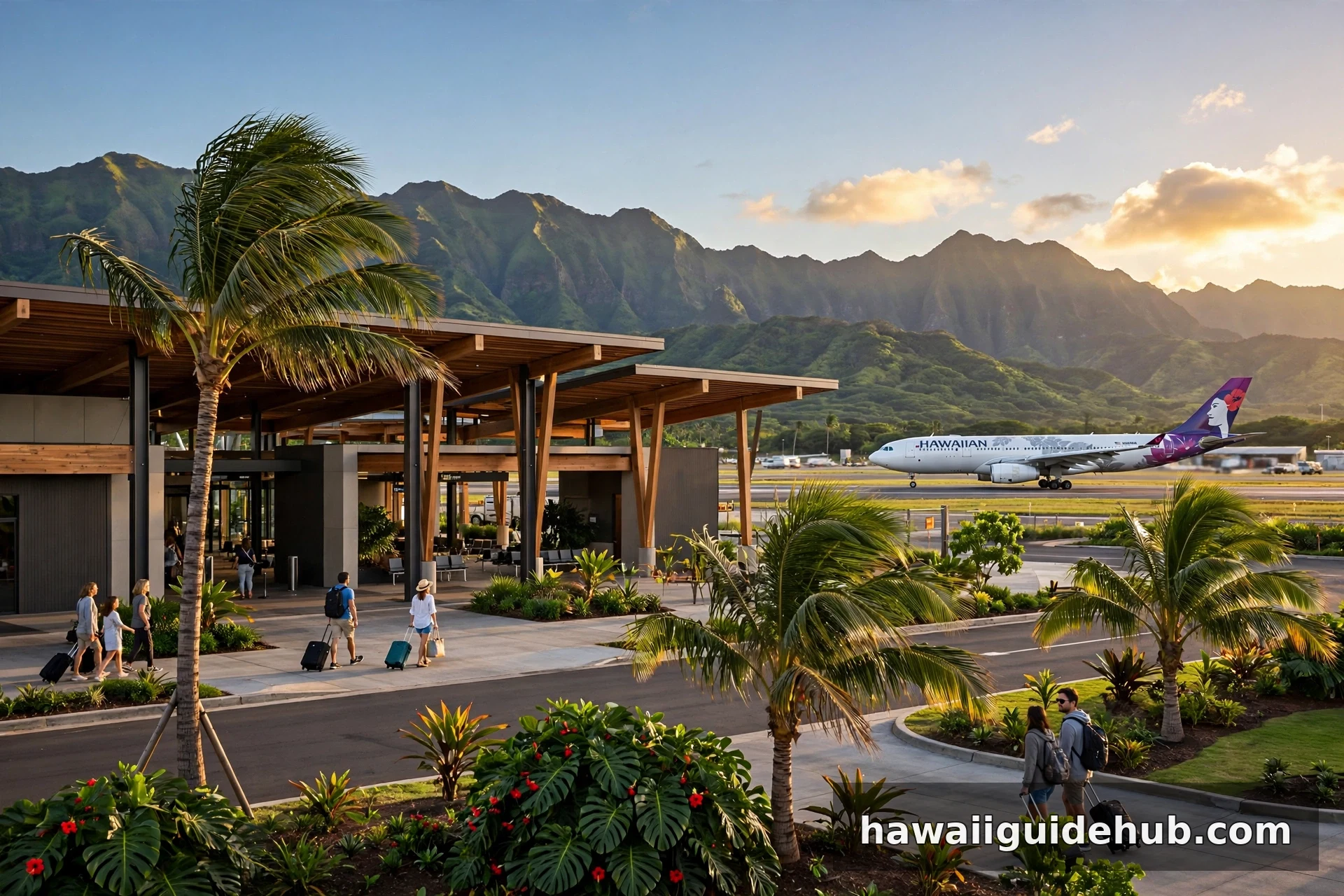
Inside, the terminals are open-air in the classic Hawaii style, with gardens between concourses. The airport has been modernizing in recent years, with consolidated rental car facilities and updated lobbies. Hawaiian Airlines moved its international check-in to Terminal 2, while inter-island flights generally use Terminal 1. If you are connecting from an international arrival to a neighbor island flight, give yourself plenty of time, because you will change terminals and reclear security.
Which Airport Is Closest to Waikiki?
HNL is the answer. Waikiki sits about 8 to 10 miles east of the airport along the south shore of Oahu, and the drive usually takes 20 to 30 minutes depending on traffic. Your options for the ride include rental cars, taxis, rideshares, hotel shuttles, and TheBus, Honolulu’s public bus system. There is no train connection yet, so plan for road transport. If Waikiki is your base, there is no reason to fly into any other airport.
For rental cars, HNL has a consolidated rental car center with shuttle service from the terminals. Book ahead, especially in peak season, because island inventory is limited and walk-up rates are painful. If you are not renting, the airport taxi line runs on flat rates to Waikiki, and rideshare pickups have a designated area upstairs from arrivals. TheBus is the budget play at a few dollars, but it takes closer to an hour with stops, so it suits light packers who are not in a hurry.
Why Is Maui’s Airport Code OGG?
Airport codes usually match the city name, so Kahului’s OGG puzzles first-timers. The code honors Bertram J. “Jimmy” Hogg, a pioneering Hawaiian Airlines pilot from the early days of inter-island flying. When the airport needed a three-letter identifier, KAH was taken, so the FAA approved OGG as a tribute. It is one of the few airport codes in the world named for a person rather than a place, and locals use it the way mainlanders say LAX or JFK.
Maui: Kahului Airport (OGG)
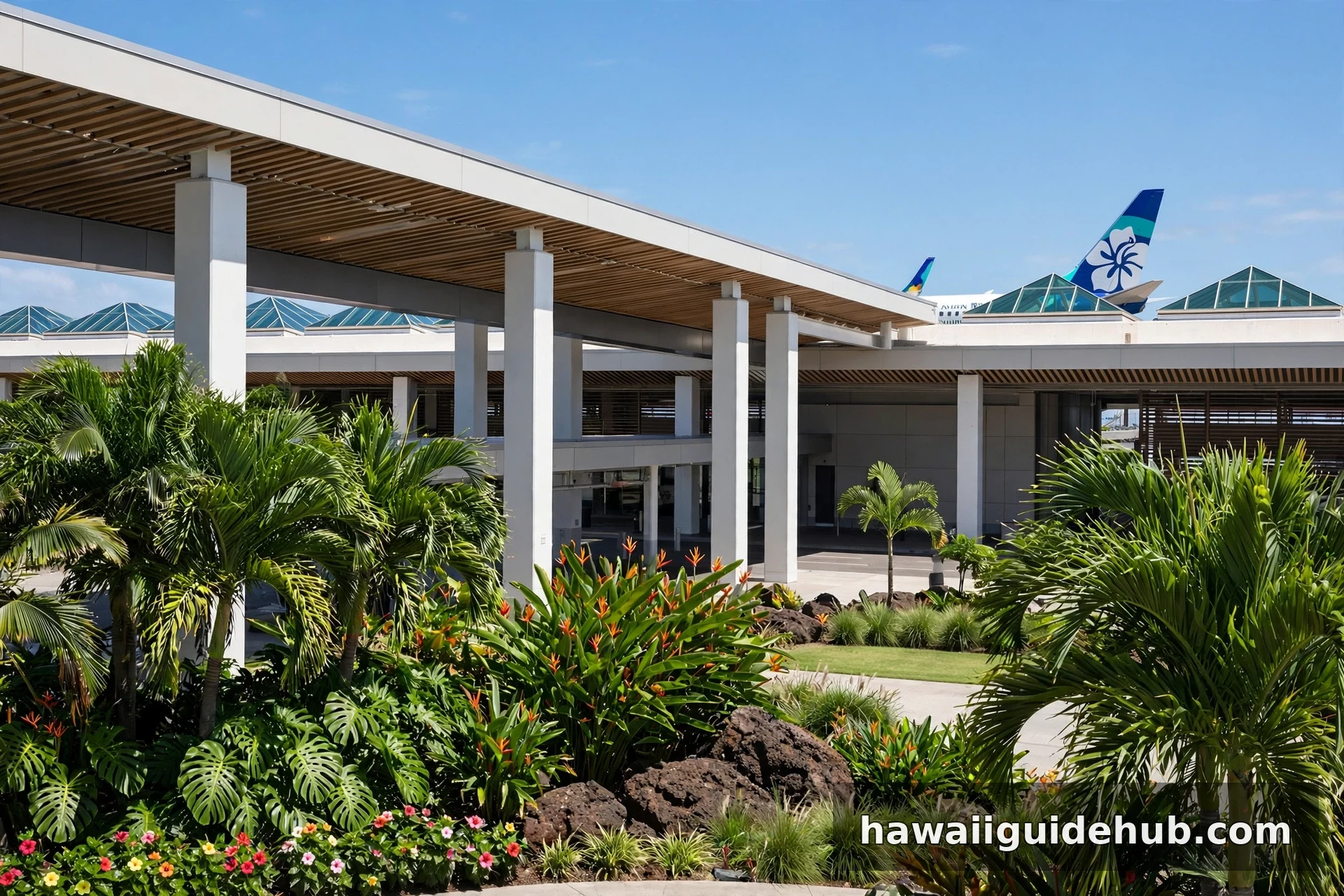
Kahului Airport is Maui’s main airport and the second busiest in Hawaii. It sits on the north-central coast near the town of Kahului, roughly in the middle of the island’s population centers. From here it is about a 15 to 25 minute drive to the resort areas of Kihei and Wailea to the south, and 30 to 45 minutes to Lahaina and Kaanapali on the west side.
OGG handles nonstop flights from the U.S. mainland and Canada as well as frequent inter-island service. If Maui is your destination, fly here rather than routing through Honolulu. Maui also has two much smaller airports, Kapalua (JHM) on the west side and Hana (HNM) on the remote east end, but both see only limited or charter traffic. For nearly every visitor, Kahului is the Maui airport.
Kahului town itself is a working town rather than a resort area, so most travelers pick up their rental car and drive straight to their side of the island. The airport has a consolidated rental car facility a short shuttle ride from the terminal. During whale season and holidays the rental lots can sell out entirely, so reserve the car when you book the flight, not after you land.
Hawaii Island: Kona (KOA) and Hilo (ITO)
The Big Island is the only Hawaiian island with two major airports, and they sit on opposite coasts about 75 miles apart. Picking the wrong one adds well over an hour of driving, so this choice matters more here than anywhere else in the state.
Ellison Onizuka Kona International Airport (KOA)
Kona International Airport sits at Keahole on the sunny west coast of Hawaii Island, about 15 minutes north of Kailua-Kona town. It is named for Ellison Onizuka, the Hawaii-born astronaut who died in the Challenger disaster. KOA handles nonstop flights from the mainland and is the right choice if you are staying in Kona, Waikoloa, Kohala, or anywhere along the west coast resort corridor.
Hilo International Airport (ITO)
Hilo International Airport serves the east side of Hawaii Island from the town of Hilo. It is a smaller airport with mostly inter-island service plus some mainland flights. Choose Hilo if your plans center on Hawaii Volcanoes National Park, the Hamakua Coast, or the lush windward side. Driving from Kona airport to the volcano takes about two hours, so flying into the correct side saves real time.
Many visitors split a Big Island trip between both coasts, and the airports make that easy. Fly into one side, drive across the island over several days, and fly home from the other. The Saddle Road between Kona and Hilo is the fastest cross-island route and is fully paved, though rental companies once restricted it, so check your agreement. Either way, do not try to see the whole island from a single base. It is bigger than all the other Hawaiian islands combined.
Kauai: Lihue Airport (LIH)
Lihue Airport is Kauai’s only commercial airport, located in the town of Lihue on the island’s southeast coast. It handles nonstop mainland flights as well as inter-island connections. From LIH it is about 15 minutes to the east side beaches, 30 minutes to Poipu on the south shore, and around 45 minutes to Princeville and Hanalei on the north shore. Kauai is compact enough that one airport serves the whole island well.
Kauai’s north shore is worth a note for drivers. The single highway to Hanalei crosses one-lane bridges and can back up badly on weekends and holidays, so a 45-minute estimate can stretch. If you are staying in Princeville or Hanalei, an early arrival beats landing at sunset and driving the coast road in the dark. The airport itself is small and easy to navigate, with rental car lots a short walk from baggage claim.
Molokai: Molokai Airport (MKK)
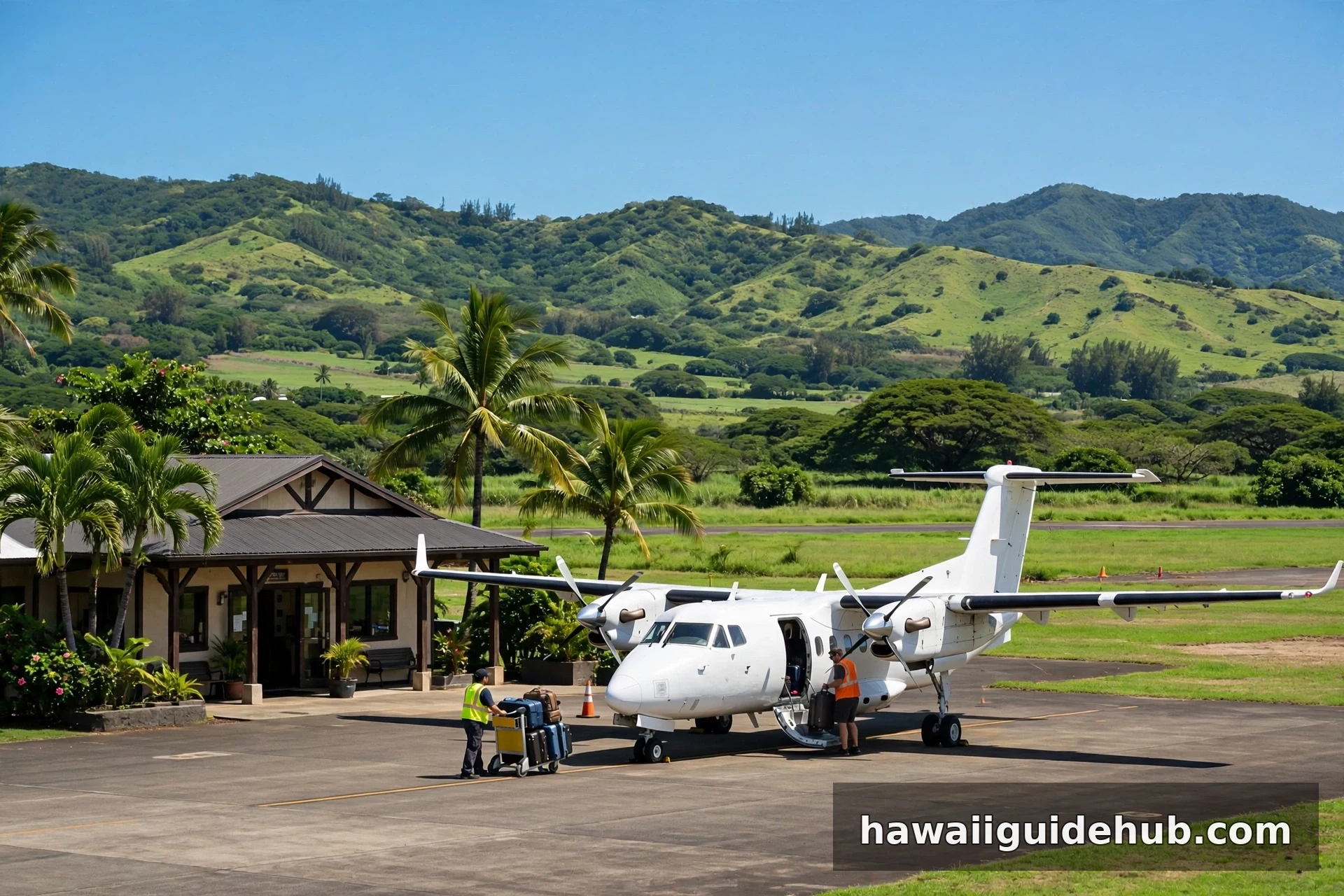
Molokai Airport, also known as Hoolehua Airport, sits on the central plateau of Molokai near the town of Kaunakakai. It is a small airport served by commuter turboprops, mostly connecting through Honolulu. There are no nonstop mainland flights to Molokai. If you are visiting the island, expect a short hop from Oahu on a small plane, which is part of the adventure.
Lanai: Lanai Airport (LNY)
Lanai Airport serves the island of Lanai from just outside Lanai City. Like Molokai, it is reached by commuter flights, usually via Honolulu. The island has only a couple of resorts and a small resident population, so air service is limited but reliable. Most visitors to Lanai arrive by air from Oahu, though a ferry from Maui is another option for those already on the Valley Isle.
Which Hawaii Airport Should You Fly Into?
The simple rule: fly directly to the island where you will spend most of your time. Oahu means HNL. Maui means OGG. Kauai means LIH. The Kona side of the Big Island means KOA, and the Hilo and volcano side means ITO. Molokai and Lanai mean connecting through Honolulu to MKK or LNY.
First-time visitors often default to Honolulu because it has the most flight options and the lowest fares, then add inter-island hops from there. That works, but if you know you want Maui or Kauai, booking the nonstop to OGG or LIH saves a connection. Oahu itself rewards more than a layover, with plenty to fill a full stay, from Pearl Harbor near the airport to the windward coast across the Koolau mountains.
Inter-Island Flights
Hopping between islands means flying. There are no ferries between the major islands for passengers with cars, and the distances are too great for anything but aircraft. Hawaiian Airlines runs the most frequent inter-island schedule, and Southwest also flies between the islands. Flights between Honolulu and the neighbor islands take 30 to 50 minutes gate to gate. Book these separately from your mainland flights or as part of a multi-city ticket, and leave generous connection time in Honolulu if you are transferring the same day.
A few practical notes for island hopping. Inter-island flights board fast and the cabins are simple, so travel light if you can. Hawaiian’s inter-island fare often includes checked bags depending on the fare class, while Southwest includes two free checked bags as standard, which matters if you are hauling snorkel gear. Morning flights are the most reliable because Hawaii’s trade winds build through the afternoon and can delay the smaller turboprops. And if you are visiting Molokai or Lanai, remember you are on a 9-seat or similar small aircraft with strict weight limits, so pack soft bags and keep it light.

Agricultural Inspection: Leaving Hawaii
One Hawaii airport ritual surprises first-timers. When you fly from Hawaii to the U.S. mainland, your checked and carry-on bags go through a U.S. Department of Agriculture inspection before you board. Hawaii’s ecosystem is uniquely vulnerable to invasive pests, so fresh fruits, vegetables, plants, and seeds are restricted. The inspection stations sit right in the departure areas, and the process is quick if you pack accordingly. Eat the pineapple before you leave, or buy pre-inspected, sealed fruit at the airport.
How Early to Arrive for Your Flight Home
Hawaii airports recommend two hours for inter-island departures and three hours for mainland and international flights, and the advice is worth following. The agriculture inspection adds a step you do not have at mainland airports, the rental car return can involve a shuttle ride, and HNL’s terminals are spread out enough that gate changes cost real walking time. Morning departures are the smoothest. By afternoon the trade winds pick up, the security lines grow, and the smaller airports start running behind. An early flight home also gives you a buffer if you are returning a rental car and catching a tight connection in Honolulu.
Video: Inside Honolulu’s Main Airport
This 4K walkthrough of the Daniel K. Inouye International Airport shows the terminals, gates, and cultural gardens so you know what to expect on arrival.
Hawaii Airports at a Glance
Hawaii’s airport system is run by the state Department of Transportation and covers 15 airports in total, though only a handful handle regular commercial traffic. For trip planning, the ones that matter are HNL on Oahu, OGG on Maui, KOA and ITO on Hawaii Island, LIH on Kauai, and the commuter fields MKK on Molokai and LNY on Lanai. Match the airport code to your island, remember the agriculture check on the way home, and the flying part of your Hawaii trip takes care of itself.