Cane Spiders in Hawaii: Size, Bites & What to Do

Every Hawaii newcomer has the moment: you flip on the bathroom light at midnight and something the size of your palm is sprinting across the wall. Welcome to the cane spider, Hawaii’s largest spider and its most misunderstood roommate. The good news, all of it, is simple: cane spiders are harmless, they eat cockroaches, and they are far more afraid of you than you are of them. This is the complete guide: identification, size, why they are called cane spiders, what to do when one appears, and why locals quietly appreciate them.
What Is a Cane Spider?
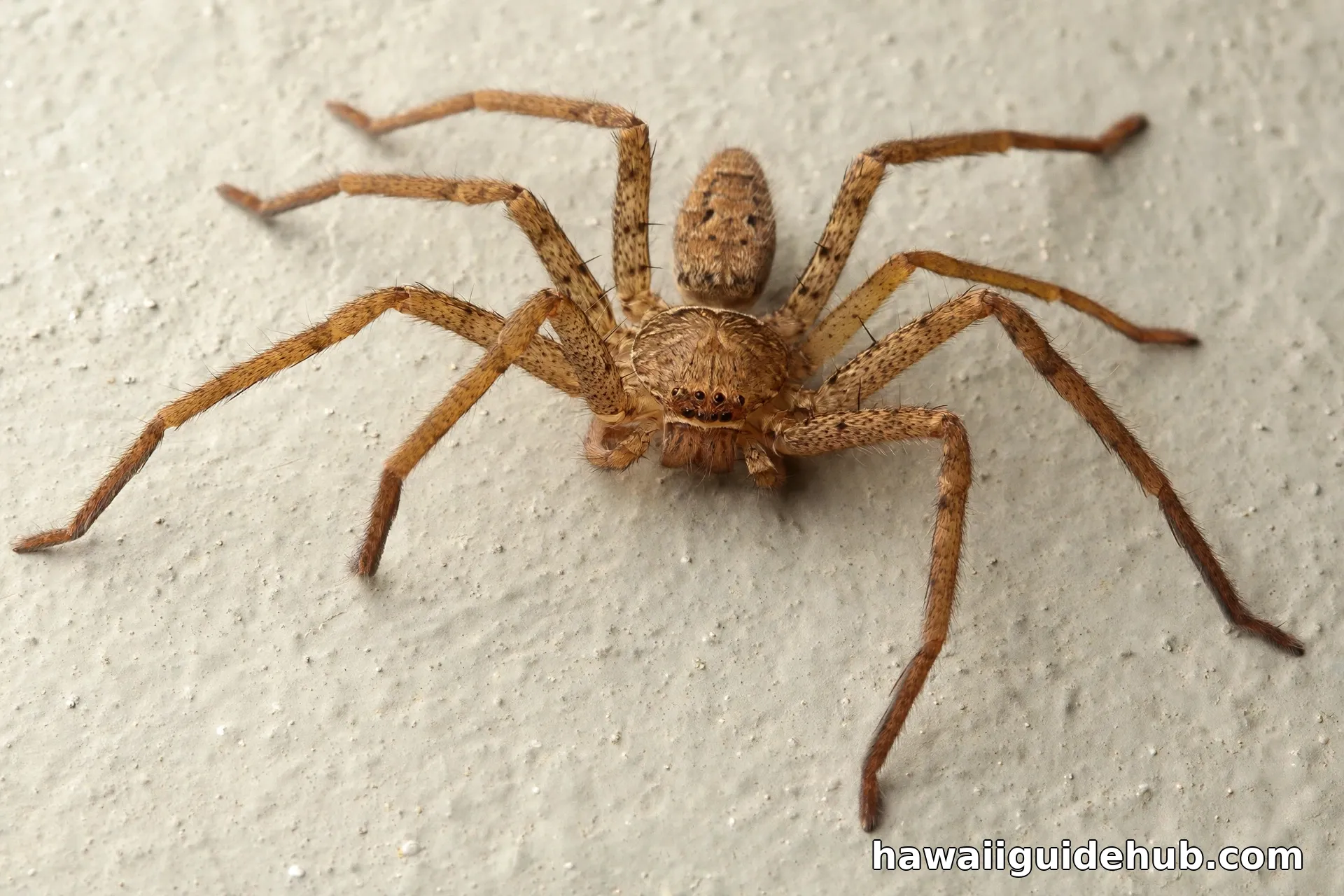
The cane spider is Heteropoda venatoria, the pantropical huntsman spider, a member of the huntsman family Sparassidae. It is not native to Hawaii: it arrived from Asia with human commerce, likely in the 1800s, and found the islands’ warm climate and abundant insects ideal. The name comes from the sugar cane fields where plantation workers constantly encountered them. Other names: huntsman spider, giant crab spider (for the sideways leg stance). They do not build webs: they are active hunters that chase down prey at night, which is why the one on your wall can move with such alarming speed.
How Big Do Cane Spiders Get?
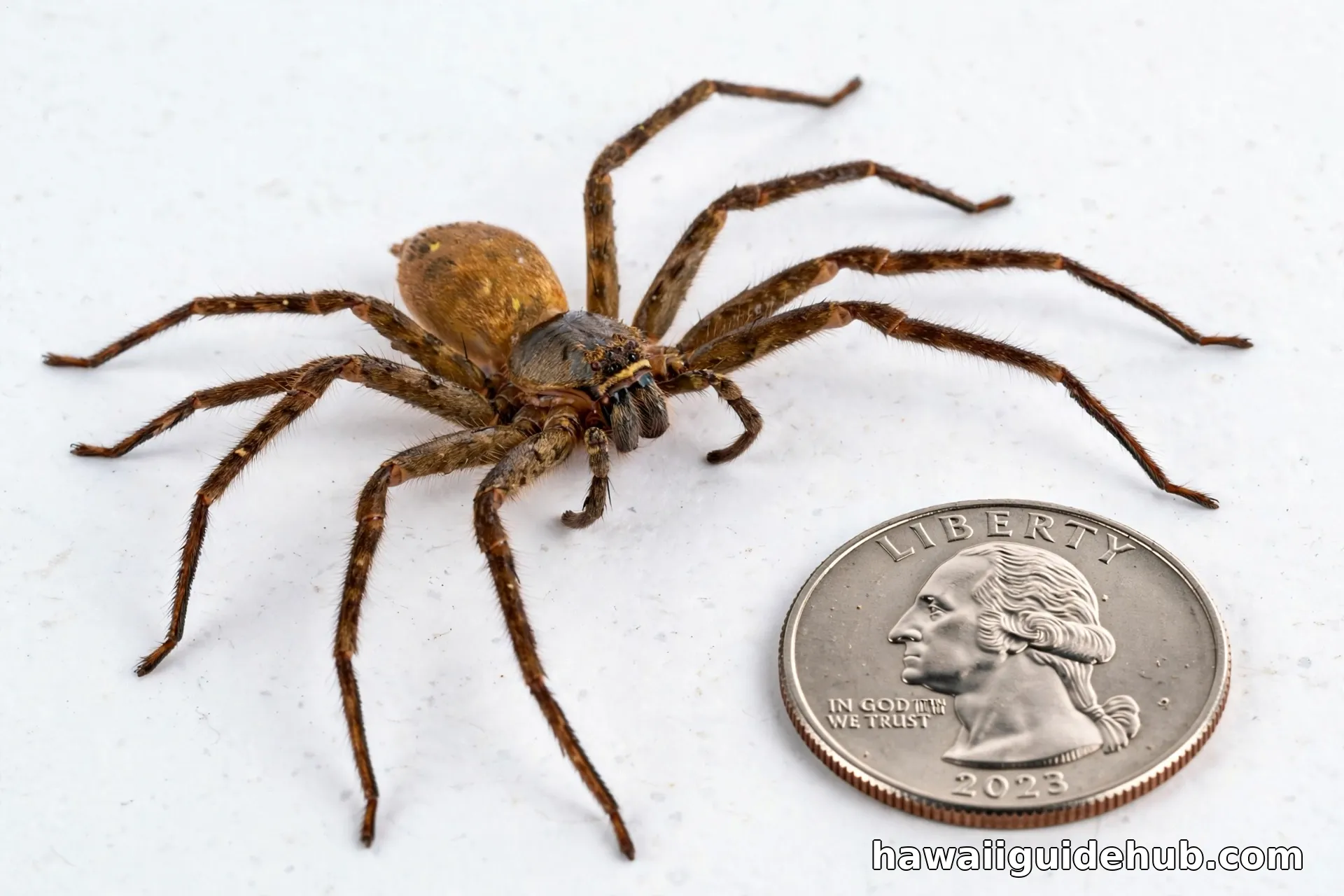
The body is 2 to 2.5 cm (about an inch) long, but the leg span reaches 7 to 10 cm (3 to 4 inches), and large females can stretch toward 5 inches (13 cm). Females are stockier with bigger abdomens; males are lankier with longer legs. Color is mottled tan, brown, cream, and black, excellent camouflage against bark and walls. They are the largest spiders in Hawaii by a wide margin, which is exactly why they cause such a stir: nothing else on the islands is remotely this big, so every encounter feels unprecedented. If you arrived here asking what the biggest spider in Hawaii is, this is it.
Are Cane Spiders Dangerous?
No. Cane spiders are famously reluctant to bite: their first, second, and third response to a human is to flee at full speed. Bites happen only when one is trapped against skin or handled, and the venom is not medically significant to humans: the bite is painful like a bee sting, may cause local swelling, and occasionally a headache, but resolves without treatment. There are no recorded serious envenomations. Compare that to the centipede, Hawaii’s actually painful arthropod, and the cane spider is a gentleman. The fear is purely about size and speed, not venom.
What to Do When You Meet One: The Decision Table
| Where you find it | Your move | Why |
| On an outside wall or lanai | Leave it alone | It is on patrol eating cockroaches; it will move on |
| Inside, on a wall or ceiling | Jar and paper, release outside | Takes 30 seconds; killing it wastes free pest control |
| In your bed or on your body | Stay calm, brush it off | It is lost and terrified; sudden swatting risks a defensive bite |
| A female with an egg sac | Release far from the house | One sac means dozens of spiderlings; relocate the whole family |
| You are phobic and cannot cope | Ask someone else, or call pest control | No shame; but ask for catch-and-release first |
The jar technique: place a large jar over the spider, slide stiff paper underneath, carry outside, release near vegetation. Huntsmen are fast, so move deliberately rather than quickly: jerky lunges trigger their sprint reflex. Never try to grab one with your hands: not because it is dangerous, but because a crushed spider can bite reflexively and you will feel bad about it.
Why Locals Secretly Love Them
Ask a longtime Hawaii resident about cane spiders and you will hear reluctant affection. A house with cane spiders is a house without cockroaches: huntsmen are voracious predators of roaches, silverfish, moths, and other household insects. In the plantation era, workers welcomed them in cane field barracks for exactly this reason. Some cultures across the Pacific keep huntsmen as deliberate household pest control. The modern Hawaii compromise: one patrols the garage and lanai, none in the bedroom. It is a working relationship.
For Visitors: Will You See One?
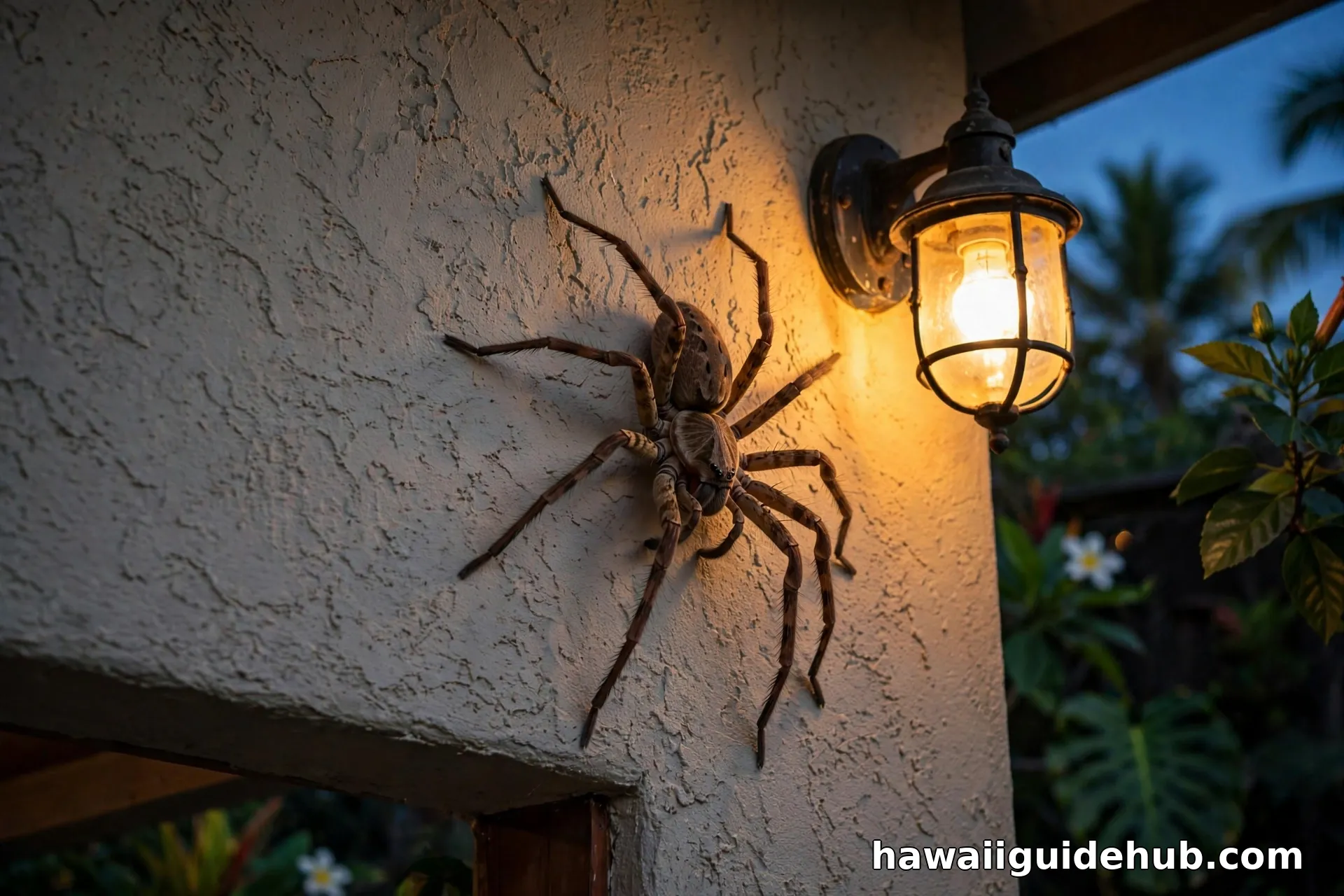
Maybe, and it will be a story. Cane spiders frequent the exteriors of buildings at night, drawn by the insects around lights. Garden-level hotel rooms, rural vacation rentals, and open-air lobbies are the most likely venues. They do not infest beds or luggage. If one appears in your room, call the front desk: staff handle this routinely and will relocate it in seconds. Do not cancel your trip over it: you are statistically more likely to be inconvenienced by a mosquito. If you are choosing accommodations, the best island for first-time visitors guide covers what to expect where, and Hawaii’s best adults-only resorts round up the polished stays where housekeeping keeps every eight-legged surprise at bay. Put the spider on your Hawaii bucket list under “wildlife encounters,” filed between the geckos and the rainbows.
The Science: How Huntsmen Hunt
Huntsmen are the cheetahs of the spider world. Instead of webs, they use eight eyes arranged in two rows, with excellent motion detection, and legs that articulate sideways like a crab’s for explosive lateral movement. They wait motionless on a vertical surface, often a wall or tree trunk, and sprint down prey in a fraction of a second. Their speed is the real defense: a startled huntsman can cross a room before you finish flinching. They also squeeze through improbably tight gaps by folding their legs flat, which is how they appear inside closed rooms. All of this machinery is aimed at insects: nothing about their hunting behavior targets humans.
The Egg Sac: Dozens of Roommates Incoming
A female cane spider carries a round, papery egg sac under her body, and she guards it fiercely: this is the one situation where a huntsman may stand its ground instead of fleeing. When the spiderlings hatch, dozens of tiny hunters disperse at once. If you find a female with a sac indoors, relocate her well away from the house rather than releasing her by the door: you do not want fifty spiderlings colonizing your garage. The spiderlings are harmless and most will not survive, but prevention beats a nursery.
Myths and Viral Hoaxes
Cane spiders star in their share of internet nonsense. The famous viral photo of a “six-foot spider” was a photoshopped wolf spider from Florida, not a Hawaiian cane spider: the artist later published a video showing exactly how he faked it. No cane spider has ever been six feet, or even one foot, across. Another persistent myth claims they are aggressive: in reality, researchers handle huntsmen routinely with simple containers, and defensive bites are a footnote. The scariest thing about a cane spider has always been the camera angle.
Cane Spiders in Plantation History
The name is a direct artifact of the sugar era. Plantation laborers working the cane fields encountered huntsmen constantly: the spiders thrived in the fields eating the insects that plagued the crop, and rode cut cane into mills and barracks. Workers learned to coexist with them, and the name “cane spider” stuck across every island. When the plantations closed, the spiders stayed, moving into suburbs and gardens. Every cane spider on your lanai is a small living relic of Hawaii’s plantation century.
Video: Are Huntsman Spiders Actually Dangerous?
The Wild Report gets up close with the pantropical huntsman and Hawaii’s garden spiders.
The Runners-Up: Other Large Spiders in Hawaiʻi
The closest challenger is the Hawaiian garden spider, Argiope appensa, an orb weaver also called a banana spider for its yellow markings. Big females, boldly patterned in yellow, black, and white with banded legs, span about 2 to 2.5 inches including legs, and they sit head down in the center of large orb webs in gardens and along paths across all the main islands. Impressive, photogenic, and completely web bound, the garden spider is the spider visitors photograph. On size, it is not close.
The giant daddy long legs cellar spider can look enormous at a glance because its thread-thin legs stretch so far, but its body is only a few millimeters long and the whole animal weighs almost nothing, so it challenges the cane spider in silhouette only. Spiny-backed orb weavers and the various jumping spiders are charming and all tiny by comparison. The honest ranking in Hawaiʻi: the cane spider first by a wide margin, the garden spider second, and everything else a distant field.
Native Spiders Worth Knowing
Hawaiʻi’s native spider fauna is remarkable, and almost none of it is large. The happy face spider, Theridion grallator, is an endemic leaf dweller famous for the smiling pattern on its small abdomen, each spider carrying a different pattern like a fingerprint. The Kauaʻi cave wolf spider, Adelocosa anops, is a completely eyeless wolf spider found only in a few lava caves in the Kōloa district of Kauaʻi, where it hunts a cave amphipod in total darkness. It was listed as federally endangered in 2000 and measures only about 2 centimeters across. Hawaiʻi’s native stick spiders and long-jawed orb weavers evolved island by island into forms found nowhere else on Earth. None of them will ever be mistaken for the biggest spider in Hawaii, and all of them deserve more wonder than fear.
Frequently Asked Questions About Cane Spiders
What is a cane spider in Hawaii?
The cane spider is Heteropoda venatoria, the pantropical huntsman spider, introduced from Asia. It is Hawaii’s largest spider, named for its abundance in sugar cane fields.
How big do cane spiders get?
Body about 1 inch; leg span 3 to 4 inches, with large females reaching 5 inches. They are the largest spiders in Hawaii.
Are cane spiders poisonous?
Not medically significant. They are reluctant biters; bites are painful but minor and resolve without treatment. The correct term is venomous, and the venom is not dangerous to humans.
Do cane spiders bite humans?
Only when trapped against skin or handled. They always prefer to run. Wash the bite, apply ice, and watch it: medical care is rarely needed.
Are cane spiders and huntsman spiders the same?
Yes. “Cane spider” is Hawaii’s local name for Heteropoda venatoria, the pantropical huntsman spider.
How do I get rid of cane spiders?
Catch and release with a jar: it takes seconds. Reduce what attracts them by sealing entry gaps, reducing outdoor lighting near doors, and controlling the insects they hunt. Consider keeping one in the garage as free cockroach control.
The Molt: The “Dead” Spider That Isn’t
One of the great cane spider pranks: finding what looks like a dead spider curled on the floor, only to realize it is an empty molt. Huntsmen shed their exoskeletons as they grow, splitting the old skin and stepping out, leaving a perfect ghost of themselves behind. A molt looks translucent and weightless, with a split along the back; a truly dead spider curls its legs tightly underneath. If you find a molt, the spider is nearby, bigger than before, and soft for a day or two while the new exoskeleton hardens. It is a sign of a healthy resident hunter, not an infestation.
Keeping Them Out (If You Must)
Exclusion works better than extermination. Seal gaps under doors with sweeps, caulk cracks around windows and pipes, and fit screens on vents: huntsmen enter through gaps you would not believe. Reduce outdoor lighting near entryways or switch to yellow “bug lights,” which attract fewer of the insects that draw hunting spiders. Keep firewood and dense vegetation away from walls. Indoors, declutter closets and storage so there are fewer hunting grounds. Sprays are a poor answer: huntsmen roam too widely for residual pesticides to reliably contact them, and you would be poisoning your free cockroach control.
Do cane spiders live in groups?
No. They are solitary hunters. Finding several in one house usually means good hunting (lots of insects) rather than a colony. Each spider holds its own territory.
Can cane spiders kill pets?
No. Cats and dogs are at no risk: many cats hunt cane spiders themselves. The spider’s venom is insect-scale, and a curious pet might get a startled nip at worst.
Why is it called a cane spider?
Plantation workers named it for the sugar cane fields where it was ubiquitous, hunting insects among the stalks. The name predates the plantations’ closure and survives across all islands.
Night Shift: A Day in the Life
By day, your cane spider is wedged motionless behind a shutter or under bark, flattened into a crevice, invisible. At dusk it emerges and takes up station on a wall near a light, where moths and beetles gather. It waits, utterly still, for hours if needed. When prey wanders within range, the strike takes a fraction of a second: a sprint, a grab with spiny pedipalps, a venomous bite sized for insects. By dawn it has eaten, and it retreats to its crevice before the birds wake. You will almost never see the hunt: only the startling moment when the hunter relocates across your wall at 2 AM, which is the spider commuting, not attacking.
Cane Spider vs. Wolf Spider: Don’t Confuse Them
Newcomers often call any big brown spider a cane spider, but Hawaii’s wolf spiders are a different family: stockier, ground-dwelling, and mothers that carry babies on their backs. The cane spider’s telltales are the flattened crab-like leg stance, the speed on vertical surfaces, and the mottled tan-brown pattern. Wolf spiders prowl the ground and rarely climb walls. Both are harmless, so the distinction is academic, but getting the name right earns nods from local naturalists. For the full lineup of what else crawls here, note that the centipede, not any spider, is the Hawaiian arthropod that actually deserves your caution.
The cane spider is Hawaii’s gentle giant: startling, speedy, and utterly harmless. Give it the jar-and-paper treatment, thank it for the cockroach patrol, and you will have earned your Hawaii resident stripes.