Kikakapu: The Complete Guide to Butterflyfish in Hawaiʻi

Few reef fish are as instantly charming as the butterflyfish. Small, bright, and almost comically flat, they flutter around coral heads in pairs like their namesakes, picking at the reef with tiny pointed snouts. In Hawaiʻi they are called kikakapu, and with about two dozen species in local waters, they are one of the fish families snorkelers see most.
This is the single complete guide to butterflyfish in Hawaiʻi. It covers how to identify kikakapu, the endemic species found only here, the common species you will see while snorkeling, what they eat, where they live, how to watch them responsibly, and answers to the questions visitors ask most. If you have been searching for anything about butterflyfish in Hawaiʻi, the answers are all here on this one page.
Butterflyfish in Hawaiʻi at a Glance
| The fact | The detail | Snorkeler’s note |
|---|---|---|
| Hawaiian name | Kikakapu (kee-kah-kah-poo) | Say it on the boat; the crew will approve |
| Family | Butterflyfish (Chaetodontidae) | One of the easiest reef families to recognize |
| Species in Hawaiʻi | About two dozen, 3 endemic | Bluestripe, milletseed, and multiband: found nowhere else on Earth |
| Size range | About 4 to 12 inches long | Hand-sized; easy to miss if you swim too fast |
| Where they live | Coral and rocky reefs on all main islands, shallow to deep water | Any decent snorkel spot will have them |
| What they eat | Coral polyps, small invertebrates, algae, and plankton, depending on species | The coral-eaters are why healthy reefs matter |
| Social life | Many species form long-term pairs and defend territories | Spot one, look for its partner nearby |
| Best time to see them | Year-round, during daylight snorkeling hours | Morning light is kindest for photos |
| Danger to humans | None; they are small, shy, and harmless | The safest fish on the reef |
What Is a Kikakapu? How to Identify a Butterflyfish
A butterflyfish is hard to mistake for anything else. The body is deep, thin, and disc-shaped, almost like a pancake standing on edge, with a small pointed mouth at the front. Most species wear bold patterns: stripes, spots, bands, and eye-like markings that break up their outline against the busy background of the reef. They swim with a fluttering motion of their pectoral fins, which is where the butterfly comparison comes from.
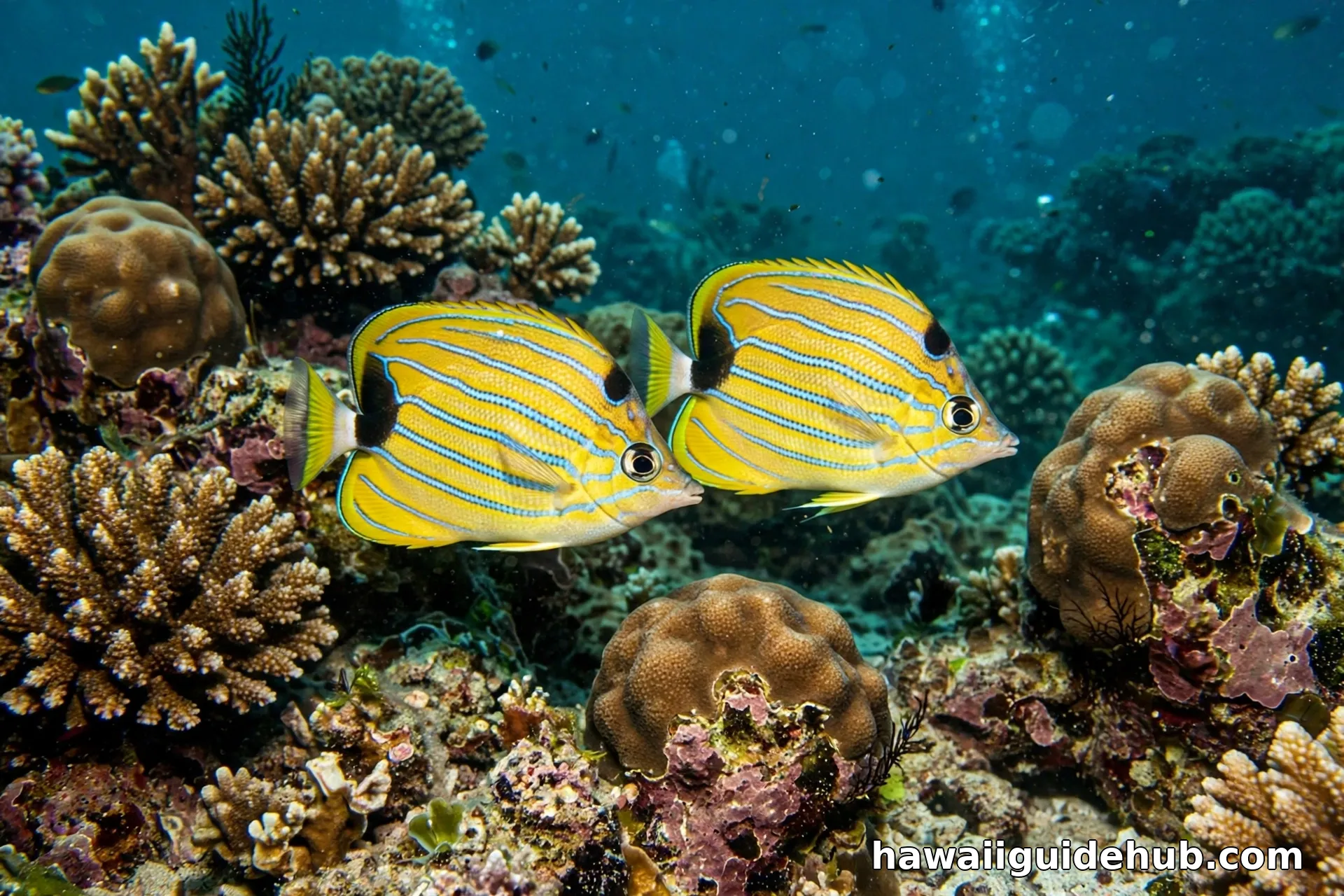
Many butterflyfish have a dark spot near the tail that looks like a false eye. Scientists believe this marking confuses predators, encouraging them to strike at the tail end while the fish escapes headfirst. Combined with a real eye often hidden inside a dark face band, it is an effective disguise. The bluestripe butterflyfish, one of Hawaiʻi’s endemics, is a textbook example: eight blue stripes radiate across a yellow body, with a black spot on the head and a larger one at the base of the tail.
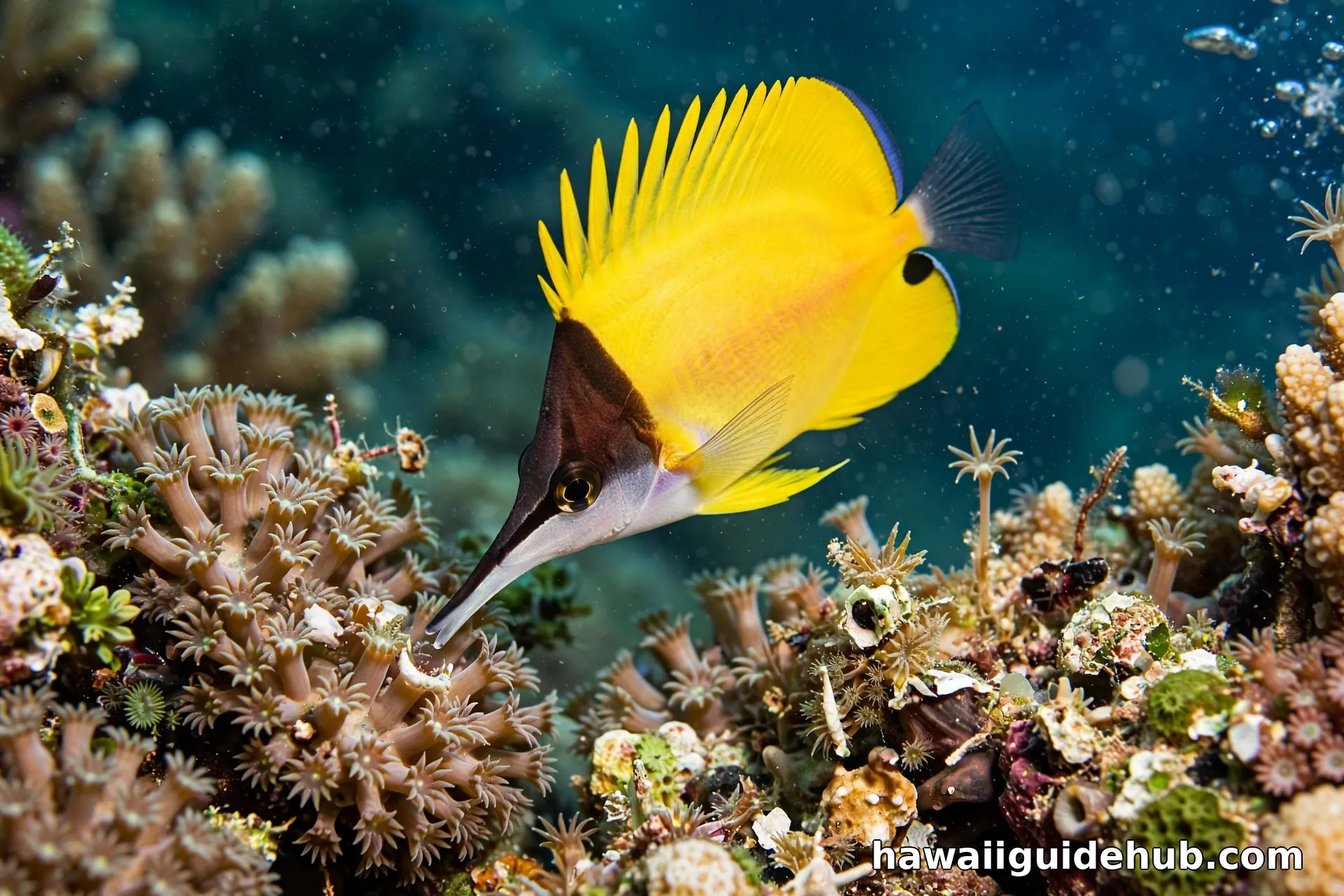
Size is modest across the whole family. Hawaiian butterflyfish range from about four inches in the smallest species to about a foot in the largest, so even the big ones fit comfortably in your mask’s field of view. The longnose butterflyfish stretches the definition with its extended snout, a specialized tool for reaching into cracks and picking out tiny prey that other fish cannot reach.
Butterflyfish Species in Hawaiʻi
About two dozen butterflyfish species live in Hawaiian waters, and three of them are endemic, found naturally only in Hawaiʻi and nearby Johnston Atoll. The endemics are the ones worth learning first, because seeing them is a Hawaiʻi-only experience. The bluestripe butterflyfish is abundant on shallow coral and rocky reefs down to about 90 feet, glowing yellow with eight diagonal blue stripes. The milletseed butterflyfish, also called the lemon butterflyfish, is yellow with rows of dark spots and is the most common member of the family in the islands. The multiband butterflyfish, also known as the pebbled butterflyfish, is white with yellow, brown, and black markings, grows to under five inches, and is famous for forming devoted pairs.
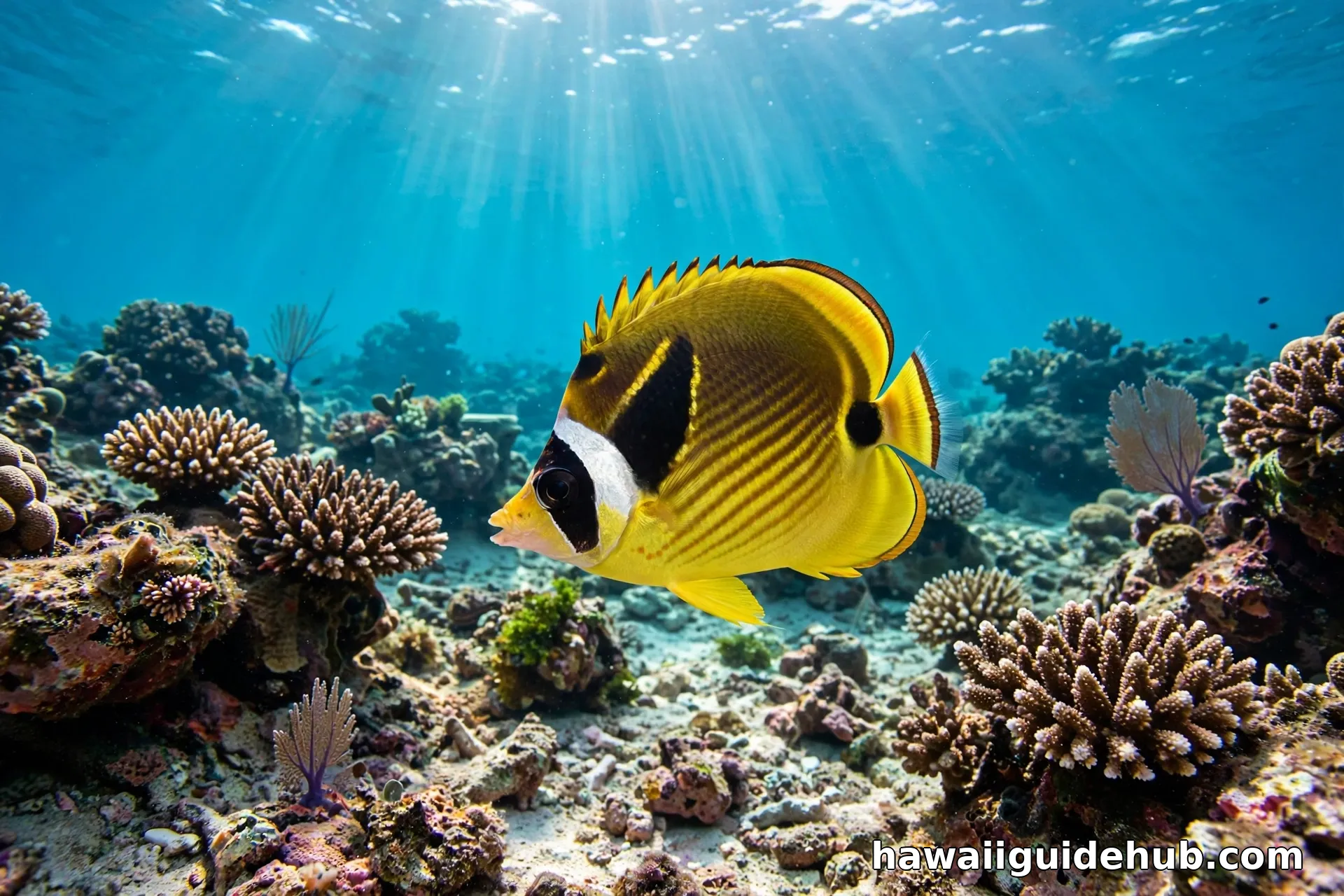
The rest of the local lineup has wider Pacific ranges. The raccoon butterflyfish wears a black mask like its namesake mammal. The threadfin butterflyfish trails a long filament from its dorsal fin and feeds on small invertebrates and algae. The teardrop, ornate, and lined butterflyfish add their own patterns to the mix. The longnose butterflyfish has the widest distribution of all, ranging from East Africa to the Americas, and takes a wide variety of foods while rarely bothering corals.
What Butterflyfish Eat
Diet is where butterflyfish get interesting, because different species eat very different things. Some are obligate corallivores, meaning they feed almost exclusively on live coral polyps, nipping them one by one with tweezer-like mouths. Others are generalists, eating small invertebrates, algae, and plankton. The threadfin butterflyfish feeds principally on sessile invertebrates, including stinging cnidarians, plus algae. The milletseed butterflyfish feeds largely on zooplankton drifting in the water column, and its juveniles even work as cleaner fish, picking parasites off larger fish.
This picky eating is why many butterflyfish do so poorly in home aquariums: a fish that eats only live coral polyps cannot be fed flakes. It is also why butterflyfish are useful indicator species for scientists. Because the corallivores depend directly on healthy coral, their numbers reflect the condition of the reef itself. A reef with plenty of paired-up butterflyfish is usually a reef in good shape, a connection explored further in our article on why salinity matters to marine life and the delicate balance reef animals depend on.
Mouth shape tells you a lot about a butterflyfish’s menu. The longnose butterflyfish carries the most extreme version, a slender tube of a snout that probes into narrow cracks for tiny worms and crustaceans other fish cannot reach. Shorter-snouted species nip and pluck at the reef surface. Even within one small family, evolution has produced a toolkit of mouths, each matched to a different way of making a living on the reef. That variety is part of why so many butterflyfish species can share the same coral head without directly competing.
Butterflyfish Behavior: Pairs, Territories, and Reef Life
Watch butterflyfish for a few minutes and a pattern emerges: they travel in twos. Many species form long-term pairs that stay together for months or years, patrolling a shared territory on the reef and driving off intruders of the same species. The multiband butterflyfish is well known for this devotion. Pairs coordinate their feeding, moving across the reef in loose formation, and researchers believe the partnership helps them defend the feeding territory they both depend on.
They are daytime fish, active from morning until late afternoon, and they sleep hidden in the reef at night. Unlike the schooling tangs or the solitary jacks, butterflyfish keep a steady, unhurried pace, which makes them wonderful photographic subjects. They are not particularly afraid of snorkelers, and a calm swimmer can often drift within a few feet of a feeding pair.
Young butterflyfish sometimes take on a completely different job. Juvenile milletseed butterflyfish work as cleaner fish, picking parasites and dead skin from larger fish that visit their cleaning stations. It is a common arrangement on reefs: the big fish gets groomed, the little fish gets a meal, and both benefit. As the milletseeds grow, they graduate to plankton feeding in the water column, trading the cleaning station for the open reef.
Where to See Butterflyfish in Hawaiʻi
You will find kikakapu on every main Hawaiian island, wherever there is coral or rocky reef. Shallow reefs are the easiest place to see the endemics: bluestripes are abundant on coral and rocky reefs in water you can comfortably snorkel. Milletseeds, the most common butterflyfish in the islands, show up almost anywhere with reef nearby. Deeper species exist too, with some butterflyfish living on steep slopes well beyond recreational diving depths, but the snorkeler’s reef holds more than enough variety.
The best strategy is simply to slow down. Butterflyfish do not flee from quiet snorkelers, so pick a coral head, float motionless, and let them come to you. Morning hours with calm water and good light make their colors pop. If you want to see reef life without snorkeling at all, the Waikīkī submarine dive descends 100 feet to a reef where butterflyfish and dozens of other species go about their day.
Depth adds another dimension to the hunt. The bluestripe, one of the endemics, is common on shallow reefs but ranges down to about 90 feet, deeper than most snorkelers go. Other butterflyfish live on steep outer slopes far beyond recreational diving limits, in a dimmer world of black coral and deep ledges. Snorkelers will never see those deep species, which is part of what makes the shallow-water community special: it is the accessible layer of a family that extends far deeper than a mask and fins can reach.
Watching Butterflyfish Responsibly
Butterflyfish are completely harmless to people. They have no spines, no venom, and no interest in swimmers. The responsibility runs the other way: these are delicate fish living on delicate reefs. Never chase or try to touch them, never stand on coral to get a closer look, and enter the water over sand whenever possible. Because several species feed directly on live coral, the reef they depend on deserves the same care they get, a theme we cover in our guide to how plastic pollution affects marine life.
Choose reef-safe sunscreen and apply it well before swimming so less of it washes off into the water. Keep your fins up and your body horizontal to avoid kicking coral heads where butterflyfish pairs hold their territories. Small courtesies add up on reefs that host thousands of visitors, and they keep the reef healthy enough for the next generation of kikakapu.
Butterflyfish in Hawaiian Culture
Unlike the uhu, butterflyfish were never important food fish in Hawaiʻi; they are small, bony, and far more valuable as living reef ornaments. Their Hawaiian name, kikakapu, is shared across many species, reflecting how Hawaiians grouped these similar little fish together. The longnose butterflyfish carries one of the longest Hawaiian fish names of all: lauwiliwilinukunukuʻoiʻoi, a mouthful that translates roughly to the long-snouted fish with a wiliwili-leaf shape.
Today their cultural role is as ambassadors of the reef. They are the fish in the postcards and the ones children spot first on a snorkeling trip. Events that affect the ocean around Hawaiʻi, from warming episodes like those described in our piece on how La Niña affects marine life to local runoff, show up in butterflyfish numbers, which makes them quiet indicators of ocean health that anyone with a mask can read.
Butterflyfish in Hawaiʻi: Frequently Asked Questions
What is the Hawaiian name for butterflyfish?
Kikakapu (pronounced kee-kah-kah-poo) is the general Hawaiian name for butterflyfish. Individual species have their own names too, like lauwiliwilinukunukuʻoiʻoi for the longnose butterflyfish.
Which butterflyfish are only found in Hawaiʻi?
Three species are endemic to Hawaiʻi and nearby Johnston Atoll: the bluestripe butterflyfish, the milletseed (lemon) butterflyfish, and the multiband (pebbled) butterflyfish. The milletseed is the most common butterflyfish in the islands.
Do butterflyfish eat coral?
Some do. Several species are obligate corallivores that feed almost entirely on live coral polyps. Others eat small invertebrates, algae, or plankton. This is why many butterflyfish are difficult to keep in aquariums and why their presence signals a healthy reef.
Why do butterflyfish swim in pairs?
Many butterflyfish form long-term pairs that share and defend a feeding territory on the reef. Pairing helps them guard the coral they feed on from rivals, and bonded pairs are a common sight for snorkelers.
Are butterflyfish safe to snorkel with?
Completely. Butterflyfish are small, shy, and harmless, with no spines or venom. They often ignore calm snorkelers, making them one of the easiest reef fish to watch up close.
What is the false eye spot on a butterflyfish for?
The dark spot near the tail is thought to fool predators into attacking the wrong end of the fish. Combined with camouflage around the real eye, it gives the butterflyfish a better chance of escaping headfirst.
Butterflyfish reward the patient snorkeler. They do not put on a show of speed or size; instead they offer something better, a glimpse of reef life at its most delicate and deliberate. Learn the three endemics, watch for the bonded pairs, and notice how the corallivores map the health of the reef beneath you. In a sea full of big personalities, the little kikakapu quietly steal the scene.