ʻApapane: Hawaii’s Most Abundant Honeycreeper

If the ʻiʻiwi is the celebrity of Hawaii’s native forest, the ʻapapane is its working chorus: the most abundant and widely distributed Hawaiian honeycreeper, still filling high forests with song on six islands. Crimson as a drop of blood against the green canopy, quick as a spark between flowering ʻōhiʻa crowns, the ʻapapane is often the first native bird a visiting birder actually sees, and very often the one whose whirring wings and endless, changeable singing stay in the memory longest.
This guide covers the apapane bird in Hawaii completely: how to identify it and separate it from the ʻiʻiwi, its life as an ʻōhiʻa pollinator, its famous flock flights between blossom patches, breeding and family behavior, where it lives from Hawaiʻi Island to Kauaʻi, its strange relationship with avian malaria, its place in Hawaiian feather work, and how to watch it responsibly in a forest where abundance should never be mistaken for safety.
How to Identify an ʻApapane
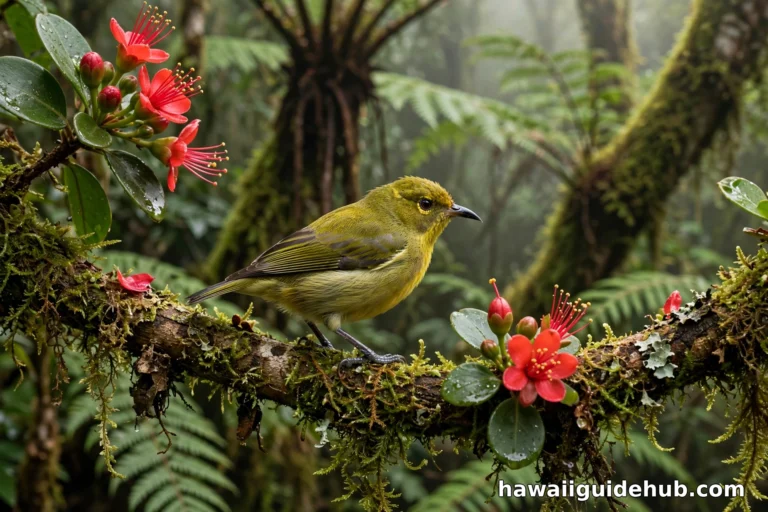
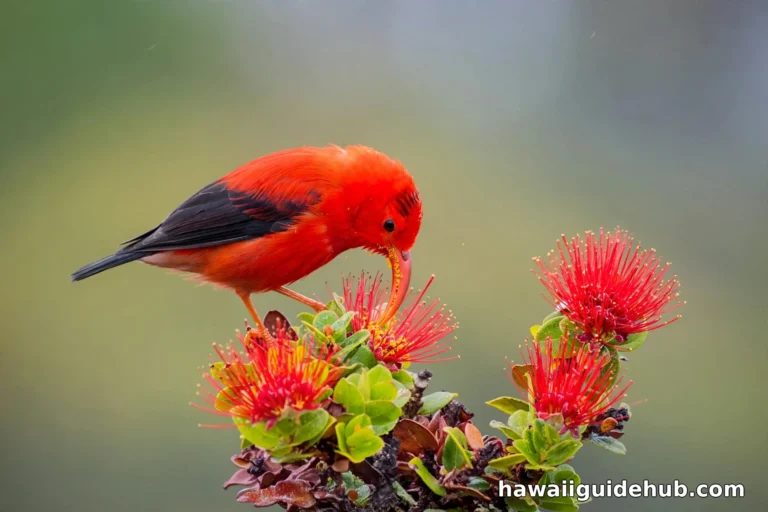
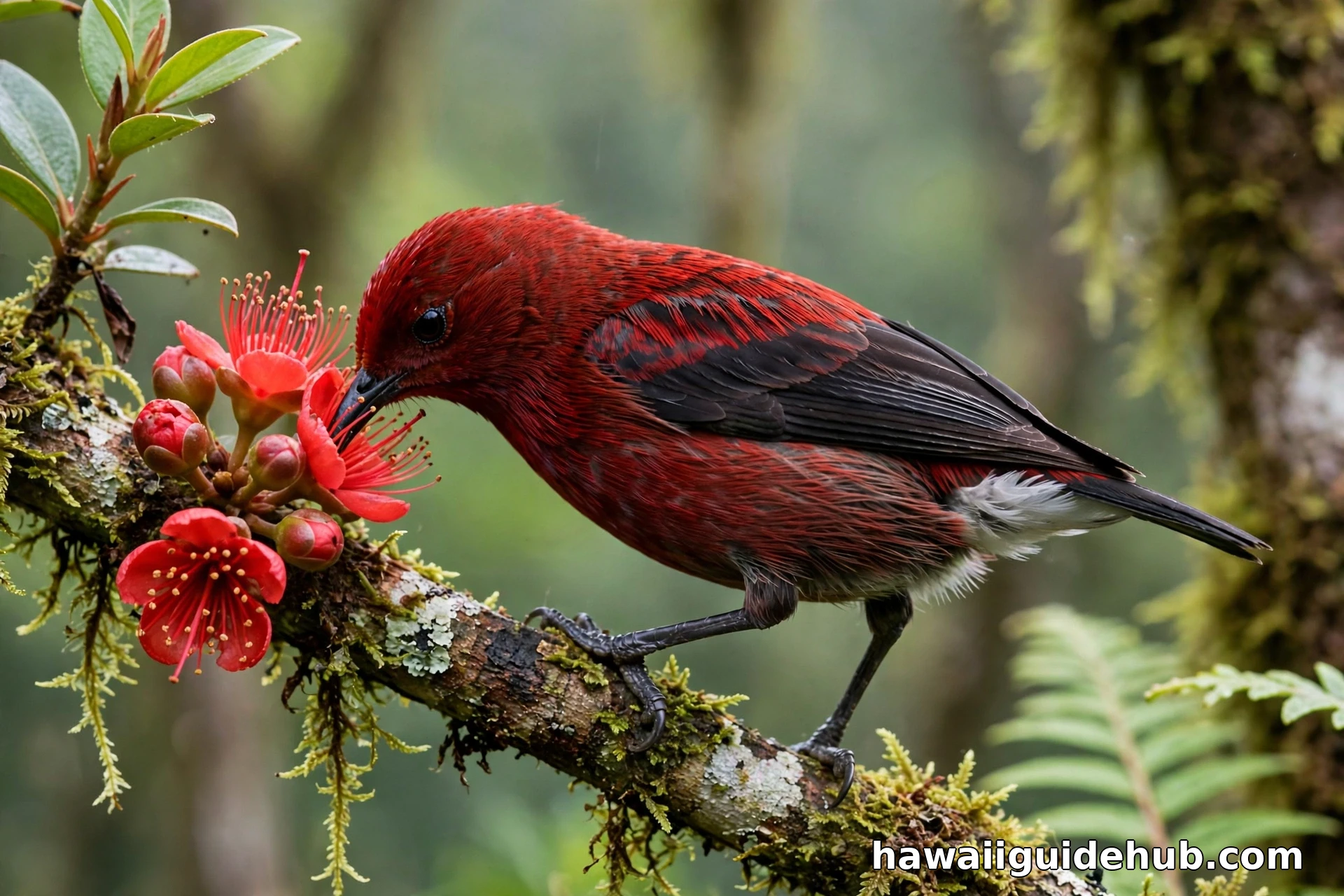
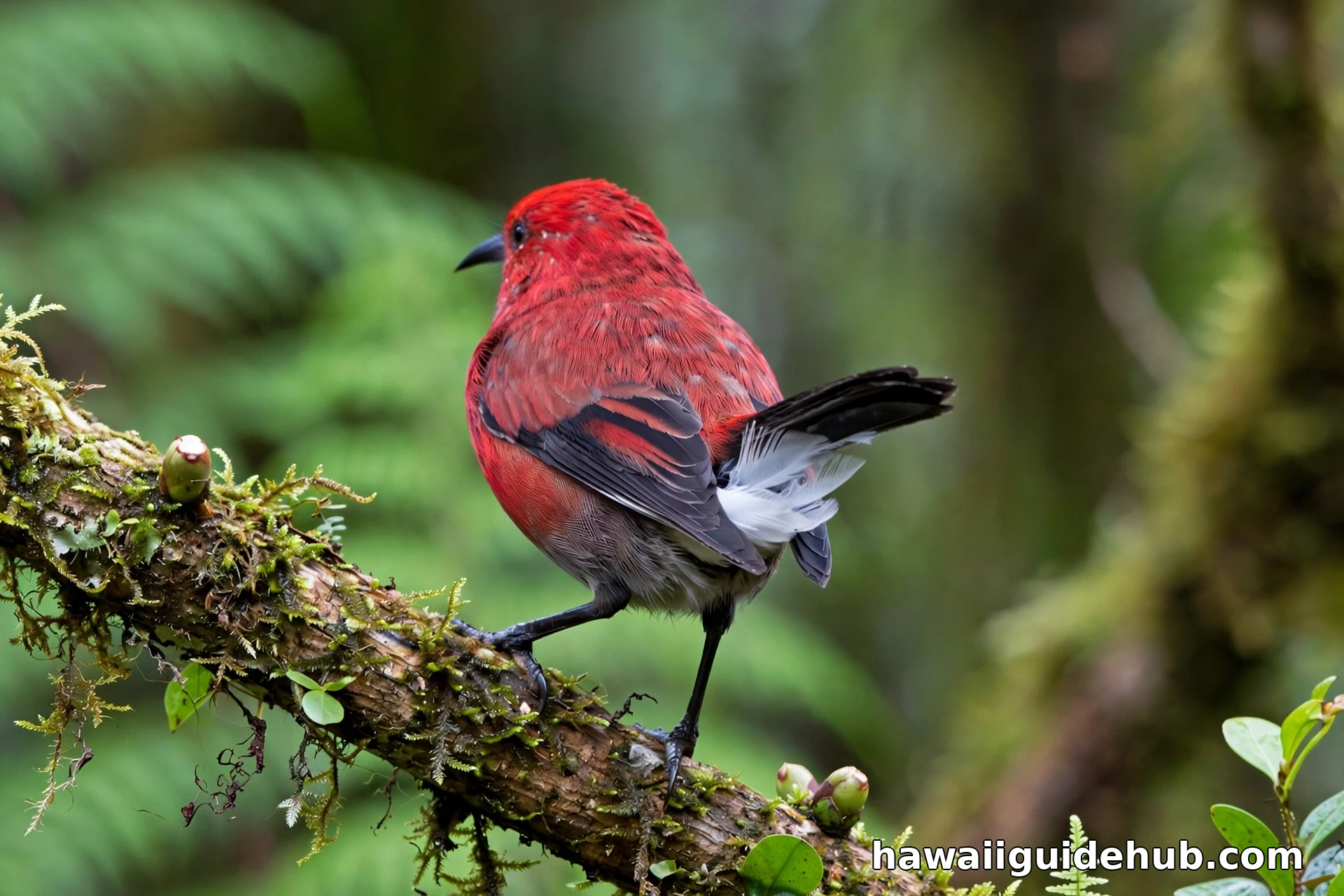
The ʻapapane is a small honeycreeper, about 5.1 inches long and weighing roughly half an ounce, colored a deep, rich crimson over the head, back, and breast. The wings and tail are black, and the single most useful field mark is the flash of white under the tail: the undertail coverts and lower belly are bright white, conspicuous when the bird cocks its tail up or flies overhead. The bill is short for a honeycreeper, slightly downcurved, and black, nothing like the long salmon sickle of the ʻiʻiwi. The Cornell Lab describes the song as two or three soft notes followed by a reedy trill, but that barely hints at the variety: ʻapapane sing chirps, whistles, squeaks, trills, and rattles that differ between islands and even between neighborhoods of the same forest.
| Feature | ʻApapane | ʻIʻiwi, for comparison |
| Color | Deep crimson, slightly darker red | Brighter vermilion scarlet |
| Bill | Short, mildly curved, black (about 15 to 17 mm) | Very long, strongly curved, salmon orange |
| Undertail | Bright white coverts, flashes in flight | Mostly dark with a small white wing patch |
| Size | About 5.1 inches, 0.5 to 0.6 oz | About 6 inches, noticeably larger |
| Tail habit | Often held cocked upward | Usually held straight |
| Status | Most abundant honeycreeper, IUCN Least Concern, NatureServe Vulnerable | Federally threatened |
Males and females share that crimson plumage, with males averaging a touch heavier, about 16 grams to the female’s 14.4 grams in the measurements the Cornell Lab reports. Juveniles are brownish rather than red and earn their adult color over their first months. Listen, too, for the wings: ʻapapane wing feathers produce a distinctive whirring in flight, a sound experienced Hawaiian birders use to identify flocks passing overhead without ever seeing a feather.
Where ʻApapane Live
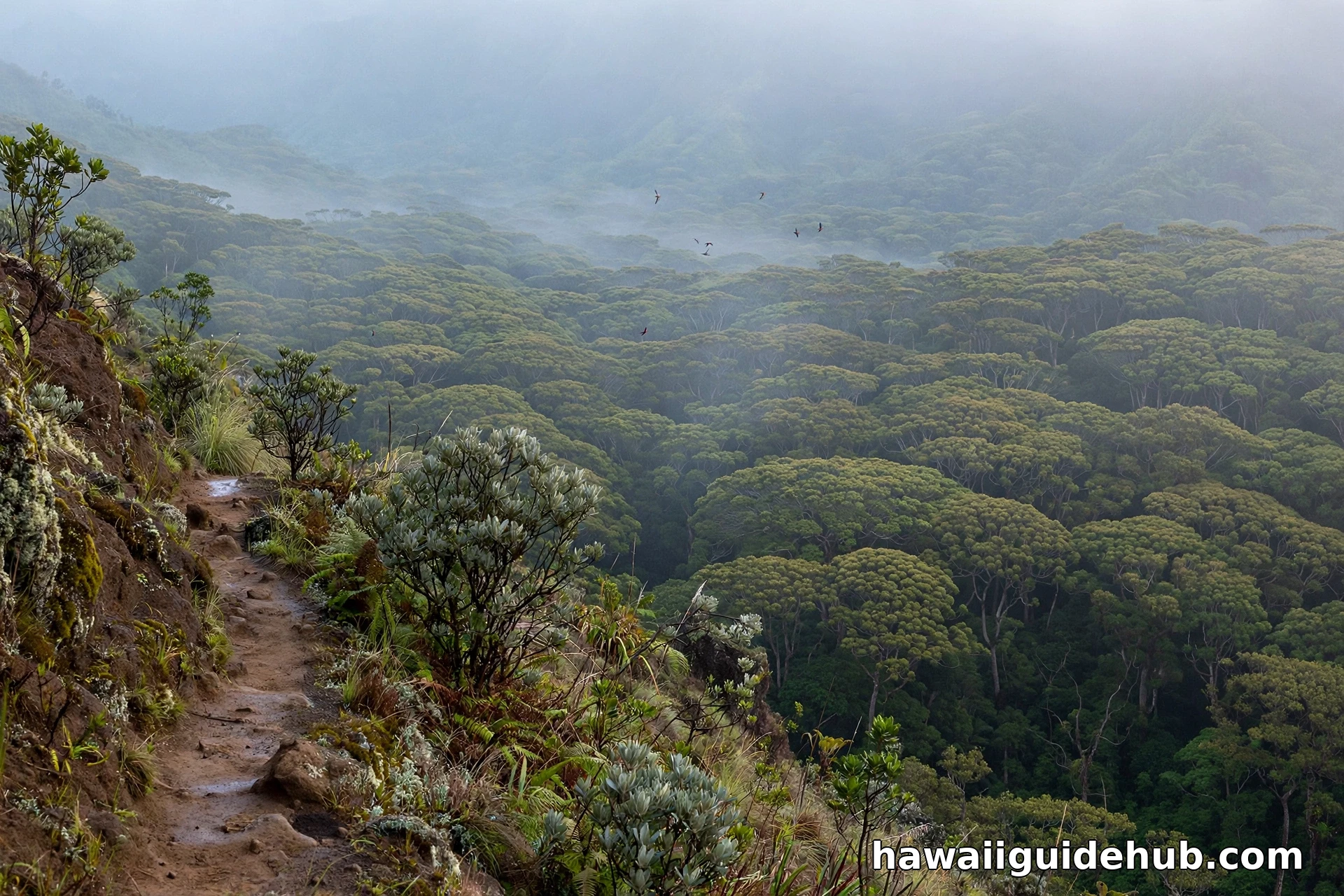
The Hawaiʻi Division of Forestry and Wildlife describes the ʻapapane as endemic and the most abundant and widely distributed Hawaiian honeycreeper, with a population commonly estimated above 1.5 million birds. It lives in native forest on Hawaiʻi Island, Maui, Kauaʻi, Oʻahu, and, rarely, Molokaʻi and Lānaʻi. On the three big forest islands it is found mainly above about 4,100 feet, while on Oʻahu it persists in the Koʻolau range from about 975 feet to the summit and in the Waiʻanae range at higher elevations. Historically it was common at low elevations on every forested island, and its retreat uphill follows the same mosquito line that governs all Hawaiian forest birds.
A lost branch of the family tells the darker version of the story. A separate subspecies once lived on Laysan Island in the Northwestern Hawaiian Islands, hundreds of miles from the main chain. After introduced rabbits stripped the island’s vegetation, the Laysan ʻapapane was last seen in 1923, filmed that year in what may be the earliest motion footage of a species in its final days. The main island birds are far more numerous, but their history includes that warning. On today’s trails, from Hawaiʻi Volcanoes and Hakalau to the ridge paths in our Pihea Trail guide, the ʻapapane remains the red bird most likely to be working the canopy above you.
A Pollinator With Wings Full of Miles
The ʻapapane is first and foremost an ʻōhiʻa bird. It feeds primarily on lehua nectar and serves as one of the tree’s most important pollinators, moving pollen between crowns as it works. Because ʻōhiʻa bloom in patches that shift across the mountains, ʻapapane live nomadically, commuting long distances and gathering where the flowers are: a single flowering tree can draw a restless crowd of birds, and flocks pour over ridgelines in the morning and evening on whirring wings. The Division of Forestry and Wildlife notes that these same species flocks sometimes overwhelm ʻiʻiwi and ʻākohekohe that try to defend rich flowering trees, a daily canopy contest between the common bird and its rarer cousins.
Nectar is not the whole diet. ʻApapane glean insects and spiders from the outer foliage and twigs of the upper and mid canopy, and outside the breeding season they join mixed species hunting parties moving through the forest. That protein matters most in the nesting season, when parents deliver insects to chicks growing in a cup nest hidden in an ʻōhiʻa crown.
Breeding and Family Life
Breeding runs mainly from February through June, timed to peak ʻōhiʻa flowering, though some pairs nest across a longer season. Courtship involves chasing flights and courtship feeding before the pair builds the nest together, usually on a terminal branch of an ʻōhiʻa, and defends a small territory around it. The female incubates a typical clutch of three eggs and broods the young, while the male feeds her away from the nest rather than at it. Both parents feed the nestlings, and the newly fledged young may trail their parents through the canopy for up to four months, an unusually long apprenticeship that suits a bird whose food map changes every week. In a good forest in late spring, family parties of still brownish juveniles following crimson parents are one of the reliable sights, and sounds, of the high country covered in our Kauaʻi hiking guide.
A Song That Changes From Island to Island
Ask a Hawaiian birder what an ʻapapane sounds like and the honest answer is: which island, which forest, which bird? The species is famous among researchers for one of the most varied repertoires of any songbird its size, a stitched together stream of chirps, trills, whistles, squeaks, and mimic like flourishes that shifts noticeably between islands and can differ between adjacent valleys. Young birds appear to learn local song the way people learn dialect, so a Kauaʻi ʻapapane and a Hawaiʻi Island ʻapapane sing recognizably different music from the same basic instrument. That variety is more than a curiosity. Because ʻapapane are so numerous and so vocal, their singing is the baseline sound by which scientists judge the health of a forest bird community: when researchers set out recorders in a restoration area, the return of dense, varied ʻapapane song is often the first measurable sign that native birds are recolonizing. A silent high forest in Hawaiʻi is never a good sign. A loud one, full of argumentative crimson singers, is a forest still doing its job.
The Malaria Paradox
Here is the ʻapapane’s puzzle: surveys repeatedly find it carries the highest prevalence of avian malaria of any Hawaiian forest bird, yet it remains by far the most abundant honeycreeper. Researchers believe the explanation is partial tolerance. Where roughly 95 percent of infected ʻiʻiwi die, a meaningful share of ʻapapane survive infection, and its huge population, broad range, and strong flight between forest patches all cushion losses that would erase a rarer species. The Division of Forestry and Wildlife adds the caution that this wide ranging movement may also help spread disease among forest birds, since a tolerant carrier can transport malaria parasites into new areas on its daily rounds.
Tolerance is a buffer, not a shield. The ʻapapane is ranked Vulnerable by NatureServe even while the IUCN lists it as Least Concern, a disagreement that reflects real declines on some islands and the certainty that warming is lifting the mosquito ceiling over its refuges. Rapid ʻŌhiʻa Death threatens its food tree, and the same landscape mosquito control now being flown over Maui and Kauaʻi forests protects ʻapapane along with its rarer relatives. Abundance, in Hawaiian forest bird conservation, is treated as a head start rather than a finish line. It is one of the more hopeful numbers in the whole story told across Hawaii facts.
ʻApapane in Hawaiian Culture
Like the ʻiʻiwi, the ʻapapane gave its red feathers to the highest art of the old kingdom. Feather cloaks, helmets, and kāhili standards for the aliʻi used ʻapapane feathers alongside ʻiʻiwi red, gathered by bird catchers who often released their catch after taking a few feathers. The bird’s voice is part of its cultural footprint too: generations of Hawaiians learned its endlessly varied songs as the everyday music of the mountain forest, the sound that tells you the native forest is still alive above the pastures and towns. In the modern Symphony of Hawaiian Birds project, schoolchildren across the state learn the ʻapapane’s calls as an introduction to the whole forest bird community, a fitting role for the species a newcomer is most likely to meet first.
How to See an ʻApapane
Choose high native forest and a flowering ʻōhiʻa, then arrive early. Dependable places include Hawaiʻi Volcanoes National Park, where the National Park Service calls the ʻapapane abundant along Crater Rim and Mauna Loa roads when lehua blooms, Hakalau Forest on Hawaiʻi Island, Hosmer Grove in Haleakalā National Park on Maui, and the Kōkeʻe forests on Kauaʻi. Watch for movement in the crowns, listen for the whirring wings and the two or three soft notes that open the song, and look for the white flash under the tail as birds cross between trees. Please stay on trail, keep your distance from nesting trees, skip playback calls, and clean your boots before and after the hike so you do not carry Rapid ʻŌhiʻa Death spores between forests. If your trip hops islands, the morning first approach works everywhere, and our Hawaii itinerary guide can help protect those early hours.
Video: A Virtual Visit to Hakalau Forest
Hakalau Forest National Wildlife Refuge on Hawaiʻi Island, prime ʻapapane habitat and a stronghold for the whole honeycreeper family.
Frequently Asked Questions
How can I tell an ʻapapane from an ʻiʻiwi?
Check the bill and the tail. The ʻapapane has a short, slightly curved black bill and bright white undertail coverts that flash when it flies or cocks its tail. The ʻiʻiwi has a very long, strongly curved salmon colored bill and is a brighter vermilion overall.
Are ʻapapane endangered?
No. The ʻapapane is the most abundant Hawaiian honeycreeper, with a population estimated above 1.5 million, and the IUCN lists it as Least Concern. NatureServe ranks it Vulnerable, however, and it has retreated from low elevations, so managers still treat it as a species to protect rather than take for granted.
What do ʻapapane eat?
Mainly ʻōhiʻa lehua nectar, which makes them key pollinators of the islands’ most important native tree, plus nectar from other native flowers and insects and spiders gleaned from canopy foliage, especially when feeding chicks.
Where is the best place to see ʻapapane?
High elevation native forest with flowering ʻōhiʻa: Hawaiʻi Volcanoes National Park, Hakalau Forest on Hawaiʻi Island, Hosmer Grove at Haleakalā on Maui, and Kōkeʻe on Kauaʻi. Mornings, when flocks commute and sing most, are best.
Why do ʻapapane travel in flocks?
Because their food moves. ʻŌhiʻa trees bloom in shifting patches across the mountains, so ʻapapane commute in flocks between flowering stands, sometimes overwhelming the territorial birds defending a rich tree. Off season, they also join mixed species foraging parties.
The ʻapapane is proof that Hawaii’s forest story is not only about loss. Here is a honeycreeper that still numbers in the millions, still pollinates the forest that feeds it, and still sings a different song on every island. Its abundance is real, hard won by tolerance and mobility, and worth defending with the same seriousness given to its rarer red cousin. Stand under a flowering ʻōhiʻa at dawn, listen for whirring wings, and you will hear what a living Hawaiian forest is supposed to sound like.