Hawaii State Tree: The Kukui, and How to Draw It

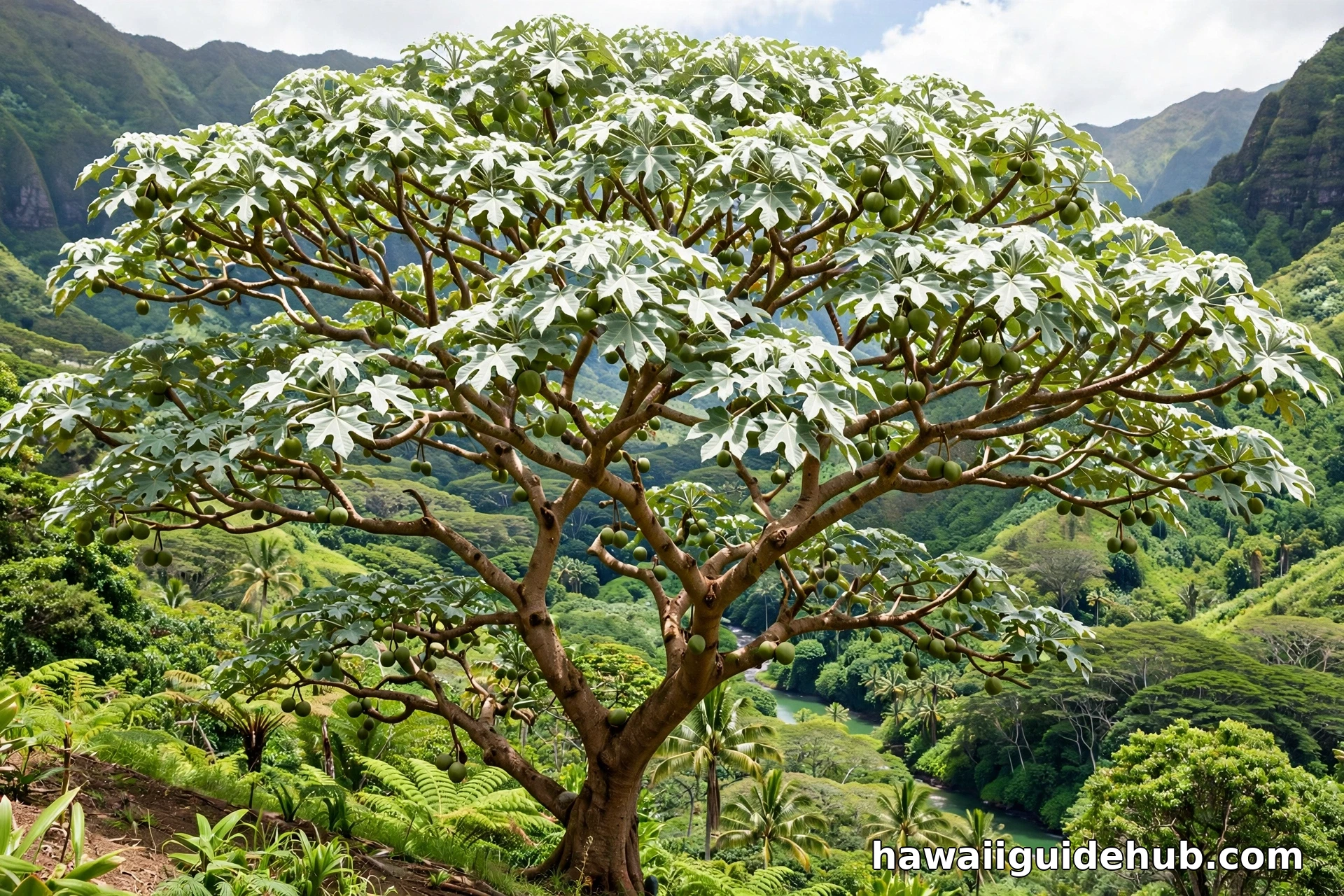
Hawaii’s state tree is the kukui, the candlenut tree, a spreading giant with a silvery green canopy that you can spot from a mile away. Named the state tree on May 1, 1959, the kukui is a symbol of enlightenment, protection, and peace in Hawaiian culture, and its oily nuts once lit the islands as natural candles. Whether you want to identify the tree on a hike or draw it for an art project, this is the single complete guide to the kukui: what it is, why it matters, and exactly how to draw it feature by feature.
This page covers the kukui’s identification, its status as a Polynesian introduced plant, its habitat, its traditional and modern uses, its cultural meaning, safety notes, and a drawing guide that breaks the tree into its recognizable parts. Everything about Hawaii’s state tree is here on this one page.
What Is the Kukui Tree?
The kukui (Aleurites moluccanus) is a fast growing evergreen tree in the spurge family that reaches 60 to 80 feet tall with a broad spreading canopy. Its scientific name has a couple of accepted spellings in older sources, but Aleurites moluccanus is the current botanical standard. The tree is monoecious, carrying both male and female flowers, small creamy white blossoms in clusters at the branch tips.
The most recognizable feature is the foliage. Kukui leaves are pale to medium green, alternate along the branches, and vary dramatically in shape: mature leaves tend to be ovate or heart shaped, while younger growth produces leaves with three, five, or seven pointed lobes, like a soft edged maple leaf. Young leaves and shoots are covered in fine silvery hairs, which is why a kukui canopy looks frosted or silvery from a distance. That silvery sheen is the fastest field identification mark: no other common Hawaiian tree glows quite like it.
One last identification trick: crush a fallen leaf gently and look at the underside. The dense silvery hairs that give the canopy its frosted glow are obvious up close, and no lookalike tree in Hawaii shares the combination of lobed pale leaves and round hard nuts.
Is the Kukui Native to Hawaii?
Surprisingly for a state tree, the kukui is not native to Hawaii. It is a Polynesian introduced plant, a canoe plant carried across the Pacific by the voyagers who settled the islands, originally native to Malesia and Southeast Asia. It naturalized so thoroughly in Hawaii’s moist valleys that it feels native, and its cultural importance earned it the state tree designation anyway.
In Hawaii, kukui grows in low to middle elevation moist areas, in valleys, along streams, and in mesic forest from sea level to about 2,000 feet. You will often find it growing alongside koa and ʻōhiʻa lehua. Because it spreads readily, it is considered moderately invasive in some native forest areas, which is worth knowing if you are interested in Hawaiian conservation.
The Fruit: Candlenuts
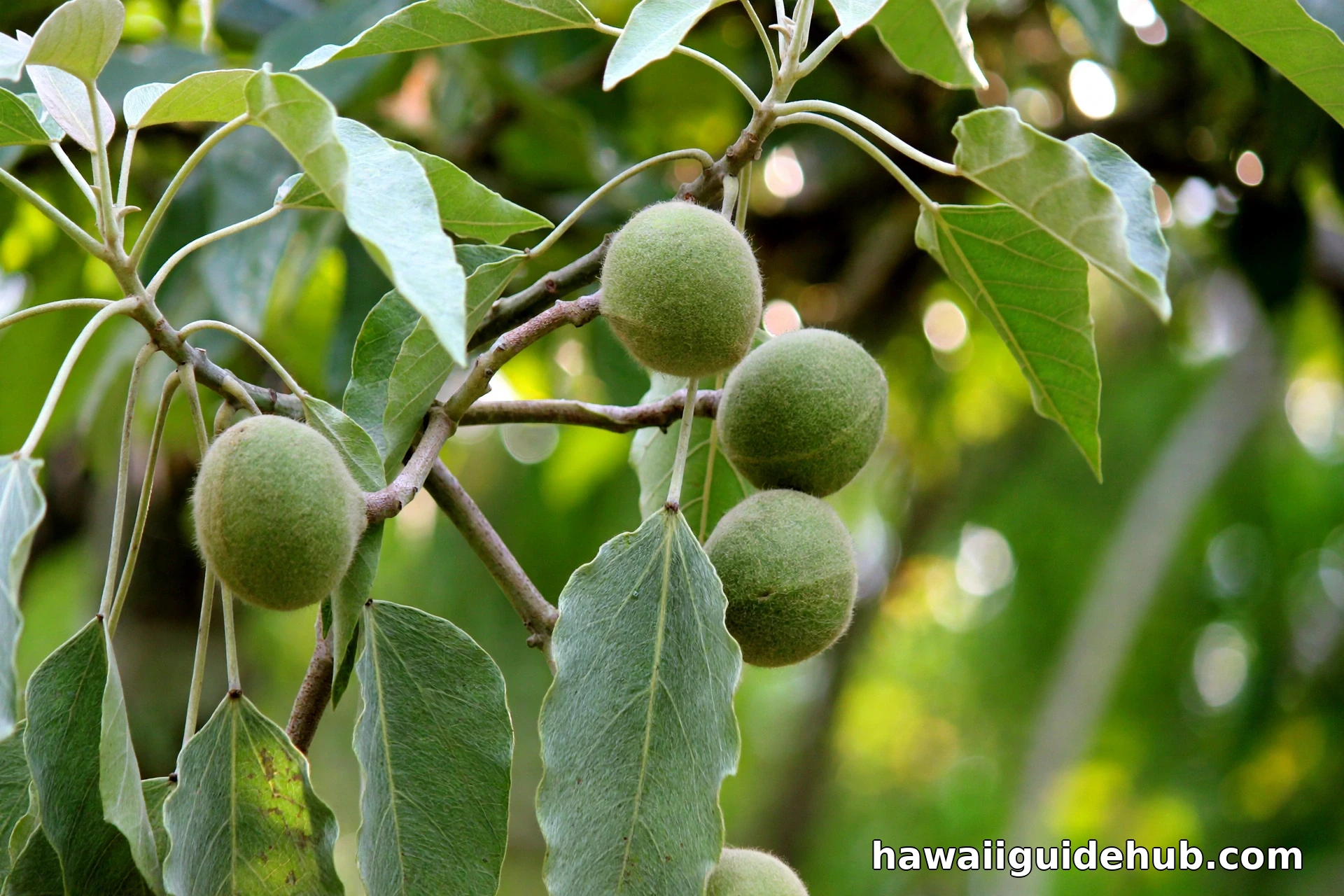
The kukui’s fruit is a round drupe about 4 to 6 centimeters across, starting green and fuzzy, then drying to reveal a hard brown or black shell containing one or two oily white kernels. The kernels are the famous part: rich in oil, they were strung on sticks and burned as torches and candles, which is where the English name candlenut comes from. The Hawaiian word kukui itself means light or torch.
One safety note matters. Raw kukui kernels are toxic: they contain compounds that act as a strong laxative and cause severe stomach upset. Traditional uses always roast the nuts first, which neutralizes the toxins. The roasted kernel is ground into ʻinamona, the classic Hawaiian condiment mixed with sea salt and eaten with raw fish. Never eat raw kukui nuts, and keep fallen nuts away from curious pets and small children.
How to Draw the Kukui Tree
If you searched for a Hawaii state tree drawing, this is the practical part. The kukui is a rewarding subject because its features are so distinctive. Work through the tree part by part, and get each signature detail right.
| Part of the tree | What it looks like | The detail that makes it recognizable |
| Overall shape | Broad, spreading, layered canopy wider than it is tall | Horizontal spreading branches, not a tall narrow crown |
| Leaves | Large, pale green, some lobed like a maple leaf, some heart shaped | Mix lobed and unlobed leaves on the same branch; add a silvery sheen with light shading |
| Leaf surface | Fine silvery hairs, especially on young growth | Use pale highlights or stippling to suggest the frosted look |
| Nuts | Round green drupes hanging in clusters, about golf ball size | Show the fuzzy green husk; draw a few cracked ones revealing the dark shell |
| Flowers | Tiny creamy white clusters at branch tips | Keep them small and simple; they are a texture, not a focal point |
| Bark and branches | Smooth dark gray bark, sturdy spreading limbs | Thick limbs that fork widely; avoid thin twiggy branching |
Start with the canopy silhouette: a wide, layered dome. Block in the big spreading limbs first, then mass the foliage in pale green clusters, leaving the lobed leaf shapes to the edges where they read clearly. Add the round nuts as simple circles tucked among the leaves, and finish with light silvery highlights across the top of the canopy. That frosted highlight is what separates a kukui drawing from a generic tree drawing.
For a simple version, such as a school project or a coloring page style drawing, reduce the tree to three elements: the wide spreading shape, five lobed maple like leaves, and three round nuts. Anyone who knows the kukui will recognize it from those three alone.
Two shading tricks sell the drawing. First, keep your greens pale: kukui foliage is noticeably lighter than the deep green of most tropical trees, so a yellow green base with white highlights reads more accurately than a rich forest green. Second, draw the nuts with a soft fuzzy edge rather than a hard outline, suggesting the fine hairs on the green husk. A kukui grove grows wild around Hawaii Volcanoes National Park, so study photos of the real canopy before you finalize your shading.
Kukui Oil: From Torches to Skin Care
The oil pressed from roasted kukui kernels was Hawaii’s original lamp fuel, but its second life is in skin care. Kukui oil is light, absorbs quickly, and is rich in essential fatty acids, which is why it appears in modern Hawaiian lotions, soaps, and hair products. Traditionally it treated burns, wounds, chapped skin, and dry scalp. If you buy kukui oil products in Hawaii, you are buying a direct continuation of a thousand year old practice.
The wood had its own uses. Lightweight and soft, kukui wood was carved into canoes, and the bark and roots yielded dyes. Fishermen chewed the nuts and spat the oil onto the ocean surface to cut glare and spot fish below, a technique that sounds like folklore and worked like optics.
Growing a Kukui Tree
Kukui is a fast grower that wants what Hawaii gives it: warmth, humidity, and room. It reaches 60 feet or more, develops a deep taproot, and resents transplanting, so plant it where it will live permanently. Young trees want shelter from drying winds until the canopy thickens. Outside the tropics it is a greenhouse or conservatory tree, not a backyard one. If you are gardening in Hawaii, give it space away from structures: those falling nuts are hard, heavy, and frequent.
Cultural Meaning: Light and Protection
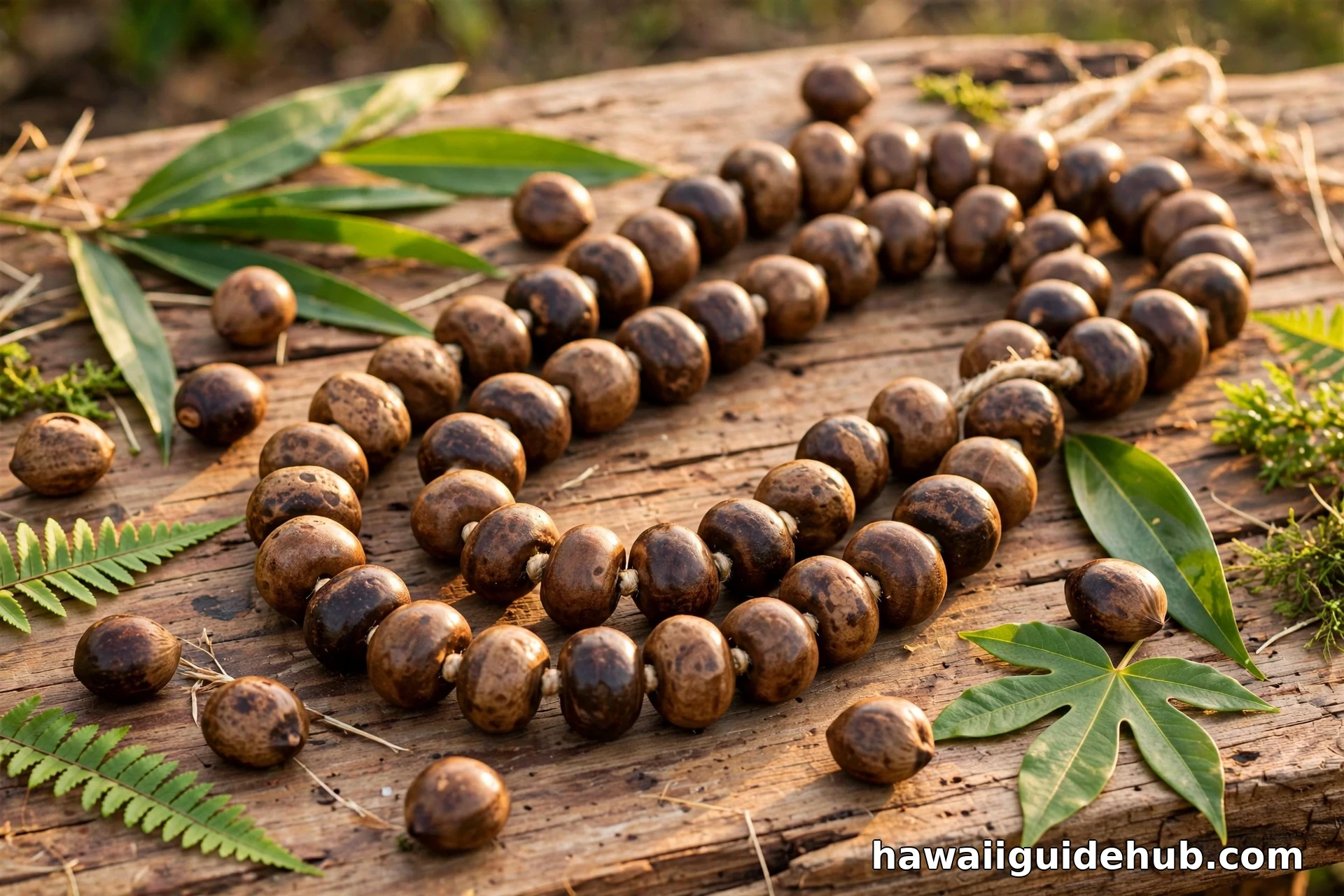
In Hawaiian culture, the kukui represents enlightenment, protection, and peace. Because kukui means light, the tree is a symbol of knowledge: the University of Hawaii’s logo includes a torch alongside a globe and a book, a direct reference. Kukui nut lei, strung from polished nuts, were worn by aliʻi, Hawaiian royalty, as emblems of light and protection, and they are still given to people seeking guidance or facing challenges.
The legends deepen the meaning. Kamapuaʻa, the pig god associated with fertility and rain, could take the form of a kukui tree, and the kukui was counted among the physical manifestations, the kino lau, of Lono, the god of agriculture and abundance. A kukui nut lei was therefore not decoration but a wearable prayer: light for the path ahead. White kukui nuts, which are rare, are considered especially powerful and darken to a honey color with handling and age. The kukui also represents the island of Molokai, whose symbolic color is the silvery green of the kukui leaf, a reminder that the tree belongs to every island’s story.
The practical uses were just as important. Beyond torches and lamp oil, kukui oil treated burns, wounds, and dry skin; the sap was used for cold sores and throat ailments; fishermen chewed the nuts and spat the oil on the water to cut glare and see fish below; and the wood was carved into canoes. Nearly every part of the tree had a job, which is exactly why it became the state tree.
Where to See Kukui Trees in Hawaii
You do not need to hike to see a kukui. They grow in valleys and parks across all the main islands: look for the silvery canopy along the Pali Highway on Oahu, in Waimea Canyon approaches on Kauai, and throughout the Hamakua coast valleys on the Big Island. Botanical gardens are the easiest guaranteed viewing: the Harold L. Lyon Arboretum on Oahu and the Hawaii Tropical Bioreserve Garden near Hilo both have labeled specimens. Fallen nuts on the ground under the tree are the confirmation: round, hard, and unmistakable.
If you collect a few fallen nuts as souvenirs, let them dry fully before storing them, and remember they are for looking at, not eating raw. Polished kukui nut lei are sold across the islands and make a meaningful gift: a lei of light for the recipient.
For more of Hawaii’s plant life, see our guide to the Hawaii state flower, and for the island where the kukui grows thickest, see the best things to do on the Big Island of Hawaii.
Video: Kukui Nut Trees
A walk through a kukui nut forest on Maui: the state tree’s canopy, falling nuts, and cultural story.
Frequently Asked Questions
What is Hawaii’s state tree?
The kukui, or candlenut tree (Aleurites moluccanus), designated the state tree of Hawaii on May 1, 1959.
What does kukui mean in Hawaiian?
Light, torch, lamp, or enlightenment. The name refers to the nuts’ use as torches and candles.
Is the kukui tree native to Hawaii?
No. It was brought by Polynesian voyagers as a canoe plant and naturalized. It is native to Malesia and Southeast Asia.
Can you eat kukui nuts?
Only roasted. Raw kukui nuts are toxic and act as a strong laxative. Roasted kernels are ground into ʻinamona, a traditional condiment.
What does a kukui tree look like?
A broad spreading tree up to 80 feet tall with a distinctive silvery pale green canopy, large lobed leaves, small white flowers, and round green nuts.
Why is the kukui the state tree of Hawaii?
Because of its multitude of traditional uses and its cultural symbolism of enlightenment, protection, and peace.
What is ʻinamona?
ʻInamona is the traditional Hawaiian condiment made from roasted, ground kukui kernels mixed with sea salt, often with seaweed. It is served with raw fish and poke. Only roasted kernels are used, never raw.
The kukui earns its place as Hawaii’s state tree twice over: once for the sheer usefulness that made it indispensable to Hawaiian life, and once for the symbolism that made it a torch of enlightenment in the culture. Learn to spot the silvery canopy on your next drive through a island valley, and if you draw it, remember the frosted highlight and the round nuts tucked among the leaves. That is the kukui’s signature, and now it can be yours too.