ʻIʻiwi: The Scarlet Honeycreeper of Hawaii’s High Forests

Few birds stop a Hawaiian forest cold like the ʻiʻiwi. A flash of vermilion in the ʻōhiʻa canopy, a long salmon colored bill curved like a sickle, and a song full of creaks and whistles: this scarlet honeycreeper is the bird on the posters, the bird in the feather cloaks of kings, and increasingly, a bird in serious trouble. Once one of the most abundant native birds in Hawaiʻi, found from the coast to the treeline, the ʻiʻiwi is now listed as threatened under the United States Endangered Species Act and confined mostly to a narrowing band of cold mountain forest.
This guide covers the iiwi bird in Hawaii completely: identification, the famous bill and tongue built for nectar, where the species survives today, its life in the ʻōhiʻa forest, why avian malaria is lethal to roughly 95 percent of infected birds, the role of Rapid ʻŌhiʻa Death, its place in Hawaiian culture and feather work, and how to see one responsibly before the window narrows further.
How to Identify an ʻIʻiwi
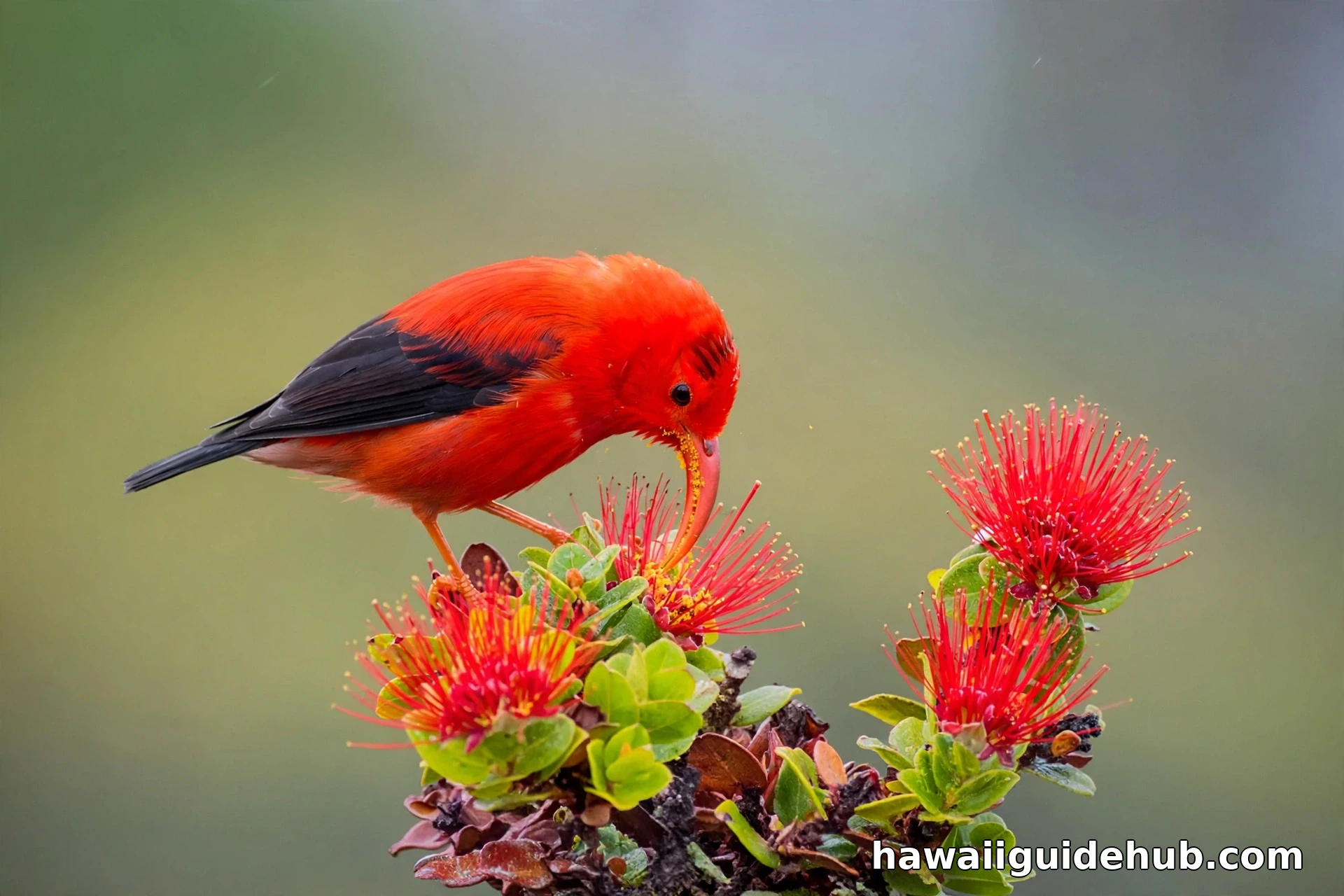
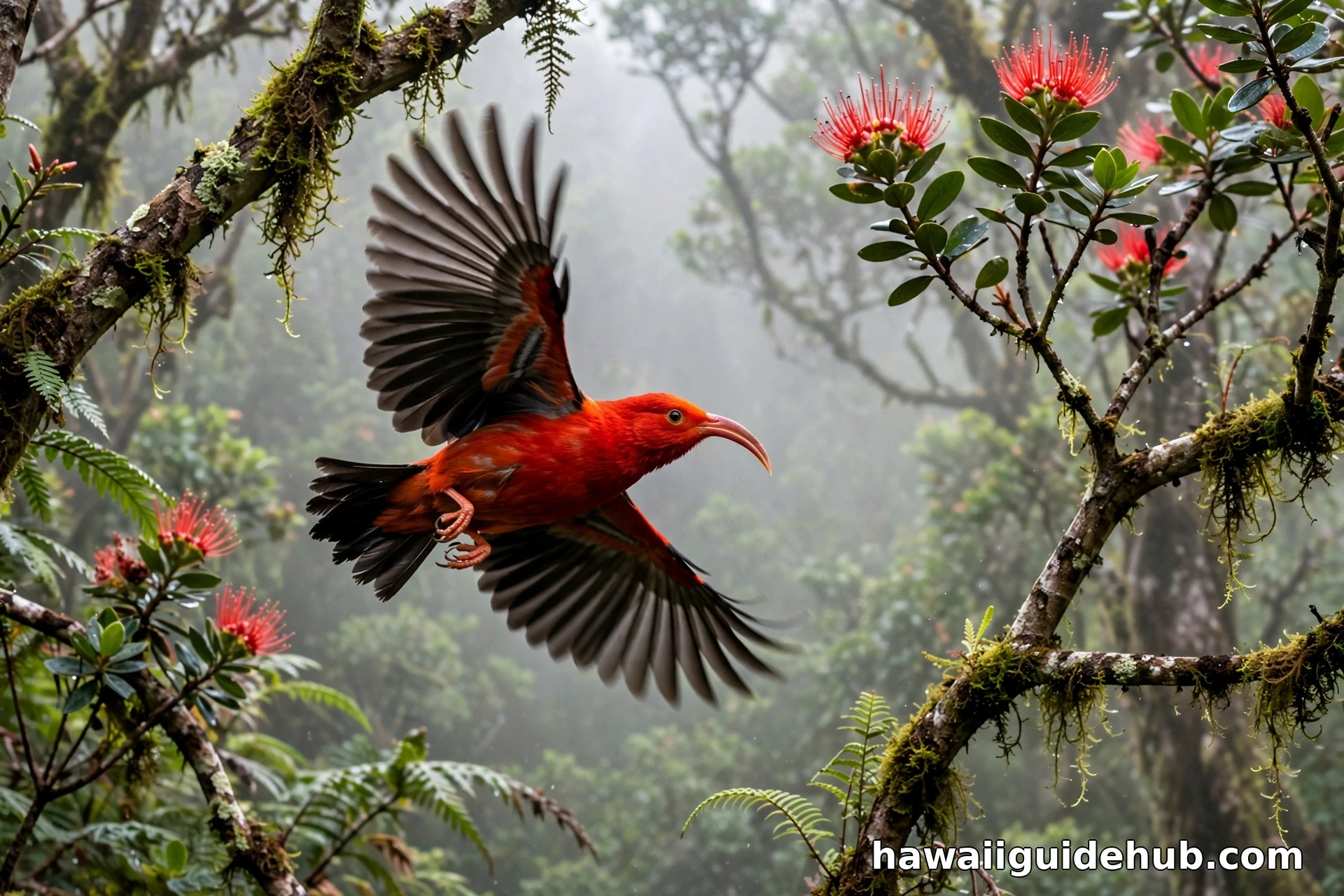
An adult ʻiʻiwi is unmistakable. The body is brilliant vermilion red, the wings and tail are black with subtle white edging, and the bill is long, strongly downcurved, and colored a warm salmon pink to orange. At about 6 inches long, it is a medium sized honeycreeper with a restless energy, rarely sitting still for long. The Cornell Lab of Ornithology describes its voice as a varied mix of whistles, creaks, gurgles, and a sound often compared to a rusty hinge, quite unlike the songs of mainland songbirds.
| Feature | ʻIʻiwi detail |
| Scientific name | Drepanis coccinea (formerly Vestiaria coccinea) |
| Plumage | Vermilion red body, black wings and tail, white patch at the wing edge |
| Bill | Long, strongly downcurved, salmon orange, matched to curved native lobelia flowers |
| Juveniles | Golden brown and spotty with a paler bill, once mistaken for a separate species |
| Closest look alike | ʻApapane: deeper crimson, shorter straight black bill, white undertail coverts |
| Status | Federally threatened since 2017, IUCN listed as Vulnerable |
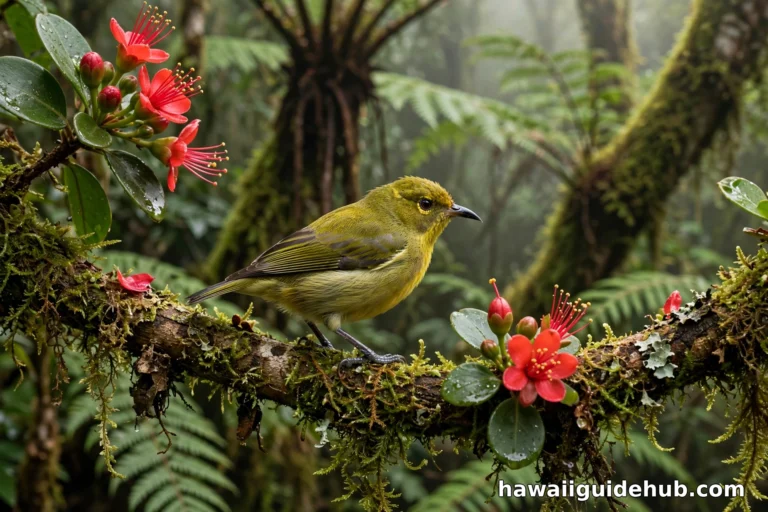
The bill deserves its own paragraph because it explains the bird. ʻIʻiwi and Hawaii’s native lobelia plants evolved together: the curve of the bill matches the curve of the tubular flowers, letting the bird slip its head in and drink nectar with a brush tipped tongue while keeping its eyes up for hawks and owls. As those lobelias declined, the birds leaned harder on ʻōhiʻa lehua blossoms, which they now depend on through most of the year. Young ʻiʻiwi look so different, with golden spotted plumage and ivory bills, that early naturalists catalogued them as another species entirely.
Where ʻIʻiwi Live Today
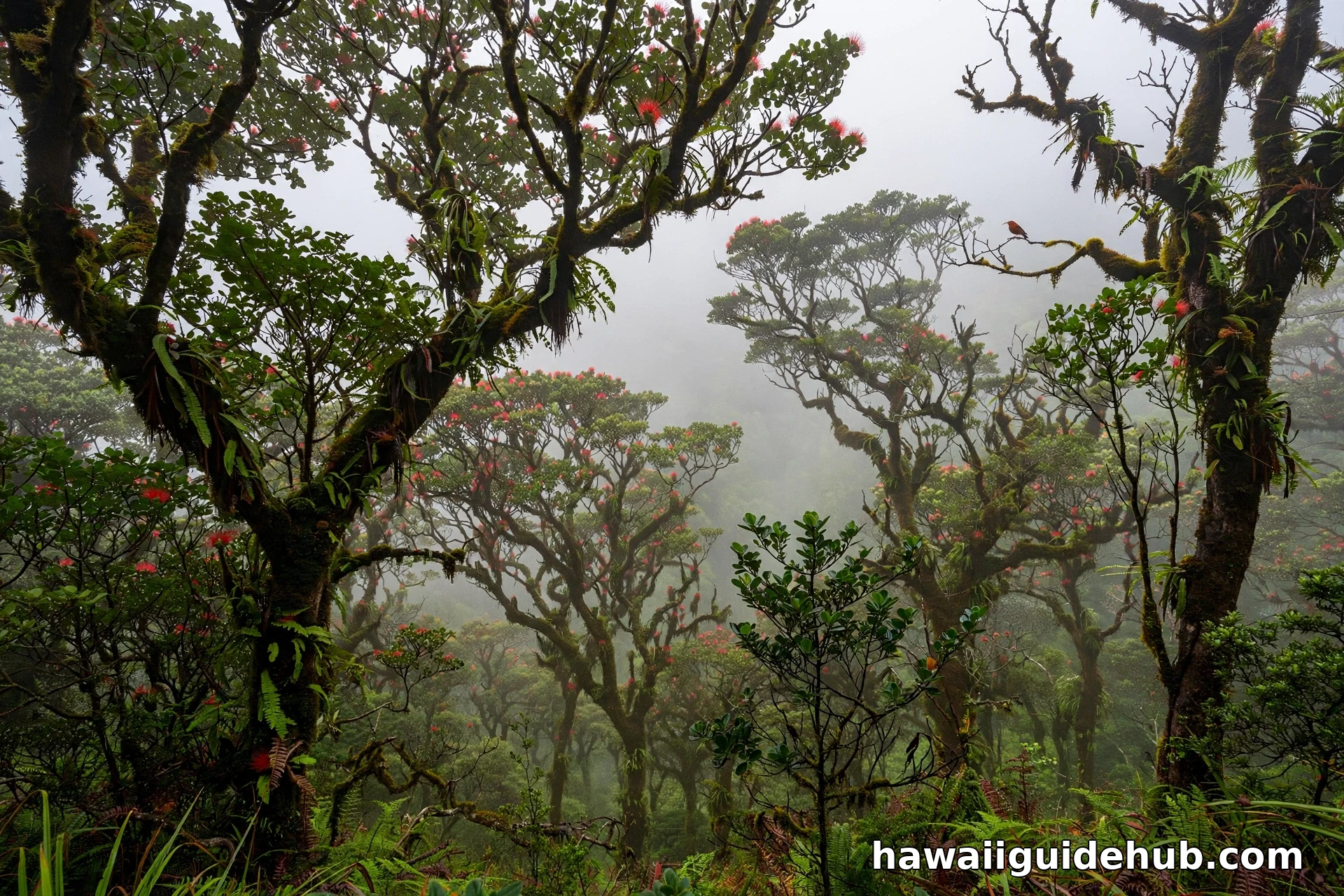
Historically, ʻiʻiwi lived on Kauaʻi, Oʻahu, Maui, Hawaiʻi Island, Molokaʻi, and Lānaʻi, from sea level during winter food shortages up to the highest forests. That map has collapsed. The species is gone from Lānaʻi and effectively gone from Molokaʻi and West Maui, hangs on in very small numbers on Oʻahu, and survives in real numbers on only three islands: Hawaiʻi, East Maui, and Kauaʻi. The United States Fish and Wildlife Service reports that about 90 percent of all ʻiʻiwi now live in a narrow elevation band between about 4,300 and 6,200 feet on East Maui and the windward slopes of Hawaiʻi Island.
Elevation is destiny for this bird, and the reason is a mosquito. The southern house mosquito, which arrived in Hawaiʻi in 1826, spreads avian malaria, and mosquitoes cannot thrive in the cold at high elevation. The ʻiʻiwi’s range today is essentially the map of land still too cold for the mosquito line, much of it protected in places such as Hakalau Forest National Wildlife Refuge on Hawaiʻi Island and the forests of Haleakalā and Kōkeʻe. Birders on trails like the Pihea Trail on Kauaʻi are listening for a bird whose island population is in steep decline even in those high forests.
Life in the ʻŌhiʻa Forest
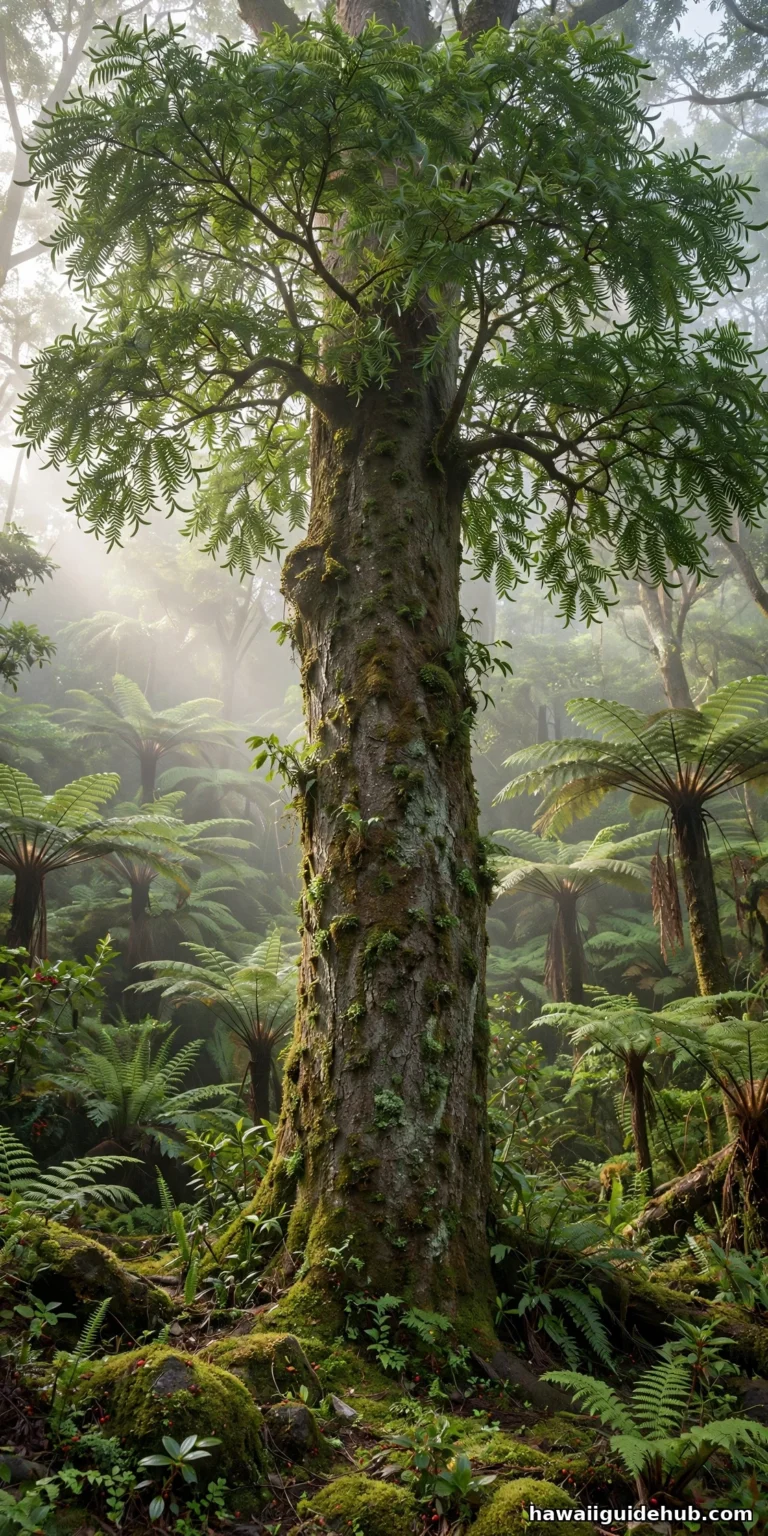
ʻIʻiwi are nectar specialists with an opportunist’s flexibility. Lehua nectar is the staple, taken from flowering ʻōhiʻa crowns, and they also work native lobelias, māmane, and other blossoms, plus insects and spiders gleaned from foliage for protein, especially when feeding chicks. They are famous wanderers: individuals track flowering across whole mountain slopes, flying miles between feeding areas, and outside the breeding season they roost in large mixed flocks, often alongside ʻapapane. Breeding peaks in the first half of the year, when pairs build a cup nest high in an ʻōhiʻa and raise one to three chicks, with the female incubating and both parents feeding the young.
That wandering, once a strength, now carries risk. A bird that commutes downslope in winter to find flowers flies straight into mosquito country, and a single bite can be enough. Researchers believe these seasonal movements help explain why ʻiʻiwi have declined faster than some of their more sedentary relatives, and why protecting unbroken forest from the mountains to as low as safely possible matters so much. The Hakalau refuge, established in 1985 as the first national wildlife refuge created specifically for Hawaiian forest birds, anchors the species’ hopes on the island that holds the great majority of remaining birds.
The Malaria Crisis
Avian malaria is the central fact of the modern ʻiʻiwi story. The disease arrived with introduced birds in the early 1900s and is spread by the introduced mosquito. Native honeycreepers evolved with no exposure to it, and the ʻiʻiwi is among the most vulnerable of all: studies summarized by the Fish and Wildlife Service and the Cornell Lab find that roughly 90 to 95 percent of infected ʻiʻiwi die. At low elevations, that lethality erased the species within decades. Climate change now pushes the mosquito line uphill a little more each decade. One widely cited estimate warns that a temperature rise of about 3.6 degrees Fahrenheit could erase up to 96 percent of the bird’s disease free habitat in Hakalau Forest. In 2017, after years of petitions and science review, the ʻiʻiwi was listed as threatened under the Endangered Species Act, and in 2022 the Service proposed more than 275,000 acres of critical habitat on Kauaʻi, Maui, and Hawaiʻi Island.
Rapid ʻŌhiʻa Death: The Second Blow
As malaria presses from below, a fungus attacks the forest itself. Rapid ʻŌhiʻa Death, first identified in 2014 on Hawaiʻi Island, kills ʻōhiʻa trees, sometimes within weeks, and has spread across large areas of the island holding most remaining ʻiʻiwi. The birds lose both food and nest trees at landscape scale. Scientists, land managers, and volunteers fight it with fencing against feral pigs that wound tree roots, strict sanitation of boots and gear to avoid moving the fungus, and seed banking of resistant ʻōhiʻa lines. Visitors help more than they realize simply by cleaning footwear before entering native forest, a habit every Hawaii hiker should adopt, as our Kauaʻi hiking guide also stresses for that island’s trails.
A Family of Birds Found Nowhere Else
The ʻiʻiwi belongs to the Hawaiian honeycreepers, a family of birds that evolved from a single finch like ancestor into dozens of species with bills shaped like warblers, parrots, sickles, and woodpeckers. It is one of the great natural experiments in evolution, Hawaiʻi’s answer to Darwin’s finches, and one of the saddest: of the more than 50 honeycreeper species known from history and fossils, well over half are extinct, and most survivors are listed as threatened or endangered. The ʻiʻiwi, still the family’s most recognizable member, is in that sense a flagship. Conservation that saves its cold forests, its ʻōhiʻa, and its mosquito free airspace shelters ʻapapane, ʻamakihi, ʻākohekohe, and a whole community of plants and insects found on no other islands on Earth.
The Fightback: Mosquito Control From the Sky
For decades the malaria story had no counterpunch, because you cannot fence a mosquito out of a forest. That is changing. A partnership of agencies and nonprofits known as Birds, Not Mosquitoes is now releasing male southern house mosquitoes carrying a naturally occurring Wolbachia bacteria strain that makes their offspring unable to hatch, a technique called the incompatible insect method. Only males are released, and males do not bite. On East Maui and on Kauaʻi, releases by helicopter and drone began in the mid 2020s over thousands of acres of forest bird habitat, the first landscape scale attempt to crash a mosquito population for the sake of birds anywhere in the world. Early monitoring shows mosquito numbers falling in treated areas. The method is not a cure by itself: it must be sustained, and it buys time rather than victory. But for a bird whose math was once only decline, bought time, measured in mosquito free breeding seasons, is exactly what recovery requires, alongside predator control, fencing, and ʻōhiʻa restoration already underway in the same forests.
ʻIʻiwi in Hawaiian Culture
Before it was a conservation symbol, the ʻiʻiwi was chiefly regalia. Aliʻi feather work, the ʻahu ʻula cloaks and mahiole helmets worn by the highest chiefs, used red ʻiʻiwi feathers in the tens of thousands, bound into patterns over fiber netting in work that could span generations. Catchers took care to release many birds alive after plucking a few feathers, an early ethic of restraint. The most famous cloak, made for Kamehameha I, drew on an estimated 80,000 birds across its making, and pieces of this art now rest in museum collections including Bishop Museum, still radiating their improbable red. Understanding this history changes how the bird reads in the forest: not just a species, but the living source of the kingdom’s most sacred material. Readers of our Hawaii facts collection will recognize the ʻiʻiwi among the islands’ emblematic native species.
How to See an ʻIʻiwi Responsibly
Go high, go early, and listen first. The most accessible reliable sites are Hosmer Grove and the Haleakalā summit area on Maui, the Kōkeʻe forests on Kauaʻi, and, on Hawaiʻi Island, the Puʻu ʻŌʻō Trail area and refuge tours at Hakalau where access is managed. Scan flowering ʻōhiʻa crowns with binoculars and learn the rusty hinge call before you go, because most first sightings begin as a voice in the canopy. Stay on trail, keep distance from any nest, and never use playback calls near breeding birds, which wastes energy a threatened species cannot spare. Clean your boots between forests to avoid spreading Rapid ʻŌhiʻa Death. Take photographs, leave the forest exactly as you found it, and consider that your visit supports the parks and refuges holding this bird’s last cold ground. A rewarding multi island plan that leaves mornings free for high forests can be sketched from our Hawaii itinerary guide.
Video: Meet the ʻIʻiwi
Forest bird research in Hawaiʻi, featuring the canopy world the ʻiʻiwi shares with ʻapapane and ʻamakihi.
Frequently Asked Questions
Is the ʻiʻiwi endangered?
The ʻiʻiwi is listed as threatened under the United States Endangered Species Act, a status it received in 2017, and as Vulnerable on the IUCN Red List. Its population is declining, driven mainly by avian malaria moving uphill with a warming climate.
What do ʻiʻiwi eat?
Mostly nectar, especially from ʻōhiʻa lehua blossoms, supplemented by native lobelia flowers, māmane, and other blossoms. They also eat insects and spiders, which are important protein for nestlings. Their long curved bill and brush tipped tongue are specialized nectar feeding tools.
Where is the best place to see an ʻiʻiwi?
High elevation native forest: Hosmer Grove in Haleakalā National Park on Maui, Hakalau Forest National Wildlife Refuge and nearby trails on Hawaiʻi Island, and the Kōkeʻe area on Kauaʻi. Look and listen around flowering ʻōhiʻa trees in the morning.
Why are ʻiʻiwi only found at high elevations now?
Because of avian malaria. Introduced mosquitoes spread the disease at warm low elevations, and about 90 to 95 percent of infected ʻiʻiwi die. The birds survive where it is too cold for mosquitoes, roughly above 4,300 feet for most of the remaining population.
What is the difference between an ʻiʻiwi and an ʻapapane?
Both are red honeycreepers of the high forest. The ʻiʻiwi is brighter vermilion with a long, strongly curved salmon bill. The ʻapapane is a slightly deeper crimson with a short, mildly curved black bill and conspicuous white undertail coverts.
The ʻiʻiwi carries a double weight in Hawaiʻi: it is a masterpiece of evolution, bill fitted to flower across a million years, and a measure of how fast that inheritance can be spent. Its survival will be decided in the cold forests at the top of three islands, by mosquito control, ʻōhiʻa protection, and the patience of the people doing that work now. Every visitor who climbs into those misty forests, boots clean and binoculars ready, meets the bird on the terms its future requires: carefully, and in time.