The Koa Tree: Hawaiiʻs Warrior of the Forest

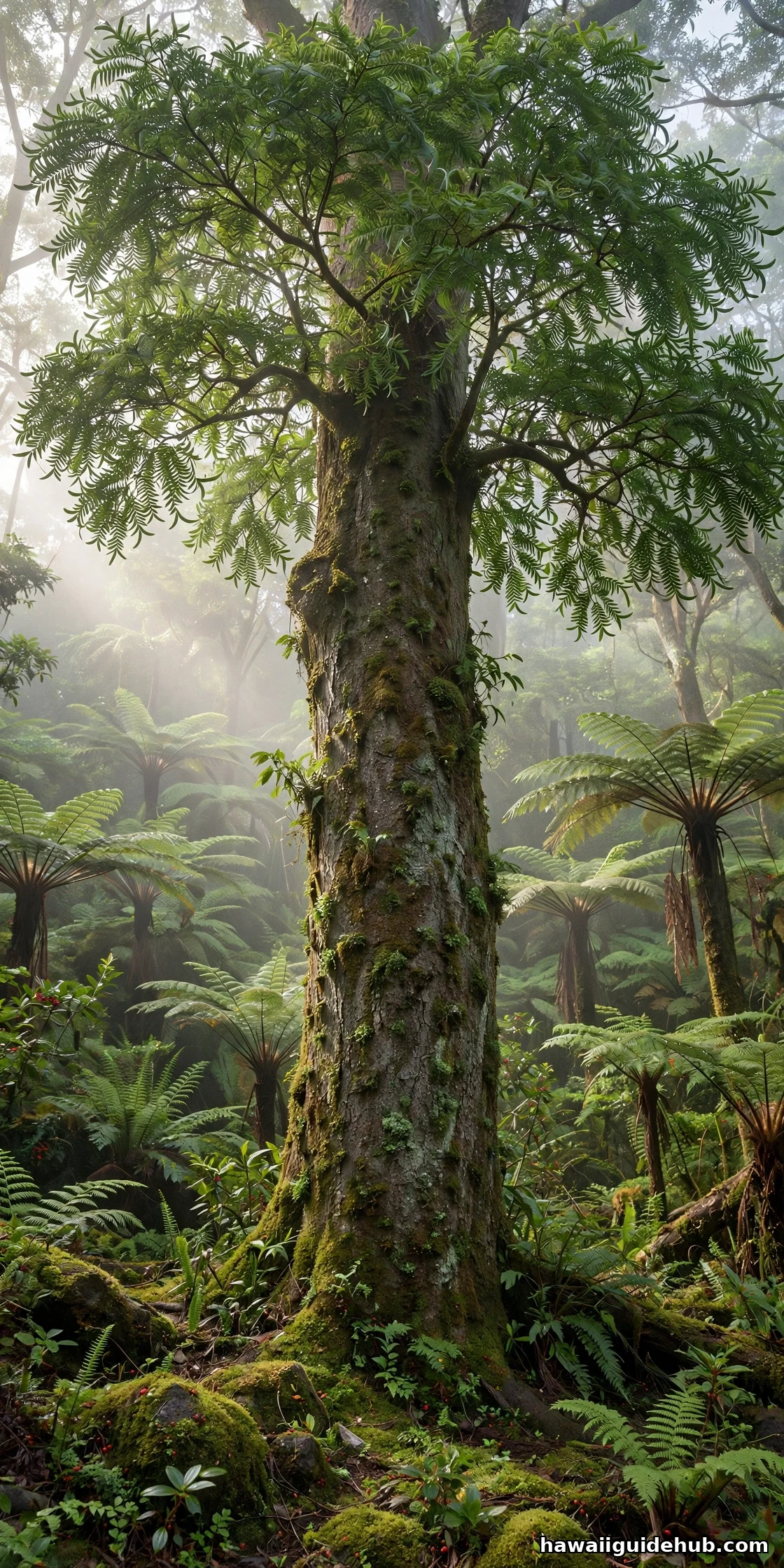
Stand beneath a mature koa tree in a Hawaiian forest and you will understand why this tree earned a name that means warrior. The trunk rises like a column, wider than a doorway, its bark furrowed and gray. Far above, the canopy spreads in a broad green crown that seems to hold up the sky. Few trees in Hawaii command this kind of presence. The koa is the largest native tree in the islands, found nowhere else on Earth, and for more than a thousand years it has shaped Hawaiian culture, from the great voyaging canoes to the music of the ukulele.
This guide covers everything worth knowing about the Hawaii koa tree: what it is, how to recognize it, where it grows, the deep role it played in ancient Hawaiian life, why its wood ranks among the most valuable on the planet, and where you can stand in a koa forest yourself.
What Exactly Is the Koa Tree
The koa tree, known to botanists as Acacia koa, belongs to the pea family, Fabaceae. It is endemic to the Hawaiian Islands, which means it grows naturally nowhere else in the world. According to the Hawaii Division of Forestry and Wildlife, koa is the largest native tree species in the islands, reaching heights of about 35 meters (115 feet). On a good site, it is also one of the fastest growing Hawaiian trees, capable of reaching 6 to 9 meters (20 to 30 feet) in just five years.
Koa typically grows 15 to 25 meters tall with a canopy spreading 6 to 12 meters wide, though exceptional specimens have grown far larger. One famous tree in the Kaʻū district of the Big Island reportedly reached 140 feet with a spread of 148 feet. There are three recognized varieties: A. koa var. koa, var. latifolia, and var. kauaiensis, the last found on Kauaʻi.
Like other members of the pea family, koa fixes nitrogen from the air through bacteria in its roots. This lets it thrive in very young volcanic soils where few other trees can gain a foothold, and its fallen leaves enrich the forest floor for everything that grows beneath it.
Why It Is Called Koa
In the Hawaiian language, the word koa means brave, bold, fearless, or warrior. The name is no accident. Ancient Hawaiians saw the tree the way they saw their finest fighters: tall, strong, straight, and unyielding. Warriors of old were themselves called koa, and the tree and the fighter shared the name as a mark of the highest respect.
That respect was written into law. During the reign of Kamehameha the Great, koa was declared kapu, sacred and restricted. Only the aliʻi, the chiefs and royalty, could possess koa wood. The finest logs were reserved for royal canoes, royal houses, and the sacred bowls of the court. To hold something made of koa was to hold something the kingdom itself had set apart.
Where Koa Grows in Hawaii
Koa grows on all the main Hawaiian Islands except Kahoʻolawe and Niʻihau. The largest and healthiest populations stand on Hawaiʻi Island, Maui, and Oʻahu. It is remarkably adaptable, found from near sea level to more than 1,830 meters (6,000 feet) in elevation, across climates from dry to wet. It does not, however, grow in Hawaii’s very wettest forests.
The sweet spot for koa lies between 915 and 1,830 meters (3,000 to 6,000 feet). This is the elevation band where the great koa forests once stood, and where the finest remaining groves stand today. Koa is intolerant of shade and grows best in large clearings, where it can capture as much as 60 percent of the available sunlight on a cloud free day.
Because so much lowland forest was cleared in the 1800s, most surviving koa now grows in upland areas, often as scattered remnants among pasture land. New plantings are reclaiming former agricultural land, mainly above 610 meters (2,000 feet), as ranchers and conservation groups work to bring the forests back.
A Closer Look: Phyllodes, Flowers, and Seeds
Koa has one of the most distinctive life cycles of any Hawaiian tree, and learning to spot its stages is part of the fun of meeting it in the forest.
The Two Kinds of Leaves
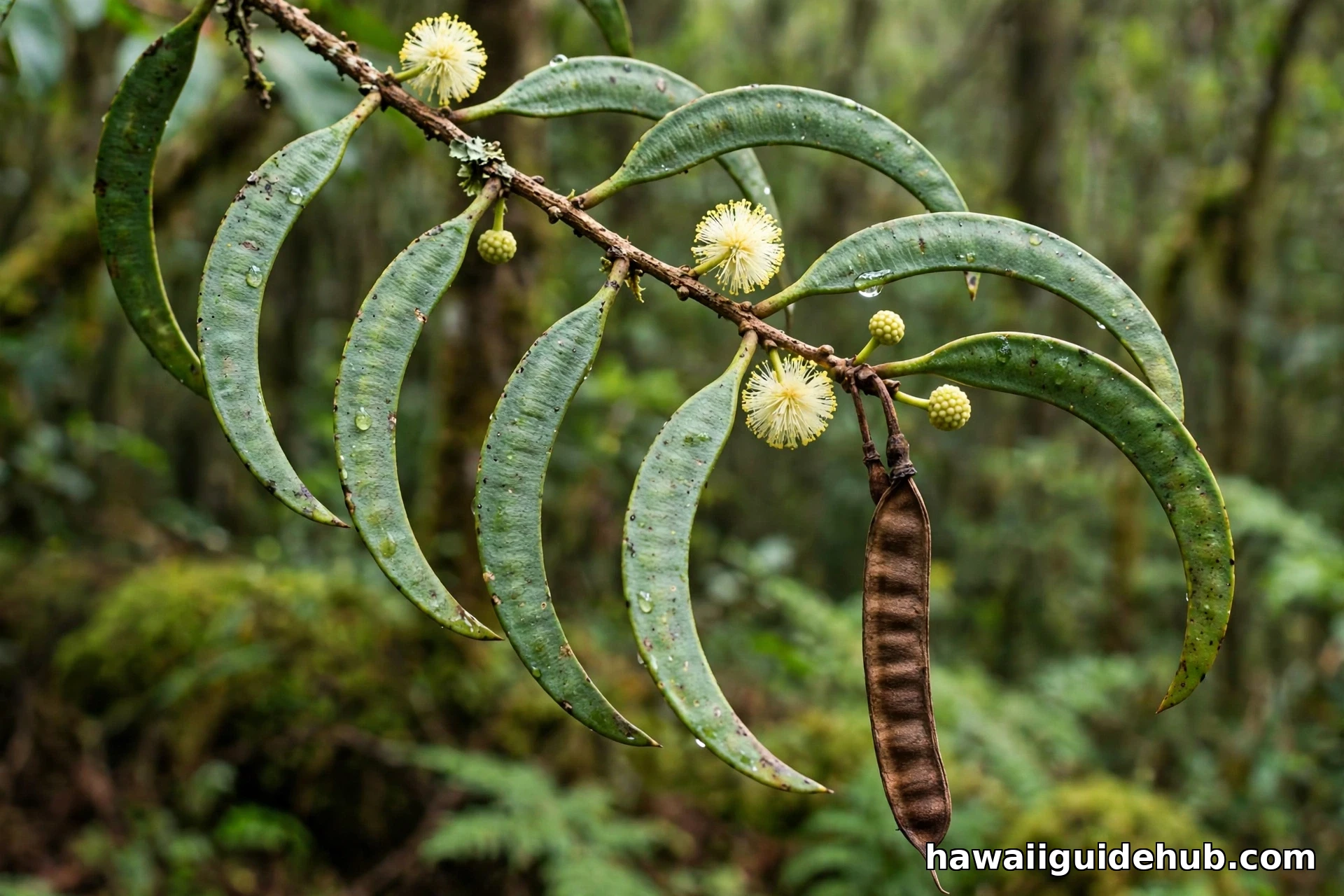
Young koa trees produce true leaves: delicate, feathery, compound leaves made of many tiny leaflets. But as the tree matures, it stops making them. In their place it grows phyllodes, which are flattened, sickle shaped leaf stalks that look and act like leaves. This switch is an adaptation to dry conditions, and it gives mature koa its unmistakable half moon foliage. If you see a tree with curved, crescent shaped green blades hanging from its branches, you are looking at koa.
Flowers and Seed Pods
Koa flowers are small pale yellow puffballs, spherical heads only about 8.5 millimeters across, borne in clusters where the phyllodes meet the branch. They bloom throughout the year, with the heaviest flowering in mid to late winter. When pollinated, they develop into flat brown pods 15 to 20 centimeters (6 to 8 inches) long, each holding 6 to 12 hard seeds.
The seeds are famously patient. Koa seeds can lie dormant in the soil for more than 25 years, waiting for the right moment. When a clearing opens and sunlight reaches the forest floor, often after a fallen tree or a fire, the seeds wake up and the forest begins again. This is one reason koa can reclaim land so aggressively once grazing animals are removed.
Koa in Ancient Hawaiian Culture
Few trees anywhere in the world have been woven so completely into a culture. For the early Hawaiians, koa was not just timber. It was the material that made ocean voyaging possible, the wood of war, and the stuff of sacred objects.
The Great Canoes
The most important use of koa was the waʻa, the dugout outrigger canoe. Master canoe builders would search the forest for a single perfect trunk, straight and massive, then fell it with stone adzes and hollow it into a hull. The largest voyaging canoes were carved from one continuous koa log. These vessels carried Hawaiians between islands and, in earlier centuries, across the open Pacific. The resurgence of traditional voyaging in modern Hawaii, led by canoes built in the old way, has renewed public awareness of just how scarce suitable canoe koa has become.
Surfboards, Spears, and Sacred Bowls
Koa also became papa heʻe nalu, surfboards. The paipo (bodyboard), kikoʻo, and alaia boards were traditionally shaped from koa, while the great olo longboards were carved from lighter, more buoyant wiliwili wood. Warriors carried spears and clubs of dense koa, including the lei o mano, a fearsome weapon edged with shark teeth.
Perhaps the most refined koa objects were the ʻumeke, wooden bowls turned and polished to a deep luster. For well over a thousand years, Hawaiian craftsmen perfected the ʻumeke as an art form. Before 1819, these bowls were sacred and strictly reserved for the aliʻi, and a commoner could face death for possessing one. Today, antique koa ʻumeke are prized collector pieces and enduring symbols of Hawaiian hospitality.
Koa bark was used for tanning, its leaves were strung into lei, and parts of the tree served medicinal and religious purposes. Walk through ʻIolani Palace on Oʻahu today and you will still see the royal connection in the koa floors, staircases, and furnishings that fill the former home of Hawaii’s monarchy.
Why Koa Wood Is Worth a Fortune
Modern koa is one of the most valuable hardwoods in the world, and the reasons start with its looks. Koa heartwood runs from golden brown to deep red, often with dark streaks and a wavy, curly figure that catches the light like moving water. It takes a high, lustrous polish, and no two boards ever look the same. In strength and weight it is similar to black walnut, with a specific gravity of about 0.55, which makes it both beautiful and genuinely useful.
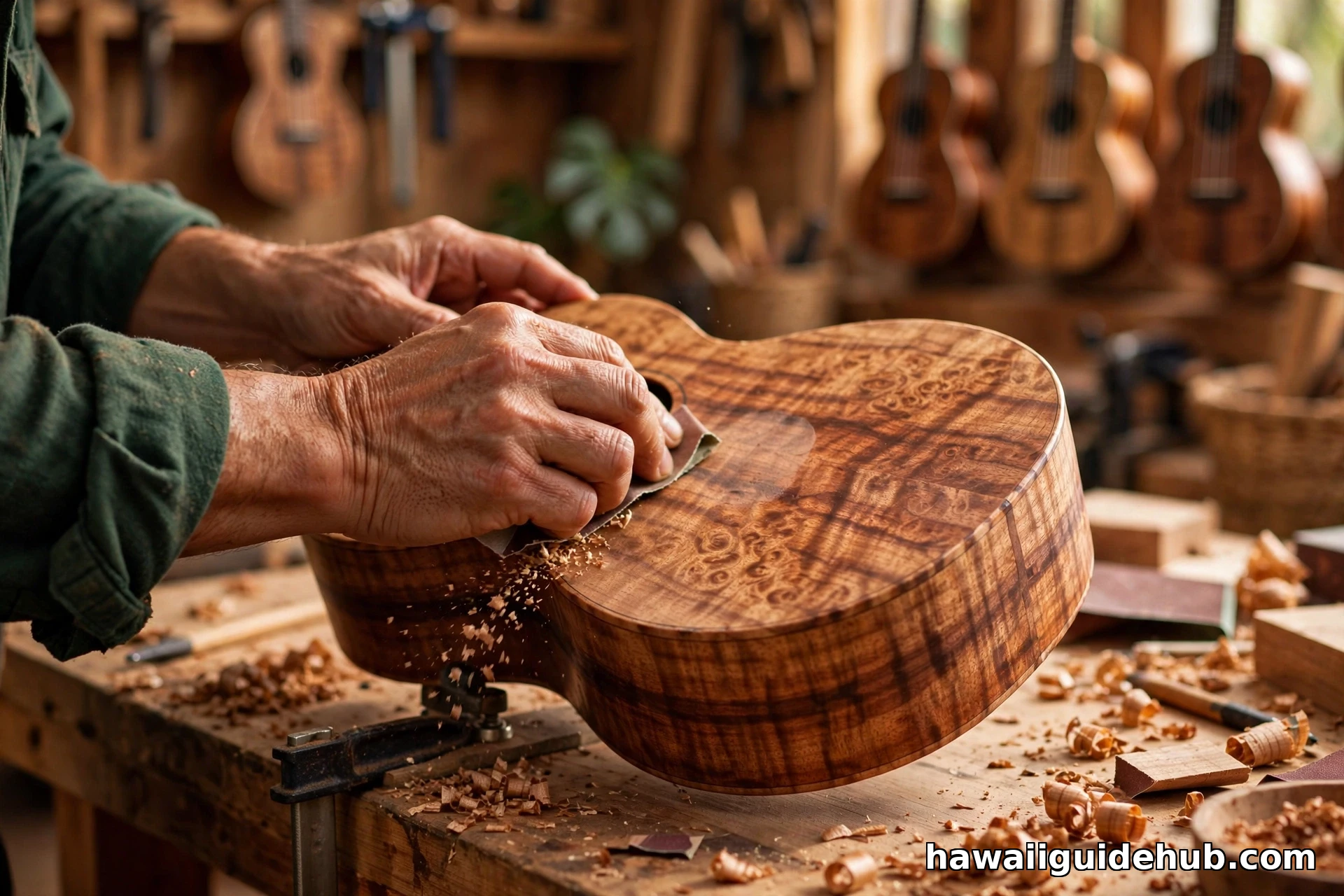
The wood’s figure is also the source of a lovely piece of Hawaiian lore. Some say the fiery red glow of polished koa is the image of Pele, the volcano goddess, shining through the grain, sharing her rapture and her pain and the glory of her creation.
The Tonewood of the Islands
Koa is one of the world’s great tonewoods. Its bright, warm voice made it the classic wood for the ukulele, and it remains the most prized choice for Hawaiian made instruments. Luthiers also build acoustic guitars and Weissenborn style Hawaiian steel guitars from koa, and major makers including Taylor, Martin, and Collings offer koa models. A guitar with a full curl koa top is a once in a lifetime instrument, and its price reflects it.
Beyond music, koa becomes fine furniture, cabinetry, gunstocks, turned bowls, pens, jewelry, and architectural paneling. State and court buildings across Hawaii are paneled in koa, and its use in island churches and public buildings is widespread. Plain koa lumber can sell for $15 to $50 per board foot, while highly figured curly koa commands $60 to $150 or more, with exceptional slabs priced in the thousands.
The Fall: How Ranching Nearly Erased Koa
Koa’s modern scarcity has a specific cause. After foreigners arrived in Hawaii, cattle ranching became big business, and vast tracts of native forest were cut and burned to create pasture. Cattle then munched their way through the regrowth, eating seedlings before they could establish. The largest and oldest koa trees, the ones with the deepest color and most stable grain, were the first to fall, and they are irreplaceable on any human timescale. A koa tree needs 50 to 80 years to develop the color, density, and curl that make the wood valuable, and 20 to 25 years of managed growth before it reaches even a useful timber size.
By the late 1800s, the old growth koa forests were mostly gone, and with them went habitat for the native birds that depend on koa canopy. Koa forests shelter 30 of the 35 remaining native Hawaiian forest bird species, 17 of them endangered. Losing koa meant losing the birds too.
The Comeback: Conservation and Replanting
The good news is that koa is coming back. The IUCN lists Acacia koa as Least Concern, and the NatureServe heritage rank is G4, apparently secure, but that status rests on active, ongoing work. Threats from insects, diseases, and invasive species remain real.
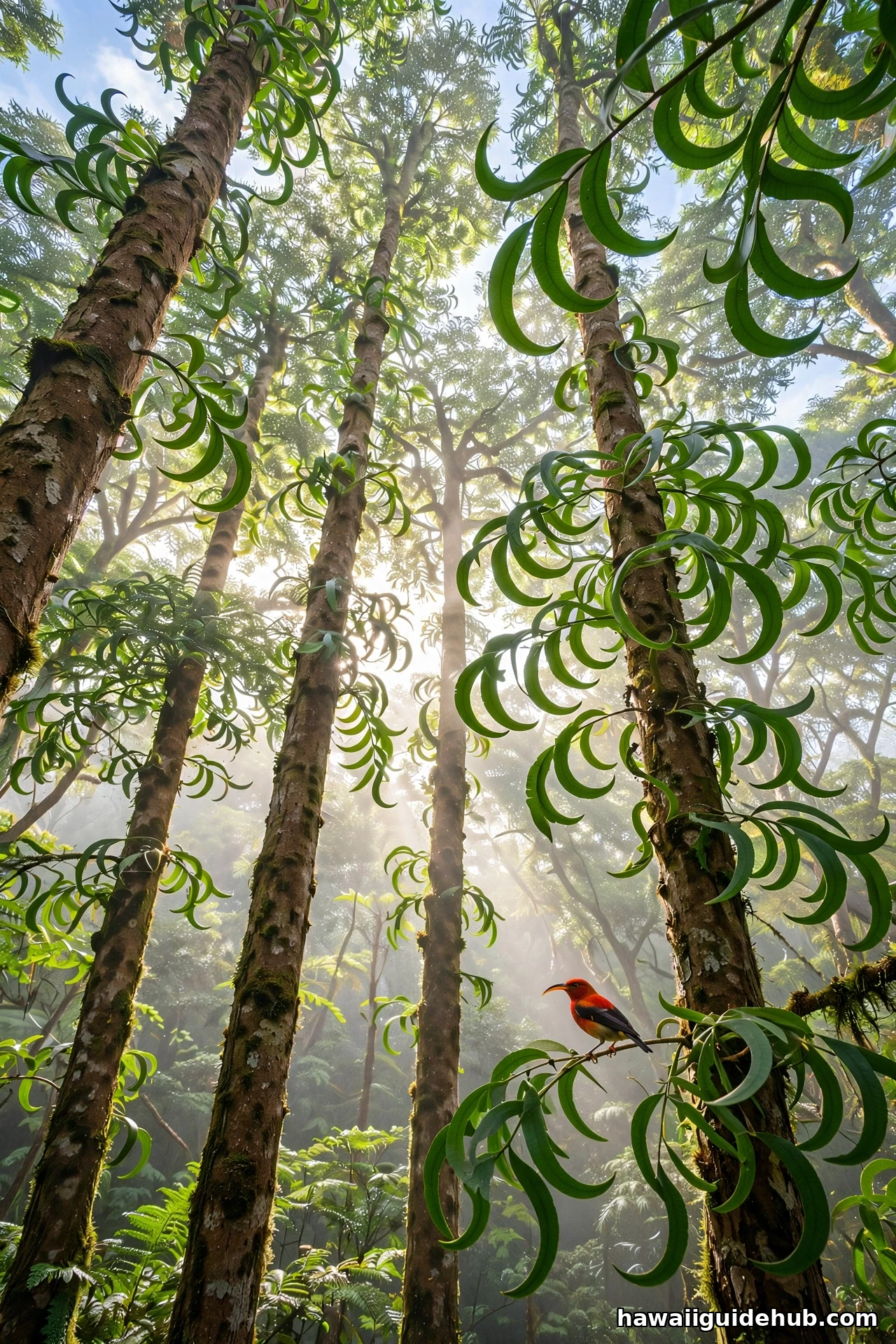
Across the islands, public agencies and private groups are reestablishing koa. The state Division of Forestry and Wildlife maintains a Koa Action Plan. On the Big Island, the Hakalau Forest National Wildlife Refuge has replanted thousands of acres of former pasture with koa and other natives, and endangered birds are returning to the new forest. Private landowners are fostering natural regeneration by removing livestock and planting seedlings, and programs like the “One Koa Tree for Every Home Sold” initiative plant a koa in a native forest for each new home sold in participating developments.
Harvest today is tightly controlled. Cutting live koa on public land is prohibited; the state issues permits only to salvage trees that are already dead or dying. Most commercial koa now comes from fallen trees, remnant pasture stands, and managed private forests. It is a small, carefully stewarded supply, which is exactly as it should be for a tree this precious.
Where to See Koa Trees in Hawaii
You do not need a botany degree to meet a koa tree. Several accessible places across the islands put you right inside koa forest.
Big Island
The Hakalau Forest National Wildlife Refuge on the windward slopes of Mauna Kea protects one of the finest recovering koa forests in Hawaii, with guided tours available by reservation. Hawaiʻi Volcanoes National Park has koa along several trails, including the Kipukapuaulu loop, where massive old trees survived the lava flows around them. If you are planning a wider Big Island trip, these forests pair beautifully with the island’s volcanoes, waterfalls, and best things to do on the Big Island.
Kauaʻi
Kōkeʻe State Park, high above Waimea Canyon, holds beautiful montane forest with koa among its canopy trees. The park’s trails and lookouts make it one of the easiest places to see mature koa in the wild. Combine it with the canyon and the Nā Pali overlooks for a full day among Kauaʻi’s top things to do on the Garden Isle.
Maui
Hosmer Grove in Haleakalā National Park, near the summit visitor area, is a short, easy loop through experimental forest plantings that include koa alongside other native and introduced trees. It is a gentle introduction to Hawaiian forest ecology at 7,000 feet. The grove sits along the road to the summit, an easy add to any of the island’s best Maui experiences.
Oʻahu
On Oʻahu, Lyon Arboretum in Mānoa Valley grows koa in its native plant collections, and Waimea Valley on the North Shore includes koa in its botanical gardens. The Honolulu Zoo and several city parks also plant koa as landscape trees. Pair a garden visit with the island’s beaches and history in our complete Oʻahu island guide.
Wherever you go, remember that koa in the wild is a protected native species. Admire the trees, photograph the phyllodes, and leave every seed pod where it lies. If you want a piece of koa to take home, buy from reputable island craftspeople who work with salvaged or sustainably sourced wood. For more ideas on exploring Hawaii’s wild side, see our guide to outdoor adventures in Hawaii.
Watch: The Vitality of Koa Trees
This short segment from KHON2 News explores what makes the koa tree so special to Hawaii, from its ecology to its cultural roots.
The Warrior Tree Endures
The koa tree has been a canoe and a weapon, a royal treasure and a sacred bowl, a song in wood and one of the priciest timbers on Earth. It survived the near total clearing of its forests and is now returning to the mountainsides, one planted seedling at a time, with native birds following close behind. To learn its story is to understand something essential about Hawaii: that the islands’ greatest treasures are living things, shaped by culture, nearly lost, and worth every effort to bring back. When you walk a trail and spot those sickle shaped leaves overhead, you are standing in the presence of a true Hawaiian warrior.