Green Sand Beach: Your Complete Guide to Papakōlea

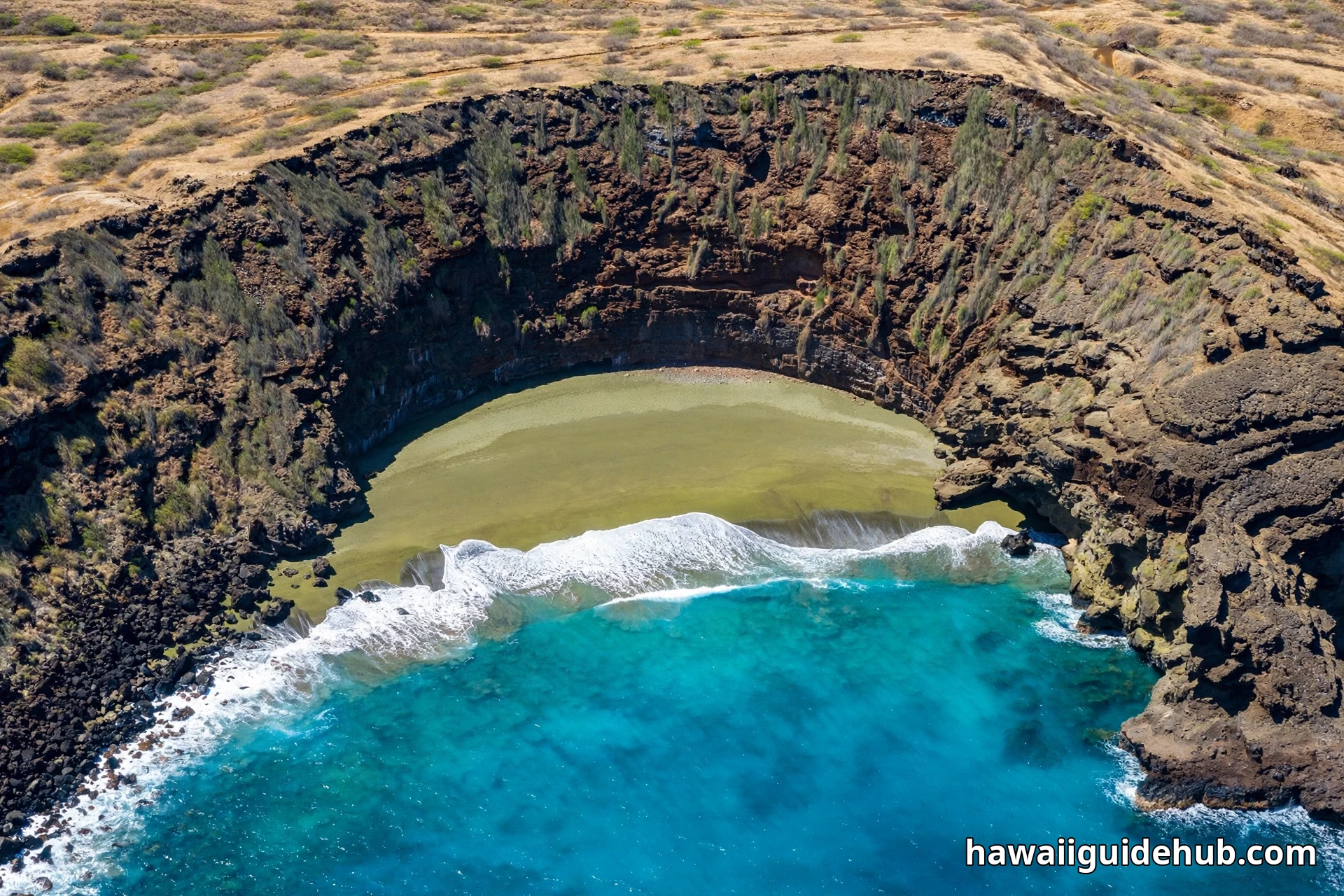
Most beaches make you work a little for the reward. A short walk from the parking lot, maybe a scramble over some rocks. Papakōlea asks for more. You drive to the southern edge of the Big Island, past where the paved road gives up, and then you walk. Two and a half miles across sun-blasted lava flats with the wind shoving at your back. There is no shade, no water fountain, no sign telling you that you are close. And then the ground drops away and there it is below you: a crescent of sand that is unmistakably, improbably green, cupped inside the remains of an ancient volcanic cone with turquoise water sliding over it.
This is one of the only green sand beaches on the planet. People cross oceans to stand on it. The walk keeps the crowds thin, which is part of the magic. What follows is everything worth knowing before you go: why the sand is green, how to get there without ruining your day, whether you should swim, and how to leave the place as remarkable as you found it.
Why the Sand Is Green
The short answer is olivine. The longer answer is a small geological miracle that took tens of thousands of years.
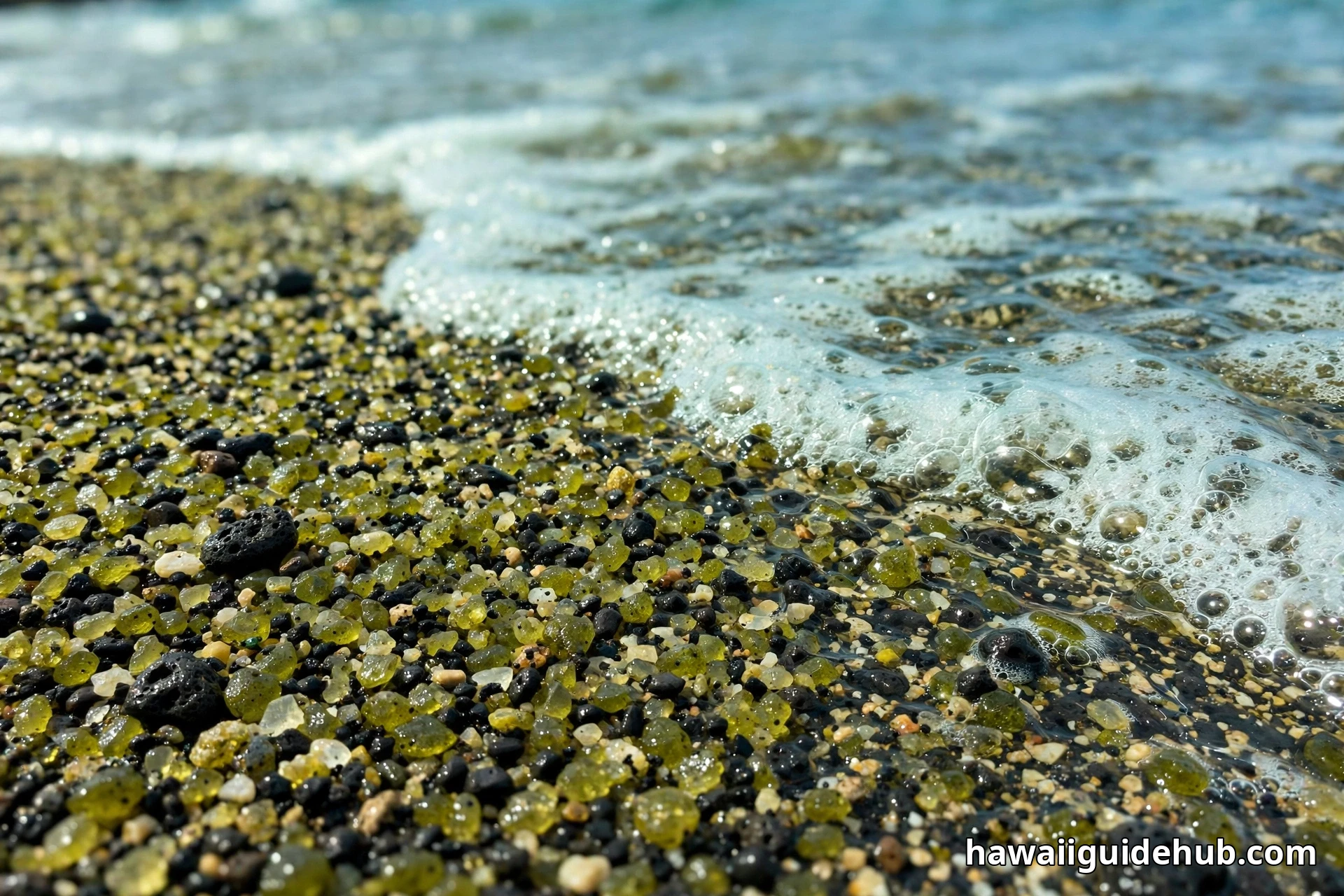
Olivine is a green, glassy mineral rich in magnesium and iron. It forms deep in the earth and rides up in basaltic lava. When lava cools slowly, olivine crystallizes out, and in gemstone quality it is known as peridot. Most Hawaiian beaches contain traces of it, but Papakōlea has it in extraordinary concentration, enough to tint the entire shoreline olive green.
The source is Puʻu Mahana, the cinder cone that cups the beach. Roughly 49,000 years ago, an eruption associated with Mauna Loa built this cone from olivine-rich material. Ever since, Pacific waves have been hammering at its slopes, breaking the rock apart grain by grain. Here is where the sorting happens: olivine is denser and tougher than the ash, volcanic glass, and dark pyroxene around it. In the churning surf of the narrow bay, the lighter particles get carried out to sea while the heavier green crystals stay behind. Thousands of years of this winnowing produced a beach with one of the highest coastal olivine concentrations anywhere in the world.
There is a quiet irony in it. The same ocean that concentrates the green sand is steadily eating away the cone that supplies it. Papakōlea exists in a slow-motion balance between creation and erosion, which is one more reason to see it with respect rather than entitlement.
Pick up a handful and look closely. The green is most vivid where feet have not ground it down, in the ripples the wind leaves and along the waterline. Mixed through it you will see black lava grains and pale flecks of coral and shell. It does not look like a putting green. It looks like what it is: a beach made of tiny gemstones.
Where Papakōlea Sits on the Map
Papakōlea Beach lies near Ka Lae, known in English as South Point, in the Kaʻū district on the southern coast of the island of Hawaiʻi. Ka Lae is the southernmost point in the fifty states, a windswept thumb of lava rock pointing toward Antarctica. The landscape out here feels like the edge of the map because it nearly is: open grassland, dark lava fields, and ocean in three directions.
The beach faces south into the open Pacific, tucked into Mahana Bay at the foot of the Puʻu Mahana cone. From the rim above, the cove looks like a bite taken out of the coastline, with 30-meter cliffs wrapping around sand that glows faintly green even from a distance.
What the Name Means
Papakōlea translates to “plover flats” in Hawaiian. The name honors the Pacific golden plover, a shorebird that migrates from Alaska to Hawaiʻi each fall and works the flat lava plains near the beach through the winter months. Visit between September and April and you will likely spot them: small, quick, gold-flecked birds picking through the dark rock, easy to miss if your eyes are only on the sand. The beach is also called Mahana Beach after the cone, but Papakōlea is the name with the story in it.
Getting to the Trailhead
Start from Highway 11, the main artery around the southern Big Island. Between the towns of Nāʻālehu and Waiohinu, watch for the turnoff to South Point Road. It is well signed. Follow South Point Road all the way to its end, roughly 12 miles of paved road through ranch country that gets progressively more remote. You will pass the turnoff for Ka Lae itself; keep going toward the boat ramp area, where a rough parking area marks the end of the pavement.
From Kona, budget about two hours of driving each way. From Hawaiʻi Volcanoes National Park, it is closer to ninety minutes. There are no gas stations, stores, or restaurants in the immediate area, so fuel up and stock up before you commit to the drive. The last stretch has no services at all.
Park in the designated area near the boat ramp. Do not leave valuables visible in the car. This is a remote spot, and break-ins happen at trailheads across the islands.
The Hike In: 2.5 Miles Each Way
From the parking area, the route to Papakōlea runs roughly 2.5 miles each way along the coast, about five miles round trip. Plan on one to two hours each direction depending on your pace and how often you stop to stare at the ocean, which will be often.
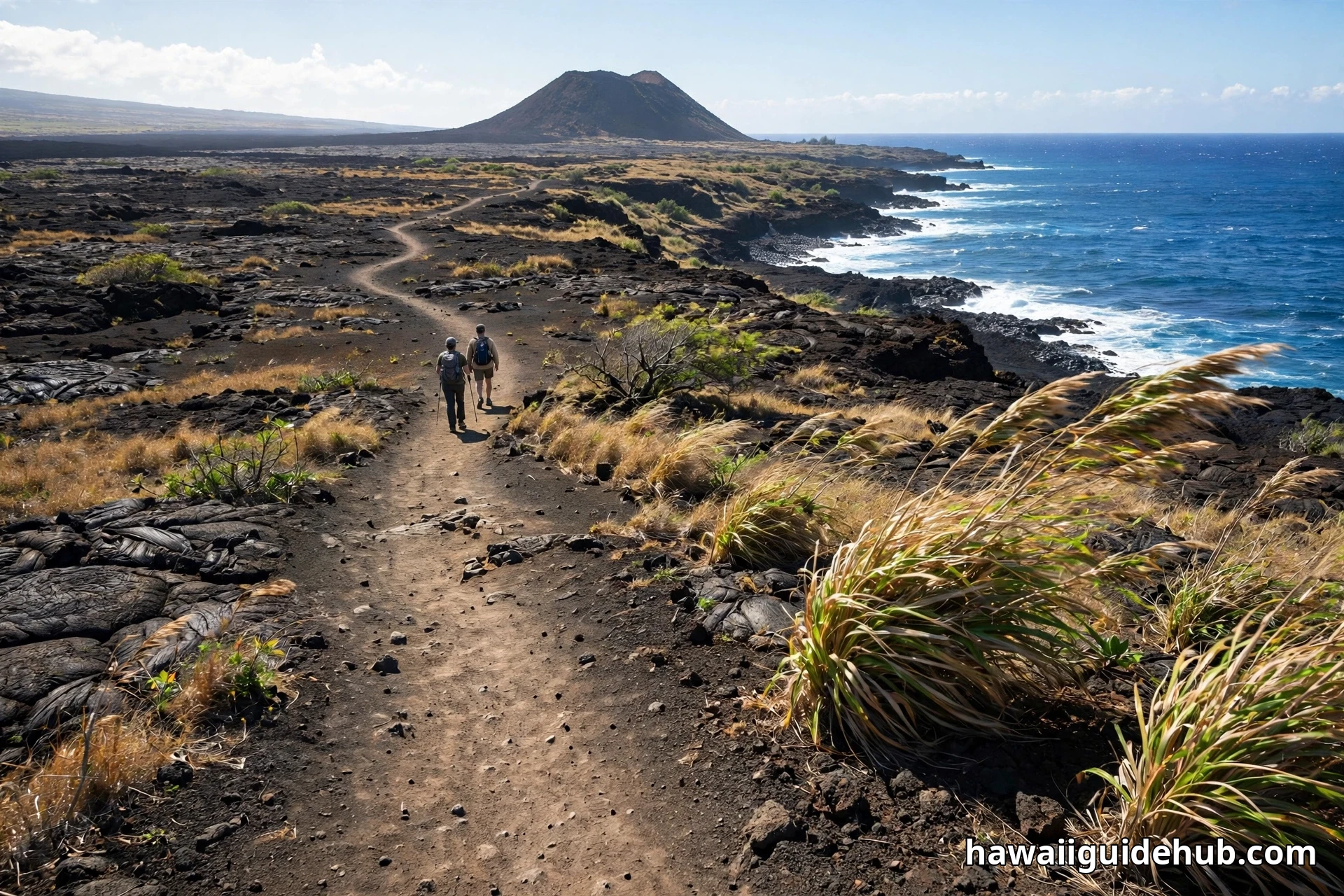
Calling it a trail is generous. There is no single marked path. Instead, a braid of dirt tracks, old jeep ruts, and footpaths fans out across the lava flats, all trending the same direction: east along the shoreline with the ocean on your right. Stay reasonably close to the coast and keep the sea in sight, and you cannot get seriously lost. The cinder cone becomes visible well before you arrive, a dark mound rising from the shoreline that tells you exactly where you are headed.
The walking itself is mostly flat but the conditions are demanding. There is essentially no shade for the entire route. The Kaʻū sun is fierce, the wind is constant and strong enough to sandblast exposed skin, and the ground alternates between dusty ruts, loose cinder, and uneven lava. Sturdy closed-toe shoes are non-negotiable; this is not a flip-flop hike. If you want more trail ideas, see our guide to hiking and outdoor adventures in Hawaii. Bring far more water than you think you need, a hat that will not blow away, sunglasses, and reef-safe sunscreen. An early start, ideally before 9 in the morning, makes an enormous difference in comfort.
The landscape rewards the effort. To one side, rolling grasslands dotted with grazing cattle. To the other, cliffs dropping to churning blue water, with seabirds riding the updrafts. On clear winter days you may spot humpback whales offshore. The plovers work the flats underfoot. It is a strange, beautiful, empty-feeling walk, and by the time the green cove appears below you, it feels earned.
The Shuttle Option: An Honest Assessment
You will notice trucks near the parking area. Local drivers offer rides to the beach in 4×4 vehicles for a cash fee, typically around $15 to $25 per person round trip. The ride takes about 20 minutes each way over brutally rough terrain that would destroy a rental car and void its contract.
Here is the honest picture. These are informal, unregulated services. The trucks are often old, the ride is violent, and seatbelts may not exist. Some drivers are experienced and careful; the quality varies. If you have mobility limitations, small children, or simply cannot face five miles in the heat, the shuttle is the pragmatic choice, and many visitors use it without incident. But go in with open eyes: inspect the vehicle, agree on the price and pickup time before getting in, and understand that you are accepting a level of risk that a maintained commercial tour would not carry.
Do not attempt to drive the track yourself unless you own a true high-clearance 4×4 and know how to use it. Rental agreements universally forbid off-pavement driving, the ruts are deep enough to high-center a standard SUV, and getting stuck out here means an expensive tow from very far away. The road has defeated better vehicles than yours.
The Descent to the Sand
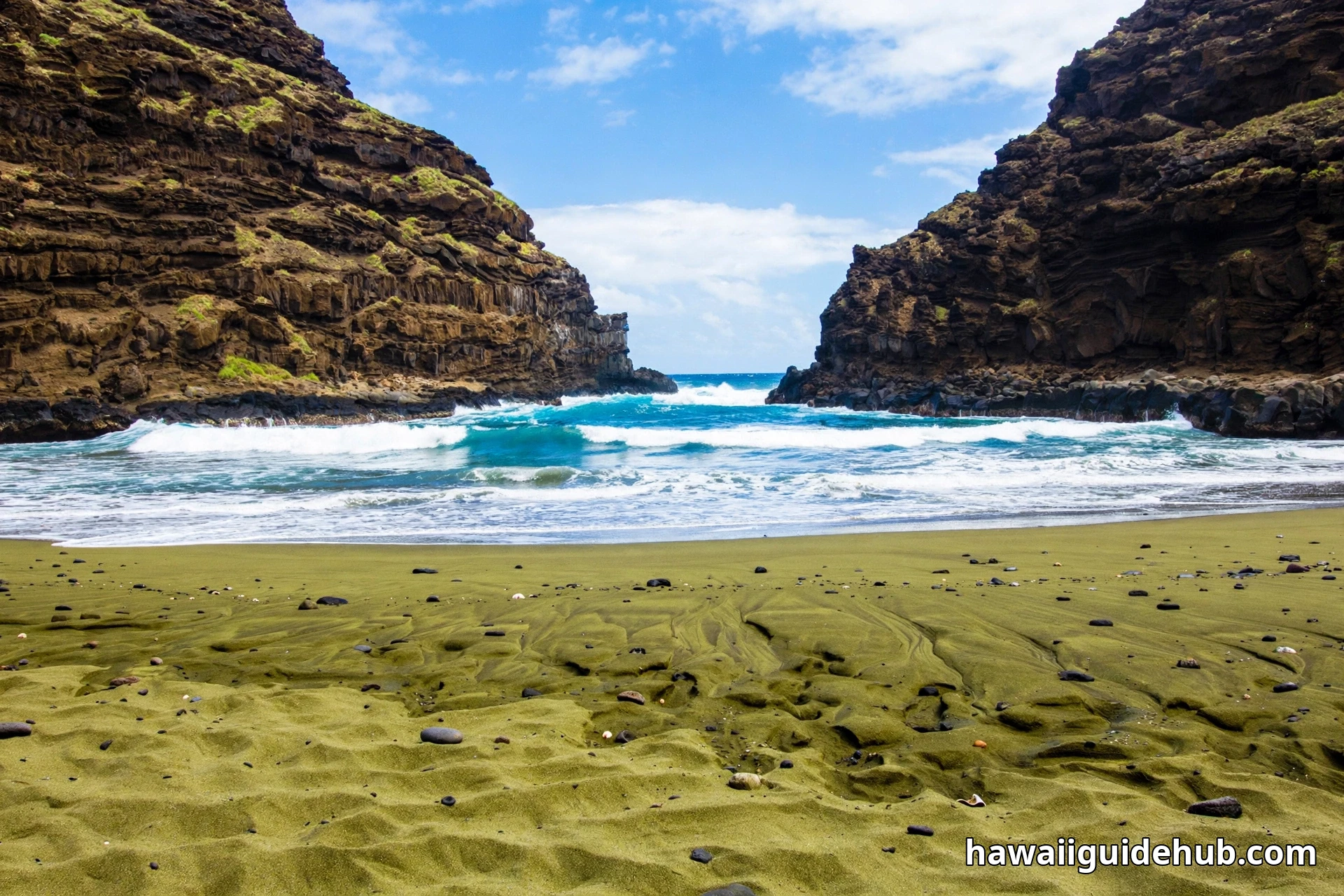
Whether you hike or ride, the last part is on foot. The track ends at the rim of the cove, and the beach sits at the bottom of the old cone. The way down is a steep scramble down loose cinder and rock, with no handrails, no ropes, and no maintained steps. Take it slowly, face the slope, and use your hands. Good shoes matter here more than anywhere else on the trip.
People with significant mobility issues, bad knees, or a fear of heights should think carefully about this section. Children can manage it with adult help, but it deserves respect. The climb back up, in the heat, after hours in the sun, is the hardest physical moment of the day for most visitors.
Swimming: Read This Before You Get In
The water in Mahana Bay is beautiful and the temptation to swim is strong after the long approach. Treat it with serious caution.
There are no lifeguards at Papakōlea. The cove faces the open ocean and the surf can be rough, with strong currents that shift with the swell. Conditions vary enormously day to day: on a calm morning the bay can be swimmable for confident swimmers, and on a rough day the shorebreak alone is dangerous. Never turn your back on the ocean, never swim alone, and keep children in the shallows or out of the water entirely if there is any meaningful surf running.
Check the surf forecast before you go and look at the water for a long while before deciding. If whitecaps are marching into the bay or the shorebreak is pounding, admire the green sand from dry land. The beach is worth the trip even if you never get wet. When in doubt, wade at the edge and watch the sets for fifteen minutes. The ocean always gets a vote.
A Note on Ocean Safety
Drowning is the leading cause of visitor fatalities in Hawaiʻi, and remote beaches without lifeguards account for a disproportionate share. Papakōlea has every risk factor: isolation, no rescue infrastructure, powerful surf, and visitors who are tired and dehydrated from the hike. This is not meant to frighten you off; it is meant to keep you honest. Swim only in calm conditions, stay within your abilities, and remember that the nearest hospital is a very long drive away. If you are not a strong ocean swimmer, enjoy the spectacle from the sand. There is no shame in it.
What to Bring
There are no facilities at Papakōlea. No restrooms, no trash cans, no food, no drinking water, no shade. Everything you need comes in with you and everything you bring leaves with you.
The non-negotiables: at least two liters of water per person, more if you run hot. Reef-safe sunscreen, applied before you start and reapplied at the beach. A wide-brimmed hat with a chin strap or a snug fit, because the wind will take a loose one. Sunglasses; the wind-driven sand and the glare off the water are brutal without them. Sturdy closed-toe shoes for the hike and the descent. Swimsuit and towel if you plan to swim, plus a dry bag or ziplock for your phone and keys.
Worth having: snacks or a full lunch, since you will be out here for half a day at minimum. A lightweight long-sleeve layer for sun protection. A small first-aid kit; blisters and scraped shins are the most common injuries. A fully charged phone, though do not count on signal. And a trash bag, because you are packing out everything, including fruit peels and tissues.
Leave No Trace: The Sand Stays
This matters more at Papakōlea than at almost any other beach in Hawaiʻi. The green sand took thousands of years to accumulate, grain by sorted grain. Removing sand, rocks, or olivine crystals from the beach is illegal under Hawaiʻi state law, and it should be unthinkable on principle: if every visitor pocketed a handful, the beach would be stripped within years.
Stay on the established paths across the lava flats to protect the thin soil and the native plants clinging to it. Do not stack rocks or carve into the cinder cone. Pack out every scrap of trash, including the tiny stuff. The beach looks the way it does because the people before you left it alone. Extend the same courtesy to whoever comes next.
When to Go
Mornings are the best time, for three reasons. The hike is cooler before the Kaʻū sun reaches full strength. The parking area fills as the day goes on. And the light on the green sand is at its most vivid in the morning, when the sun angle makes the olivine glow against the turquoise water.
Trade winds blow year-round on this coast, but winter months can bring bigger surf and rougher conditions in the bay. Summer tends to offer calmer water, though the heat on the hike is more punishing. There is no perfect month; there is only the day you get, so check the surf and weather forecast the night before and go early whatever the season.
Pair the trip with Ka Lae itself, a short drive away, as part of a wider day of things to do on the Big Island. Standing at the southernmost point in the United States, watching the currents collide below the cliffs, is a worthy bookend to the green sand. Between the two, you will have seen the rawest edge of the Big Island.
Is It Worth It
Five miles of hot, windy walking for a beach you might not swim at sounds like a questionable trade until you stand on the rim and see the green crescent below. Then the arithmetic changes. Papakōlea is one of those places that recalibrates what you thought a beach could be: not white, not black, but green, made of gemstones, sitting in the ruins of a volcano at the bottom edge of the country.
Go prepared, go early, respect the water, and take nothing but pictures. The rarest beaches ask the most of their visitors, and they repay it exactly in kind.