Bonefish in Hawaii: Chasing the ʻŌʻio, the Grey Ghost of the Flats

Hawaii’s bonefish are the ghosts of the flats: bigger, warier, and harder to catch than their famous Caribbean cousins. Called ʻōʻio in Hawaiian, these silver bullets haunt the shallow sand flats of Oahu and Molokai, growing to 16 pounds and more, and they have humbled some of the world’s best fly anglers. This is the complete guide to bonefish in Hawaii: identification, where they live, how to fish for them, and why the ʻōʻio is the ultimate flats challenge.
This page covers what ʻōʻio are, identification, native status, size and records, habitat, behavior, the best flats, fishing techniques, gear, catch and release, regulations, and FAQs. Everything about Hawaii bonefish is on this one page.
The Short Answer
The bonefish in Hawaii is the ʻōʻio (Albula species, including Albula virgata, found only in the Hawaiian Islands per recent taxonomy). It is a bright iridescent silver fish with a greenish back and an elongate upper jaw, reaching over 40 inches and up to 16 pounds according to Hawaii DLNR. It lives on sandy flats and reef channels, feeds nocturnally on crustaceans and small fish, and is prized by fly anglers as one of the hardest bonefish on earth to catch.
Identifying the ʻŌʻio
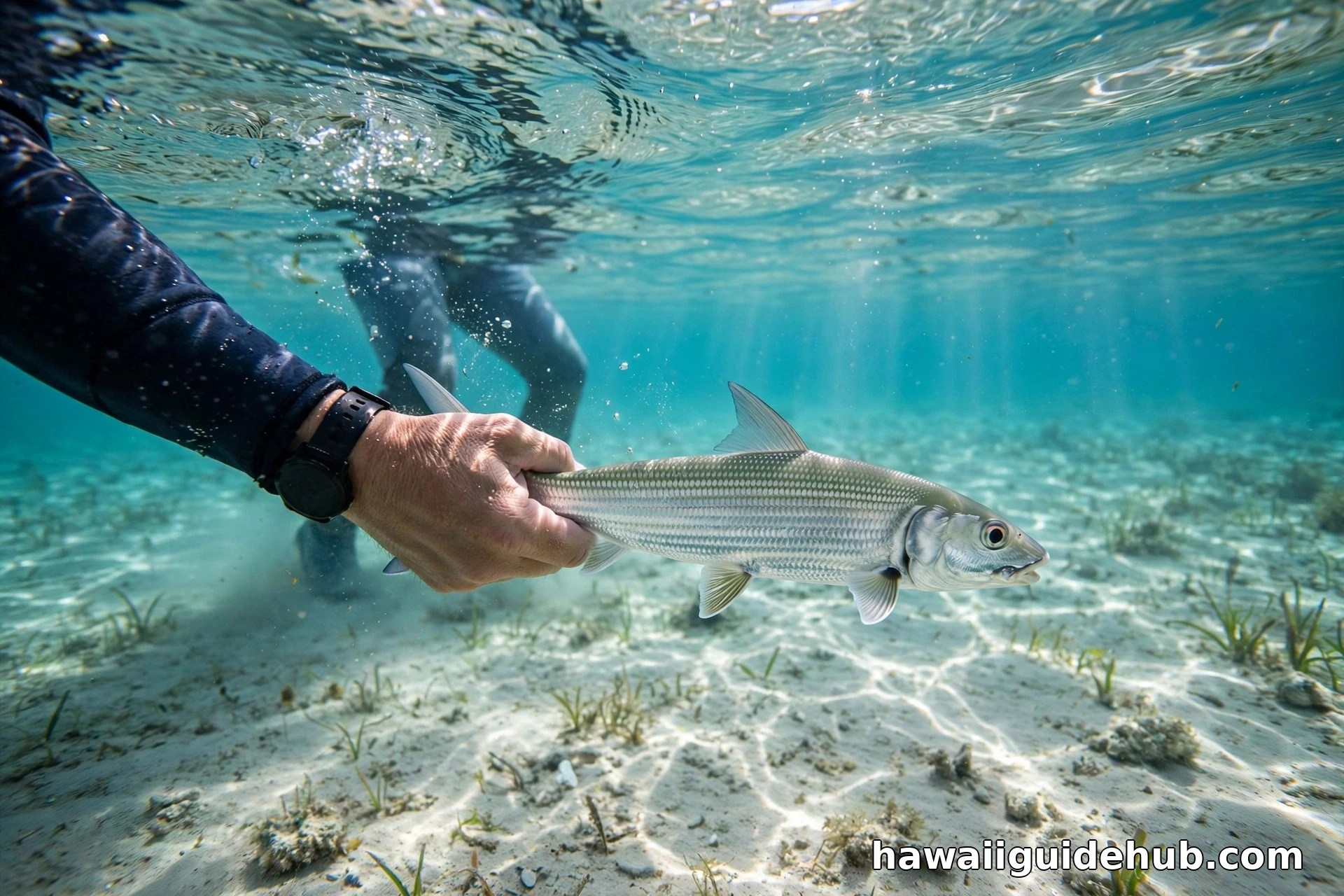
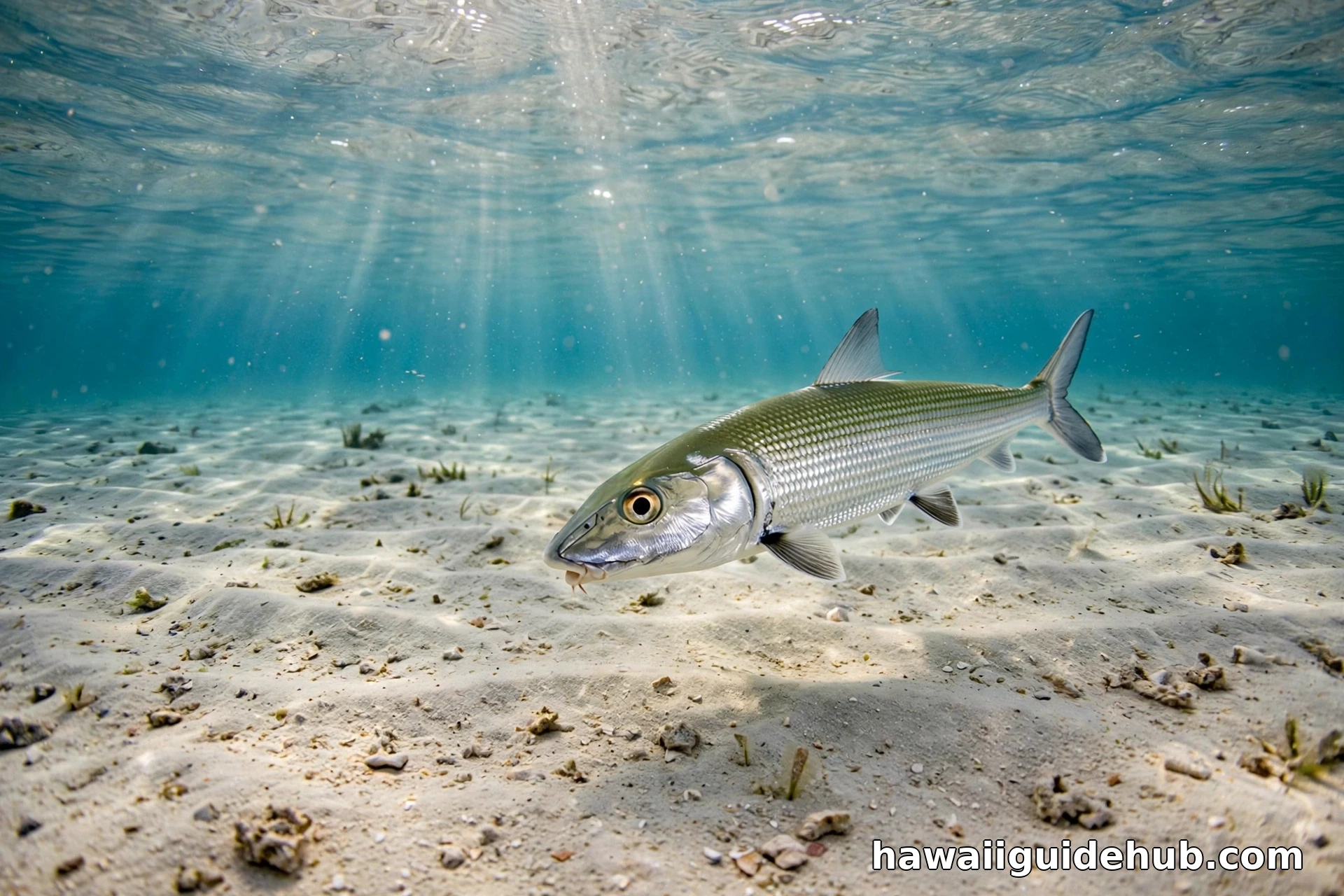
Look for a torpedo of polished silver: elongated body, deeply forked tail, large scales that flash in the sun. The back carries a greenish-bronze tinge, the belly is white, and the upper jaw juts past the lower, a snout built for rooting crabs and shrimp from the sand. On the flats you rarely see the whole fish: you see the signs, a tail tipping out of the water as it feeds (tailing), a V-wake pushing across the flat, a shadow that vanishes when you blink. That vanishing act is the species’ signature.
Hawaii’s Bones vs the Caribbean’s: No Contest
| Trait | Hawaii ʻōʻio | Caribbean bonefish |
| Species | Albula virgata, Hawaii only, per recent taxonomy | Albula vulpes, widespread |
| Size | Up to 16+ lb; 8-10 lb fish common | Typically 3-8 lb |
| Schooling | Solitary or small groups; rarely schools | Large schools of hundreds |
| Wariness | Legendary; spooks at 30 feet | Wary but catchable |
| Flats habitat | Rare, fragmented flats (Oahu, Molokai) | Vast endless flats |
Why Hawaii’s Bonefish Are So Hard
Three things make the ʻōʻio the hardest bonefish alive. First, size: a 10-pound bonefish is smarter than a 4-pounder, and Hawaii grows them big. Second, solitude: Caribbean bones travel in schools where competition makes them reckless; Hawaii’s fish cruise alone or in pairs, with nothing but caution on their minds. Third, pressure and habitat: the flats are few and fragmented, the fish see anglers, and the water is often deeper, thigh-deep rather than shin-deep, which favors the fish. Anglers describe Hawaii bones as the graduate school of flats fishing: everything you learned elsewhere barely applies.
Where the Flats Are
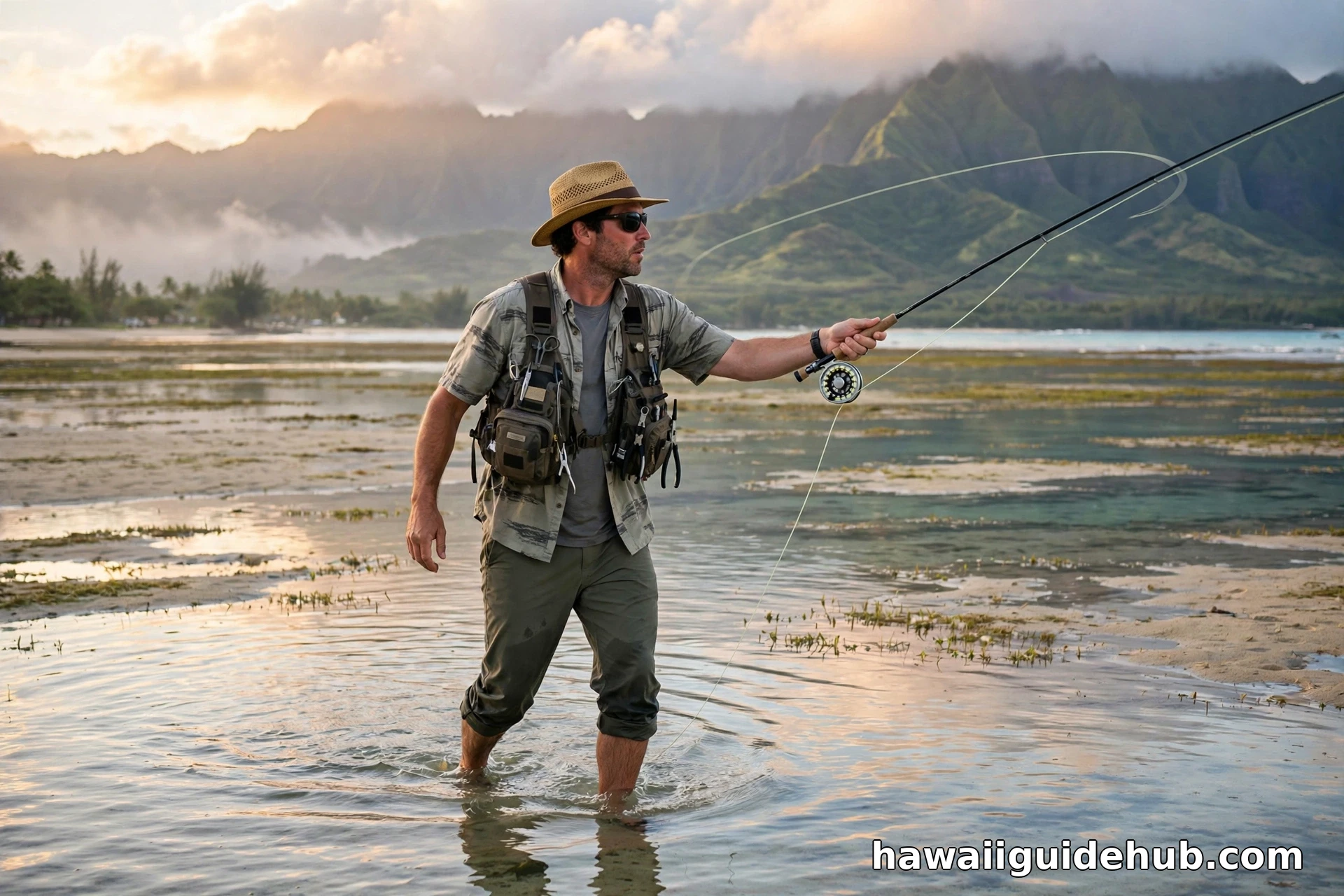
Oahu and Molokai hold Hawaii’s bonefish flats. On Oahu, the great flat running from Diamond Head to Koko Head is miles of wadeable water, though the fish concentrate in specific spots known to guides: dark-bottomed areas with spongy weed, shallow humps surrounded by deeper water. Molokai’s south shore flats are wilder and less pressured, the choice of DIY adventurers. The fish move with the tides: incoming water brings them onto the flats to feed, and dawn is prime. Local knowledge matters enormously here; a guide day is the best money in Hawaii fishing.
How to Catch One: Tactics
Forget sight-fishing postcard casts. Hawaii veterans recommend covering water: long blind casts with a nymphing-style retrieve, keeping the fly just above the bottom, working productive-looking water methodically. When you do spot a fish, lead it generously and let the fly settle: Hawaii bones eat crabs the color of sand, so match the bottom with larger, drabber flies and minimal flash. The wind almost never quits, so cast with it, not against it. Strikes often come at the far end of the cast. And when the line goes tight, hold on: 200 yards of backing can vanish in seconds.
Gear: Bring the Heavy Stuff
An 8-weight fly rod is the standard: enough backbone for the wind and the fish. Bring more fly line and backing than you think you need; a big ʻōʻio will test every yard. Flies should be crab and shrimp patterns in sand colors, sizes 4 to 6, tied sparse. Polarized sunglasses are non-negotiable for spotting fish. Wade quietly in soft-soled flats boots, and go slow: these fish hear you coming. There is one small fly shop in the state, so bring everything you need.
Catch and Release: The Ethic
Bonefish are rarely eaten in Hawaii: they are famously bony, which is how they got the name, and the old Hawaiians never prized them as food. The modern fishery is overwhelmingly catch and release. Handle fish with wet hands, keep them in the water, revive them facing into the current, and release quickly. Barbless hooks make release faster and safer. The ethic is simple: these are among the rarest, hardest-earned fish in the sport, and every one released is a ghost returned to the flat.
For more fishing, see a guide for anglers to deep sea fishing in Ko Olina, exploring Hawaii’s hidden gems, and your full Hawaii bucket list.
The ʻŌʻio in Hawaiian Culture
The old Hawaiians knew the ʻōʻio well: they caught them in fishponds and with nets, though the fish’s many bones kept it off the luau menu. The name ʻōʻio is old and specific, a sign of long observation. Hawaiian fishponds (loko iʻa) like those on Molokai trapped bonefish among other species. The fish appears in place names and fishing lore. Modern Hawaiians mostly encounter it as the fly angler’s prize, but the cultural memory is deeper: this is a fish the islands have known by name for centuries.
Reading the Flat: How to Spot Bonefish
Spotting bones is a skill measured in hours. Look for tails breaking the surface as fish tip down to feed. Look for wakes: a V-shaped ripple pushing across calm water with no visible cause. Look for shadows, then look again, because the shadow moves. Nervous water, a patch of surface that shimmers differently, betrays a cruising fish. Polarized sunglasses cut the glare; the sun at your back helps. And “bonefish eyes” are real: after a few days, your brain learns the pattern, and fish you would have walked past start appearing everywhere.
The Flies That Work
Hawaii bones eat crabs, and the crabs match the sand: tan, olive, nondescript. Tie or buy accordingly: sparse crab patterns in sand colors, sizes 4 to 6, with minimal flash. Local patterns have local names and local followings; ask at the fly shop what is working this month. Shrimp patterns work too, fished the same way: settled on the bottom, twitched like something trying not to be noticed. Bright, flashy, generic bonefish flies from the Caribbean box get refused: these fish have seen it all.
DIY or Guided: The Honest Math
DIY bonefishing in Hawaii is possible and romantic: just you, the flat, and the dawn. It is also brutally hard: the flats are subtle, the fish are few, and without local knowledge you can walk for hours seeing nothing. A guide day costs real money but compresses years of learning into hours: the guide knows which flat on which tide, spots fish you would never see, and poles you into casting range. First-timers should hire the guide. Veterans chasing the DIY dragon should budget several days and embrace the skunking as tuition.
Other Ghosts on the Flat
The ʻōʻio shares its flats with worthy bycatch. Giant trevally (ulua) patrol the deeper edges: a 50-pound GT on a fly rod is a life event. Bluefin trevally (omilu) cruise the shallows in flashing blue. Milkfish (awa) tail like bones and fight in powerful short bursts. Ladyfish and sharpnose sharks add chaos. Many anglers arrive for bonefish and leave dreaming of trevally. The flat is an ecosystem, not a single-species stage, and every day out there deals surprises.
Protecting the Flats
Hawaii’s flats are fragile and finite. Wade carefully: trampling turtle grass and coral rubble damages the food web the bones depend on. Do not drive on flats. Pack out all line and leader: monofilament kills birds and turtles. Support the guides and shops pushing for flats conservation, and respect kapu areas and private land boundaries: much of the best water crosses property lines. The ʻōʻio survived millions of years; whether it survives the next fifty depends on how we treat its living room.
A Day on the Flats, Hour by Hour
0500: alarm, coffee, rig the 8-weight in the dark. 0600: first light on the flat, tide pushing in. 0700: the golden hour, tails up on the shallow humps. 0900: sun high enough to spot cruisers over dark bottom. 1100: wind builds, switch to blind-casting the deeper edges. 1300: lunch in the shade, re-tie leaders. 1500: afternoon tide shift, fresh fish moving in. 1700: last light, one more flat, the day’s best shot. 1800: drive home replaying the one that got away. That is the rhythm. The fish set it; you just keep time.
A Species All Its Own
For decades, Hawaii’s bonefish were lumped in with the Caribbean’s as one species. Modern taxonomy split them: Albula virgata is now recognized as distinct, known only from the Hawaiian Islands, separated by vertebrae counts, lateral-line scales, and fin measurements invisible to anglers but real to science. The split matters: it means Hawaii’s ʻōʻio is an endemic species, found nowhere else on earth, which raises the conservation stakes. You are not just chasing a big bonefish; you are chasing a Hawaiian original.
What the Bones Do at Night
Per Hawaii DLNR, bonefish feed generally at night: they move onto the flats under cover of darkness to root crabs and shrimp from the sand, then retreat to deeper channels by day. That is why dawn finds them finishing breakfast on the shallow humps and why the evening push can be electric. Moon phases matter: bright nights mean fed fish and slow dawns; dark nights mean hungry fish at first light. Ask the guides about the moon before you book: it is not superstition, it is the fish’s schedule.
The Cast You’ll Remember
Every bonefish angler has one cast burned into memory: the long one, into the wind, that landed soft and true. In Hawaii that cast is harder to earn and sweeter to remember. The fish that ate it probably weighed more than any bonefish you had caught before, ran farther, and left you shaking. You will tell the story for years, and nobody who has not stood on that flat will quite believe it. That is the ʻōʻio’s gift: it makes believers out of skeptics, one impossible fish at a time.
Video: Fly Fishing for Bonefish in Hawaii
A day on the Oahu flats with a guide: the ʻōʻio experience.
Frequently Asked Questions
What is ʻōʻio?
The Hawaiian name for bonefish, a silvery flats fish prized by fly anglers.
How big do Hawaii bonefish get?
Up to 16 pounds and over 40 inches per Hawaii DLNR: much bigger than typical Caribbean bonefish.
Where can I fish for bonefish in Hawaii?
Oahu’s flats (Diamond Head to Koko Head) and Molokai’s south shore. A guide is strongly recommended.
Are bonefish good to eat?
No: they are extremely bony. The fishery is catch and release.
What gear do I need?
An 8-weight fly rod, crab/shrimp flies in sand colors, polarized sunglasses, and flats boots.
When is the best time to fish the flats?
Dawn on an incoming tide, when bonefish move onto the flats to feed.
The ʻōʻio does not give itself away: no jumping, no schooling frenzy, just a shadow that was there and then was not. That is the whole game, and it is why anglers cross oceans for it. Hook one Hawaii bonefish, feel that first run strip your reel to the backing, and you will understand why the grey ghost of the flats has no equal.