
Kauaʻi Wildlife
Kauaʻi is the oldest of the main Hawaiian Islands, and its age shows in its wildlife. Roughly five million years of isolation, erosion, and trade-wind rain have produced a living community found nowhere else on Earth: honeycreepers with beaks shaped for blossoms that no longer exist on any other island, seabirds that return to the same cliff ledges their ancestors used for millennia, and a marine world where endangered monk seals haul out on public beaches within sight of hotel pools. This guide covers the animals you can realistically expect to see on Kauaʻi, where to find them, and how to watch without harming the very creatures that make the Garden Isle extraordinary.
On This Page
Kauaʻi Wildlife at a Glance
Because Kauaʻi has never been connected to any continent, every native land animal either flew here, floated here, or was blown here on the wind. The result is an ecosystem unlike any other: no native land mammals at all (the hoary bat, which reaches Kauaʻi too, is the only native land mammal in all of Hawaiʻi), an astonishing radiation of forest birds from a single finch-like ancestor, and insects and snails found in a single valley and nowhere else.
What makes Kauaʻi special even within Hawaiʻi is that it was never connected to the younger islands, so its species had the longest time to diverge. The island is home to some of the rarest birds on the planet, including the ʻakikiki and ʻakekeʻe, two honeycreepers found only in Kauaʻi’s high-elevation Alakaʻi Plateau, and the puaiohi, a small thrush whose entire wild population lives in a few remote ravines. Conservation groups describe Kauaʻi as the front line of the fight against avian malaria, a mosquito-borne disease that is pushing the island’s remaining forest birds upslope toward the cool refuges of the Alakaʻi.
The surrounding ocean is equally rich. Kauaʻi sits in the middle of the Hawaiian archipelago’s most productive nearshore waters, and its beaches host one of the most accessible populations of the endangered Hawaiian monk seal anywhere in the state. Humpback whales crowd the island’s north shore and Nāpali Coast each winter, spinner dolphins rest in sheltered coves by day, and green sea turtles graze the reefs of the south and east shores year-round.
Introduced animals have reshaped the island too. Feral pigs root through native forest, free-roaming chickens (descended from domestic birds scattered by hurricanes ʻIwa in 1982 and ʻIniki in 1992) have become Kauaʻi’s unofficial mascot, and feral cats threaten ground-nesting seabirds and monk seal pups. Understanding which animals belong and which do not is part of understanding Kauaʻi itself.
One practical note: Kauaʻi has no mongooses. The small Indian mongoose, introduced to Oʻahu, Maui, Molokaʻi, and Hawaiʻi Island in 1883 to control rats in sugarcane fields, was never released on Kauaʻi, and the island’s residents have worked hard to keep it that way. That absence is one reason Kauaʻi’s ground-nesting birds have fared better than their relatives on other islands, and it is worth appreciating while it lasts.
Marine Life: Turtles, Seals, Dolphins, and Whales
The waters around Kauaʻi hold some of the most rewarding marine wildlife encounters in Hawaiʻi, and many of them require nothing more than a beach towel and patience.
Green Sea Turtles (Honu)
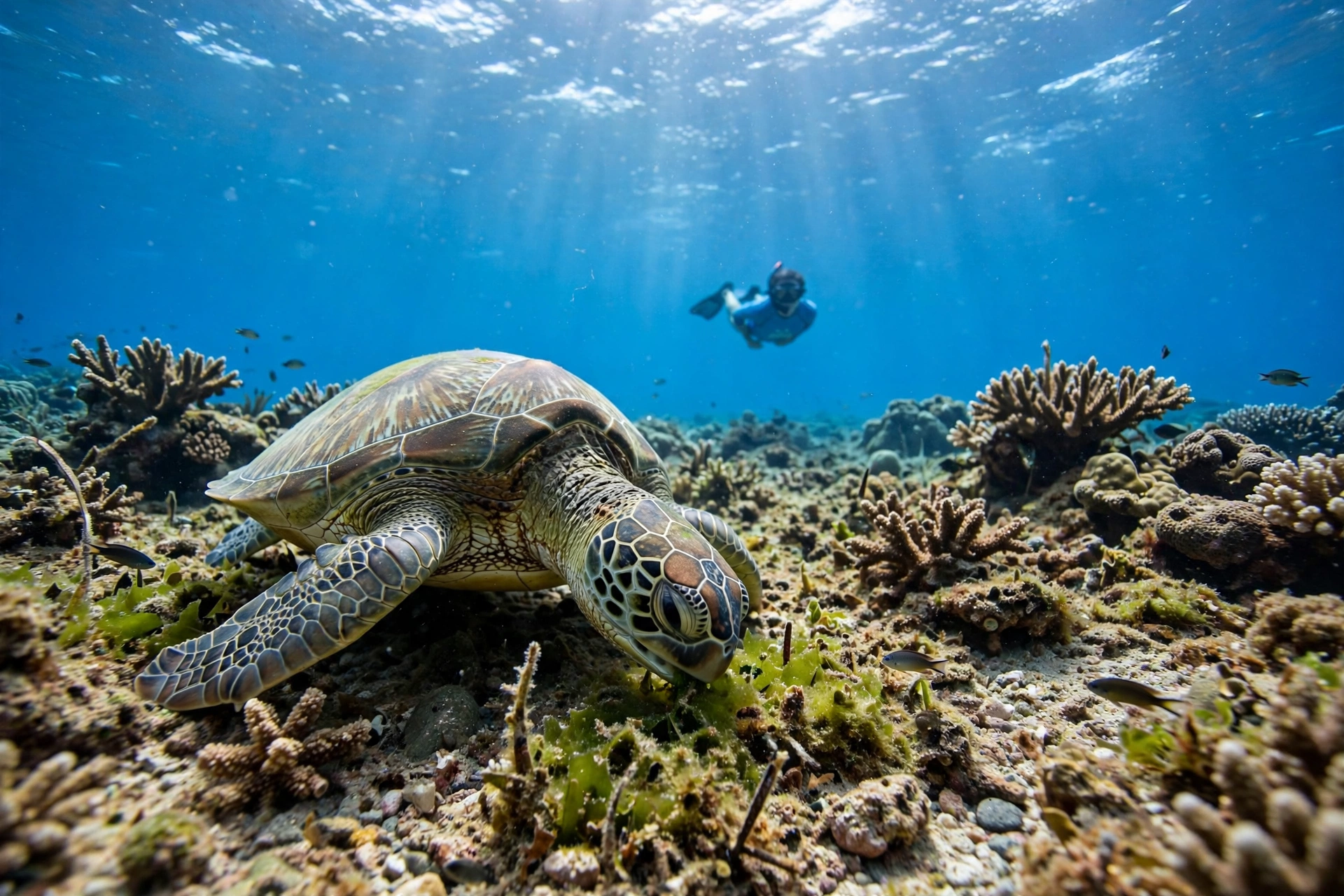
Green sea turtles are the marine animal you are most likely to meet on Kauaʻi. They haul out to bask on beaches, especially along the south and east shores, and graze the nearshore reefs at spots like Poʻipū, Lydgate, and Anini. A basking turtle looks profoundly relaxed, flippers tucked, eyes half closed, and it is tempting to approach. Do not. All sea turtles in Hawaiʻi are protected under the U.S. Endangered Species Act and Hawaiʻi state law, and NOAA Fisheries recommends staying at least 10 feet away. Touching, chasing, or riding a turtle is illegal and can carry serious penalties. A turtle that feels crowded may abandon a basking spot it has used for years.
Hawaiian Monk Seals (ʻĪlio-holo-i-ka-uaua)
The Hawaiian monk seal is one of the most endangered marine mammals on Earth, with roughly 1,600 animals remaining, and Kauaʻi is one of the best places in the world to see one. Monk seals haul out on Kauaʻi’s beaches to rest, sometimes for an entire day, and nursing mothers with pups need absolute quiet. NOAA Fisheries asks the public to keep at least 50 feet (about 15 meters) from a hauled-out seal, and 150 feet from a mother with a pup. Volunteers from community response networks often rope off a resting seal and post signs; treat those boundaries as law, not suggestion. If a seal looks at you, lifts its head, or moves away, you are already too close. Photograph with a zoom lens, keep dogs leashed and far away, and never get between a seal and the water.
Spinner Dolphins (Naiʻa)
Hawaiian spinner dolphins hunt offshore at night and return to sheltered bays by day to rest and socialize. On Kauaʻi they favor calm leeward coves, and you may spot their famous spinning leaps from shore or from a boat along the Nāpali Coast. Resting dolphins are vulnerable: federal regulations prohibit swimming with, approaching within 50 yards of, or otherwise disturbing spinner dolphins in Hawaiian waters. If dolphins approach your kayak or paddleboard on their own, that is their choice; do not chase, circle, or leap into the water beside them.
Humpback Whales (Koholā)
Each winter, thousands of North Pacific humpback whales migrate to Hawaiian waters to breed, calve, and nurse their young, and Kauaʻi’s north shore and the waters off the Nāpali Coast are prime whale territory. The season runs roughly December through April, peaking February and March, when a mother and calf may surface so close to shore that you can hear the blow from the beach. Federal law requires vessels and swimmers to stay at least 100 yards from humpback whales. Shore watching needs no boat at all: Kīlauea Point, the overlooks along the north shore, and any high coastal vantage on a calm winter morning can deliver breaches, tail slaps, and the misty exhale of a blow on the horizon.
Reef Fish and Coral
Kauaʻi’s reefs host the familiar cast of Hawaiian reef fish: humuhumunukunukuāpuaʻa (reef triggerfish, Hawaiʻi’s state fish), yellow tang, parrotfish (uhu) that crunch coral and excrete the sand beaches are made of, and the occasional octopus (heʻe) tucked into a reef crevice. Coral itself is a living animal, and a single misplaced fin kick can destroy decades of growth. Practice good buoyancy, never stand on coral, and wear reef-safe sunscreen that complies with Hawaiʻi’s Act 104, which bans the sale of sunscreens containing oxybenzone and octinoxate.
Birds of Kauaʻi: Forest Birds and Seabirds
Kauaʻi’s birds are the island’s greatest wildlife treasure and its greatest conservation emergency, and both stories deserve to be told.
The Forest Birds of the Alakaʻi
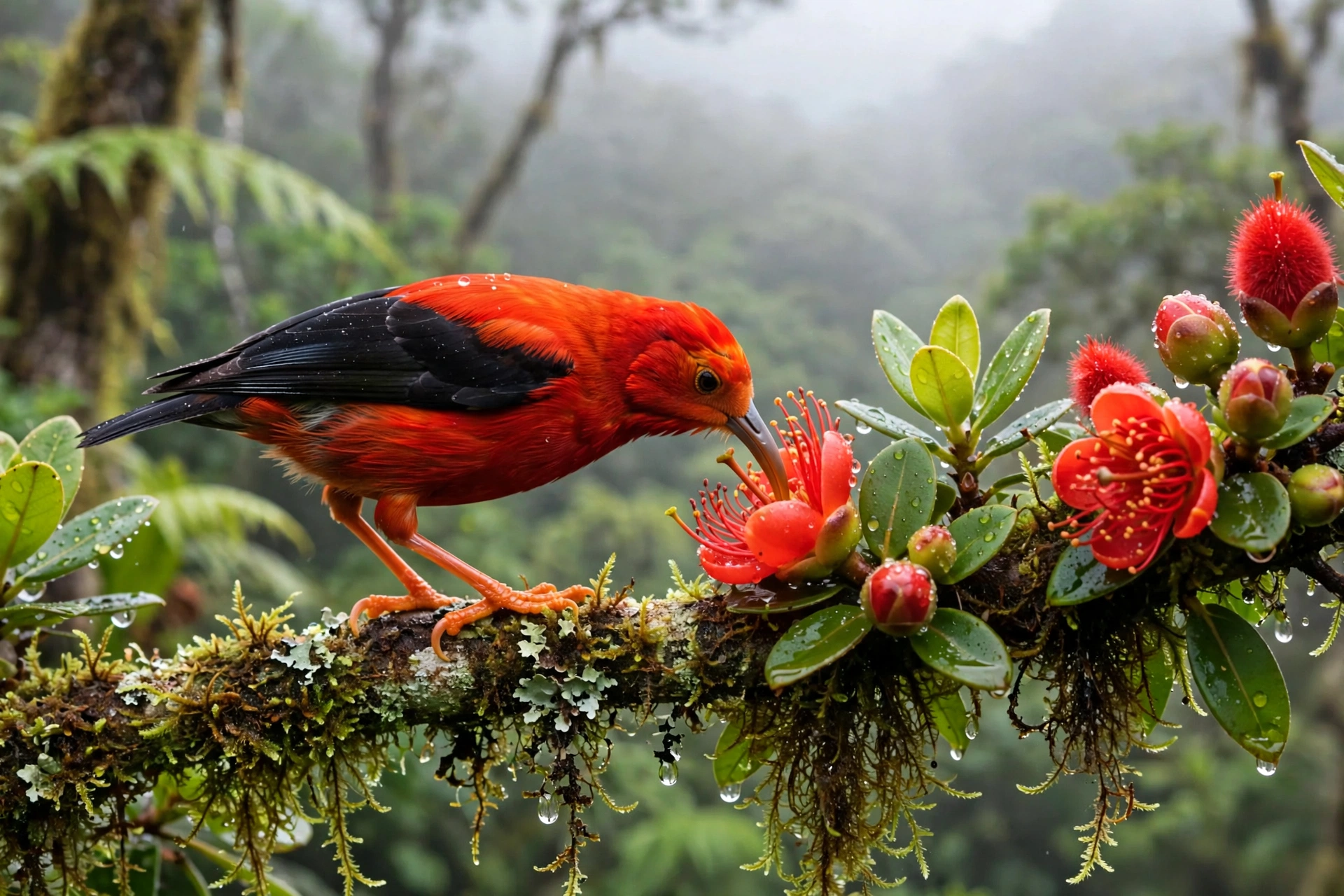
High on the Alakaʻi Plateau, in the cloud forest between Kōkeʻe and the summit bogs, lives a community of honeycreepers found nowhere else. The ʻiʻiwi, a scarlet bird with a curved salmon-colored bill, and the ʻapapane, a crimson bird with black wings, are the most visible; both feed on the red blossoms of the ʻōhiʻa tree. The ʻamakihi, a small yellow-green bird, is more adaptable and easier to find at lower elevations.
The rarest are the ones most visitors will never see. The ʻakikiki, a small gray bird that creeps along branches prying insects from bark, and the ʻakekeʻe, with its crossed bill for prying open buds, survive only in a shrinking band of high-elevation forest. The puaiohi, a small brown thrush, holds on in a few steep ravines. All three are critically endangered, and conservationists consider them among the most extinction-prone birds on Earth. The primary threat is avian malaria, carried by introduced mosquitoes that are moving uphill as the climate warms, shrinking the cool, mosquito-free refuges the birds depend on. An ambitious mosquito-control program using the incompatible-insect technique is underway in the Alakaʻi, and it represents one of the most important conservation efforts in the Pacific.
You do not need to be an expert to appreciate the forest birds. The trails of Kōkeʻe State Park, especially around the Kanaloahuluhulu Meadow area and along the Alakaʻi Swamp Trail boardwalk, pass through prime honeycreeper habitat. Go early in the morning, walk quietly, and listen: the ʻapapane’s buzzy trill and the ʻiʻiwi’s creaking whistle carry far in the still mountain air. Bring binoculars and a field guide, and keep to the trail, since the bog vegetation is extraordinarily fragile.
Seabirds at Kīlauea Point
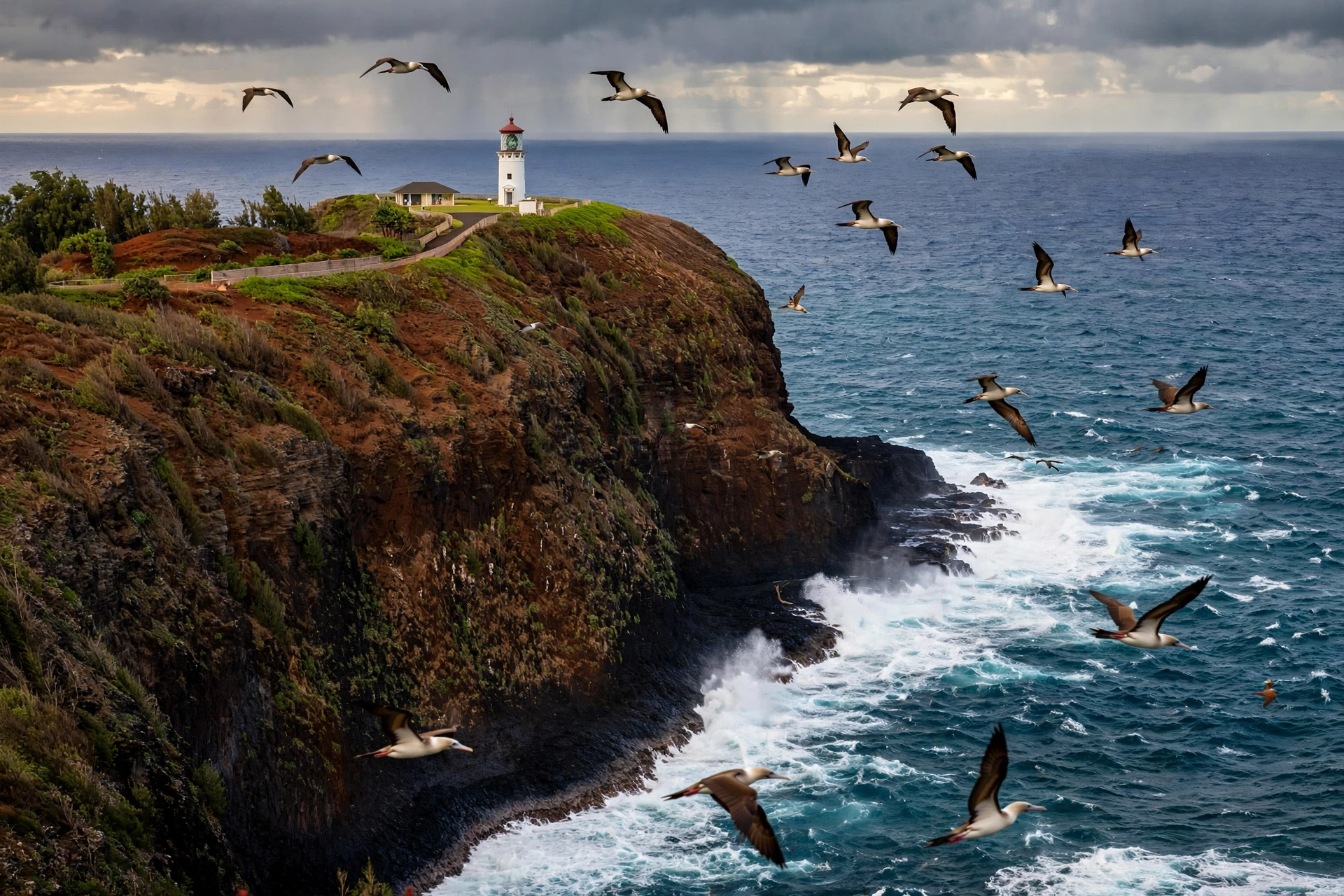
For most visitors, the finest birding on Kauaʻi is not in the mountains but at the island’s northern tip. Kīlauea Point National Wildlife Refuge, managed by the U.S. Fish and Wildlife Service, protects a headland where red-footed boobies (ʻā) nest in the ironwood trees within arm’s reach of the viewing area, great frigatebirds (ʻiwa) soar overhead on seven-foot wingspans, and Laysan albatrosses (mōlī) glide in from the open ocean. The refuge is also one of the most reliable places in the main Hawaiian Islands to see the ʻuaʻu kani, or wedge-tailed shearwater, and seasonal visitors like the red-tailed tropicbird (koaʻe ʻula) with its streaming tail feathers.
The refuge’s 1913 lighthouse, the Daniel K. Inouye Kīlauea Point Lighthouse, anchors the headland and the view, but the birds are the main event. Winter adds humpback whales to the panorama, and Hawaiian monk seals occasionally haul out on the rocks below. The refuge charges a small entry fee and reservations are recommended; check the USFWS website before going, since hours and access rules change.
Nēnē, Pueo, and Familiar Faces
The nēnē, the Hawaiian goose and Hawaiʻi’s state bird, grazes the grassy slopes of Kōkeʻe and the pastures of the island’s uplands. Brought back from fewer than 30 wild birds in the 1950s through captive breeding, the nēnē is a genuine conservation success, but it remains vulnerable, and vehicle strikes are now a leading cause of death. Drive slowly in signed nēnē crossing areas, never feed them, and keep dogs leashed.
The pueo, the Hawaiian short-eared owl, hunts over open country by day, a striking sight as it quarters low over grassland on silent wings. In Hawaiian culture the pueo is an ʻaumakua, a family guardian, and it deserves the same respectful distance as any wild animal. Introduced birds are everywhere too: zebra doves, mynahs, red-crested cardinals, and the white-rumped shama, whose flute-like song fills Kauaʻi’s lowland forests at dawn.
Land Animals of Kauaʻi
Kauaʻi has no native land mammals besides the Hawaiian hoary bat (ʻōpeʻapeʻa), which is rarely seen as it hunts insects at dusk. Every other land mammal was brought by people, deliberately or otherwise, and the distinction matters.
The Hawaiian Hoary Bat (ʻŌpeʻapeʻa)
The ʻōpeʻapeʻa is Hawaiʻi’s only native land mammal and an endangered subspecies found nowhere else. These solitary bats roost in trees by day and hunt moths and beetles on the wing at night, and Kauaʻi’s forested valleys are among their strongholds. You are unlikely to see one unless you watch the sky at dusk near forest edges, but knowing the island’s skies hold a native mammal found nowhere else on Earth adds another layer to Kauaʻi’s wildlife story. Protecting roost trees and reducing pesticide use are the main ways people help them.
Feral Pigs
Feral pigs, descended from animals brought by early Polynesian settlers and later European breeds, root through Kauaʻi’s forests and damage native plants, spread invasive seeds, and create wallows where mosquitoes breed. They are most active at dawn and dusk in forested areas like Kōkeʻe. Hunting is permitted in designated areas under DLNR rules, but for most visitors pigs are simply a sign to stay on the trail and keep food secured.
The Wild Chickens
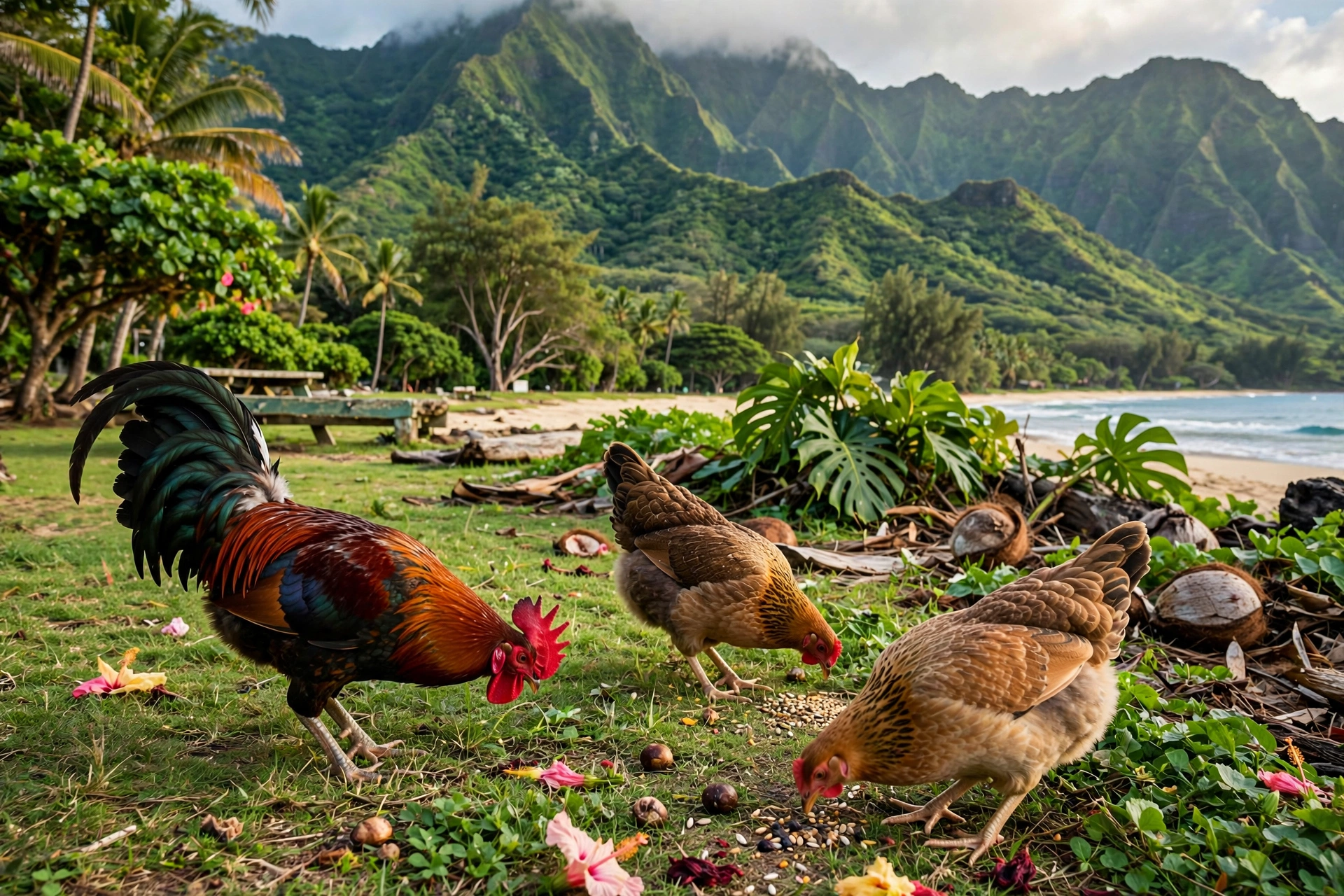
No wildlife account of Kauaʻi is complete without the chickens. Free-roaming roosters, hens, and chicks strut through parking lots, beach parks, and town centers across the island, descendants of domestic birds set loose by hurricanes ʻIwa (1982) and ʻIniki (1992), mixed with the wild red junglefowl brought by Polynesian voyagers. They are charming, noisy, and entirely unofficial. Enjoy them, do not feed them (feeding concentrates birds and spreads disease), and remember they are not native wildlife.
Feral Cats
Feral cats are one of the gravest threats to Kauaʻi’s native birds and to monk seal pups, which can contract the parasite toxoplasmosis from cat feces washed into the ocean. Toxoplasmosis has killed endangered monk seals, and cats also prey on ground-nesting seabirds. Keep pet cats indoors, never abandon cats, and support trap-neuter-return or humane management programs rather than feeding colonies near wildlife areas.
No Mongooses
As noted above, Kauaʻi is mongoose-free, and keeping it that way is a point of island pride. If you believe you have seen a mongoose on Kauaʻi, report it to DLNR immediately; early detection is the only way to prevent establishment.
Where to See Wildlife on Kauaʻi
Kauaʻi rewards a simple strategy: go early, go quiet, and let the animals come to you.
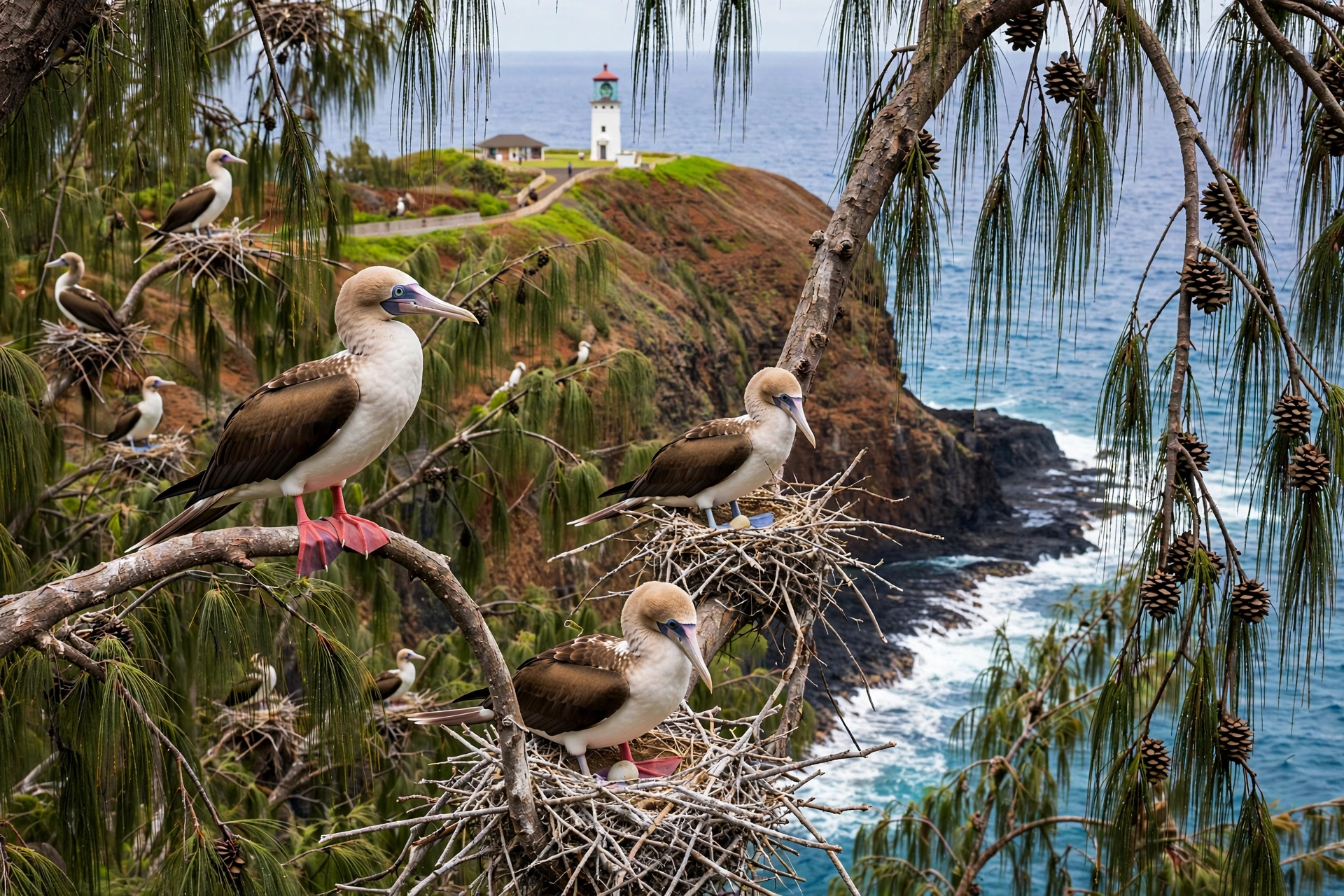
Kīlauea Point National Wildlife Refuge
The single best wildlife stop on the island for most visitors. Seabirds at close range, the historic lighthouse, winter whales, and occasional monk seals, all from accessible overlooks. Arrive at opening to beat the crowds, bring binoculars, and allow at least an hour. Reservations are recommended through the USFWS.
Kōkeʻe State Park and the Alakaʻi
The mountain parks above Waimea Canyon are Kauaʻi’s forest-bird capital. The Kalalau Lookout area, the Puʻu o Kila lookout at the end of the road, and the Pihea and Alakaʻi Swamp trails offer the best chances at ʻiʻiwi, ʻapapane, and ʻamakihi, plus nēnē grazing the meadows. Mornings are calmest and clearest; clouds often build by midday. Dress warmly, since temperatures can be 15 to 20 degrees cooler than at sea level.
Poʻipū and the South Shore
Monk seals haul out regularly on south shore beaches, and community volunteers often staff the most popular spots to answer questions and keep boundaries respected. Turtles bask at Poʻipū Beach Park and graze the reefs offshore. Dawn patrols with binoculars along the Mahaʻulepu coastline can be wonderfully productive.
The Nāpali Coast (by Water)
The Nāpali Coast’s sea cliffs are a seabird city, and the surrounding waters hold dolphins, turtles, and winter whales. Boat tours from the west side (informational note: choose operators that follow NOAA wildlife-viewing guidelines and keep legal distances) offer the only practical access to this roadless coast. Kayak tours run in summer when conditions allow. Whatever the vessel, the wildlife rules are the same: no chasing, no feeding, legal distances always.
Hanalei and the North Shore
The Hanalei National Wildlife Refuge protects taro fields and wetlands where endangered Hawaiian waterbirds feed: the aeʻo (Hawaiian stilt), ʻalae keʻokeʻo (Hawaiian coot), and ʻalae ʻula (Hawaiian gallinule). The refuge itself is closed to the public, but the birds are easily viewed from the ʻŌhai Nā Hanalei overlook area and surrounding roads. Pull fully off the road, use binoculars, and never enter the fields.
Wildlife Ethics and the Law
Hawaiʻi’s wildlife laws exist because the animals have nowhere else to go. A few principles cover nearly every encounter.
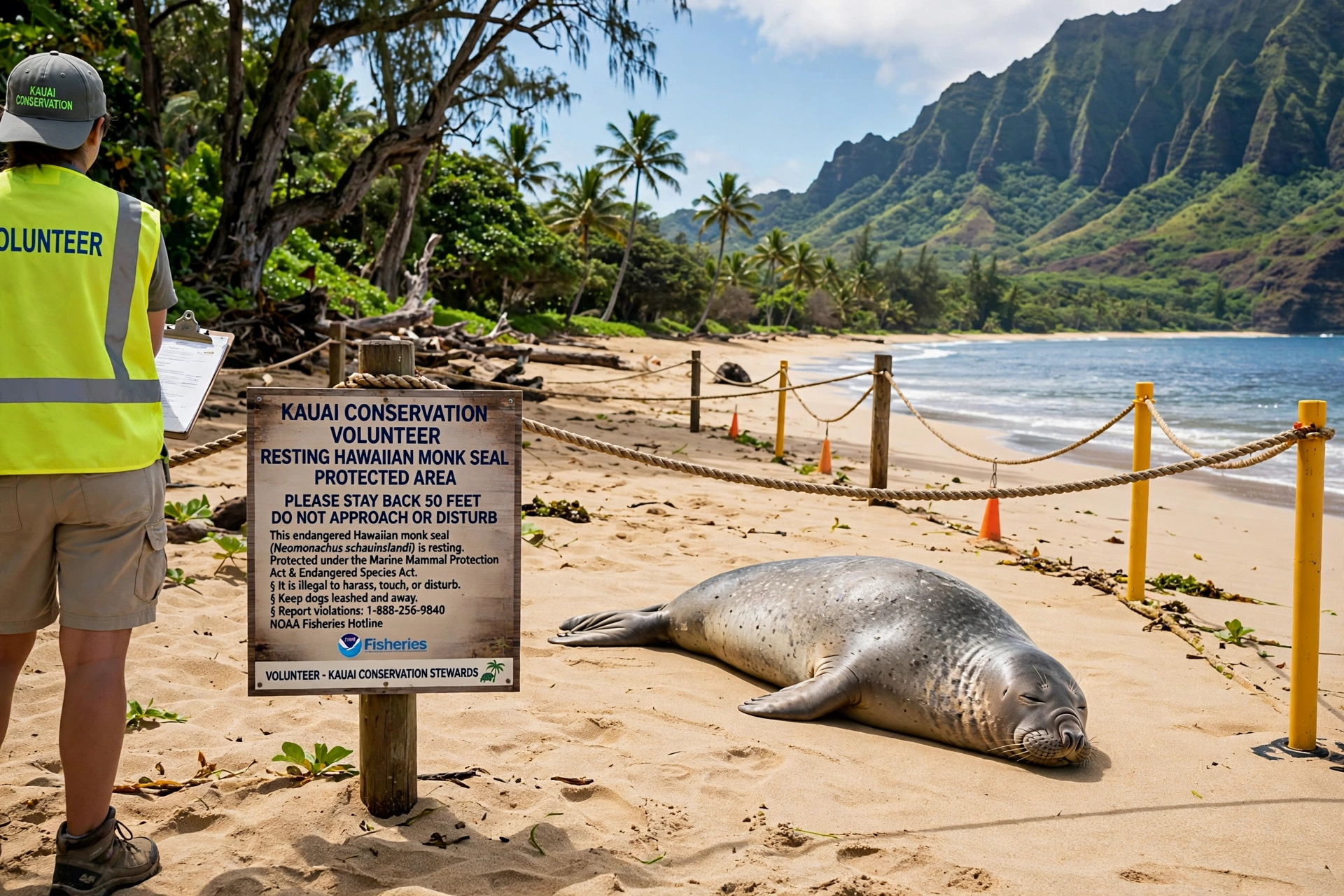
Distances Are Minimums, Not Targets
Federal and state rules set hard floors: 50 yards from Hawaiian monk seals and spinner dolphins, 100 yards from humpback whales, 10 feet from sea turtles. Treat these as the closest you should ever be, not the distance to aim for. If an animal changes its behavior because of you, swimming away, stopping feeding, lifting its head, moving off a basking spot, you are too close regardless of the number.
Never Feed Wildlife
Feeding changes behavior, spreads disease, and teaches animals to associate people with food, which ends badly for the animal. This applies to nēnē, chickens, feral cats near wildlife areas, reef fish, and every other animal you meet.
Protect the Reef
Coral is alive and slow growing. Never stand on it, avoid touching it, rinse off non-compliant sunscreen before entering the water, and choose mineral sunscreens that comply with Hawaiʻi’s Act 104. Secure loose gear so nothing drags across the reef.
Dogs and Wildlife
Dogs must be leashed in parks and beaches where allowed, and kept far from seals, turtles, nesting seabirds, and nēnē. A single off-leash dog can destroy a seabird colony in minutes and can transmit disease to monk seals.
Report Problems
Report injured or entangled marine animals to the NOAA marine wildlife hotline, and report suspected mongoose sightings, injured forest birds, or wildlife harassment to DLNR. Visitors are often the first to notice something wrong.
Best Time for Wildlife Watching
There is no bad month for wildlife on Kauaʻi, but the calendar shapes what you will see.
- December through April: Humpback whale season, peaking February and March. Seabirds are active at Kīlauea Point, and winter rains green up the island. North shore ocean conditions are rough; wildlife watching is best from shore.
- May and June: A sweet spot. Whales are departing, seas are calming, forest birds are breeding and vocal in the Alakaʻi, and summer seabird nesting is underway.
- July through September: Calmest ocean conditions, best for Nāpali Coast boat trips and snorkeling with turtles. Shearwaters fledge; beware of grounded fledglings on roads at night during fledging season and call the Save Our Shearwaters program if you find one.
- October and November: Shoulder season with fewer visitors, returning winter swells, and the first whales usually arriving by late November.
Daily timing matters as much as season. Forest birds are most active in the first three hours after dawn. Seabirds ride the morning thermals at Kīlauea Point. Turtles often bask midday. Seals haul out at any hour but favor quiet beaches. Whales can surface at any time, though calm mornings offer the best viewing.
Kauaʻi Wildlife FAQs
When is whale season on Kauaʻi?
Humpback whales are typically in Hawaiian waters from December through April, with peak numbers in February and March. Kauaʻi’s north shore, Kīlauea Point, and the Nāpali Coast are excellent shore-watching areas. Federal law requires staying at least 100 yards from whales.
Where can I see monk seals on Kauaʻi?
Monk seals haul out on beaches island-wide, with regular sightings along the south shore near Poʻipū. Keep at least 50 feet away, 150 feet from mothers with pups, and respect volunteer rope barriers. Never get between a seal and the water.
Can I swim with dolphins on Kauaʻi?
No. Federal regulations prohibit swimming with or approaching within 50 yards of spinner dolphins in Hawaiian waters, because daytime rest is critical to their survival. Enjoy them from shore or from a vessel that keeps its distance.
Where are the best birds on Kauaʻi?
Kīlauea Point National Wildlife Refuge for seabirds at close range, and the trails of Kōkeʻe State Park and the Alakaʻi Swamp for native forest birds like ʻiʻiwi and ʻapapane. Go early in the morning with binoculars.
Are there mongooses on Kauaʻi?
No, and residents work hard to keep it that way. The mongoose was never introduced to Kauaʻi. If you think you have seen one, report it to DLNR immediately.
Why are there so many chickens on Kauaʻi?
Kauaʻi’s free-roaming chickens descend from domestic birds scattered by hurricanes ʻIwa (1982) and ʻIniki (1992), mixed with wild junglefowl ancestry. With no mongooses to prey on them, they have thrived. They are not native wildlife, so enjoy them but do not feed them.
Is it safe to snorkel with turtles?
Yes, with respect. Watch turtles from at least 10 feet away, never touch or chase them, and do not block their path to the surface. Turtles are protected by federal and state law.
What should I do if I find a stranded or injured animal?
Keep your distance, keep dogs and people away, and call the experts: the NOAA marine wildlife hotline for seals, turtles, dolphins, and whales, or DLNR for birds and land animals. Do not attempt a rescue yourself.
Related Guides
- Kauaʻi Map: the island-wide overview for planning wildlife stops by region.
- Kauaʻi Hikes: trail guides for Kōkeʻe, the Alakaʻi Swamp, and Nāpali overlooks where forest birds live.
- Kauaʻi Snorkeling: where to meet turtles and reef fish, with safety and etiquette.
- Kauaʻi Weather: seasons, microclimates, and ocean conditions that shape wildlife viewing.
- Kauaʻi Towns: Hanalei, Kīlauea, and Waimea as bases for wildlife day trips.
- Maui Wildlife: how Kauaʻi’s wildlife compares with its younger neighbor.
- Oʻahu Wildlife: the Oʻahu edition for island-hoppers.
- Hanalei Beach wildlife and bay guide: monk seals, turtles, and shorebirds along the north shore crescent.
- size and scale of Kauai: how the compact size of the island shapes a wildlife focused day.
A Final Note
Kauaʻi’s wildlife has survived five million years of isolation, two devastating hurricanes, and the full weight of introduced predators and disease, and much of it now depends on the choices of the people who visit. The nēnē grazing beside a Kōkeʻe meadow, the monk seal dozing on a Poʻipū beach, the ʻiʻiwi flashing scarlet through the ʻōhiʻa blossoms: each is the product of an unbroken chain stretching back to the first finch, the first seal, the first goose that found this island. Watching quietly, keeping distance, and leaving no trace are small acts, but on an island where so many species exist nowhere else, they are the acts that keep the chain unbroken.