Humuhumunukunukuāpuaʻa: Hawaii’s State Fish, Up Close

It is the longest word most visitors will ever attempt, and it belongs to a 10-inch fish with the attitude of a junkyard dog. The humuhumunukunukuāpuaʻa, Hawaii’s state fish, is a reef triggerfish that grunts like a pig, locks a spine on its back like a switchblade, spits jets of water to uncover its dinner, and has been known to bite snorkelers on the ankle for swimming too close to its nest. Say it three times fast: humu-humu-nuku-nuku-a-puaʻa.
This is the single complete guide to the humuhumunukunukuāpuaʻa in Hawaii. It covers how to pronounce the name and what it means, the strange history of the state fish designation, the trigger mechanism and other anatomy, how to tell it from its look-alike cousins, its feeding and territorial behavior, nesting, where snorkelers can see it, and the story behind the grunt. If you have been searching for anything about the humuhumunukunukuāpuaʻa, the answers are all here on this one page.
The Name: How to Say It and What It Means
Break it into pieces and the monster word surrenders: humu-humu (hoo-moo-hoo-moo), nuku-nuku (noo-koo-noo-koo), a-puaʻa (ah-poo-ah-ah). Say each chunk, then run them together, and you will be pronouncing it better than most visitors within a minute. The name translates roughly to “triggerfish with a snout like a pig,” a reference to the fish’s blunt face and its habit of grunting, by grinding its teeth, when caught or threatened. Some sources render it as “the fish that snorts like a pig,” which amounts to the same barnyard compliment.
The state fish story has a twist. In 1985 the reef triggerfish was voted Hawaii’s official state fish, but the designation came with a five-year sunset and quietly expired. For 16 years Hawaii technically had no state fish, until 2006, when the humuhumunukunukuāpuaʻa was reinstated, this time permanently. It is worth knowing, because older guidebooks and websites still carry the confusion, some calling it the “former” or “unofficial” state fish. As of today, it is official, and it is not going anywhere.
Anatomy of Attitude
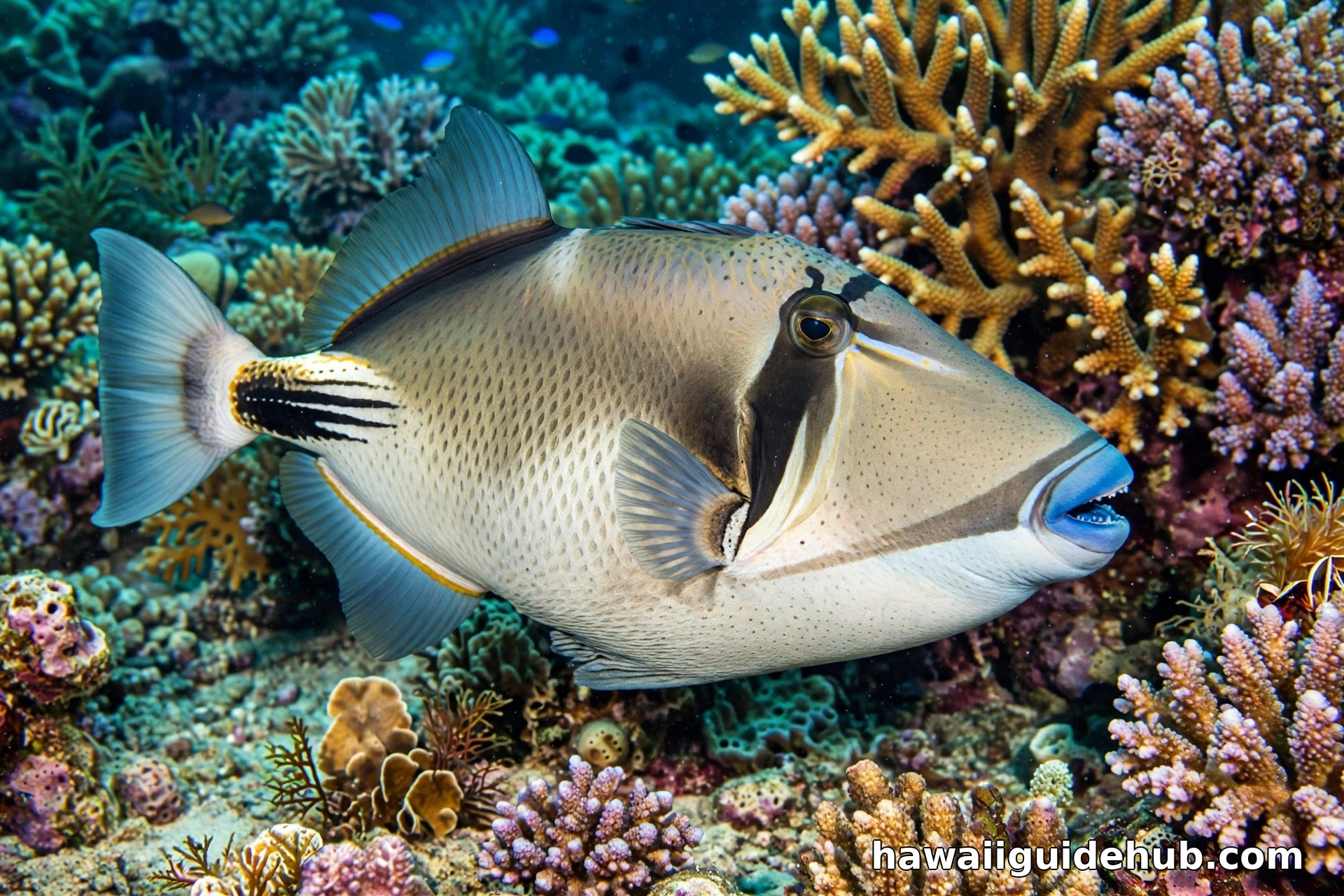
The reef triggerfish, Rhinecanthus rectangulus, reaches about 12 inches and wears one of the reef’s most distinctive paint jobs: blue teeth and a blue upper lip, a black band running from the eye back across the gill to the pectoral fin, a black wedge at the base of the tail edged with iridescent green-gold lines, and a broad blue band between the eyes crossed by three thin black lines. It can fade these colors to drab when sleeping or submitting and blaze them at full intensity when healthy and unthreatened.
The famous trigger is a mechanical marvel. The tall first dorsal spine can be locked upright by the smaller second spine, the “trigger,” wedging the fish immovably into a crevice so predators cannot extract it. Unlocking requires depressing the second spine, a mechanism so effective that divers are advised never to try pulling a wedged triggerfish out by hand. Add tough, armor-like scales, a beak-like mouth with ever-growing teeth, and the ability to swim backward, hover, and dart using rippling dorsal and anal fins, and you have one of the most maneuverable fish on the reef.
Which Triggerfish Is It? Sorting the Look-Alikes
Hawaii hosts several triggerfish, and the long Hawaiian name is sometimes applied loosely to more than one of them. The table below sorts out the common confusion, because the fish biting your ankle and the fish on the postcard are not always the same species.
| Feature | Reef triggerfish (the humuhumu) | Lagoon / Picasso triggerfish |
| Scientific name | Rhinecanthus rectangulus | Rhinecanthus aculeatus |
| State fish? | Yes, since 2006 (permanent) | No, though the name is sometimes misapplied to it |
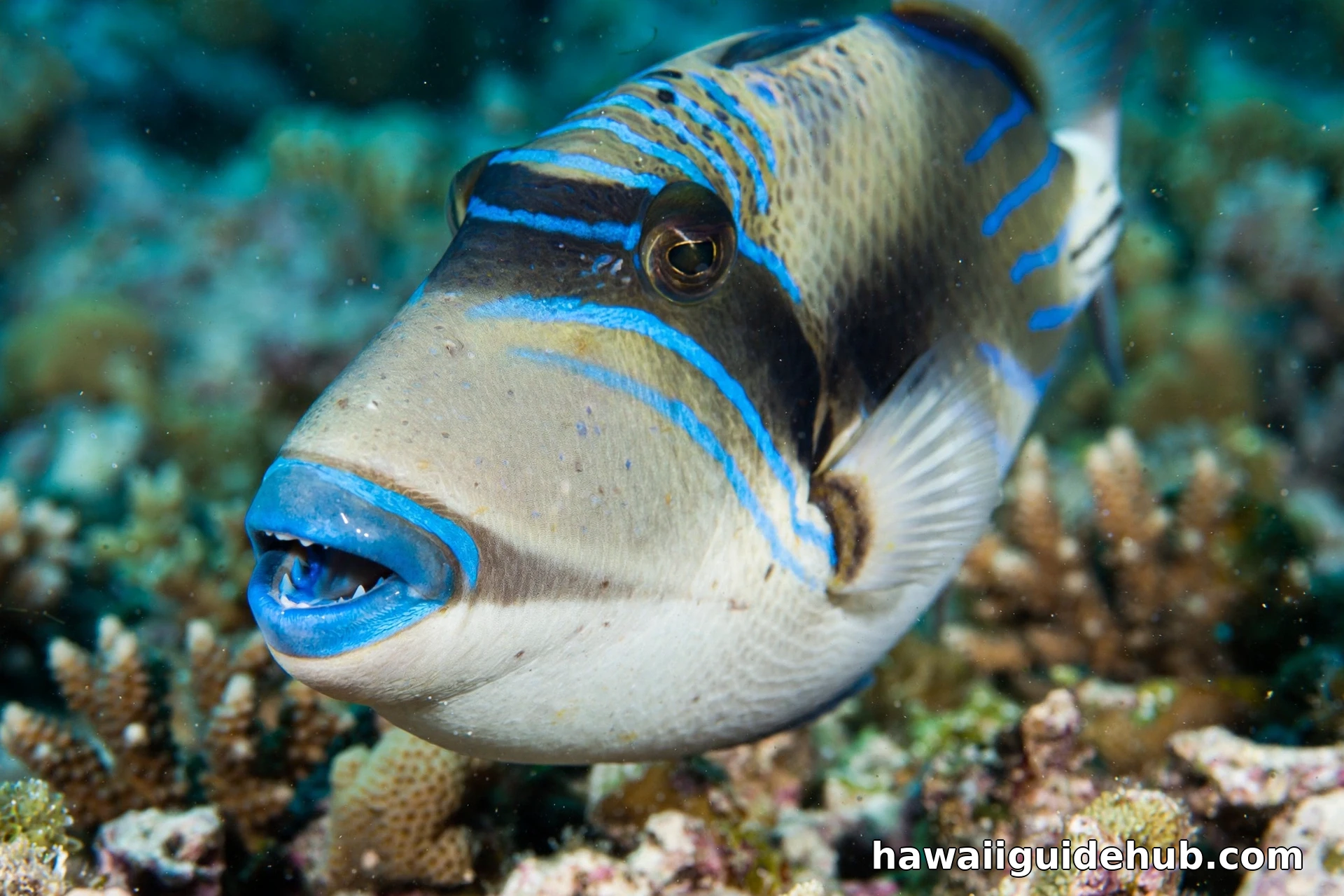
| Face | Blue lips and teeth; blue band between eyes (per species accounts) | Yellow-orange stripes radiating from eyes; more “painted” face |
| Body pattern | Black wedge at tail base; black diagonal band | Black bars and spots; bolder geometric patterning |
| Temperament | Territorial; known ankle-biter near nests (per diver reports) | Also territorial; equally feisty |
| Where in Hawaii | Reef flats, lagoons, seaward reefs island-wide | Shallow lagoons and reef flats; common snorkel sighting |
The scientific name carries its own story. Rhinecanthus rectangulus refers to the fish’s roughly rectangular, diamond-like body shape, while the common name “wedgetail triggerfish” points to the black wedge at the tail base. English has at least four names for this fish, rectangular, wedgetail, reef triggerfish, humuhumu, and Hawaiian adds the longest one of all. It is a lot of naming for a 10-inch fish, but then, few 10-inch fish have ever earned it more thoroughly.
A Day on the Reef: Feeding and Feuds
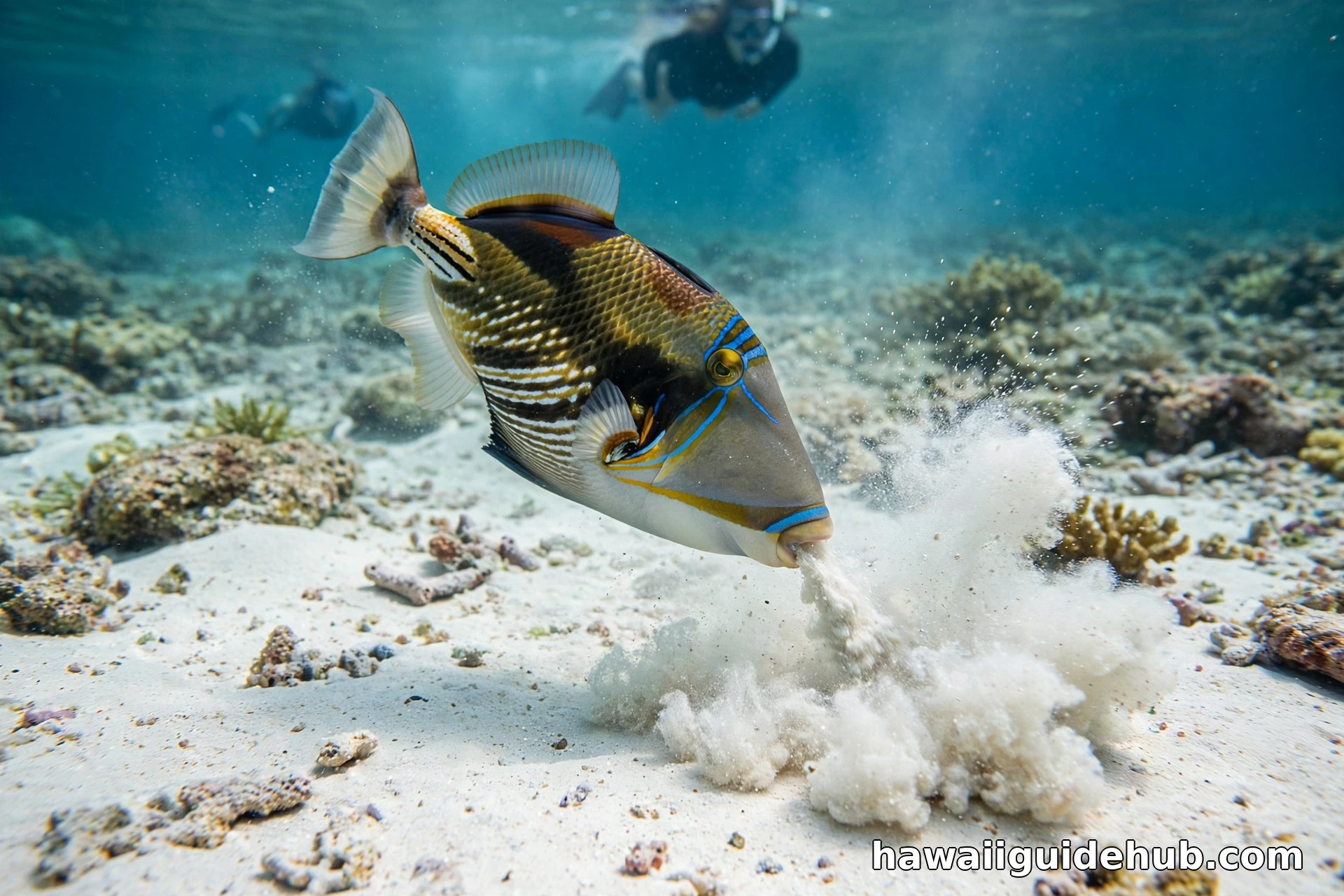
Watch a humuhumu work and you will see one of the reef’s great foraging performances. The fish blows jets of water from its mouth into the sand, then scoops up a mouthful, sifts it for edible detritus, crabs, worms, mollusks, and urchins, and spits the rest out in a puff. It is methodical, messy, and oddly endearing, like watching someone pan for gold. Algae and reef detritus round out an omnivorous diet, and those powerful jaws crush through shells and urchin tests with ease.
Feeding done, the feuding begins. Reef triggerfish are strongly territorial and generally do not tolerate others of their kind nearby, so most adults are solitary. They will charge intruders, including fish many times their size, and snorkelers who drift over a nest may get a sharp nip on the ankle as a reminder of whose reef it is. The bites leave marks but are more insult than injury, and the standard advice is simple: admire from a few body lengths away and do not hover over one spot too long.
Love and War: The Nesting Season
Triggerfish reproduction is a study in parental dedication. They are egg-layers, and the female prepares a nest in the sand, tends it, and guards it fiercely until the eggs hatch. Young have been observed on Hawaiian reefs in summer, suggesting a late-winter spawning cycle, though much about their breeding in the wild remains unstudied. During nesting season the already feisty humuhumu becomes genuinely formidable, and this is when most ankle bites happen: the fish is not being mean, it is defending its children.
At night, the warrior rests. Humuhumu sleep on their sides in reef crevices, colors faded to drab, dorsal spine locked to hold them in place. It is a vulnerable posture for such a pugnacious fish, and a good reminder that the reef’s toughest characters still need their sleep.
The Grunt, Explained
The pig comparison is not just about the snout. Reef triggerfish produce audible grunts by grinding their pharyngeal teeth, and the sound carries surprisingly well underwater, and even out of water when a caught fish is handled. The grunt serves as a warning: approached by a predator, a diver, or a rival, the humuhumu may swim directly at the intruder while repeating a series of grunts, an audiovisual display that says “back off” in two channels at once. Aquarium keepers report hearing the grunts through the glass, and occasionally through the wall, when a triggerfish is annoyed. For a 10-inch fish, it is an impressive voice, and it is the sound that gave Hawaii’s state fish its name.
The Humuhumu in Song and Story
Few fish get their own song, but the humuhumu has several. Don Ho’s classic “My Little Grass Shack” name-checks the humuhumunukunukuāpuaʻa about a minute in, and generations of Hawaii visitors have learned the word by singing along. Children’s entertainers have recorded humuhumu songs that teach the pronunciation, and the fish turns up in classrooms, cartoons, and souvenir shops across the islands. It is the rare state symbol that children can actually find on a reef the same day they learn its name, which may be why the designation stuck in the public imagination even during the 16 years it technically lapsed.
The cultural footprint runs deeper than novelty. In old Hawaii, reef fish were intimately known, named, and managed, and the triggerfish’s Hawaiian name encodes real natural history: the pig-like snout, the grunt, the attitude. When you say humuhumunukunukuāpuaʻa correctly, you are speaking a small piece of that observational tradition, a name that is also a field guide entry.
Sleeping Sideways: The Night Humuhumu
Night transforms the reef’s brawler into something almost comical. Humuhumu sleep on their sides in reef crevices, colors faded to a drab ghost of the daytime pattern, wedged in place by the locked dorsal spine. Divers on night dives occasionally find them like this and have to look twice to recognize the fish. The posture is a trade-off: the trigger that makes the fish nearly impossible for a predator to extract by day doubles as a sleeping anchor by night. Come dawn, the colors flood back, the spine unlocks, and the reef’s most confident 10 inches of attitude resumes its rounds.
Where to See the Humuhumu
The good news: you barely have to try. Humuhumu inhabit reef flats, lagoons, and seaward reefs from a few feet deep to about 100 feet, all across the islands. Hanauma Bay’s shallow reefs hold them in snorkel-friendly depths. The Kona coast’s reef flats, Kealakekua Bay, and the lagoons of the Big Island’s west side are reliable. On Oahu, the reef flats off Waikiki and the North Shore’s summer lagoons produce sightings. Look for a solitary, diamond-shaped fish rooting in the sand or hovering over coral, flashing blue and black and gold.
Look for a solitary, diamond-shaped fish rooting in the sand or hovering over coral, flashing blue and black and gold. Early morning is prime time: the fish are actively foraging and the low light makes their colors electric. If one swims directly at you grunting, congratulations, you have found a nesting territory. Back away slowly, give it a wide berth, and count it as one of your best snorkel stories. The fish means business, but the encounter is harmless if you respect the boundary.
Give nesting fish their space, keep your fins off the coral, and enjoy the grunt if you are lucky enough to hear one. For more reef residents, the guide to ocean wildlife behavior and the responsible wildlife watching guide cover the etiquette, and Hawaii’s ocean traditions add the cultural depth behind the names.
Watch: The Humuhumunukunukuāpuaʻa on the Reef
Frequently Asked Questions
How do you pronounce humuhumunukunukuapuaa?
Humu-humu-nuku-nuku-a-puaʻa: hoo-moo-hoo-moo, noo-koo-noo-koo, ah-poo-ah-ah. Practice the three chunks separately, then run them together.
What does humuhumunukunukuapuaa mean?
“Triggerfish with a snout like a pig,” referring to its blunt face and pig-like grunting.
Is the humuhumunukunukuapuaa really Hawaii’s state fish?
Yes. It was designated in 1985, the designation lapsed after five years, and it was reinstated permanently in 2006.
Do humuhumu bite people?
They can nip snorkelers, usually on the ankle, when defending a nest. The bites are startling rather than dangerous; give nesting fish space.
What is the difference between a reef triggerfish and a Picasso triggerfish?
The reef triggerfish (Rhinecanthus rectangulus), the humuhumu, has blue lips and a black wedge at the tail; the Picasso or lagoon triggerfish (R. aculeatus) has yellow-orange facial stripes and bolder geometric patterning. Only the reef triggerfish is Hawaii’s state fish.
Why is it called a triggerfish?
Its tall first dorsal spine locks upright via a smaller second spine, the “trigger.” Depressing the second spine unlocks the first, like a trigger mechanism.
What does the humuhumu eat?
An omnivorous mix of algae, small crabs, worms, mollusks, sea urchins, and detritus sifted from sand.
The humuhumunukunukuāpuaʻa is Hawaii in miniature: a small fish with an enormous name, a pig’s grunt, a switchblade spine, and the confidence to take on the whole reef. Learn to say the name, learn to spot the blue lips, and you will never look at a “little reef fish” the same way again. Few animals pack so much attitude and personality into ten inches.