The Kukui Tree: Hawaii’s Tree of Light

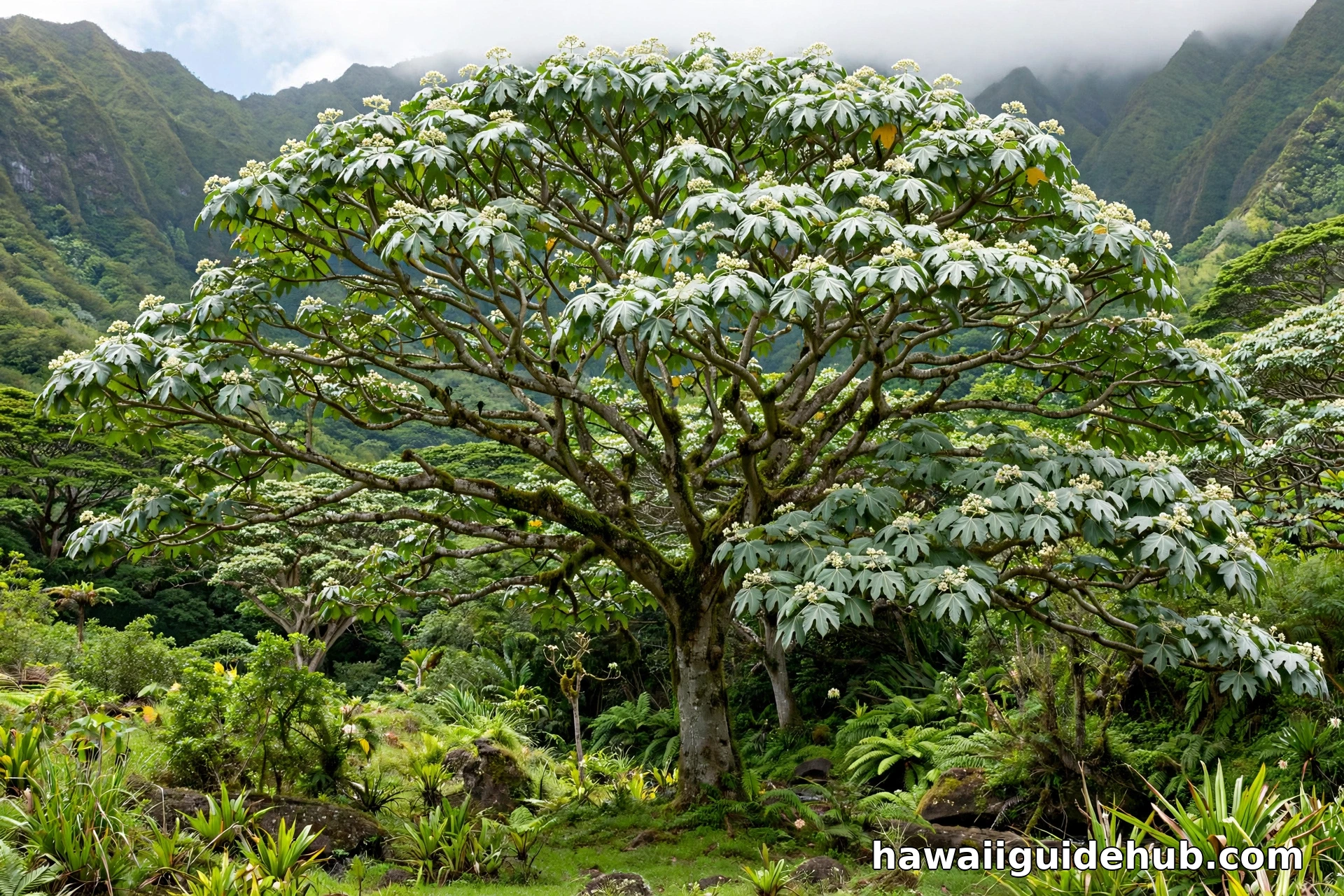
From a distance, a kukui tree announces itself by color. Its canopy glows a pale, silvery green against the darker forest, as if lit from within. The name is no accident: kukui means light in Hawaiian, and for centuries these trees quite literally lit Hawaiian homes. Strung on coconut-leaf midribs and set alight one by one, kukui nuts were the candles of old Hawaii, each burning long enough to mark the passing of time. On May 1, 1959, the kukui was named the official state tree of Hawaii, honoring a plant that gave light, food, medicine, dye, wood, and lei to the people who brought it across the Pacific.
This is the single complete guide to the kukui tree in Hawaii. It covers how to identify one, its status as a Polynesian canoe plant, the dozens of traditional uses that made it indispensable, its role in Hawaiian culture and spirituality, where visitors can see kukui trees today, and practical growing notes. If you have been searching for anything about the kukui tree in Hawaii, the answers are all here on this one page.
Kukui Tree at a Glance
| Spot it | Silvery green, maple-like, variably lobed leaves on a 60 to 80 foot spreading canopy; small creamy-white flower clusters (Molokaʻi’s island flower) |
| The nuts | Round, 2 inches, hard black or brown shell |
| Find it | Low to middle elevation moist valleys, statewide |
| Its story | Aleurites moluccana (spurge family); Polynesian canoe plant, now naturalized; official state tree of Hawaii since May 1, 1959 |
| Handle with care | All parts toxic raw; roasted nuts edible only sparingly |
How to Identify a Kukui Tree
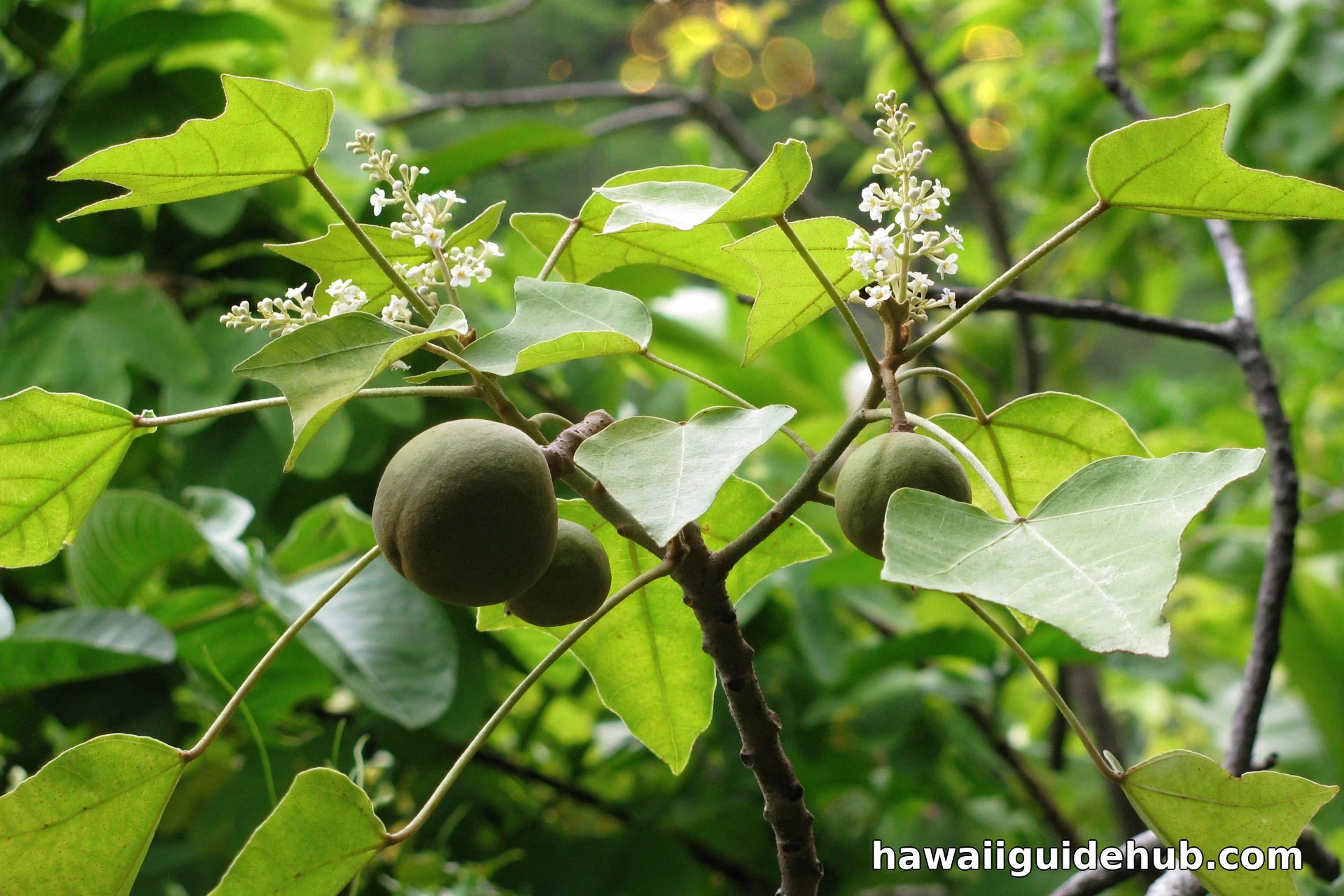
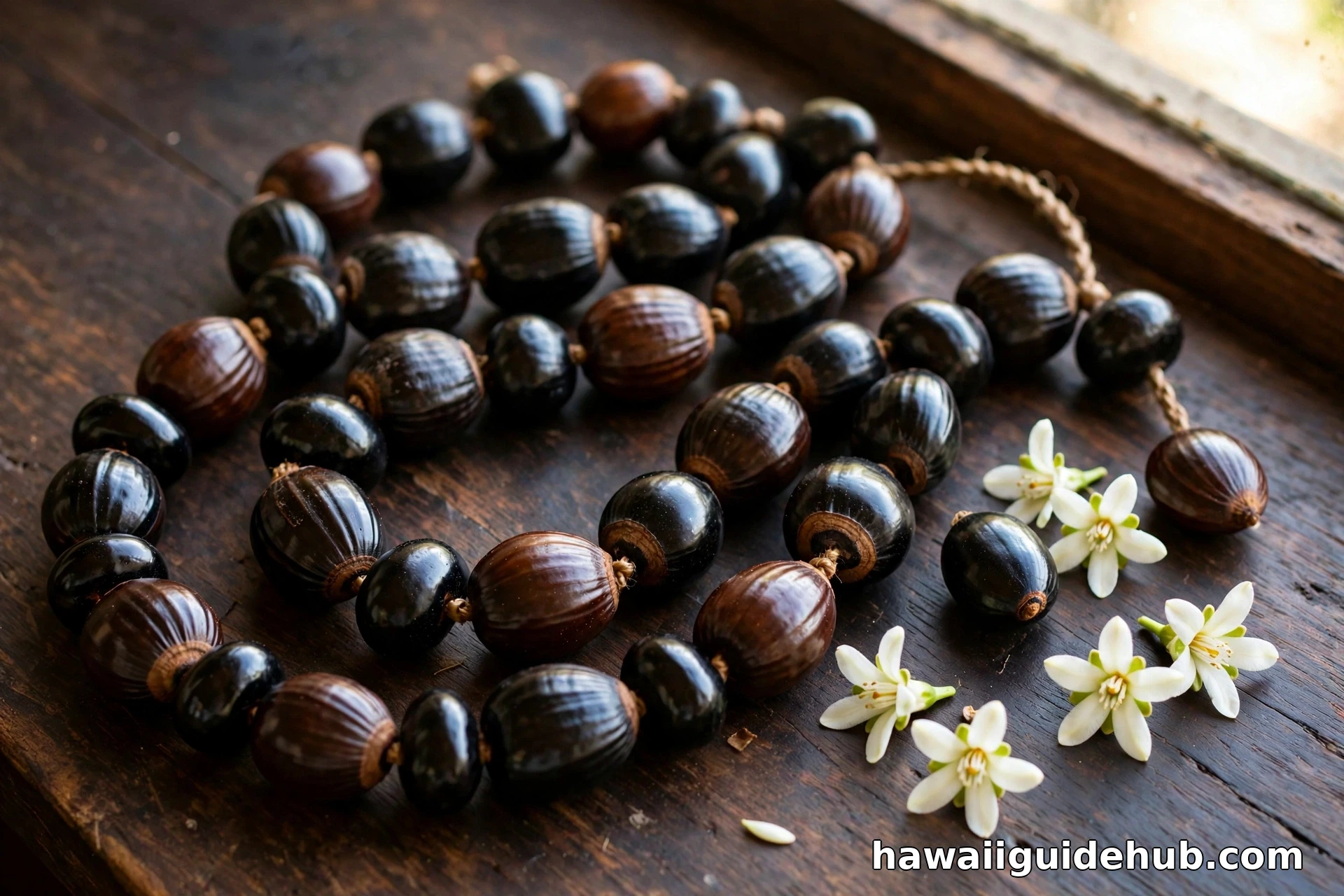
You can spot a kukui from half a mile away. The leaves are a distinctive pale, silvery green, thanks to fine star-shaped hairs that cover the leaf surface and scatter the light. The leaves themselves are variable: some are shaped like maple leaves with three to seven pointed lobes, others are narrowly oval, and a single tree may carry both forms. In late spring and summer, clusters of small creamy-white flowers appear at the branch tips, followed by round green fruits about two inches across. Inside each fruit sits the famous nut: a hard, glossy black or brown shell protecting an oily white kernel.
Mature kukui trees reach 60 to 80 feet with broad, spreading canopies that make them excellent shade trees. The bark is smooth and dark gray when young, roughening with age. In moist valleys on every island except Kahoʻolawe, kukui forms nearly pure stands along streams and lower slopes, their pale canopies marking the valley floors from the ridges above. The blossom of the kukui is also the official island flower of Molokaʻi, whose symbolic color is the silvery green of the kukui leaf.
A Canoe Plant: The Kukui’s Journey to Hawaii
The kukui is not native to Hawaii in the strictest sense. It originated in the Indo-Malaysian region and spread across the Pacific with human voyagers, earning it the title of canoe plant: one of the useful species Polynesian settlers deliberately carried to new islands. They brought it to Hawaii over a thousand years ago, and it naturalized so thoroughly in the moist valleys that early Western botanists sometimes mistook it for a native. Its many Polynesian names share a root meaning light, a hint at the use that defined it everywhere it grew.
That light was literal. About a dozen shelled nuts were threaded onto the stiff midrib of a coconut leaf or a sliver of bamboo, the top nut was lit, and each nut burned for roughly 15 minutes before the strand was flipped to light the next. Because each nut burned for a predictable time, a strand of kukui nuts doubled as a clock, measuring out the evening. For brighter light, Hawaiians pressed the oil-rich kernels and burned the pure oil in stone lamps called kukui hele po, which translates roughly to light, darkness goes, using twisted kapa cloth as a wick. Torches called lamaku were packed with kukui kernels inside hollow bamboo.
The Tree of a Thousand Uses
Few plants in Polynesia were as versatile as the kukui. Beyond light, the roasted kernels were ground with salt into ʻinamona, the savory condiment that remains a key ingredient in traditional poke. The polished black, brown, and occasionally white shells were strung into kukui nut lei, still worn today and once worn by aliʻi, chiefs, as symbols of status and the life-giving force of Lono, the god of agriculture, whose physical manifestation, or kino lau, the kukui was believed to be.
The practical list goes on. Soot from charred nuts made the black ink for traditional tattooing. The inner bark yielded a red-brown dye for kapa cloth and cordage. Kukui oil, like linseed oil, served as a varnish and a preservative for fishing nets and the wood of waʻa, outrigger canoes, whose seats and gunwales were sometimes carved from kukui wood itself, prized for its buoyancy. Fishermen chewed the oily nuts and spat them onto the water to break the surface tension and clear reflections, sharpening their view of fish below. Leaves were used as poultices, the latex sap as glue, and the pressed seed cake as animal fodder and fertilizer. In modern times, kukui nut oil has found a second life in the cosmetics industry, valued in moisturizers and skin oils.
How a Nut Became a Clock
The kukui nut’s most charming use may be its least known. Because each roasted nut burned for a remarkably consistent time, roughly 15 minutes, Hawaiians used strands of nuts to measure the evening hours. A host could tell how long guests had stayed, or how much night remained for a task, by how far down the strand the flame had traveled. It was a clock you could hold in your hand, and it worked anywhere, no sundial or hourglass required.
For work that needed both hands, there were the lamaku torches: hollow sections of bamboo packed with kukui kernels and other combustible material, carried on night fishing expeditions and processions. The famous night marchers of Hawaiian legend, the huakaʻi pō, are often described carrying kukui torches through the darkness. And for the finest light of all, the pure pressed oil burned in carved stone lamps with kapa wicks, a flame clean enough for detailed nighttime work like weaving and carving. When the oil ran out, the leftover seed cake was not wasted either: it fed animals and enriched garden soil as mulch.
Kukui Across the Pacific
Hawaii was only one stop on the kukui’s long voyage with humans. Across Polynesia, Melanesia, and Southeast Asia, the same tree served the same needs under different names: lumbang in the Philippines, where the nuts thicken curries and sauces; kemiri in Indonesia and Malaysia, a staple of spice pastes; and tung-like uses in parts of China and Japan. In Tonga, chewed kukui nuts were made into sweet-scented oils used in traditional funerary rituals. The pattern is unmistakable: wherever voyagers carried this tree, they carried a toolkit, light, food, medicine, dye, and timber in a single species.
Modern science has added new chapters. Kukui nut oil is rich in essential fatty acids, which is why it appears in contemporary skin care for dry skin, minor burns, and irritation, a commercial echo of its traditional medicinal uses. Researchers have also studied the oil as a potential biofuel feedstock, since the nuts are inedible raw and the trees grow on marginal land. Whether any of these scale up, the kukui has already proven its central point: a tree the Polynesians chose to carry across thousands of miles of open ocean was never going to be a one-trick plant.
Kukui in Hawaiian Culture and Spirituality
The kukui carries spiritual weight beyond its practical uses. As a kino lau of Lono, the tree was associated with abundance, healing, and protection. Wearing a kukui nut lei was understood as wearing light itself, a symbol of enlightenment and hope. Some traditions hold that kukui seed lei served as prayer beads, gathering mana, spiritual energy, with each handling. In legend, the pig god Kamapuaʻa is also linked to the kukui as one of his body forms.
This layered meaning is why the kukui endures in modern Hawaii far beyond its utility. You will see kukui nut lei at graduations, weddings, and welcoming ceremonies, glossy black strands that photograph beautifully and carry a quiet symbolism most visitors never learn. Understanding the cultural heritage behind Hawaiian traditions turns a souvenir into a story. The tree’s presence in hula, chant, and storytelling keeps it alive in performance as well as in the forest.
Where to See Kukui Trees
Kukui is everywhere in the right habitat, which makes it one of the easiest culturally significant plants for visitors to find. On Oahu, the valleys of the Koʻolau range are full of them, and Hoʻomaluhia Botanical Garden in Kāneʻohe has fine labeled specimens. On Maui, the Sacred Garden in Haiku sits within a kukui forest, and the trees line many roadsides on the windward side. On the Big Island, look for the pale canopies in the valleys around Waimea and Hilo. The nuts fall year-round, so keep an eye on the ground, but watch your step: the round nuts are a classic slipping hazard on trails.
If you want to take kukui home, the nuts themselves are the souvenir. Polished kukui nut lei are sold across the islands, and craft shops sometimes sell loose nuts for jewelry making. Do not eat raw kukui nuts: all parts of the tree are toxic, and the raw kernels are a strong laxative. Roasted nuts are eaten only sparingly, and ʻinamona is made by those who know the preparation. Admire, photograph, and wear the lei, but leave the snacking to the prepared condiment.
Growing Kukui at Home
Gardeners in warm climates can grow kukui, with caveats. The tree needs tropical or subtropical conditions, roughly USDA zones 10 through 12, with well-drained, moist soil and full sun to part shade. It grows fast and big, so give it room: a mature tree spreads wide and drops nuts, leaves, and fruit litter year-round, which makes it a poor choice near pools, driveways, or play areas. It is an excellent shade tree for large properties, parks, and restoration plantings in moist areas. Propagation is by seed, though the hard shells benefit from scarification. In Hawaii, check with local nurseries for seed-grown stock, and remember that in some regions outside Hawaii the tree can naturalize aggressively, so plant responsibly.
Watch: Kukui Nut Trees
Frequently Asked Questions
What is Hawaii’s state tree?
The kukui, or candlenut tree (Aleurites moluccana), designated the official state tree on May 1, 1959, for its multitude of uses and its beauty on the mountain slopes.
What does kukui mean in Hawaiian?
Kukui means light or torch, referring to the traditional use of the oil-rich nuts as candles and lamp fuel.
Is the kukui tree native to Hawaii?
It is a Polynesian introduction, a canoe plant brought by early settlers from the western Pacific and naturalized in Hawaii’s moist valleys over a thousand years ago.
Can you eat kukui nuts?
Only roasted and only sparingly, as in the condiment ʻinamona. Raw kukui nuts are toxic and act as a strong laxative. All parts of the tree are considered poisonous.
What are kukui nut leis?
Lei strung from the polished black, brown, or white shells of kukui nuts. Once worn by Hawaiian chiefs as symbols of light and status, they remain popular for graduations and celebrations.
The kukui is Hawaii’s quiet overachiever: a tree that lit homes, fed families, dyed cloth, inked tattoos, built canoes, and still shades the valleys with its silver-green glow. When you see that pale canopy from a ridge trail, you are looking at a thousand years of human history written in leaves. Take the photo, and if the timing is right, take home a lei of light.