How the Hawaiian Islands Formed

How did the Hawaiian Islands form? The answer is one of the most elegant stories in geology: a blowtorch of magma fixed deep in the Earth, a tectonic plate sliding slowly over it, and 70 million years of volcanoes rising from the sea. Every Hawaiian island is a volcano, built grain by grain from lava, and the chain stretches 3,600 miles across the Pacific, from the Big Island all the way to Alaska.
This guide explains the complete science in plain language: the hotspot that fuels it all, the timeline from ancient Kauaʻi to the still-growing Big Island, why the islands get younger toward the southeast, and the brand-new island already rising off the coast. You will never look at these islands the same way again.
The Hawaiian Islands at a Glance
| Island | Age | Volcano status | The landscape it built |
|---|---|---|---|
| Island | Approximate age | Volcano status | Lush and deeply carved by time |
| Kauaʻi | About 5 million years | Extinct, deeply eroded | Eroded into classic island scenery |
| Oʻahu | About 3 to 4 million years | Extinct, eroded | Valleys carved between quiet volcanoes |
| Maui Nui (Maui, Molokaʻi, Lānaʻi, Kahoʻolawe) | About 1 to 2 million years | Dormant | New land still being born |
| Hawaiʻi (Big Island) | Less than 1 million years | Active and still growing | The next Hawaiian island, still submerged |
The Hotspot: A Blowtorch Under the Pacific
Deep beneath Hawaii, a plume of extremely hot rock rises from near the boundary between the Earth’s mantle and core. This mantle plume stays fixed in place while the Pacific Plate, the slab of crust carrying the entire ocean basin, slides northwest over it at about 3 to 4 inches per year, roughly as fast as your fingernails grow. Where the plume meets the plate, it melts through the crust and erupts as lava on the seafloor.
What makes Hawaii special is its location. Most volcanoes on Earth sit at the edges of tectonic plates, where plates collide or pull apart. Hawaii sits in the middle of a plate, nearly 2,000 miles from the nearest plate boundary. The hotspot is the only explanation for volcanoes here, and it was studying Hawaii’s neat age progression that helped scientists prove how hotspots work in the first place.
How a Single Island Is Born
Every Hawaiian island follows the same life story. It begins as a seamount, an underwater volcano erupting on the ocean floor thousands of feet below the surface. Eruption after eruption piles lava higher over hundreds of thousands of years until the summit finally breaks through the waves. From that moment, the volcano builds above water too, with lava flows adding layer upon layer.
Hawaiian volcanoes are shield volcanoes, named for their broad, gently sloping profile that resembles a warrior’s shield lying on the ground. Their lava is basaltic, hot and fluid, so it flows far before hardening instead of piling into steep cones. Mauna Loa, which makes up half the Big Island, is the largest subaerial volcano on Earth by volume. Mauna Kea, measured from its base on the seafloor to its summit, is the tallest mountain on the planet, taller than Everest by that measure.
The Island Timeline: From Kauaʻi to the Big Island
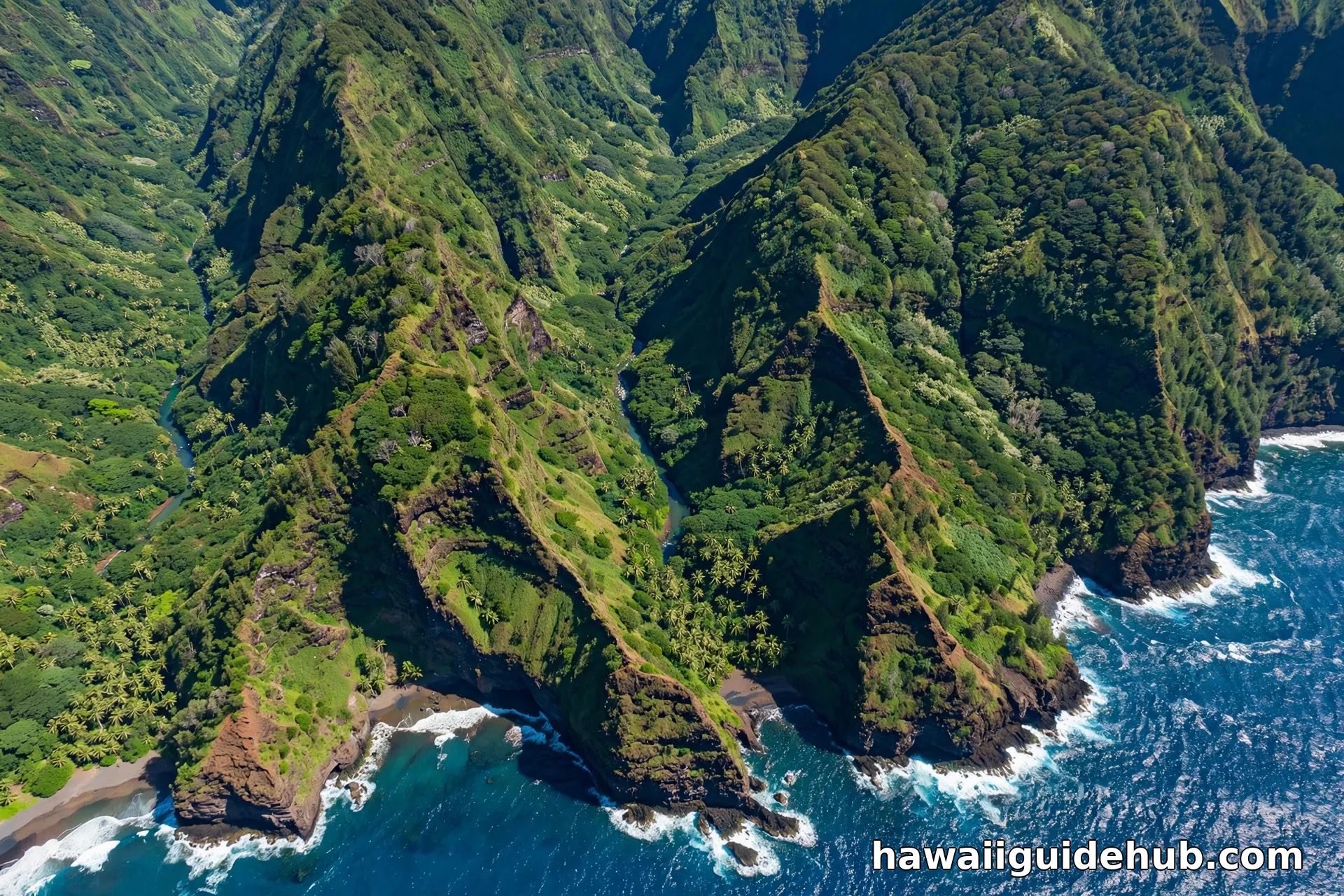
Because the plate keeps moving, each island gets only a limited time over the hotspot before it is carried away and its volcano starves. The result is a perfect age progression: the oldest islands in the northwest, the youngest in the southeast. Kauaʻi, at about 5 million years old, is the oldest of the main islands, and its volcanoes have been extinct for so long that erosion has carved it into the dramatic cliffs of the Nā Pali Coast and the deep gash of Waimea Canyon.
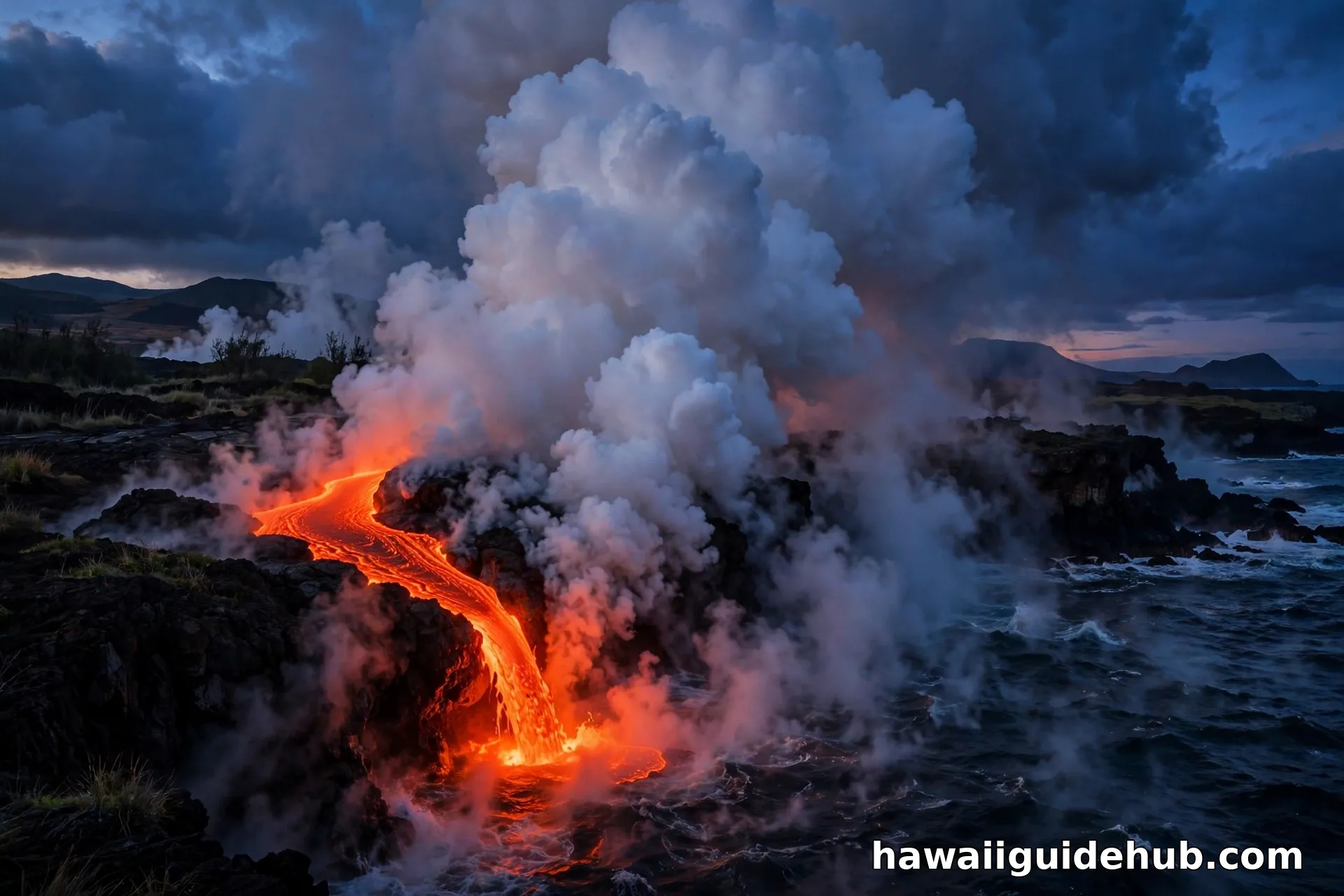
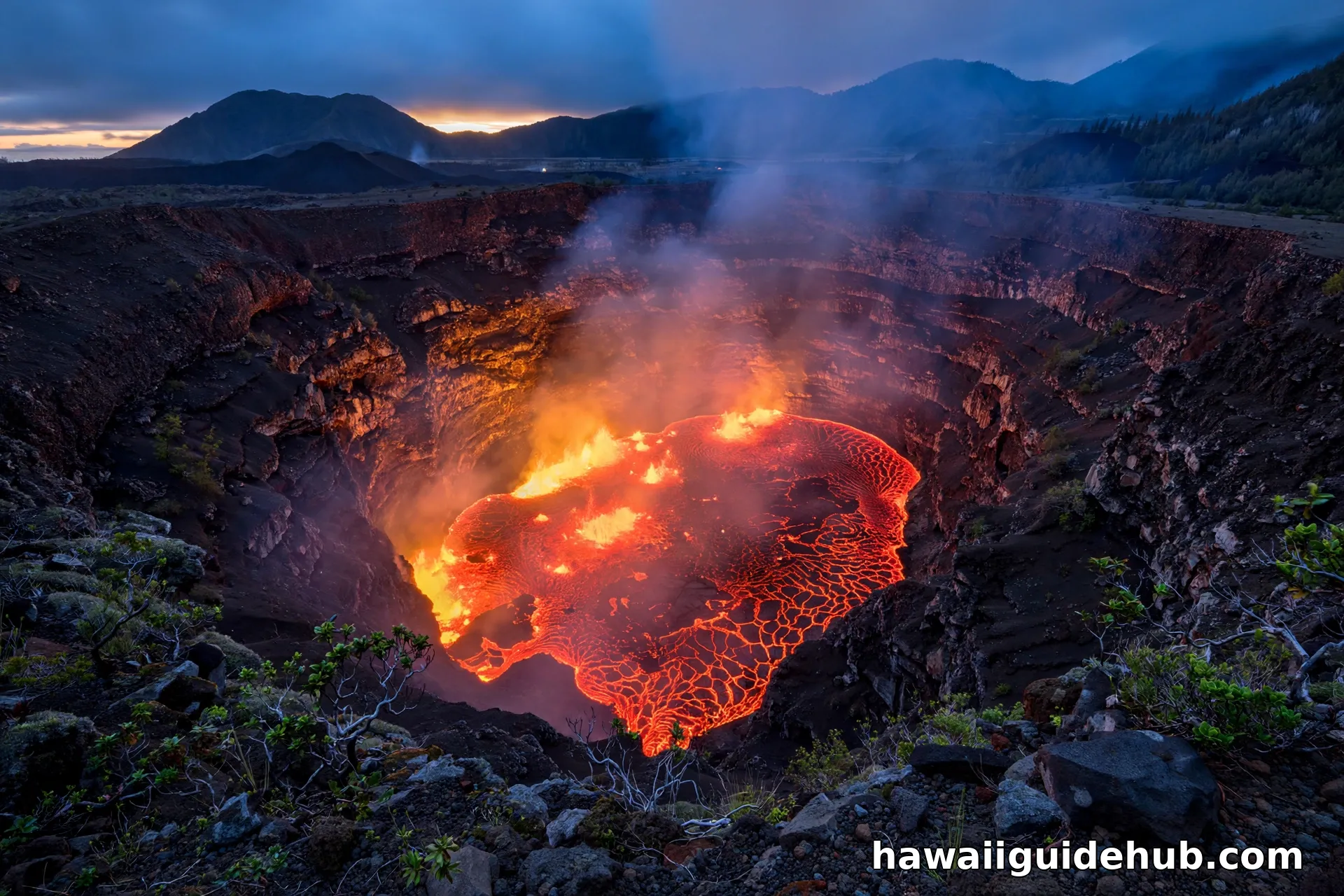
Oʻahu rose about 3 to 4 million years ago from two great shield volcanoes, Waiʻanae and Koʻolau, whose eroded remnants form the island’s two mountain ranges. Then came the Maui Nui complex about 1 to 2 million years ago, a single enormous island that later subsided and eroded into the separate islands of Maui, Molokaʻi, Lānaʻi, and Kahoʻolawe. And finally, less than a million years ago, the Big Island began to rise, and it is still growing today, with Kīlauea and Mauna Loa among the world’s most active volcanoes.
Erosion: The Sculptor of the Older Islands
Once an island drifts off the hotspot, volcanism stops and erosion takes over for millions of years. Rain, wind, waves, and landslides carve the smooth shield volcano into the jagged landscapes visitors love. Kauaʻi’s Nā Pali sea cliffs, plunging 4,000 feet into the ocean, are erosion’s masterpiece. Oʻahu’s Koʻolau Range, with its fluted ridges, is what remains of a volcano half-collapsed by ancient landslides.
The islands also slowly sink under their own immense weight, a process called subsidence. The oldest islands of the Hawaiian-Emperor chain have sunk entirely beneath the waves, becoming flat-topped seamounts called guyots. The chain records about 80 million years of this cycle, a 3,600-mile trail of drowned islands stretching toward Alaska, each one a former Hawaii in its youth.
How Life Reached These Remote Islands
When each island rose from the sea, it was a barren pile of black rock, the most isolated land on Earth. Hawaii sits over 2,000 miles from the nearest continent, so life arrived only by extraordinary accident: seeds and spores carried by wind and storms, birds blown off course, and a few hardy creatures rafting on driftwood. Over millions of years, these rare arrivals founded everything.
Isolation then worked its famous magic. With few competitors and countless empty niches, single colonists radiated into dozens of species. One finch ancestor gave rise to more than 50 species of Hawaiian honeycreepers, birds with beaks shaped for every food source from nectar to bark insects. The silversword alliance, giant rosette plants found on the high volcanoes, all descend from a single North American tarweed ancestor. Around 90 percent of Hawaii’s native plants and animals are found nowhere else on Earth, which is why the islands are sometimes called the extinction capital of the world as well: isolation creates uniqueness, and uniqueness is fragile.
This is the deeper reason the islands’ formation story matters to visitors. The beaches, the rainforests, the birdsong at dawn in the high forests of Maui and Kauaʻi, all of it exists because a hotspot built land in the middle of an empty ocean and life did the rest. Protecting that life, through the agriculture rules, the quarantine laws, and simple respect on the trails, is part of visiting Hawaii well.
The Full Chain: 80 Million Years of Islands
The eight main Hawaiian Islands are just the youngest tip of a much longer story. The Hawaiian-Emperor chain contains more than 80 volcanoes stretching 3,600 miles across the Pacific, and the oldest date back about 80 million years. Most of the chain is underwater now: ancient islands that eroded and subsided into seamounts and, in the shallows, coral atolls.
The chain even records a dramatic turn in Earth’s history. About 47 million years ago, the Pacific Plate changed direction, and the line of volcanoes bends sharply at that point, like an elbow in the trail. Northwest of the bend lie the Emperor Seamounts, marching toward Russia’s Kamchatka Peninsula. Midway Atoll, famous for the World War II battle, is a 28-million-year-old Hawaiian island worn down to a ring of coral. Every atoll and seamount in that line was once a high volcanic island like the Big Island is today.
Standing on a Hawaiian beach, you are standing at the active end of one of the longest-lived volcanic systems on the planet. The islands behind you in the chain are Hawaii’s future written in advance: erosion, subsidence, and finally the quiet of the deep ocean, while new islands rise behind them in turn.
The Next Hawaiian Island Is Already Growing
The story is not over. About 20 miles off the Big Island’s southeast coast, a seamount called Kamaʻehuakanaloa, formerly known as Lōʻihi, is actively growing on the hotspot right now. Its summit is still about 3,000 feet below the ocean surface, and scientists estimate it will take tens of thousands of years before it breaks through the waves. When it does, it will become the newest Hawaiian island, and the Big Island will begin its own long drift into old age.
Kamaʻehuakanaloa is already a fascinating place. Its summit hosts hydrothermal vents with unique microbial communities, and its eruptions have been detected by seismometers. It is a reminder that the Hawaiian Islands are not a finished landscape but a single frame in a movie that has been running for 80 million years and will run for tens of millions more.
Where to See the Geology Yourself
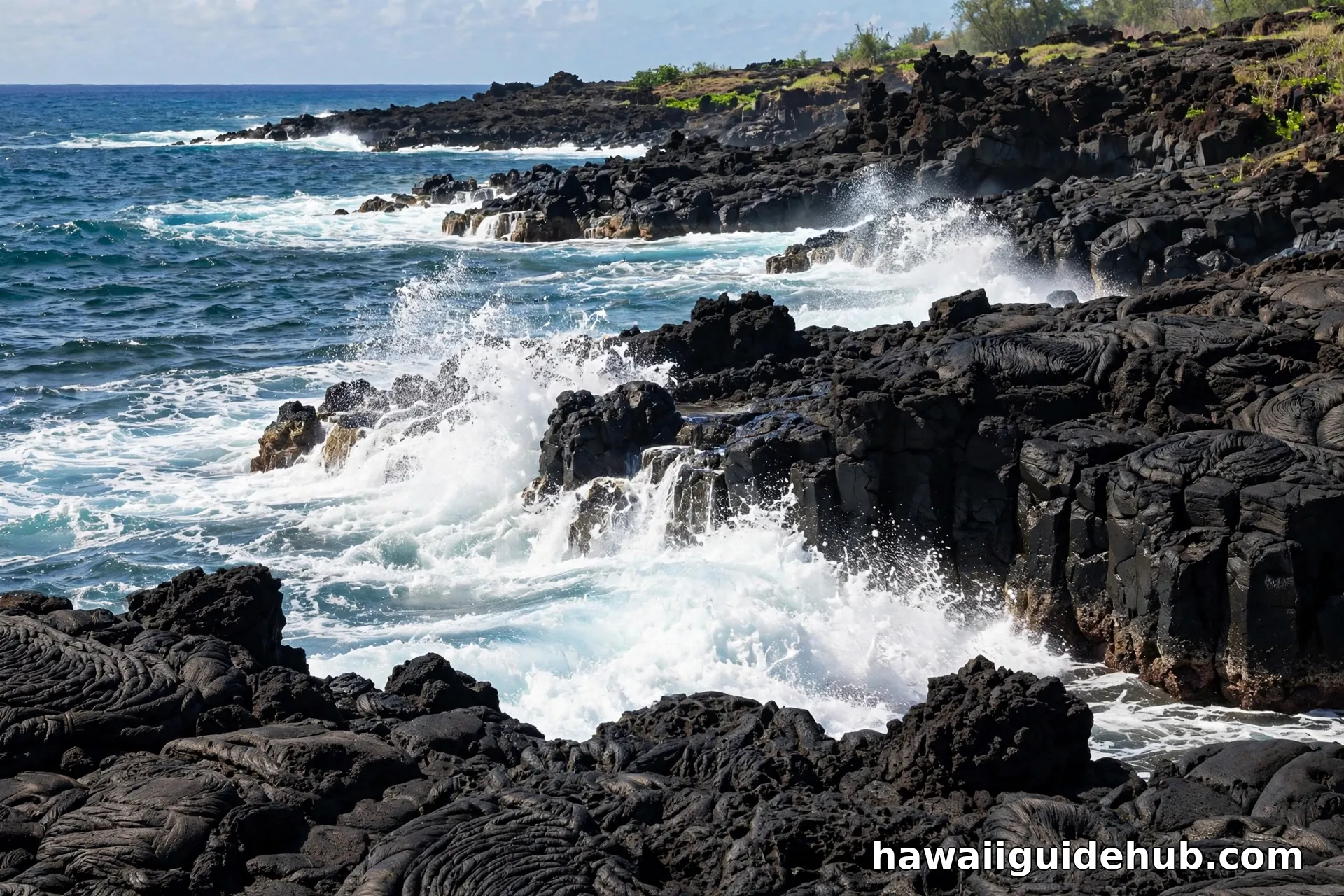
The Big Island is the best classroom. Hawaiʻi Volcanoes National Park lets you stand at the edge of Kīlauea’s caldera, walk through a lava tube, and see fresh lava fields that did not exist a few decades ago. For the broader island, our Big Island guide and Kona guide cover the volcanic landscapes alongside everything else the island offers.
On the older islands, look for erosion’s handiwork: the Nā Pali Coast on Kauaʻi, the Koʻolau cliffs above Honolulu, and the sea cliffs of Molokaʻi, among the tallest on Earth. Each viewpoint is a page in the same story, written in lava and rain over millions of years.
Video: What Is a Volcanic Hotspot?
An animated explainer from IRIS Earthquake Science: how a volcanic hotspot works, why the plate moving over it creates island chains like Hawaii, and the life cycle of a hotspot volcanic island.
Frequently Asked Questions
How were the Hawaiian Islands formed?
The Hawaiian Islands formed as the Pacific Plate moved slowly over a fixed volcanic hotspot, a plume of hot magma rising from deep in the Earth. Each island began as an underwater volcano that grew until it broke the ocean surface, then drifted away from the hotspot as the plate moved on.
Which Hawaiian island is the oldest?
Kauaʻi is the oldest of the main Hawaiian islands at about 5 million years old. Its volcanoes are long extinct, and erosion has carved its dramatic cliffs and canyons.
Which Hawaiian island is the youngest?
The Big Island of Hawaiʻi is the youngest at less than 1 million years old. It sits directly over the hotspot today and is still growing, with active volcanoes Kīlauea and Mauna Loa.
Why are the Hawaiian Islands in a line from oldest to youngest?
Because the hotspot stays fixed while the Pacific Plate moves northwest over it. Each new island forms over the hotspot in the southeast, and older islands are carried northwest, away from the magma supply, going extinct as they go.
Will there be a new Hawaiian island?
Yes. The seamount Kamaʻehuakanaloa is growing on the hotspot about 20 miles off the Big Island’s coast. Its summit is still about 3,000 feet underwater, and scientists estimate it will take tens of thousands of years to break the surface.
What type of volcanoes are the Hawaiian Islands?
Hawaiian volcanoes are shield volcanoes, broad gently sloping mountains built by fluid basaltic lava flows. Mauna Loa is the largest subaerial shield volcano on Earth by volume, and Mauna Kea, measured from its base on the seafloor, is the tallest mountain on the planet.
Are the Hawaiian Islands still growing?
The Big Island is still growing through eruptions of Kīlauea and Mauna Loa. The older islands are no longer growing; they are slowly eroding and sinking.
The Hawaiian Islands are a story written in fire and water: a fixed plume of magma, a plate drifting a few inches a year, and 80 million years of islands rising, flourishing, and sinking back into the sea. When you stand on black sand that did not exist when your grandparents were born, or gaze up at cliffs carved over five million years, you are looking at geology happening in real time. Few places on Earth let you watch a planet build itself. Hawaii is one of them.