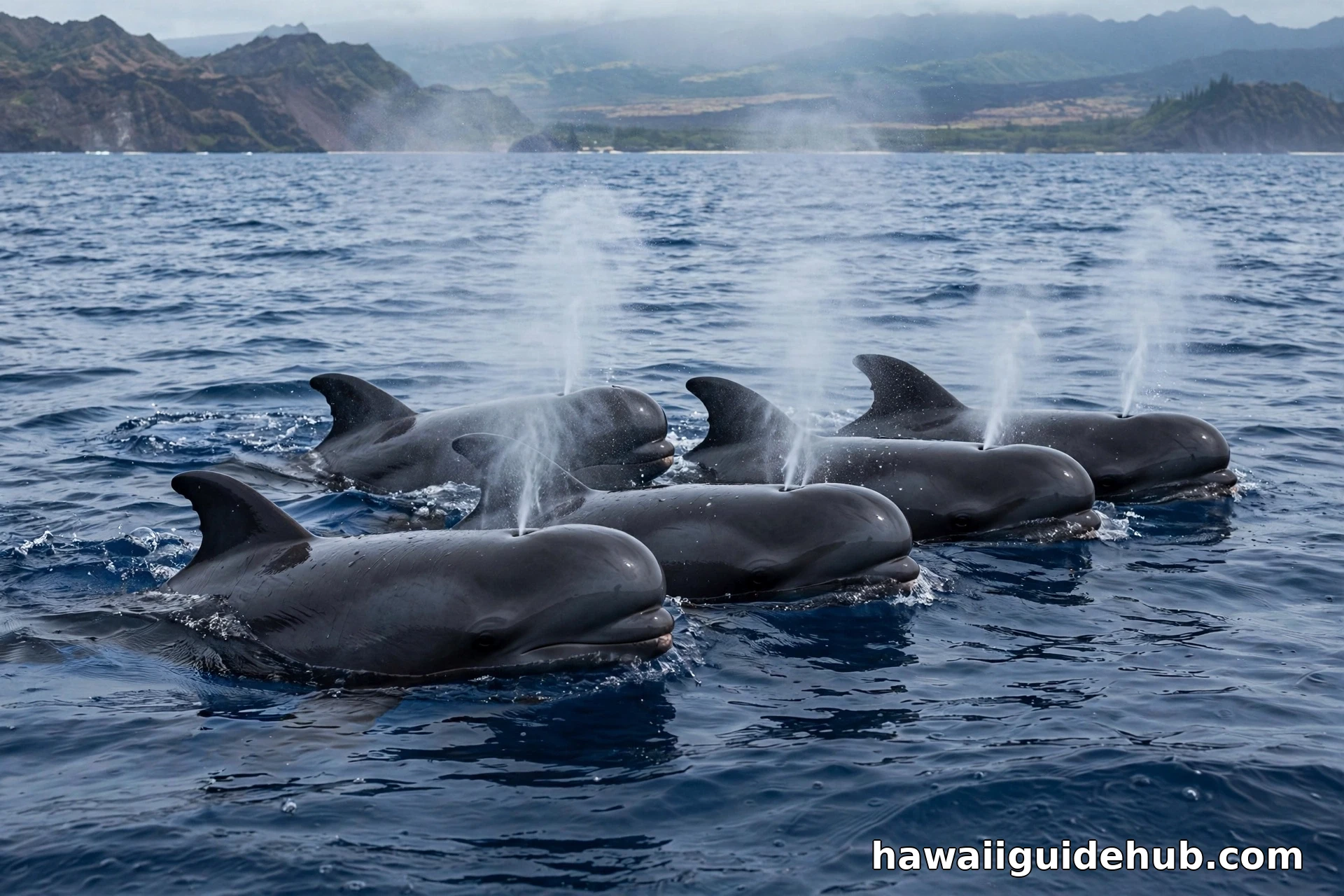
Pilot Whales in Hawaii: Meet the Deep-Diving Residents

Off the Kona coast, a pod of dark, blunt-headed animals surfaces in a tight line, exhaling in near unison before arching back down into the blue. They are pilot whales, and if you take a boat into deep water anywhere around the main Hawaiian Islands, they are the cetaceans you are most likely to meet. Short-finned pilot whales are Hawaii’s resident deep-divers: highly social, squid-obsessed, and capable of plunging more than 3,000 feet into the dark to hunt. Around 8,000 of them live in Hawaiian waters, and scientists here know them better than almost any pilot whale population on Earth.
This is the single complete guide to pilot whales in Hawaii. It covers what these animals are, how to identify them, the resident island communities and their complex social lives, their record-setting deep dives, what the latest science says about their enormous squid appetite, the threats they face, and how visitors can see them responsibly. If you have been searching for anything about pilot whales in Hawaii, the answers are all here on this one page.
What the Satellite Tags Revealed: Day vs. Night Diving
Depth-transmitting satellite tags on Hawaiian pilot whales exposed a striking split in how the animals use the water column. The pattern follows their squid prey, which migrates vertically each night.
| Daytime dives | Nighttime dives | |
| Share of dives | 31% (per Owen et al. 2019, Hawaii tagging) | 58% (per Owen et al. 2019) |
| Mean depth | 666 m, about 2,185 ft | 415 m, about 1,360 ft |
| Deepest recorded | Beyond 1,000 m in Hawaii; 1,300 m reported (per R. Baird) | Shallower; prey migrates upward |
| Longest dive | Up to 27 minutes (Hawaiian archipelago) | Shorter on average |
| Moon effect | Full moon: deeper, longer, farther offshore than new moon (per Hawaii tag data) | |
| Why | Tracking histioteuthid and onychoteuthid squid through their daily vertical migration | |
What Pilot Whales Are
The first surprise about pilot whales is that they are dolphins. Short-finned pilot whales belong to the oceanic dolphin family, and their behavior sits somewhere between a dolphin and a whale: they travel in tight, chatty pods like dolphins but dive to the crushing depths of beaked whales. Adults are dark gray to black with a bulbous, rounded forehead called a melon, a thick stocky body, and a broad-based dorsal fin set about a third of the way down the back. Males reach about 20 feet and can weigh over 6,000 pounds; females are smaller at around 15 feet.
Two species of pilot whale exist worldwide, the short-finned and the long-finned, and they are nearly impossible to tell apart at sea. In Hawaii, only the short-finned species occurs, which settles the question for island visitors. Their life history is slow and long: females mature around 10 years, carry calves for about 15 months, nurse for at least two years, and give birth only every five to eight years. Females can live to 60, outliving the males by 15 years, and older females play a central role in their pods, much like the matriarchs of elephant herds or orca families.
Hawaii’s Resident Communities
Hawaiian pilot whales do not migrate. Satellite tagging and decades of photo identification by researchers at Cascadia Research Collective and the University of Hawaii have shown that the population around the main islands is divided into three insular communities that favor the island slopes in water less than 3,000 meters deep. Some groups are true residents, seen in the same areas year after year, while others are visitors that pass through occasionally. This is unusual: in most of the world, pilot whales roam the open ocean, but Hawaii’s steep island slopes create a reliable deep-water hunting ground close to shore.
Their social structure is among the most complex known in dolphins. A long-term study off the island of Hawaii found a hierarchical society: individuals travel in stable, mixed-sex social units made up of related animals, and multiple units preferentially associate to form larger social clusters. These bonds last for decades. It is also why pilot whales are famous for mass strandings: when one animal strands, its podmates may follow, unwilling to abandon their family. Rescue teams in Hawaii train for exactly this scenario.
Deep Divers: Hunting Squid in the Dark
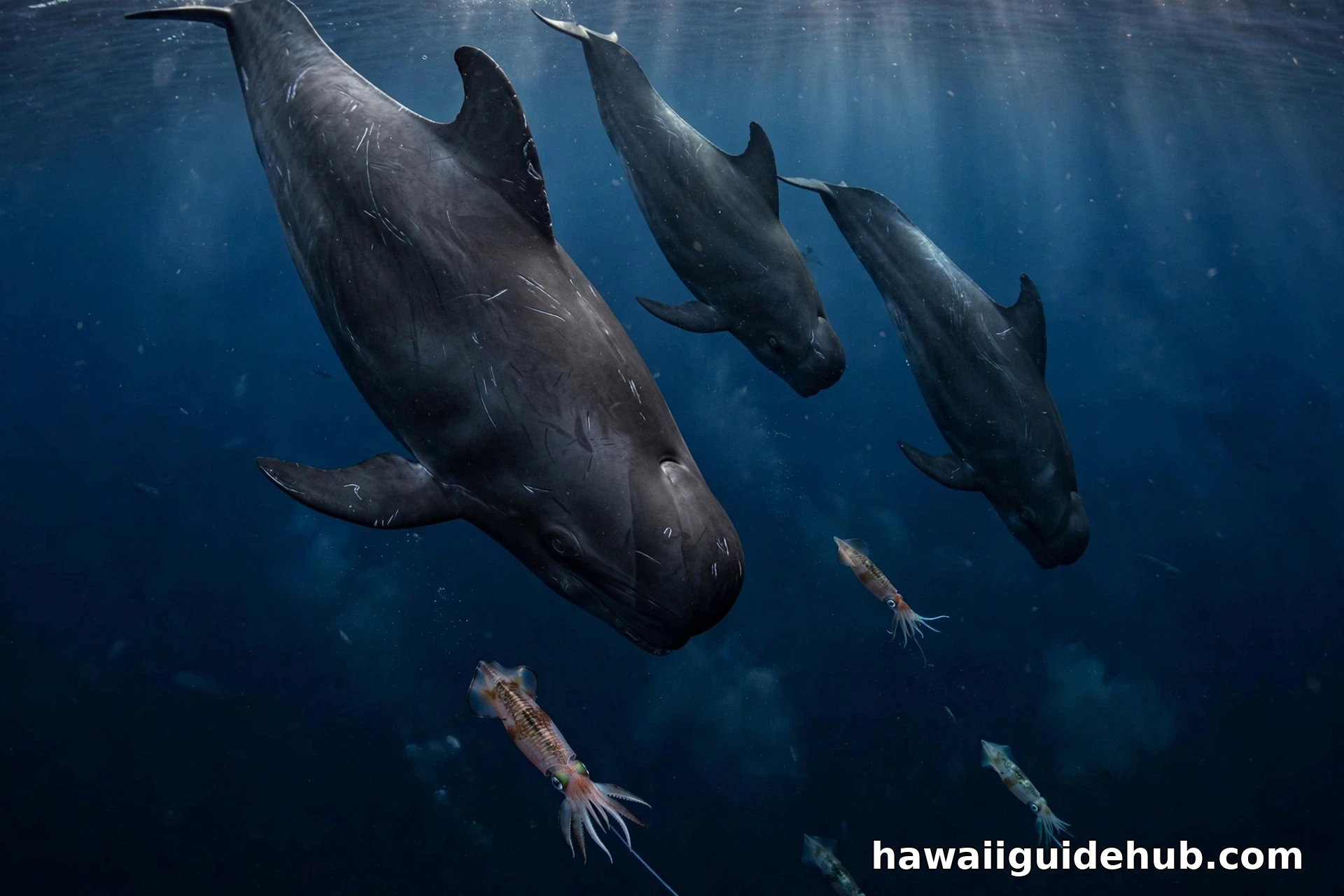
Pilot whales are one of the only oceanic dolphins that routinely hunt at extreme depth. Tags on Hawaiian animals show they dive deepest during the day, with about a third of daytime dives averaging 666 meters (roughly 2,185 feet), and dive more frequently but shallower at night, averaging 415 meters, likely following the nightly vertical migration of their squid prey toward the surface. The deepest recorded dives in Hawaii exceed 1,000 meters, and animals have stayed down for up to 27 minutes on a single breath. Lunar phase matters too: during a full moon, when prey stays deeper, the whales dive deeper, longer, and farther from shore.
Their prey is almost entirely deep-water squid, especially histioteuthid and onychoteuthid species that live in the ocean’s twilight zone. A landmark 2025 study by the University of Hawaii’s Marine Mammal Research Program, using suction-cup tags, drone measurements, and hydrophone recordings, finally answered how much squid a pilot whale needs: between 82 and 202 squid per day per adult, averaging about 142. Scaled up, Hawaii’s roughly 8,000 pilot whales consume an estimated 416 million squid per year, about 88,000 tonnes. That sounds staggering until you learn it is a drop in the ocean for the local squid population, and the researchers concluded Hawaiian pilot whales are in relatively good shape, with an abundant, reliable food supply.
How to Identify a Pilot Whale
From a boat, pilot whales are distinctive once you know the marks. Look for a large, dark, blunt-headed animal with a thick body and a dorsal fin that is broad at the base and set well forward. They surface in tight groups, often logging, resting motionless at the surface, between deep foraging dives. Their blows are low and bushy. The most common confusion is with false killer whales, which are slimmer, with a more conical head and a taller, more backswept dorsal fin. Melon-headed whales are much smaller and travel in pods of hundreds. If you see a big, dark, round-headed dolphin in a close-knit group off Kona, it is almost certainly a short-finned pilot whale.
Individual whales can be recognized by their dorsal fins. Researchers photograph the nicks, scars, and shapes of fins to identify animals across years, and cookiecutter sharks leave their own signature: the small sharks take round plugs of skin from the whales, and scientists have even studied the seasonal pattern of these bites to learn about the sharks. Visitors who photograph dorsal fins and share them with research groups contribute directly to the long-term catalog.
Threats and Conservation
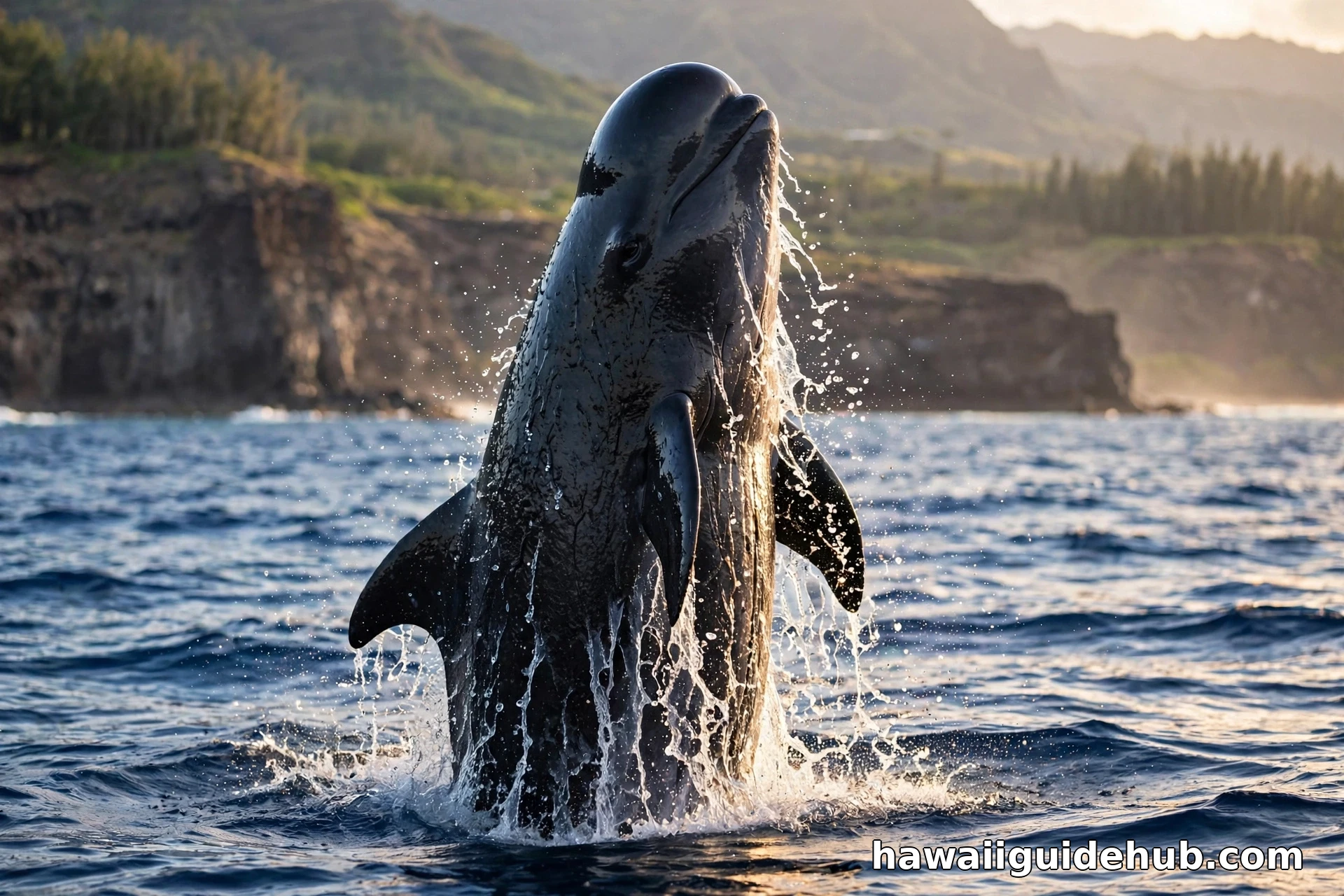
Hawaiian pilot whales are not listed as endangered, and the population appears stable, but they face the standard pressures of modern oceans. Entanglement in fishing gear and marine debris injures and kills animals. Ocean noise from shipping and sonar can disrupt their echolocation and deep-diving behavior. Contaminants accumulate in their blubber. And their tight social bonds, normally a strength, become a vulnerability during stranding events. Hawaii’s stranding network responds to pilot whale strandings with the understanding that separating an animal from its pod often fails: the whales simply re-strand to rejoin their family.
Climate change adds a longer-term question. Pilot whales depend on deep-water squid whose distribution follows ocean temperature and currents. If warming shifts the squid’s vertical migration or abundance, the whales’ energetically expensive deep-diving strategy could stop paying off. The 2025 energy-budget study gives scientists a baseline: they now know exactly how many squid a pilot whale needs, so future changes in body condition or foraging effort will be detectable. For now, the news is good, but the monitoring continues.
The Squid Economy: What 416 Million Squid Means
The 2025 energy-budget study did more than satisfy curiosity; it gave managers a number they can use. Knowing that an adult pilot whale needs roughly 142 squid a day, about 52,000 a year, means researchers can now estimate what the whole population requires: some 416 million squid annually, weighing around 88,000 tonnes. Against the vast squid biomass of the central Pacific, that is a small fraction, which is why the study’s authors are optimistic about the population’s future. But the figure is also a tripwire. If ocean warming or fishing pressure ever shrinks the deep-water squid supply, scientists will be able to calculate exactly when the whales’ foraging math stops working, because they finally know the cost side of the equation.
The finding also reframes the pilot whale’s ecological role. These animals are not just charismatic surface visitors; they are one of the largest predators of the mesopelagic zone around Hawaii, moving tonnes of deep-ocean biomass up into the surface food web every night through their feeding and waste. In that sense, a pod of pilot whales is a nutrient pump, connecting the twilight zone to the sunlit ocean in a way no net or sensor can replicate. Protecting them protects a process, not just a species.
If you encounter a stranded pilot whale, the protocol is specific: call the NOAA Fisheries stranding hotline immediately, keep people and dogs away, keep the animal’s skin wet and shaded if you can do so safely, and never push it back into the water yourself. Because podmates often re-strand, responders work to keep the whole group together offshore while the stranded animal is assessed. Your call, with a precise location, is the single most useful thing you can do.
Seeing Pilot Whales Responsibly
Your odds are genuinely good. Because the resident communities hug the island slopes, deep-water wildlife tours out of Honokohau Harbor near Kona encounter pilot whales on a large share of trips, often alongside bottlenose dolphins, rough-toothed dolphins, or the occasional beaked whale. Winter brings humpbacks into the same waters, so a single trip can deliver an extraordinary cetacean lineup. Choose operators that follow federal wildlife-viewing guidelines: no chasing, no encircling, no feeding, and engines in neutral if the animals approach. The responsible whale watching principles used for humpbacks apply to every cetacean in Hawaiian waters.
Bring binoculars and a camera with a fast shutter, and keep your eyes on the water between sightings: pilot whales surface in groups, so where there is one blow, there are usually more. If you are fascinated by Hawaii’s smaller social dolphins, the science of dolphin behavior covers the same social intelligence at a smaller scale, and the melon-headed whale offers a look at another deep-water Hawaiian resident that travels in far bigger herds.
Watch: Pilot Whales off Kailua Kona
Frequently Asked Questions
Are pilot whales dolphins or whales?
Pilot whales are oceanic dolphins, members of the dolphin family, despite their whale-like size and behavior. The short-finned pilot whale is one of the largest dolphins in the world.
How deep do pilot whales dive in Hawaii?
Tagged Hawaiian pilot whales routinely dive 400 to 800 meters, with the deepest dives exceeding 1,000 meters (about 3,300 feet) and lasting up to 27 minutes.
What do pilot whales eat?
Almost entirely deep-water squid. An adult Hawaiian pilot whale eats an estimated 82 to 202 squid per day, averaging about 142.
Where is the best place to see pilot whales in Hawaii?
Deep-water boat tours out of Kona on the Big Island offer the best odds, since resident communities live along the island slopes year-round.
Are pilot whales endangered?
No. The Hawaiian population of about 8,000 short-finned pilot whales appears stable, though they face threats from entanglement, ocean noise, and contaminants.
Pilot whales are the deep-water soul of Hawaii’s cetacean community: family-bound, squid-fueled, and at home in a vertical world most visitors never imagine. When their dark backs roll through a Kona sunset in perfect formation, you are watching one of the ocean’s great social lives play out on the surface, with a mile of dark water and a hundred squid beneath it.