Hala Tree in Hawaii: The Tree That Wove an Ocean Culture

Stand under a hala tree and you are standing under a hardware store, a pharmacy, a sail loft, and a legend. The hala, Pandanus tectorius, is the screw pine of Hawaii’s coasts: a leaning tree on stilt-like prop roots, crowned with spiraling sword leaves, bearing pineapple-like fruit on female trees and intensely fragrant flowers on males. Its leaves, lauhala, became the most important woven fiber in Oceania, fine enough for chiefly mats, strong enough for voyaging canoe sails.
This is the single complete guide to the hala tree in Hawaii. It covers what the tree is and the fossil that proved it arrived without humans, the difference between male and female trees, every major traditional use organized by plant part, the art of lauhala weaving, hala’s role in legend and medicine, and where to see great hala groves. If you have been searching for anything about the hala tree in Hawaii, the answers are all here on this one page.
What the Hala Tree Is
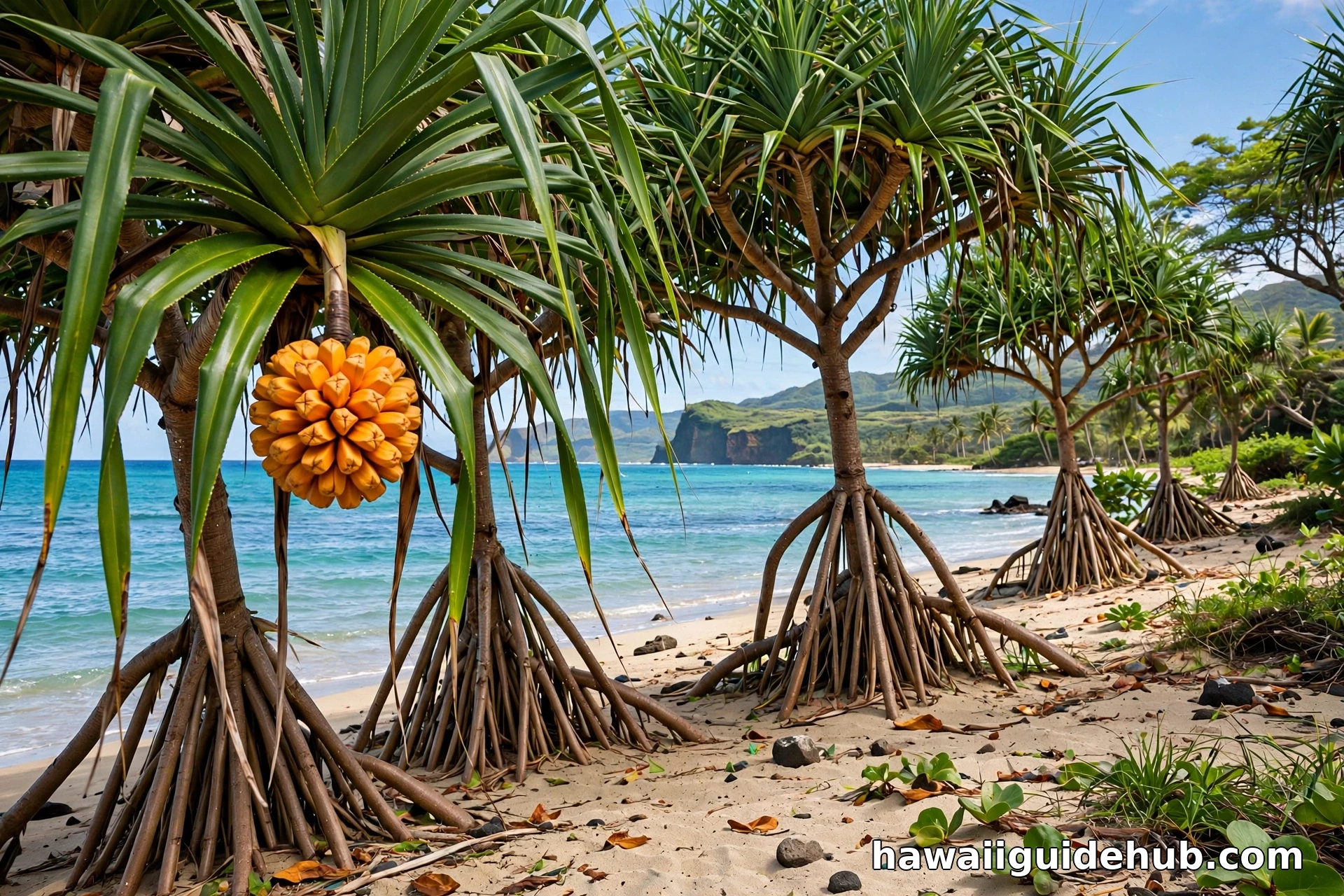
Hala is an indigenous tropical evergreen that grows to about 30 feet, with a stout, often leaning trunk held up by rigid prop roots that can extend several feet from the base. The leaves are the tree’s signature: two inches wide, two feet long, sword-shaped with toothed margins and a prominent midrib, arranged in a spiral that winds up the trunk like a screw, hence the English name “screw pine.” Branches leave the trunk at wide angles, and both branching and prop roots increase with age. Individual trees live up to 60 years.
For a long time botanists assumed hala was a Polynesian introduction, a canoe plant brought by settlers. Then a landslide on Kauai exposed a fossil bearing a hala fruit impression, dated to at least 1.2 million years old. Hala had arrived on its own, a million years before people, its buoyant fruit drifting across the Pacific. The Polynesians later brought their own selected varieties, but the tree was already home.
Male Trees, Female Trees
Hala is dioecious: male and female flowers grow on separate trees, and the two sexes look and behave quite differently. Male trees produce the hīnano, long, creamy flower spikes of extraordinary fragrance, heavy pollen producers that flower one to three times a year. Across Oceania, male hala flowers are associated with sensuality, and the pollen is traditionally considered an aphrodisiac. Female trees bear the famous fruit: large, round, segmented heads like pineapples, composed of wedge-shaped sections called keys or phalanges that ripen from green to bright orange-yellow.
The fruit is more than ornamental. The fleshy keys are edible, and on Pacific atolls hala fruit has been a staple food, second in importance only to coconut. In Hawaii the fruit is eaten more occasionally, but the keys are widely used in lei, their brilliant color and geometric form making striking adornments. If you find a hala with fruit on the ground beneath it, you have found a female; plant the keys and you can grow your own.
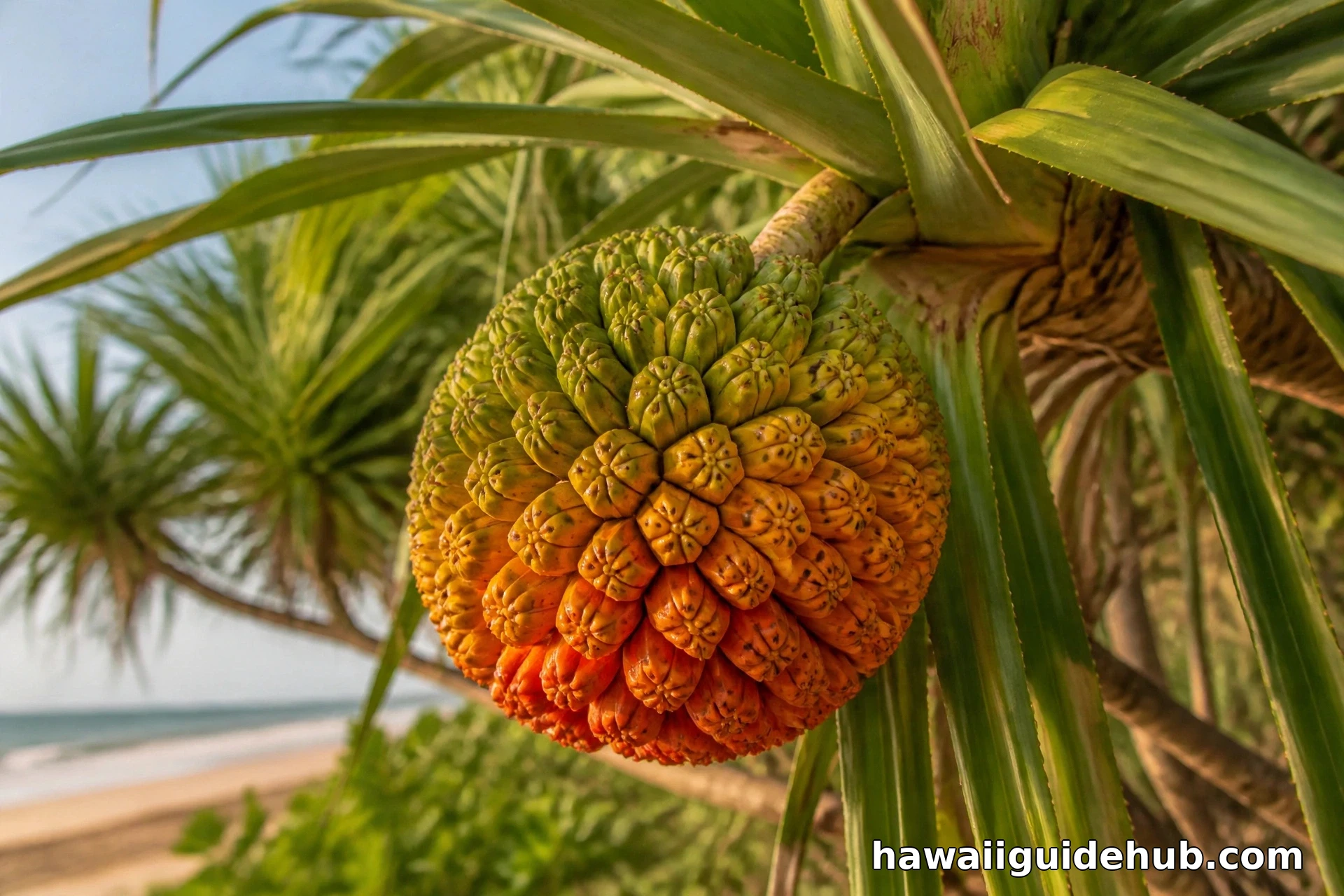
The fruit’s architecture rewards close inspection: each key is a self-contained package with its own seed, designed to break away and float to new shores. Fallen keys wash along beaches and ride currents between islands, the same dispersal strategy that carried hala across the Pacific millions of years before canoes existed.
One Tree, a Hundred Uses
Few plants on Earth have been put to as many uses as hala. Nearly every part of the tree had a job in old Hawaii and across Oceania. The table below inventories the plant part by part.
| Part | Traditional uses | Notes |
| Leaves (lau hala) | Mats, hats, baskets, pillows, sails, thatch, clothing | Most popular natural fiber in Oceania (per Plant Pono); finely woven sails enabled Pacific voyaging |
| Fruit keys | Food; lei material; brushes from dried keys | Staple food on atolls; keys ripen green to orange (per agroforestry guides) |
| Male flowers (hīnano) | Perfumery; lei; traditional aphrodisiac | Distilled as kewra in South Asia; intensely fragrant |
| Prop roots | Cordage and rope; dye; skipping ropes; basket handles | Fibers separated by beating (per Summers 1990) |
| Root tips | Medicine: childbirth, skin disorders, chest pain (with other plants) | Per Kapiolani CC Hawaiian plant records; aerial root tips also used |
| Trunk wood | Construction poles; house posts | Particularly male tree trunks, per Pacific use surveys |
| Leaf thorns | Protection: planted as living fences | Thornless varieties (kilipaki) now favored in landscaping |
Lauhala: The Weaving That Sailed the Pacific
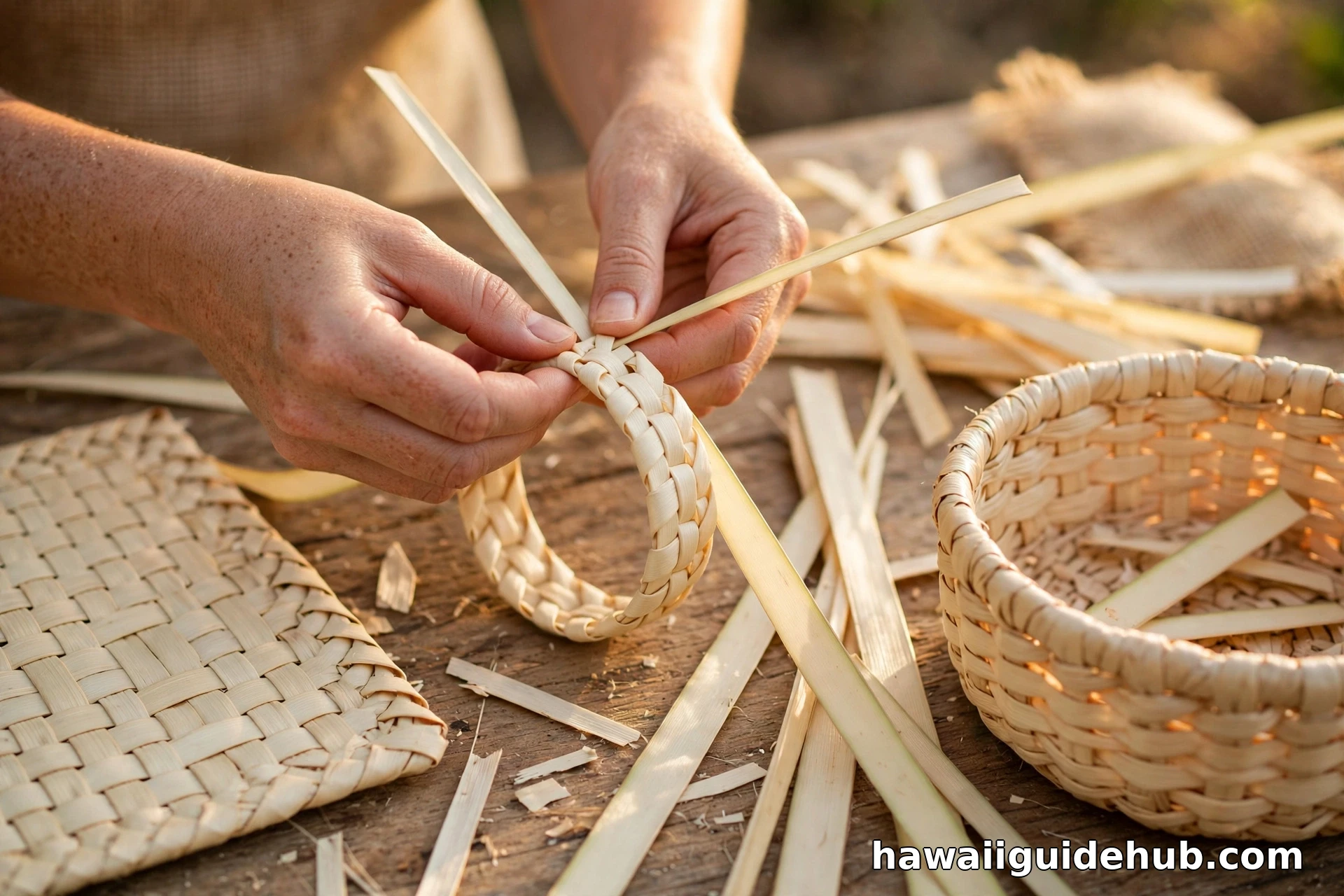
Ulana lauhala, the plaiting of hala leaves, is one of Hawaii’s great living arts. Preparation is laborious: leaves are gathered, the thorns stripped, the blades softened and dried, sometimes dyed, then plaited into mats, hats, baskets, and bracelets of remarkable fineness. A well-made lauhala hat or bracelet, cared for properly, becomes a family heirloom passed from grandparent to grandchild. Master weavers, often taught by kupuna in unbroken lineages, still teach the art across the islands.
The highest form of the craft was the sail. Finely woven hala sails, light, strong, and repairable at sea, were among the technologies that made the Polynesian exploration of the Pacific possible. When you see a lauhala mat or hat, you are looking at the same fiber technology that carried canoes across thousands of miles of open ocean. It is no exaggeration to say that without hala, there would be no Hawaii as we know it.
Hala in Legend and Daily Life
Hala is woven into story as deeply as into mats. The seal of Punahou School in Honolulu features the hala tree, commemorating the legend of an aged Hawaiian couple who lived above the present campus and prayed for water. In a dream they were told to uproot an old hala stump; beneath it they found a spring of clear, sweet water, which they named Ka Punahou, “the New Spring.” The school’s lily pond is said to be fed by that same spring.
In daily life, hala was everywhere: thatch for houses (a pandanus roof lasts about 15 years, versus 3 for coconut thatch), sleeping mats, pillows, cordage, and medicine. The aerial roots treated childbirth complications and skin disorders; the fruit entered treatments for childhood ailments; combined with other plants, hala preparations addressed chest pain. Modern landscapers favor thornless varieties, but the old thorny hala still guards coastal properties as a living fence, beautiful and unclimbable.
The Hīnano Season
If hala fruit is the tree’s visual signature, the hīnano is its olfactory one. When male trees flower, typically in spring and early summer in Hawaii, the long creamy spikes release a perfume so rich it carries on the wind, sweet, heavy, and unmistakably tropical. Old Hawaiians prized the flowers for lei and for scenting kapa cloth, tucking them into bundles of fabric the way other cultures use lavender sachets. In South Asia, the same fragrance is distilled into kewra water, a prized flavoring and perfume.
The cultural associations run deep. Throughout Oceania, male hala flowers are linked with romance and sensuality, and the pollen carries a traditional reputation as an aphrodisiac. Whether or not the chemistry supports the folklore, the scent itself is persuasive: walk past a flowering male hala on a warm evening and you will understand why poets reached for it. If you are choosing a hala for a garden and want the fragrance without the fruit drop, plant a male.
Not All Hala: Varieties and Look-Alikes
The hala of old Hawaii was thorny, and weavers’ hands bore the proof. But the genus Pandanus is diverse, and Hawaii now hosts several introduced relatives. The thornless kilipaki, a variety associated with Kiribati, has become the landscaping favorite, planted on the University of Hawaii at Mānoa campus and in gardens island-wide to replace the older thorny hala. Botanical gardens hold the wide-leafed P. dubius from the western Pacific and variegated ornamentals, and experimental weavers actively test new introductions for color, strength, and texture.
This diversity is both opportunity and concern. Researchers documenting hala’s past and future in Hawaii note that traditional varieties are becoming harder to find, as replanting lags, development clears old groves, and younger generations lose the knowledge of which tree is which. The thornless kilipaki is easier to live with, but the old thorny hala is the tree of the legends, the sails, and the thousand-year weaving lineages. Conservationists urge planting and maintaining the traditional varieties before the knowledge of them fades.
Growing Your Own Hala
Hala is forgiving to grow in Hawaii’s climate. It tolerates drought, salt spray, strong wind, and poor soils, including coral sand and young lava, thriving in full sun or partial shade. Propagation is straightforward: branch cuttings root readily and grow faster than seedlings, about 20 to 32 inches a year, while seedlings grow slowly to moderately. Plant it where the prop roots have room to spread and where falling fruit, on a female, will not become a nuisance.
Choose your variety deliberately. For weaving, seek traditional thorny hala with long, strong leaves, the kind old weavers prefer. For fragrance, plant a male. For a tidy landscape tree, the thornless kilipaki behaves better near paths and lawns. And give it space: a mature hala spreads 20 to 30 feet, and its silhouette, leaning trunk, radiating prop roots, spiral crown, only improves with age. In sixty years your tree will be a landmark.
Where to See Hala in Hawaii
Hala grows wild along coasts throughout the islands, but the great groves are the experience to seek. The hala forests of the Puna district on the Big Island are among the most atmospheric, leaning trees over black sand and lava. Botanical gardens on every island maintain labeled specimens, including thornless varieties, and the Foster Botanical Garden in Honolulu and the Hawaii Tropical Bioreserve Garden near Hilo are excellent for close study. Coastal walks anywhere windward will pass hala; look for the prop roots, the spiral leaf arrangement, and, in season, the orange fruit or the fragrant hīnano.
If you buy lauhala work, buy from Hawaiian weavers and expect to pay for the labor: a fine hat represents days of preparation and weaving. For more on Hawaii’s living traditions, see the guide to Hawaiian cultural traditions, and for the landscapes hala grows in, the guide to Hawaii’s ocean environments and responsible wildlife watching cover the etiquette of visiting wild places with care.
Watch: Weaving a Hawaiian Lauhala Bracelet
Frequently Asked Questions
What is the hala tree?
Hala (Pandanus tectorius) is an indigenous Hawaiian tree with prop roots, spiral sword leaves, and segmented fruit, famous as the source of lauhala weaving fiber.
What is lauhala?
Lauhala are the leaves of the hala tree, prepared and plaited into mats, hats, baskets, and sails. Ulana lauhala is the Hawaiian weaving art.
Are hala trees male or female?
Both: hala is dioecious. Male trees bear fragrant hīnano flowers; female trees bear the segmented fruit.
Can you eat hala fruit?
Yes. The fruit keys are edible and were a staple food on Pacific atolls, though in Hawaii the fruit is more commonly used for lei.
What is the difference between male and female hala trees?
Male trees produce fragrant hīnano flower spikes; female trees produce the segmented fruit. Hala is dioecious, so each tree is one or the other. For fragrance without fruit drop, plant a male.
Is hala native to Hawaii?
Yes. A Kauai fossil with a hala fruit impression dates back at least 1.2 million years, proving hala arrived without human help long before Polynesian settlers brought their own varieties.
Where can I see hala trees in Hawaii?
Coastal areas island-wide; the Puna district groves on the Big Island; Foster Botanical Garden (Honolulu); Hawaii Tropical Bioreserve Garden (Hilo).
The hala tree is a million-year-old native that became a cultural foundation: fiber for sails that crossed an ocean, mats for chiefs, medicine for families, and a spring legend for a school. Walk a Puna grove at golden hour, prop roots casting long shadows, and you are walking through one of the deepest stories in Hawaii.