Hawaiian Pork Hash: The Steamed Dim Sum Favorite, Recipe and Pro Tips

If you grew up in Hawaii, you know the sound of a bamboo steamer lid lifting and the smell of ginger and shoyu that rushes out with the steam. Inside, sitting in neat rows, are pork hash: plump, open-faced dumplings with juicy pork and shrimp filling peeking out of delicate wonton wrappers. One bite, dipped in shoyu spiked with hot mustard, and you understand why this humble snack has its own devoted following across the islands.
Pork hash is Hawaii’s answer to the Chinese shumai, and it is everywhere once you know to look. You will find it at old-school dim sum counters in Chinatown, at the front register of 7-Eleven, in school lunchboxes, and on party tables next to the fried rice and mac salad. It is comfort food, pupu, and afternoon snack all in one steaming little package.
This guide covers everything: what pork hash is, how it came to Hawaii, how it differs from Chinese shumai, a full classic recipe you can make at home, pro tips, variations, the all-important dipping sauce, and where to find the best pork hash in Hawaii.
What Is Pork Hash?
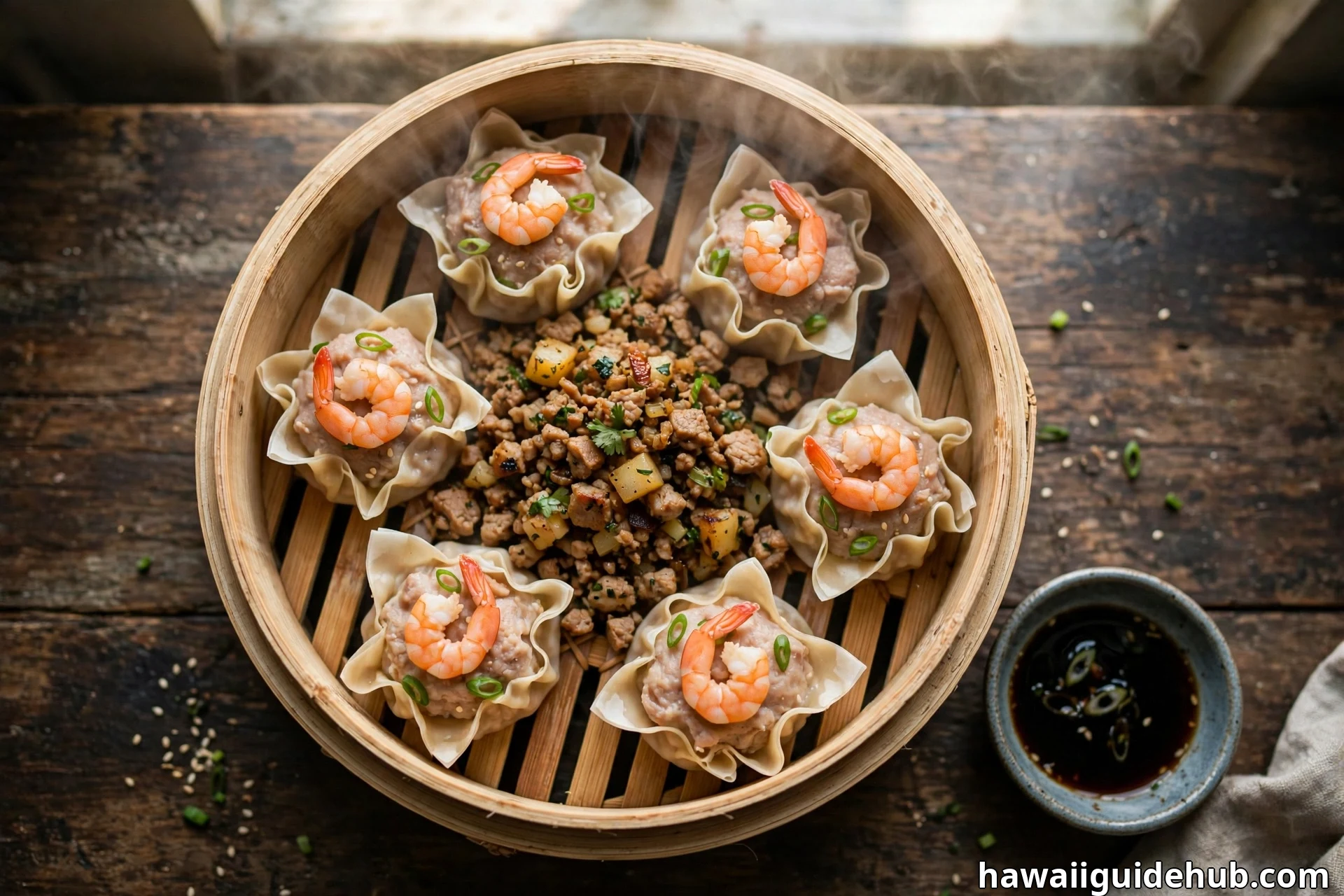
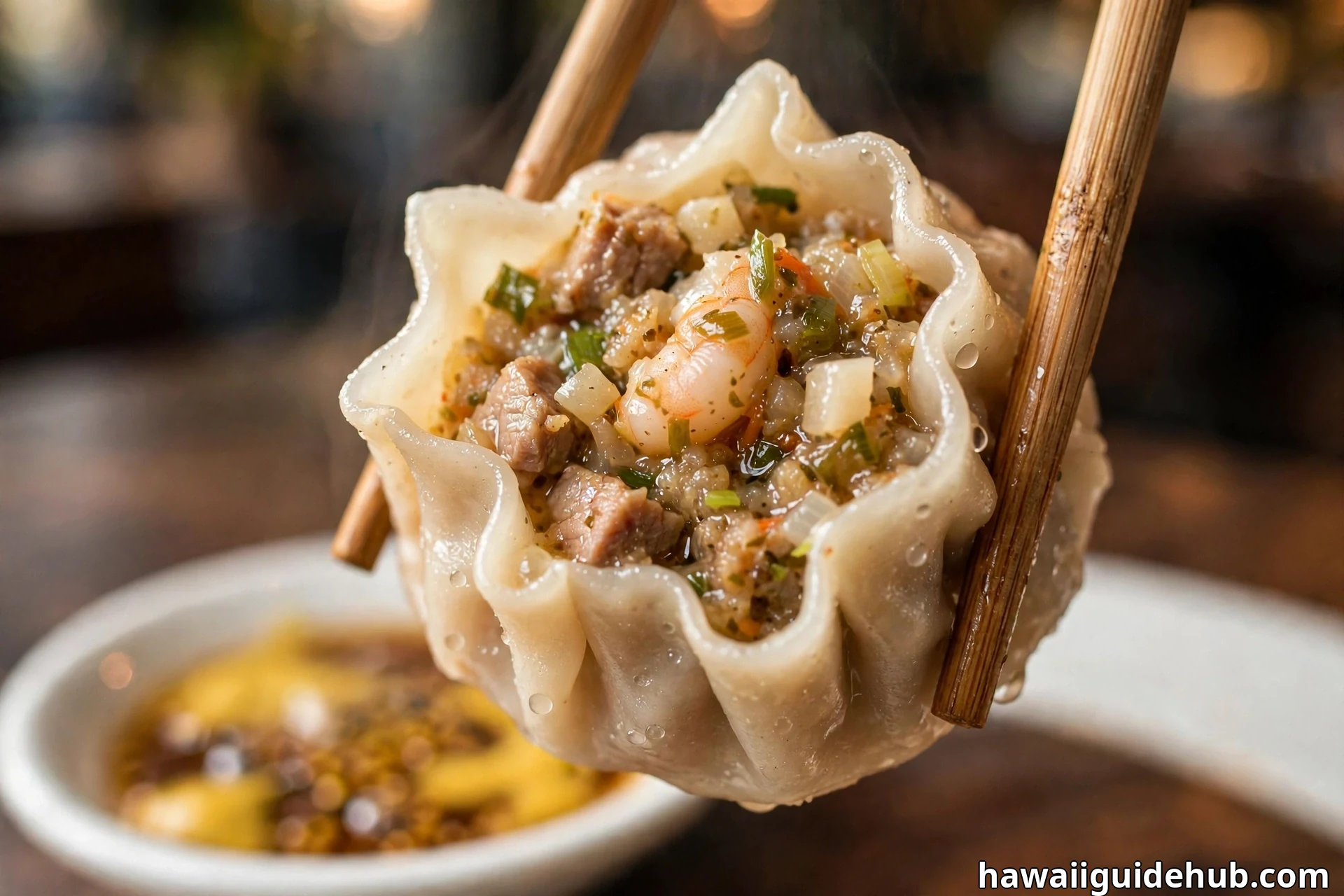
Pork hash is a steamed, open-faced dumpling filled with seasoned ground pork and chopped shrimp. A round wonton wrapper is gathered around a spoonful of filling and pinched into a little cup, leaving the top open so you can see the savory filling inside. The dumplings are steamed until the pork is cooked through and the wrapper turns slightly translucent.
The classic filling mixes ground pork with shrimp, diced water chestnuts for crunch, green onions, shoyu, oyster sauce, sesame oil, and a little sugar. Each piece is typically topped with a single shrimp or a dot of orange tobiko (flying fish roe) for color. They are served hot, usually with a simple dipping sauce of shoyu and Chinese hot mustard.
In Hawaii, pork hash belongs to the world of local-style dim sum rather than traditional Chinese dim sum. That distinction matters, and it shapes where you find it and how it tastes.
From Chinese Shumai to Hawaiian Pork Hash
Pork hash arrived in Hawaii with Chinese immigrants who came to work the sugar plantations in the late 1800s. They brought shumai, the classic Cantonese steamed dumpling, with them. Over more than a century, shumai adapted to local tastes, local ingredients, and local eating habits, and pork hash was born.
The plantation era mixed Chinese, Japanese, Portuguese, Filipino, Korean, and Native Hawaiian food traditions into something new. Pork hash is a perfect example of that blending. It kept the shumai’s shape and steaming method but grew bigger, meatier, and bolder in flavor to suit local appetites.
Today, Hawaii has both shumai and pork hash, but you find them in different places. Shumai shows up at traditional Chinese dim sum restaurants with cart service and tea. Pork hash is the takeout version: sold at local counter-service shops, manapua bakeries, okazuya (Japanese delis), and even convenience stores. If you want to taste the difference the islands made, try them side by side.
Pork Hash vs. Shumai: What Is the Difference?
Visitors often ask whether pork hash and shumai are the same thing. They are cousins, not twins. Here is how they differ:
Size. Pork hash is noticeably larger than Cantonese shumai. A pork hash dumpling is a hearty two-bite (or generous one-bite) snack, while shumai tends to be smaller and more delicate.
Filling. Pork hash leans heavily on pork with shrimp as a partner, seasoned boldly with shoyu and oyster sauce. Shumai fillings vary more and often include pork with shrimp or crab in subtler seasoning.
Texture. Diced water chestnuts are close to mandatory in pork hash, giving it a distinctive crunch that survives steaming. Shumai may or may not include them.
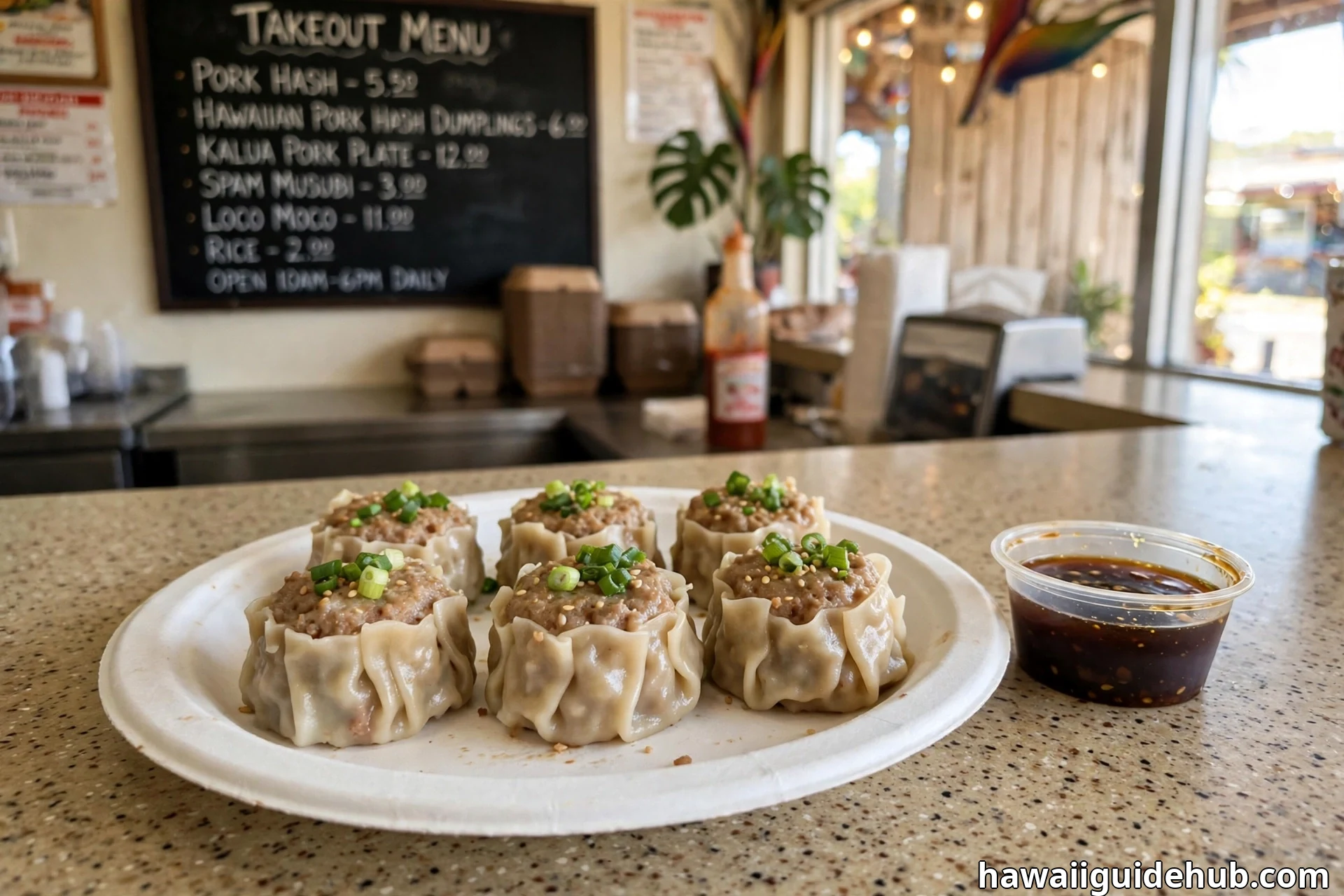
Where you eat it. In Hawaii, pork hash is takeout food. You grab a few pieces in a paper tray with mustard-shoyu and eat them on the go. Shumai is sit-down dim sum food, eaten with tea at a restaurant table.
The sauce. Pork hash is almost always paired with shoyu mixed with Chinese hot mustard. Shumai might come with chili oil, vinegar, or mustard, depending on the restaurant.
The Classic Hawaiian Pork Hash Recipe
This recipe makes about 30 pieces, enough for a party or a week of snacks. The method is simple, and most of the work is in the folding, which gets faster with every piece.
Ingredients
For the filling:
- 1 pound ground pork (not too lean)
- 1/2 pound raw shrimp, peeled, deveined, and roughly chopped
- 1/2 cup water chestnuts, finely diced
- 2 green onions, thinly sliced
- 2 tablespoons shoyu (soy sauce)
- 1 tablespoon oyster sauce
- 1 tablespoon cornstarch
- 1 teaspoon sesame oil
- 1 teaspoon sugar
- 1/2 teaspoon salt
- 1/4 teaspoon white pepper
- 1 teaspoon grated fresh ginger (optional but recommended)
For assembling:
- 30 round wonton or shumai wrappers
- Small bowl of water for sealing
- Parchment paper or cabbage leaves for lining the steamer
For the dipping sauce:
- 3 tablespoons shoyu
- 1 tablespoon Chinese hot mustard (or to taste)
Instructions
Step 1: Mix the filling. Add the ground pork, shoyu, oyster sauce, cornstarch, sesame oil, sugar, salt, white pepper, and ginger to a large bowl. Stir in one direction for 2 to 3 minutes until the mixture feels sticky and holds together. Fold in the chopped shrimp, water chestnuts, and green onions last so they stay chunky.
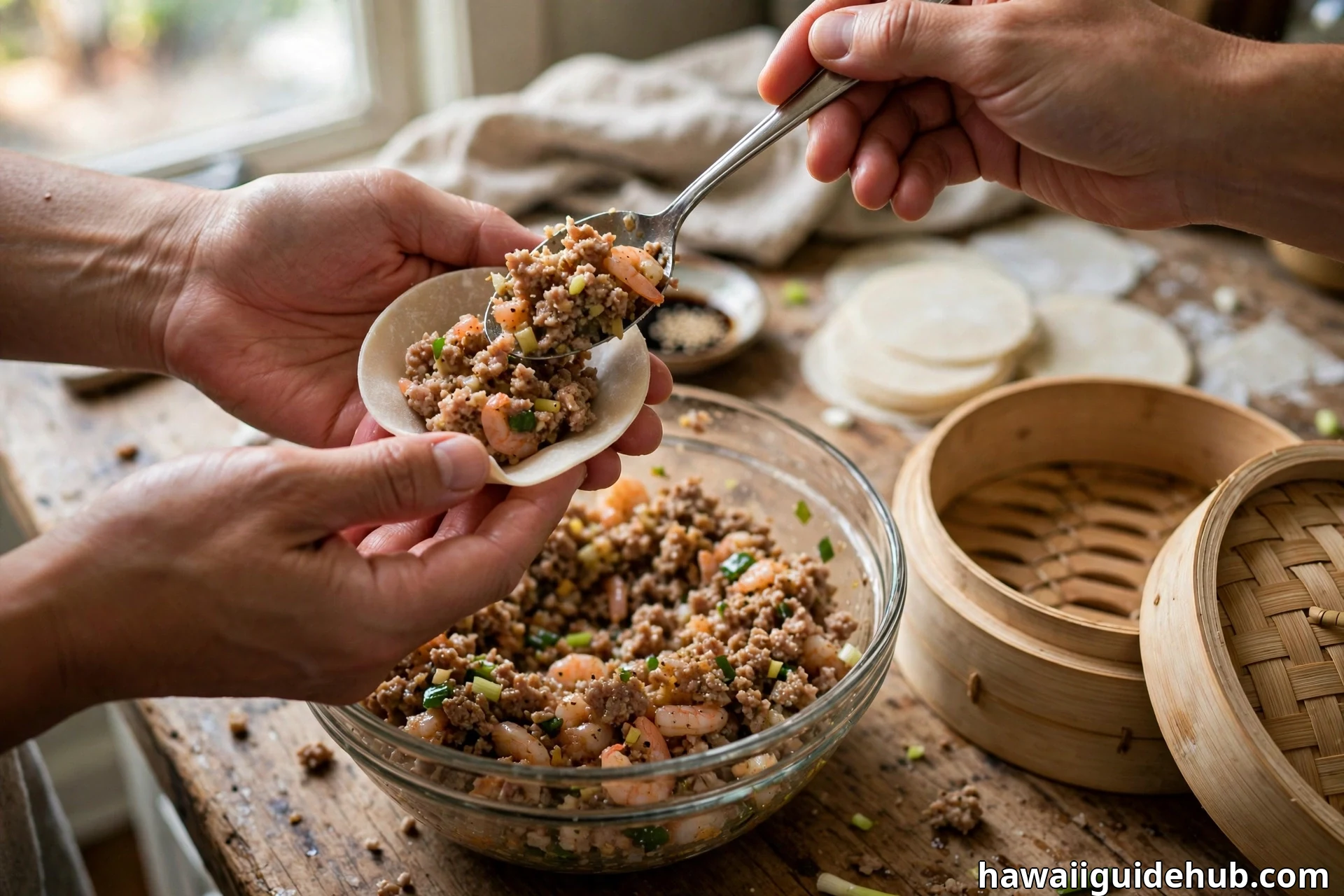
Step 2: Shape the dumplings. Lay a wonton wrapper over your thumb and forefinger to form a small cup. Place about 1 tablespoon of filling in the center. Gather the wrapper up around the filling, gently squeezing to form a cup shape, and tap the bottom on the counter so it stands flat. Leave the top open. If you like, press a small piece of shrimp into the top of each one.
Step 3: Prepare the steamer. Bring a pot of water to a boil and line a bamboo steamer with parchment paper or cabbage leaves, poking a few holes for steam to pass through. Arrange the pork hash in the steamer with a little space between pieces so they do not touch.
Step 4: Steam. Set the steamer over the boiling water, cover, and steam for 12 to 15 minutes. The pork hash is done when the pork is cooked through (no pink inside) and the wrappers look slightly translucent. Work in batches if needed.
Step 5: Make the dipping sauce and serve. While the last batch steams, stir the shoyu and hot mustard together in a small bowl. Serve the pork hash hot with the sauce on the side.
Pro Tips for Perfect Pork Hash
Do not use lean pork. Ground pork with some fat (around 80/20) stays juicy through steaming. Extra-lean pork turns dry and crumbly.
Mix until sticky. The single most important technique is stirring the pork mixture in one direction until it becomes tacky. This develops the bind that keeps the dumpling intact. If the mix feels loose, keep stirring.
Keep the shrimp chunky. Roughly chop the shrimp rather than mincing it. Distinct pieces of shrimp in the filling are a hallmark of good pork hash.
Do not overfill. One tablespoon per wrapper is the sweet spot. Overfilled dumplings burst in the steamer, and underfilled ones are mostly wrapper.
Keep wrappers covered. Wonton wrappers dry out fast. Keep the stack under a damp towel while you work, and cover finished dumplings with plastic wrap until steaming.
Do not overcrowd the steamer. Leave space between pieces for steam circulation. Crowded dumplings cook unevenly and stick together.
Tasty Variations to Try
Once you have the classic down, pork hash is easy to riff on. Here are variations that stay true to the spirit of the dish:
Shrimp-heavy pork hash. Flip the ratio to half pork and half shrimp for a lighter, sweeter dumpling. This is closer to traditional har gow territory but still very much pork hash.
Spicy pork hash. Add 1 to 2 teaspoons of chili garlic sauce or a finely minced Thai chili to the filling. Serve with chili oil in the dipping sauce for extra heat.
Mushroom pork hash. Add 1/4 cup of finely diced shiitake mushrooms (fresh or rehydrated) for an earthy depth. This is a nod to the Cantonese roots of the dish.
Crab pork hash. Replace half the shrimp with lump crabmeat for a richer, more luxurious version. Top each piece with tobiko for color and a pop of brininess.
Baked pork hash cups. For a party twist, press wonton wrappers into a mini muffin tin, fill with the pork hash mixture, and bake at 375°F for 12 to 15 minutes until golden. Not traditional, but undeniably ono.
The Dipping Sauce
In Hawaii, pork hash without mustard-shoyu is barely pork hash at all. The sauce is dead simple: shoyu stirred with Chinese hot mustard. The standard ratio is about 3 parts shoyu to 1 part mustard, but locals adjust freely. Some like it sinus-clearing hot; others prefer just a whisper of mustard.
Chinese hot mustard comes as a powder you mix with cold water, or pre-made in tubes and jars. The powder, mixed fresh, gives the sharpest heat. Let it sit for 10 minutes after mixing for the full effect.
If you want to get fancy, add a drop of sesame oil or a splash of rice vinegar. But the classic two-ingredient version is what you will get at most shops, and it is all you need.
Where to Find the Best Pork Hash in Hawaii
Making pork hash at home is rewarding, but part of the fun in Hawaii is tasting how the pros do it. Here are the spots locals swear by:
Char Hung Sut (Honolulu, Chinatown). This 60-year-old Chinatown institution is synonymous with local-style dim sum. Their pork hash, manapua, and half-moon dumplings are made fresh daily, and the shop regularly sells out by noon. Bring cash and go early. Watching the aunties roll dough in the open kitchen is half the experience.
7-Eleven Hawaii. Yes, really. Pork hash at the front register of 7-Eleven is a genuine Hawaii institution. It is the after-school, after-surf, road-trip snack of generations. Do not knock it until you have tried it steaming hot from the warmer.
Manapua shops and okazuya. Neighborhood manapua bakeries and Japanese-style delis across the islands sell pork hash by the piece. Ask around wherever you are staying; every area has a local favorite.
Dim sum restaurants. For the sit-down experience, Honolulu’s dim sum houses serve excellent shumai alongside the full cart spread. It is a different style from takeout pork hash, and worth trying for comparison.
For more ideas on what to eat around the islands, check out our guide to must-try local dishes in Hawaii and where to find them.
Serving Ideas
Pork hash is endlessly versatile. In Hawaii, a few pieces with mustard-shoyu is the standard afternoon snack, the thing you grab when you are hungry but dinner is hours away. But it works in plenty of other settings too.
As party pupu, pork hash is unbeatable. A big steamer of pork hash on the table disappears fast, and it is easy to keep batches coming. Pair it with huli huli chicken skewers and a fruit platter for a crowd-pleasing spread.
For lunch, pack pork hash alongside fried rice and mac salad for a local-style plate lunch vibe. Kids love them in lunchboxes, and they reheat well.
For dessert-adjacent snacking, follow the savory with something sweet. Malasadas make the perfect chaser after a plate of pork hash, and native Hawaiian fruits are a lighter option.
Storage and Reheating
Make ahead: Assemble the pork hash up to a day before and refrigerate them on a parchment-lined tray, covered with plastic wrap. Steam straight from the fridge, adding about 2 minutes to the cooking time.
Freezing: Pork hash freezes beautifully. Arrange uncooked dumplings on a tray, freeze until solid, then transfer to a freezer bag. They keep for up to 2 months. Steam from frozen for 18 to 20 minutes; no need to thaw.
Reheating: Re-steam leftover pork hash for about 5 minutes rather than microwaving. The microwave toughens the wrapper and makes the filling rubbery. A bamboo steamer over simmering water brings back the just-made texture.
See It Made on Video
Frequently Asked Questions
Is pork hash the same as shumai?
They are closely related but not identical. Pork hash is Hawaii’s localized version of Chinese shumai: larger, meatier, with water chestnuts for crunch, and typically eaten as takeout with mustard-shoyu. Shumai is the broader Cantonese original served at dim sum restaurants.
What is pork hash made of?
The classic filling is ground pork mixed with chopped shrimp, diced water chestnuts, green onions, shoyu, oyster sauce, sesame oil, sugar, and seasonings, all wrapped in a round wonton wrapper and steamed.
Can I make pork hash without shrimp?
Yes. An all-pork version is perfectly good, though the shrimp adds sweetness and is traditional. You can also substitute finely chopped mushrooms for a different texture.
Where can I buy pork hash in Hawaii?
Char Hung Sut in Honolulu’s Chinatown is the most famous spot. You will also find pork hash at 7-Eleven stores, manapua bakeries, okazuya delis, and dim sum restaurants across the islands.
How long does pork hash keep?
Cooked pork hash keeps in the refrigerator for 3 to 4 days. Uncooked assembled dumplings freeze well for up to 2 months. Always re-steam rather than microwaving for the best texture.
What do you dip pork hash in?
The classic dip is shoyu mixed with Chinese hot mustard, roughly 3 parts shoyu to 1 part mustard. Adjust the heat to your taste.
Pork hash is one of those dishes that tells the story of Hawaii in a single bite: Chinese technique, local ingredients, plantation-era ingenuity, and a century of island appetites shaping it into something all its own. Whether you steam a batch at home or grab a few pieces from a Chinatown counter, you are tasting a genuine piece of Hawaii’s food culture. Once you have had it fresh from the steamer with that sharp mustard-shoyu kick, ordinary dumplings may never quite satisfy you again.