Waiahole Poi Factory: Oahu’s Century-Old Home of Hand-Pounded Poi

Drive the windward side of Oahu on Kamehameha Highway, past the green wall of the Koolau mountains and the turnoff for Kualoa Ranch, and you will come to a weathered roadside building that has been feeding people, in one form or another, for more than a century. The Waiahole Poi Factory is not fancy. You order at a window, the seating is minimal, and the whole operation fits in a structure that started life as an actual working poi factory in 1905. But for anyone who cares about real Hawaiian food, the kind made by Native Hawaiian hands from taro pounded the old way, this unassuming stop might be the most important restaurant on the island.
Locals line up here. Tour guides detour for it. And the dessert, a warm slice of kulolo under a scoop of haupia ice cream called the Sweet Lady of Waiahole, has its own song. This guide covers the factory’s remarkable history, what to order, and how to plan your visit.
A Building With Four Lives
The story of the Waiahole Poi Factory is really four stories stacked inside one building at 48-140 Kamehameha Highway in Kaneohe.
The first life began in 1905, when the building was constructed as a full working poi factory, complete with a conveyor belt. For nearly 70 years it processed kalo, taro, from the surrounding ahupuaa of Waiahole Valley into poi, the staple starch of the Hawaiian diet. It ran that way until 1971.
The second life started when Charlene and Calvin Hoe took over the building in the 1970s and turned it into an art gallery. During the Hawaiian Renaissance, when Native Hawaiian culture, language, and arts were experiencing a powerful revival, the old factory became a space for Native Hawaiian artisans. It ran as a gallery for about a decade into the 1980s.
The third life came in the 1980s, when the Hoes, along with others from Waiahole Valley, refurbished the kitchen and other areas so the building could produce poi once again. From then until about 2009, the factory served as an incubator kitchen where local families could rent space and try out food ideas.
The fourth life, the one you visit today, began in 2009. The family returned the Waiahole Poi Factory to its roots as a full time restaurant serving homemade Hawaiian food and hand pounded poi. The mission, in their own words, is to share Hawaiian culture through food while supporting local farmers and keeping agricultural traditions alive in Waiahole Valley.
The family lives by a motto you will hear around the place: “Hanai i ka ai, hanai i ke aloha,” which translates as “to nourish with food, to nourish with love.” It reflects a Hawaiian belief that traditional food and locally sourced ingredients do more than feed the body. They keep the culture and traditions of the Hawaiian people alive.
What to Order at the Waiahole Poi Factory
Every dish on the menu is inspired by the food you would find at a traditional Hawaiian luau. The format is simple: plates, bowls, sides, and desserts, ordered at the window and served takeout style.
The Plates
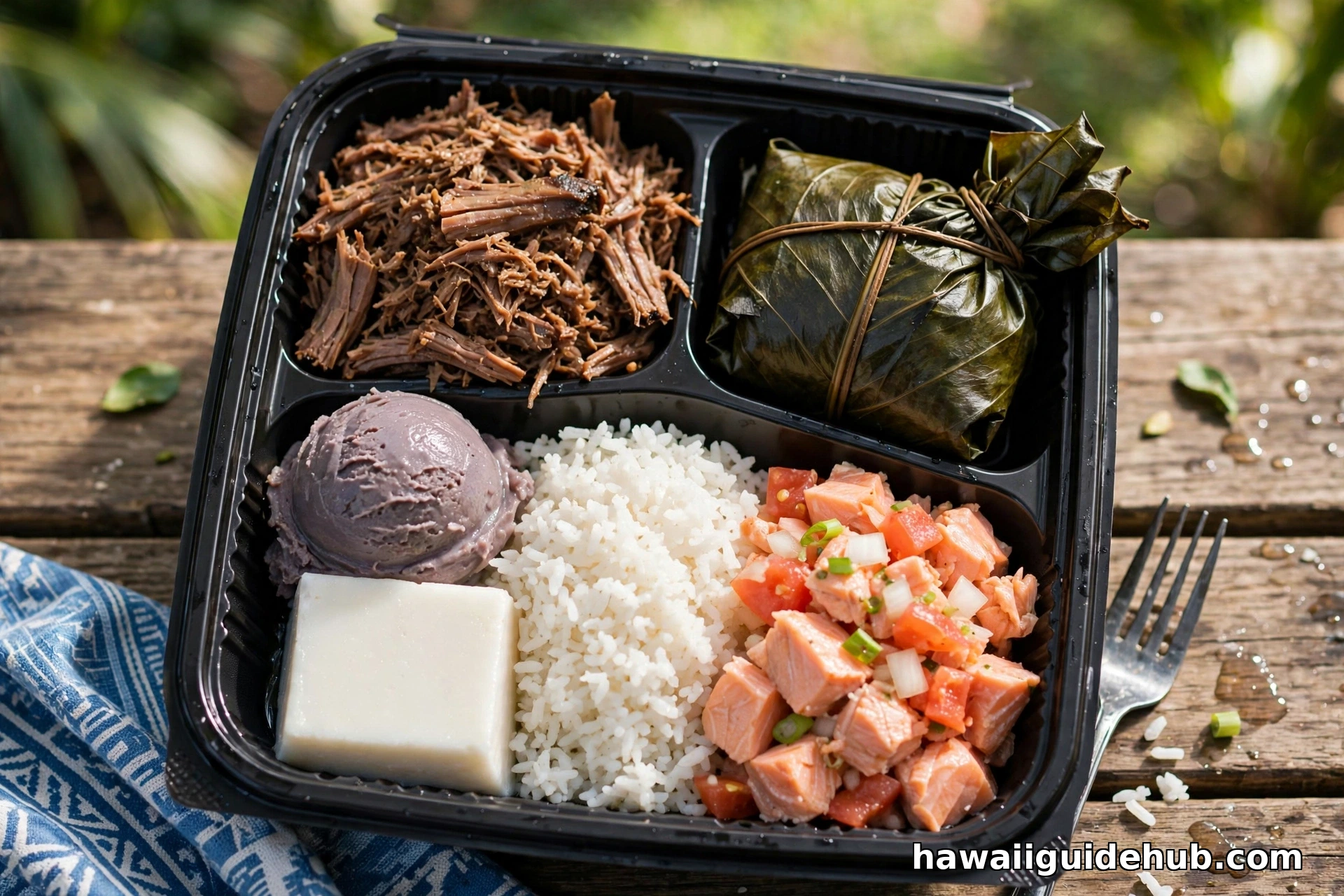
The Kanaka Nui, priced at $29.95, is the full spread and the move if you are hungry or sharing. It comes with laulau, kalua pig, and chicken long rice, plus your choice of beef luau or squid luau, your choice of rice or poi, and lomi salmon and haupia on the side. The name translates roughly to “the big Hawaiian,” and it earns it.
The Combo Plate ($20.30) lets you pick any two entrees from beef luau, chicken long rice, kalua pig, laulau, or squid luau, and it also comes with your choice of rice or poi plus lomi salmon and haupia. The Single Plate ($16.80) is the same idea with one entree. The Bowl ($11.90) is one entree served with rice only, which makes it the budget pick.
If you are new to Hawaiian food, here is a quick decoder for the entrees. Laulau is pork and a touch of butterfish wrapped and steamed in taro leaves. Kalua pig is pork butt slow cooked and smoked for twelve hours until it shreds, seasoned with Hawaiian sea salt. Beef luau is a savory stew of braised beef chuck with onions, ginger, and slow cooked taro leaves. Squid luau (actually made with thinly sliced octopus) simmers the seafood in rich coconut milk with taro leaves. Chicken long rice is chicken and rice noodles in a ginger broth, a lighter counterpoint to the heavier plates.
Sides Worth Knowing
The sides menu reads like a greatest hits of the Hawaiian table. Hoio salad ($6.10) is a refreshing fern salad with julienned onions, diced tomatoes, and dried shrimp in a sweet soy and ginger dressing. It is also the vegan option if you ask them to hold the shrimp. Lomi salmon ($6.10), haupia ($4.50), poi ($3.50), and rice ($3.20) round out the classics.
Drinks at the original location include house made limeaide ($4.20), mamaki tea brewed fresh with mamaki leaves and lemongrass ($4.20), and awa ($4.20), the traditional ceremonial drink. Sodas and water run $2.10.
The Sweet Lady of Waiahole
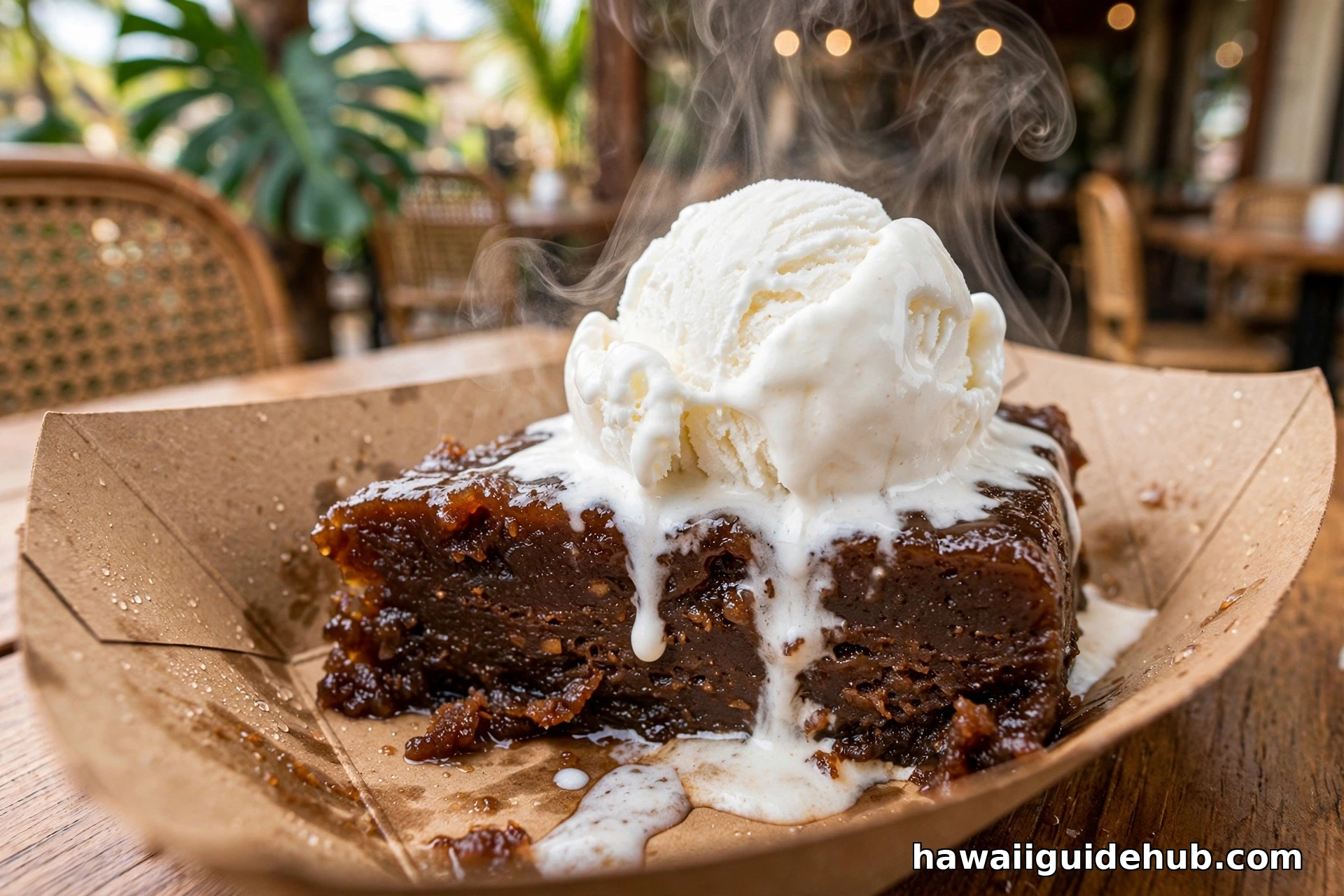
Save room. The signature dessert here is the Sweet Lady of Waiahole: warm, house made kulolo topped with a scoop of haupia flavored ice cream. A single scoop runs $8.40, a double $10.50.
Kulolo is one of Hawaii’s most beloved traditional desserts, made from taro root, coconut milk, and sugar, steamed for twenty four hours until it becomes a dense, gooey, caramelized block with the chew of thick mochi. Served warm under cold coconut ice cream, the temperature contrast is the whole point. The warm kulolo softens the ice cream at the contact point, and each bite lands somewhere between pudding and candy.
If kulolo is not your thing, the Tahitian Sweet Lady swaps in warm banana poe, another steamed pudding, under the same haupia ice cream, at the same price. You can also buy kulolo by the scoop ($4.80 for three ounces) or by the pound ($17.10, when available) to take home.
The dessert is famous enough to have its own song. “Sweet Lady of Waiahole,” made famous by Bruddah Waltah, is a local music staple, and there is even a KITV news segment about the real Sweet Lady who inspired it. When a dessert gets a ballad, you order the dessert.
The Poi Tradition: Hand Pounded the Old Way
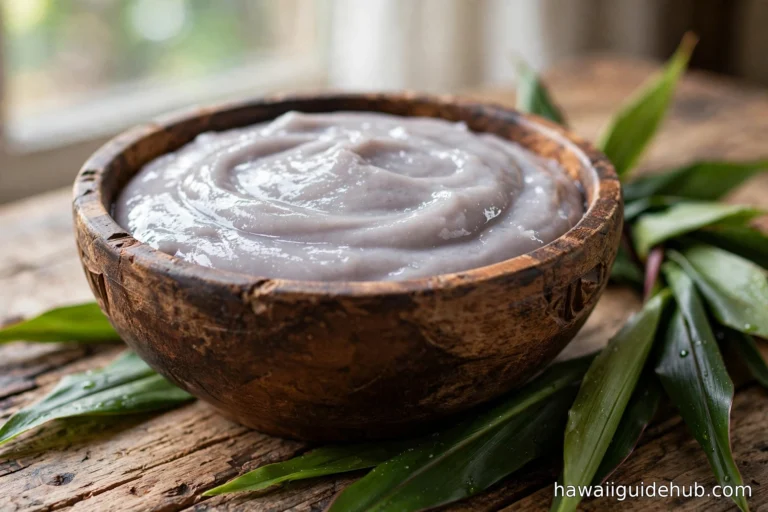
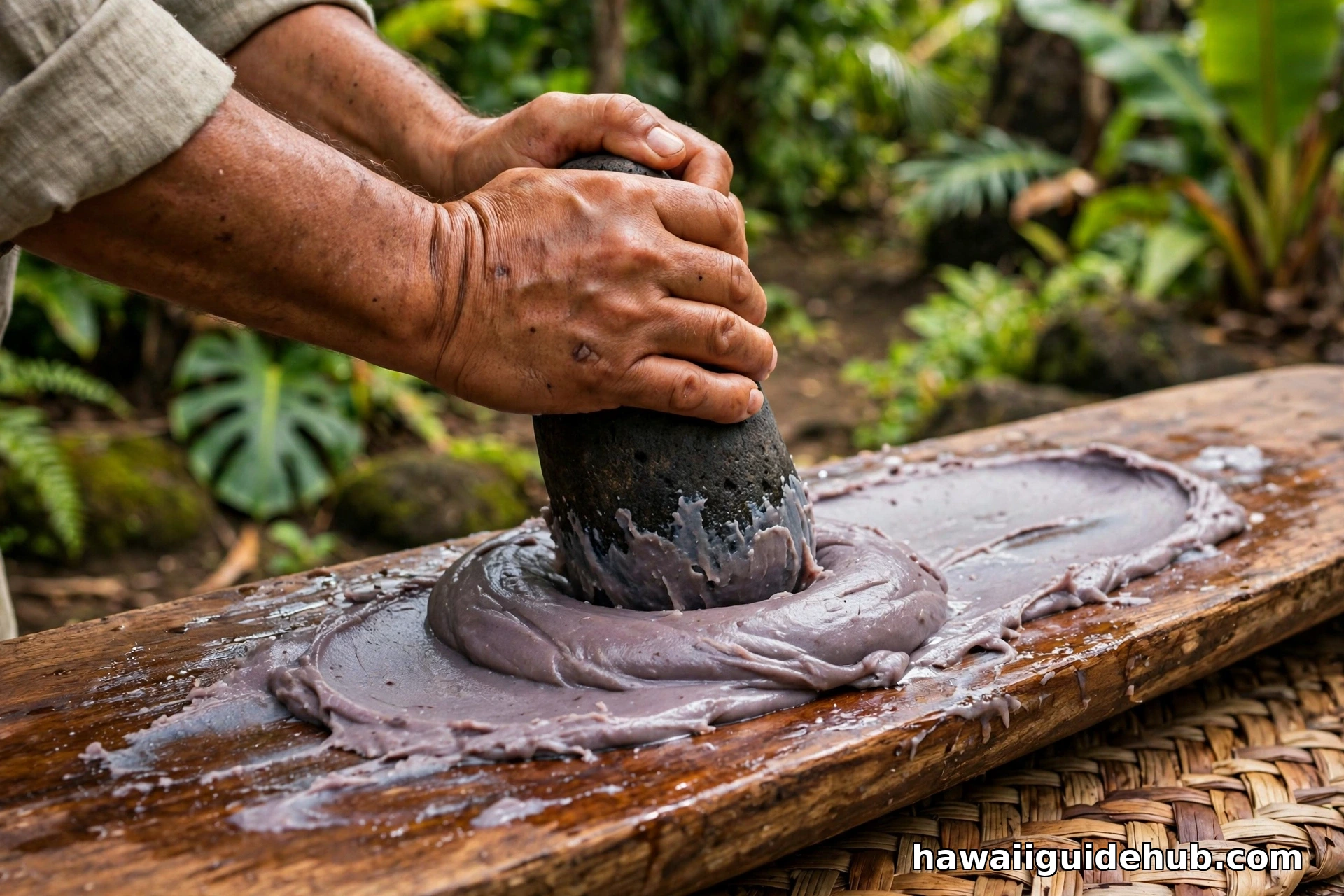
What truly sets the Waiahole Poi Factory apart is the poi itself. Most poi sold in Hawaii today is milled by machine. Here, it is still pounded by hand with a stone pestle on a wooden board, the way Hawaiians have made it for generations. The result is paiai, cooked taro pounded to a dense, mochi like consistency before water is worked in to reach the final texture.
The factory is one of the only places on Oahu where you can still get fresh hand pounded poi, and if your timing is right you might catch Liko Hoe, the third generation of the family running the place, pounding poi near the outdoor tables. Visitors describe watching him work with his son, the same motion Hawaiians have used for centuries, as one of those travel moments that sticks with you.
A note for first timers: fresh poi tastes different from what you might expect. It is mildly tangy, earthy, and starchy, and it is meant to be eaten alongside salty, rich foods like kalua pig and laulau, which is exactly how the plates are built. If you are unsure, ask for a small taste before committing to a full side. Bulk poi can be ordered, but it needs to be arranged at least a week in advance, which tells you how seriously they take the made fresh part.
See the Factory in Action
Planning Your Visit
The original location sits at 48-140 Kamehameha Highway in Kaneohe, right at the mouth of Waiahole Valley, about a 30 to 40 minute drive from Waikiki depending on traffic. The phone number is (808) 239-2222.
Hours at the historic valley location are Wednesday through Monday, 10:00 AM to 6:00 PM. Tuesdays the original location is closed. This is the single most important planning detail, because more than one visitor has made the scenic drive on a Tuesday and found the shutters down.
If Tuesday is your only free day, there is a second option. The family opened a Waiahole Poi Factory location in the Windward Mall food court in Kaneohe, which is open daily: Monday through Thursday 10 AM to 8 PM, Friday and Saturday 10 AM to 9 PM, and Sunday 10 AM to 6 PM. The mall spot serves the same core menu of bowls, plates, and combos, including the Sweet Lady, though the hand pounded poi and a few extras stay exclusive to the original valley location. Its phone number is (808) 235-7685.
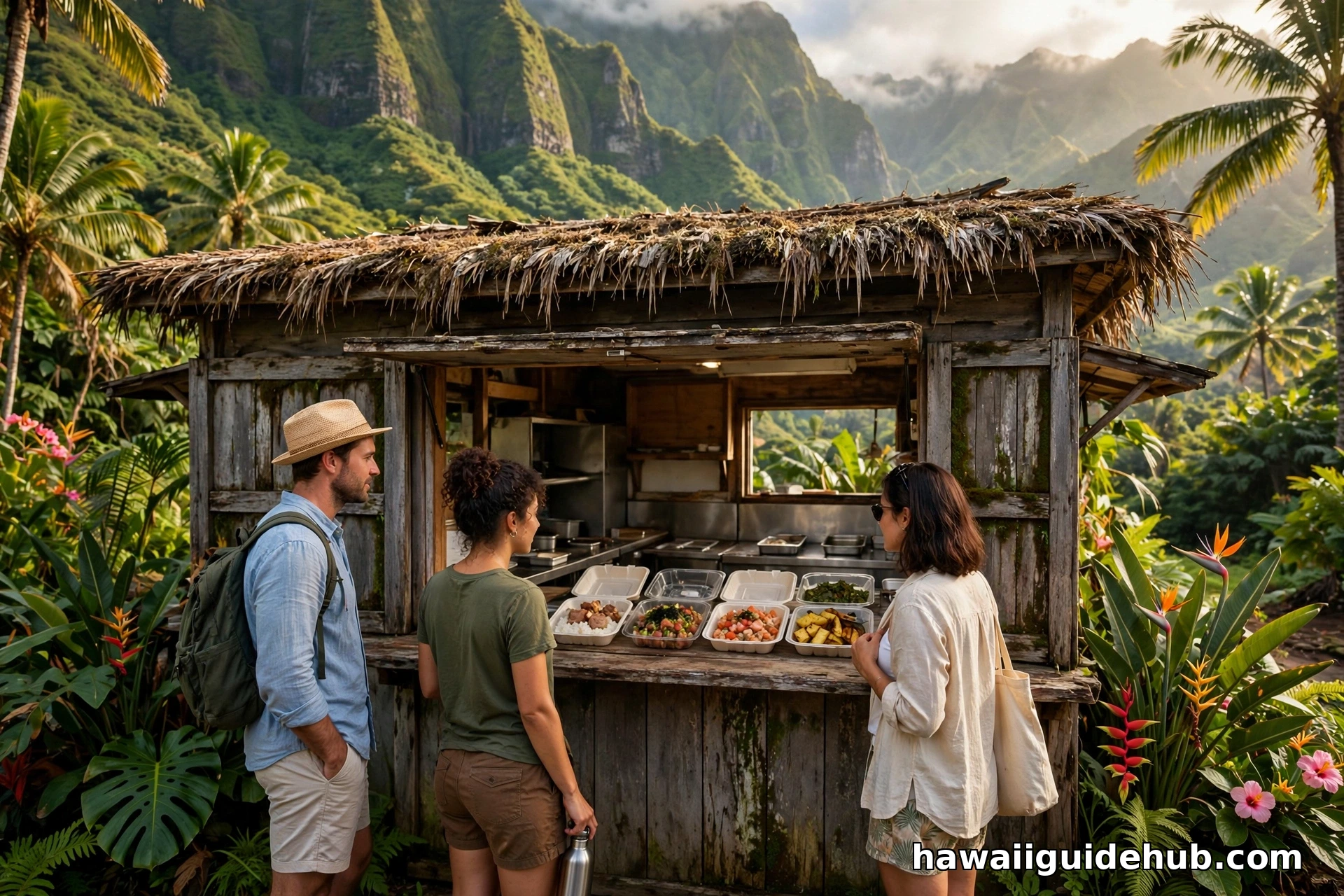
Set your expectations for the format. The original factory is a takeout window operation with very limited seating. The standard local move is to order at the window, then take your food to a nearby beach or scenic pullout. Kualoa Regional Park is a short drive away and makes a fine picnic spot. Lines can form at lunch, especially on weekends, but the food comes out quickly once you order, and a line of locals is the best review a Hawaiian restaurant can get.
The drive itself is part of the experience. The factory sits on one of the most beautiful stretches of road on Oahu, and it pairs naturally with a Kualoa Ranch visit, a stop at Kaneohe Bay, or a full windward coast and North Shore loop. If you are building a broader Oahu itinerary, slot the factory in as your lunch stop on a windward day.
The Country Store and Cultural Workshops
Next to the food operation, the family runs the WPF Country Store, which continues the building’s gallery era tradition of supporting Native Hawaiian artisans. The shop carries work from local artists and makers, so it doubles as a place to pick up genuinely local gifts rather than the imported souvenirs you find in Waikiki.
The factory also keeps its cultural education role alive through workshops in traditional Hawaiian arts and musical instruments, including ohe hano ihu, the bamboo nose flute, and ipu, the gourd instruments used in hula. If you are interested, call (808) 239-2222 ahead of your visit to ask what is scheduled. For groups and events, the family also offers catering, which is worth knowing if you are planning a gathering on the windward side and want the food to be the real thing.
Why It Matters Beyond the Food
In 2022, the Waiahole Poi Factory won Kamehameha Schools’ Mahi’ai Match-Up, an agricultural business plan contest, which says something about how the family is viewed: not just as a restaurant, but as a steward of Hawaiian food traditions and local farming. The ingredients come from Waiahole Valley farmlands, the poi is pounded by hand, and the building itself is a piece of living history that has served its community as a factory, a gallery, an incubator, and now a kitchen.
For visitors exploring must-try Hawaiian dishes, the factory offers something no resort luau can: food made by the descendants of the people who built the place, in the same building where taro has been processed for over a century. That continuity is rare, and it is worth the drive. The experience connects directly to the deeper story of Hawaiian culture and traditions that make the islands more than a beach destination.
Order the Kanaka Nui if you are hungry, get the Sweet Lady no matter what, and if you see poi being pounded, stop and watch for a minute. You are looking at a tradition that predates the building, the highway, and just about everything else around it. Few roadside stops anywhere in Hawaii carry this much history in such an unassuming package.