
Hawaiʻi Towns
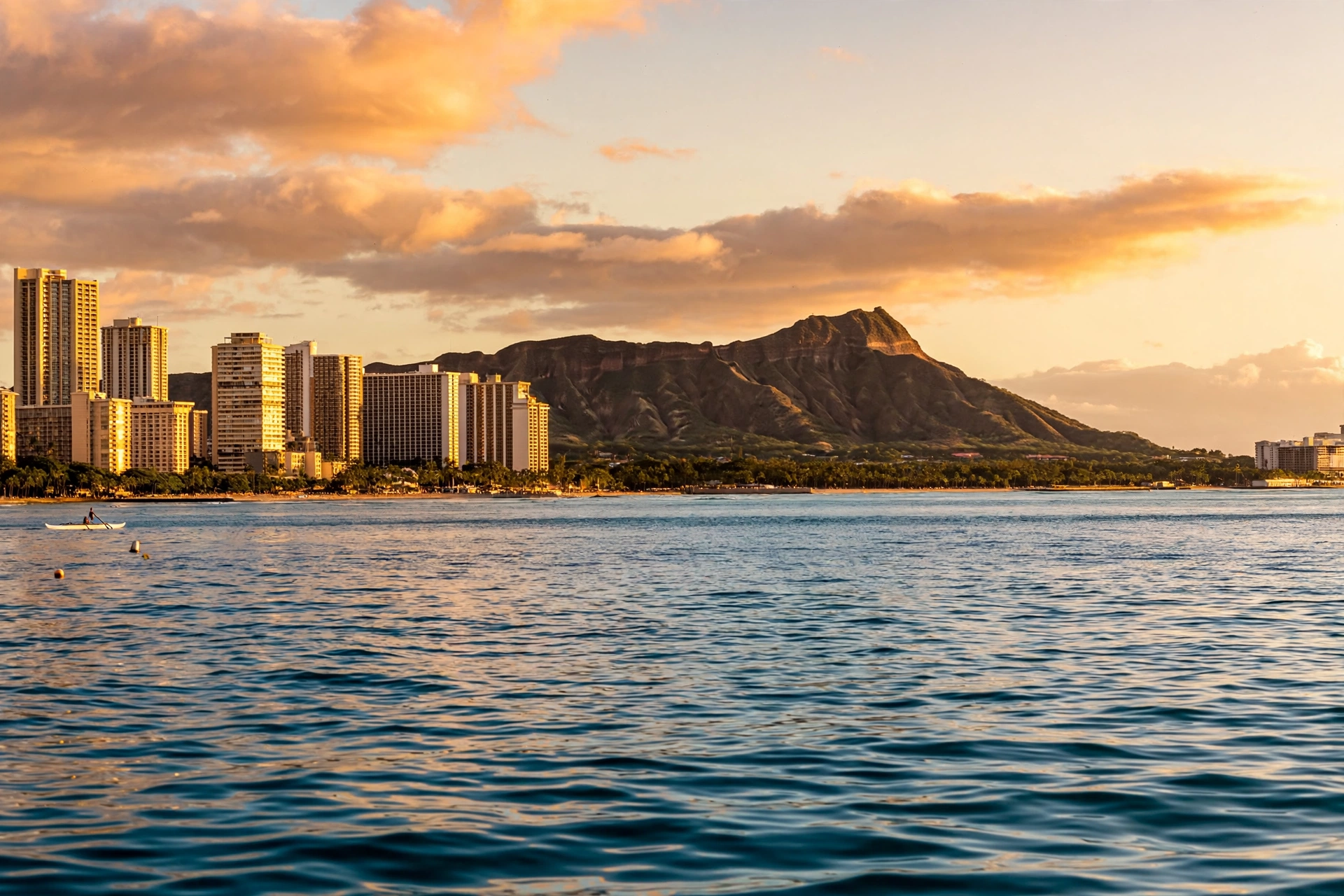
Hawaiʻi’s towns are where the islands’ history becomes visible. The plantation-era storefronts of Pāʻia and Makawao, the kingdom-era streets of Honolulu and Lahaina, the ranching heritage of Waimea and Kōloa, the quiet company village of Lānaʻi City: each community tells part of the story of how these islands became what they are. Visitors who only move between beach and resort miss a large part of what makes Hawaiʻi distinctive. The towns are where you eat with residents, browse local shops, attend farmers markets, and see the daily life that continues long after the sun sets on the sand.
This guide covers the notable towns across all six major islands, from the urban neighborhoods of Honolulu to the one-stoplight communities of Molokaʻi and Lānaʻi. You will find practical orientation for each area, what each town is known for, and guidance on choosing a base for your trip. For deeper coverage of any single island’s communities, each section links to the dedicated towns guide for that island.
On This Page
Hawaiʻi Towns at a Glance
Unlike the mainland United States, Hawaiʻi has no sprawling metropolitan areas beyond greater Honolulu. Most island towns are small, many with just a few thousand residents, and they tend to be tightly connected to the landscape around them: fishing villages on the coasts, plantation towns in the cane fields, ranching towns in the uplands, harbor towns where the ships came in. Because the islands developed in relative isolation, each town kept a distinct character that larger cities tend to lose.
Honolulu is the exception and the center of gravity. As the state capital and by far the largest city, it holds roughly a third of the state’s population in its urban core and close to a million people across the City and County of Honolulu, which covers all of Oʻahu. Every other island town is small by comparison. Hilo, the largest town on the Big Island, has around 44,000 residents. Kahului, Maui’s largest town, has about 28,000. Līhuʻe, Kauaʻi’s county seat, has roughly 6,500. Kaunakakai on Molokaʻi has about 3,500, and Lānaʻi City has around 3,000. Understanding this scale helps set expectations: outside Honolulu, “town” in Hawaiʻi usually means a walkable main street, not a downtown skyline.
The towns also reflect the islands’ layered history. Many began as Native Hawaiian settlements, grew during the whaling and sugar plantation eras of the 1800s, and then reinvented themselves again as tourism reshaped the economy in the late 1900s. You can read that history in the architecture: false-front wooden storefronts from the plantation days, stone churches from the missionary era, art deco theaters from the 1930s, and mid-century buildings from the statehood boom of 1959. A town like Hilo or Wailuku rewards a slow walk precisely because the buildings themselves are the exhibit.
Finally, where you base yourself shapes your trip more in Hawaiʻi than in most destinations. Traffic on Oʻahu can be heavy, and driving times on the neighbor islands are longer than distances suggest because of winding two-lane roads. Choosing a town that matches your plans, whether that means nightlife, quiet beaches, hiking access, or cultural sites, is one of the most consequential decisions of trip planning. The sections below describe the main towns island by island so you can compare them directly.
Oʻahu Towns
Oʻahu holds the state’s only true city and the widest range of urban experiences in the islands. But the island is far more than Honolulu. Its windward towns face the trade winds and the green Koʻolau mountains, its North Shore towns revolve around surf culture, and its central and leeward communities are where most residents actually live.
Honolulu
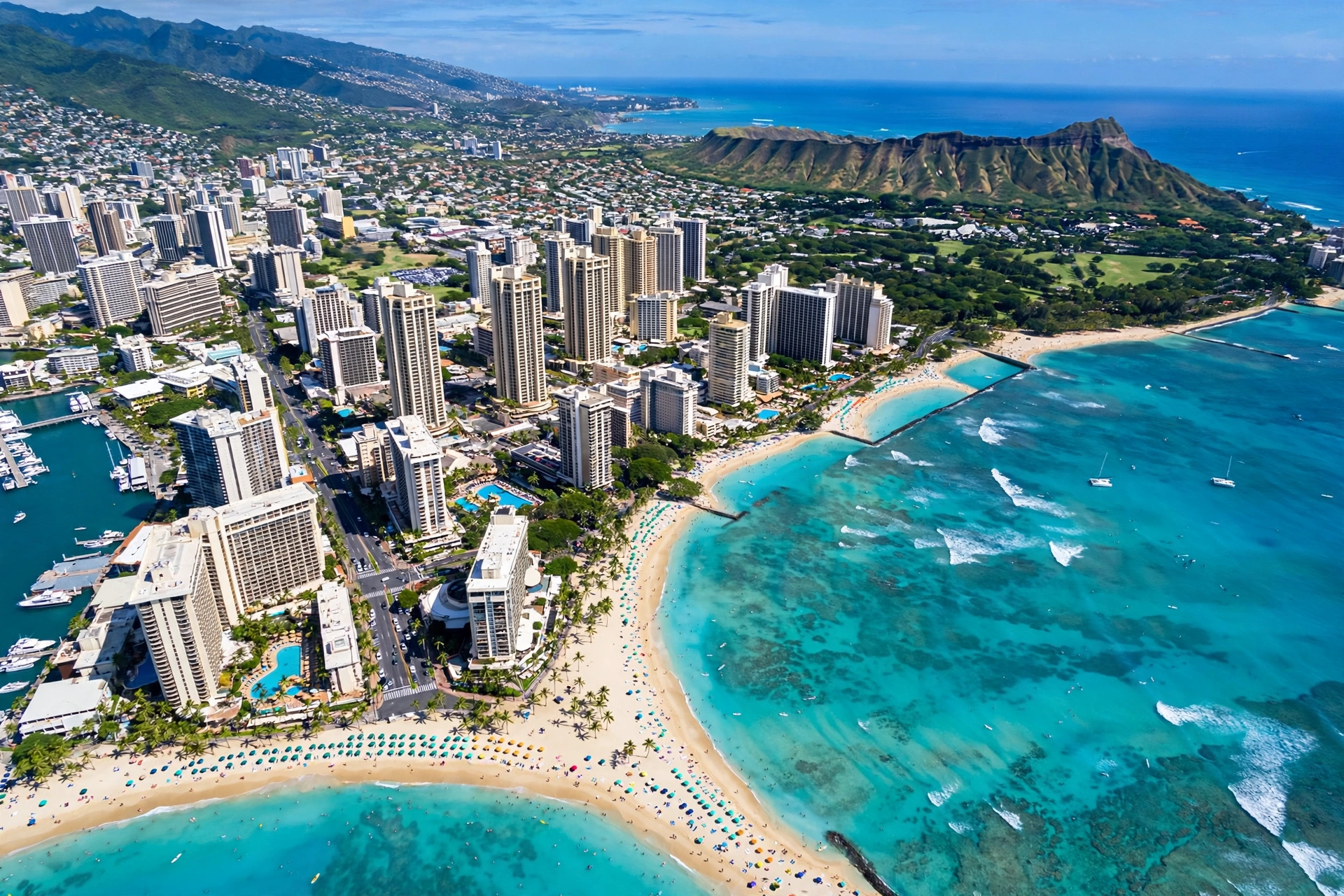
Honolulu is the capital of Hawaiʻi and the political, economic, and cultural center of the state. The urban core stretches from downtown Honolulu through the neighborhoods of Kakaʻako, Ala Moana, and Mōʻiliʻili to Waikīkī, and the greater metropolitan area holds most of Oʻahu’s roughly one million residents. Downtown Honolulu has the state’s government buildings, the historic ʻIolani Palace (the only royal palace in the United States), Chinatown’s markets and restaurants, and the harbor. It is a working city, not a resort, which is exactly what makes it interesting: this is where Hawaiʻi’s contemporary culture is made.
Waikīkī
Waikīkī is a neighborhood of Honolulu, not a separate town, but it functions as the state’s main visitor district and deserves its own mention. About two miles of beachfront here hold the densest concentration of hotels, restaurants, and shops in the islands. The beach itself is famous as the birthplace of modern surfing, where Duke Kahanamoku taught the sport to visitors a century ago. Waikīkī is the obvious base for first-time visitors who want walkable dining, nightlife, and easy access to tours, though it is also the busiest and most expensive part of the island.
Kailua
On the windward side, Kailua is Oʻahu’s most appealing beach town. Its roughly 40,000 residents enjoy two of the island’s best beaches, Kailua Beach and Lanikai Beach, with soft white sand and calm turquoise water sheltered by offshore islets. The town center has a pleasant mix of local shops, cafes, and restaurants, and the vibe is relaxed and residential rather than touristy. Kailua makes an excellent base for travelers who want beautiful beaches without the Waikīkī crowds, though prices reflect its popularity.
Kāneʻohe
Just north of Kailua, Kāneʻohe is a larger windward community of about 35,000 people, set against the dramatic cliffs of the Koʻolau range. It is more residential and less visitor-oriented than Kailua, but it holds attractions worth a stop: the ancient Heʻeia Fishpond, one of the best-preserved Native Hawaiian fishponds in the state, and the scenic drive around Kāneʻohe Bay with views of the iconic Chinaman’s Hat islet. The Hoʻomaluhia Botanical Garden in the valley above town is a peaceful free attraction.
Haleʻiwa
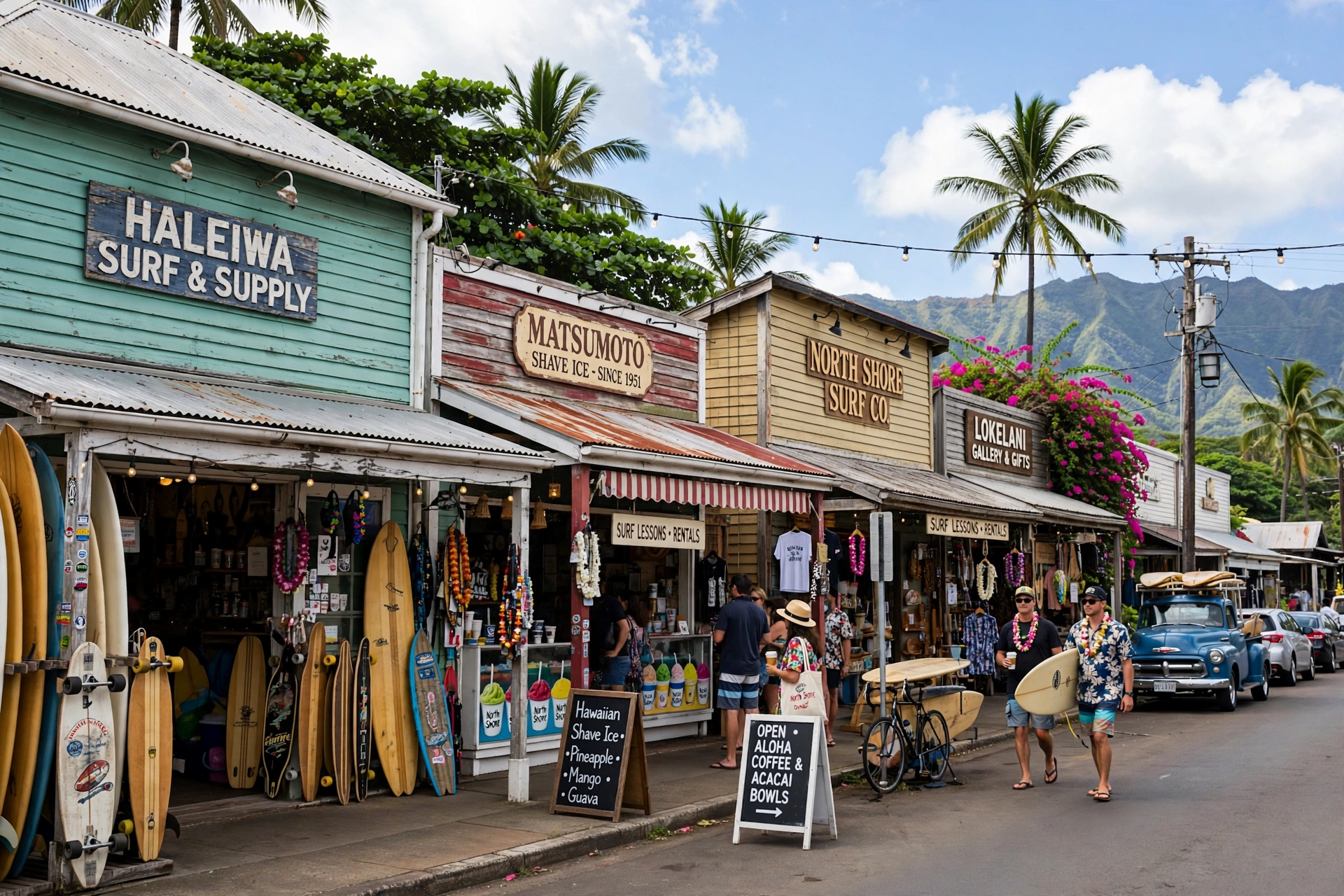
Haleʻiwa is the North Shore’s main town and the spiritual home of big-wave surfing culture. This small community of about 4,000 people has a laid-back, artsy main street lined with surf shops, shave ice stands, galleries, and historic plantation-era buildings. In winter, the town fills with surfers and spectators drawn by the massive swells at nearby Waimea Bay, Pipeline, and Sunset Beach. In summer, the same coastline turns calm and swimmable. Haleʻiwa is a great day trip from Honolulu and a fun overnight base for surf fans.
Other Oʻahu Communities
Central Oʻahu holds the residential towns of Mililani, Pearl City, and ʻAiea, where most of the island’s workforce lives; visitors pass through mainly en route to Pearl Harbor. Hawaiʻi Kai, in East Honolulu below the Koko Crater, is an upscale suburb near Hanauma Bay. On the leeward side, Kapolei has grown rapidly as Oʻahu’s “second city,” with shopping, resorts at Ko Olina, and family attractions. For full detail on every Oʻahu community, see our Oʻahu towns guide.
Maui Towns
Maui’s towns are scattered around the island’s two volcanic masses and fall into distinct clusters: the historic and resort towns of the west, the sunny communities of the south, the working towns of the central isthmus, the farm towns of Upcountry, and remote Hāna on the far east coast. Each cluster has a different climate, pace, and reason to visit.
Lāhainā
Lāhainā is one of the most historically significant towns in all of Hawaiʻi. It served as the capital of the Hawaiian Kingdom from 1820 to 1845, became a booming whaling port in the mid-1800s, and grew into a beloved visitor town known for its Front Street waterfront, art galleries, and the famous banyan tree planted in 1873 that shaded nearly a full city block. On August 8, 2023, a catastrophic wildfire swept through Lāhainā, destroying much of the historic town and taking more than 100 lives. It was one of the deadliest wildfires in modern American history, and the community’s recovery is still underway.
Visitors should approach Lāhainā with respect and awareness. Rebuilding is progressing, with residents and cultural leaders guiding the restoration of the town, but conditions and access change over time. Other parts of West Maui, including Kāʻanapali, Nāpili, and Kapalua, are fully open and welcoming. Before planning any visit to the Lāhainā area, check current conditions through official Maui County sources, and when you go, support local businesses and honor the community’s pace of recovery.
Pāʻia
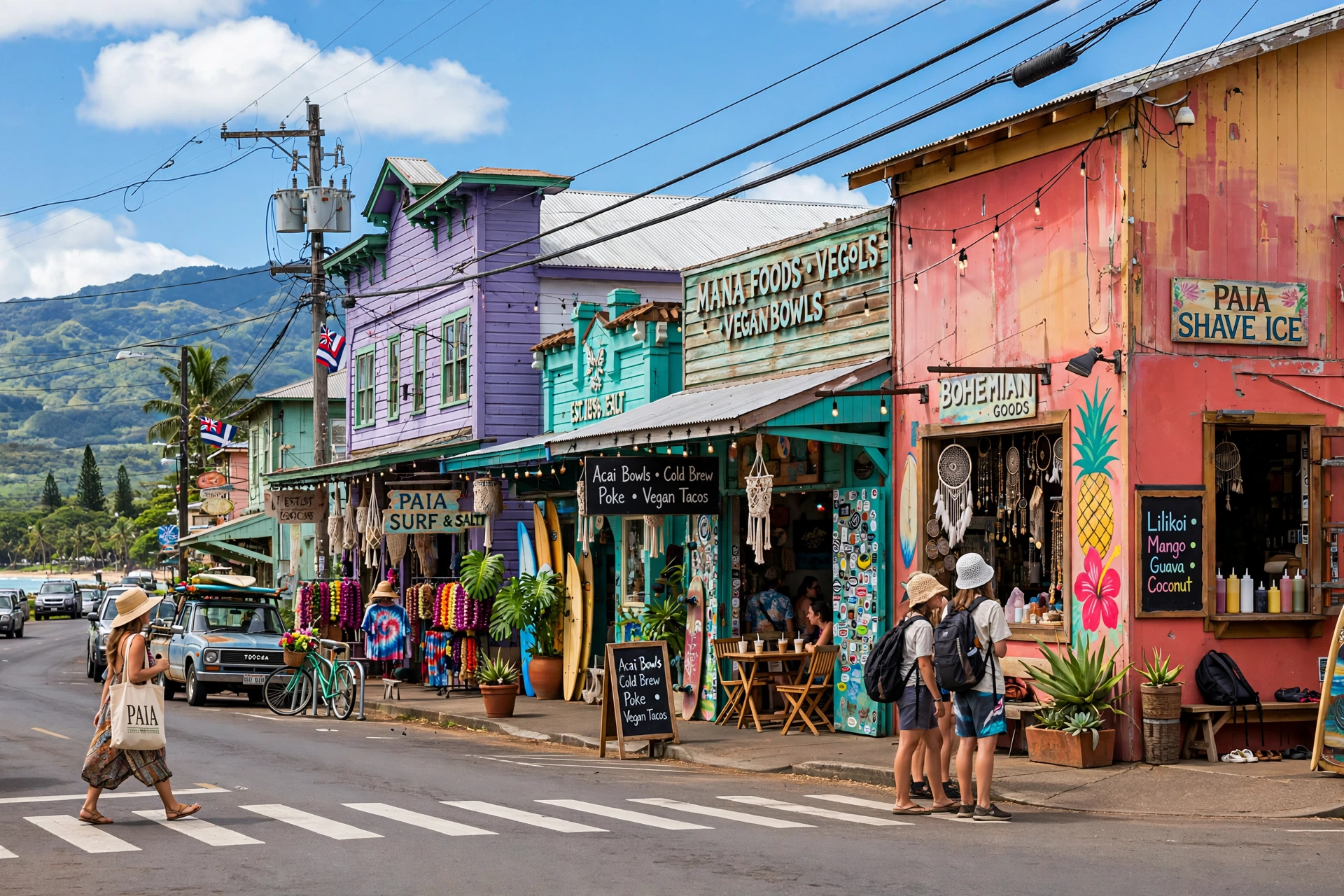
Pāʻia is Maui’s most colorful small town, a former sugar plantation community turned surf town on the North Shore. Its wooden false-front storefronts, painted in bright colors, now hold boutiques, galleries, and some of the island’s best casual restaurants. Just east of town, Hoʻokipa Beach Park is one of the world’s most famous windsurfing spots and a reliable place to see Hawaiian green sea turtles resting on the sand. Pāʻia is also the last real town before the Road to Hāna, making it the natural fueling and breakfast stop for that drive.
Makawao
Makawao sits in Upcountry Maui at about 1,600 feet elevation, where the air is cool and the landscape looks like ranch country. This is the heart of paniolo (Hawaiian cowboy) culture, and the town keeps its Old West character in its wooden boardwalks and storefronts. Today Makawao is equally known as an arts community, with galleries and studios along Baldwin Avenue, and its Fourth of July rodeo is one of the island’s biggest local events. It is a pleasant stop for lunch and browsing on the way up or down Haleakalā.
Hāna
Hāna anchors the remote east end of Maui, reached by the famously winding Hāna Highway. With about 1,200 residents, it is one of the most isolated communities in the state, and its lush, rainy setting feels like a different island from sunny West Maui. Hāna has a deep Native Hawaiian heritage, beautiful black-sand beaches at Waiʻānapanapa State Park, and the serene pools and waterfalls of the Kīpahulu district of Haleakalā National Park. Visitors should treat Hāna as an overnight destination rather than a rushed day trip, and respect that this is a small residential community, not a theme park.
Kahului, Wailuku, and Kīhei
Kahului is Maui’s largest town and its commercial hub, home to the main airport (OGG), the deep-draft harbor, and the island’s biggest shopping centers. Neighboring Wailuku is the county seat, with a characterful historic Market Street district and the gateway to sacred ʻĪao Valley. Kīhei stretches six miles along the sunny south coast and is the island’s most practical visitor base, with family beaches, casual dining, and central access to both the Wailea resort area and Haleakalā. For the complete picture, see our Maui towns guide.
Big Island Towns
The Island of Hawaiʻi is larger than all the other islands combined, and its towns are correspondingly spread out. The island divides roughly into two halves for visitors: the lush, rainy east side anchored by Hilo, and the sunny, dry west side anchored by Kailua-Kona. The upland ranch country of Waimea and the historic villages of the north and south add further variety.
Hilo
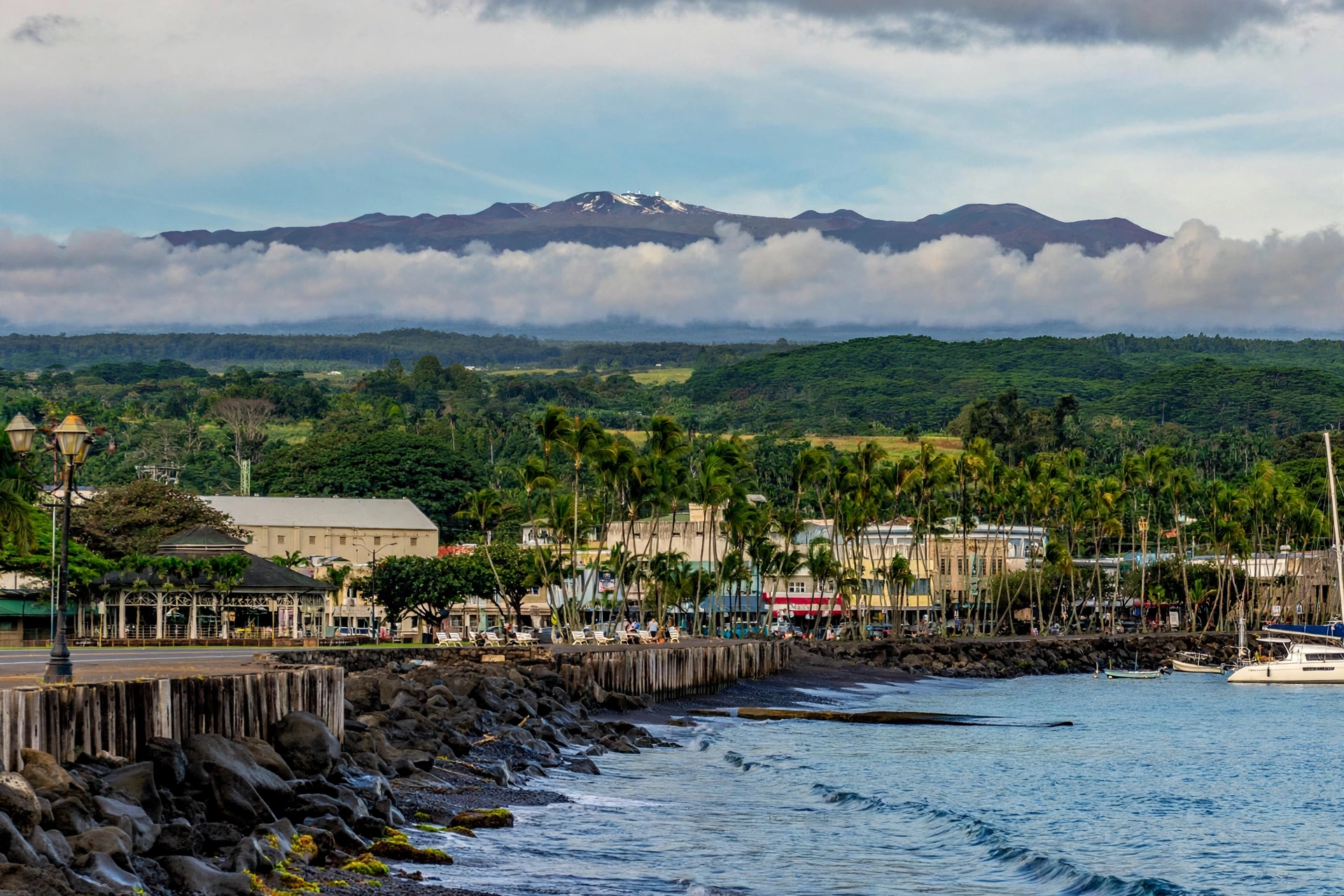
Hilo is the largest town on the Big Island, with about 44,000 residents, and the seat of Hawaiʻi County government. Set on a crescent bay on the rainy windward side, Hilo is famously wet, which is exactly why it is also famously green, with orchids, banyan trees, and lush gardens everywhere. The downtown has a charming historic waterfront with museums, the Hilo Farmers Market, and views across the bay to Mauna Kea. Hilo is the best base for Hawaiʻi Volcanoes National Park, ʻAkaka Falls, and the Hāmākua Coast, and it has the island’s most authentically local feel. The annual Merrie Monarch Festival, the world’s premier hula competition, makes Hilo the center of Hawaiian culture each spring.
Kailua-Kona
Kailua-Kona, usually just called Kona, is the west side’s main town and the island’s visitor hub. With about 12,000 residents, it sits on the sunny leeward coast where the weather is reliably warm and dry. Aliʻi Drive, the waterfront street, is lined with shops, restaurants, and historic sites including Huliheʻe Palace, the former vacation home of Hawaiian royalty. Kona is the base for the island’s famous coffee farm tours, manta ray night snorkeling, and deep-sea fishing. It is livelier and more tourist-oriented than Hilo, with most of the island’s beach resorts strung along the Kohala Coast to the north.
Waimea
Waimea, also known by its post office name Kamuela, sits at about 2,700 feet elevation in the island’s paniolo heartland. This is ranching country, home to Parker Ranch, one of the largest cattle ranches in the United States, and the town has an authentic cowboy heritage that shows in its steakhouses, rodeos, and western-wear shops. The cool, misty climate supports farm stands, farmers markets, and a respected food scene that punches above the town’s size. Waimea makes a good central base, roughly equidistant from the Kohala Coast resorts, Hilo, and the summit of Mauna Kea.
Volcano Village
Volcano is a small village of about 2,500 people at the entrance to Hawaiʻi Volcanoes National Park, and it exists largely to serve park visitors. Set in a cool rainforest at nearly 4,000 feet, it has a misty, almost Pacific Northwest atmosphere that surprises first-time visitors. The village has lodges, bed-and-breakfasts, cafes, and art galleries, plus the fascinating Volcano Art Center. Staying here puts you minutes from the park’s main sights and lets you visit the caldera overlooks after dark, when any volcanic glow is most visible.
Hawi, Honokaʻa, and the Kohala Coast
Hawi, at the northern tip of the island, is a charming small town known for the original King Kamehameha statue and a row of colorful historic storefronts. Nearby Honokaʻa, on the Hāmākua Coast, is a former sugar town with a classic main street and access to the stunning Waipiʻo Valley lookout. The Kohala Coast to the west holds the island’s major beach resorts at Waikoloa and Mauna Kea, which function as resort districts rather than towns. For the full rundown, see our Big Island towns guide.
Kauaʻi Towns
Kauaʻi’s towns ring the island along the main coastal highway, each serving its stretch of coastline. The island has no city in the conventional sense: Līhuʻe, the county seat, has only about 6,500 residents. What Kauaʻi’s towns lack in size they make up for in scenery, with every community set against a backdrop of green mountains or ocean cliffs.
Līhuʻe
Līhuʻe is Kauaʻi’s county seat and the island’s main transportation hub, home to Līhuʻe Airport and the Nawiliwili Harbor where cruise ships dock. It is a working town rather than a resort, with government offices, the island’s main shopping centers, and museums including the Kauaʻi Museum, which is the best single introduction to the island’s history. Most visitors pass through Līhuʻe without staying, but it is worth a stop for supplies, and its central location makes it a practical base for exploring the whole island.
Kapaʻa
Kapaʻa, on the east side, is Kauaʻi’s largest town with about 11,000 residents. It stretches along Kūhiō Highway in a long strip of shops, restaurants, and condo resorts, with a lively main street that has reinvented itself in recent years. The coastal bike path that runs from Kapaʻa to Keālia Beach is one of the island’s best easy outings. Kapaʻa is centrally located for day trips to both the North Shore and the South Shore, and its dining scene is one of the best on the island.
Hanalei
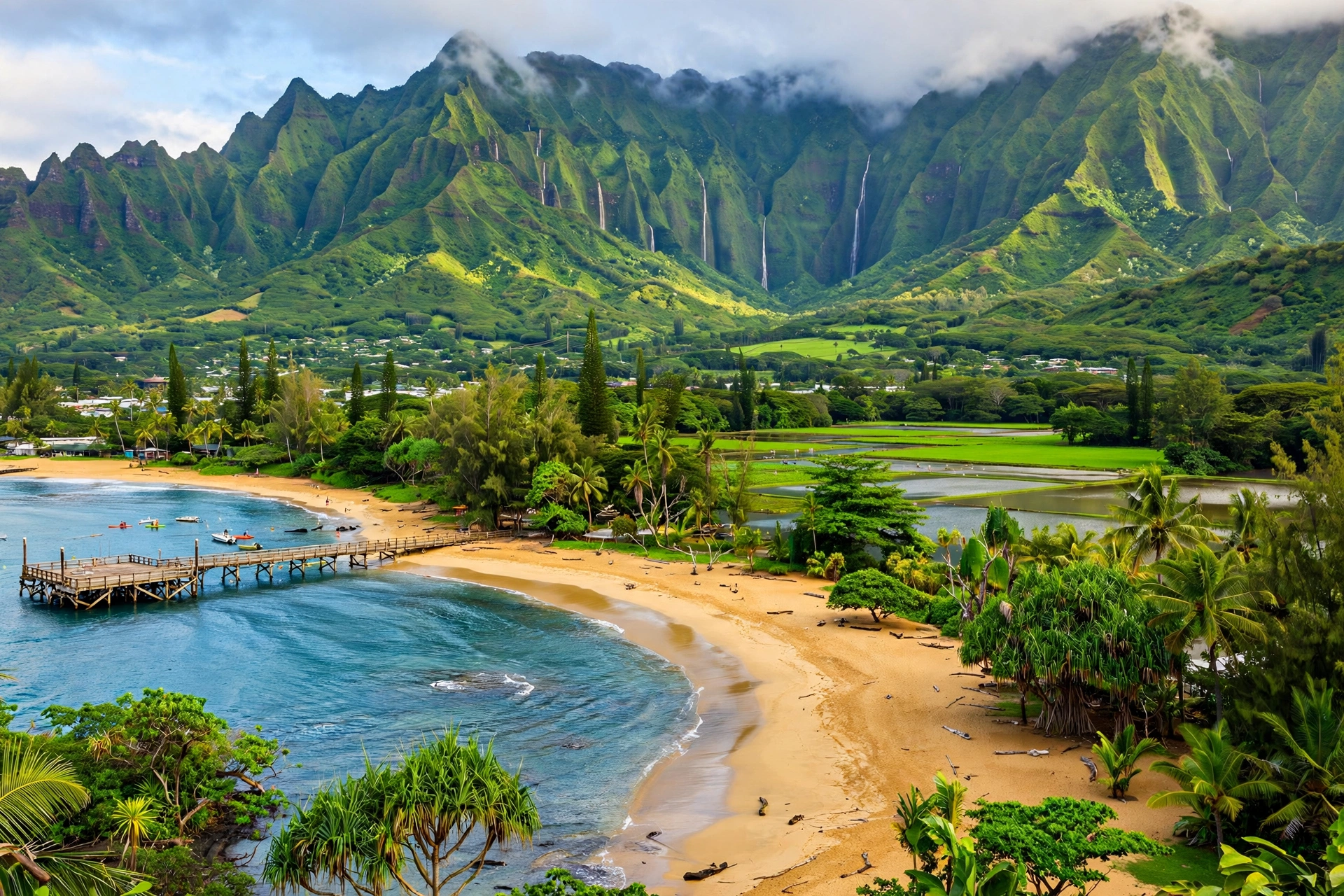
Hanalei, on the North Shore, is arguably the prettiest town setting in all of Hawaiʻi: a small community of a few hundred people wrapped around a crescent bay, with the emerald cliffs of the Nā Pali Coast rising behind it. The town itself is tiny, just a few blocks of shops and restaurants, but Hanalei Bay is one of the island’s most beautiful beaches, and the surrounding taro fields and one-lane bridges give the whole area a timeless feel. It is expensive and often rainy in winter, but for scenery per dollar, few places in Hawaiʻi compete.
Kōloa, Poʻipū, and Waimea
Kōloa, on the sunny south shore, is a historic sugar town where Hawaiʻi’s first commercial sugar plantation began operating in 1835. Its Old Kōloa Town district has plantation-era buildings now housing shops and restaurants. Nearby Poʻipū is the south shore’s resort district rather than a true town, with the island’s most reliable sunshine and family beaches. On the west side, Waimea (population about 2,000) is where Captain Cook first landed in Hawaiʻi in 1778; today it is the gateway to Waimea Canyon, the “Grand Canyon of the Pacific.” Hanapepe, nearby, calls itself “Kauaʻi’s biggest little town” and is known for its swinging bridge and Friday art night. For more, see our Kauaʻi towns guide.
Molokaʻi and Lānaʻi Towns
Molokaʻi and Lānaʻi have the smallest and quietest towns in the islands, which is precisely their appeal. Neither island has anything resembling a city. What they offer instead is a look at everyday island life largely untouched by mass tourism.
Kaunakakai
Kaunakakai is the largest town on Molokaʻi, with about 3,500 residents, and it is the island’s commercial and social center. The main street, Ala Malama Avenue, has a frontier-town feel with false-front stores, local eateries, and the friendly bustle of a community where everyone knows everyone. There are no traffic lights on Molokaʻi, and Kaunakakai has none either. The town hosts the island’s harbor, grocery stores, and the Saturday market. It is the natural base for exploring the island, and its unhurried pace sets the tone for a Molokaʻi visit. Smaller communities include Maunaloa on the west end and Kualapuʻu in the central uplands. See our Molokaʻi towns guide for the full picture.
Lānaʻi City
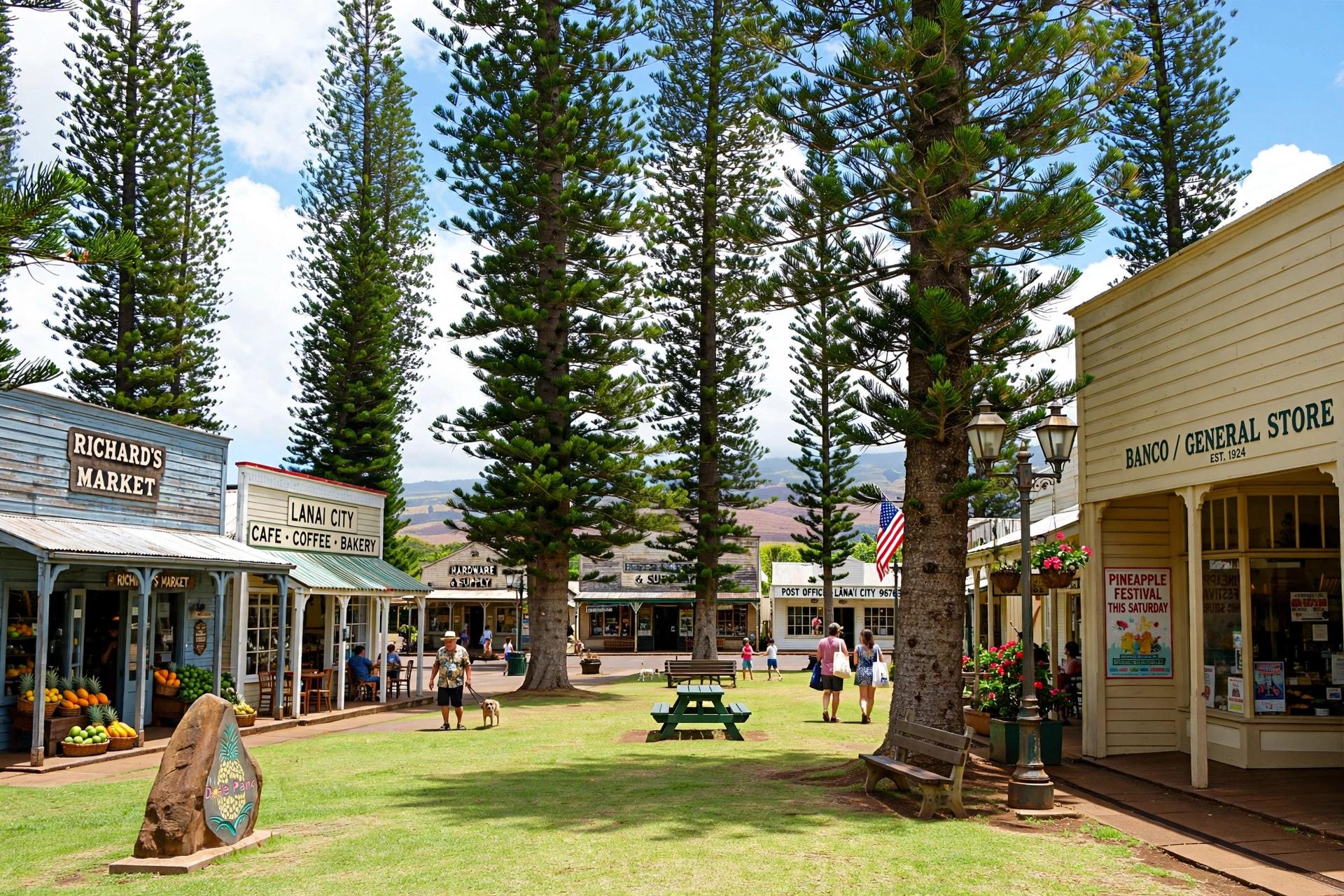
Lānaʻi City is effectively the only town on Lānaʻi, and it is one of the most distinctive communities in Hawaiʻi. Built by the Dole company in the 1920s as a plantation town for pineapple workers, it centers on Dole Park, a shady town square ringed by Cook pines and plantation-era storefronts. With about 3,000 residents, it has a timeless, almost mid-century feel. The town sits at about 1,600 feet elevation, so it is noticeably cooler than the coast, and morning mist in the pines is common. Lānaʻi City has the island’s grocery store, restaurants, shops, and the Lānaʻi Culture and Heritage Center. Mānele, on the south coast, is the island’s harbor and resort area rather than a town. Our Lānaʻi towns guide covers both in detail.
Choosing a Base
The right base depends on what you want from your trip, and the honest answer is that most visitors split their stay or accept tradeoffs. Here is how the main options compare.
First-time visitors who want it all: Waikīkī is the default for a reason. It has the widest range of hotels, restaurants, and activities within walking distance, plus easy access to the rest of Oʻahu. The tradeoff is crowds and prices. Kailua is the quieter Oʻahu alternative, with better beaches and a residential feel.
Beach-focused travelers: On Maui, Kīhei offers the best value with good beaches and central access, while Kāʻanapali and Wailea offer polished resort experiences at higher prices. On the Big Island, the Kohala Coast resorts have the island’s best weather and beaches, while Kailua-Kona offers a livelier town scene. On Kauaʻi, Poʻipū has the most reliable sunshine and calm family beaches, while Hanalei has the most spectacular setting.
Culture and history lovers: Honolulu rewards several days on its own, with ʻIolani Palace, Bishop Museum, and Chinatown. Hilo is the Big Island’s cultural heart and the best base for volcano and waterfall country. Wailuku and the Upcountry towns show a different, more local side of Maui.
Budget travelers: Kīhei on Maui, Hilo on the Big Island, Kapaʻa and Līhuʻe on Kauaʻi, and Honolulu’s neighborhoods outside Waikīkī all offer better value than the resort districts. Vacation rentals and smaller hotels in working towns cost significantly less than beachfront resorts, and you will eat where residents eat.
Quiet and off the beaten path: Kaunakakai and Lānaʻi City are the smallest bases in the islands, suited to travelers who want to slow down. Hāna and Volcano Village are small, atmospheric bases for specific adventures. Hawi and Honokaʻa suit road-trippers exploring the Big Island’s north.
One practical note: driving between towns on different islands always means flying. There are no inter-island ferries for rental cars, and the only passenger ferry in the state runs between Maui and Lānaʻi. Plan at least half a day for any inter-island move, and consider the “open jaw” approach of flying into one island and home from another to avoid backtracking.
Frequently Asked Questions
What is the biggest town in Hawaiʻi?
Honolulu, by an enormous margin. The urban Honolulu area has about 350,000 residents, and the City and County of Honolulu, which covers all of Oʻahu, has close to one million. The next largest towns are Hilo on the Big Island (about 44,000) and Kailua on Oʻahu (about 40,000). Every other island town has fewer than 30,000 residents.
Is Lāhainā open to visitors?
Parts of West Maui, including Kāʻanapali, Nāpili, and Kapalua, are fully open and welcoming visitors. Lāhainā town itself was devastated by the August 2023 wildfire, and rebuilding is ongoing under the guidance of residents and cultural leaders. Access and conditions change over time, so check current information through official Maui County sources before planning a visit, and approach the town with respect for the community’s recovery.
What is the prettiest town in Hawaiʻi?
It depends on taste, but the most common answers are Hanalei on Kauaʻi, with its bay and mountain backdrop; Hāna on Maui, for remote lush beauty; Haleʻiwa on Oʻahu’s North Shore, for surf-town charm; and Pāʻia on Maui, for colorful plantation character. Honolulu’s historic districts and Hilo’s bayfront are the best urban contenders. Each town sits in a different landscape, so the prettiest one is usually the one that matches your idea of paradise.
What is the difference between Kailua and Kailua-Kona?
They are two different towns on two different islands, and confusing them is one of the most common Hawaiʻi mix-ups. Kailua is a windward beach town on Oʻahu, known for Kailua Beach and Lanikai Beach. Kailua-Kona, usually shortened to Kona, is a town on the leeward west coast of the Big Island, known for coffee, sunshine, and Aliʻi Drive. Always confirm which island you mean when booking.
Where should first-time visitors stay?
Waikīkī is the standard answer because it concentrates hotels, dining, and activities in one walkable area with easy access to the rest of Oʻahu. Travelers who prefer a quieter introduction might choose Kailua on Oʻahu, Kīhei on Maui, Kailua-Kona or the Kohala Coast on the Big Island, or Poʻipū on Kauaʻi. Each offers a different balance of convenience, scenery, and cost.
Are there towns on Molokaʻi and Lānaʻi worth visiting?
Yes, though they are small. Kaunakakai is Molokaʻi’s main town, with about 3,500 residents, local shops, and the island’s harbor. Lānaʻi City is the island’s only real town, a preserved 1920s plantation community centered on Dole Park. Neither has nightlife or extensive dining, but both offer an authentic look at island life that the larger islands have partly lost.
Which Hawaiian town is best for walking around?
Honolulu has the most walkable urban districts: Waikīkī, Chinatown, and the downtown arts district all reward exploring on foot. Among smaller towns, Hilo’s bayfront and downtown, Līhuʻe’s central streets, Haleʻiwa’s main street, Pāʻia’s colorful blocks, and Hawi’s historic storefronts are all pleasant walking towns. Most resort districts, like Wailea and the Kohala Coast, are designed around cars despite their beach paths.
How do I get between towns on different islands?
By air. Hawaiʻi has no bridges or tunnels between islands, and rental cars cannot travel between islands. Inter-island flights connect Honolulu with every other island’s airport, and there are direct flights between several neighbor-island pairs. The only scheduled passenger ferry runs between Maui (Māʻalaea) and Lānaʻi (Mānele). Allow at least half a day for any inter-island transfer once you count airport time.
Related Guides
- Maui Towns: Complete Guide
- Oʻahu Towns: Complete Guide
- Kauaʻi Towns: Complete Guide
- Big Island Towns: Complete Guide
- Molokaʻi Towns: Complete Guide
- Lānaʻi Towns: Complete Guide
- Hawaiʻi Map: Complete Guide
- Best Time to Visit Hawaiʻi: Complete Guide
Reading Hawaiʻi Through Its Towns
Hawaiʻi’s towns reward the traveler who slows down. The plantation storefronts of Pāʻia and Kōloa, the kingdom history of Honolulu and Lāhainā, the paniolo heritage of Waimea and Makawao, the quiet streets of Kaunakakai and Lānaʻi City: each community preserves a chapter of the islands’ story that no beach can tell. Plan your bases with care, leave time for wandering main streets and talking to shopkeepers, and let the towns add their depth to your understanding of the islands. The scenery may be what brings most visitors to Hawaiʻi, but the towns are what make it feel like a real place.