
Lānaʻi Towns
Lānaʻi has exactly one town. That is not an exaggeration for effect; it is a simple statement of fact. Lānaʻi City, population roughly 3,000, is the island’s only incorporated-style community and its entire commercial center. Beyond it there is a harbor village with a resort, a scattering of historic settlement sites reachable only by rough dirt road, and about 140 square miles of ranch land, pine forest, and coastline with nobody living on it at all. This guide covers Lānaʻi City in depth, explains what Mānele actually is, walks through the historic settlements that appear on old maps but not on modern ones, and helps you decide where to base yourself on an island where the answer is usually simpler than you expect.
On This Page
Lānaʻi’s Towns: An Overview
Most Hawaiian islands have a handful of towns that divide the island into regions, each with its own character. Lānaʻi does not work that way. The island is small enough, and its modern history unusual enough, that nearly all resident life concentrates in a single plantation town on the central plateau. Everything else is a place people go, not a place people live.
The reason is the pineapple. In the 1920s, the Dole company turned Lānaʻi into the largest pineapple plantation in the world, and the town that housed its workforce was built all at once, as a single planned community. When pineapple left the island in the early 1990s, the town stayed. Today Lānaʻi City holds the island’s grocery store, its schools, its clinic, its library, its post office, and nearly all of its restaurants and shops. If you need anything on Lānaʻi, you will get it here.
Mānele, on the south coast, is the island’s second named place, but calling it a town would mislead you. It is a small boat harbor, a resort, and a beach, clustered around one of the calmest bays in Hawaiʻi. Nobody would describe it as a community with its own civic life; it exists for the harbor and the visitors who arrive through it.
The remaining named places, Keōmuku, Kaunolū, and Maunalei, are history rather than geography in the practical sense. They were villages or work camps in earlier eras, and today they are archaeological sites, a standing church, and rough 4WD destinations. They matter to the island’s story, and they are worth understanding, but you cannot buy lunch in any of them.
The short version: Stay in Lānaʻi City for local life and the lowest prices, or at Mānele for the resort and the beach. There is no third option with services, and that is part of the island’s appeal.
One practical note before we go further: Lānaʻi has no traffic lights, no fast food chains, and a single gas station. The island runs on a small-town schedule, and Sunday closures are common. Plan around that, and the one-town layout becomes a convenience rather than a limitation.
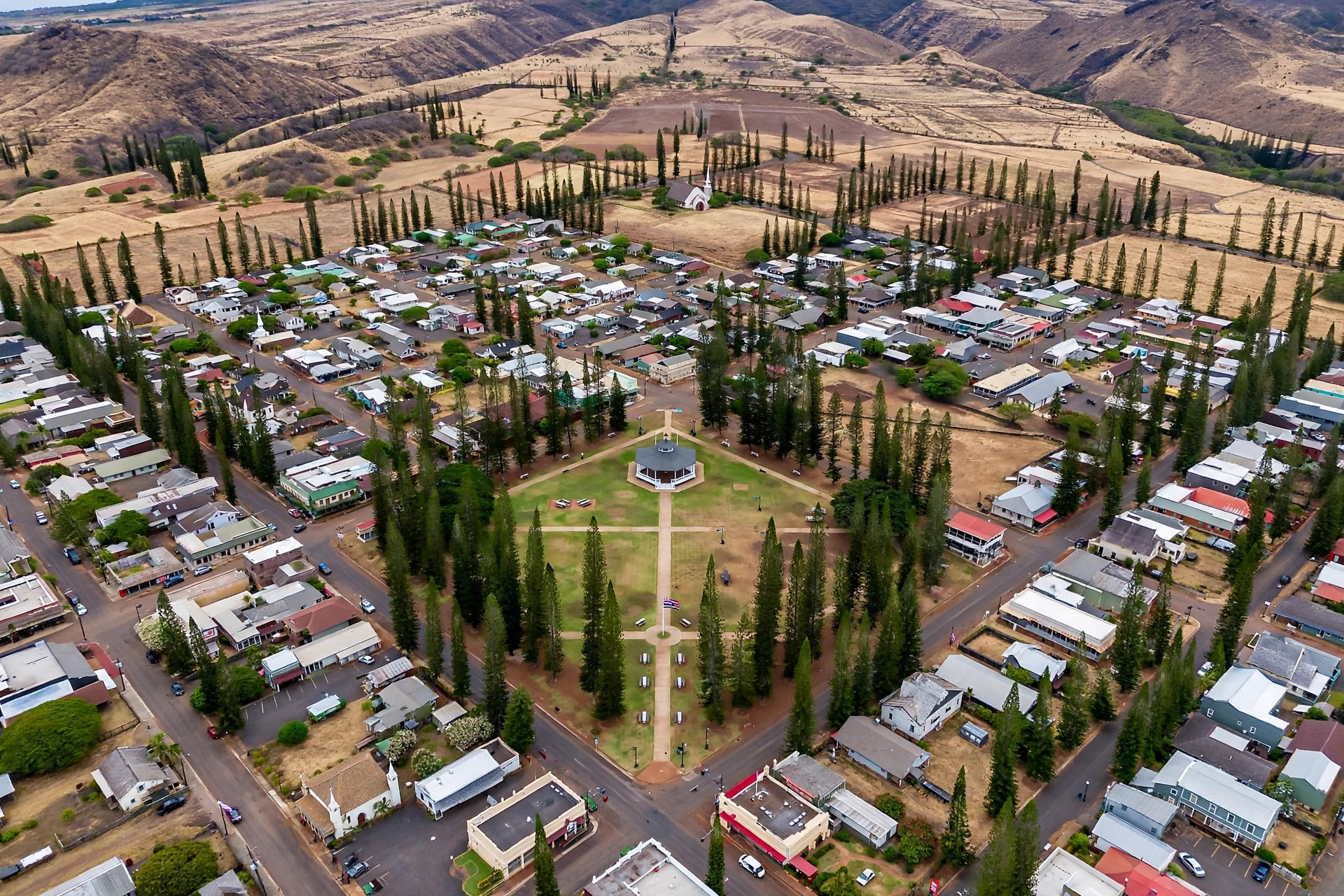
Lānaʻi City itself is compact enough to explore on foot. The grid around Dole Park covers only a few blocks, and an unhurried walk takes in the park, the historic commercial buildings, the plantation cottages, and the pine lined streets in under an hour. It is the rare Hawaiian town where walking is genuinely the best way to see it.
Lānaʻi City: The Island’s Only Town
Lānaʻi City sits on the central plateau at about 1,600 feet of elevation, which makes it one of the coolest towns in Hawaiʻi. Mornings can be misty and sweater worthy, a fact that surprises visitors who drove up from the hot, dry coast twenty minutes earlier. The town was built in the 1920s as a planned plantation community, and it still looks like one: a neat grid of streets, rows of small plantation cottages with corrugated roofs, and towering Cook pines that were planted as windbreaks and have grown into the town’s defining feature.
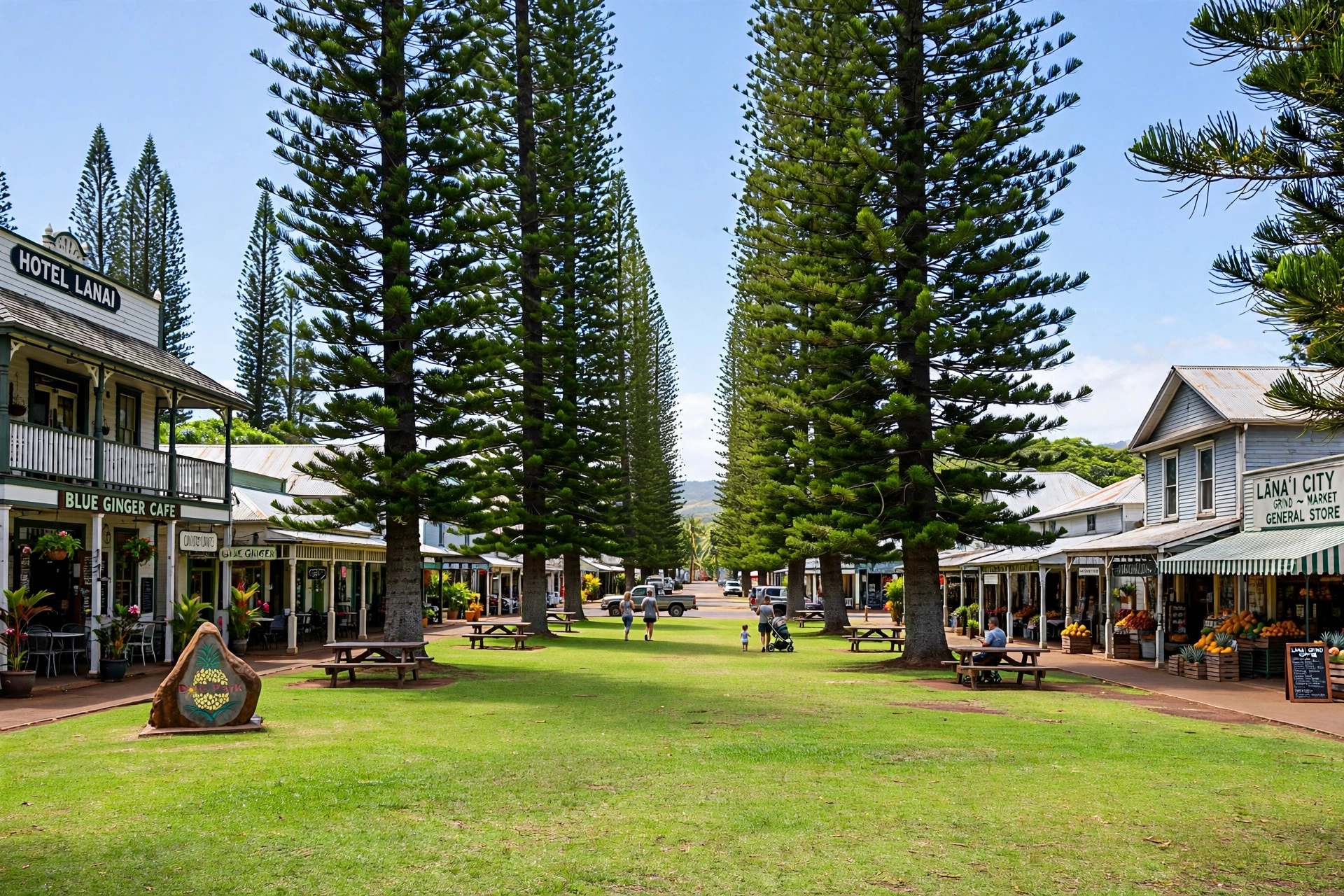
The Cook pines deserve a moment. They were planted in the late 1800s by George Munro, a naturalist who managed the island’s ranch, in an effort to catch moisture from the passing clouds and bring water to the dry plateau. The experiment worked well enough that the pines now line the main roads and give Lānaʻi City a look unlike any other town in the state, something between a New England village and a highland outpost. They are the first thing visitors notice and the thing residents mention when they describe home.
The Town Square: Dole Park
Everything in Lānaʻi City radiates from Dole Park, the grassy town square at the center of the grid. The park is ringed by the town’s main commercial buildings, most of them dating to the plantation era, and it functions the way a town square should: as a meeting place, a lunch spot, and the venue for community events. On weekends you may find a farmers market or a local fundraiser here. On weekdays it is simply the green heart of the town, shaded by pines and busy with residents.
The buildings around the square hold most of the island’s commerce. The town’s full-service grocery store is here, along with a general store, a bank, and the post office. You will also find the island’s best concentration of restaurants, which is to say a handful of locally owned spots serving plate lunches, poke, burgers, and a few sit-down dinners. None of them are large, and hours can be short, so it pays to eat when kitchens are open rather than when you happen to get hungry.
Plantation History on Every Street
Lānaʻi City is one of the best preserved plantation towns in Hawaiʻi, and walking it is a history lesson in itself. The cottages were built by the Dole company for its workers, and many are still occupied by the families of former plantation employees. The street layout, the commercial core, and even the town’s social geography all date to the plantation era, when the company managed housing, stores, and recreation as a single system.
The plantation story has a clear arc. James Dole’s Hawaiian Pineapple Company bought the island in the 1920s and built the town to house thousands of workers. At its peak, Lānaʻi grew more pineapple than anywhere else on earth. The industry declined through the late twentieth century as production moved overseas, and Dole ended pineapple operations on Lānaʻi in 1992. The town that the industry built, however, did not empty out. Many workers stayed, their children stayed, and Lānaʻi City remains a living community rather than a museum.
In 2012, the island changed hands again when businessman Larry Ellison purchased the vast majority of Lānaʻi’s land. The purchase brought new investment to the town, including renovations of commercial buildings around Dole Park and the historic Hotel Lānaʻi. The plantation cottages, the pines, and the town’s scale have remained, which is why Lānaʻi City still reads as a 1920s plantation town even as its ownership and economy have moved on.
Services and Daily Life
For visitors, Lānaʻi City is where logistics happen. This is where you buy groceries and supplies, fill the gas tank (the island’s only gas station is here), pick up anything you forgot, and ask a local for advice. The town has a public library, a community health clinic, an elementary and high school, churches, and a small hospital facility. It is a complete small town, just a very small one.
The town’s elevation makes it the practical base for exploring the island’s interior. The Munro Trail, the island’s best known hike, starts near here. The road to the Garden of the Gods (Keahiakawelo) and the island’s north shore lookouts begins here. And the twenty minute drive down Mānele Road to the beach starts here. Most visitors who rent a 4WD will sleep in Lānaʻi City and radiate outward each day, which works well because no drive on the island’s paved roads takes very long.
Evenings in Lānaʻi City are quiet. There is no nightlife to speak of, and the town goes dark early. What it offers instead is the thing many visitors remember most about Lānaʻi: the feeling of a real community going about its evening, kids on bikes, neighbors talking on porches, the pines moving in the trade winds. If you want to understand the island beyond its beaches, spend an evening here.
Mānele: Harbor and Resort Area
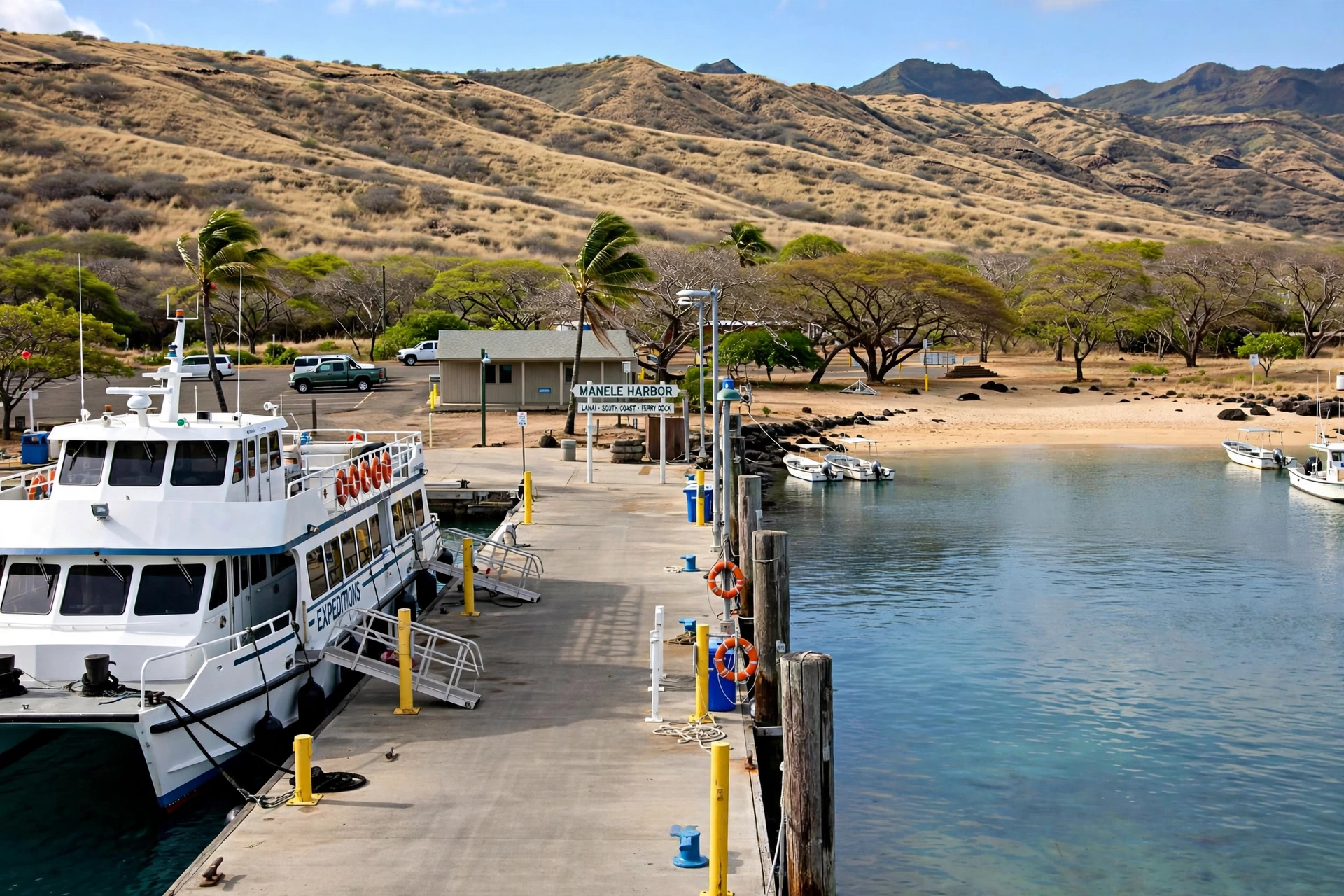
Mānele sits on the island’s south coast, about a twenty minute drive down Mānele Road from Lānaʻi City, and the descent tells you everything about the island’s two climates. You leave the cool, misty plateau and arrive at a hot, dry, sunny shoreline where the island’s best beach and its only harbor sit side by side.
The harbor is the practical heart of Mānele. Mānele Small Boat Harbor is where the passenger ferry from Maui arrives, which makes it the entry point for most day visitors. It is a working harbor with charter boats, not a town waterfront, and there are no shops or restaurants at the harbor itself beyond what serves the arriving traffic.
Next to the harbor is the resort area, anchored by a large luxury resort set above Mānele Bay. The resort is the island’s biggest employer and its most visible presence on the coast. Around it there is a golf course, and that is essentially the full extent of Mānele’s built environment. Visitors staying here get the beach, the harbor, and the resort’s facilities, and they drive up to Lānaʻi City for everything else.
What draws people to Mānele is not the settlement but what surrounds it. Hulopoʻe Bay, a short walk from the harbor, is the island’s best beach and a marine life conservation district with excellent snorkeling. The tide pools at the beach’s western end are a destination in themselves. Offshore, the island of Puʻupehe (Sweetheart Rock) rises from the water, visible from the shoreline trail. Mānele is the base for all of this, and for most beach focused visitors it is the only part of the coast they will ever need.
Planning note: Mānele has no grocery store, no gas station, and no independent restaurants outside the resort. If you stay here, plan to drive to Lānaʻi City for supplies, or expect to pay resort prices for everything.
Historic Settlements
Three more names appear on Lānaʻi maps and in the island’s history. None of them is a town you can visit in the normal sense. All of them reward the effort if you are interested in what Lānaʻi was before the pineapple.
Keōmuku: The East Coast Ghost Village
Keōmuku sits on the island’s remote east coast, at the end of a long dirt road that requires a 4WD vehicle and dry conditions. In the late 1800s it was the site of an early sugar plantation attempt, the Maunalei Sugar Company, which failed after only a few years. A small community persisted around the site, and a little wooden church built in the early 1900s still stands there, maintained as a historic landmark. The setting is striking: a quiet shoreline, the ruins and remnants of the plantation era, and views across the channel to Maui and the West Maui Mountains. Keōmuku is the closest thing Lānaʻi has to a ghost town, and it is worth the drive for visitors who are comfortable on rough roads.
Kaunolū Village: The Ancient Fishing Settlement
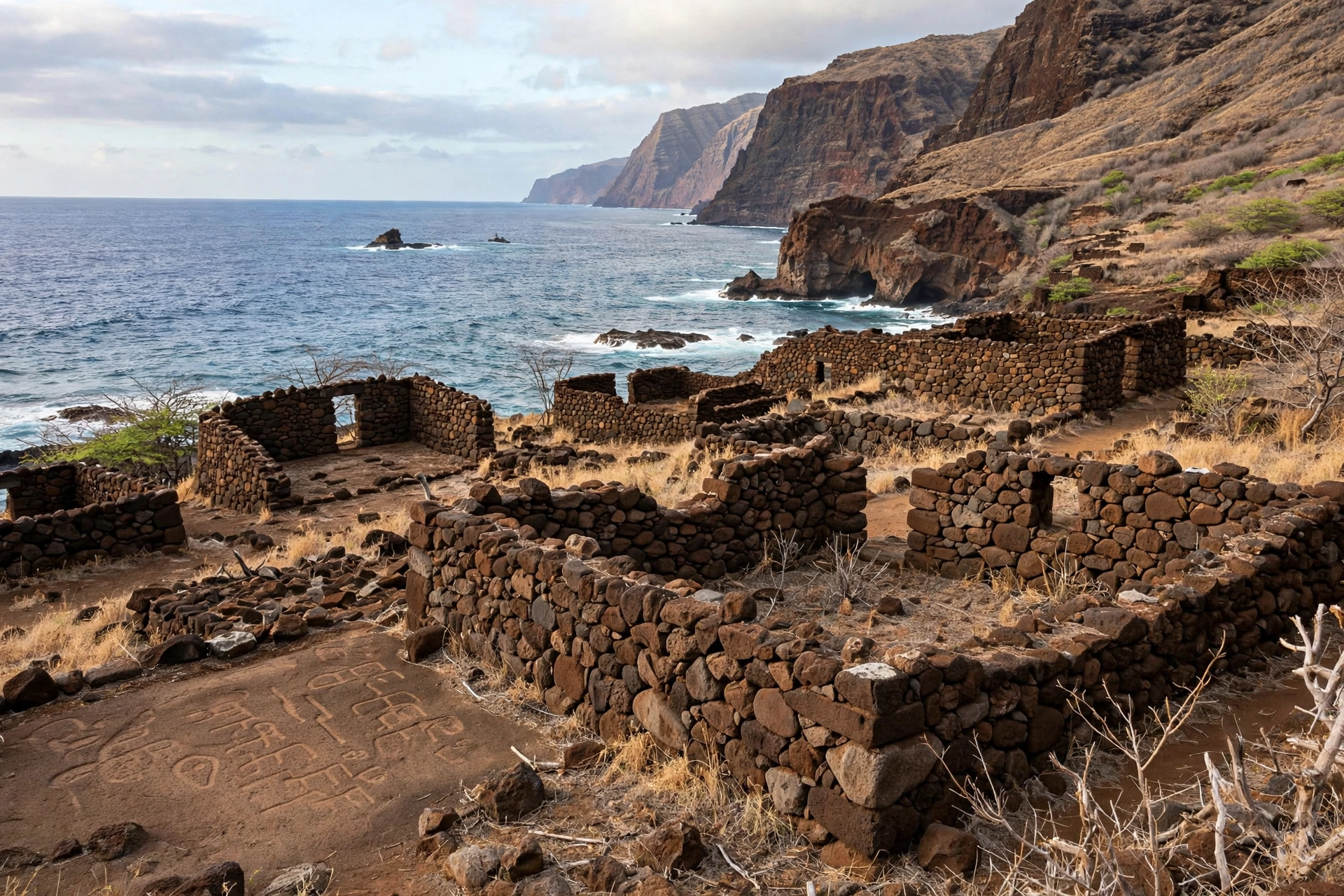
On the island’s rugged southwest coast lie the remains of Kaunolū, an ancient Hawaiian fishing village that was once among the most important settlements on Lānaʻi. The site includes house foundations, temple platforms, and other stonework spread across a dramatic coastal landscape. It is a protected archaeological site, which means you visit to look, learn, and leave everything exactly as you found it. Reaching Kaunolū requires a 4WD vehicle, good weather, and a willingness to drive one of the island’s roughest roads. There are no signs, no facilities, and no services. Go with respect, bring everything you need, and treat the stonework as the irreplaceable record that it is.
Maunalei: The Windward Valley
Maunalei is a valley and former village area on Lānaʻi’s windward (eastern) side, in the wettest part of the island. It was a significant settlement in the pre-contact era, supported by the valley’s streams, and later the center of the short-lived sugar venture. Today it is remote even by Lānaʻi standards: no services, rough 4WD access, and a landscape that feels a world away from the dry west end. Most visitors experience Maunalei only as a name on the map, but its gulches are where the island’s rare seasonal waterfalls appear after heavy winter rains.
Access warning: All three of these sites require a 4WD vehicle, and rental agreements on Lānaʻi often restrict which dirt roads you may drive. Check your rental terms before heading out, go only in dry weather, and never attempt these roads alone.
Getting Between Places
Getting around Lānaʻi’s settled areas is simple. One paved road, Mānele Road (Highway 440), connects Lānaʻi City to Mānele Harbor and Hulopoʻe Beach in about twenty minutes. Another paved road runs from Lānaʻi City to the airport. Everything else of interest sits at the end of dirt roads that range from graded and easy to rough enough to require a true 4WD and good judgment.
There is no public bus service on Lānaʻi and no rideshare network to speak of. A handful of taxi and shuttle operators serve the island, and the resort runs shuttles for its guests between Mānele, Lānaʻi City, and the airport. For independent travelers, a rental vehicle is effectively required, and a 4WD is required if you want to see anything beyond the paved corridor. Book rental vehicles well in advance; the island’s fleet is tiny and sells out.
Day visitors arriving on the ferry from Maui will find that Mānele’s beach, tide pools, and snorkeling are all walkable from the harbor. Seeing Lānaʻi City or anything in the interior requires a vehicle or a shuttle. Plan accordingly before you board the ferry.
Where to Stay by Area
With one town and one resort area, the choice of where to stay on Lānaʻi is refreshingly simple.
Lānaʻi City is the right base for travelers who want local life, lower prices, and central access to the island’s interior. The town has a small historic hotel dating to the plantation era, plus vacation rentals and bed and breakfasts scattered through the residential streets. Staying here puts you walking distance from the grocery store, the restaurants, and Dole Park, and a short drive from the Munro Trail, the Garden of the Gods road, and the island’s lookouts. Evenings are quiet and cool.
Mānele is the right base for travelers who want the beach at their doorstep and are comfortable with resort pricing. The resort here is a full service luxury property with dining, a spa, and a golf course. You will be minutes from Hulopoʻe Beach and the harbor, but you will drive to Lānaʻi City for groceries, gas, and anything resembling local nightlife. For honeymooners and dedicated beachgoers, the tradeoff is usually worth it.
There is no accommodation at Keōmuku, Kaunolū, or Maunalei, and no legal camping near the historic sites. Book well ahead in every season; the island’s total room count is small and fills up.
Frequently Asked Questions
What is the main town on Lānaʻi?
Lānaʻi City is the island’s only town. It has the grocery store, gas station, schools, clinic, post office, library, and nearly all restaurants and shops. Everything else on the island is a resort area, a harbor, or a historic site.
Is Mānele a town?
Not really. Mānele is a harbor and resort area on the south coast with no independent shops, grocery store, or civic center. It is where the ferry arrives and where the island’s best beach is, but for services you will drive up to Lānaʻi City.
How many people live on Lānaʻi?
Roughly 3,000 residents, nearly all of them in Lānaʻi City. It is the smallest population of any inhabited Hawaiian island, which is why the island feels so quiet.
Can I visit Keōmuku and Kaunolū?
Yes, but both require a 4WD vehicle, dry weather, and self-sufficiency. There are no services, signs, or facilities at either site. Check your rental agreement first, since some contracts restrict dirt road driving, and never go alone.
Are there traffic lights on Lānaʻi?
No. Like Molokaʻi, Lānaʻi has no traffic lights. Drive slowly, yield to local traffic, and respect the island’s pace.
Where should I stay: Lānaʻi City or Mānele?
Choose Lānaʻi City for local life, lower prices, and easy access to hiking and the island’s interior. Choose Mānele for the beach at your door and resort amenities, accepting higher prices and a drive for everything else.
Is there a grocery store on Lānaʻi?
Yes, one full-service grocery store in Lānaʻi City, plus a general store. Stock up there before heading to the coast or the back roads, and note that Sunday hours can be limited.
What happened to the pineapple plantation?
Dole operated the world’s largest pineapple plantation on Lānaʻi from the 1920s until 1992, when production ended. The plantation town it built, Lānaʻi City, remains the island’s community today.
Related Guides
- Lānaʻi Travel Guide: the complete island overview
- Lānaʻi Map: regions, towns, roads and distances
- Lānaʻi Beaches: Hulopoʻe, Shipwreck Beach and more
- Lānaʻi Hikes: Munro Trail and beyond
- Lānaʻi History: plantation era to present
- Lānaʻi Transportation: getting around the island
- Molokaʻi Towns: Kaunakakai and the island’s villages
- Hawaiʻi Map: the full island chain
A Final Note
Most destinations sell you on how much they have. Lānaʻi’s towns sell you on how little they need. One town square, one harbor, a few historic sites at the ends of dirt roads, and a community small enough that the grocery cashier will recognize you by your second visit. Walk Dole Park in the morning mist, drive down to Mānele for the afternoon sun, and stand at Keōmuku where a plantation failed and a church still stands, and you will have the measure of the island. Lānaʻi does not have many towns because it never needed them. One, done well, was enough.