
Molokaʻi Towns
Molokaʻi has fewer towns than any other inhabited Hawaiian island, and that is exactly the point. With a resident population of roughly 7,300, the Friendly Isle was never built for crowds, and its communities still carry the quiet rhythm of plantation days. There are no stoplights, no high rises, and no shopping malls. Instead there is one main street in Kaunakakai, a handful of plantation-era villages scattered across the central plateau and east end, and a single settlement at Kalaupapa that remains closed to casual visitors. This guide walks through each of Molokaʻi’s towns and villages so you know where things are, what each place offers, and where it makes sense to base your stay.
On This Page
Molokaʻi’s Towns: An Overview
It helps to reset your expectations before arriving. Molokaʻi’s “towns” would be called villages almost anywhere else in the United States. Kaunakakai, the largest, has a single main street and a few hundred residents. Maunaloa, Kualapuʻu, and Hoʻolehua are unincorporated communities that grew up around plantations and homestead lands rather than around commerce. The east end villages of Kamalo, ʻUalapuʻe, and Pūkoʻo are little more than clusters of homes along the highway. None of this is a shortcoming. It is the reason Molokaʻi feels so different from the rest of Hawaiʻi, and the reason visitors who love it tend to love it fiercely.
The geography of the towns follows the island’s two-volcano structure. Kaunakakai sits on the central south shore, roughly in the middle of the island and within easy reach of everything. West of it, the dry hills around Maunaloa belong to the old pineapple lands. North and east of Kaunakakai, the central plateau rises toward Kualapuʻu and Hoʻolehua, where the Molokai Airport (MKK) serves as the island’s only commercial gateway. From there the Kamehameha V Highway runs east along the south shore through the villages of the east end, ending at Hālawa Valley. The Kalaupapa peninsula hangs off the north shore, cut off by the world’s tallest sea cliffs and reachable only by a restricted trail, small aircraft, or the sea.
What the towns share is a plantation-era character that has survived because development never arrived to replace it. False-front storefronts, community halls, and family businesses dominate. Many shops close on Sundays, and some close early on weekdays. Cell service is patchy outside Kaunakakai. There are no chain hotels, and dining options are limited to local spots. For travelers, the practical takeaway is simple: stock up in Kaunakakai, fuel up whenever you see a station, and plan your days around the island’s unhurried schedule rather than against it.
The plantation history behind these towns is worth understanding because it explains the island’s protective attitude today. Pineapple companies and ranches once employed much of the island, and company towns like Maunaloa and Kualapuʻu were built to house their workers. When the plantations closed, the towns stayed but the jobs did not, leaving communities that are close-knit, self-reliant, and wary of outside development proposals. Molokaʻi’s famous resistance to resort development is not nostalgia; it is a lived memory of what the plantation economy did and did not deliver. Visitors who understand this will find locals far more welcoming than those who treat the island as an undiscovered playground.
Quick orientation: Think of Molokaʻi in four clusters. Kaunakakai (central, main services), the west end (Maunaloa, dry and sunny), the central plateau (Kualapuʻu, Hoʻolehua, coffee and homesteads), and the east end (small villages, lush and remote). Kalaupapa stands alone on the north shore.
Kaunakakai: The Main Town
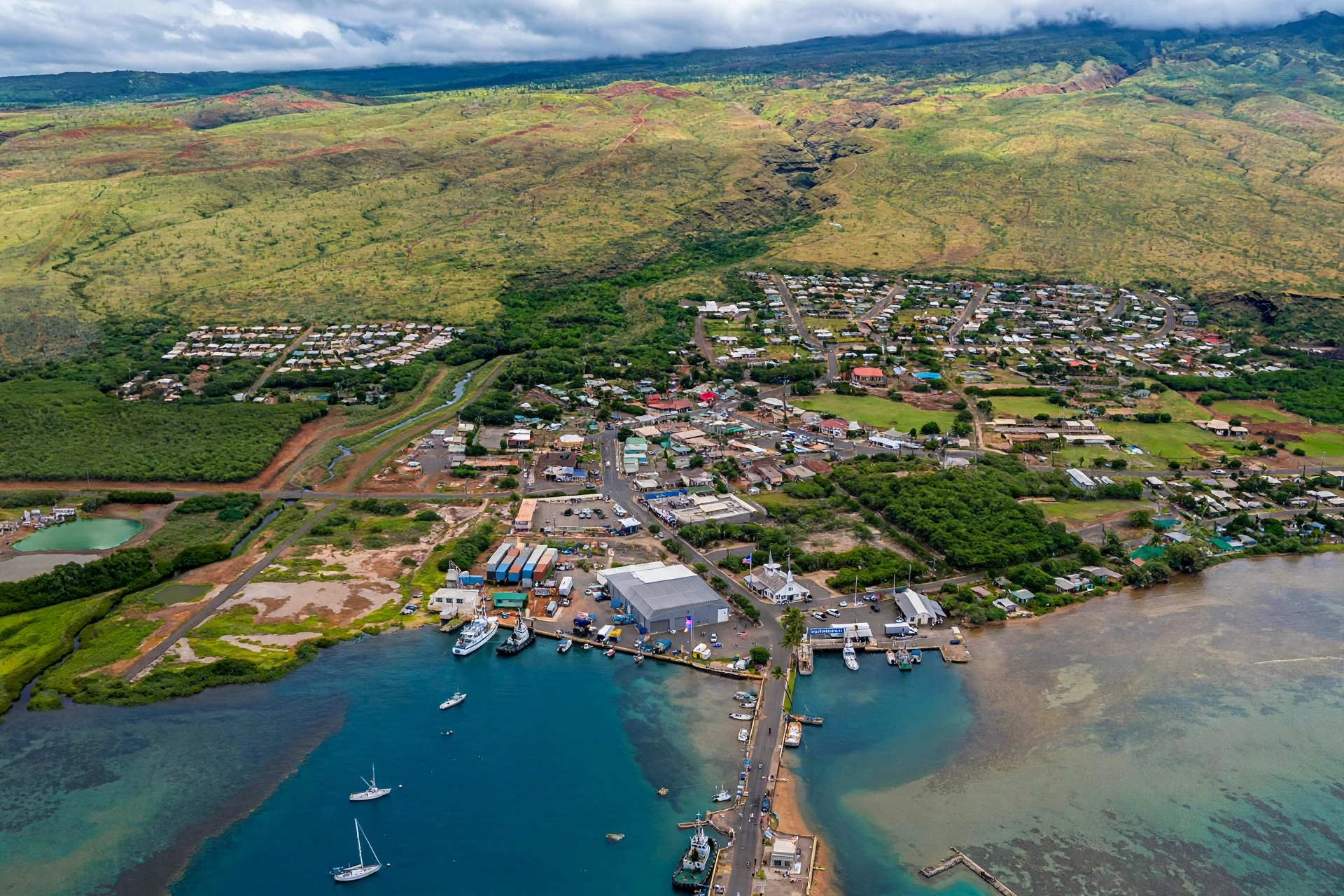
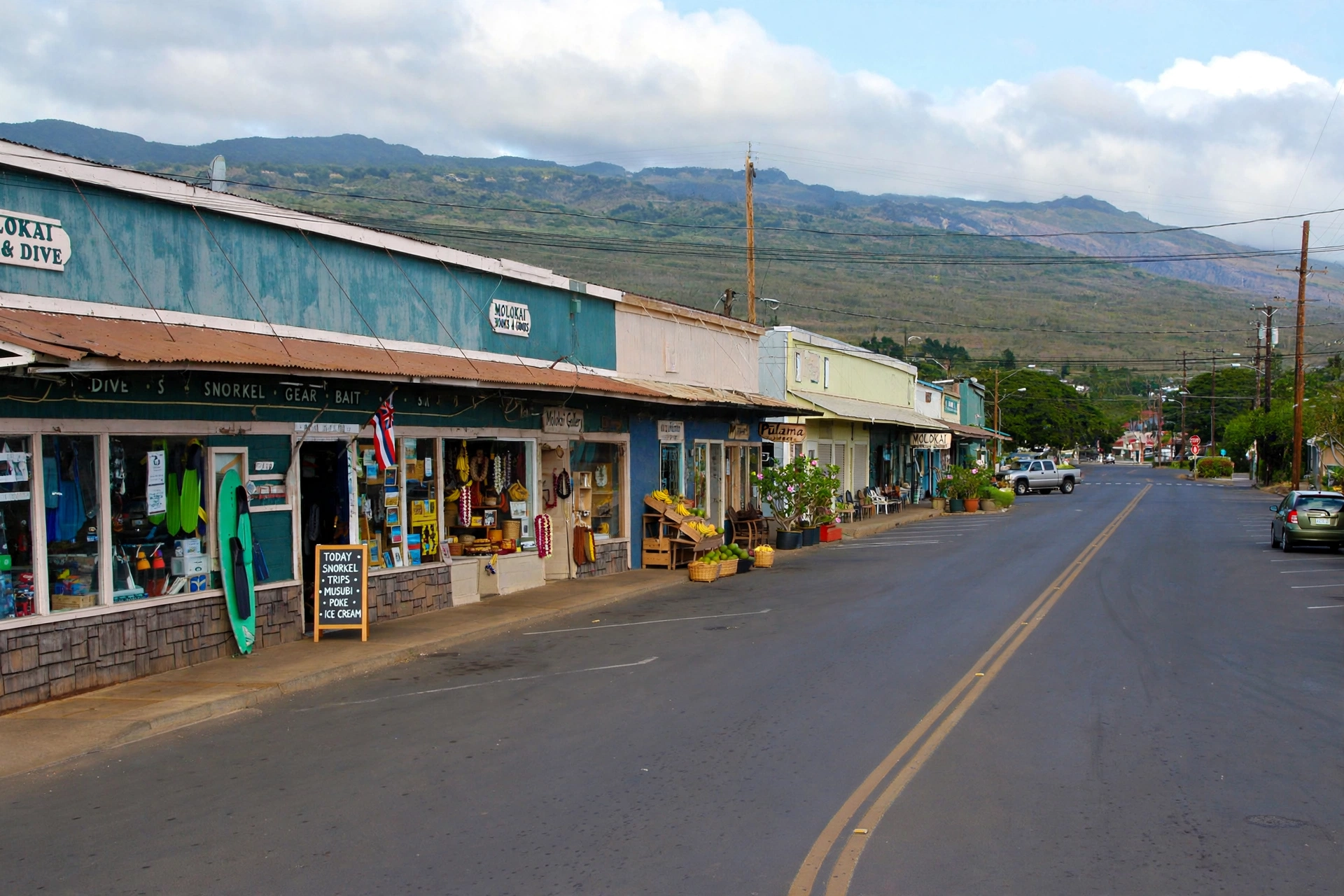
If Molokaʻi has a center of gravity, it is Kaunakakai. The town sits on the island’s south shore roughly midway between the west and east ends, and nearly everything a visitor needs is found along its main street, Ala Malama Avenue. This is where the harbor, the grocery stores, the banks, the post office, and most of the island’s restaurants and shops are located. If you are driving anywhere on Molokaʻi, you will pass through Kaunakakai at least twice, and most visitors end up orienting their whole trip around it.
Kaunakakai’s history is tied to the sea and to agriculture. The harbor, built in the early 1900s, once shipped pineapples and other plantation goods off the island, and it remains the island’s main marine gateway for cargo and small craft. The town grew as a commercial hub for the surrounding ranches and plantations, and its false-front storefronts date from that era. Compared with the resort towns of the other islands, Kaunakakai feels like a time capsule, and locals are proud of it that way.
For visitors, the town’s highlights are modest but genuine. The Saturday morning farmers market is the week’s main social event, with local produce, flowers, baked goods, and crafts. Kanemitsu Bakery, a family institution, is famous for its hot bread, baked late in the evening and sold warm. The main street has a handful of shops selling local art, books, and island-made goods. The harbor is worth a walk in the late afternoon, when the light softens over the south shore reef.
Just east of town along the highway are two landmarks worth knowing. Kapuāiwa Coconut Grove, planted in the 1860s during the reign of Kamehameha V, is one of the island’s most photographed spots, with hundreds of royal palms in orderly rows along the shore. A little farther east, Hotel Molokai (in the Kamiloloa area) is one of the island’s few lodging options and a useful reference point for the east end drive.
Practically speaking, Kaunakakai is where you should do all your provisioning. The town has the island’s main grocery stores, gas stations, and an ATM network. Fuel up here before heading east or west, because stations are few and far between elsewhere. Most rental cars are picked up at the airport in Hoʻolehua, about a 20-minute drive north of Kaunakakai.
Two more Kaunakakai notes are worth having. First, the harbor area is the departure point for the small number of ocean activities that do operate from Molokaʻi, and it is a pleasant place to watch the local fishing boats come in. Second, the town’s evening rhythm is quiet: most businesses close by early evening, and the dining scene is a handful of local restaurants rather than a nightlife district. Plan dinners early, or plan to cook. Visitors who arrive expecting a resort town’s after-dark options will be disappointed; visitors who embrace the early, quiet evenings will understand why people live here.
Maunaloa: The West End
Maunaloa anchors the dry, sunny west end of Molokaʻi, and its story is the story of pineapple. The town was built as a plantation community for Libby, McNeill and Libby, which grew pineapple across the west end’s rolling lands. When the plantation era ended, Maunaloa shrank to a quiet residential village, and the west end became one of the least developed coastlines in Hawaiʻi.
Today Maunaloa is a small, sleepy community of plantation-era homes. There is little in the way of visitor services here, which is part of the appeal for travelers who want the driest, sunniest corner of the island. The west end’s beaches, including Papohaku Beach and Kapukahehu (Dixie Maru) Beach, are the island’s best for wide-open sand, though swimming is often unsafe and there are no lifeguards. The town itself is mostly a place you pass through on the way to those beaches, but its plantation streets are worth a slow drive for a sense of old Molokaʻi.
The west end also carries the legacy of Molokai Ranch, the large landholding whose closure in 2008 reshaped the island’s west side economy. The community’s relationship with large-scale development remains cautious, and visitors should understand that the west end’s emptiness is something locals actively protect. Treat the beaches and roads here with the same respect you would bring to a small town anywhere: drive slowly, pack out everything, and do not assume access where gates or signs indicate otherwise.
Maunaloa’s present-day life is modest and residential. A general store serves the immediate community, and the town’s small park and community facilities are the social anchors. There is no visitor center and no tour desk. If you stop in Maunaloa, you are stopping in a working neighborhood, so keep visits brief and quiet. The reward is a glimpse of the Molokaʻi that existed before and after the plantations, a place that endures on its own terms rather than performing for guests.
Kualapuʻu: Plantation Camp Country
Kualapuʻu sits on the central plateau north of Kaunakakai, and like Maunaloa it was built around pineapple. This was a Del Monte plantation camp, a company town of tidy workers’ houses set among the fields, and its layout still shows it. The camp is quieter than Kaunakakai and feels more residential, but it holds one of the island’s most popular visitor stops: Coffees of Hawaii, a working coffee plantation on the slopes above town that offers tours and tastings.
The coffee plantation is worth the detour. Molokaʻi’s red volcanic soil and elevation produce a distinctive cup, and the tour explains how coffee replaced pineapple on these slopes. The plantation’s café and shop make a good morning stop before heading to the airport or the east end. Beyond the coffee, Kualapuʻu is a place to drive through slowly and appreciate rather than a destination in itself, though its plantation-era houses are among the best preserved on the island.
Kualapuʻu also illustrates how the central plateau functions as Molokaʻi’s agricultural heart. The fields around the camp still grow coffee and other crops, and the area’s cooler elevation makes it noticeably different in climate from the coast below. If you are driving between the airport and Kaunakakai, the route passes through this landscape, and it is worth slowing down to take it in rather than treating it as a connector road.
Hoʻolehua: Homesteads and the Airport
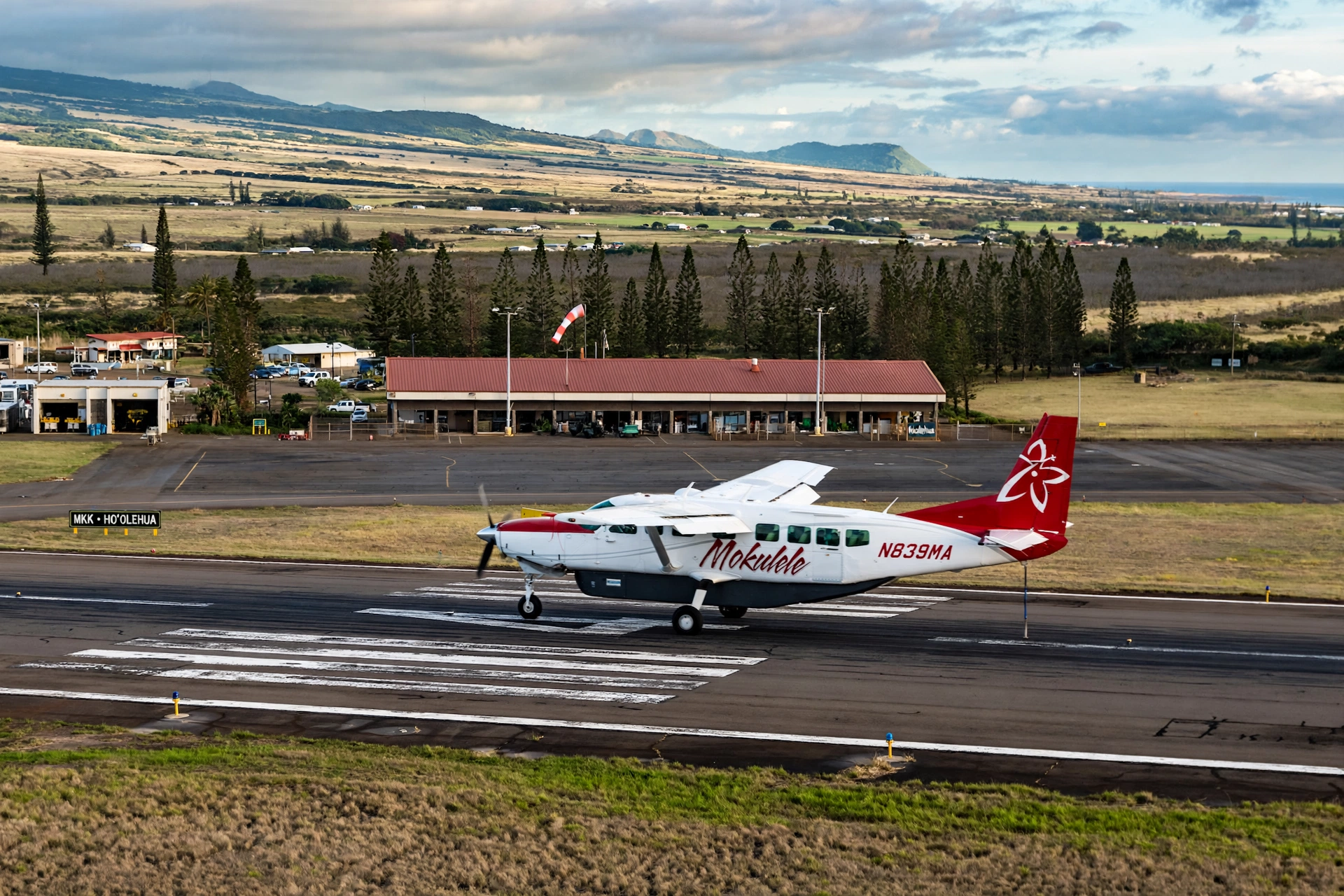
Hoʻolehua, on the central plateau near Kualapuʻu, is best known to visitors as the home of Molokai Airport (MKK), the island’s only commercial airport. Nearly every visitor to Molokaʻi arrives through Hoʻolehua on a commuter flight from Honolulu, then drives south to Kaunakakai to begin the trip in earnest.
Beyond the airport, Hoʻolehua is a community of Hawaiian homestead lands, residential areas set aside for Native Hawaiians under the Hawaiian Homes Commission Act. The homesteads give this part of the island a distinctly local, agricultural character, with family farms and pasture land rather than visitor infrastructure. There is little for tourists to do here beyond the airport itself, and visitors should treat the homestead neighborhoods as what they are: people’s homes, not attractions.
Kalaupapa: A Place Apart
Kalaupapa is not a town you can simply visit, and it is important to say that plainly. The settlement sits on a flat peninsula on Molokaʻi’s north shore, cut off from the rest of the island by sea cliffs up to 3,000 feet high. From 1866, it served as the place of exile for people with Hansen’s disease (leprosy), and it remains home to a small number of elderly former patients who chose to stay. It is now protected as Kalaupapa National Historical Park, and access is strictly controlled.
Visiting Kalaupapa requires a permit and must be done through the park’s authorized arrangements; independent visits are not allowed. The park’s most famous figures are Saint Damien (Father Damien) and Saint Marianne Cope, who devoted their lives to caring for the settlement’s residents. Their legacy is central to the site’s meaning, and the park presents it with appropriate gravity.
The right way to experience Kalaupapa for most travelers is from above, at the Palaʻau State Park overlook on the Kalae Highway. The view down the cliffs to the peninsula is one of the most striking in all of Hawaiʻi, and it requires no permit. When you stand at that overlook, remember what you are looking at: not a tourist attraction, but a community shaped by suffering, devotion, and remarkable human dignity. Keep your voice down, stay on the paths, and give the place the quiet it deserves.
East End Villages
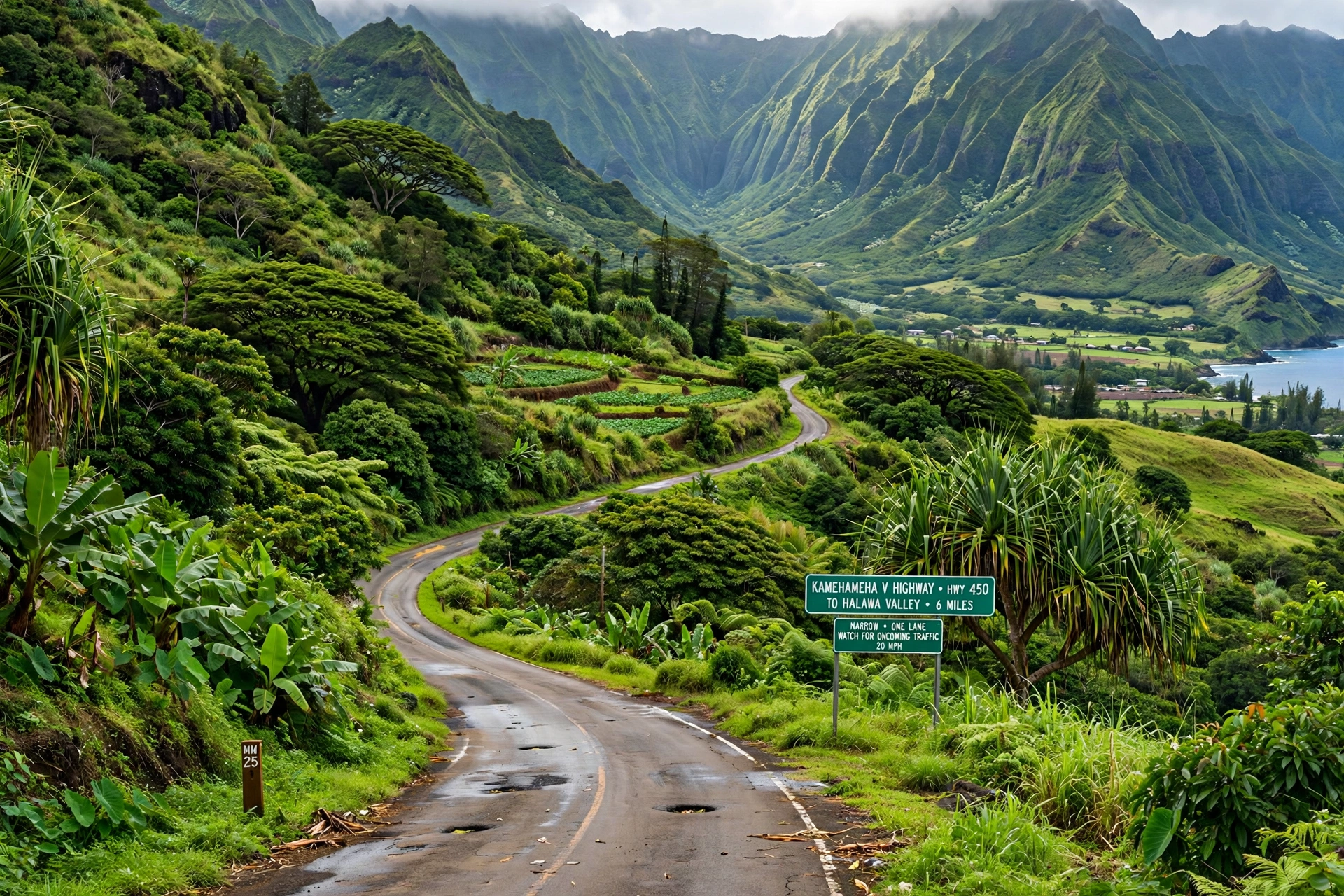
East of Kaunakakai, the Kamehameha V Highway runs about 28 miles along the south shore to the end of the road at Hālawa Valley. The villages along this route are small, lush, and increasingly remote as you go. This is the wet, green side of Molokaʻi, and the drive itself is one of the island’s best experiences.
Kamalo
The first village of note east of Kaunakakai, Kamalo is home to St. Joseph Church, a small wooden church built by Saint Damien in the 1870s. It is one of the oldest churches on Molokaʻi and a quiet stop for those interested in the island’s history. The village is otherwise a scattering of homes along the highway.
ʻUalapuʻe
Farther east, ʻUalapuʻe sits along the shore near one of Molokaʻi’s ancient fishponds, ʻUalapuʻe Fishpond, part of the island’s remarkable south shore fishpond system. The village is tiny, but the shoreline here rewards a slow walk and a look at the fishpond walls that have stood for centuries.
Pūkoʻo
Near the eastern reaches of the highway, Pūkoʻo is a small community surrounded by some of the lushest scenery on the island. The road narrows and the vegetation closes in as you approach Hālawa Valley. There are no visitor services in Pūkoʻo, so treat it as part of the journey rather than a stop.
The east end drive is best done as a half-day or full-day outing from Kaunakakai. Bring water, snacks, and fuel, because there are no stores past a certain point. The road ends at Hālawa Valley, where the valley itself requires a cultural guide to enter (see our Molokaʻi hikes guide). Turn around respectfully and enjoy the drive back.
A few practical notes for the east end run. The highway is narrow and winding in places, with one-lane sections and blind curves, so drive at the posted speeds and pull over to let faster local traffic pass. Cell service drops out along much of the route, so download offline maps before you leave Kaunakakai. And because this is a residential coastline, not a scenic byway with pullouts every mile, stop only where it is clearly safe and appropriate. The drive rewards patience: waterfalls appear after rain, the fishponds catch the light differently through the day, and the valley at the end of the road is one of the most beautiful places in Hawaiʻi.
Where to Base Yourself
With so few towns, the decision of where to stay on Molokaʻi is simpler than on the other islands, but it still matters.
Kaunakakai is the obvious and usually the best choice. It puts you within reach of the harbor, the main street, the grocery stores, and the highway in both directions. Most of the island’s vacation rentals and the main hotel options cluster in and around Kaunakakai and the adjacent Kamiloloa area. If this is your first visit, stay here.
The west end around Maunaloa suits travelers who want maximum sun and solitude. This is the driest part of the island, and the beaches are spectacular in their emptiness. The tradeoff is distance from services: you will drive to Kaunakakai for groceries and dining, and there are no restaurants or shops nearby.
The east end is for the deeply adventurous. Rentals here are few and remote, and you will be genuinely far from help if something goes wrong. The scenery is extraordinary, but this is a base for experienced, self-sufficient travelers only.
One note that applies everywhere on Molokaʻi: book lodging well in advance. The island’s small inventory of vacation rentals and rooms fills up, and there is no backup supply of hotels to absorb overflow.
Wherever you base yourself, one rule of thumb will serve you well: let Kaunakakai be your supply run, not your whole trip. The town is the practical heart of the island, but Molokaʻi’s real character reveals itself in the smaller places, on the plantation streets, at the fishponds, and on the long quiet drives between towns. A good base simply makes those explorations easier. Choose the one that matches your travel style, stock the kitchen, fuel the car, and let the island set the pace.
Frequently Asked Questions
What is the main town on Molokaʻi?
Kaunakakai is the main town and the island’s commercial center. It has the harbor, the main grocery stores, the banks, most restaurants and shops, and the Saturday farmers market. Nearly all visitors pass through it and provision here.
Can I visit Kalaupapa?
Kalaupapa is a restricted settlement and National Historical Park. Independent visits are not allowed; you need a permit and must visit through the park’s authorized arrangements. Most travelers experience it from the Palaʻau State Park overlook, which needs no permit and offers a stunning view of the peninsula.
Are there stoplights on Molokaʻi?
No. Molokaʻi famously has no traffic lights. The island’s pace is slow, and drivers should keep it that way: observe speed limits, yield to local traffic, and never rush.
Where do I fly into on Molokaʻi?
Molokai Airport (MKK) in Hoʻolehua is the island’s only commercial airport, served by commuter flights from Honolulu. The airport is about a 20-minute drive north of Kaunakakai.
Is Maunaloa worth visiting?
Maunaloa is a quiet former plantation town on the west end with little in the way of visitor services. It is worth a slow drive for its plantation-era character, and it is the gateway to the west end’s beaches, including Papohaku. Do not expect shops or restaurants.
What are the east end villages like?
Kamalo, ʻUalapuʻe, and Pūkoʻo are tiny villages along the Kamehameha V Highway. They are scenic and worth passing through on the east end drive, but they have no visitor services. St. Joseph Church in Kamalo is the main landmark.
Where should I stay on Molokaʻi?
Kaunakakai is the best base for most visitors because it is central and has the island’s services. The west end suits travelers seeking sun and solitude, while the east end is for experienced, self-sufficient travelers. Book well in advance everywhere.
Do shops close on Sundays on Molokaʻi?
Many do. Molokaʻi keeps a small-town schedule, and Sunday closures are common. Plan your grocery and fuel stops around this, especially if you arrive on a weekend.
Related Guides
- Molokaʻi Travel Guide: the complete island overview
- Molokaʻi Map: regions, towns, roads and distances
- Molokaʻi Beaches: Papohaku, Dixie Maru and more
- Molokaʻi Hikes: trails, permits and safety
- Molokaʻi Snorkeling: reef, spots and safety
- Hawaiʻi Map: the full island chain
A Final Note
Molokaʻi’s towns will not impress you with their size, and they are not trying to. Their value is in what they have refused to become: another set of resort storefronts selling the same souvenirs. Walk the main street of Kaunakakai on a Saturday morning, drive the plantation streets of Maunaloa and Kualapuʻu, stand at the Palaʻau overlook above Kalaupapa, and you will understand the island on its own terms. That understanding is the real souvenir Molokaʻi offers, and unlike most, it does not fade.