Flat Fish in Hawaiʻi: Flounders, Soles, and Hidden Hunters

The first time you see a flat fish in Hawaiʻi, you probably almost miss it. A patch of sand at the edge of the reef seems to ripple, two small eyes lift on tiny stalks, and a fish that was invisible a second ago glides away in a smooth wave of fin. Flat fish are the masters of the sandy bottom in Hawaiian waters, and once you learn how to spot them, every snorkel over a sand flat becomes a treasure hunt.
This is the complete guide to flat fish in Hawaiʻi. It covers the flounders and soles that actually live here, led by the peacock flounder that Hawaiians call pakiʻi, explains the strange eye migration that makes a flatfish a flatfish, and shows you how and where to watch them responsibly. Because searchers often land on this topic from two other fish, this page also settles the yellow striped fish and the black and white spotted fish you are most likely seeing, so one page answers the whole cluster of questions.
What Counts as a Flat Fish
Flatfish are a distinct order of fishes that includes flounders, soles, halibut, and their relatives. Hawaiʻi hosts about twenty flatfish species, sorted by scientists into three groups: left eyed flounders, which lie on their right side, right eyed flounders, and soles, which are all right eyed in local waters. Roughly a dozen of the Hawaiian species are left eyed flounders, and the peacock flounder is the largest and most commonly seen of them near shore.
The defining trick happens early in life. A baby flatfish hatches looking like an ordinary fish, upright, with one eye on each side of its head. As it grows, one eye migrates across the top of the head until both eyes sit on the same side. The young fish then settles onto its blind side, which turns pale, while the eyed side develops the colors and patterns of the seafloor. An adult flatfish therefore swims on its side in a horizontal plane, watches the world from two eyes on top, and breathes and feeds from a body plan no other reef fish shares.
| Feature | Peacock flounder (pakiʻi) |
| Scientific name | Bothus mancus, also called the flowery flounder |
| Family type | Left eyed flounder; lies on its right side |
| Maximum size | Up to about 20 inches, the largest flatfish in Hawaiʻi |
| Field marks | Wide set eyes, blue spots and ring patterns, rapid color change |
| Habitat | Sand and rubble beside reefs, from shallow flats to deeper slopes |
| Diet | Small fish, shrimp, crabs, and other bottom prey taken by ambush |
| Status | Native Indo-Pacific species, widespread and not endemic |
Pakiʻi: The Peacock Flounder You Are Most Likely to Meet
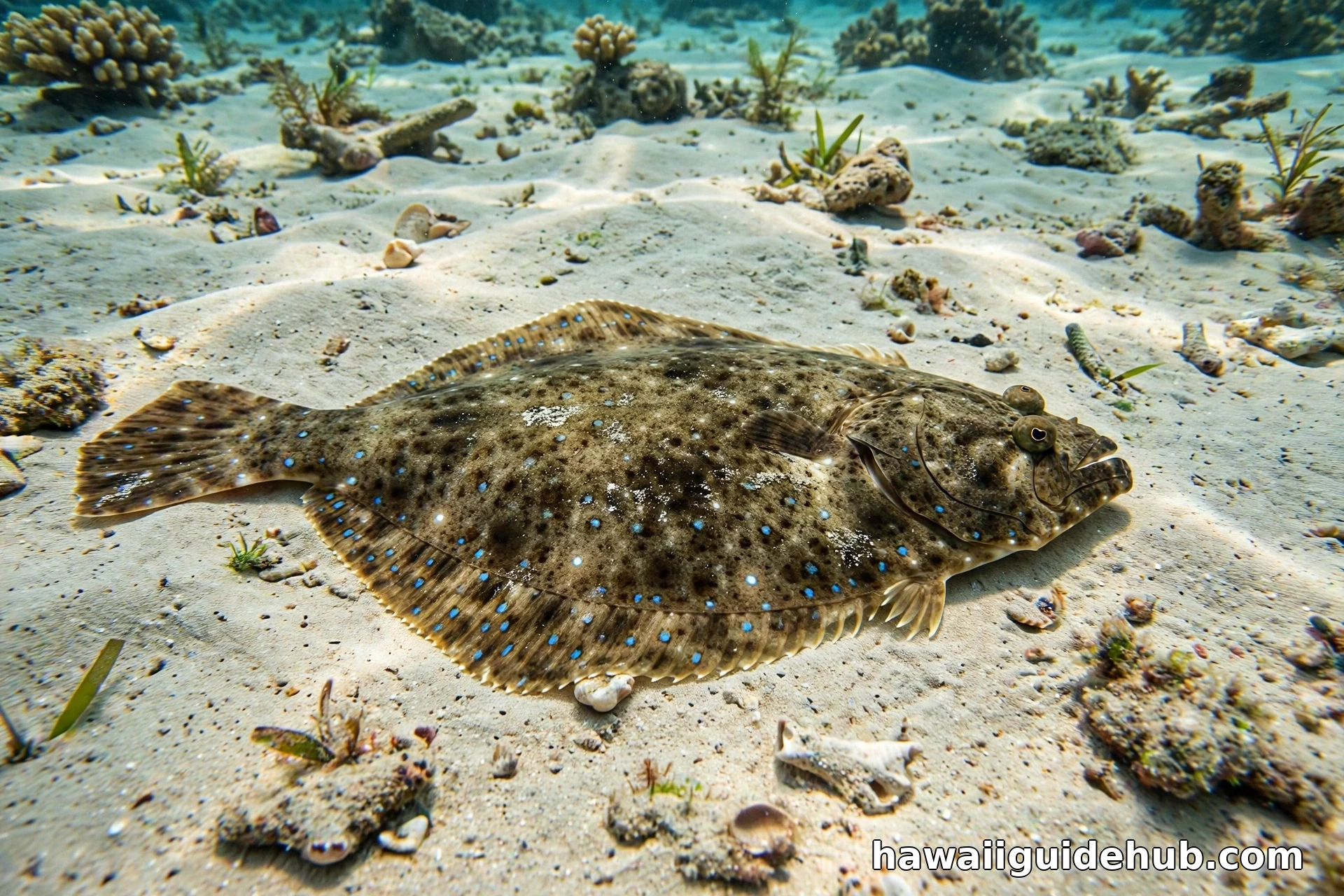
The Hawaiian name pakiʻi means fallen flat or spread out, and it fits perfectly. The peacock flounder, also called the flowery flounder, spreads itself over sand and flat reef like a living piece of the bottom. Its eyed side carries mottled browns and tans broken by pale blotches and vivid blue spots and circles, the peacock markings behind its English name. Males can show a longer pectoral fin on the eyed side. The two eyes sit far apart on raised bumps, and the lower eye sits slightly ahead of the upper one, a detail that helps separate this species from its smaller relatives.
Camouflage is its whole strategy, and it is active camouflage. A pakiʻi can shift its pattern and tone within moments to match sand, rubble, or mottled reef, which is why snorkelers routinely swim directly over a fish longer than a dinner platter and never see it. Experienced observers at places like Shark’s Cove on Oʻahu have watched a large pakiʻi hold perfectly still in two feet of water while dozens of people passed overhead. The fish is not lazy. It is hunting.
How a Flat Fish Hunts, Hides, and Moves
A resting flounder is an ambush predator at work. Buried to the eyes or lying flush on the bottom, it waits until a small fish, shrimp, or crab passes within range, then erupts upward and sucks the prey down in a strike too fast to follow. Between strikes it relies on stillness. When it does move, a flatfish swims by rippling the long fins that fringe its body, gliding just above the bottom in smooth waves before settling and re-camouflaging in a new spot. It has no need for speed over distance. Its defense is to be overlooked by predators as completely as it is overlooked by people.
Flatfish feed mostly on bottom living prey and are most active when their prey is. Snorkelers and divers see them across the day, but patient, slow observation over sand channels at the reef edge is the reliable method. Scan for the symmetrical outline, the pair of raised eyes, or a faint drift of sand where a fish has just settled. Once you find your first pakiʻi, your eyes recalibrate, and fish that were invisible all morning start appearing on every sand flat.
Other Hawaiian Flatfish: Soles and Smaller Flounders
Beyond the peacock flounder, most Hawaiian flatfish are smaller and shyer. The right eyed flounders and the soles work the same sand habitat at smaller sizes, and several species live deeper than snorkelers usually reach. Soles tend to be more elongated and smaller eyed than flounders, and many bury themselves more completely, leaving only eyes and a dusting of patterned skin above the sand. None of the local flatfish are invasive concerns, and none are a major food fishery in the islands; they are best known to divers, photographers, and anyone who has learned to love the quiet drama of a sand flat. Flatfish as a group are native members of the Indo-Pacific fauna that reached Hawaiʻi naturally, and their presence is one more sign of how much life the plain looking sand between reefs actually holds.
The Yellow Striped Fish You Keep Seeing
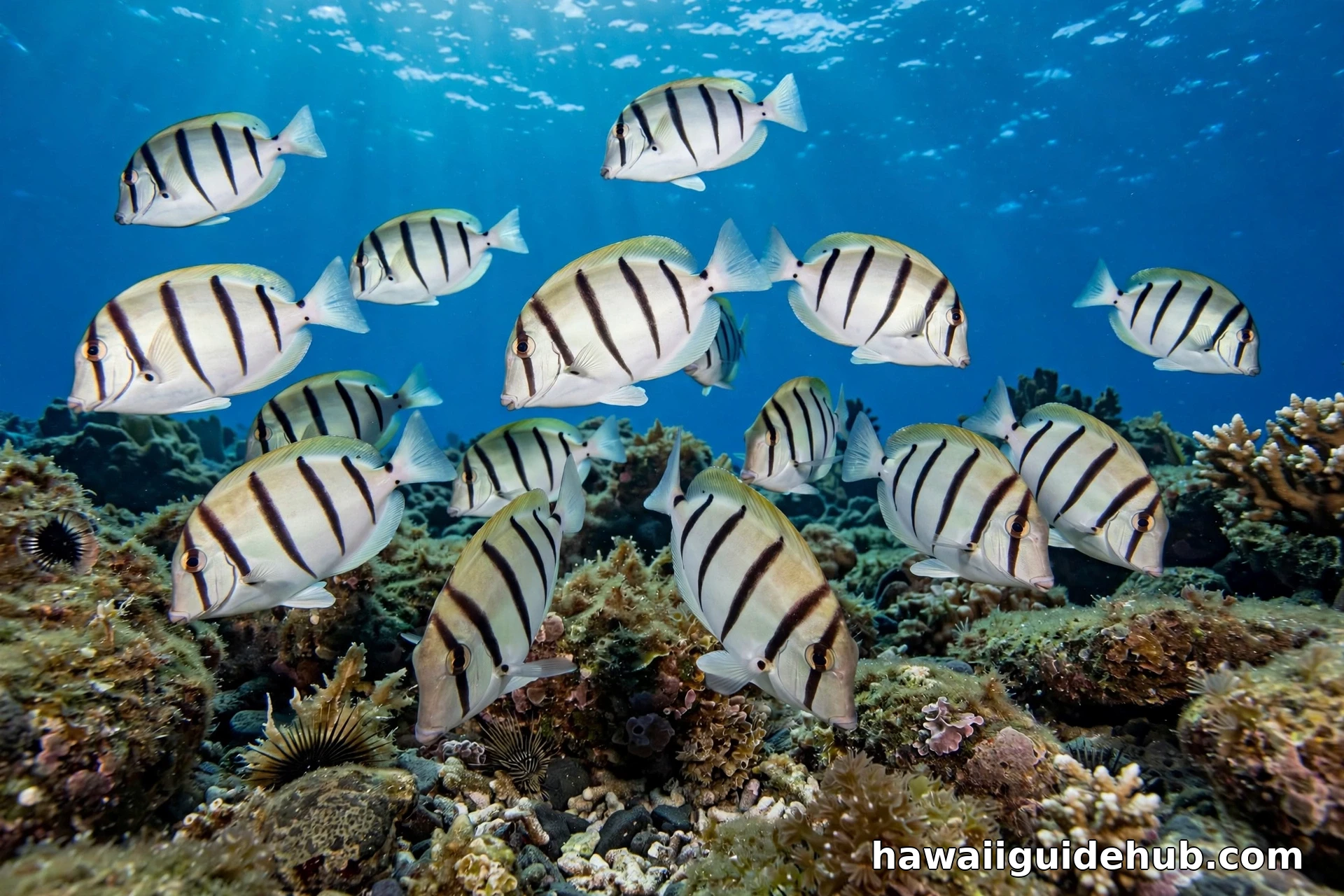
Many readers arrive here chasing a different fish: something yellow with stripes, seen in a school over the reef. In Hawaiʻi that description most often fits the convict tang, called manini. Manini have a pale body that reads white, greenish, or faintly yellow in sunlight, crossed by bold black vertical bars, including a bar through the eye, on a flattened oval body up to about 10 inches long. They graze algae from reef surfaces in schools that can number in the dozens, moving together like a single animal, and juveniles turn up in tide pools. The Hawaiian population is recognized as an endemic subspecies, found only here.
Two other yellow fish cause the confusion. The yellow tang, lauʻīpala, is solid, vivid yellow with no stripes at all, so if your fish had stripes, it was not a yellow tang. The yellowstripe goatfish carries a single horizontal yellow band along its side and a pair of chin barbels it uses to taste the sand, and it often hovers over sand flats in loose groups, sometimes in the same view as a flounder. Checking whether the stripes run vertically or horizontally, and whether the fish grazes rock or probes sand, separates all three in seconds.
The Black and White Spotted Fish, Explained
The other great identification puzzle in Hawaiian water is the black fish covered in white spots. Two species share that costume. The spotted boxfish, called moa, wears it on a rigid, boxy body with a small puckered mouth. Females are black to dark brown and densely covered in white spots. Males are showier, with dark backs carrying white spots and blue flanks. Boxfish swim slowly by fluttering their fins, look almost like floating dice, and should never be handled, since stressed boxfish can release a skin toxin. The Hawaiian form is treated as an endemic subspecies.
The guineafowl puffer wears the same colors on a rounded, inflatable body with a beak like mouth and large, expressive eyes. It reaches about 13 inches, works reefs and lagoons for algae, mollusks, and crustaceans, and can appear in a brown phase as well as the classic black with white spots. Body shape settles the identification every time: boxy and rigid means boxfish, round and soft means puffer. Both are look only fish, best enjoyed from a respectful distance while they go about their slow business.
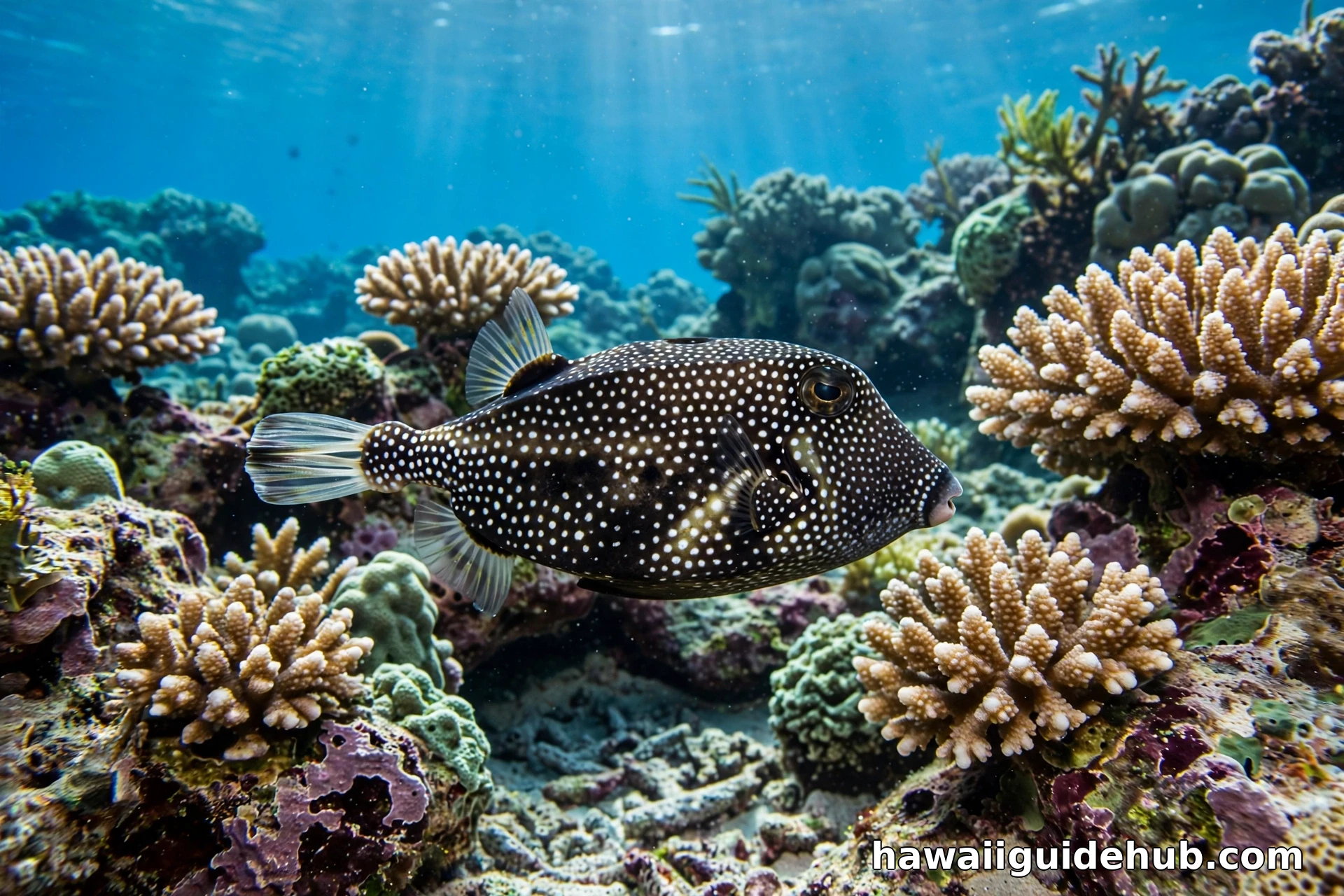
Where to Watch Flat Fish in Hawaiʻi
Any calm snorkel site with sand beside reef can hold a flounder. On Oʻahu, the sand channels inside Pūpukea Beach Park, home to Shark’s Cove, are classic pakiʻi water in summer when the north shore calms down, and the sand patches at Electric Beach on the west side reward slow scanning. The method matters more than the map: move slowly, stay low, watch the sand at the reef edge rather than the coral itself, and give any fish you find room to stay put. A flounder that trusts you will hold still for long, close observation. A flounder that bolts in a puff of sand is telling you the distance was wrong. Flat fish share the bottom with other masters of disguise, and our guide to moray eels covers the reef’s other great ambush hunters, while the Oʻahu travel guide helps you place these snorkel stops in a full day.
Safety and Etiquette Around Flat Fish
Flatfish are harmless to watch and fragile to bother. Never touch, prod, or corner one to force a photograph; a stressed flounder burns energy it needs and may leave the patch it was hunting. Do not stand on sand flats where fish rest if you can float instead, and never try to handle a boxfish or puffer, both of which carry defensive toxins and are protected by good sense if not by a specific rule. Hawaiʻi fishing regulations do not target pakiʻi as a common food fish, and the respectful local practice is to leave them in place. The general ocean rules apply everywhere on this page: check conditions, snorkel with a partner, and remember that the sand flats at surf exposed sites are only calm in the right season.
Video: How a Flatfish Is Built
Watch how the migrating eye and sideways body plan turn an ordinary larva into a flatfish.
Frequently Asked Questions
What is the flat fish called in Hawaiian?
Pakiʻi, meaning fallen flat or spread out. The name is used for the peacock or flowery flounder, Bothus mancus, the largest and most familiar flatfish in Hawaiian nearshore waters. Other flounders and soles live here too, at smaller sizes and often in deeper water.
Why do flat fish have both eyes on one side?
They are not born that way. A larval flatfish starts with an eye on each side, and during development one eye migrates over the top of the head so both eyes end up on the side that faces up when the fish lies on the bottom. The downward side turns pale and eyeless. The arrangement lets the fish lie completely flat while still watching for prey and predators above it.
Are flat fish in Hawaiʻi dangerous?
No. Flounders and soles do not bite or sting people and will always choose to flee or freeze rather than confront you. The caution on this page runs the other direction: they are easy to stress, and the spotted fish often confused with this topic, boxfish and puffers, should never be handled because of their defensive toxins.
What is the yellow striped fish in Hawaiʻi?
Most often the convict tang, or manini: a flat, oval grazer with a pale yellow green body and bold black vertical bars, seen in grazing schools over reefs and in tide pools as juveniles. If the stripe runs horizontally instead, look at the yellowstripe goatfish. If there are no stripes at all, the solid yellow fish is the yellow tang.
What is the black and white spotted fish in Hawaiʻi?
Usually either the spotted boxfish or the guineafowl puffer. A rigid, boxy body with a tiny mouth is the boxfish, whose females are black with dense white spots. A round, soft, inflatable body with a beak like mouth is the puffer. Both are common reef residents and both are strictly look only.
Flat fish ask something unusual of the people watching them: slowness. The reef’s bright schools announce themselves, but the pakiʻi lying in plain sight on an open sand flat only appears to someone willing to drift, look down, and wait for the sand to blink. Learn that pace and Hawaiʻi’s quietest habitat, the pale floor between the reefs, turns out to be one of its richest, full of flat fish going about a sideways life most visitors never notice at all.