Needlefish in Hawaii (Aha): Identification, Safety & Facts

Needlefish in Hawaii (ʻaha): the skinny, silvery surface-dwellers with beaks like daggers. Beautiful, fascinating, and: in rare circumstances: genuinely dangerous. This guide covers identification, the species in Hawaiian waters, their ecology, the real story behind the jumping danger, and how to stay safe.
What Is a Needlefish?
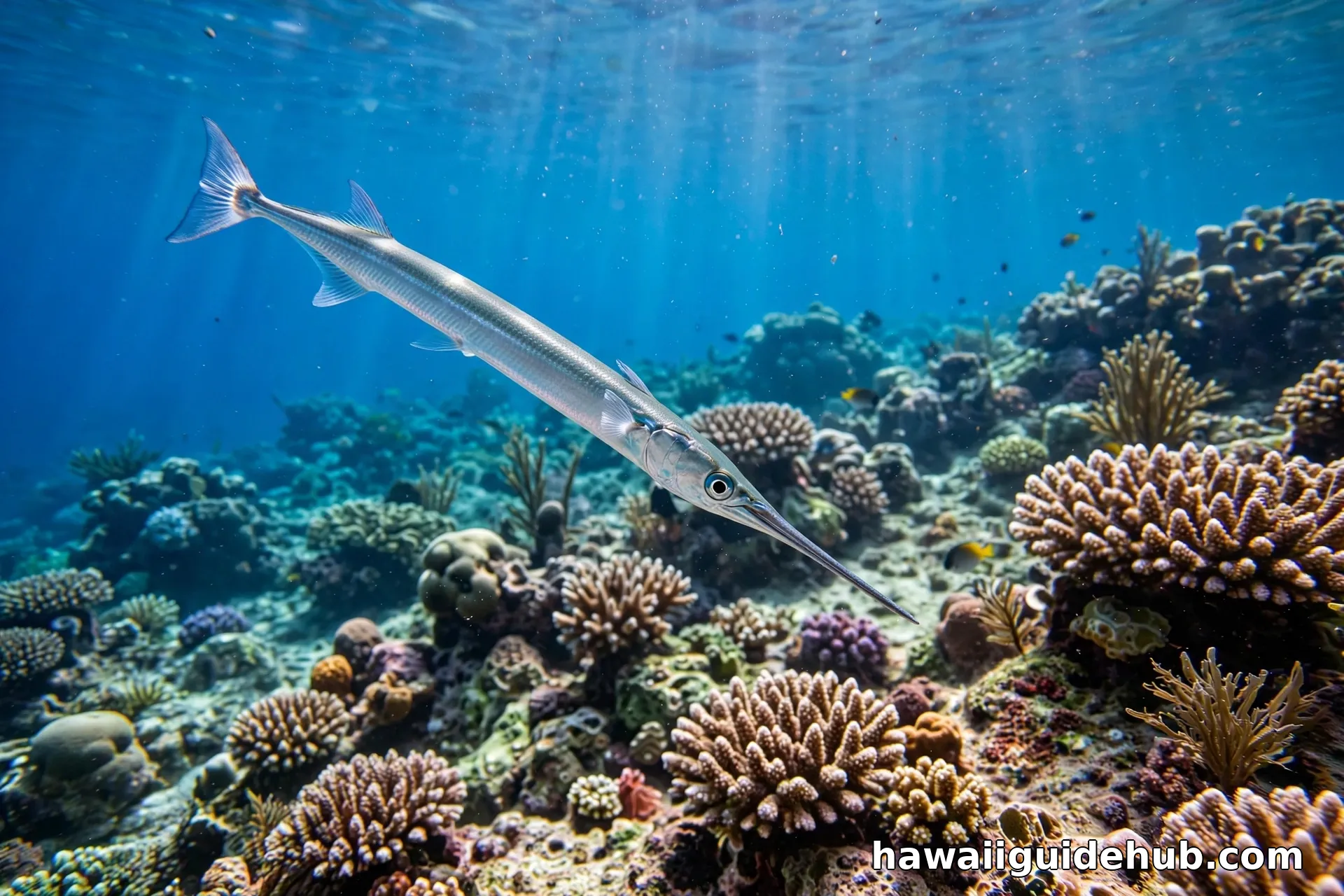
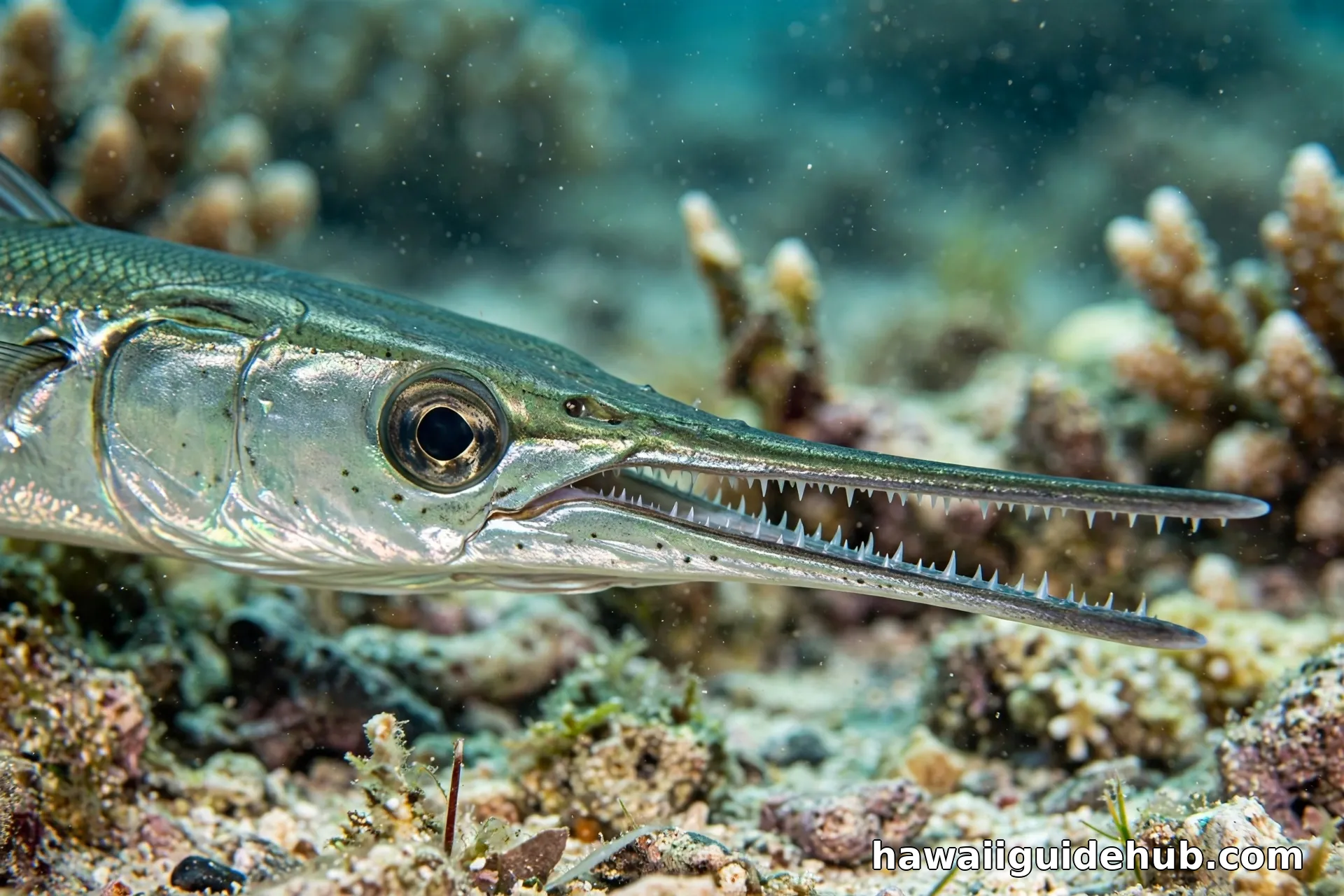
Needlefish (family Belonidae) are elongated surface predators with long, needle-like jaws lined with sharp teeth. They cruise just beneath the surface, ambushing small fish, and can leap from the water at up to 38 mph. In Hawaii they are called ʻaha. Several species occur in Hawaiian waters, including the flat needlefish and the larger houndfish (also called ʻaha). Sizes range from a few inches to over 3 feet. They are native, not invasive: a natural part of the reef and open-water ecosystem.
Needlefish vs. Their Look-Alikes: How to Tell
| Fish | Beak | Size | Behavior |
| Needlefish (ʻaha) | Long, both jaws equal | Up to 3+ ft | Surface cruising, leaps |
| Halfbeak | Only lower jaw long | Under 1 ft | Schools, skips on surface |
| Flying fish (malolo) | Short, blunt | Under 1.5 ft | Glides on wing fins |
| Cornetfish | Long tube snout | Up to 5 ft | Slow, hovers vertically |
The key field mark: needlefish have both jaws elongated into the beak. Halfbeaks (common in the same waters) have only the lower jaw extended. Once you see the difference, you cannot unsee it.
Ecology: The Surface Hunters
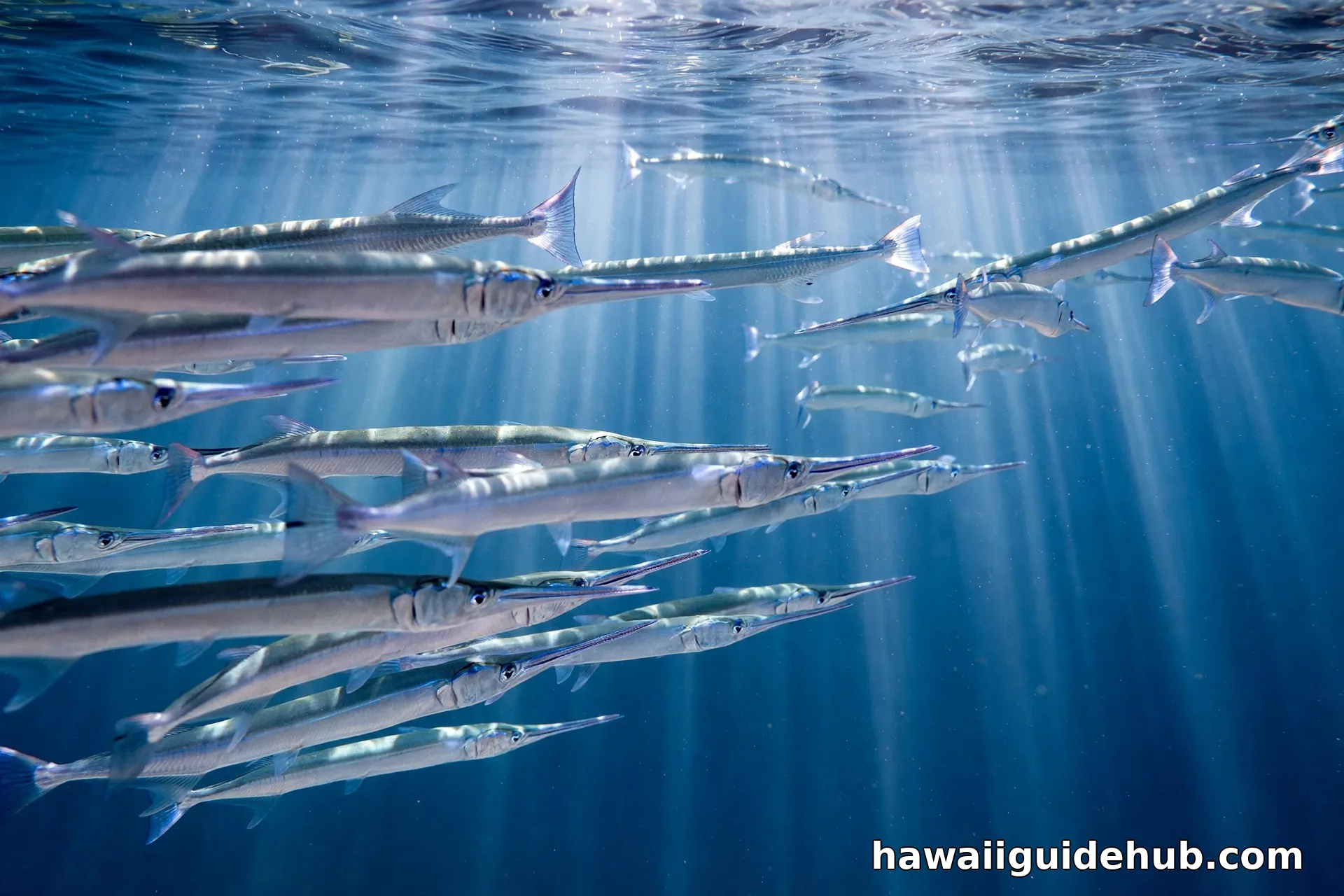
Needlefish hunt at the air-water interface: the most dangerous real estate in the ocean. They eat small fish, crustaceans, and cephalopods, striking sideways with the beak. They are in turn prey for larger fish, seabirds, and marine mammals. Juveniles hide in floating debris and seaweed. Their green bones (from the pigment biliverdin) startle first-time cooks: the flesh is fine, the color is natural. They are a mid-level predator: abundant, ecologically important, and largely ignored by humans. Calm, clear spots like those used for snorkeling in Lānaʻi are ideal for watching them hunt. Surface hunters are especially exposed to debris; see how plastic pollution affects marine life in Hawaiʻi.
The Jumping Danger: The Honest Story
Here is the serious part. At night, lights attract and excite needlefish, and they can leap from the water at up to 38 mph: beak first. Their beaks have penetrated outrigger canoe hulls. In the Pacific, needlefish have punctured people in the chest, abdomen, arms, legs, head, and neck: and one tragedy involved a young night fisherman on Kauaʻi. Night fishermen in low boats with lights are at greatest risk: for many Pacific village fishermen, needlefish are a greater occupational hazard than sharks. No such injuries have been reported in Hawaii’s recreational diving, but night divers should keep lights off until well submerged, per local experts.
Species in Hawaiian Waters
Hawaii hosts several needlefish species. The flat needlefish (Ablennes hians) is the common inshore species: silvery, up to 3 feet, often seen in harbors and calm bays. The houndfish (Tylosurus crocodilus, also ʻaha): the giant, reaching 5 feet, an offshore predator that occasionally cruises reefs. Keeltail needlefish and others occur in deeper water. Juveniles of all species look alike: tiny silver slivers with beaks already forming. For snorkelers, the flat needlefish is the one you will see: patrolling the top foot of water in loose schools.
Night Safety: For Fishermen and Divers
The danger scenario is specific: night, small boat, bright lights, shallow reef. Lights draw baitfish; baitfish draw needlefish; excited needlefish leap toward the light: and anything in the flight path is at risk. Precautions from local experts: night divers should keep lights off until well submerged and pointed down, not up. Fishermen in small boats should be aware when running bright deck lights over shallow reefs. Do not dangle limbs over the side at night in needlefish country. Daytime: no precautions needed. The fish are not aggressive: the physics of a 38-mph beak is the problem.
Needlefish in Hawaiian Culture
ʻAha appears in Hawaiian fishing tradition as a known quantity: respected, occasionally eaten, and understood. Traditional night torch fishing (lamalama) knew the jumping risk long before marine biologists quantified it. The fish’s Hawaiian name is straightforward descriptive: no elaborate mythology, just a working fish with a working name. In modern Hawaii, ʻaha is bait as often as food: its oily flesh (in some species) makes good cut bait for larger predators.
The Houndfish: Hawaii’s Giant Needlefish
The houndfish (Tylosurus crocodilus) is the needlefish family’s heavyweight: up to 5 feet, 10+ pounds, with a crocodilian snout. It hunts offshore and around reef drop-offs, taking larger prey including small tuna. Divers occasionally encounter them: impressive, indifferent, and best admired from a respectful distance. A houndfish leaping at night is the nightmare scenario behind the safety warnings: the physics scale with size. Daytime encounters are thrilling, not threatening.
Needlefish and Flying Fish: Surface Cousins
Needlefish (ʻaha) and flying fish (malolo) share the surface zone and the leaping habit, but solve predation differently: needlefish with speed and beaks, flying fish with wing-like fins and glides up to 650 feet. Both are bait for the same predators: tuna, mahi-mahi, ono, seabirds. Hawaiians traditionally caught malolo in nets at dawn; ʻaha were incidental. Together they are the silver economy of the surface: the forage base that supports everything above them in the food chain.
Photographing Needlefish
Needlefish are photogenic but skittish: approach slowly, no sudden movements. Shoot from slightly below for the silver flash against the surface. Morning light in calm harbors is ideal: the fish cruise predictable paths. A fast shutter freezes the beak’s detail. Do not chase: a chased needlefish is a gone needlefish. Patience at a cleaning station or harbor mouth beats pursuit every time.
Video: Needlefish Facts
Anatomy, hunting, and why the jaws are deadly.
Frequently Asked Questions About Needlefish in Hawaii
Are needlefish dangerous in Hawaii?
Almost never: but they can leap at night when attracted to lights. Night fishermen in small boats should be cautious; daytime snorkelers and divers face essentially no risk.
What is the Hawaiian name for needlefish?
ʻAha: applied to needlefish and the larger houndfish.
Can you eat needlefish?
Yes: the flesh is good, though the green bones surprise people. They are not a targeted food fish in Hawaii.
Where can you see needlefish in Hawaii?
Just below the surface at calm bays and harbors statewide: look for silver slivers cruising in the top foot of water, especially at dawn and dusk.
Reproduction and Life Cycle
Needlefish lay eggs that attach to floating debris, seaweed, and flotsam via sticky filaments: a strategy that disperses the young across the open ocean. Juveniles grow fast in the plankton-rich surface layer, beaks lengthening as they shift from plankton to fish prey. Lifespan is poorly studied but likely a few years. They mature quickly and spawn repeatedly: a life history built for abundance, which is why they remain common despite heavy predation from above and below.
Conservation Status
Needlefish are not threatened: they are abundant across tropical oceans, reproduce prolifically, and face no targeted fishery in Hawaii. Their conservation story is really about habitat: healthy reefs and clean surface waters support the baitfish they eat. Plastic debris is a double-edged sword: juveniles shelter in flotsam, but ingest microplastics with it. No special protections apply: just the general marine stewardship that keeps Hawaii’s waters alive.
How fast can needlefish swim?
Leaps reach up to 38 mph: among the fastest bursts of any fish their size. Cruising speed is far slower.
Why do needlefish have green bones?
The pigment biliverdin colors their bones green. It is harmless and natural: the flesh cooks up normal.
Responsible Viewing
Watching needlefish needs no special ethics beyond standard reef manners: do not chase, do not feed, keep your distance. At night, minimize lights near the surface in harbors and anchorages: not just for needlefish, but for all the life the lights disturb. If you fish, handle incidental needlefish carefully: the beak and teeth demand respect, and the fish deserves a quick release. They are wild animals doing wild things: our job is to watch well.
Needlefish Around the World
Belonidae is global: needlefish occur in tropical waters worldwide, in oceans and even rivers. The jumping danger is documented across the Pacific, the Red Sea, Japan, and the Caribbean: it is a family trait, not a Hawaiian quirk. Some cultures prize them as food: in parts of the Pacific they are grilled whole. Hawaii’s ʻaha are part of a worldwide clan of surface hunters: the same silver arrows, on every tropical coast.
Do needlefish attack humans?
No: needlefish are not aggressive toward people. Injuries happen when leaping fish collide with someone in their flight path, almost always at night near lights.
What do needlefish eat?
Small fish, crustaceans, squid, and plankton (juveniles). They are ambush predators of the surface layer.
The Anatomy of Speed
Everything about a needlefish is built for the surface sprint: a cylindrical body with minimal drag, fins set far back for rear-drive thrust, a deeply forked tail for burst acceleration, and silvery countershading that erases it against the bright surface. The beak is both weapon and sensor: lateral-line pores along the jaws detect the vibrations of prey. Even the eyes are specialized: positioned to watch above and below the surface film simultaneously. It is a masterclass in hydrodynamic engineering: evolution’s answer to life at the boundary between air and water.
Myths and Misconceptions
Myth: needlefish are baby barracudas. They are unrelated: barracudas are bulkier with underslung jaws. Myth: the green bones mean the fish is spoiled. Biliverdin is natural. Myth: needlefish are dangerous to swimmers. Daytime risk is essentially zero: the danger is narrowly about night, lights, and small boats. Myth: they are rare. They are among the most abundant surface fish in Hawaii: you have probably swum near them without noticing. The truth is more interesting than the myths: as usual.
Where to See Them: A Snorkeler’s Guide
Calm harbors and bays at dawn: Honokohau Harbor (Big Island), Maʻalaea Harbor (Maui), Kewalo Basin (Oʻahu). Protected lagoons: Hanauma Bay’s outer reef, Kealakekua Bay. Anywhere with a bright sandy bottom and calm surface film. Look for disturbances on the surface: tiny wakes and flashes. Polarized sunglasses help enormously. And remember the viewing ethic: float, watch, do not pursue. The ʻaha will put on the show if you let them.
Needlefish and the Food Web
Needlefish sit in the middle of the ocean’s food web: eating the small, feeding the large. Their prey: anchovies, silversides, small squid, shrimp. Their predators: tuna, mahi-mahi, ono, barracuda, reef sharks, brown boobies, frigatebirds. Remove needlefish and the surface food web thins: they are the conduit between planktonic production and the pelagic predators that Hawaiians fish for. A healthy ʻaha population means a healthy bait base: which means healthy ahi. Everything connects at the surface.
What We Still Don’t Know
For such common fish, needlefish are understudied. Lifespans are estimates. Spawning aggregations are poorly documented. The exact trigger for mass leaping events is debated: predator avoidance, parasites, or light attraction. How far juveniles drift on ocean currents is unknown. Even the taxonomy is in flux: cryptic species hide within named ones. The ʻaha you watch at the harbor is, scientifically speaking, still partly a mystery: which is a fine reason to keep watching.
Snorkeling with ʻAha: What to Expect
Most snorkelers meet needlefish without realizing it: silver flashes at the surface that resolve into long, beaked fish on the second look. They are shy of splashing and quick movements: float calmly and they will resume their patrols. The best encounters are at dawn in calm harbors, when schools hunt in the top foot of water. They will not bother you: and during the day, you are in no danger from them. File them with the other surface wonders you will meet in Hawaii: and then go look for the bigger reef fish and Hawaiian green sea turtles waiting over at Shark’s Cove, Oʻahu’s best shore snorkel.
Needlefish are the reef’s silver arrows: beautiful to watch, deserving of respect after dark. For more of Hawaii’s underwater cast, see Hawaii’s iconic marine species.