Valley of the Temples: Oahu’s Byodo-In Temple and Its Quiet Gardens

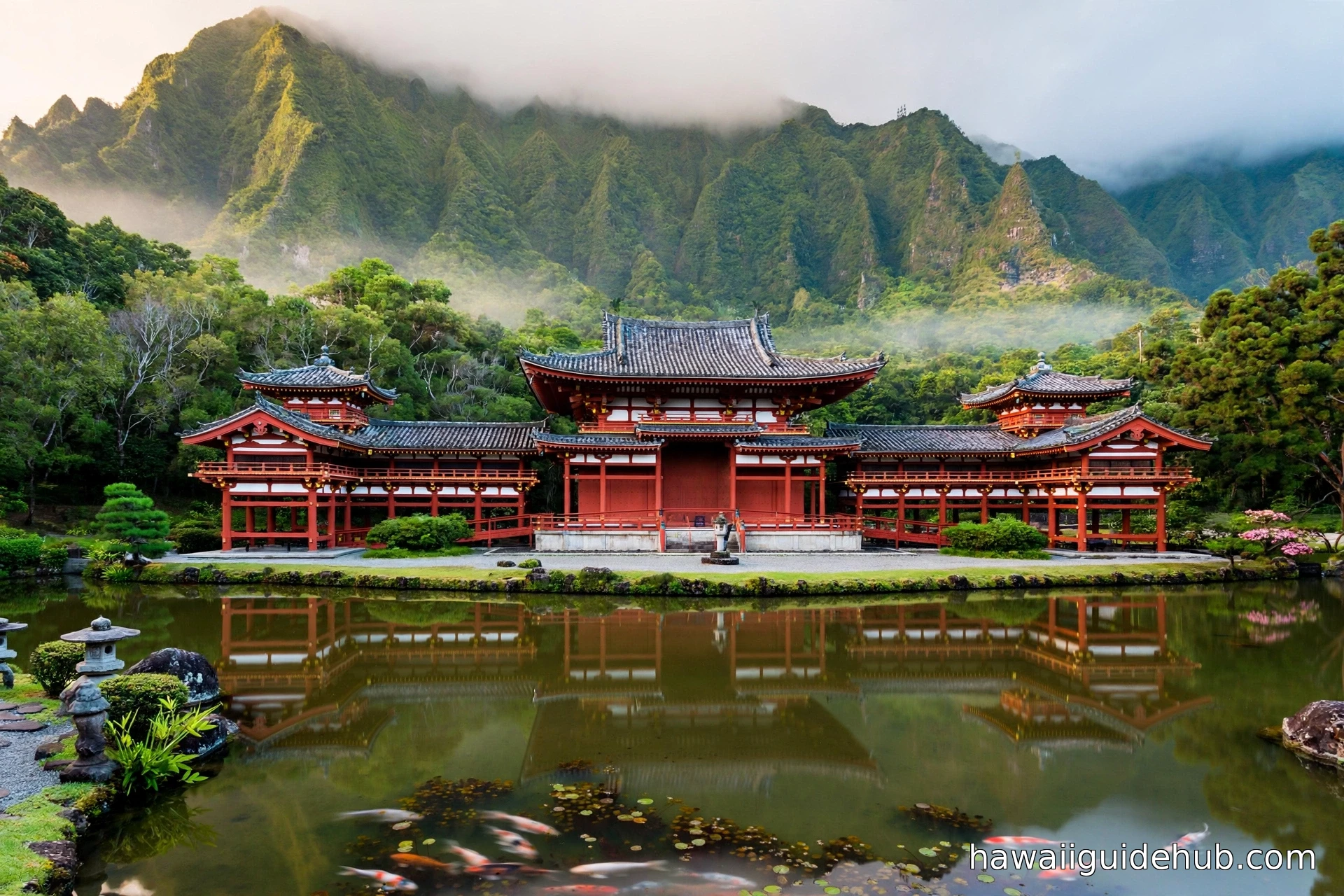
The road bends, the jungle opens, and there it is: a vermilion temple with sweeping tiled roofs mirrored in a black pond, the green wall of the Koʻolau cliffs rising straight up behind it. Nothing on the drive in prepares you. One minute you are on Kahekili Highway passing strip malls in Kāneʻohe, and the next you have stepped into a landscape that belongs to Kyoto, not Oʻahu. That sudden shift is the whole magic of the Valley of the Temples, and it is why this quiet corner of the windward side has become one of the most photographed places in Hawaiʻi.
The Byodo-In Temple sits at the far end of the Valley of the Temples Memorial Park, a cemetery and memorial ground tucked against the mountains. That detail surprises some visitors, but it makes perfect sense once you are there. The temple was built as a place of remembrance and reflection, and the stillness of the valley suits it. Come on a weekday morning, when the mist is still caught in the cliff folds and the koi are just waking up, and you will understand why people describe this as the most peaceful half hour on Oʻahu.
Where the Valley of the Temples Sits
The temple’s address is 47-200 Kahekili Highway in Kāneʻohe, on Oʻahu’s windward side, roughly 14 miles northeast of Honolulu. From Waikīkī the drive takes about 35 to 45 minutes depending on traffic. Take the H-1 west, exit onto the Likelike Highway (Route 63), cross through the Wilson Tunnel under the Koʻolau Range, then turn onto Kahekili Highway and follow it about three miles to the Valley of the Temples entrance.
The entrance leads into the memorial park itself, and the road winds uphill past manicured lawns and mausoleums to the temple grounds at the top. If a guard is stationed at the gate, you can pay admission there; otherwise you pay at the temple entrance. Paid parking is available on site near the temple. The setting is the point as much as the destination: the valley traps the trade-wind clouds, which is why the cliffs behind the temple are so impossibly green and why a light mist often hangs in the air. Bring a light rain layer even on sunny days. The windward side makes its own weather.
If you are still getting your bearings on the island’s geography, our guide to Oʻahu’s windward side explains why this coast looks and feels so different from Honolulu.
The Story Behind the Temple
The Byodo-In Temple on Oʻahu is a smaller-scale replica of the Byōdō-in in Uji, Japan, a temple completed in 1053 that is now a UNESCO World Heritage Site. The original’s Phoenix Hall is one of the most famous buildings in Japanese architecture, and the Oʻahu version reproduces its distinctive shape: a central hall flanked by two wing corridors and a rear corridor, with two bronze phoenix figures on the roof ridge.
Construction in Kāneʻohe began in 1963. The temple was dedicated in August 1968 to mark the 100th anniversary of the first Japanese immigrants to Hawaiʻi, the Gannenmono who arrived in 1868 to work the sugar plantations. That centennial is the reason the temple exists at all. It was conceived as a tribute to the generations of Japanese immigrants whose labor and culture shaped the islands, and as a non-denominational sanctuary where people of all faiths could come to reflect.
It is worth knowing what the temple is not. Despite its authentic construction and consecrated Buddha, it is a non-practicing temple with no resident monastic community and no active congregation. The official site describes it plainly: a place that welcomes people of all faiths to worship, meditate, or simply appreciate its beauty and history. It is also a designated Hawaiʻi state landmark. Weddings and memorial services are held here, and the grounds host cultural events through the year, but on an ordinary day it functions as a historic site and a garden.
Inside Phoenix Hall: The Golden Buddha
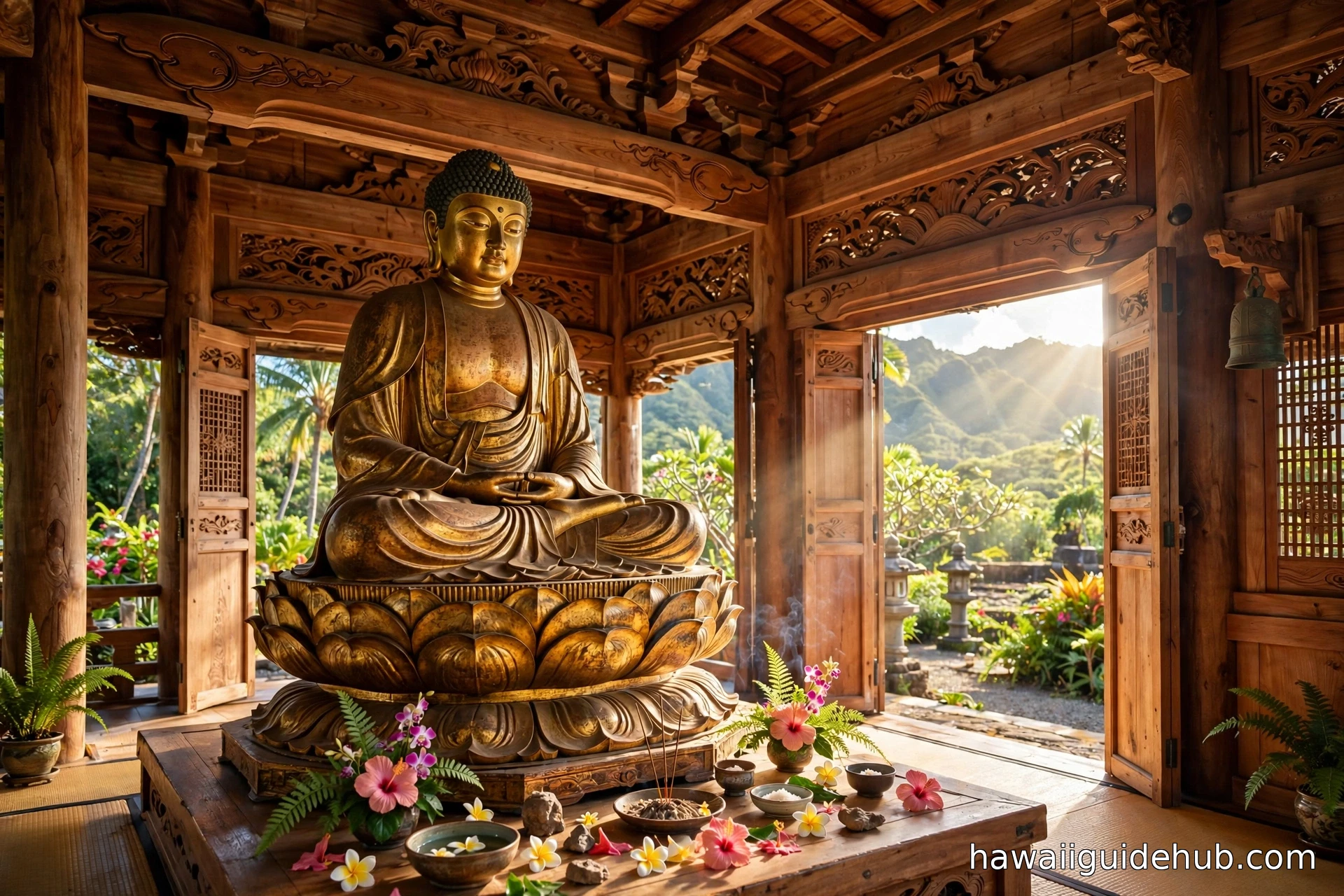
The centerpiece of the temple is the Amida Buddha, a large statue of Amitābha covered in gold and lacquer, seated in meditation on an intricately carved lotus pedestal. It is surrounded by 52 smaller wooden bodhisattvas, each one individually carved, that line the walls of the hall in a serene procession. The effect is quietly overwhelming. The hall is dim after the bright gardens, the woodwork is dark with age and incense, and the gold of the Buddha seems to hold what little light there is.
Visitors are welcome inside. Remove your shoes before stepping up into the hall, dress modestly out of respect, and keep your voice low. You can light incense at the altar, and many visitors pause here to remember loved ones, which feels fitting given the memorial park setting. Photography is generally permitted, but be discreet and never use flash inside the hall. Take your time. Most people rush this part, and it is the part that stays with you.
The Grounds: Koi Ponds, Peacocks and Quiet Corners
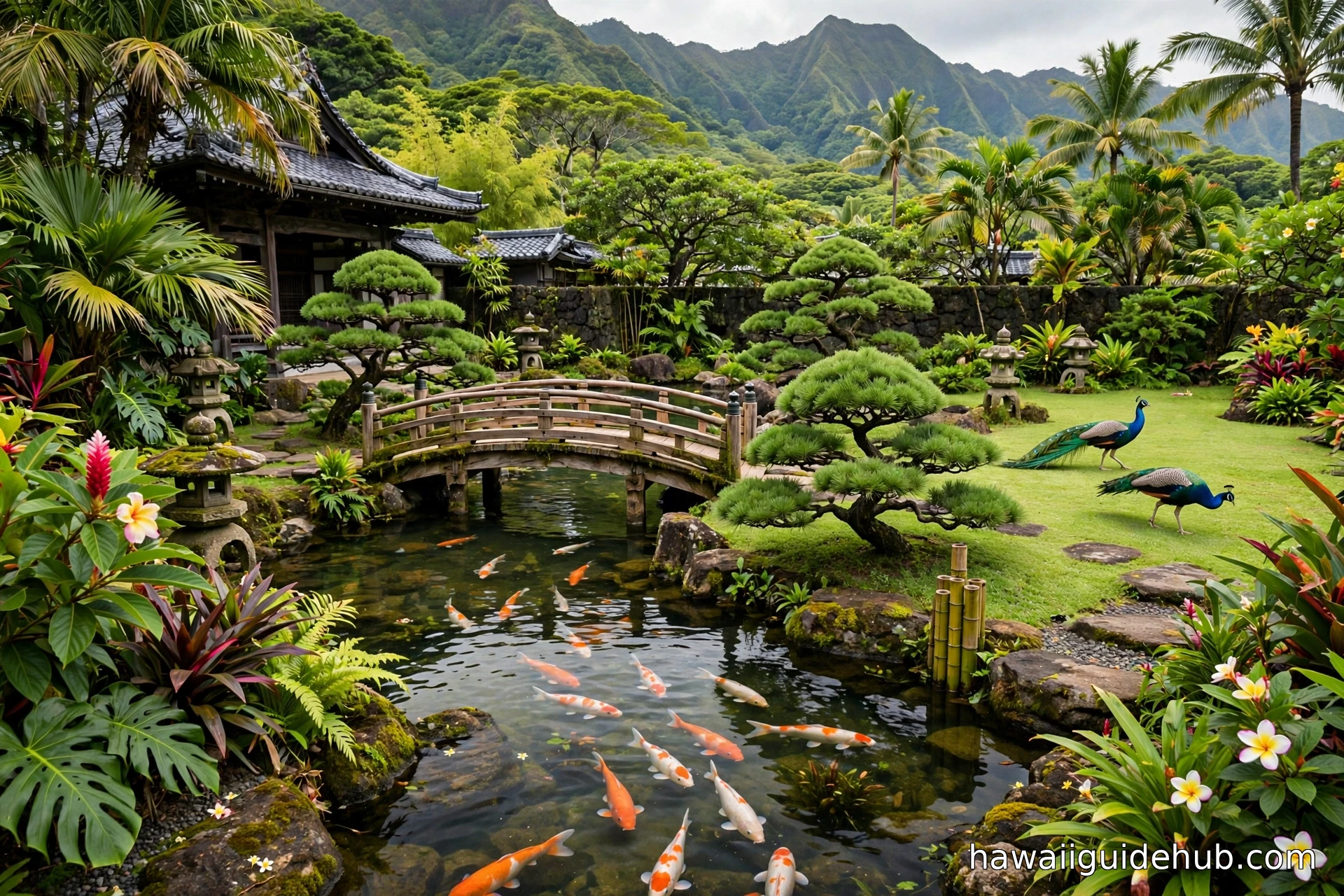
Outside the temple, the grounds unfold as a traditional Japanese garden wrapped around large reflecting ponds. The ponds cover roughly two acres and are stocked with hundreds of koi in orange, white, black, and gold. You can buy koi food at the gift shop and feed them from the pond’s edge, which is enormously popular with children. Do not bring outside food for the fish; the staff asks that visitors use only the food sold on site, and it keeps the pond’s ecosystem balanced.
Wandering the paths, you will find stone lanterns, a small arched bridge, manicured pines, and meditation niches tucked into the landscaping where you can sit undisturbed. The gardens are also home to peafowl that strut across the lawns with complete indifference to visitors, plus sparrows and the occasional mongoose darting through the undergrowth. The whole circuit takes 30 to 60 minutes at a relaxed pace, and the temple recommends arriving by about 3:30 PM so you are not hurrying through it.
Ringing the Three-Ton Peace Bell
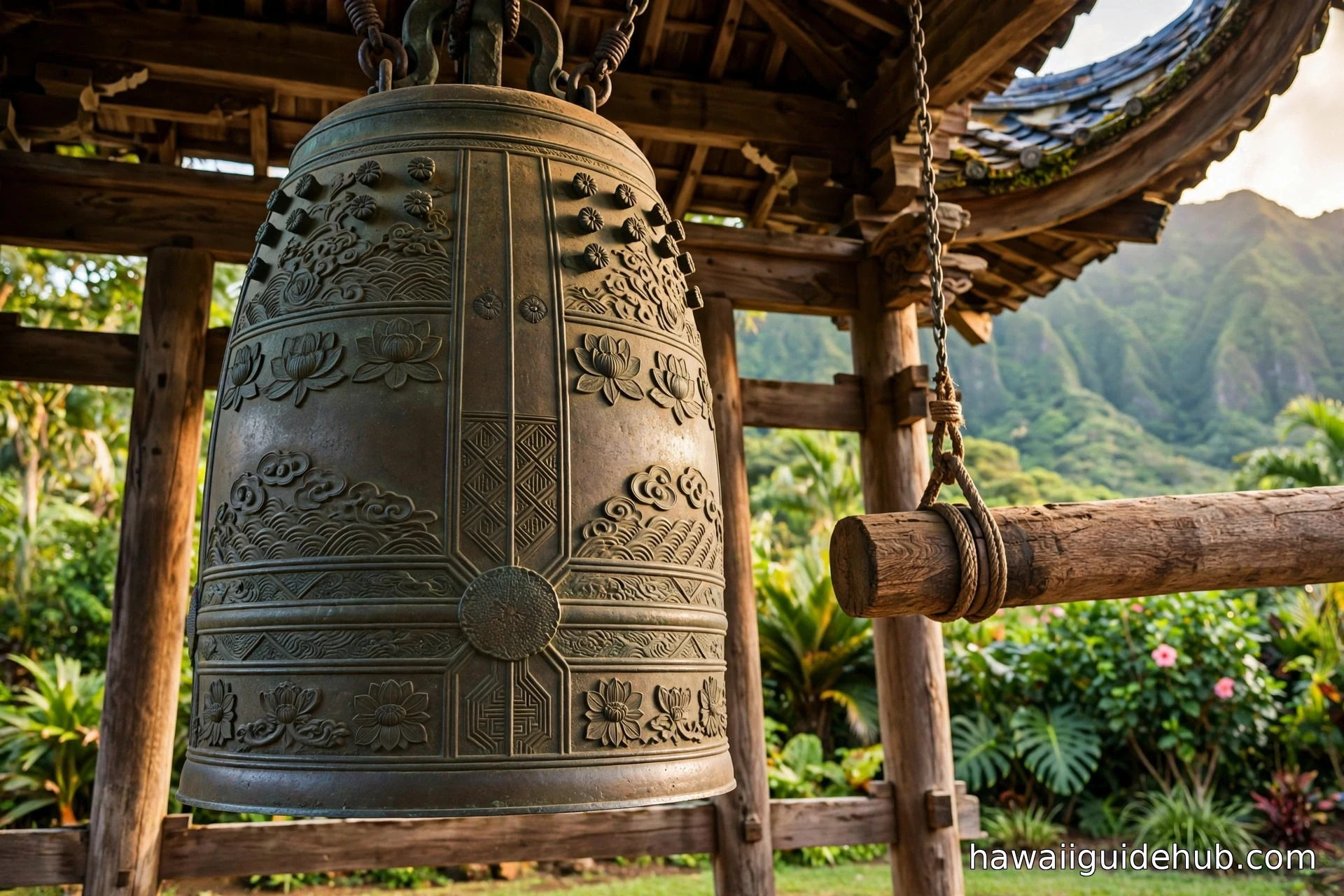
Before you reach the temple itself, stop at the belfry near the entrance. Hanging there is a three-ton brass peace bell, a bonshō cast with intricate lotus and wave patterns. Visitors are invited to ring it, and you should. Take the heavy wooden beam in both hands, draw it back, and let it swing firmly into the bell’s side. The tone is deep enough to feel in your chest, and it rolls out across the valley and up the cliff face.
Tradition holds that ringing the bell clears the mind and brings peace to all who hear it. One firm strike is the custom; this is not a gong to be pounded repeatedly. It is a lovely ritual to begin your visit with, a way of announcing to yourself that you have arrived somewhere set apart.
The Architecture Up Close
It is worth slowing down to look at how the temple is put together. The Phoenix Hall reproduces the original’s most famous feature: a symmetrical complex with a central worship hall, a corridor stretching to each side, and a tail corridor at the rear, all of it raised on a stone platform above the pond. The roofs are the signature element, broad planes of dark tile that curve upward at the corners in the classic irimoya style, and the two bronze phoenixes on the central ridge give the hall its name. The woodwork is finished in vermilion lacquer with white plaster panels, a color combination that reads as unmistakably Japanese even from across the water.
Everything here was built by Japanese craftsmen using traditional methods, without nails in the structural joinery. That is part of why the temple has weathered more than half a century of tropical sun and windward rain while still looking precise. Stand on the far side of the pond in the morning and watch the light move across the rooflines; photographers consider the first hour after opening the best time of day here, when the cliffs are still half in mist and the pond is glass.
Making a Morning of It: What to Combine Nearby
The temple sits in a part of Oʻahu that rewards slow exploration, and it pairs naturally with two nearby stops. Five minutes away is the Hoʻomaluhia Botanical Garden, a 400-acre garden at the foot of the same Koʻolau cliffs, with a lake, walking trails, and some of the finest mountain views on the island. Admission is free, and the contrast between the manicured Japanese garden of the temple and the sprawling tropical plantings of Hoʻomaluhia makes for a satisfying morning.
If you are hungry afterward, Kāneʻohe town has local plate-lunch spots and poke counters that the tour buses skip. Alternatively, continue north on Kahekili Highway toward Kualoa, where the highway hugs the coast with views across to Chinaman’s Hat. The whole windward loop, temple plus gardens plus coastline, makes one of the best half-day itineraries on Oʻahu, and it shows a side of the island that the Waikīkī strip never will.
Planning Your Visit: Hours, Admission and Etiquette
The temple grounds are open daily from 8:30 AM to 4:30 PM, with last entry at 4:15 PM. The gift shop keeps the same hours. The temple closes on Thanksgiving Day and Christmas Day, closes early on Thanksgiving Eve, Christmas Eve, and New Year’s Eve, and opens late on New Year’s Day. These holiday hours come straight from the temple’s official site, but it is always worth a quick check at byodo-in.com before you make the drive.
Admission is $10 for adults (ages 13 to 64), $8 for seniors 65 and older, $6 for children ages 2 to 12, with children under 2 free; kamaʻāina rates ($9/$7/$5) are available with a valid Hawaiʻi ID. Tickets can also be bought online ahead of time, and parking is $6 per vehicle.
A few points of etiquette will make your visit smoother. Remove your shoes before entering the temple hall. Dress modestly; this is a sacred space even if it is not an active temple. Speak quietly throughout the grounds. Buy koi food only from the gift shop. And remember that you are inside a memorial park, so the same respectful behavior you would bring to any cemetery applies on the paths and lawns.
A Note on the Setting
Some visitors feel uncertain about sightseeing inside a memorial park. The Valley of the Temples is an active cemetery, and the temple was deliberately placed within it as a spiritual anchor for the grounds. The arrangement is common in Japan, where temples and burial grounds have stood together for centuries. The staff and the families who come here to remember their loved ones are accustomed to visitors; all that is asked is the quiet, unhurried behavior the place naturally encourages anyway.
That contemplative quality is what separates the Byodo-In from Oʻahu’s other attractions. There is no performance here, no tour to catch, no line to stand in. You walk, you look, you sit for a while. If your trip has been all surf lessons and luaus, this is the counterweight. Our Oʻahu island guide places it among the island’s essential stops for exactly that reason.
The Temple on Screen
Film and television fans may recognize the temple before they ever arrive. It stood in for South Korea in an episode of Lost, appeared in Hawaii Five-0 and Magnum, P.I., and was used in the 2001 film Pearl Harbor as a stand-in for its Japanese namesake. The producers did not have to dress the set much. The temple already looks like a place out of time, which is precisely why cameras love it.
The Japanese connection runs deeper than film locations. The temple’s centennial dedication honored the Gannenmono and the generations that followed, whose influence on Hawaiʻi’s food, language, festivals, and daily life is everywhere once you start looking. For more on that history, see our guide to Hawaiʻi’s history before statehood and the story of the aloha spirit that shapes how visitors are welcomed here.
Watch: Walking Tour of the Temple Grounds
The Valley of the Temples rewards the visitor who slows down. Go early, walk the full loop of the gardens, ring the bell, sit for a few minutes in one of the meditation niches, and let the cliffs do what they have done for centuries: hold the noise of the world at a distance. Few places on Oʻahu offer that kind of stillness, and none of them look quite like this.