False Killer Whales in Hawaii: The Endangered Residents

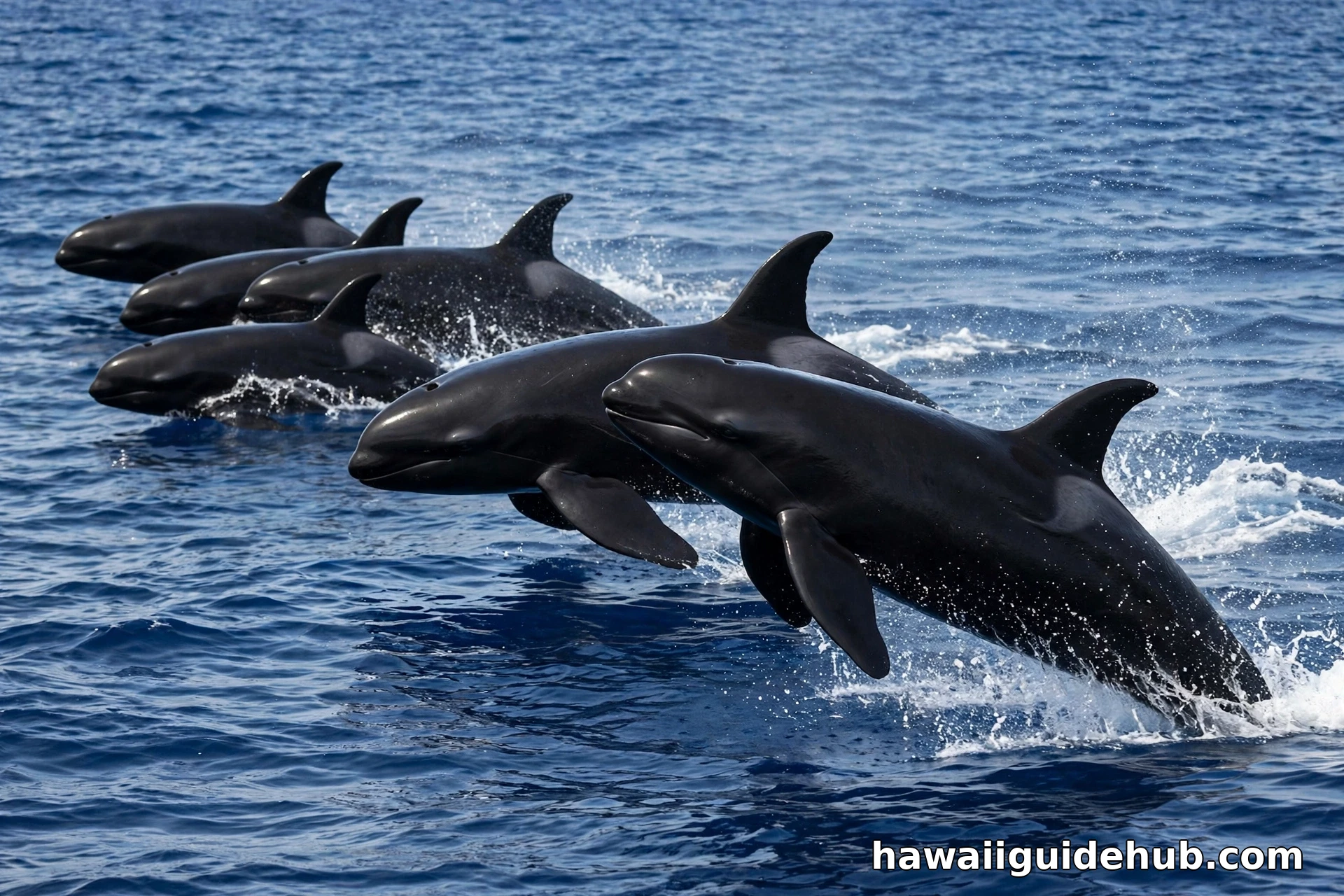
A long, black dorsal fin slices the surface off the Kona coast, followed by another, and another, until a dozen sleek dark bodies are porpoising in formation. Most people on the boat assume they are seeing killer whales, or maybe pilot whales. They are looking at something rarer: false killer whales, members of the only endangered population of their species anywhere on the planet. Around 150 of these animals spend their entire lives in the waters around the main Hawaiian Islands, and they are disappearing at roughly 3.5 percent per year.
This is the single complete guide to false killer whales in Hawaii. It covers what these animals are, the three distinct populations in Hawaiian waters, why the island-resident group is endangered, their cooperative hunting behavior, the conservation work trying to save them, and what visitors should know about seeing one. If you have been searching for anything about false killer whales in Hawaii, the answers are all here on this one page.
False Killer Whales at a Glance
| Fact | Detail | Why you should care |
|---|---|---|
| Scientific name | Pseudorca crassidens | “False” is in the name; dolphin is in the family |
| Family | Dolphin family, not true killer whales | Bigger than most dolphins, smaller than orcas |
| Size | Adults 12 to 20 feet, up to about 4,400 pounds | Among the largest dolphins on Earth |
| Hawaiian populations | Three: main-island insular, pelagic, Northwestern Hawaiian Islands | Only the insular group stays close to shore |
| Insular population | About 150 animals, endangered under the ESA | The whole resident population could fit in a small theater |
| Trend | Declining about 3.5 percent per year | Roughly five fewer animals each year |
| Diet | Mahi mahi, tuna, squid, other large fish | Apex predators of the open ocean |
| Social groups | Pods of 10 to 20, sometimes several hundred | Highly social animals |
| Key threats | Bycatch in fisheries, contaminants, low genetic diversity | Human-caused, which means human-fixable |
| Viewing odds | Low; offshore and rarely encountered by tourists | Any sighting is a once-in-a-trip moment |
What False Killer Whales Are
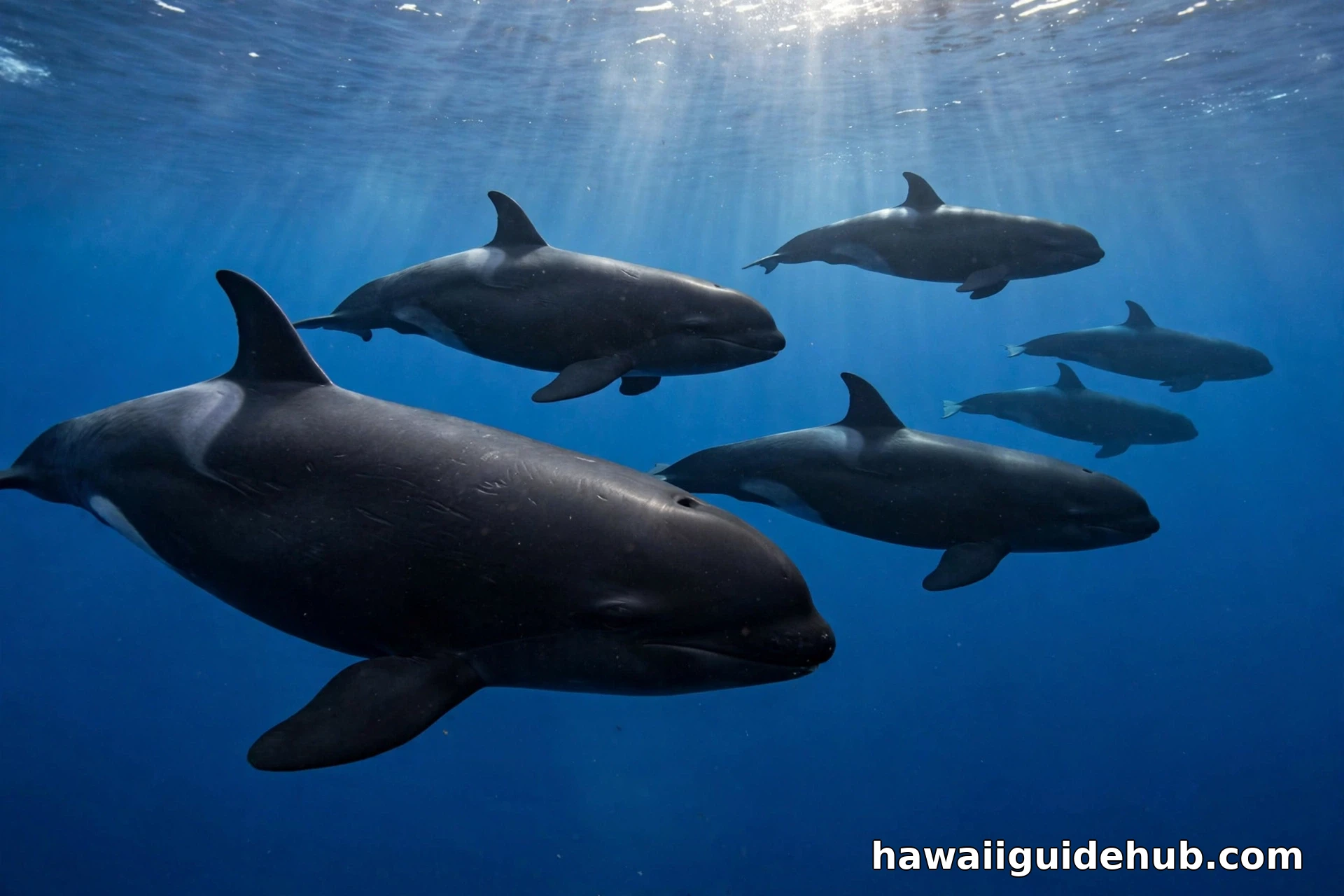
Despite the name, false killer whales are not closely related to true killer whales, though their skull shapes are similar. They are large members of the dolphin family, slender and almost entirely black, with long, sickle-shaped pectoral flippers and a rounded, conical head. Males can reach about 20 feet and 4,400 pounds, making them one of the largest dolphins in the ocean. They are fast, acrobatic, and intensely social, and NOAA researchers describe them as cryptic: even in waters they inhabit year-round, they are hard to find.
Reproduction is slow, which matters for a declining population. Females do not reach sexual maturity until around 12 years of age and typically have only one calf every six to seven years. When a population numbers only about 150 animals, losing even a few breeding females each year to fishing gear or disease can push the trend line downward for a decade. This slow life history is a big part of why the Hawaiian population cannot bounce back quickly.
Three Populations in Hawaiian Waters
NOAA recognizes three distinct populations of false killer whales in Hawaiian waters, and they are managed separately because they barely interact. The main Hawaiian Islands insular population is the resident group, the kamaʻaina. These animals live their whole lives around the populated islands, moving widely and quickly between them but staying close to shore. They do not socialize or breed with the other populations. In 2012, NOAA listed this group as endangered under the Endangered Species Act, making it the only endangered population of false killer whales in the world.
The pelagic population roams the open ocean beyond the islands and is far larger. The Northwestern Hawaiian Islands population inhabits the remote atolls and reefs stretching northwest of the main islands. Genetic studies show the insular population is distinct from both, with reduced genetic diversity that reflects its small size. For visitors, this distinction matters: the endangered animals are the ones hugging the main islands, exactly where boats, fishing gear, and coastal development are concentrated.
False Killer Whales vs. Their Look-Alikes
False killer whales are easy to misidentify, which is one reason sightings get underreported. The most common confusion is with short-finned pilot whales, another black, blunt-headed dolphin common in Hawaiian waters. Pilot whales have a thicker, more bulbous forehead, a stockier body, and a dorsal fin set farther forward that is broader at the base. False killer whales are slimmer, with a more conical head and a taller, more backswept dorsal fin. In a mixed sighting, size helps: pilot whale males can exceed 20 feet and look heavy, while false killer whales look athletic.
Melon-headed whales are smaller, usually under 9 feet, and travel in enormous pods of hundreds, a very different impression from a false killer whale group’s dozen or so animals. Pygmy killer whales are rarer and smaller still, with a more rounded head and a white patch on the belly. If you are on a boat and unsure, the rule of thumb is this: a sleek, all-black dolphin the size of a small car, in a tight group of 10 to 20, leaping and socializing far offshore, is most likely a false killer whale. Take the dorsal fin photo anyway; researchers can confirm the ID from the markings, and a confirmed sighting from a new area is valuable data.
Behavior: Cooperative Hunters of the Open Ocean
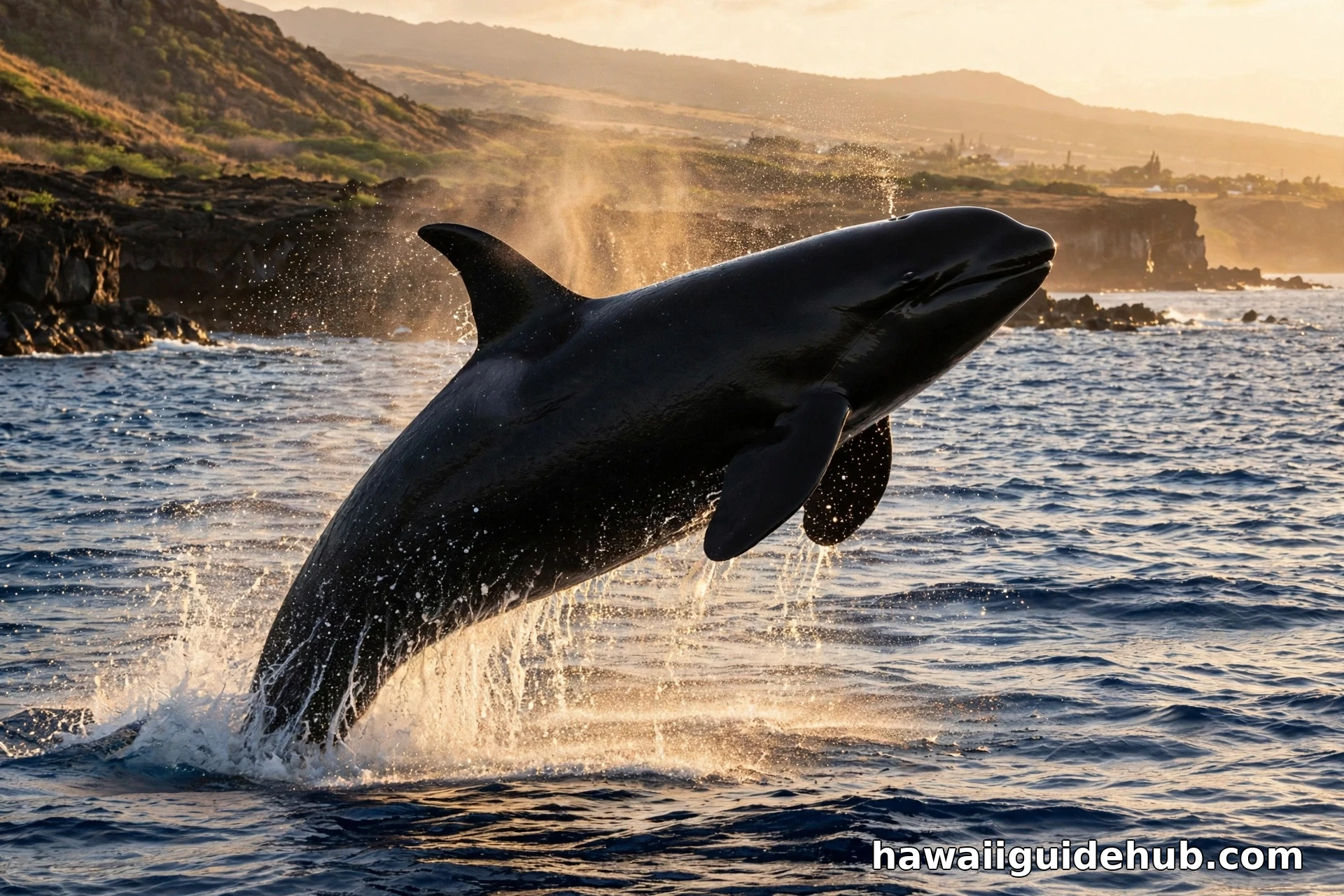
False killer whales hunt the way wolves do: together. They typically travel in groups of 10 to 20 but can gather in bands of several hundred when schooling fish are concentrated. Researchers and fishermen have watched them herd mahi mahi and tuna, take turns rushing the prey, and even throw fish into the air during the chase. They leap high out of the water while foraging, a behavior that makes a feeding group visible from a surprising distance.
Their taste for the same fish people target has put them in direct conflict with fisheries. False killer whales have learned to strip hooked tuna and mahi mahi straight off commercial longlines, a behavior called depredation. In response, some fishermen have retaliated, and the whales get hooked, entangled, or injured by gear. NOAA notes that high rates of dorsal fin disfigurement and mouthline injuries in the insular population point to fisheries interactions as one of the most significant threats to its survival. To address it, NOAA established a False Killer Whale Take Reduction Team to cut down the serious injury and death of these animals in Hawaii’s longline fisheries.
The depredation problem is expensive for everyone. A single false killer whale interaction can strip thousands of dollars of catch from a longline set, and the whales themselves risk hooking and entanglement every time they approach the gear. Researchers have tried acoustic deterrents, changes in fishing depth and timing, and modified hooks, with mixed results. The most promising path, according to the Take Reduction Team’s work, is cooperation: fishermen reporting interactions in real time so scientists can map hotspots, and gear modifications tested jointly rather than imposed. It is slow, adversarial work, but it is the only approach that has reduced bycatch in other fisheries, and the insular population does not have time for anything slower.
Why the Island Population Is Endangered
The numbers tell a stark story. Historical spotter-plane reports from the 1980s described aggregations of 350 to 400 false killer whales in a single area. Today the insular population is estimated at about 150 animals, and aerial survey data suggested it was falling at an average of 9 percent per year through the early 2000s. The current estimate is a decline of about 3.5 percent per year over the last decade. A 2010 Biological Review Team identified 29 threats, with the heaviest being the effects of small population size, including inbreeding depression, exposure to environmental contaminants, competition for food with commercial fisheries, and hooking, entanglement, or intentional harm by fishermen.
The small-population effects deserve a closer look. When only 150 animals remain, genetic diversity shrinks, making the population less resilient to disease and environmental change. Contaminants like PCBs and flame retardants accumulate in their blubber, passed from mother to calf through milk, potentially suppressing immune systems and reproduction. And because the insular whales live near the populated islands, they swim through the most contaminated, most heavily fished water in the archipelago. These threats compound one another: a whale weakened by pollutants is less likely to survive a fishing-gear injury, and a population with low genetic diversity is less likely to adapt.
Research and Conservation
Scientists know the insular population better than any other false killer whale group on Earth, largely through patient fieldwork. Researchers from the Pacific Whale Foundation and NOAA use photo identification, matching the unique nicks and scars on dorsal fins, to track individuals over years and estimate population size and survival rates. Satellite tags have revealed how widely and quickly the residents move between islands. Acoustic recorders pick up their distinctive clicks and whistles, helping scientists study the depredation behavior around longlines and design countermeasures with fishermen.
Citizen scientists have a real role here. Because the population is so small, every sighting helps. Researchers ask anyone on the water in Hawaii who spots false killer whales to report the location, especially in the Maui Nui region, where rapid-response teams can sometimes get to the animals for photo identification. If you photograph them, the dorsal fin shots are gold: unique markings let scientists name the individual and add it to the catalog. It is one of the few endangered species where a tourist’s vacation photo can become a data point.
Can You See False Killer Whales in Hawaii?
Honestly, probably not, and that is part of their mystique. False killer whales live offshore and are rarely encountered on standard whale-watching or snorkel tours, which is why most visitors never know they exist. Your best odds are on multi-hour pelagic wildlife or fishing-charter trips well offshore, particularly off Kona and in the channels between islands, and even then it is a lucky day. If you do encounter them, federal guidelines apply: keep your distance, never chase or encircle them, and let them approach the boat if they choose. The principles of responsible whale watching cover any cetacean encounter in Hawaii.
What you can do on every boat trip is keep your eyes open and your camera ready. A dorsal fin photo sent to researchers can help track this population. And if you are interested in Hawaii’s other offshore toothed whales, the melon-headed whale travels in huge pods in similar waters and is encountered more often. For those heading out with rods instead of binoculars, understanding deep-sea fishing in Hawaii includes knowing that the fish you are after are also the false killer whale’s dinner, which is exactly where the conflict begins.
Watch: False Killer Whales in the Hawaiian Islands
Frequently Asked Questions
Are false killer whales actually killer whales?
No. Despite the name and a similar skull shape, false killer whales (Pseudorca crassidens) are large dolphins, not closely related to true killer whales (Orcinus orca).
Why are false killer whales in Hawaii endangered?
The main Hawaiian Islands insular population, about 150 animals, was listed as endangered in 2012. Key threats are bycatch and injuries from fishing gear, competition for fish with commercial fisheries, environmental contaminants, and low genetic diversity.
How many false killer whales are left in Hawaii?
The resident insular population is estimated at about 150 individuals and is declining roughly 3.5 percent per year. Two other, larger populations also use Hawaiian waters but are not endangered.
Do false killer whales attack humans?
There are no documented attacks on humans in the wild. They are curious and have approached boats and divers, but they are not considered dangerous to people.
What do false killer whales eat?
Mostly large fish like mahi mahi and tuna, plus squid. In Hawaii they are known to take hooked fish off longlines, which brings them into conflict with fishermen.
The false killer whale is Hawaii’s quiet conservation emergency: an animal most visitors never see, found nowhere else in this form, slipping away a few percent at a time. Its future depends on unglamorous work, safer fishing gear, cleaner water, and patient research. The next time you are on a boat off Kona and a black fin cuts the swell, take the photo. It might be one of the 150, and it might be data.