
Moving to Hawaii with Dogs: The Complete Guide to Quarantine, Costs and Settling In

Picture this: you are watching the sun sink into the Pacific from a lanai, a trade wind ruffling the palms, and your dog is asleep at your feet. Moving to Hawaii with your dog is one of the great island dreams. But before the sunset naps, there is a gauntlet of paperwork, vet visits, and waiting periods that catches almost every newcomer by surprise. Hawaii is the only rabies-free state in the country, and it protects that status with the strictest pet import rules in the country. Get the process right and your dog walks out of the airport with you on arrival day. Get it wrong and your dog faces up to 120 days in a state quarantine kennel, at your expense, while you visit through a fence. This guide walks you through every step: the quarantine programs, the exact timeline, the costs, the flights, finding a rental that accepts dogs, and settling into island life together.
Why Hawaii’s Dog Rules Are So Strict
Hawaii has never had rabies. The islands’ isolation kept the virus out, and the state intends to keep it that way. Every dog, cat, and carnivore arriving from outside Hawaii must comply with the state’s import requirements under Hawaii Administrative Rules Chapter 4-29, no matter the animal’s age. Puppies and kittens are included. There are no exemptions for emotional support animals, and a dog that arrives without meeting the requirements will be quarantined for up to 120 days at the Animal Quarantine Station in Halawa Valley on Oahu.
The good news is that the state built a program for people who plan ahead. If you complete every requirement before you fly, your dog can be released directly to you at the airport after a short inspection. That program is called the 5-Day-Or-Less program, and its fastest track is Direct Airport Release.
The Two Paths: Direct Release or Quarantine
There are really only two outcomes when your dog lands in Hawaii. The first is Direct Airport Release, often called DAR. Your dog arrives at Daniel K. Inouye International Airport in Honolulu, passes an inspection, and walks out with you the same day. The second is quarantine at the Animal Quarantine Station, which can last up to 120 days. Which outcome you get is decided entirely by the paperwork and preparation you completed before boarding your flight. Nothing can be fixed on arrival day.
To qualify for the 5-Day-Or-Less program and direct release, your dog must meet every one of these requirements, in this order. Miss one and the 120-day quarantine applies.
1. Microchip first, before anything else
Your dog needs a working microchip, and it must be implanted before the qualifying rabies vaccinations are given. If your dog was vaccinated before being microchipped, those vaccinations do not count. The microchip number must appear on every document: the vaccination certificates, the blood test submission, the health certificate, and the import form.
2. Two rabies vaccinations, at least 30 days apart
Your dog must have received at least two rabies vaccinations in its lifetime, given at least 30 days apart, with the most recent one current and not expired. You will need the original certificates for the two most recent vaccinations. The state also requires a 30-day waiting period after the most recent vaccination before your dog can enter Hawaii.
3. The FAVN blood test and the 120-day wait
This is the step that surprises most people. After the vaccinations, your vet draws blood for an OIE-FAVN rabies antibody test, which must be processed by an approved laboratory such as Kansas State University. The result must show a passing titer of 0.5 IU/ml or higher. Then the real waiting begins: your dog cannot enter Hawaii until 120 days after the laboratory received the blood sample. The 120-day clock is non-negotiable.
4. Paperwork submitted more than 10 days before arrival
All documents must be received by the Animal Quarantine Station as a complete set more than 10 days before your dog arrives in Honolulu. That means the Dog and Cat Import Form (AQS-279), the two rabies vaccination certificates, and payment. The address is the Animal Quarantine Station, 99-951 Halawa Valley Street, Aiea, Hawaii 96701. Send it by mail with return receipt or an overnight carrier with tracking. Faxes and photocopies are not accepted.
5. Health certificate within 14 days of travel
Your vet must issue a health certificate within 14 days before your arrival in Hawaii. Time this one carefully, since it sits at the very end of a months-long process and expires quickly.
6. Fees paid in full
Payment must be made in full before your pet is released. The fee is $185 per pet for Direct Airport Release at Honolulu, or $244 per pet for the 5-day-or-less program. Payment is by cashier’s check or money order only, made payable to the Department of Agriculture. Personal checks are not accepted. Include your pet’s microchip number with the payment so it is credited correctly.
Your Timeline: Start 6 to 10 Months Before Moving Day
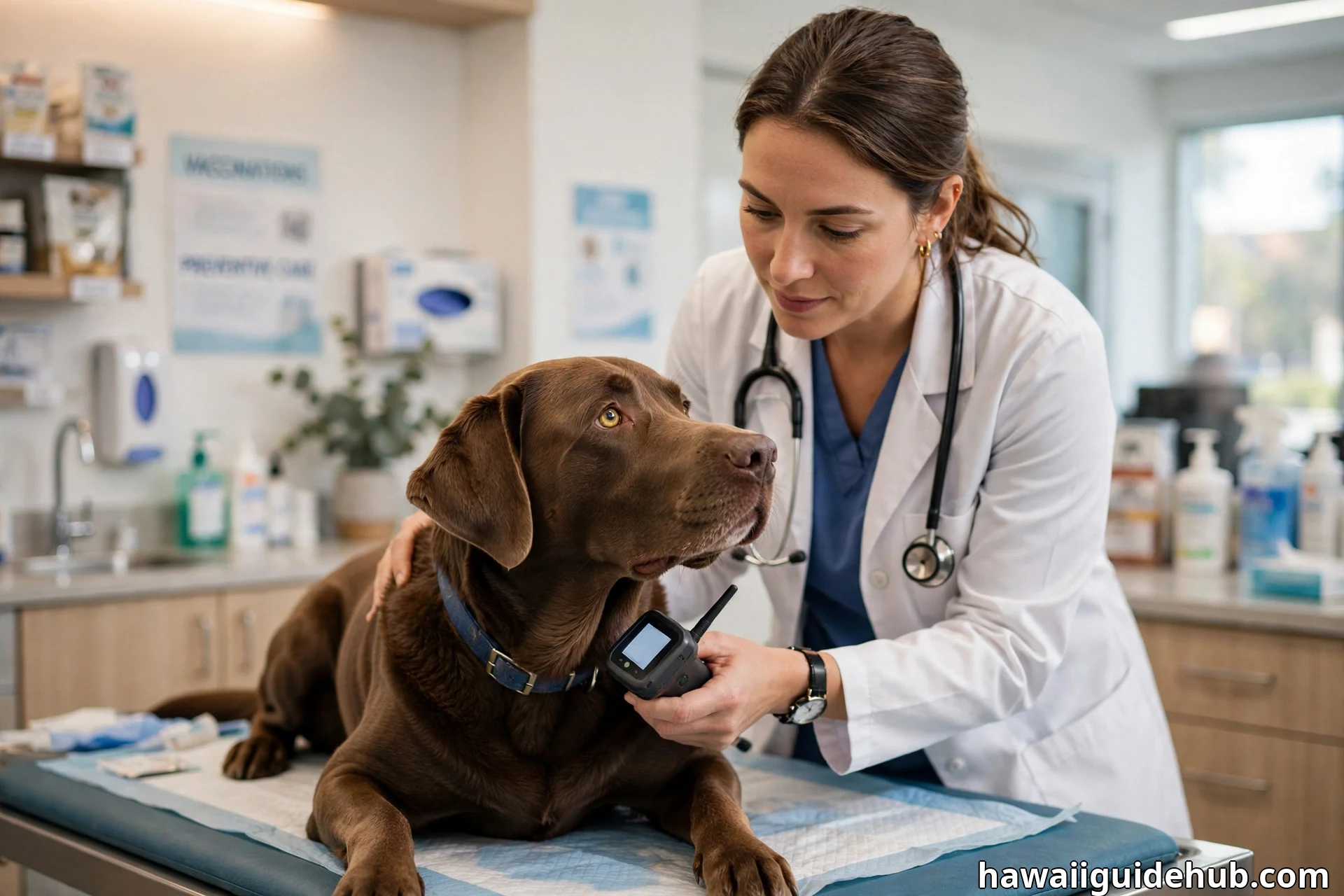
Work backward from your arrival date. For an adult dog with at least one prior rabies vaccination, the minimum preparation time is about four months, and most owners need six to seven once vet scheduling, lab processing, and the document submission window are factored in. For a puppy or a dog starting from zero, plan on ten months. Here is how a typical seven-month timeline looks:
- Month 1: Microchip your dog if not already chipped. Get the first qualifying rabies vaccination. Confirm with your vet that the chip is readable and recorded.
- Month 2: Second rabies vaccination, at least 30 days after the first. Ask your vet about waiting 20 or more days after this vaccine before the blood draw, which gives the best chance of a passing titer.
- Month 3: Blood draw for the FAVN test. Your vet submits it to the approved lab. The 120-day clock starts when the lab receives the sample, not when the blood is drawn.
- Months 4 to 6: Wait. Use this time to book flights, research pet-friendly housing, and buy an airline-approved crate.
- 3 to 4 weeks before flying: Assemble the complete document set and mail it to the Animal Quarantine Station with tracking, so it arrives more than 10 days before your dog does.
- Within 14 days of flying: Vet visit for the health certificate.
- Arrival day: Land at Honolulu during inspection hours with all original documents in hand as backup.
If your dog arrives between 5:00 PM and 8:00 AM, or on a weekend or state holiday outside the holding facility’s pickup hours, your pet will be transferred to the Animal Quarantine Station and entered under the 5-day-or-less program rather than released at the airport. Plan your flight to land during the day on a weekday if you want the smoothest possible release.
What It Costs to Bring Your Dog to Hawaii
Doing everything right still costs real money. Budget for the full picture, not just the state fees:
- State fees: $185 for Direct Airport Release or $244 for the 5-day-or-less program, per pet, paid by cashier’s check or money order.
- Vet costs: two rabies vaccinations, the microchip if needed, the FAVN blood draw and lab fee, and the final health certificate. Expect several hundred dollars depending on your vet.
- Airline pet fees: most airlines charge $125 to $200 each way for in-cabin pets and $200 to $500 or more for cargo, depending on the size of the crate.
- Crate: an airline-approved hard-sided kennel large enough for your dog to stand, turn, and lie down, often $75 to $250 for medium and large dogs.
- If you miss a requirement: the 120-day quarantine program costs up to $1,082 per pet, plus $14.30 per day for early arrival before eligibility. That is on top of the heartbreak of a four-month separation.
All in, most owners spend roughly $600 to $1,200 per dog when everything goes to plan. There are no multi-pet discounts, so multiply accordingly for two or more dogs.
Flying With Your Dog: Airline Rules
Airlines have their own rules on top of the state’s, and they change, so confirm everything directly with your carrier before booking. A few things that trip people up:
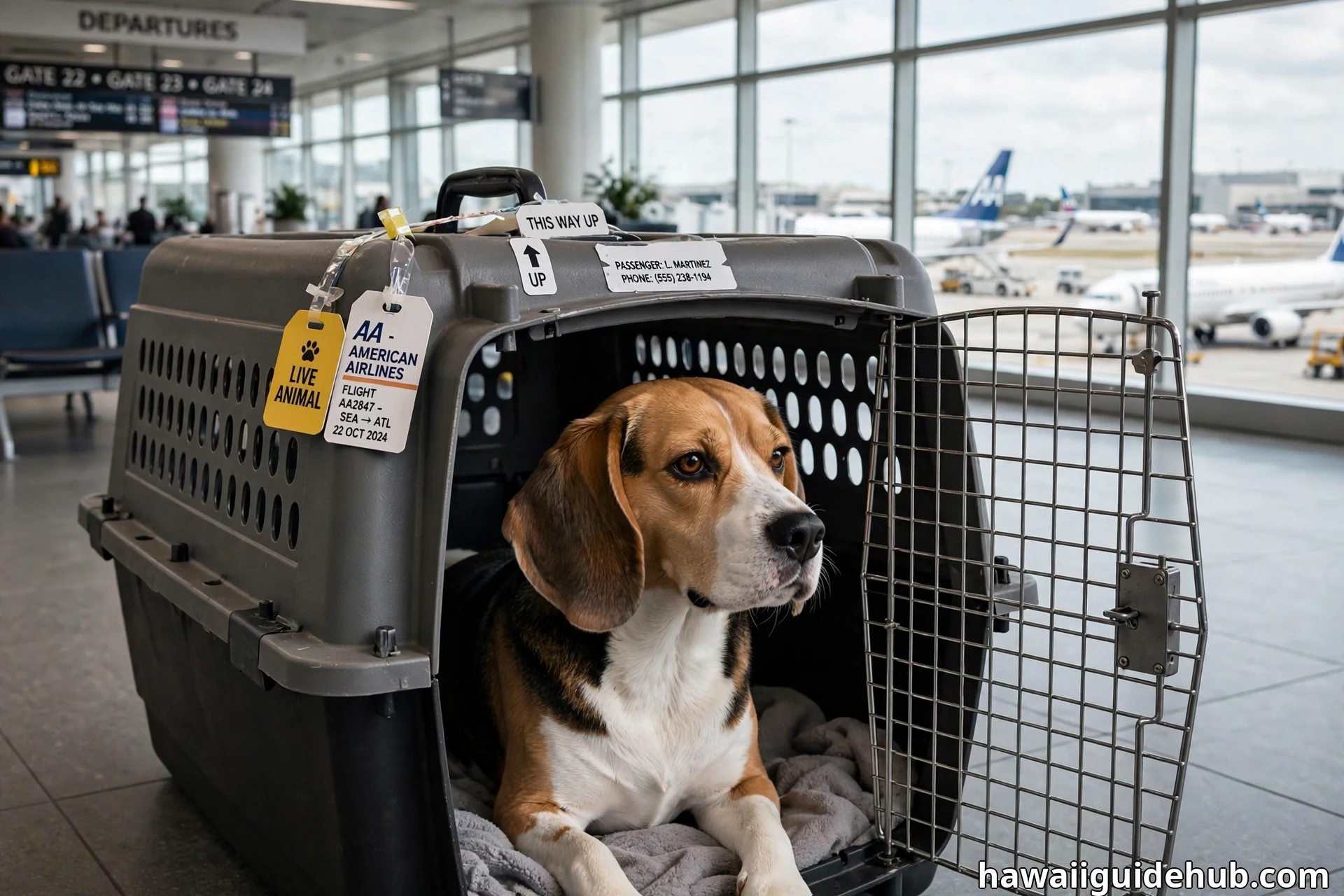
- In-cabin vs. cargo: small dogs that fit in a carrier under the seat can fly in the cabin on many airlines, but weight limits are strict, often around 20 pounds for the dog plus carrier combined. Larger dogs must fly as checked baggage or cargo in a hard-sided, airline-approved crate.
- Breed restrictions: many airlines restrict or refuse brachycephalic (short-nosed) breeds like bulldogs, pugs, and Boston terriers because of breathing risks at altitude.
- Book the pet spot early: airlines limit the number of animals per flight. Reserve your dog’s spot when you book your own ticket.
- Direct flights matter: a nonstop flight to Honolulu is far less stressful for your dog than connections, and it keeps your arrival timing predictable for the airport inspection.
- Summer heat embargoes: airlines often refuse to fly pets as cargo during hot months. Ask about seasonal restrictions before you book.
On flight day, exercise your dog well before the airport, attach food and water dishes to the crate, and tape a copy of the health certificate and your contact information to the top.
Arriving on a Neighbor Island
Direct Airport Release inspections happen at Honolulu International Airport on Oahu. If you are moving to the Big Island, Maui, or Kauai and want to fly your dog directly there, you need a Neighbor Island Inspection Permit, arranged in advance with an approved veterinary inspector on that island. Without it, your dog must clear through Honolulu first. If your final home is on a neighbor island, look into this permit early. Our best island for first-time visitors guide can help you think through which island fits your life.
Finding Dog-Friendly Housing in Hawaii
The quarantine is only the first hurdle. Hawaii’s rental market is tight, and pet-friendly rentals are a smaller slice of it. Many landlords limit the number, size, or breed of dogs, and pet deposits are standard. A few practical tips from people who have done it:
- Start the housing search early and filter for pet-friendly listings from day one. On a tight timeline, some newcomers book a pet-friendly vacation rental for the first month while they search in person.
- Prepare a pet resume: a one-page summary with your dog’s photo, age, weight, vaccination record, training, and a reference from a previous landlord goes a long way with hesitant property managers.
- Offer a larger deposit or pet rent if the listing is on the fence. Money talks in a competitive market.
- Condos and HOAs often have their own pet rules separate from the landlord, including weight limits and breed restrictions. Always check the building’s rules, not just the rental ad.
- Yard space is rare in many island neighborhoods. If your dog needs room to run, prioritize ground-floor units or homes over high-rise condos, and map the nearest dog park before you sign.
Settling In: Vets, Parks, and Island Dog Life
Once you are through the airport with your dog, island life begins. A few things to know:
- Find a vet fast: register with a local veterinarian within the first weeks. Ask about heartworm prevention, which matters year-round in Hawaii’s mosquito climate, and about leptospirosis vaccination, which many island vets recommend.
- Beaches are mostly off-limits: most public beaches in Hawaii do not allow dogs, and the rules are enforced with fines. Each county publishes its own list of where dogs are and are not permitted, so check before you go. Off-leash dog parks exist on every island and are the reliable option for off-leash play.
- Heat and paws: lava rock, sand, and asphalt get dangerously hot by midday. Walk early in the morning or late in the afternoon, and test surfaces with your hand first. Hawaii’s year-round warmth means there is no cool season for your dog to acclimate, so watch for overheating, especially in thick-coated breeds. If you are wondering what time of year it rains in Hawaii, the wetter winter months can actually be the most comfortable walking season.
- Hiking together: many island trails welcome leashed dogs, and hiking is one of the best parts of dog ownership in Hawaii. Check trail rules before you go, carry more water than you think you need, and watch for wild pigs on rural trails. Our guide to outdoor adventures across Hawaii is a good starting point for planning dog-friendly outings.
- Keep the chip registered: make sure your dog’s microchip registration shows your new Hawaii address and phone number from day one.

Watch: How to Avoid Pet Quarantine in Hawaii
Frequently Asked Questions
How long does it take to bring a dog to Hawaii?
For an adult dog with prior rabies vaccinations, plan on four to seven months. For a puppy starting from zero, about ten months. The longest fixed wait is the 120 days after the FAVN blood sample reaches the lab.
Can my dog skip quarantine entirely?
Yes, through Direct Airport Release. If every requirement is completed before arrival and documents are received more than ten days ahead, your dog is inspected at Honolulu airport and released to you the same day.
What happens if I miss a requirement?
Your dog enters the state quarantine program for up to 120 days at the Animal Quarantine Station in Halawa Valley, at your expense, up to $1,082 in fees.
Are some dog breeds banned in Hawaii?
Non-domestic dogs and hybrids such as wolf crosses and dingoes are prohibited. Airlines restrict short-nosed breeds, and landlords commonly impose their own breed and weight limits.
Can I fly my dog directly to Maui, Kauai, or the Big Island?
Only with a Neighbor Island Inspection Permit arranged in advance. Otherwise your dog must clear through Honolulu first.
Do the same rules apply to cats?
Yes. Hawaii’s import rules cover all dogs, cats, and carnivores identically.
Moving to Hawaii with a dog takes months of planning, a stack of paperwork, and a real budget, but thousands of owners do it every year and would tell you it was worth it. Start the clock early, follow the state’s checklist to the letter, and keep the Animal Quarantine Station’s number handy: (808) 483-7151. If you are still deciding where to land, our Oahu island adventure guide and our roundup of must-try local dishes in Hawaii will help you picture daily life once the paperwork is behind you. Do the preparation right, and your dog’s first Hawaiian sunset will be with you, not behind a kennel fence.