Lei Etiquette: How to Receive, Wear, and Honor a Hawaiian Lei

There is a moment almost every visitor to Hawaii remembers: someone steps forward, smiles, and drapes a fragrant ring of flowers over your shoulders. It is warm. It is personal. And it comes with a set of quiet traditions that most visitors never hear about. Getting lei etiquette right is not complicated, but it matters. A lei is not a souvenir trinket or a costume prop. In Hawaiian culture it is a circle of love, given and received with intention, and treating it with respect is one of the simplest ways to honor the spirit of aloha.
This guide covers everything about lei etiquette: how to spell lei in Hawaii, how to receive one, how to wear it, and what to do with a lei, including old leis that have wilted.
Lei Etiquette at a Glance
| The moment | The respectful move |
|---|---|
| Receiving a lei | Bow your head slightly and let the giver place it over your shoulders; never refuse, it is a high honor |
| Wearing it | Draped over both shoulders, front and back |
| Taking it off | Do not remove it in front of the person who gave it to you |
| When you’re done with it | Return it to the earth, a tree, or the sea; never throw it in the trash |
| If you’re expecting | Receive an open (untied) lei, never a closed circle |
How Do You Spell Lei in Hawaii?
It is spelled lei, L-E-I. It is pronounced exactly like the English word “lay,” which is why visitors often write it phonetically and get it wrong.
The word lei refers to a garland or wreath worn around the neck. The plural is also lei, one lei, many lei. Getting the spelling right is a small sign of respect. It shows you understand that a lei is a specific cultural tradition with a proper name.
What a Lei Really Means
To understand lei etiquette, you first need to understand what a lei is. Ancient Polynesians wore lei long before Europeans arrived in the Pacific, and Native Hawaiians used them to mark rank, honor guests, and pay respect to the gods.
A lei is a circle, and the circle matters. It has no beginning and no end, and Hawaiians see it as a symbol of unbroken love and connection between the giver and the receiver. When someone places a lei over your shoulders, they are wrapping you in that circle. This is why the rules around giving, wearing, and disposing of lei are treated so seriously. The concept of aloha runs deeper than a simple greeting, and the lei is one of its most physical expressions.
Lei are given for almost every meaningful occasion in island life: birthdays, graduations, weddings, anniversaries, arrivals, farewells, retirements, and memorials. At Honolulu airport you will still see greeters holding name signs and armfuls of fresh flower lei, continuing a tradition that started when visitors arrived by steamship in the early 1900s.
How to Receive a Lei
Receiving a lei is the part of the tradition most visitors encounter first, and it is also where most mistakes happen. The custom is simple: when someone offers you a lei, bow your head slightly and allow the giver to place it over your shoulders. Do not reach for it. Do not duck away. Let the moment happen.

Never refuse a lei. This is the single most important rule of lei etiquette. In Hawaiian culture, receiving a lei is a high honor, and refusing one is seen as rejecting the giver’s love and respect. Even if you feel awkward, accept the lei with gratitude. A smile and a sincere mahalo go a long way.
If you genuinely cannot wear the lei, for example because of a severe allergy, explain the situation kindly rather than simply pushing it away. Traditional practice makes room for this: a lei you cannot wear can be displayed in a place of honor, such as draped over a chair, hung in your room, or placed somewhere you will see it. The point is to honor the gift, not to suffer for it.
You will often see the giver lean in for a kiss on the cheek after placing the lei. This warm gesture became part of the modern tradition during World War II. You do not have to kiss back if you are uncomfortable, a warm smile and thanks are perfectly fine.
How to Wear a Lei Properly
Wearing a lei correctly is about placement. A neck lei should drape evenly over both shoulders, with part of the lei hanging down your chest and part resting against your back. Think of it as a sash, not a necklace. Bunching the whole lei up around your neck like a scarf looks wrong and misses the point of the design, which is meant to fall naturally on both sides.
Once the lei is on, keep it on. Hawaiians consider it unkind to remove a lei in the presence of the person who gave it to you. Taking it off in front of them can look like dissatisfaction with the gift. Wear it proudly while the giver is around. You can respectfully remove it later, once you are no longer in their company.
Lei and Pregnancy: The Open Lei Tradition
There is one specific tradition that visitors should know about: by custom, only open lei are given to a pregnant or nursing woman. An open lei is one whose ends are not tied into a closed circle. A closed lei, the standard ring shape, is traditionally avoided for hapaʻi (pregnant) women because the unbroken circle is believed to symbolize the umbilical cord wrapping around the baby’s neck.
Whether or not you share this belief, the custom is widely observed in Hawaii. If you are pregnant and receive a lei, you will likely notice it is an open style that drapes rather than encircles. This is not a mistake. It is a thoughtful gesture of care.
Types of Lei You Will Encounter
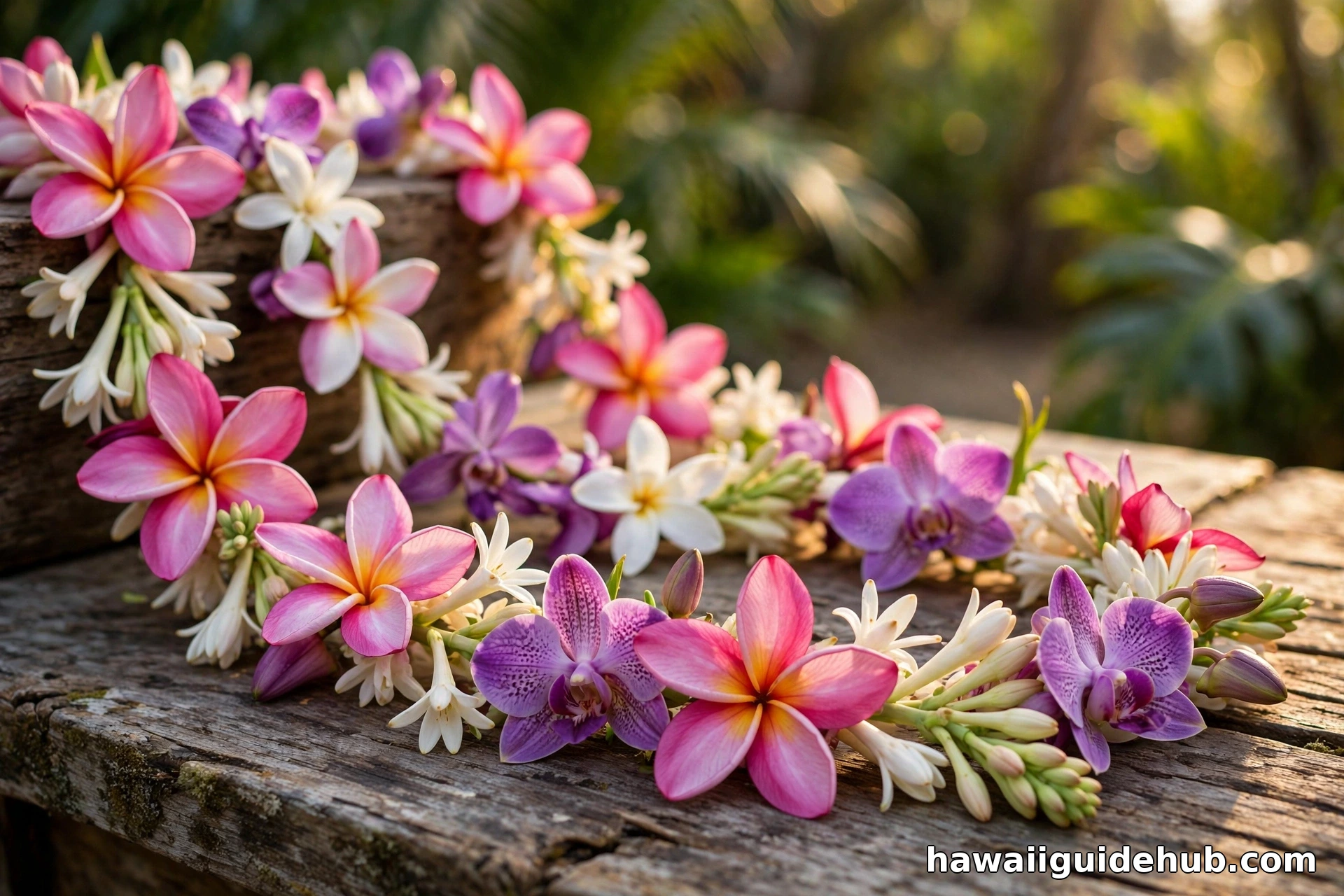
Not all lei are made of flowers, and knowing the main types helps you appreciate what you have received. Fresh flower lei are the most famous: plumeria with its sweet perfume, orchids in vivid purples and whites, tuberose with its intense fragrance, and tiny pikake jasmine blossoms. Each flower has its own character. Pikake and tuberose are among the most fragrant but also the most delicate, while orchid lei last longer and travel better.
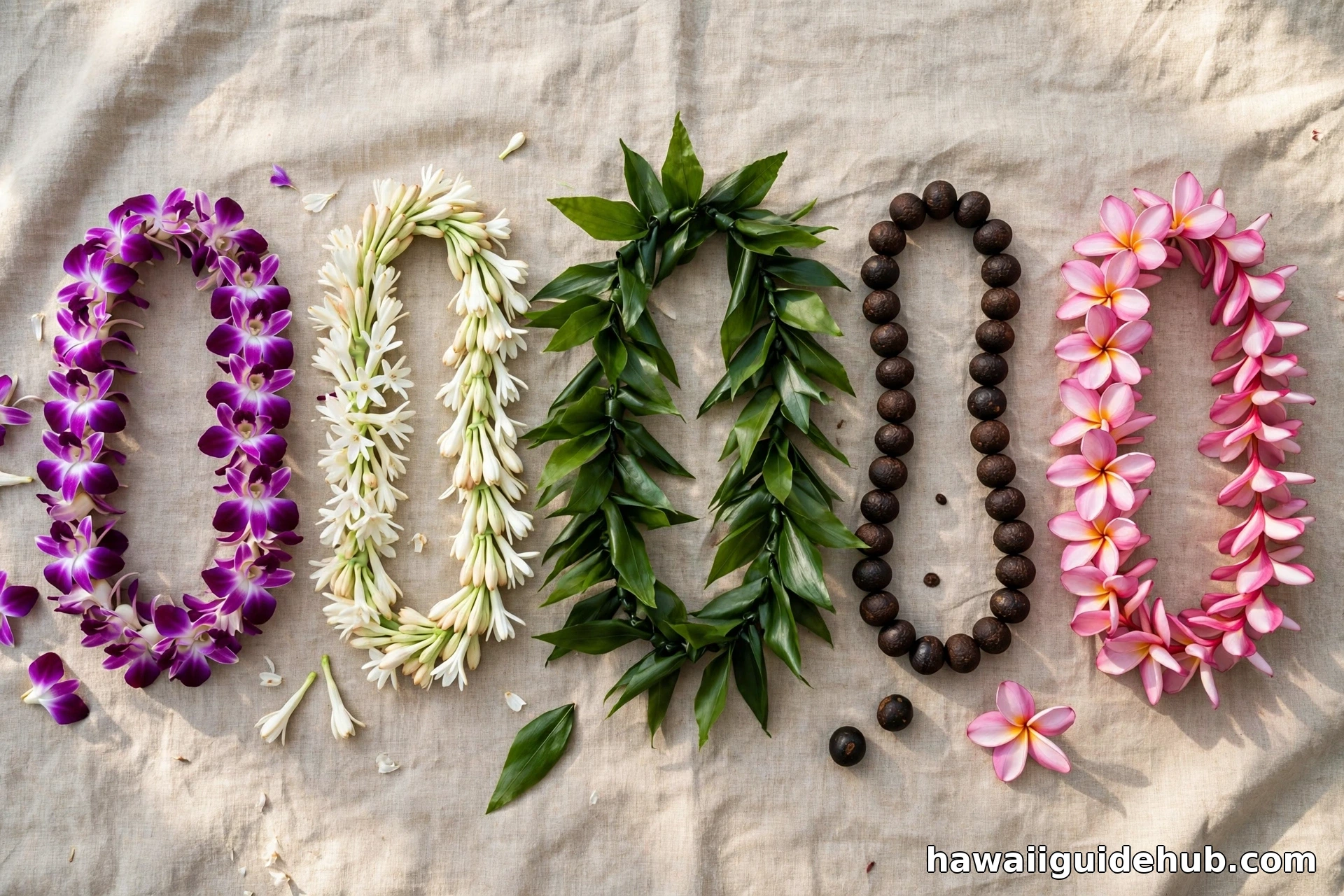
Leaf lei are a whole tradition of their own. The maile lei, made from a fragrant native vine, is sacred and reserved for important occasions like weddings and graduations. Ti leaf lei, braided from glossy green leaves, are hardy and long-lasting. Then there are the durable lei: kukui nut lei strung from polished candlenuts, and shell lei made from tiny sunrise or puka shells. These do not wilt, which makes them popular as keepsakes.
You will also see modern ribbon and yarn lei, especially at graduations, where they are often made in school colors and sometimes strung with candy or money. These are festive rather than traditional, but they follow the same etiquette of gracious giving and receiving. If you are attending a luau, a fresh flower lei is the classic choice to match the occasion.
When Lei Are Given
Lei mark the milestones of island life. Graduations are perhaps the most spectacular: in Hawaii, graduates are often buried shoulder-deep in dozens of lei from family and friends, a visible mountain of love and pride. Weddings feature lei for the couple and the wedding party, with maile lei holding special significance for the groom. Birthdays, anniversaries, retirements, and new babies all call for lei.
Arrivals and farewells have their own lei customs. The airport greeting remains one of Hawaii’s most beloved traditions, and many visitors arrange a lei greeting in advance so the flowers are waiting at baggage claim. At memorial services, white and pale-colored lei are traditional, symbolizing purity and peace.
May Day is Lei Day in Hawaii, celebrated every May 1 with lei-making contests, concerts, and pageantry honoring the craft. It was first celebrated in 1928 and officially proclaimed in 1929, and it remains one of Hawaii’s most charming cultural celebrations.
The Art of Lei Making
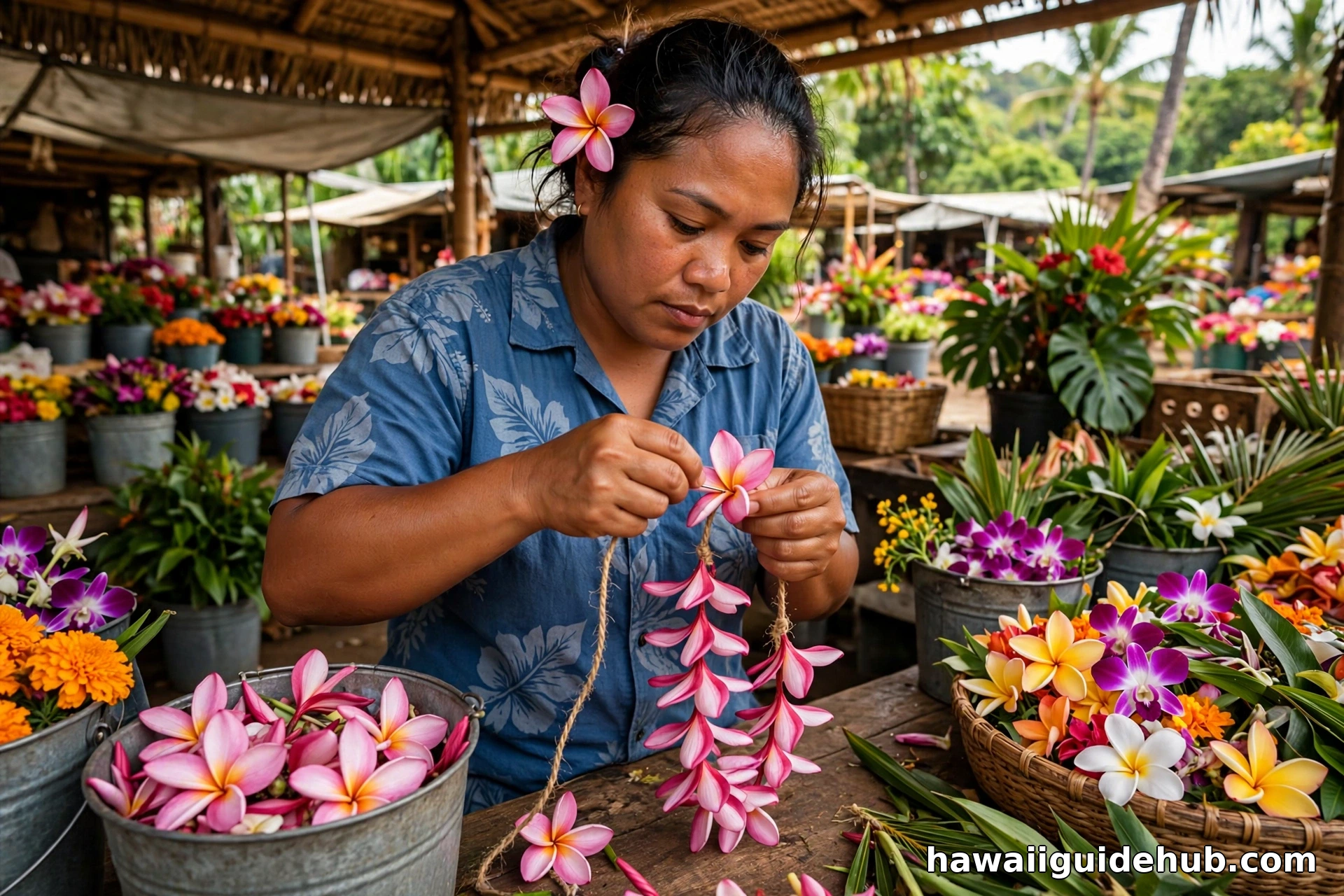
Every fresh lei you receive was made by hand, flower by flower. Lei making is a skilled craft: makers string hundreds of blossoms onto cord with a long needle, braid vines like maile into intricate patterns, or weave ti leaves into geometric designs. A single elaborate lei can take hours to complete.
Honolulu’s Chinatown is famous for its lei shops, where fourth-generation makers still craft lei daily in open-air storefronts heavy with perfume. Buying directly from these shops supports the living tradition and the families who keep it alive. Lei making sits alongside hula and chant as one of Hawaii’s great living arts, passed down through families for generations.
What to Do With a Lei
So the celebration is over and you are holding a beautiful lei. What now? What to do with a lei is governed by the same respect that governs receiving one. The golden rule is simple: never throw a lei in the trash. Because a lei represents the giver’s love, tossing it into a garbage can is seen as throwing that love away. It is one of the rudest things you can do with a lei, even if no one is watching.
Instead, tradition says a lei should be returned to the earth. The classic methods are hanging it in a tree, burying it, or burning it. Each returns the natural materials to nature with dignity. If your lei came from the ocean, such as a shell lei, it can be returned to the sea. For flower lei, many people place them in a garden, on a hiking trail, or in a park, somewhere the blossoms can rest naturally.
One practical note: remove anything that is not natural before returning a lei to nature. Take off the string, ribbon, wire, or plastic picks. Flowers and leaves only. This matters especially for ocean farewells, where string and ribbon can harm sea life.
What to Do With Old Leis
What to do with old leis that have wilted follows the same principle. A faded lei is not garbage. It is a gift that has finished its first life, and it deserves the same respectful farewell. Hang the old lei in a tree, bury it in soil, or burn it. Many locals drape wilted lei over statues or leave them in places of personal meaning, letting them return to the landscape gradually.
Some people keep their old lei much longer than you might expect. Fragrant lei like tuberose and pikake can be hung in a window or in the car to dry, and they will perfume the air for weeks as they fade. Kukui nut and shell lei last indefinitely and are meant to be kept.
If you would rather preserve a fresh lei than retire it, refrigeration helps. Coil the lei gently, place it in a sealed plastic bag with a lightly damp paper towel, and store it in the fridge. Orchid and ti leaf lei are the hardiest, while delicate pikake and ginger fade fastest.
Can You Take a Lei Home?
Many visitors want to bring their lei home, and often you can. Fresh lei can travel to the US mainland, but they must pass agricultural inspection at the airport, and not all materials are allowed. Citrus flowers and leaves, gardenia, jade vine, and Mauna Loa are restricted. Ginger, tuberose, maile, and orchid lei are generally fine as long as they clear inspection.
The practical move is to ask your lei seller before you buy. Honolulu lei shops deal with this question daily and will tell you honestly which lei can fly. If your heart is set on a particular lei for someone back home, buy it close to your departure and keep it refrigerated until you leave.
One more tradition worth knowing: if you do take your lei home and it eventually wilts there, the same rule applies. Do not bin it. Return it to the earth wherever you are.
Watch: The Story of the Lei
Seeing the tradition in motion helps everything click. This short video explores why the lei is everywhere in Hawaii and what it means to the people who make, give, and wear them.
Lei Etiquette FAQs
How do you spell “lay” in Hawaii?
It is spelled lei, pronounced like “lay.” The plural is also lei. Writing “lay” is a common visitor mistake, but the correct Hawaiian spelling is always L-E-I.
Is it rude to refuse a lei?
Yes. Refusing a lei is considered deeply disrespectful in Hawaiian culture, because the lei represents the giver’s love and honor. Always accept with gratitude. If you cannot wear it for a genuine reason like an allergy, explain kindly and display it in a place of honor instead.
How do you wear a lei properly?
Drape it over both shoulders so it hangs down your chest in front and rests against your back, like a sash. Do not bunch it around your neck. Keep it on while the giver is present, and remove it respectfully later.
What should you do with a lei when you are done with it?
Never throw it in the trash. Return it to nature by hanging it in a tree, burying it, or burning it. Flower lei can be placed in the ocean only after removing all string, ribbon, and non-natural materials. Fragrant lei can also be hung to dry as a keepsake.
What do you do with old wilted leis?
Treat them with the same respect as a fresh lei. Hang old leis in a tree, bury them, or burn them to return them to the earth. Many people dry fragrant lei in a window or car, where the scent lingers for weeks. Kukui nut and shell lei last indefinitely and are meant to be kept.
Why do pregnant women receive a different kind of lei?
By tradition, pregnant (hapaʻi) or nursing women are given an open lei with untied ends rather than a closed circle. The unbroken ring is believed to symbolize the umbilical cord wrapping around the baby’s neck. Lei makers in Hawaii observe this custom as a matter of course.
Carrying the Tradition Forward
Lei etiquette is not a list of traps waiting to catch visitors. It is an invitation to take part in something genuine. Bow your head, accept with warmth, wear the lei proudly, and when its time comes, return it to the earth with the same care it was given. Hawaii’s traditions survived suppression and change because people kept practicing them with intention.
The next time someone steps forward with a circle of flowers, you will know what to do. And you will know why it matters.