The Shaka Sign: Meaning, History and How to Do It

You will see it before you even leave the airport. The baggage handler flashes it as your suitcase rolls past. The shuttle driver throws one up in the rearview mirror. By the time you reach your hotel, a dozen strangers will have greeted you with the same loose flick of the wrist: thumb and pinky out, middle fingers tucked away. It looks simple, and it is, but the shaka carries more history in one hand gesture than most state flags manage in a whole design.
Visitors pick it up fast. Within a day, most tourists are throwing shakas back at every friendly local they meet, sometimes with more enthusiasm than accuracy. But the gesture most people call “hang loose” has a real origin story rooted in a sugar mill accident on Oahu’s North Shore, a name with mysterious roots, and a meaning that shifts with the moment. This is the full story of Hawaii’s most famous hand sign.
What Is the Shaka Sign?
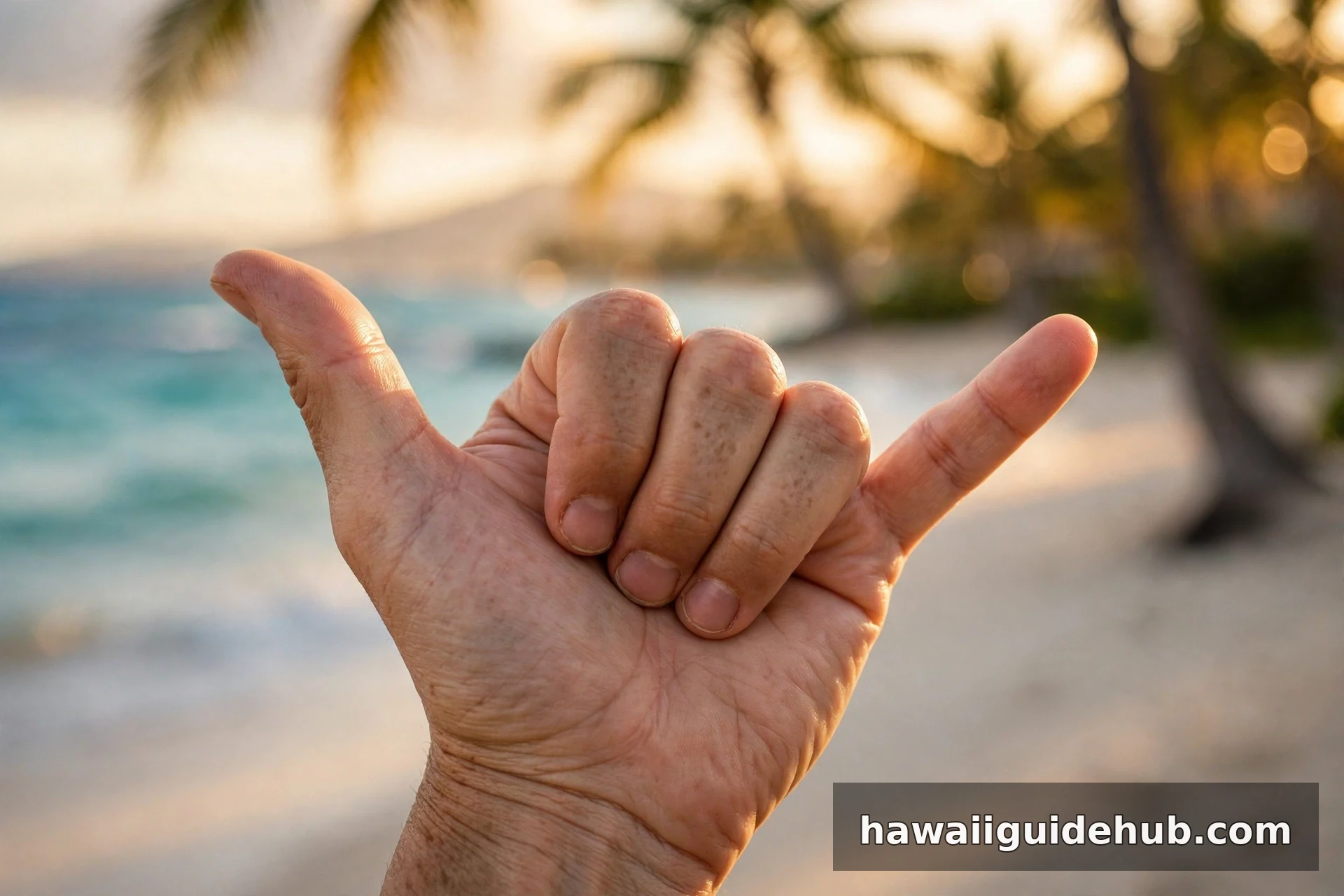
The shaka is Hawaii’s signature hand gesture and a worldwide symbol of the islands. It is made by extending the thumb and the pinky finger while keeping the three middle fingers curled down into the palm. The hand is then typically shaken side to side, though a still shaka works just as well. Palm can face out or in; locals do both.
If the shape looks familiar from somewhere else, there is a reason. The shaka is identical to the letter Y in American Sign Language and to the hand shape for the number six in Chinese finger counting. It is also the emoji your phone offers when you type certain words: the little yellow hand with thumb and pinky out. But in Hawaii, it is not an emoji or an alphabet letter. It is a greeting, a thank you, a goodbye, and a small daily expression of the aloha spirit, all in one motion.
How to Do the Shaka
Doing a proper shaka takes about five seconds to learn and a lifetime to make look natural. The key is the hand shape: thumb and pinky out, middle three fingers tucked. The photos in this guide show the hand shape from a few angles.
A few details separate a natural shaka from an awkward one. Keep your hand relaxed rather than stiff; the whole point of the gesture is ease. The wrist shake should be loose, not vigorous. And smile. The shaka without a smile is just a hand shape. With one, it is a conversation.
Some people flash it with the palm facing outward, toward the other person, which many locals consider the more respectful form, as if offering the gesture outward. Others do it palm-in, casual and quick. Both are understood everywhere in the islands.
What Does the Shaka Mean?
Ask ten people in Hawaii what the shaka means and you will get ten answers, and all of them will be right. The gesture is deliberately flexible. Its most common meanings include:
Hello and goodbye. The shaka works as both greeting and farewell, often replacing a wave entirely. A driver rolling past a friend on the street will toss one out the window instead of waving.
Thank you. This is the shaka’s workhorse meaning. A driver who lets you merge in traffic gets a shaka. A server who goes out of their way gets a shaka. It is Hawaii’s all-purpose expression of gratitude, warmer than a nod and quicker than words.
Hang loose / take it easy. The most famous translation, and the one that traveled the world with surf culture. It signals relaxation, go-with-the-flow energy, and the unhurried pace the islands are known for.
Right on / I agree. A shaka can mean approval or solidarity, the equivalent of a nod that says “exactly” or “you got it.”
Calm down. Locals joke, only half joking, that the shaka has prevented more traffic fights than any law ever written. A shaka flashed after a close call on the road defuses tension instantly. It is hard to stay angry at someone offering you aloha.
Children in Hawaii learn the shaka almost as early as they learn to wave. Kupuna, the respected elders, use it. Surfers use it. Politicians use it. It belongs to everyone, and its meaning bends to fit the moment.
The True Origin Story: Hamana Kalili of Laie
Every origin story of the shaka begins in the same place: the small town of Laie on Oahu’s North Shore, with the same man. His name was Hamana Kalili, and by all accounts he was a remarkable figure: a powerfully built Hawaiian fisherman, a descendant of chiefs, a beloved community leader, and the director of the Mormon church choir in Laie. He lived from 1882 to 1958, and he changed the way the world says hello.
Kalili worked at the Kahuku Sugar Mill during Hawaii’s plantation era, feeding sugar cane into the heavy rollers that squeezed out the juice. One day his right hand got caught in the machinery, and he lost his three middle fingers. He could no longer work the mill, so the plantation reassigned him as a guard on the sugar train that ran between Ka’a’awa and Sunset Beach. Part of his job was keeping local kids from hopping the train for free rides between towns.
Here is where the story turns. Kalili’s wave was unlike anyone else’s, because his hand was unlike anyone else’s. With only thumb and pinky remaining on his right hand, every wave he made was, by necessity, a shaka. The local keiki noticed. They started copying his distinctive gesture, using it to signal each other when Kalili was not looking and the way was clear to jump the train. What began as children’s mimicry of an injured man’s wave slowly became something bigger.
Kalili also spread the gesture through the two communities where everyone knew him. He conducted his church choir with that same hand, and he greeted thousands of visitors as a performer in the famous Laie hukilau, the community fundraiser where he often appeared as King Kamehameha. Tourists watched, learned, and carried the gesture home. His family kept the story alive, and today a bronze statue of Hamana Kalili stands outside the Polynesian Cultural Center in Laie, his right arm extended in a permanent shaka.
Other Theories About the Origin
The Kalili story is the prevailing local account, passed down by his family and the Laie community, but it is not the only theory.
One alternative traces the gesture to Spanish immigrants who came to work in Hawaii’s fields. According to this account, the workers would fold their middle fingers and bring their thumbs to their lips as a friendly invitation to share a drink with the Hawaiians they met. Over time, the theory goes, the gesture shed its drinking association and became a general sign of friendliness.
Another name that comes up is David “Lippy” Espinda, an Oahu used car salesman and entertainer who became a local television personality in the 1960s. Espinda ended his commercials with an enthusiastic “shaka, brah!” accompanied by the hand sign, and some credit him with creating it. Most historians treat this claim with skepticism, but nobody disputes his role in popularizing both the gesture and the phrase across the islands. Honolulu mayor Frank Fasi later adopted the shaka as a symbol of his political campaigns starting in 1976, cementing it further in public life.
The honest answer is that gestures like this rarely have a single clean birth certificate. But in Hawaii, the Kalili story is the one people tell, the one his descendants stand behind, and the one honored in bronze.
Why Is It Called “Shaka”?
Here is a curious detail: the gesture and its name may have arrived separately. According to the Oxford English Dictionary, the origin of the word “shaka” is uncertain, but it may come from Japanese, where it is a byname for the Buddha. Japanese and Okinawan plantation workers were a large part of Hawaii’s workforce, and the theory holds that the word traveled with them and eventually attached itself to the hand sign.
The word is also used on its own as an exclamation of approval, which may actually predate its use for the gesture. Either way, “shaka” stuck, and it stuck so firmly that most people outside Hawaii have never heard the gesture called anything else.
How the Shaka Conquered the World
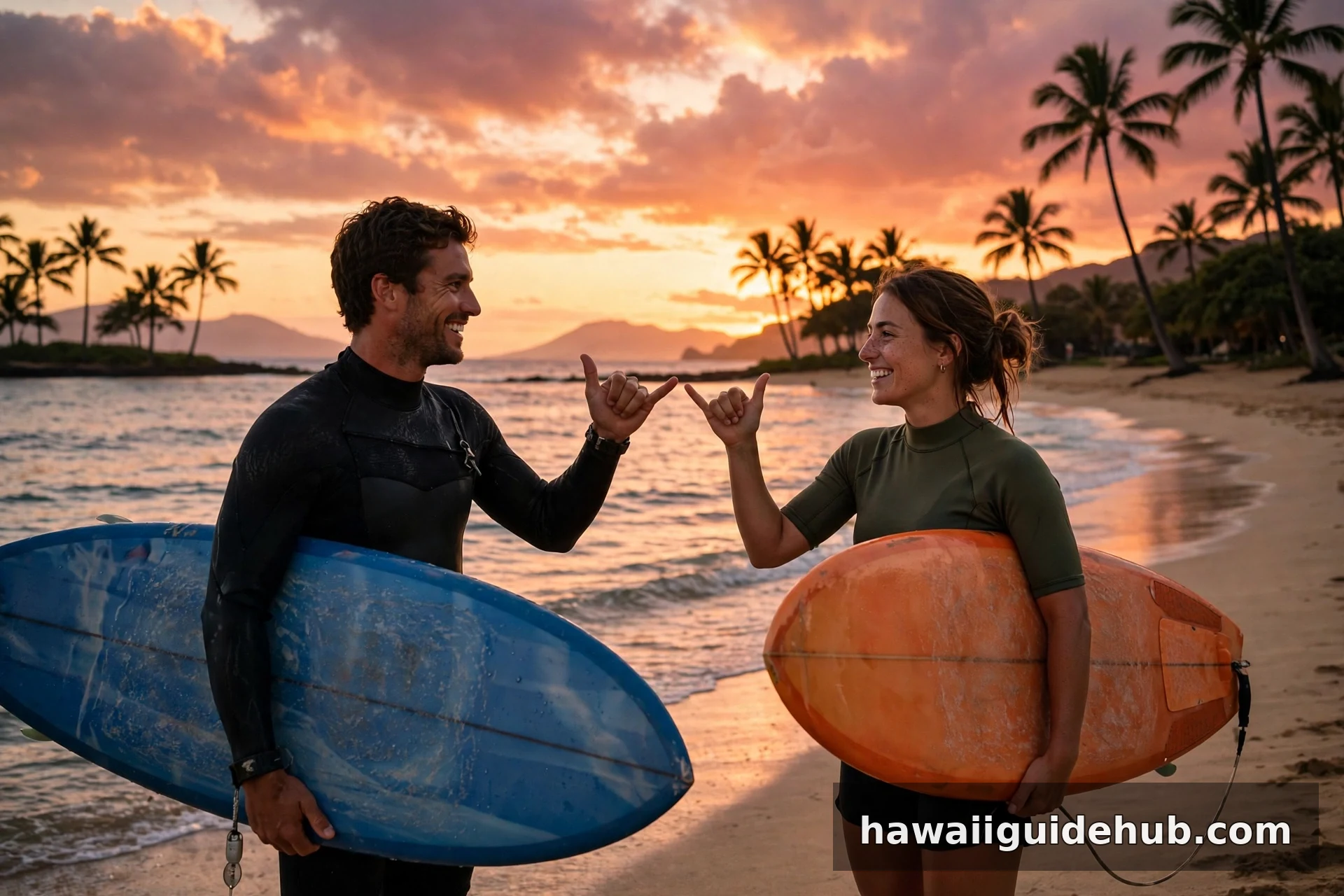
For decades, the shaka stayed mostly in Hawaii. Then the surfers found it. In the 1960s and 70s, as surf culture exploded out of Hawaii and California, traveling surfers carried the gesture to every coastline with waves. It fit the culture perfectly: relaxed, friendly, anti-establishment in the gentlest possible way. From surf breaks it jumped to skate parks, to snowboard slopes, to music festivals.
Pop culture did the rest. Athletes flashed it after victories. Musicians threw it from stages. When Barack Obama, who grew up in Hawaii, started giving shakas in public, the gesture reached people who had never touched a surfboard. Today the shaka emoji lives on every smartphone, and you can spot the gesture in photos from Brazil to Bali to Biarritz. It remains, however, unmistakably Hawaiian in origin, something the islands take quiet pride in.
Hawaii’s Official State Gesture
Hawaii already had a state dance in the hula and a state sport in surfing. In 2024, state lawmakers moved to give the islands an official state gesture too, advancing a bill to formally recognize the shaka as Hawaiian in origin and designate it the state’s official gesture. The effort was championed by legislators who described the shaka as a visual signal for sharing aloha, and it drew support from the family of Hamana Kalili, including his great-great-granddaughter, who asked that his name be included in the recognition.
Shaka vs. Hang Ten vs. Hang Loose
The terminology around the shaka gets tangled, so here is the straight version. “Hang loose” is a phrase, not a gesture; it describes the relaxed attitude the shaka represents, and people use the two interchangeably in casual speech. “Hang ten,” on the other hand, is something entirely different: a surfing maneuver where the rider hangs all ten toes over the nose of a longboard. Calling the hand gesture “hang ten” is a common mistake, even in surf shops. The hand sign is the shaka. Hang loose is what it means. Hang ten is what you do on a wave.
How Visitors Should Use the Shaka
Good news: visitors are welcome to use the shaka. Unlike some cultural practices that are reserved or sacred, the shaka is an open invitation. Locals genuinely appreciate it when visitors throw one back. A few guidelines will keep you on the right side of the custom.
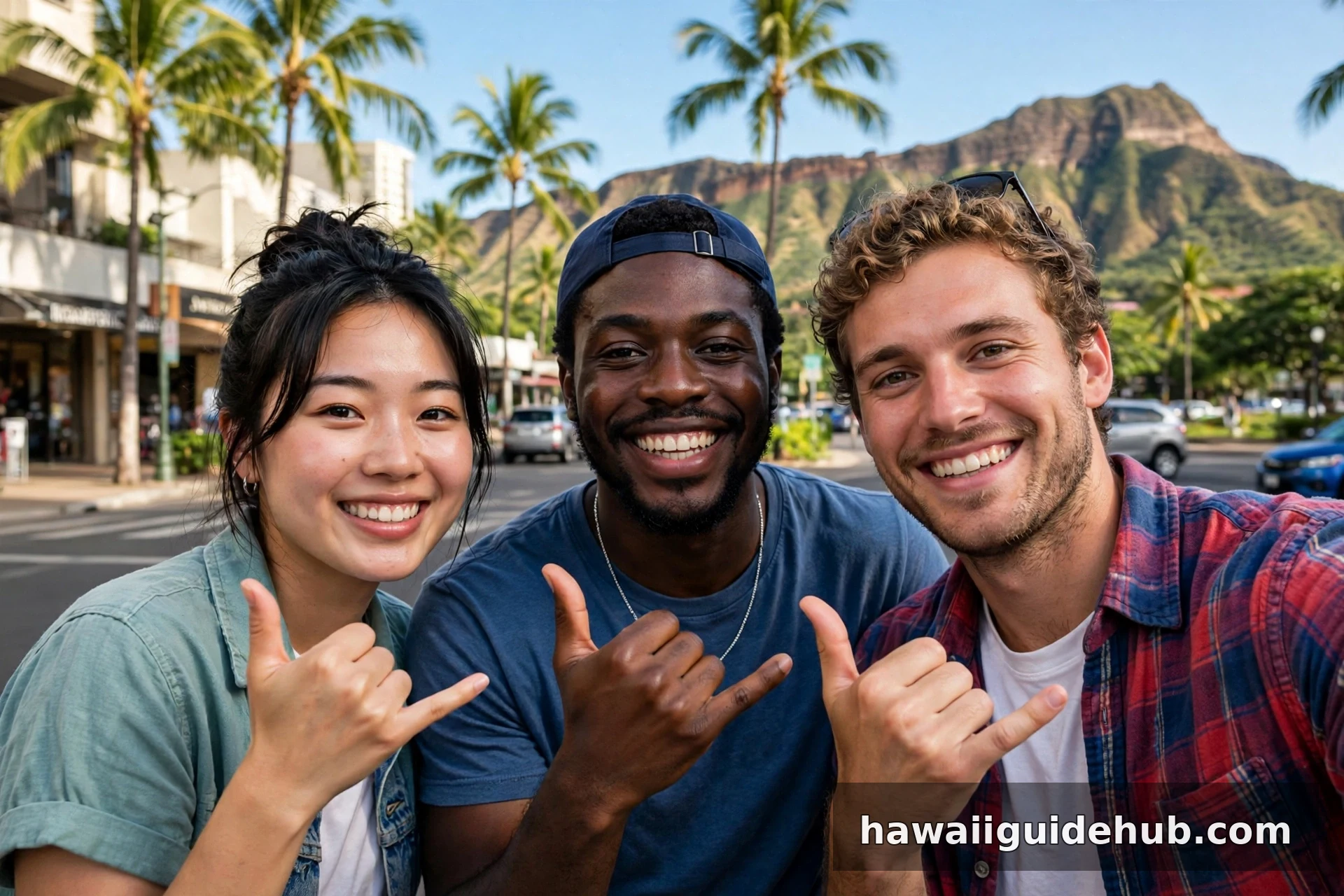
Use it the way locals do. Greet people with it. Say thanks with it. Say goodbye with it. The most common visitor moment is the traffic shaka: someone lets you merge, and you flash one out the window. That single gesture will mark you as someone paying attention.
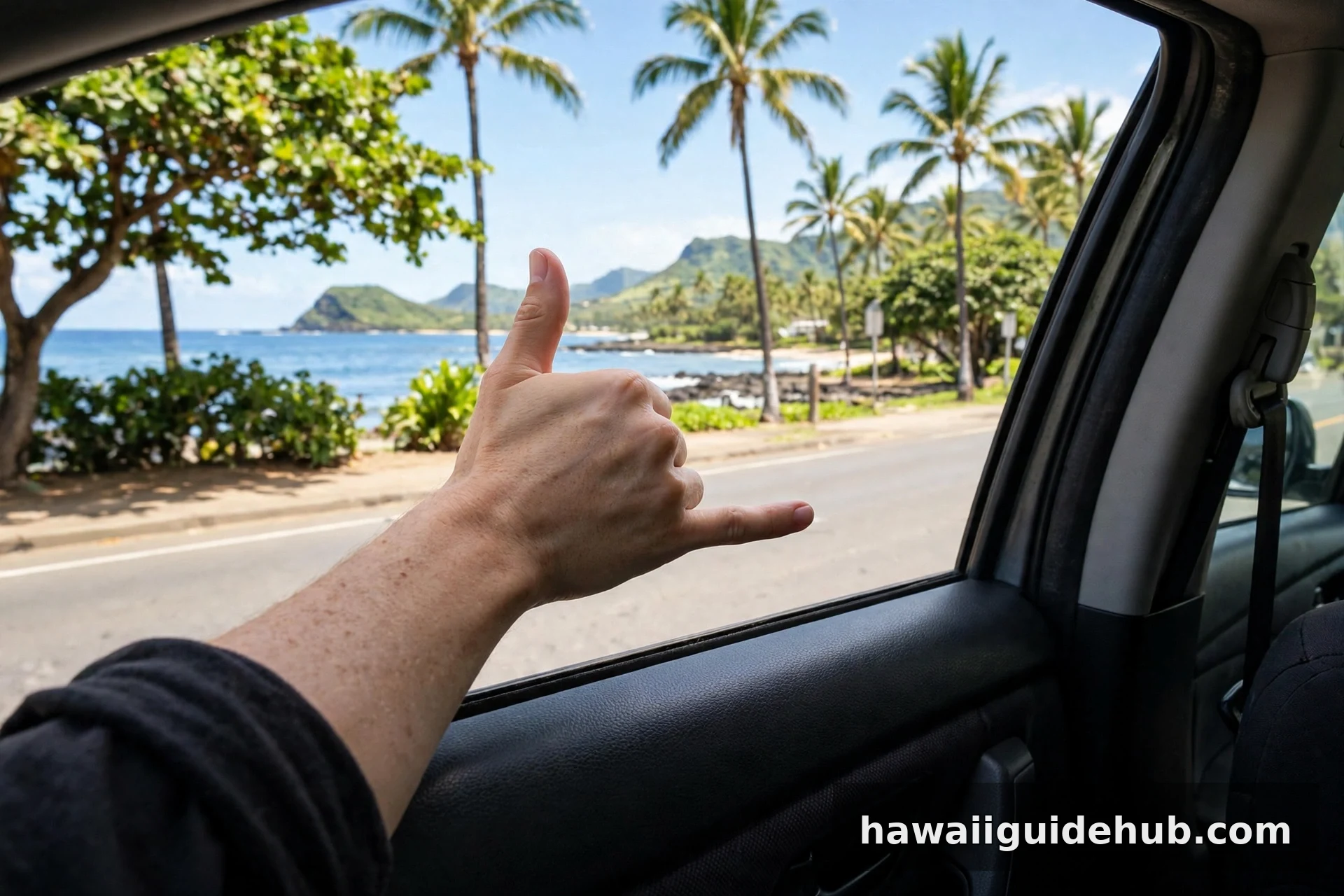
Keep it sincere. The shaka works because it carries genuine warmth. A relaxed, friendly shaka beats a stiff, self-conscious one every time. If someone gives you one, give one back. That exchange is the whole point.
Learn the surrounding culture too. The shaka is one piece of a much larger tradition of Hawaiian cultural traditions, from hula to language to the concept of aloha itself. Visitors who take an interest in the deeper culture behind the gesture are always welcomed.
Mistakes to Avoid
Do not confuse it with the sign of the horns. The rock-and-roll “devil horns” gesture extends the index and pinky fingers while the thumb holds down the middle two. The shaka extends the thumb and pinky with the middle three curled. They look nothing alike once you know the difference, but mixing them up is the classic beginner error.
Do not turn it upside down. An inverted shaka can read as disrespectful or dismissive in local culture. Keep it upright.
Do not overdo it. The shaka is casual by nature. Flashing it constantly, posing with it in every photo, or using it ironically can come across as trying too hard. Let it happen naturally, the way it does for everyone who lives there.
Do not treat it as a joke. The gesture has real roots in a real person’s injury and in generations of island life. Using it with respect costs nothing and means everything.
The Shaka on Film
For the visual version of Hamana Kalili’s story, this short documentary trailer tells it through the voices of the Laie community who knew him:
A Gesture Worth Getting Right
The shaka began as one man’s wave, shaped by an accident nobody would have chosen, and became a symbol recognized on every continent. It asks nothing of the person giving it except sincerity, and it gives back a small moment of connection: stranger to stranger, driver to driver, visitor to local. Learn it properly, use it genuinely, and you will be speaking a little bit of Hawaii’s language before you ever open your mouth. That is exactly what Hamana Kalili’s wave was always meant to do.