
Lānaʻi History
Lānaʻi is the smallest inhabited island in Hawaiʻi, and its history reads like a condensed version of the entire archipelago. Ancient fishing villages, a legendary prince who faced down spirits, cattle barons, the largest pineapple plantation on earth, and a billionaire’s modern reinvention all unfolded on just 141 square miles. This guide walks through every era of Lānaʻi history, from the first Polynesian settlers to the island’s present day.
In This Guide
Lānaʻi History at a Glance
Lānaʻi’s recorded history begins with Polynesian voyagers who settled the island centuries before European contact, building fishing villages like Kaunolū that thrived on the rich waters off the southwest shore. Hawaiian legend holds that the island was once the domain of restless spirits until a Maui prince named Kaululāʻau drove them out, making the island safe for human settlement. The story, whether read as myth or as a memory of early hardship, captures something true about Lānaʻi: it has always been an island that had to be tamed.
In the 19th century, after decades of relative quiet, outsiders arrived with new plans. Mormon elder Walter Murray Gibson established a colony and later a ranching operation, and the island passed through several owners who tried cattle, sugar, and other ventures with mixed success. Then, in 1922, everything changed. James Drummond Dole purchased the island and transformed it into the largest pineapple plantation in the world. A planned plantation town, Lānaʻi City, rose on the central plateau, and for most of the 20th century Lānaʻi was known around the world as the Pineapple Isle.
The pineapple era ended in 1992, when the last harvest was brought in. Castle and Cooke, under David Murdock, pivoted the island toward luxury tourism, opening two Four Seasons resorts. In 2012, Oracle co-founder Larry Ellison purchased 98 percent of the island for a reported 300 million dollars, launching a new chapter focused on sustainability, conservation, and careful development. Through every transformation, a small permanent community has kept the island’s plantation-town character alive, and ancient sites like Kaunolū still stand watch over the coast.
Ancient Lānaʻi: Villages, Spirits, and a Prince
First Settlement
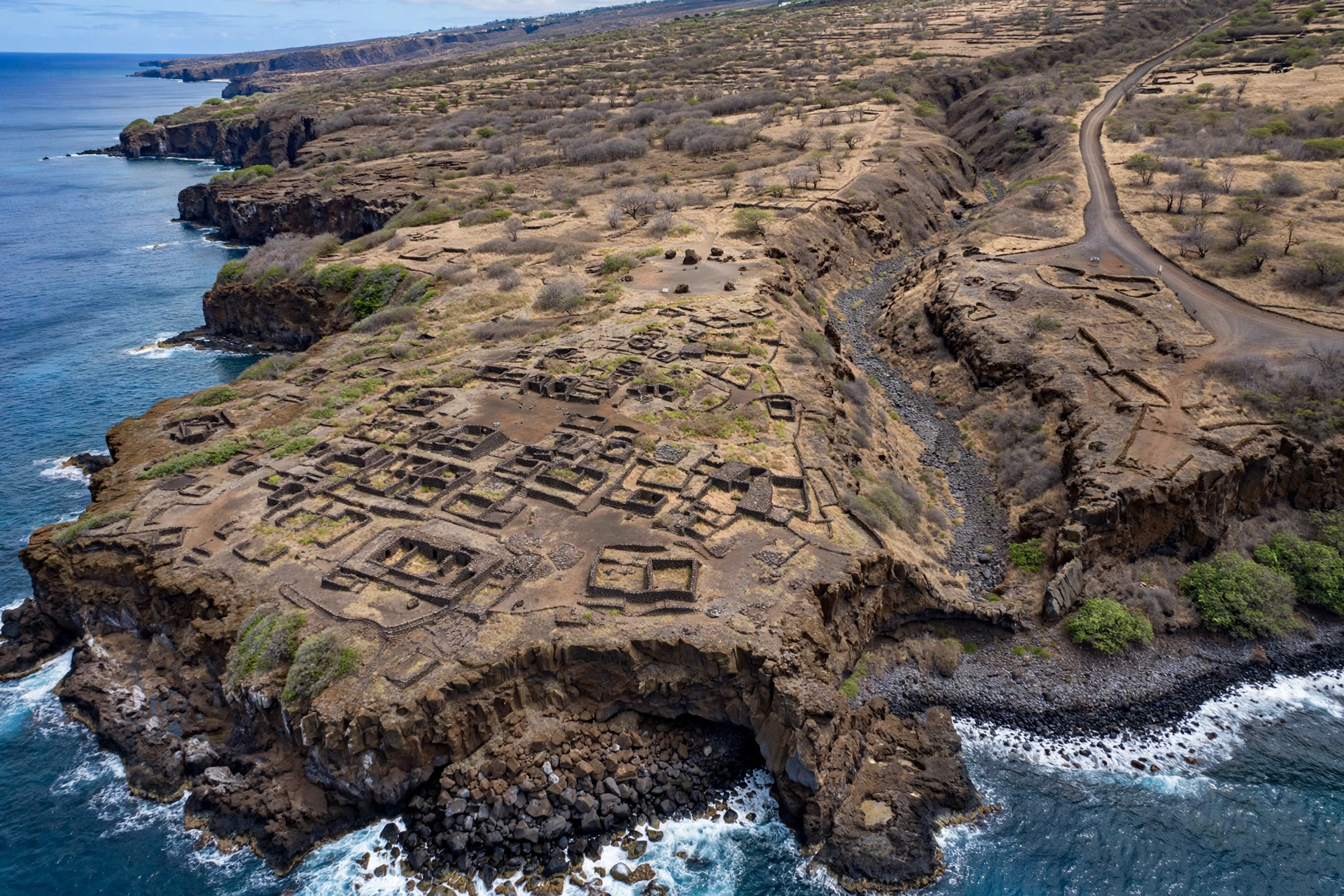
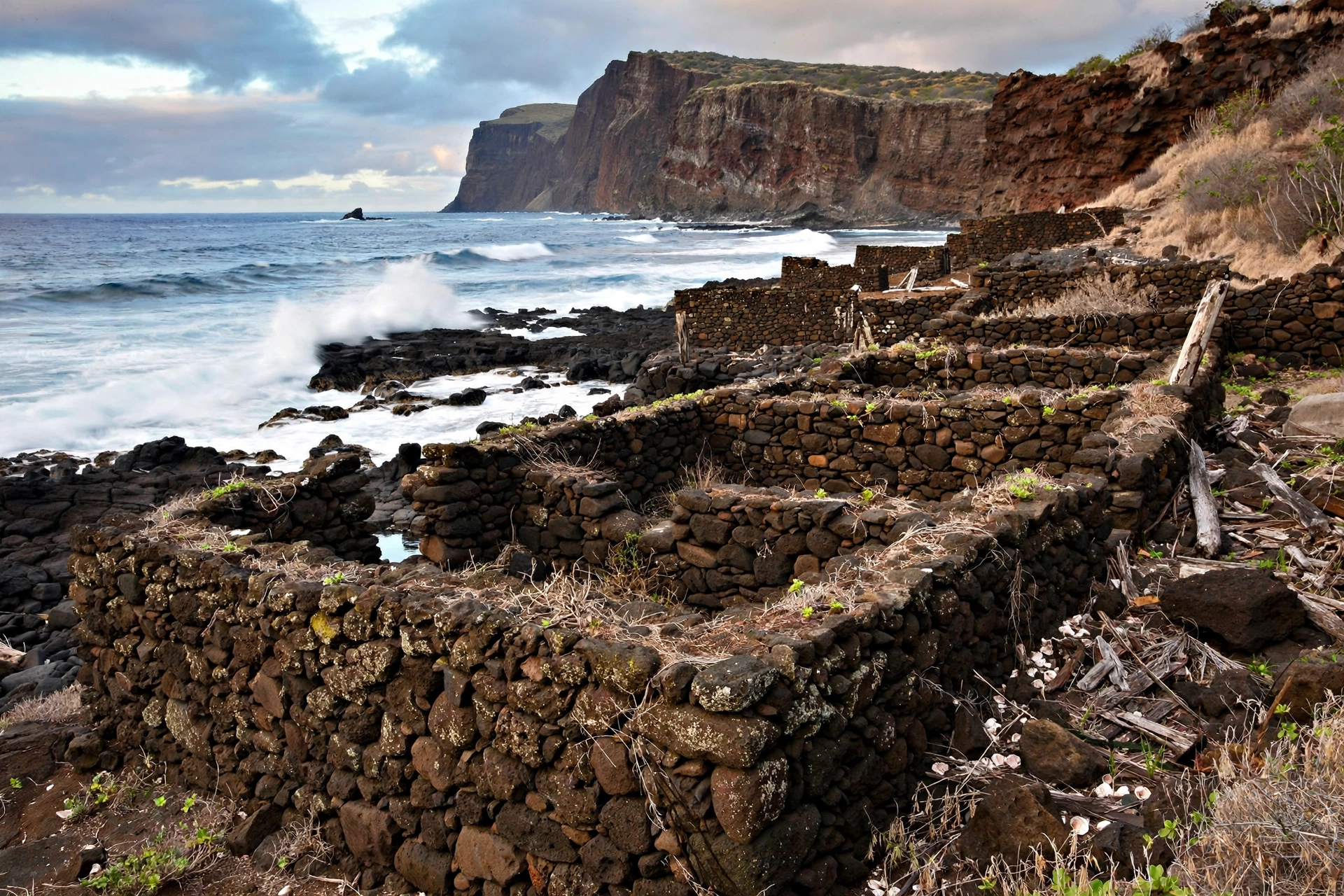
Archaeologists believe Polynesian voyagers reached Lānaʻi around the same time they settled the other main Hawaiian islands, roughly a thousand years ago. The island’s dry climate made large-scale taro farming difficult, so ancient Lānaʻi’s people concentrated where fresh water and rich fishing grounds met. The most important of these places was Kaunolū, on the southwest shore, a thriving coastal village with house sites, heiau (temples), and petroglyphs. The village was large enough to serve as a favored residence of Kamehameha I himself, who kept a home there and used the offshore waters as a fishing ground.
Other ancient sites cluster along the south and west coasts. The Luahiwa Petroglyphs, carved into boulders near the island’s north shore, record the presence of early inhabitants with images of human figures, dogs, and canoes. Scattered stone structures, agricultural terraces in the wetter uplands, and fishing shrines along the shore complete a picture of a community that adapted cleverly to an arid island, drawing most of its wealth from the sea rather than the land.
The Legend of Kaululāʻau
Lānaʻi’s most famous legend explains why the island stood apart. According to Hawaiian tradition, Lānaʻi was inhabited by akua and restless spirits that made the island dangerous for ordinary people. Kakaʻalaneo, a chief of Maui, had a mischievous son named Kaululāʻau whose pranks finally exhausted his father’s patience. As punishment, the young prince was banished to spirit-haunted Lānaʻi.
Rather than cowering, Kaululāʻau confronted the spirits one by one, using wit and courage to drive them from the island. When he had cleared Lānaʻi of its supernatural inhabitants, the island became safe for settlement, and his father welcomed him home in honor. The story is told across the islands in various forms, and on Lānaʻi it carries special weight: it is the founding story of a place that has repeatedly been remade by bold newcomers, from an exiled prince to a pineapple king to a modern billionaire.
Life Before Contact
By the time Captain James Cook’s expedition sighted the Hawaiian Islands in 1778, Lānaʻi supported a modest population organized under the chiefs of Maui. The island’s people fished the productive offshore waters, gathered upland resources, and maintained the coastal villages that dotted the shore. Because Lānaʻi lacked the great valleys and abundant streams of its neighbors, it never developed the large chiefly centers seen on Maui or Oʻahu. Instead, it remained a quieter outpost, valued for its fisheries and its strategic position between Maui and Molokaʻi.
The early 19th century brought the same disruptions to Lānaʻi that swept the archipelago: introduced diseases that reduced the Native Hawaiian population, the arrival of missionaries and traders, and the gradual shift of the islands toward a cash economy. The Great Māhele of 1848, which introduced private land ownership to the kingdom, set the stage for large-scale foreign acquisition on Lānaʻi. Where land had once been held by chiefs and worked by commoners under the traditional system, it could now be bought outright, and speculators quickly recognized the value of an entire island with open grazing land and a small population. By mid-century, Lānaʻi’s small population and open lands made it attractive to outsiders with ranching ambitions, and the island’s communal past began giving way to the plantation future.
The Ranching Era
Lānaʻi’s first great transformation by outsiders began with an unlikely figure: Walter Murray Gibson, a Mormon elder who arrived in Hawaiʻi in 1861. Gibson established a Mormon colony on Lānaʻi, and although the colony itself did not last, he stayed on, acquiring land and influence. He eventually became a prominent figure in the Hawaiian Kingdom’s government, serving in King Kalākaua’s cabinet, while his ranching interests on Lānaʻi continued to grow.
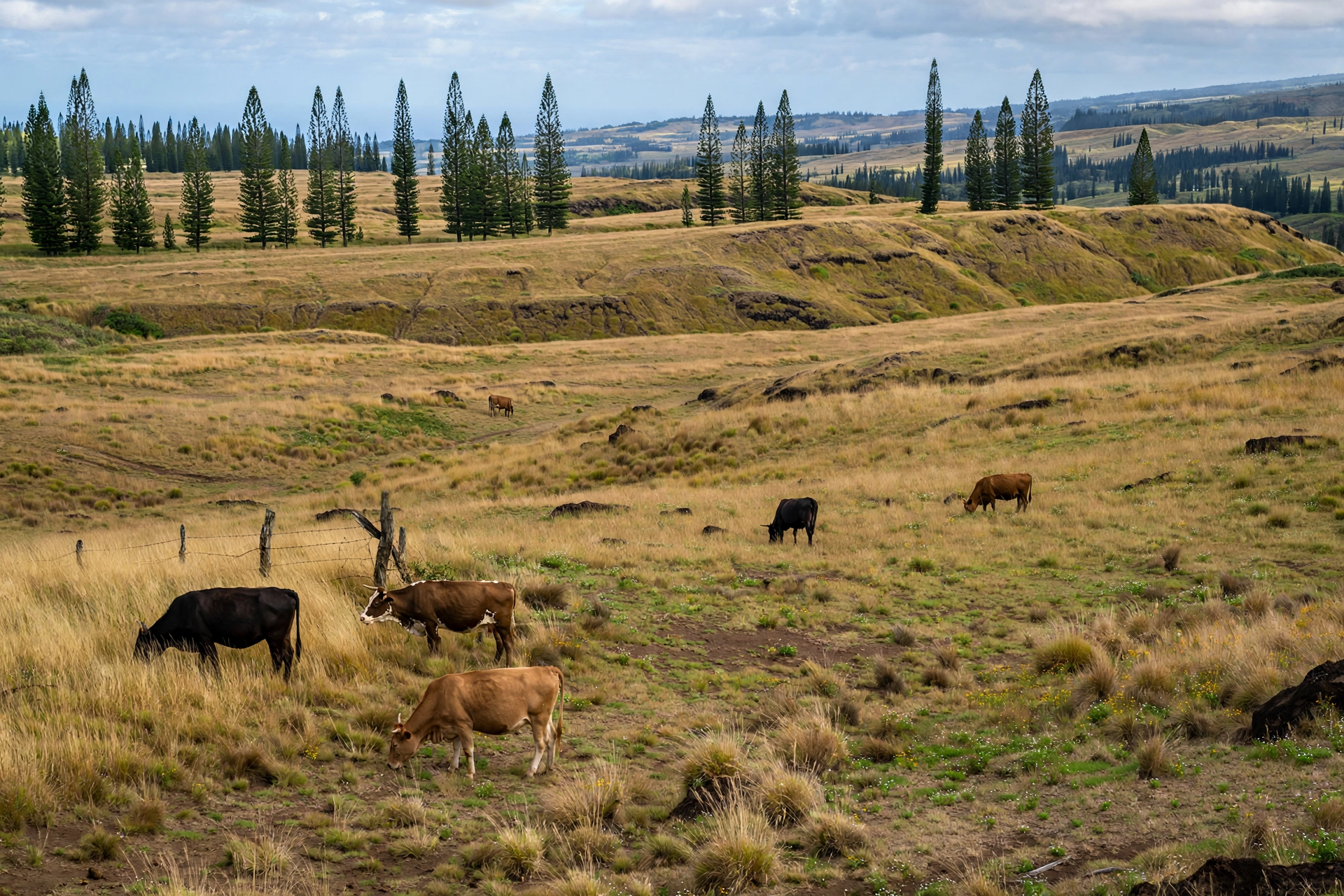
Throughout the late 19th century, Lānaʻi’s open grasslands supported cattle, sheep, and goats. Ranching suited the dry island, and the animals thrived on the plateau’s grasses. But the herds came at a cost. Introduced ungulates stripped native vegetation, accelerated erosion, and began the long transformation of Lānaʻi’s upland forests, a change whose effects are still being managed today. The ranching era established a pattern that would repeat: outside owners treating the island as a single economic unit, for better and for worse.
By the turn of the 20th century, Lānaʻi had passed through several owners and ventures, including attempts at sugar cultivation that never matched the success of the wetter islands. The island’s population remained small, and its economy modest. That changed in 1922, when one of the most consequential land purchases in Hawaiian history turned the entire island into a single crop.
The Pineapple Era: The Pineapple Isle
Dole Buys an Island
In 1922, James Drummond Dole, the pineapple magnate whose Hawaiian Pineapple Company would become the Dole Food Company, purchased the island of Lānaʻi for a reported 1.1 million dollars. It was one of the largest private land transactions in the territory’s history, and Dole had a sweeping vision: to convert nearly the entire island into the largest pineapple plantation in the world.
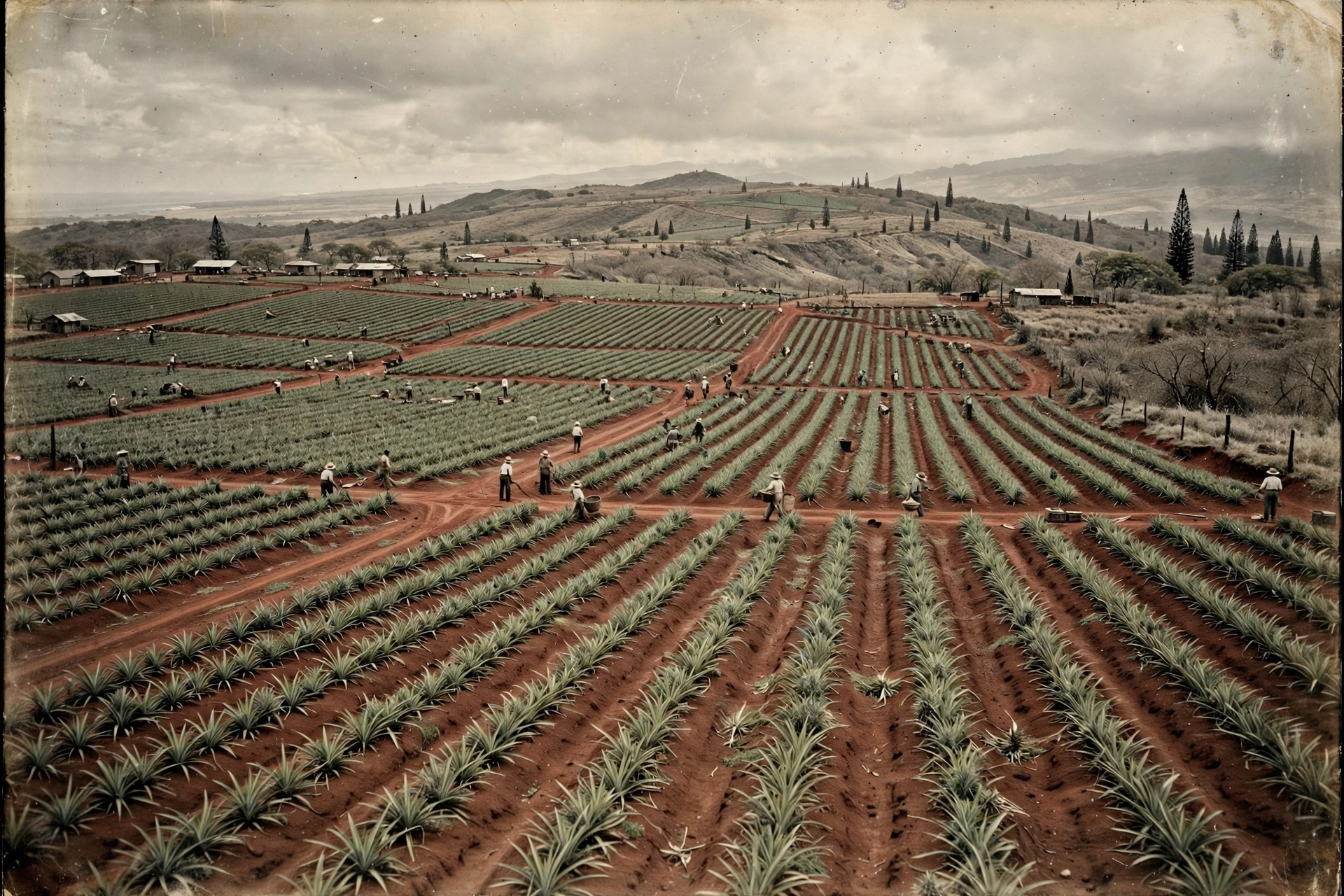
What followed was one of the most ambitious agricultural engineering projects of the era. Dole’s crews cleared thousands of acres of the central plateau, installed irrigation and transportation systems, and built an entire town from scratch to house the plantation workforce. At its peak, the Lānaʻi plantation covered roughly 20,000 acres, and the island produced a dominant share of the world’s canned pineapple. The nickname “the Pineapple Isle” was earned, not invented by marketers.
Lānaʻi City: A Planned Plantation Town
Lānaʻi City, founded in the 1920s, is one of Hawaiʻi’s few truly planned towns, and its layout still reflects the plantation blueprint. Dole Park, the grassy square at the town’s center, is ringed by the plantation-era commercial buildings that once served the workforce: the general store, the theater, the hotel, and the company offices. Cook pines, planted by the company to catch moisture from the passing clouds and increase the island’s water supply, line the streets and give the town its distinctive alpine-in-the-tropics feel.
The plantation recruited workers from the Philippines, Japan, China, Korea, and Portugal, and their descendants still form the core of Lānaʻi’s community. Plantation life was hard but stable, and the company-town structure meant that housing, stores, schools, and medical care all flowed through Dole. Generations of families grew up in Lānaʻi City knowing exactly one industry, and the town’s tight-knit character today is a direct inheritance of that era.
Peak and Decline
Through the mid-20th century, Lānaʻi’s pineapple operation was a marvel of industrial agriculture. Mechanized harvesting, on-island canneries, and a dedicated harbor at Kaumālapaʻu for shipping the crop moved enormous volumes of fruit to world markets. For decades, if you ate canned pineapple anywhere in the world, there was a good chance it grew in Lānaʻi’s red soil.
But the economics of pineapple shifted. Rising labor costs in Hawaiʻi and cheaper production in Southeast Asia and Central America made the Lānaʻi operation increasingly uncompetitive. Castle and Cooke, which had acquired Dole’s Hawaiian interests, began winding down the plantation through the 1980s. The last pineapple harvest on Lānaʻi came in 1992, ending a 70-year era. Almost overnight, the island’s single industry vanished, and Lānaʻi faced the same question it faces in every era: what comes next.
The Modern Era: Resorts and Renewal
Castle and Cooke and the Resort Pivot
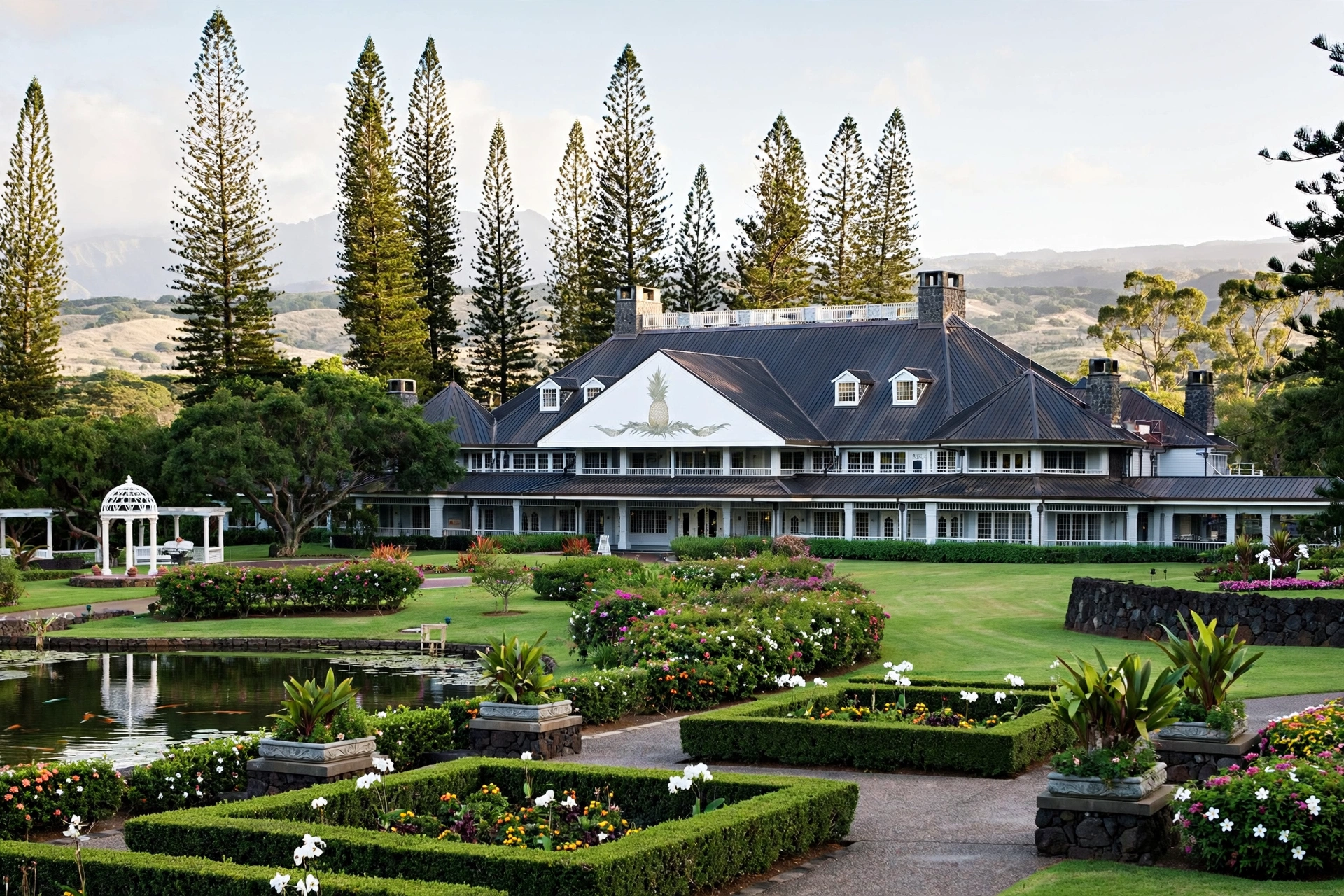
After pineapple ended, David Murdock’s Castle and Cooke moved to reinvent Lānaʻi as a luxury destination. Two Four Seasons resorts opened in the early 1990s: the beachfront resort at Mānele Bay and The Lodge at Kōʻele in the cool uplands. The strategy was to trade agricultural volume for high-end tourism, and for two decades the resorts anchored the island’s economy, employing hundreds of residents.
The transition was not painless. An island built around one company town had to adapt to a service economy, and the population, which had peaked during the plantation years, settled at roughly 3,000 residents. Many families with deep plantation roots stayed, and the community worked to preserve Lānaʻi City’s character even as the economic base changed beneath it. The resorts brought new jobs in hospitality, maintenance, and management, but they also brought a new kind of dependence: where the town had once relied on Dole, it now relied on visitors arriving by ferry and small plane.
The Ellison Purchase
In 2012, Larry Ellison, the co-founder of Oracle, purchased 98 percent of Lānaʻi from Castle and Cooke for a reported 300 million dollars. Murdock retained a small portion of the island, including his home. Ellison described his vision as turning Lānaʻi into a model of sustainability: solar power, organic agriculture, improved water systems, and carefully managed tourism.
In the years since, visible changes have followed. The Lodge at Kōʻele was reimagined as Sensei Lanai, a wellness resort developed with Dr. David Agus. Agricultural projects, including hydroponic and greenhouse farming, aim to reduce the island’s dependence on imported food. Infrastructure upgrades have touched the water system, roads, and the small commercial core. The Four Seasons Resort Lānaʻi at Mānele Bay continues to anchor the island’s visitor economy alongside Hulopoʻe Beach.
Not every resident has welcomed every change, and debates about development, water use, and the island’s future remain lively in community meetings and local media. But the through line of Lānaʻi’s modern history is consistent with its past: a small community adapting to the ambitions of whoever holds the island’s deed, while working to keep its identity intact.
Conservation and the Land
Parallel to the economic story runs an ecological one. The Nature Conservancy’s Kānepuʻu Preserve protects one of the last remnants of Lānaʻi’s native dryland forest, home to rare plants found nowhere else. Watershed partnerships work to restore the upland forests that capture the fog drip sustaining the island’s limited fresh water. Feral axis deer and mouflon sheep, descendants of introduced game animals, are managed through hunting programs to limit damage to native ecosystems and farms.
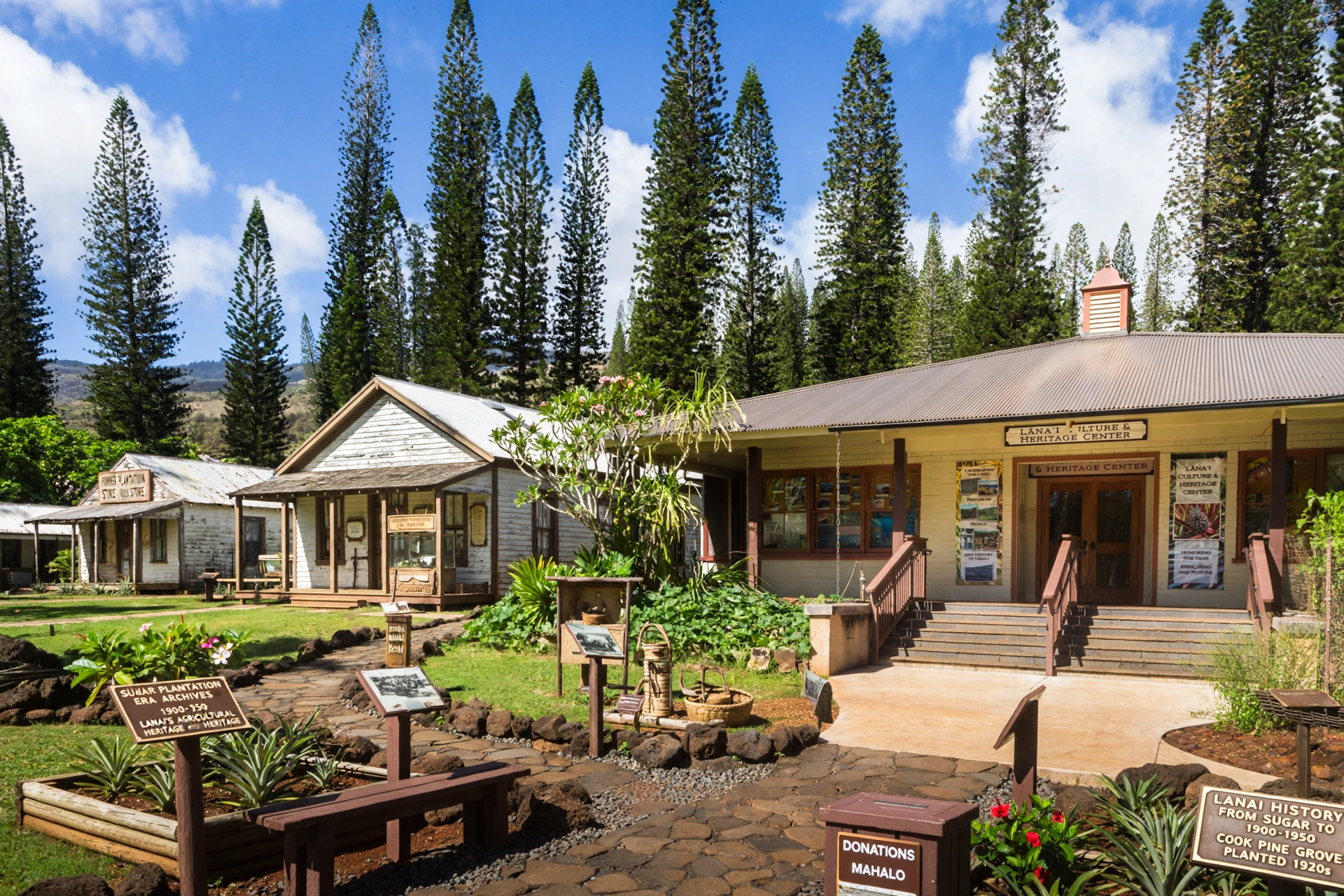
The Lānaʻi Culture and Heritage Center, founded by longtime resident Kepā Maly, documents the island’s history through oral histories, photographs, and artifacts, ensuring that the plantation generations’ stories survive the economic transitions. Together, these efforts reflect a maturing view of the island’s heritage: Lānaʻi’s history is not just something that happened to the island, but something its people actively preserve.
Historic Sites to Visit
Lānaʻi’s history is unusually accessible. Many of its most important sites can be reached on a day trip, though some require a four-wheel-drive vehicle or a guided visit. These are the places where the island’s past is still visible on the ground. Before visiting any archaeological site, remember that these are culturally sensitive places: stay on marked routes where they exist, never climb on walls or structures, do not remove stones or artifacts, and keep noise low. Photographs are welcome, but the sites themselves should be left exactly as you found them.
Kaunolū Village Site
The ancient fishing village on the southwest coast is a National Historic Landmark and the single most important archaeological site on Lānaʻi. Stone house platforms, heiau remains, and petroglyphs spread across the coastal shelf where Kamehameha I once kept a residence. Reaching Kaunolū requires a rough four-wheel-drive road, and visitors should treat the site with the respect due a place of deep cultural significance: stay on established paths, do not move stones, and leave everything as found.
Luahiwa Petroglyphs
Near the island’s north shore, boulders carved with figures of people, dogs, and canoes record the artistic tradition of Lānaʻi’s early inhabitants. The petroglyphs sit in a dry, exposed landscape that has changed little since they were carved, and visiting them offers a direct connection to the island’s first centuries of human history.
Lānaʻi City and Dole Park
The plantation town itself is a living historic district. Dole Park’s square, the surrounding 1920s commercial buildings, the old theater, and the Cook pine lined streets preserve the company-town plan almost intact. Walking the town is the best way to understand the pineapple era, and the Lānaʻi Culture and Heritage Center nearby adds photographs, maps, and oral histories.
Keōmuku and the East Coast
The ghost town of Keōmuku on the east coast, once a small settlement with a church and school, stands as a quiet reminder of the communities that rose and fell with the island’s economic tides. The stone church remains are reachable by four-wheel-drive road.
Kānepuʻu Preserve
For the island’s natural history, the Nature Conservancy’s preserve protects native dryland forest with guided access. It is the best place to see what Lānaʻi’s uplands looked like before ranching and plantation agriculture reshaped them.
Frequently Asked Questions
Who were the first people to live on Lānaʻi?
Polynesian voyagers settled Lānaʻi roughly a thousand years ago, around the same time as the other main Hawaiian islands. They built coastal fishing villages, with Kaunolū on the southwest shore becoming the most important settlement and a favored residence of Kamehameha I.
What is the legend of Kaululāʻau?
According to Hawaiian tradition, Lānaʻi was once inhabited by spirits that made it dangerous for people. Kaululāʻau, a mischievous son of the Maui chief Kakaʻalaneo, was banished to the island and drove out the spirits one by one, making Lānaʻi safe for settlement. It is the island’s founding legend.
When did Dole buy Lānaʻi?
James Drummond Dole purchased Lānaʻi in 1922 for a reported 1.1 million dollars through his Hawaiian Pineapple Company. He converted the central plateau into the largest pineapple plantation in the world and built Lānaʻi City as a planned plantation town.
Why was Lānaʻi called the Pineapple Isle?
At its peak, the Lānaʻi plantation covered roughly 20,000 acres and produced a dominant share of the world’s canned pineapple. The nickname reflected the island’s near-total economic dependence on a single crop for most of the 20th century.
When did pineapple farming end on Lānaʻi?
The last pineapple harvest on Lānaʻi came in 1992. Rising labor costs in Hawaiʻi and cheaper production overseas made the plantation uncompetitive, and Castle and Cooke wound down operations through the 1980s before closing the fields.
Who owns Lānaʻi now?
In 2012, Oracle co-founder Larry Ellison purchased 98 percent of Lānaʻi from Castle and Cooke for a reported 300 million dollars. David Murdock retained a small portion of the island. Ellison has pursued sustainability projects including solar power, greenhouse agriculture, and water system upgrades.
Can visitors see Kaunolū Village?
Yes, but reaching the National Historic Landmark requires a rough four-wheel-drive road on the southwest coast. Visitors should stay on established paths, never move stones, and treat the village, heiau remains, and petroglyphs with appropriate respect.
What is the Lānaʻi Culture and Heritage Center?
Founded by Kepā Maly, the center in Lānaʻi City preserves the island’s history through oral histories, photographs, maps, and artifacts, with a focus on the plantation generations and Native Hawaiian heritage. It is the best starting point for understanding the island’s past.
Related Guides
- Lānaʻi Travel Guide: the complete overview for planning a visit
- Lānaʻi Towns: Lānaʻi City, Mānele, and historic settlements
- Lānaʻi Map: find historic sites and landmarks across the island
- Lānaʻi Hikes: trails including routes near historic areas
- Molokaʻi History: the neighboring island’s past, from fishponds to Kalaupapa
- Maui History: the larger island whose chiefs once ruled Lānaʻi
A Final Note
Lānaʻi’s history is unusually legible. Stand at Kaunolū and you can read a thousand years of fishing life in the stone foundations. Walk Dole Park and the plantation century surrounds you in the storefronts and Cook pines. Drive the red dirt roads and you cross the ranching era, the pineapple era, and the newest chapter in a single afternoon. Few places in Hawaiʻi compress so much change into so little land, and that compression is what makes the island’s past worth knowing: every era of Lānaʻi is still visible, if you know where to look.