
Kauaʻi History
Kauaʻi is the oldest of the main Hawaiian Islands, and its age shows in every chapter of its story. Roughly five million years of wind and rain have carved the fluted cliffs of the Nāpali Coast, the red walls of Waimea Canyon, and the great amphitheater of Kalalau Valley. Roughly a thousand years of human history have layered Polynesian chiefdoms, a proud separate kingdom, Russian intrigue, missionary stations, plantation towns, and two devastating hurricanes onto that ancient landscape. No other Hawaiian island held out against Kamehameha the Great the way Kauaʻi did. No other island hosted a Russian-built fort, grew Hawaiʻi’s first commercial sugar crop, or rebuilt itself from back to back hurricane disasters. This guide walks through Kauaʻi’s history from the first voyaging canoes to the present day, and points you to the historic places where that past is still visible.
On This Page
Kauaʻi History at a Glance
Kauaʻi’s story begins long before people arrived. The island emerged from the sea about five million years ago, making it the oldest of the eight main Hawaiian Islands. Because it has had the longest time to erode, Kauaʻi’s landscapes are the most deeply sculpted in the chain: Waimea Canyon cuts 3,000 feet into the island’s west side, the Nāpali Coast rises in cathedral-like sea cliffs, and Mount Waiʻaleʻale at the island’s heart collects around 450 inches of rain a year, making it one of the wettest places on Earth.
Polynesian voyagers reached the Hawaiian Islands roughly a thousand years ago, and Kauaʻi was among the earliest islands settled. Its fertile valleys, especially Wailua on the east side, became centers of aliʻi (chiefly) power. By the time Europeans arrived, Kauaʻi and its neighbor Niʻihau formed a separate kingdom under their own high chiefs, independent of the warring chiefdoms on the other islands.
The major dates of Kauaʻi history read like a condensed version of Hawaiʻi’s past:
- Around 1000 to 1200: Polynesian voyagers settle Kauaʻi; the ahupuaʻa land system, heiau temples, and the kapu system take shape.
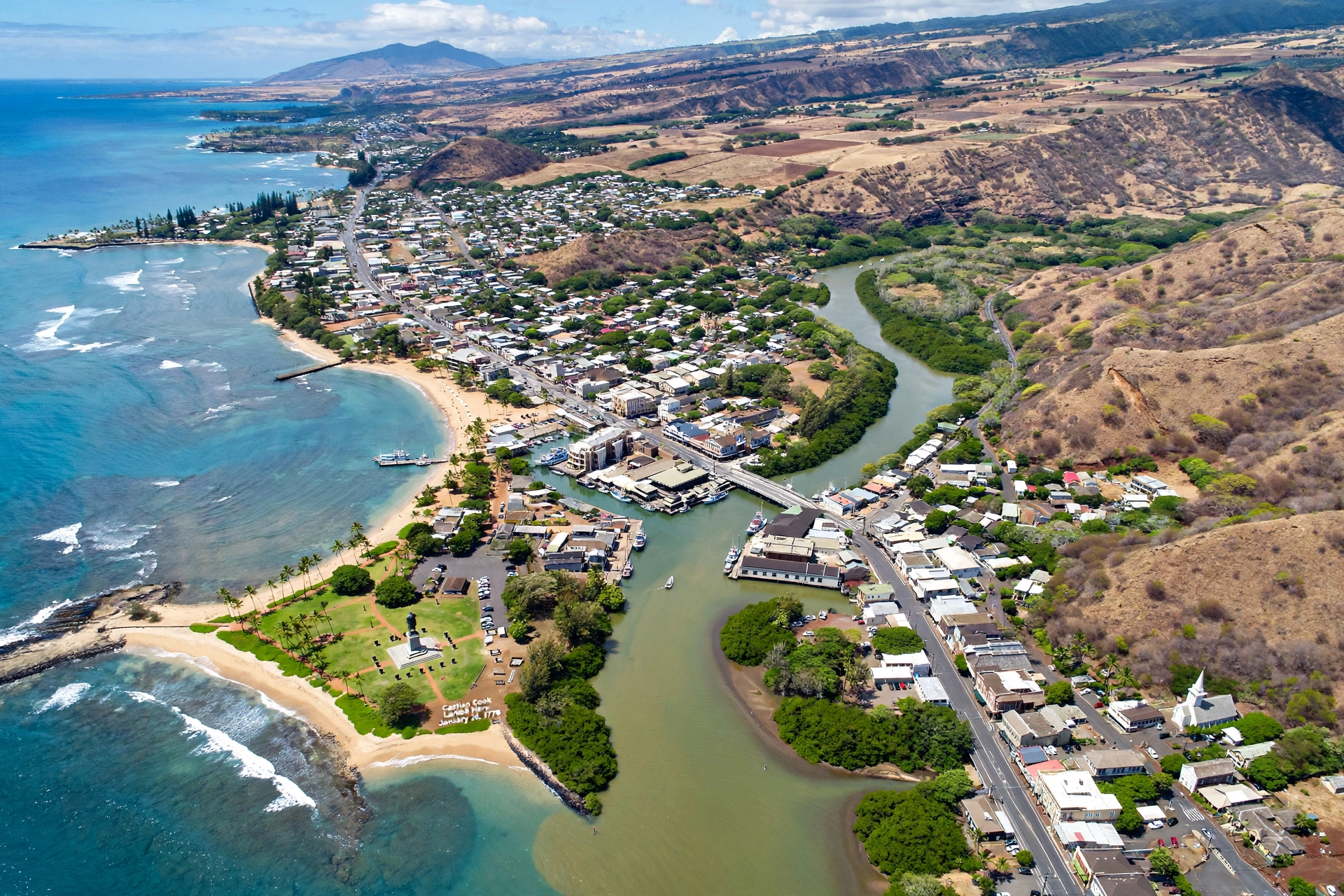
- 1778: Captain James Cook lands at Waimea, the first documented European contact with Hawaiʻi.
- 1796 and 1803 to 1804: Kamehameha’s invasion fleets fail to reach Kauaʻi, first scattered by rebellion at home, then by disease.
- 1810: King Kaumualiʻi cedes Kauaʻi and Niʻihau to Kamehameha peacefully in Honolulu, completing the unification of the islands.
- 1816 to 1817: The stone fort at Waimea known as Russian Fort Elizabeth is built during Kaumualiʻi’s brief alliance with the Russian-American Company.
- 1835: Ladd & Company founds Hawaiʻi’s first commercial sugar plantation at Kōloa.
- 1893 to 1898: The Hawaiian Kingdom is overthrown; Hawaiʻi is annexed by the United States.
- 1982 and 1992: Hurricanes ʻIwa and ʻIniki devastate Kauaʻi; ʻIniki, a Category 4 storm, causes the worst damage.
What makes Kauaʻi’s history distinct is how often the island stood apart. It was the last island to join a united Hawaiʻi, the only island courted by Imperial Russia, and the birthplace of the sugar industry that reshaped the entire archipelago. Even its disasters set it apart: no other Hawaiian island has been struck by two major hurricanes in a single decade the way Kauaʻi was in the 1980s and 1990s.
Ancient Kauaʻi: Chiefs, Heiau, and the Menehune
The first settlers arrived in double-hulled voyaging canoes, navigating by stars, swells, and bird flight across thousands of miles of open ocean. They brought taro, sweet potato, breadfruit, pigs, dogs, and chickens, and they organized the land into ahupuaʻa, wedge-shaped divisions running from the mountains to the sea so each community held farmland, forest, and fishing grounds. Society was stratified: aliʻi (chiefs) ruled, kahuna (priests and experts) advised and conducted ritual, makaʻāinana (commoners) farmed and fished, and all of it was bound by the kapu system of sacred prohibitions.
On Kauaʻi, the royal center was Wailua on the east side. The mouth of the Wailua River holds one of the most important sacred landscapes in Hawaiʻi. Here stood a complex of heiau (temples) including Hikinaakalā, the temple of the rising sun, where important ceremonies greeted the dawn; Hauola, a place of healing; and Malae, associated with the island’s ruling chiefs. Nearby at Holoholokū are the royal birthing stones, where aliʻi wahine (high-ranking women) came to give birth so their children would be recognized as high chiefs. Just inland, the great Poliahu Heiau crowns a bluff above the river. When you stand at these sites today, you are standing where Kauaʻi’s kings were legitimized.
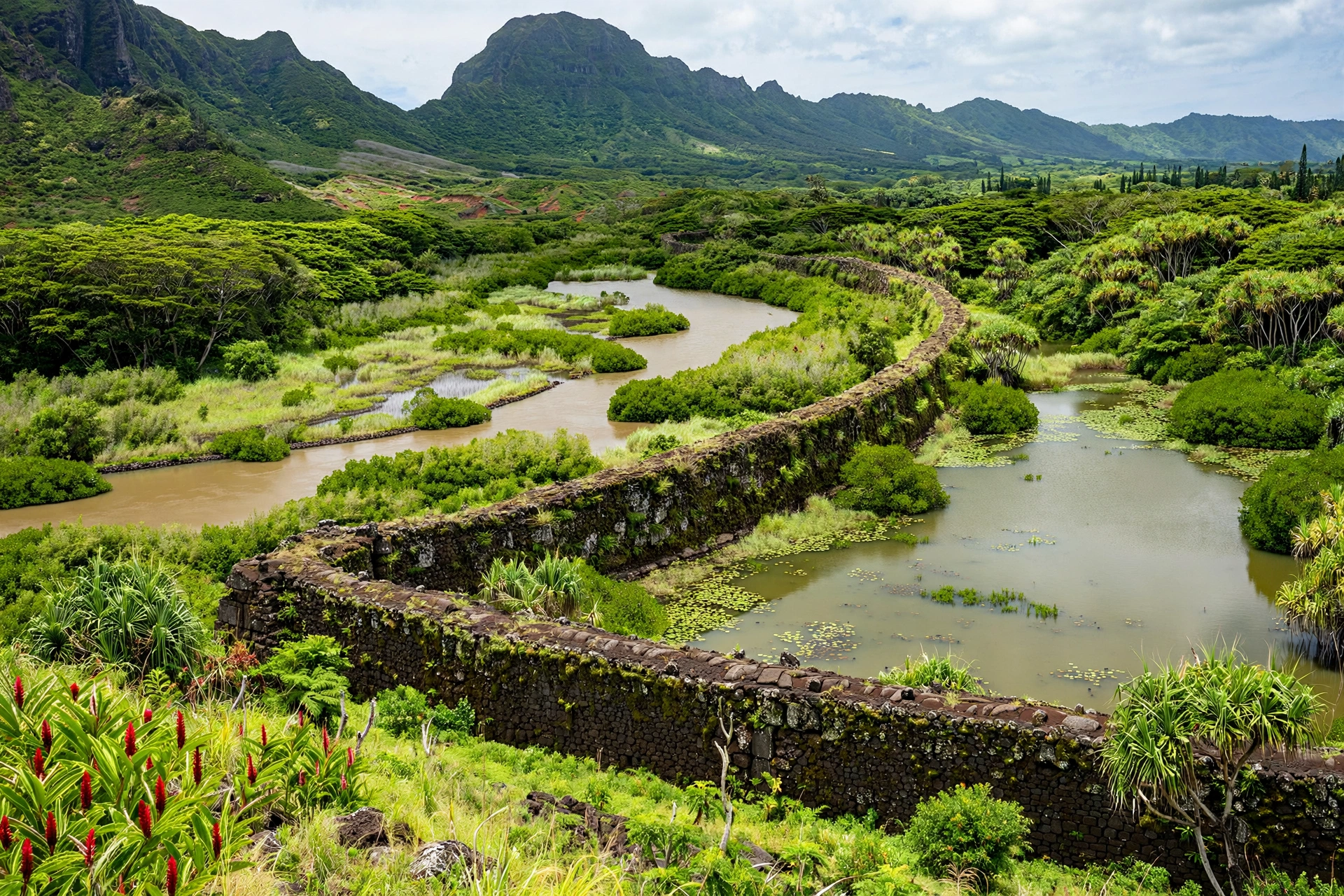
Kauaʻi is also the island most closely tied to the Menehune, the legendary small people of Hawaiian tradition. According to moʻolelo (stories), the Menehune were master builders who accomplished great works in a single night. Two of their attributed feats still exist on Kauaʻi. The Alekoko Fishpond, also called the Menehune Fishpond, is a 900-foot stone wall enclosing a fishpond near the Hulēʻia River above Nāwiliwili Harbor; tradition says the Menehune built it in one night, passing stones hand to hand in a long human chain. The Menehune Ditch, or Kikiaola, is a stone-lined irrigation channel near Waimea whose precisely cut stones still puzzle observers. Historians note that legends of the Menehune may preserve memories of an earlier population, but for Kauaʻi residents the Menehune remain a living part of the island’s identity, appearing in place names, stories told to children, and local art.
By the late 1700s, Kauaʻi was ruled by its own aliʻi nui. The island’s isolation, guarded by the treacherous Kaʻieʻie Waho Channel separating it from Oʻahu, had kept it politically independent through centuries of inter-island warfare. That independence would be tested, and ultimately preserved through diplomacy rather than battle, when Kamehameha the Great turned his attention westward.
Kauaʻi Resists Kamehameha
Kamehameha the Great unified the Hawaiian Islands through conquest, but Kauaʻi never fell to his armies. After his victories at the Battle of Kepaniwai on Maui in 1790 and the Battle of Nuʻuanu on Oʻahu in 1795, only Kauaʻi and Niʻihau remained outside his control, ruled by King Kaumualiʻi.
Kamehameha tried twice to take them by force. In 1796 he assembled an invasion fleet, but before it could sail, a rebellion led by Namakeha broke out on the island of Hawaiʻi, and Kamehameha was forced to turn back to suppress it. The invasion was abandoned. Several years later, Kamehameha gathered the largest armada Hawaiʻi had ever seen: foreign-built schooners, massive war canoes, cannon, and thousands of warriors massed at Kealakekua Bay and then Honolulu. In 1803, as the fleet prepared to sail, a devastating epidemic, remembered as maʻi ʻōkuʻu, swept through the crowded ranks. Kamehameha himself fell ill, though he recovered. The expedition collapsed, and the invasion was called off.
Kaumualiʻi watched this buildup and made a calculated decision. Rather than face an invasion he might lose, he chose negotiation. Foreign merchants, especially the sandalwood traders whose business suffered from the constant state of near war, encouraged a peaceful settlement. In 1810, Kaumualiʻi sailed to Honolulu and met Kamehameha face to face. The two chiefs negotiated a peaceful cession: Kaumualiʻi acknowledged Kamehameha as supreme ruler, Kauaʻi and Niʻihau entered the kingdom as a tributary domain, and Kaumualiʻi remained in power as governor of his islands. He further agreed that Kamehameha’s heir would rule Kauaʻi after his own death. Hawaiʻi was united without a battle on Kauaʻi’s shores.
The cession was a triumph of diplomacy, but it left Kaumualiʻi in an ambiguous position: a king who had surrendered his crown yet still governed his island. In the years that followed, he played foreign powers against one another to preserve what autonomy he could, first siding with American interests and then, fatefully, with the Russians.
The Kingdom Era: Russians, Missionaries, and First Sugar
In 1815, a ship of the Russian-American Company wrecked on Kauaʻi, and Kaumualiʻi seized its cargo. The company’s governor in Alaska dispatched the German physician Georg Anton Schäffer to recover the goods. Schäffer arrived with instructions to cultivate Kamehameha’s friendship first, but he quickly saw a greater opportunity in Kaumualiʻi’s desire for a powerful protector against the Kamehameha dynasty.
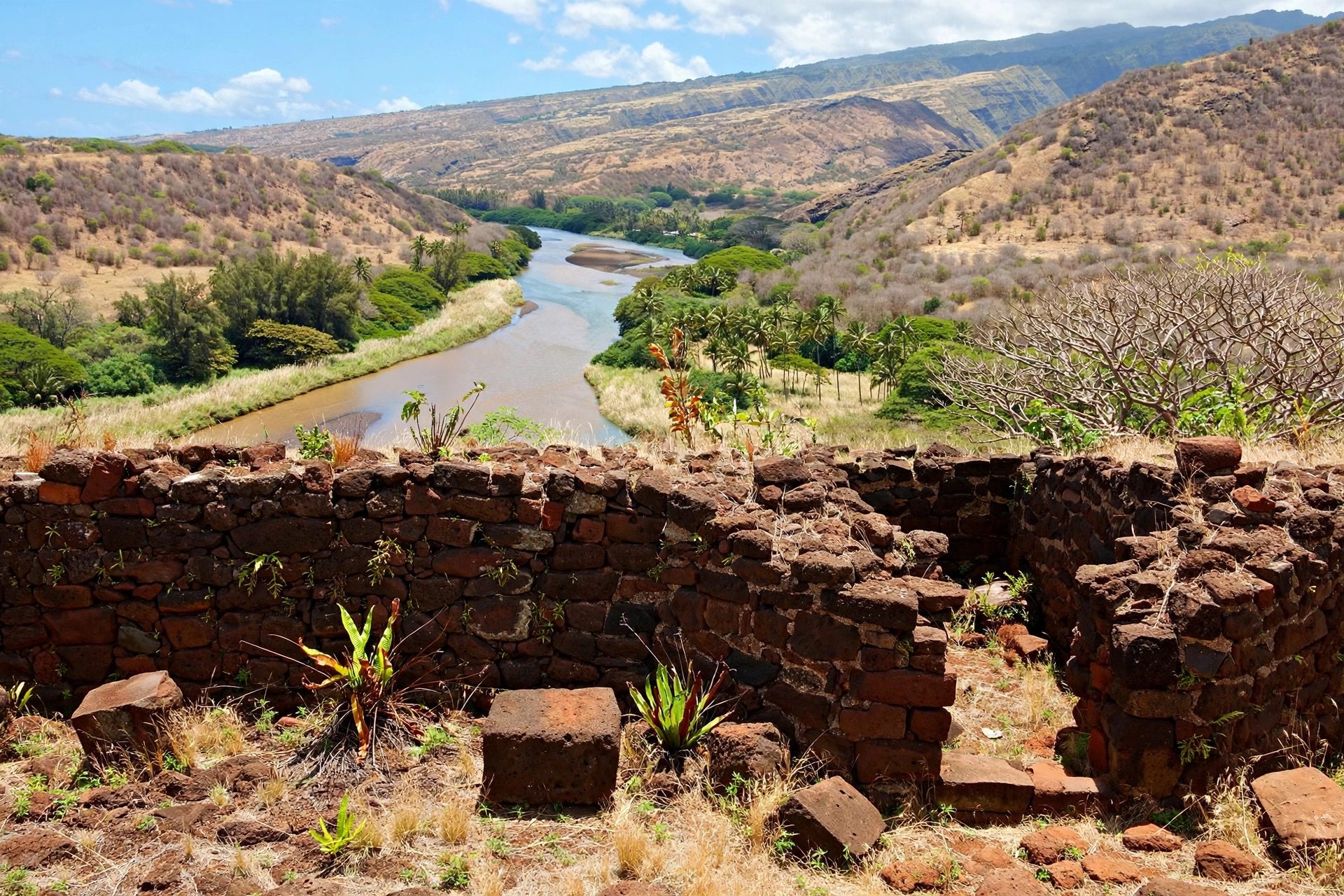
Kaumualiʻi and Schäffer struck an extraordinary bargain. The chief pledged allegiance to the Russian emperor, granted the company a sandalwood monopoly and land for crops, and promised hundreds of Hawaiian laborers and even soldiers for Russian ventures. In return, Schäffer provided the designs for a European-style star fort on the east bank of the Waimea River, overlooking Waimea Bay. Built in 1816 to 1817 by Kaumualiʻi’s own people of stone and adobe, with walls some 20 feet high, the fort was named Fort Elizabeth for the Russian empress. Two smaller earthen forts, Alexander and Barclay-de-Tolly, were raised near Hanalei. A small Russian Orthodox chapel inside Fort Elizabeth became Hawaiʻi’s first Orthodox church.
The Russian adventure collapsed almost as quickly as it began. Schäffer had promised imperial backing he did not possess, and when word of his freelance empire-building reached both St. Petersburg and Honolulu, his position became impossible. By the fall of 1817, the Russians were expelled from Kauaʻi, and Captain Alexander Adams replaced the Russian flag with the flag of the Hawaiian Kingdom. The fort passed into the kingdom’s hands. Its Hawaiian name, Pāʻulaʻula (often rendered Pāʻulaʻula o Hipo), reflects that it was a Hawaiian-built fort on a Hawaiian chief’s land all along, a fact modern scholarship has restored after generations in which it was remembered simply as the “Russian Fort.”
The fort saw one more dramatic episode. In 1824, Kaumualiʻi’s son George Kaumualiʻi, known as Humehume, attempted a rebellion against the kingdom government, and the fort at Waimea became the stronghold from which royalist forces put the uprising down. The fort was eventually abandoned in the 1850s and its armaments removed; today its walls are preserved as Pāʻulaʻula State Historical Park, a National Historic Landmark.
The kingdom era also brought the missionaries. In 1820, the first company of American Protestant missionaries arrived aboard the brig Thaddeus, and Humehume himself helped guide them to his home island. A mission station was established at Waimea, bringing schools, the printing press, and eventually profound changes to Hawaiian religion and law. Whaling ships and sandalwood traders made Kauaʻi’s ports, especially Waimea and Hanalei, busy with foreign commerce.
Then, in 1835, Kauaʻi made the contribution that would reshape all of Hawaiʻi. At Kōloa, the firm of Ladd & Company leased land from Kamehameha III and planted Hawaiʻi’s first commercial sugarcane crop. The Kōloa plantation proved that sugar could be grown profitably in the islands, and within a few decades sugar dominated the Hawaiian economy, drove immigration from around the Pacific, and concentrated land and political power in the hands of a small planter elite. Everything about modern Kauaʻi’s towns, from Kōloa’s plantation storefronts to Līhuʻe’s mills, traces back to that 1835 planting.
The Sugar Plantation Century
Sugar ruled Kauaʻi for well over a century. After the Kōloa experiment succeeded, plantations spread across the island’s sunny plains: the Līhuʻe Plantation, Grove Farm under the Wilcox family, the McBryde plantation at Kōloa, Kekaha Sugar on the west side, and others. Immense irrigation works carried water from the wet mountains to the dry fields, including ditch systems that remain among the great engineering feats of 19th century Hawaiʻi.
The plantations needed workers, and the workers changed Kauaʻi forever. Beginning in the mid-1800s, laborers arrived in waves: Chinese, then Portuguese, then Japanese, Korean, Puerto Rican, and above all Filipino workers. Each group brought foods, festivals, religions, and languages that blended into the local culture modern visitors encounter in plate lunches, bon dances, and fiesta celebrations. Plantation camps housed workers by ethnicity in an explicit hierarchy, with wages and housing graded by race, a system that bred resentment and, eventually, organized labor.
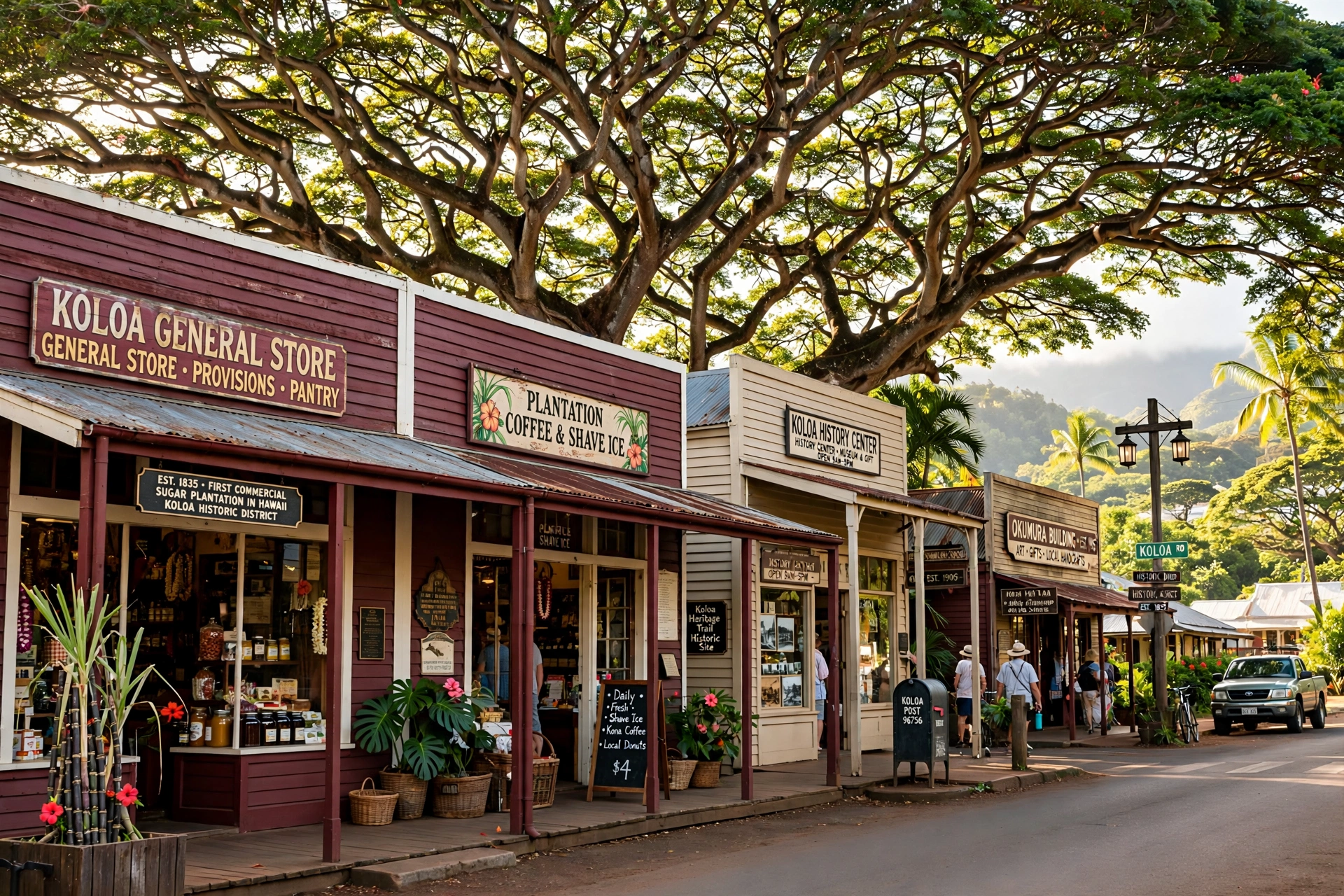
Kauaʻi’s plantation towns still show that era’s footprint. Kōloa keeps its plantation-era storefronts along its old main street. Līhuʻe grew around its mill into the island’s county seat. Kapaʻa, Waimea, Kekaha, and Hanapēpē each grew as mill or port towns. Grove Farm in Līhuʻe, the homestead of the Wilcox family who became major plantation owners, preserves the gracious wooden houses, gardens, and outbuildings of the planter class.
The plantation era was not peaceful. In 1924, a strike by Filipino sugar workers on Kauaʻi ended in violence at Hanapēpē, where sixteen workers and four policemen were killed in what is remembered as the Hanapēpē Massacre. The tragedy remains one of the darkest episodes in Hawaiʻi labor history and a reminder that the prosperity of the sugar towns was built on harsh conditions.
Sugar’s decline came in the late 20th century as global prices fell and production moved to lower-cost countries. Plantation after plantation closed across Hawaiʻi. On Kauaʻi, the last sugar harvests ended in the 2000s, closing a chapter that had begun at Kōloa in 1835. The fields gave way to diversified agriculture, including seed corn operations and Kauaʻi Coffee at Numila near Kalāheo, the largest coffee farm in the United States, and to the tourism economy that now sustains the island.
The Twentieth Century: War, Tourism, and Hurricanes
The 1900s brought Kauaʻi fully into the American century. After annexation in 1898 and territorial status in 1900, the island’s economy remained lashed to sugar, but new forces arrived. During World War II, Kauaʻi hosted military installations, and the Pacific Missile Range Facility at Barking Sands on the west side became a major naval installation that still operates today.
Tourism grew slowly, then quickly. The Coco Palms Resort near Wailua, opened in 1953, became Kauaʻi’s most famous hotel, its coconut grove and torch-lighting ceremonies featured in films and television. Princeville rose as a planned resort community on the north shore. Visitors came for the scenery that sugar had never needed: the Nāpali Coast, Waimea Canyon, Hanalei Bay.
Then the hurricanes came. In November 1982, Hurricane ʻIwa struck Kauaʻi, damaging thousands of homes and the island’s infrastructure. The island rebuilt. Ten years later, on September 11, 1992, Hurricane ʻIniki made landfall on the south shore near Makaweli as a Category 4 hurricane, the most powerful storm to hit Hawaiʻi in recorded history. ʻIniki killed six people statewide, destroyed or damaged nearly every building on Kauaʻi, stripped the island’s vegetation bare, and caused billions of dollars in damage. The Coco Palms never reopened. The recovery took years and reshaped the island: building codes were strengthened, the landscape regrew, and Kauaʻi earned a reputation for resilience that residents still cite with pride.
Since ʻIniki, Kauaʻi has rebuilt itself as an island that balances tourism with a fierce protectiveness about its character. Strict building height limits keep the island low-rise. Community opposition has turned back developments seen as threats to the island’s rural nature. Agriculture has diversified, film productions use the island’s dramatic landscapes, and the visitor industry, centered on Poʻipū, Princeville, and the east side, operates alongside towns like Hanapēpē, Waimea, and Kapaʻa that still feel like the plantation island Kauaʻi once was.
Historic Sites to Visit on Kauaʻi
Kauaʻi’s history is not confined to museums. These places put you in direct contact with the island’s past.
Russian Fort Elizabeth / Pāʻulaʻula State Historical Park (Waimea)
The stone walls of the 1816 to 1817 fort still stand on the bluff above the Waimea River. Interpretive signs explain the Schäffer affair, the fort’s Hawaiian construction, and its later use by the kingdom. The park is a National Historic Landmark and the most tangible reminder of Kauaʻi’s flirtation with Imperial Russia.
Grove Farm Museum (Līhuʻe)
The Wilcox family homestead preserves the plantation-owner’s side of sugar history: the gracious main house, gardens, and outbuildings of one of Kauaʻi’s most powerful families. Guided tours explain how the plantation system worked and who it served.
Kauaʻi Museum (Līhuʻe)
Housed in the historic Albert Spencer Wilcox Building in downtown Līhuʻe, the museum holds the island’s most important collection of Hawaiian artifacts, plantation-era objects, and fine art. It is the best single stop for understanding Kauaʻi’s layered past.
Wailua Heiau Complex and Alekoko Fishpond (Wailua)
The sacred landscape at the mouth of the Wailua River includes the Hikinaakalā, Hauola, and Malae heiau, the royal birthing stones at Holoholokū, and the great Poliahu Heiau on the bluff above. A short drive away, the Alekoko (Menehune) Fishpond’s massive stone wall curves through the wetlands above Nāwiliwili. Together they are the deepest window into ancient Kauaʻi.
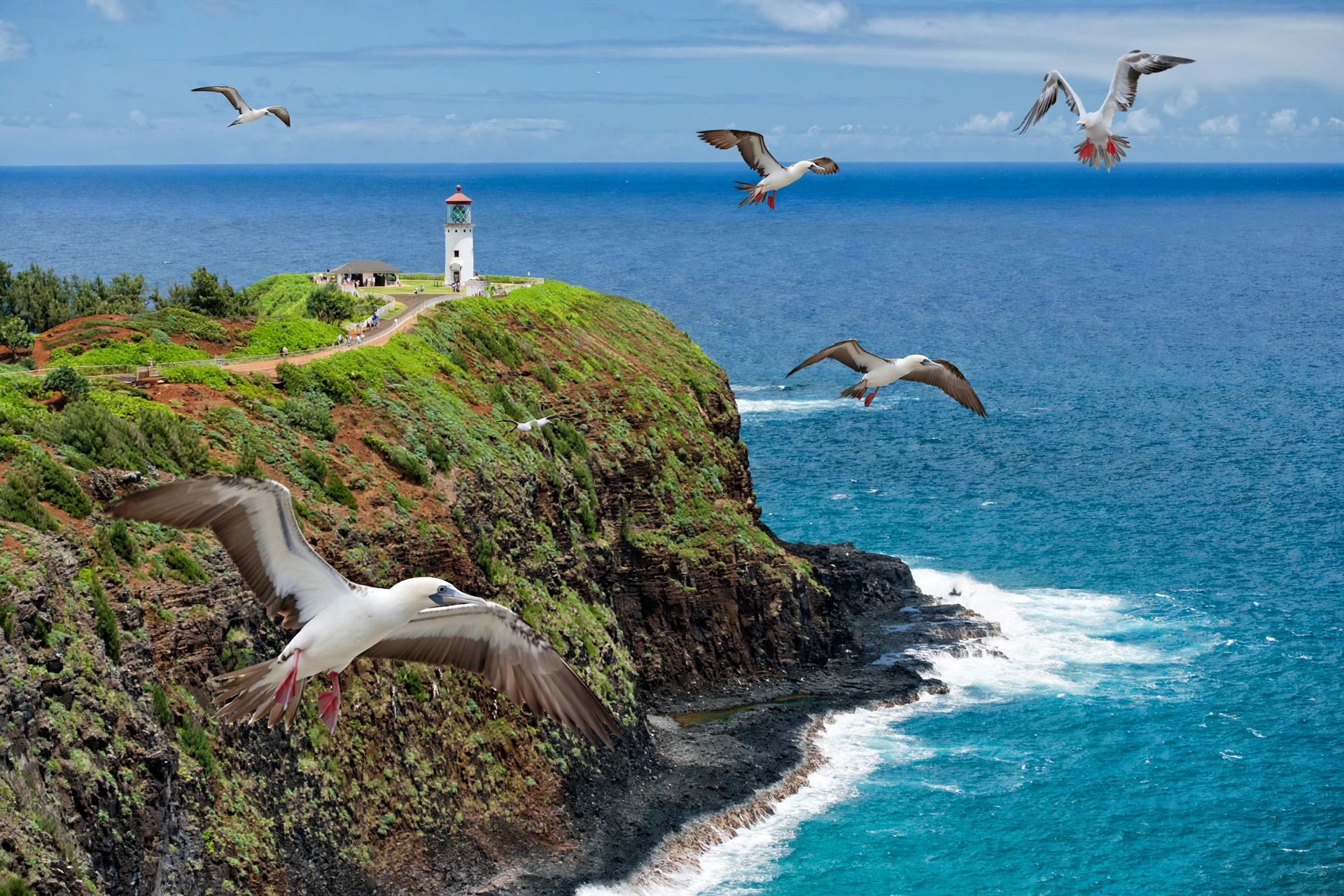
Kīlauea Point Lighthouse (Kīlauea)
Built in 1913 and now part of the Kīlauea Point National Wildlife Refuge, the lighthouse guided ships past Kauaʻi’s dangerous north shore for over sixty years. The refuge protects nesting seabirds, and the point offers the island’s best land-based whale watching in winter. Reservations are required to visit.
Old Kōloa Town and the Sugar Monument (Kōloa)
The plantation-era storefronts of Old Kōloa Town mark the birthplace of Hawaiʻi’s sugar industry. A monument commemorates the 1835 founding of the first commercial plantation, and the town’s shops and restaurants occupy buildings that once served plantation workers and managers.
Waimea Town (Waimea)
The town where Cook landed in 1778 keeps its historic character: the Waimea Theater, old plantation buildings, and the Menehune Ditch (Kikiaola) nearby. Captain Cook’s landing is commemorated at the coast, and the town serves as the gateway to Waimea Canyon.
Frequently Asked Questions
How old is Kauaʻi?
Kauaʻi is about five million years old, the oldest of the eight main Hawaiian Islands. Its age is why its landscapes are so deeply eroded: Waimea Canyon, the Nāpali Coast cliffs, and the amphitheater of Kalalau Valley were all carved by millions of years of wind and rain. The island of Hawaiʻi, by contrast, is less than a million years old and still growing.
Why did Kauaʻi resist Kamehameha?
Kauaʻi was a separate kingdom under its own high chiefs, protected by the treacherous Kaʻieʻie Waho Channel. Kamehameha tried to invade in 1796, but a rebellion on the island of Hawaiʻi forced him to turn back. A second attempt in 1803 to 1804 collapsed when disease ravaged his massed army. King Kaumualiʻi then chose diplomacy, ceding the island peacefully in 1810, so Kauaʻi was never conquered by force.
Who was Kaumualiʻi?
Kaumualiʻi was the last king of the independent kingdom of Kauaʻi and Niʻihau. In 1810 he peacefully ceded his islands to Kamehameha the Great, completing the unification of the Hawaiian Islands, and remained as their governor. He later allied briefly with the Russian-American Company, resulting in the construction of Fort Elizabeth, before the Russians were expelled in 1817.
What was the Russian fort on Kauaʻi for?
Fort Elizabeth, built in 1816 to 1817 above the Waimea River, was part of King Kaumualiʻi’s brief alliance with Georg Anton Schäffer of the Russian-American Company. Kaumualiʻi hoped Russian backing would protect his autonomy from the Kamehameha dynasty. The fort was built by Hawaiians to Schäffer’s European designs and named for the Russian empress, but the Russians were expelled within a year and the fort passed to the Hawaiian Kingdom.
Where was Hawaiʻi’s first sugar plantation?
Hawaiʻi’s first commercial sugar plantation was founded at Kōloa, Kauaʻi, in 1835 by Ladd & Company. Its success proved sugar could be grown profitably in the islands and launched the industry that dominated Hawaiʻi’s economy and society for more than a century. Old Kōloa Town preserves the plantation-era buildings, and a monument marks the 1835 founding.
What happened during Hurricane ʻIniki?
On September 11, 1992, Hurricane ʻIniki struck Kauaʻi as a Category 4 hurricane, the strongest storm to hit Hawaiʻi in recorded history. It destroyed or damaged nearly every building on the island, stripped vegetation bare, and caused billions of dollars in damage. Six people died statewide. The recovery took years, strengthened building codes across Hawaiʻi, and became a defining event in modern Kauaʻi identity.
Who were the Menehune?
The Menehune are the legendary small people of Hawaiian tradition, said to be master builders who completed great works in a single night. On Kauaʻi, tradition credits them with the Alekoko Fishpond’s 900-foot stone wall and the precisely fitted stones of the Menehune Ditch at Waimea. Historians debate whether the legends preserve memories of an earlier people, but the Menehune remain central to Kauaʻi’s cultural identity.
What historic sites can I visit on Kauaʻi?
The essential stops are Russian Fort Elizabeth (Pāʻulaʻula State Historical Park) at Waimea, the Grove Farm Museum and Kauaʻi Museum in Līhuʻe, the Wailua heiau complex and Alekoko Fishpond on the east side, the Kīlauea Point Lighthouse on the north shore (reservations required), Old Kōloa Town, and historic Waimea town. Together they cover ancient, kingdom-era, plantation, and 20th century history.
Related Guides
- Kauaʻi Map: the island’s regions, towns, and landmarks
- Kauaʻi Towns: Hanalei, Poʻipū, Kapaʻa, Waimea, and more
- Kauaʻi Hikes: Kalalau Trail, Waimea Canyon, and Nāpali trails
- Kauaʻi Waterfalls: Waipoʻo, Wailua Falls, and Hanakāpīʻai
- Kauaʻi Snorkeling: Tunnels, Poʻipū, Keʻe, and Anini
- Kauaʻi Weather: seasons, microclimates, and hurricanes
- Kauaʻi Wildlife: forest birds, seabirds, and monk seals
- Hawaii Map: the full island chain
A Final Note
Kauaʻi’s history rewards the visitor who looks past the beaches. The island that would not be conquered, that parleyed with an empire’s agents and built their fort with its own hands, that planted the first commercial cane and then buried the industry a century and a half later, that lost nearly everything to ʻIniki and rebuilt: that island is still visible in stone walls, plantation storefronts, lighthouse beams, and fishpond walls. Walk those places with their stories in mind, and Kauaʻi stops being merely beautiful. It becomes legible, and far more interesting than scenery alone.