The Jacaranda Trees of Hawaii: A Purple Spring

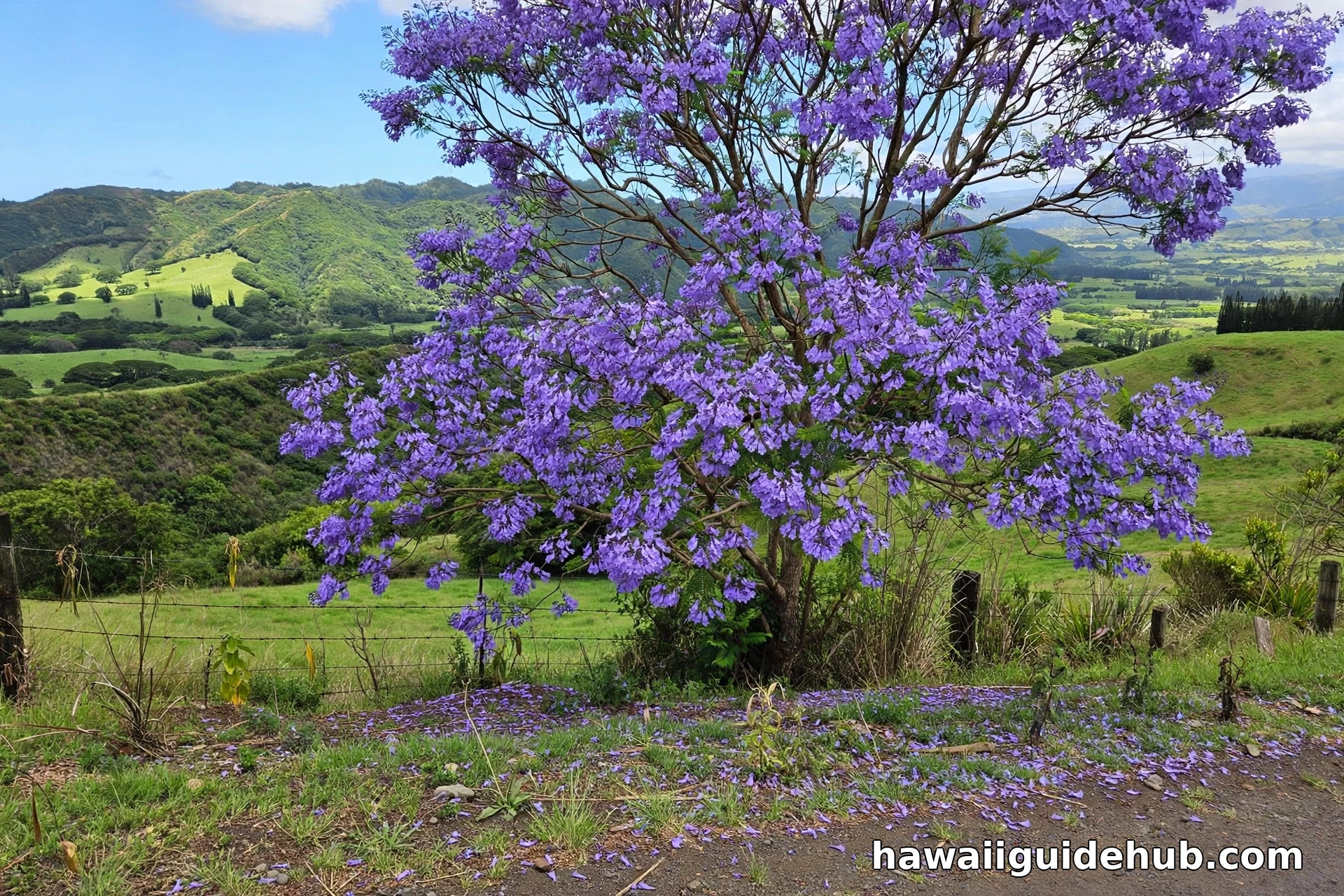
For a few weeks each spring, parts of Hawaiʻi turn purple. Not beach sunset purple, but tree canopy purple: whole hillsides in upcountry Maui dusted lavender, country roads carpeted in fallen blossoms, and drivers pulling over in Kula for a color that looks edited until you stand under it. The tree responsible is the jacaranda, and its Hawaiʻi season is one of the islands quieter natural shows, hiding in plain sight at elevations most beach itineraries never reach.
This guide covers the jacaranda tree in Hawaii completely: how to identify it, where it came from and how it got here, when and where to see the bloom at its best, its honest status as an introduced tree that can spread, and how to enjoy the season responsibly. If you have only ever associated Hawaiʻi flowers with plumeria and hibiscus, the jacaranda is your invitation to look up.
Meet the Jacaranda: Identification
The jacaranda planted across Hawaiʻi is Jacaranda mimosifolia, a member of the Bignoniaceae family. Learn three features and you will never confuse it with anything else. First, the flowers: clusters of trumpet shaped, lavender to violet blue blossoms, each about two inches long, carried in loose bunches that can span close to a foot across. In full bloom the flowers cover the crown before the new leaves fully open, which is why a flowering jacaranda reads as a solid cloud of color from a distance.
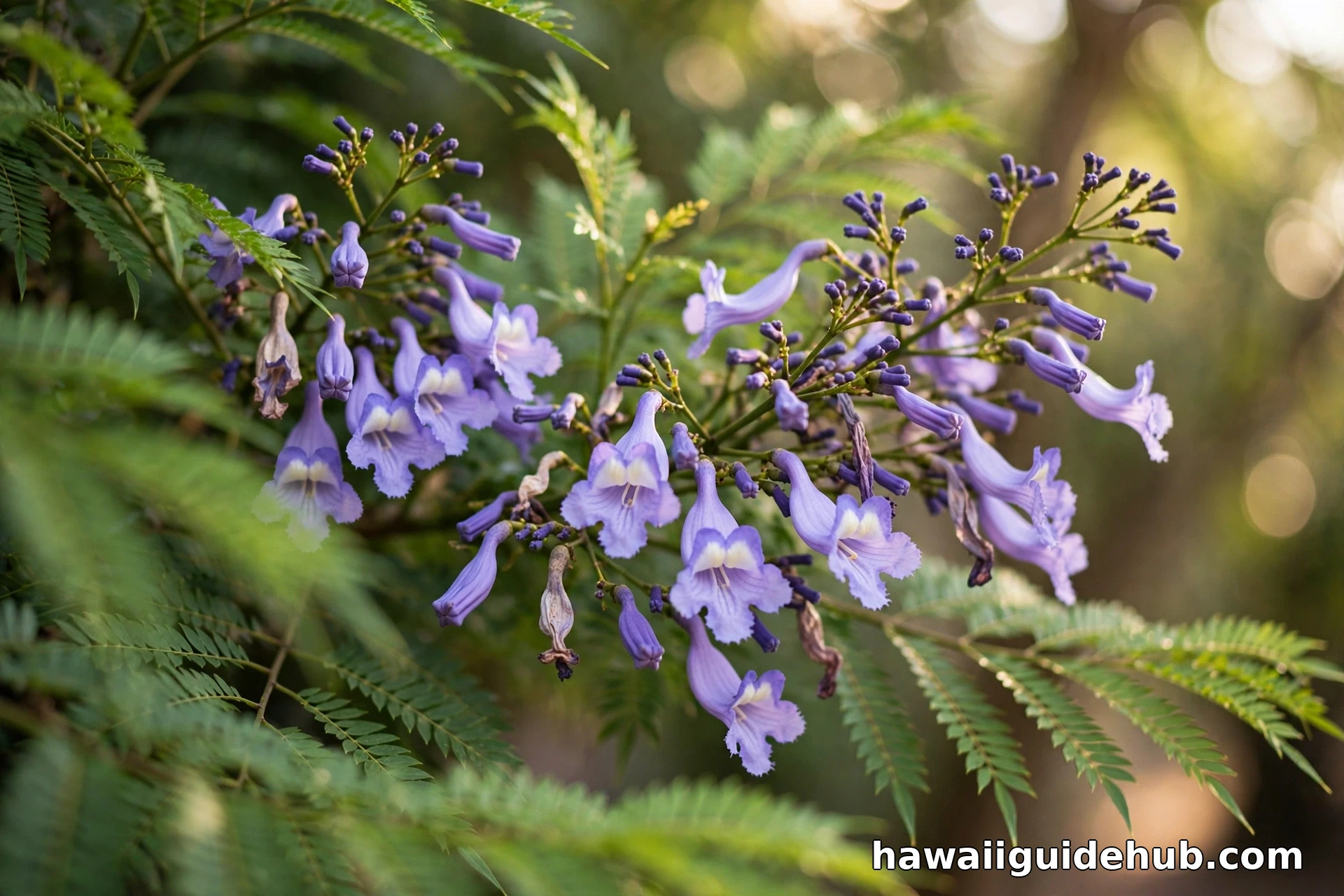
Second, the leaves: delicate, fern like, and twice divided, so fine that the canopy casts a lacy, shifting shade. Third, the seed pods: flat, round, woody discs about two inches across that hang on the tree and rattle dry in the trade winds. The tree itself has an open, spreading, slightly sculptural form, commonly reaching 25 to 50 feet in Hawaiʻi, with smooth gray brown bark on younger trees roughening with age. Out of bloom season it is a graceful, easy to overlook shade tree. In bloom, it stops traffic.
| Feature | Jacaranda detail |
| Scientific name | Jacaranda mimosifolia |
| Origin | South central South America, including Argentina and Bolivia |
| Status in Hawaiʻi | Introduced and naturalized, not native or endemic |
| Typical height in Hawaiʻi | About 25 to 50 feet |
| Bloom season | Spring, usually peaking April into May, sometimes June |
| Best known Hawaiʻi home | Upcountry Maui: Kula, Pukalani, Makawao, Keōkea |
Not Native: Where Hawaiʻi Jacarandas Came From
The jacaranda is not a Hawaiian native, and it is not a canoe plant. It is a South American ornamental that spread around the warm world in the nineteenth and twentieth centuries, to Australia, South Africa, Portugal, and the Pacific, because people simply loved the bloom. In Hawaiʻi its story centers on upcountry Maui, where Portuguese farming and ranching families settled the cool slopes of Haleakalā. Local accounts credit those ranching communities with the earliest upcountry trees around Keōkea, where the elevation and drier air suited the species.
The planting that made the tree famous came later. In the late 1950s, Maui legislator Elmer F. Cravalho, who grew up in Keōkea and later served as mayor of Maui County from 1969 to 1979, persuaded the Territorial Highway Commission to plant jacarandas along the upcountry highways around Kula and Pukalani. Those roadside trees, now mature, produce the miles of purple that define the spring drive toward Haleakalā National Park. It is one of the clearest examples in Hawaiʻi of a landscape people treasure that was, quite deliberately, planted within living memory.
Where to See Jacarandas in Hawaiʻi
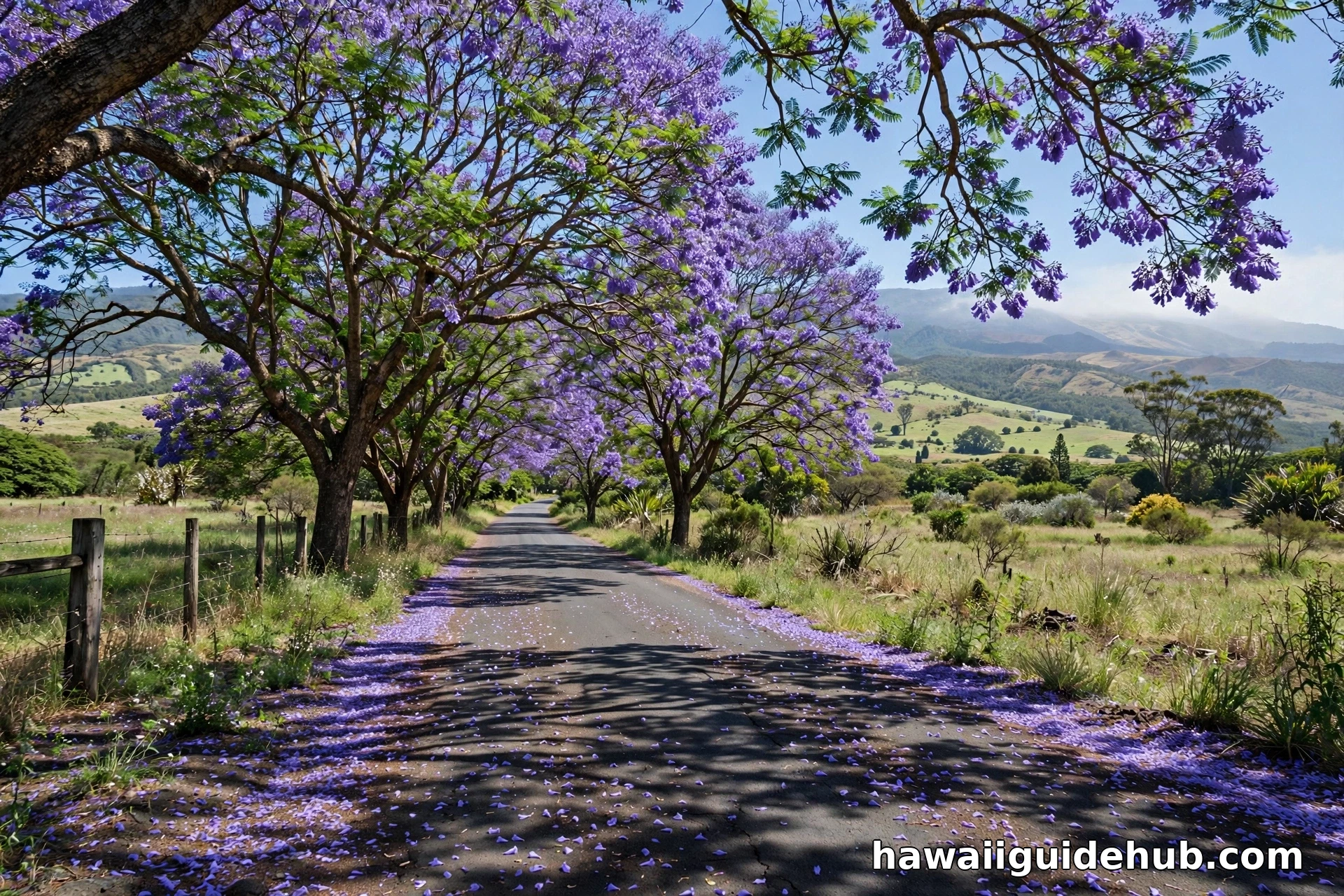
Upcountry Maui is the headline act. The Kula Highway corridor and the roads through Pukalani, Makawao, and Keōkea hold the densest plantings, at elevations roughly between 2,000 and 3,500 feet, where nights are cool enough to trigger a synchronized bloom. The classic experience is a slow spring drive with the windows down on the way to or from Haleakalā, paired with farm stops and the cooler air that surprises everyone who only knows the beach side of Maui. Readers timing a spring trip around the bloom will find the seasonal picture in our guide to Hawaii in April useful.
Hawaiʻi Island runs a quiet second. The uplands around Waimea, the ranching town in South Kohala, grow fine jacarandas in the same cool, drier pattern, and scattered trees color roads in the Kona uplands and around Volcano. On Oʻahu the tree appears as a street and campus ornamental rather than a landscape event, handsome single trees in Honolulu neighborhoods that reward residents more than itineraries. Kauaʻi has scattered upcountry specimens as well. The pattern is the real lesson: jacaranda in Hawaiʻi is an elevation tree. Wherever the land climbs into cooler nights, from Maui to the Big Island uplands explored on the way to places like La Perouse Bay on Maui south shore, the purple follows.
When Jacarandas Bloom, and Why the Timing Moves
Expect the main show from about mid April into May in most years, with early trees coloring in March and late trees dropping their last flowers in June. The display usually peaks for two to four weeks in any one neighborhood. Bloom follows a cool, relatively dry winter: jacarandas flower on growth triggered as temperatures warm, and a wet or unusually warm winter can scatter the timing. Rain at peak bloom knocks flowers down early, trading canopy color for the famous second act, a carpet of purple on roads, lawns, and trails that many photographers love even more than the trees.
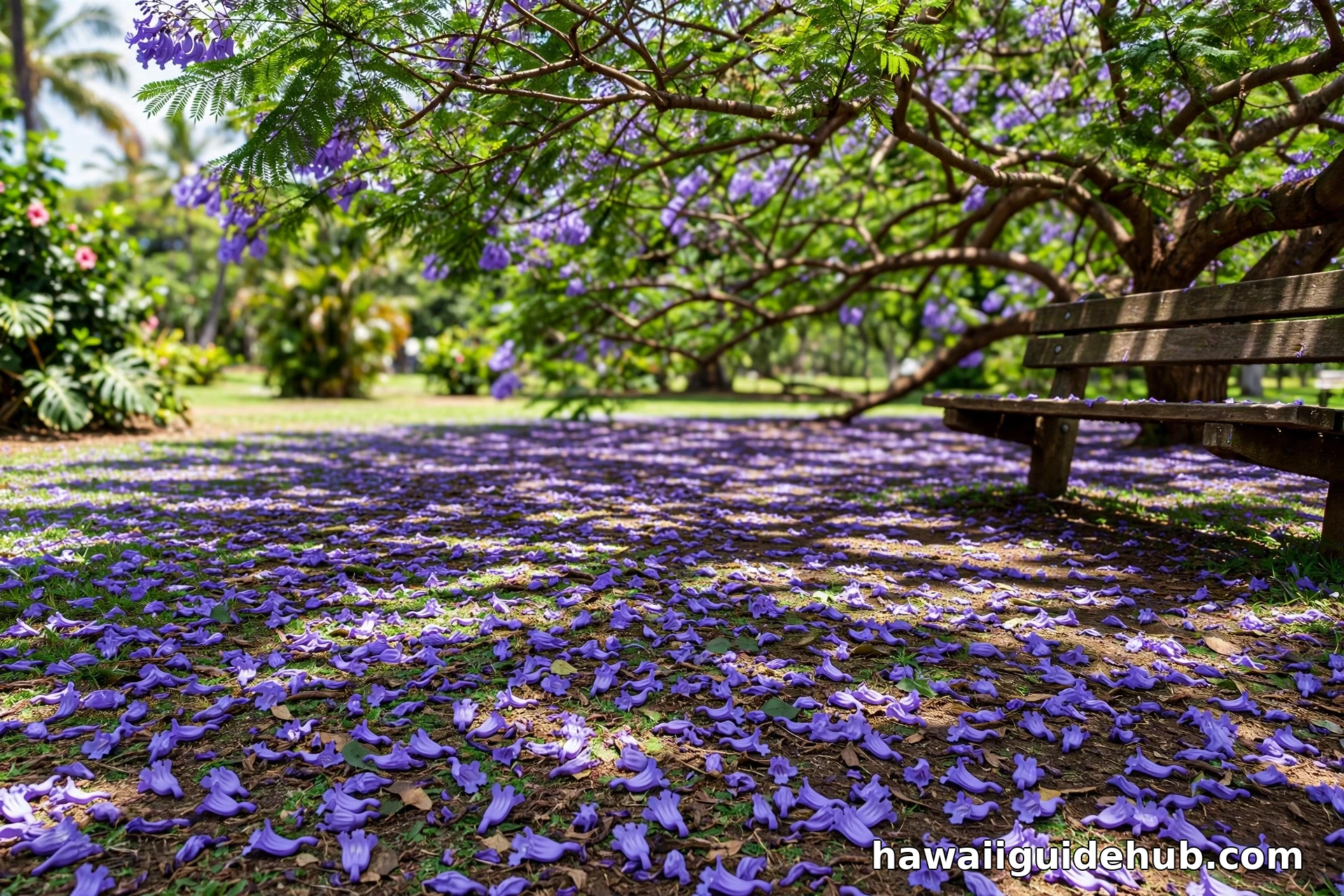
Because the season is short and movable, build flexibility into a bloom trip. Aim for the middle of the usual window rather than the edges, follow local social media and garden reports in the two weeks before you fly, and keep the drive as a half day plan that can slide by a few days. Spring in upcountry Maui offers plenty beyond one tree, protea farms, lavender, and the road to the summit, so a slightly early or late arrival still pays off, especially combined with east side stops like those in our Maui black sand beach guide on a longer Maui stay.
Not Every Purple Tree Is a Jacaranda
Spring visitors often lump every colorful canopy together, and Hawaiʻi gives them material for confusion. The royal poinciana, or flame tree, blooms later and in unmistakable scarlet orange, with flat topped crowns over parking lots statewide. Pink trumpet trees, the tabebuia family, flower in soft pink earlier in the year and drop their blossoms fast. Silk floss and shower trees add their own pinks and yellows as summer builds. The jacaranda gives itself away with the combination no other common Hawaiʻi tree matches: lavender blue trumpet flowers that arrive in spring, held above twice divided fern leaves, over those distinctive flat woody seed discs from the season before. Check for the discs and the fern leaves together and the identification is certain.
Growing a Jacaranda in Hawaiʻi: Resident Notes
For residents rather than visitors, the tree rewards the right site and punishes the wrong one. It wants full sun, well drained soil, and the cooler nights of elevation, roughly 1,500 feet and up for the most reliable bloom, although lowland trees flower acceptably in good years. Young trees are frost tender and thirsty in their first seasons, then settle into a drought tolerant maturity. Give the canopy room: a mature jacaranda spreads wide, lifts sidewalks if it is cramped, and resents hard pruning, which costs a season of flowers because blossoms form on new growth at the branch tips. Above all, site it thoughtfully and away from native forest edges, where self sown seedlings do not belong. A jacaranda in a big upcountry lawn, flowering over pasture, is the tree at its best and most responsible.
Seedlings can take several years to reach flowering size, and named selections are usually grafted where bloom quality matters. Most Hawaiʻi trees, though, are honest seedlings planted by highway crews, ranchers, and homeowners, which explains the pleasant variation you see along the Kula roads: one tree deep violet, the next a shade softer, exactly the kind of unplanned harmony no designer would dare to specify.
The Honest Ecology: Beautiful, Introduced, and Able to Spread
A responsible guide has to say the whole thing. Jacaranda is an introduced species in Hawaiʻi, and like many introduced trees it can self seed and naturalize beyond gardens, particularly in drier upland areas where its wind spread seeds find open ground. It is not in the class of Hawaiʻi most damaging invaders, the trees that blanket native forest, but it does not belong in wild planting projects either. Extension guidance from the University of Hawaiʻi treats jacaranda as a landscape ornamental for developed areas, and the sensible visitor takeaway is simple: celebrate the mature trees that exist, photograph them, enjoy them, and do not scatter seed or plant new trees anywhere near natural areas.
There is a practical side too. Fallen jacaranda flowers are famously slippery on wet pavement, a real if minor hazard on upcountry driveways and paths during peak drop. The flowers also stain, and the trees drop fine leaf litter for much of the year, which is why thoughtful landscapers keep them out of pool decks and tiny courtyards. None of this diminishes the tree. It simply places the jacaranda where it belongs in the Hawaiʻi story: a beloved immigrant, held with affection and a little care.
Enjoying Jacaranda Season Well
Go in the morning, when upcountry light is clear and the roads are quiet. Use real pullouts for photographs rather than stopping in the travel lane on the Kula Highway, because these are working ranch roads with local traffic. Many of the finest trees stand on private ranch and farm frontage, so admire from the road and resist gates, however photogenic the pasture beyond them looks. Pair the drive with upcountry food stops in Makawao or Kula, bring a layer for the elevation, and if a blossom lands on you, enjoy the local joke that it brings good luck. Spring regulars plan whole Maui trips around that purple week, and after one slow drive under the canopy, the habit is easy to understand.
A tour of Hawaiʻi flowering trees, with jacaranda among the spring standouts on Maui and Hawaiʻi Island.
Frequently Asked Questions
Are jacaranda trees native to Hawaii?
No. Jacaranda mimosifolia is native to South America and was introduced to Hawaiʻi as an ornamental. It has naturalized in places, especially in cooler upland districts, but it is neither a native nor an endemic Hawaiian species.
When is jacaranda season in Hawaii?
Spring. The main bloom usually runs from April into May, with variation by elevation and by year. Some trees start in March and hold flowers into June, and the petal fall that follows the peak is part of the show.
Where is the best place to see jacarandas in Hawaii?
Upcountry Maui, along the Kula Highway and through Pukalani, Makawao, and Keōkea, holds the most celebrated plantings. Waimea on Hawaiʻi Island is the best second choice. Both reward a slow drive on a clear spring morning.
How tall do jacaranda trees grow in Hawaii?
Commonly about 25 to 50 feet, with an open, spreading canopy about as wide as the tree is tall. Young trees grow quickly in the right upland climate and can begin flowering within a few years of planting. The oldest Hawaiʻi trees, including survivors from the highway plantings of the 1950s, show how large and characterful the species becomes with age, all gnarled branching and spring color.
The jacaranda season asks so little of visitors: a spring date, a drive uphill, a slower morning. In return it gives Hawaiʻi a color nobody expects from the beach postcards, and a reminder that these islands keep whole landscapes in reserve above the shoreline. If your trip lands anywhere near April or May, point the car toward the cool slopes and go see the purple for yourself.