
Honokaʻa, Hawaiʻi
Honokaʻa Overview
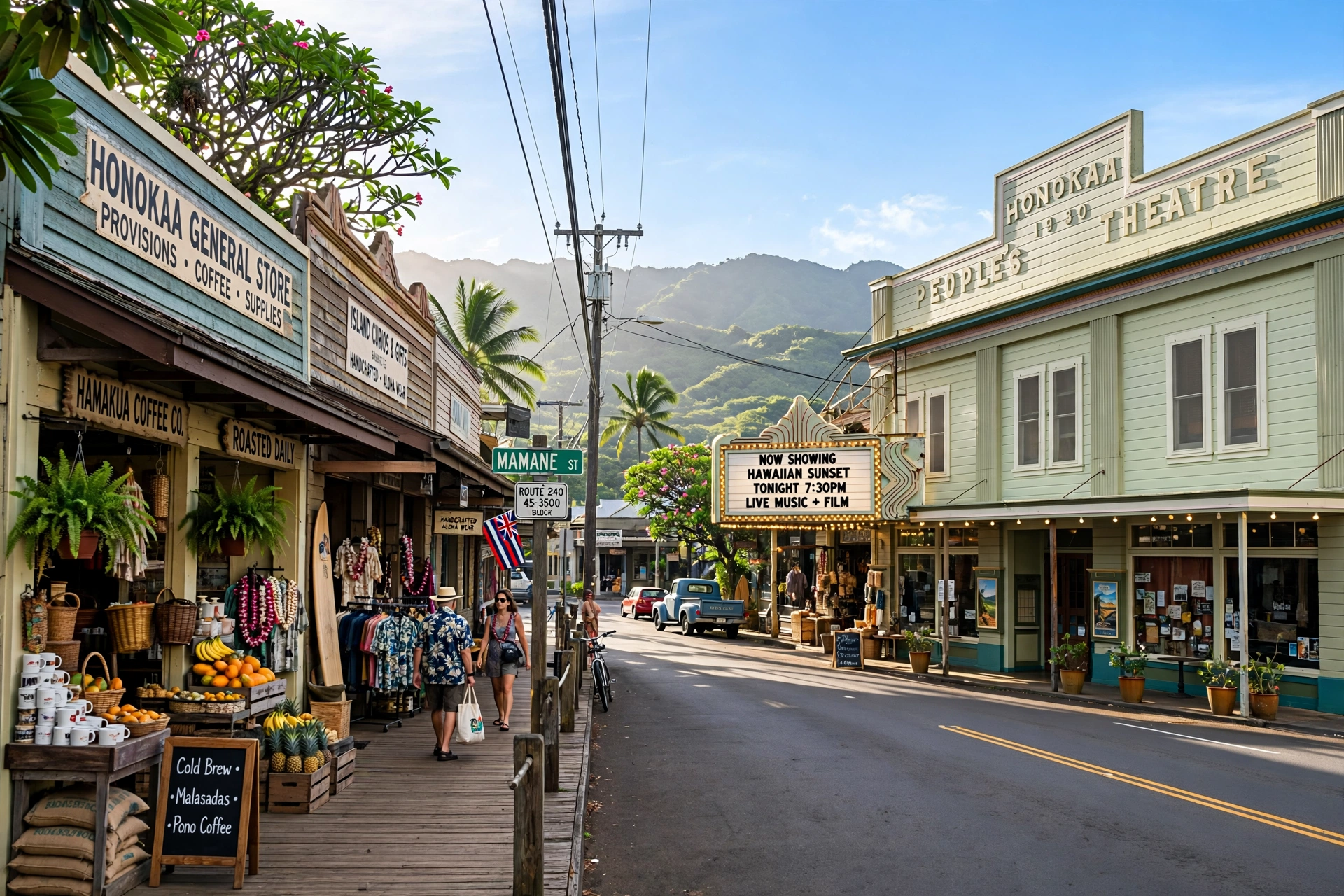
Honokaʻa sits on the lush Hāmākua Coast of the Big Island, about 40 miles north of Hilo on the Māmalahoa Highway. With a population of roughly 2,300 people, it is the kind of town many visitors picture when they imagine old Hawaiʻi: a single wide main street lined with wooden storefronts, false-front facades, and a vintage movie theater that has been showing films since the 1930s. Yet Honokaʻa is no museum piece. It is a living town where ranchers in cowboy boots still stop for coffee, where local musicians play in small venues, and where the Portuguese malasadas at the famous drive-in draw lines out the door.
The town occupies a strategic spot for travelers exploring the Hāmākua region. It is the closest full-service town to the Waipiʻo Valley lookout, about nine miles up Highway 240 past Kukuihaele. It also sits within easy reach of ʻAkaka Falls State Park, Waimea’s paniolo country, and the scenic coastline stretching south toward Laupāhoehoe. Most visitors pass through Honokaʻa on a day trip from Hilo, Kona, or the Kohala Coast, and that is usually enough time to walk Māmane Street, grab a malasada, and continue on to the valley lookout. But those who linger find a town with genuine depth, shaped by more than a century of sugar history and the cultural layers that came with it.
Honokaʻa’s elevation of roughly 1,200 feet above sea level keeps it cooler and greener than the coast below. Morning mists roll over the cane fields that once fed the town’s mills, and the weather can shift quickly from sun to drizzle, so a light layer is worth carrying. The town moves at a deliberate pace. Shops open when they open, conversation is unhurried, and the prevailing mood is one of quiet pride in a place that has reinvented itself without losing its character. For travelers, that reinvention is the real draw: Honokaʻa offers a window into the Hawaiʻi that existed before the resort era, and it does so without staging or apology.
History of a Plantation Town
Honokaʻa’s story is inseparable from sugar. The first plantation in the district of Hāmākua was the Honokaa Sugar Company, founded in 1876 by Englishman J. Marsden and German J. F. H. Siemsen, who planted the first crop with Hawaiian laborers and processed it with a simple two-roll crusher mill. In 1878, Marsden and Siemsen joined forces with Frederick August Schaefer, James Clark Bailey, and Patrick Michael McInerny to organize a new company, and the Honokaa Sugar Company was formally chartered on May 8, 1878. Schaefer served as president for roughly forty years, and the enterprise grew from a small mill into a major operation.
Over the decades, the company hired workers from China, Portugal, Japan, Puerto Rico, Korea, and the Philippines, along with a few Russians and Spaniards. This immigrant workforce left a permanent mark on the town’s food, festivals, and family names. The plantation eventually grew to encompass more than 9,000 acres, and its infrastructure was a marvel of the era: a railroad system stretching six and a half miles, an elaborate flume network for moving cane from hillsides to railroad cars, and an inclined tramway that carried bags of sugar down the cliff to a wharf, where they were loaded directly onto ships bound for the mainland.
In 1913 the neighboring Pacific Sugar Mill sold its mill and sent its cane to Honokaa, and in 1928 the two companies finally merged under the Honokaa Sugar Company name. At its peak the operation ran a nine-roller mill, and company lands stretched across more than 9,000 acres. Half a century later, in 1978, Honokaa merged with other companies to become part of the Davies Hamakua Sugar Company. That company was purchased by Frances Morgan and renamed Hamakua Sugar Company, which closed permanently after a final harvest in 1994. The closure ended more than a century of sugar production in the district and forced the entire Hāmākua Coast into a difficult economic transition. The Lyman Museum in Hilo preserves records from the Honokaa Sugar Company as part of the larger Hamakua Sugar Company archives, an important resource for anyone researching the plantation era.
Like much of the Hāmākua Coast, Honokaʻa had to find a new identity after sugar. Some former sugar lands were converted to ranching, macadamia orchards, and diversified agriculture. The town itself leaned into its historic character rather than away from it. The wooden buildings on Māmane Street were preserved rather than demolished, and Honokaʻa gradually attracted artists, musicians, small farmers, and visitors seeking an authentic small-town Hawaiʻi experience. Today the town wears its plantation past openly, in its architecture, its food culture, and the names on its old storefronts.
Exploring Māmane Street
Māmane Street is Honokaʻa’s main thoroughfare and its beating heart. Stretching for a few blocks through the center of town, it is lined with wooden storefronts that date to the plantation era, many still bearing their original false-front designs. Walking it is the essential Honokaʻa experience, and it rewards a slow pace. Look up at the cornices and faded signage, notice the mix of architectural details left by different immigrant communities, and duck into the small shops and galleries that now fill the old buildings.
The street’s most famous landmark is the Honokaʻa People’s Theatre, a vintage movie house that has been screening films since the 1930s. The theater remains active, hosting films, concerts, and community events, and its marquee is one of the most photographed sights in town. Catching a show here, if the timing works out, is a genuine slice of local life rather than a tourist production.
Māmane Street’s shops include art galleries, bookshops, vintage stores, and small boutiques selling locally made crafts. Several establishments honor the town’s multicultural heritage, and you may find Hawaiian quilts, koa wood items, and artwork by local painters. The Honokaa Trading Company and other longstanding general stores on the street have served the community through the plantation era and beyond, and browsing them gives a tangible sense of how the town supplied its workers and families for generations. Dining options are modest but satisfying: plate lunch counters, bakeries, and cafés that cater as much to locals as to visitors. The food scene reflects the plantation legacy, with influences from Japanese, Portuguese, Filipino, and Hawaiian cooking. Nobody is trying to be a destination restaurant here, and that is part of the charm.
Honokaʻa’s community events give the town a pulse that belies its size. Music is a particular thread in local life, with venues along Māmane Street hosting live performances that draw audiences from across the Hāmākua Coast and Waimea. Festivals and holiday parades bring the whole town out. If you happen to be passing through on an event day, stay for it; the town’s warmth shows most clearly when it gathers.
Waipiʻo Valley Gateway
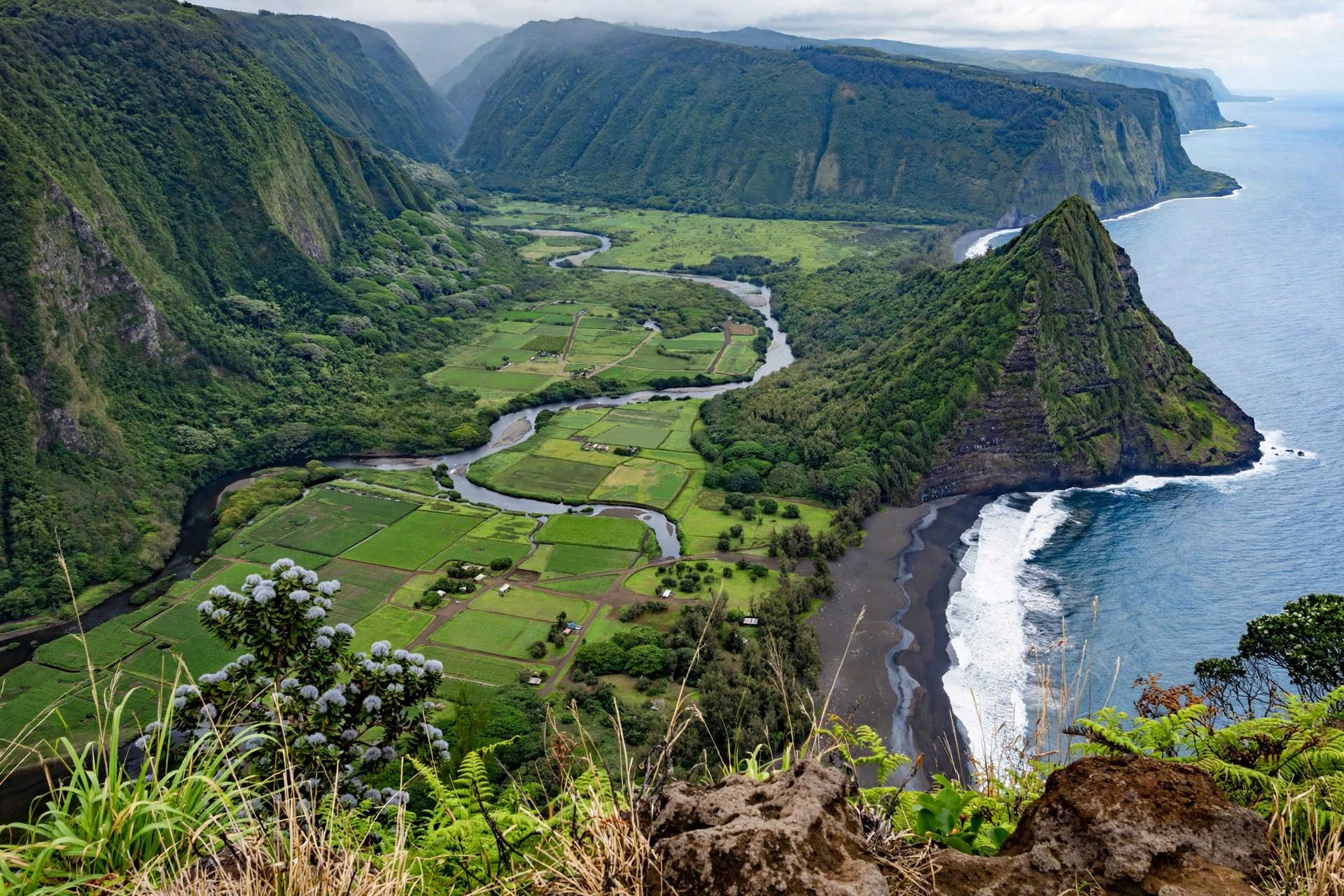
Honokaʻa is the natural gateway to Waipiʻo Valley, one of the Big Island’s most storied and visually stunning places. From the center of town, Highway 240 winds nine miles through Kukuihaele to the Waipiʻo Valley lookout, a free county lookout and viewing area with a paved viewing platform, a covered pavilion, restrooms, and a small parking lot. The view from the rim is extraordinary: a mile-wide green valley floor, a black sand beach curving across the valley mouth, and sea cliffs marching off toward Kohala.
Here is the essential fact every visitor needs to know: you cannot drive or hike down into Waipiʻo Valley on your own. Waipiʻo Valley Road has been closed to visitors since February 2022, when the County of Hawaiʻi shut it down over rockfall and landslide risks identified in a geotechnical assessment. The county has renewed the emergency closure repeatedly, and pedestrian traffic, ATVs, and horseback access are prohibited on the road. Only Hawaiʻi County residents, licensed tour operators with county permits, and Native Hawaiians exercising recognized traditional and customary rights may drive the road, using four-wheel-drive vehicles under strict rules.
For visitors, the only way to reach the valley floor is as part of a permitted tour. A shuttle service currently operates the route, running down the famously steep road, which drops about 800 feet in less than a mile at an average grade near 25 percent, among the steepest roads of its length in the United States. Check current availability and pricing with the shuttle operator before making plans, since schedules and capacity can change.
This honesty matters because older guidebooks and countless social media posts still describe driving or hiking down as if nothing has changed. Those descriptions are outdated. Respecting the closure protects both your safety and a place that is sacred to Native Hawaiians. Waipiʻo is called the Valley of the Kings for a reason: it was home to Hawaiian royalty, its cliffs served as burial grounds for high chiefs, and only a few dozen people live on the valley floor today. Treat the lookout as the main event, and if you want to go deeper, do it with a permitted operator who has the relationships and knowledge to go respectfully.
On the drive back toward Honokaʻa, stop at the small community of Kukuihaele, where a café and an artworks shop make a pleasant pause before the road drops back into town.
Nearby Attractions
Honokaʻa makes a fine base for exploring the Hāmākua Coast and the Kohala side of the island. The most popular nearby stop is ʻAkaka Falls State Park, roughly 15 miles south, where a short paved loop trail leads past lush tropical vegetation to the viewing overlook for ʻAkaka Falls, a 442-foot plunge into a deep gorge, along with the smaller Kahūnā Falls. The state park charges entry and parking fees, so check current rates with the Hawaiʻi Division of State Parks before visiting.
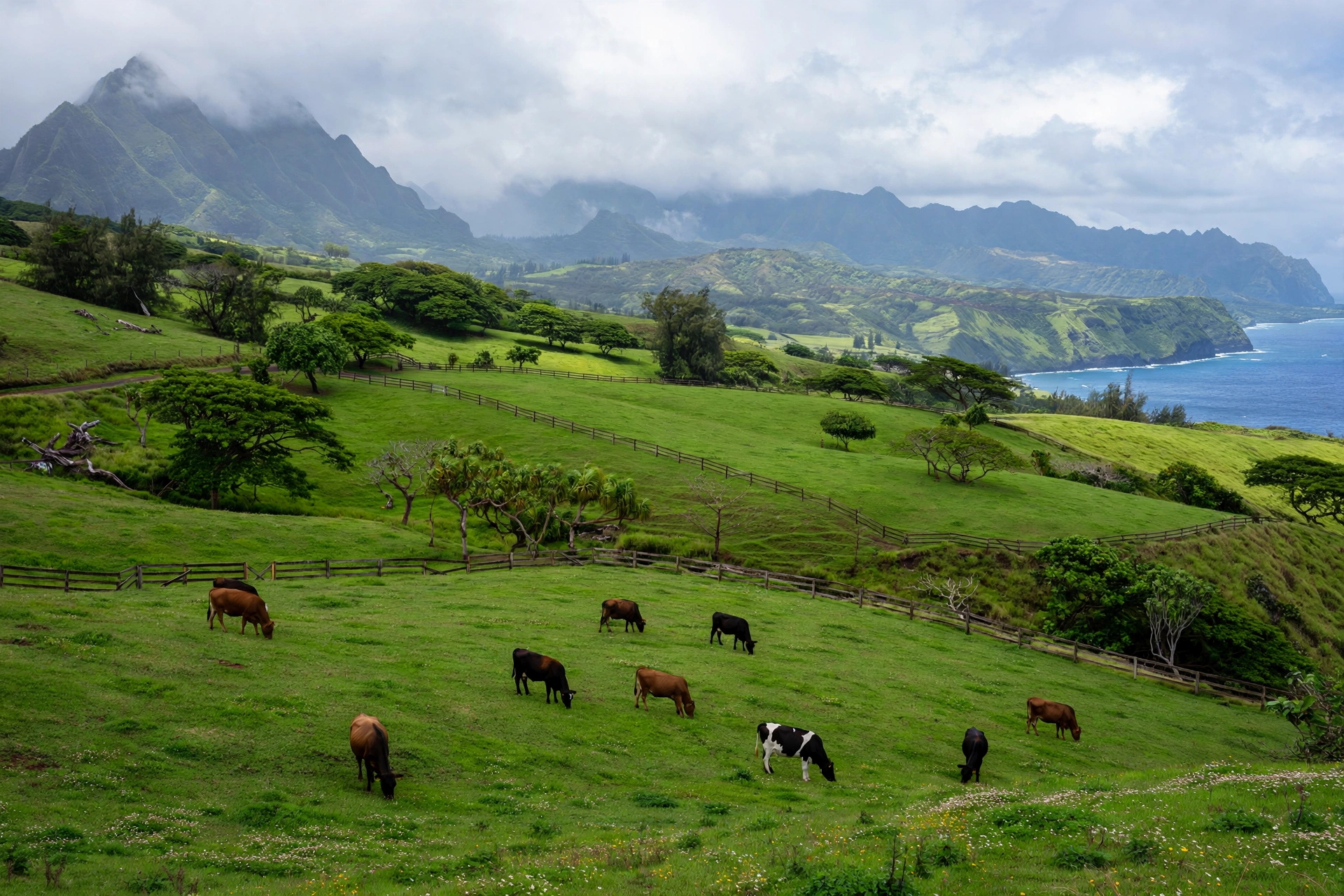
To the west, the paniolo town of Waimea sits about 20 miles away over the rolling ranch lands of the Kohala Mountains. Waimea is home to Parker Ranch, one of the largest ranches in the United States, and its cowboy heritage makes for a fascinating contrast with the plantation character of Honokaʻa. The drive itself, along Highway 19 or the scenic Highway 250, is one of the prettiest on the island.
Closer to town, Kalōpā State Recreation Area sits in a native forest of ʻōhiʻa and koa just outside Honokaʻa, offering picnic areas, cabins, and nature trails through some of the finest native forest on the island. It is an underappreciated gem and a good option for a quiet morning walk. The park’s arboretum showcases native Hawaiian plants, and the trails range from easy loops to longer routes for more experienced hikers. South along the coast, the Laupāhoehoe Point area and the wild Hāmākua shoreline offer dramatic ocean scenery, though swimming conditions along this coast are generally rough and shore access is limited.
For visitors interested in the broader Hāmākua story, the small museums and historic sites scattered along the coast fill in the plantation narrative. The Laupāhoehoe area, just south of Honokaʻa, carries the memory of the 1946 tsunami, and a memorial park there honors those who were lost. These stops are quiet and uncommercialized, which suits the region’s character.
Malasadas at Tex Drive-In
No visit to Honokaʻa is complete without stopping at Tex Drive-In, the town’s most famous food stop. Tex is widely known for its malasadas, the Portuguese-style fried dough brought to Hawaiʻi by plantation-era immigrants, and its sign claims an establishment date of 1969. Lines are a regular feature, particularly on weekends, and watching the dough being made fresh behind the counter is part of the experience. It is a local institution rather than a tourist trap, and it doubles as a practical fuel stop on the Hāmākua highway, with plate lunches, burgers, and shave ice alongside the famous dough. Hours can change, so verify the current schedule before planning a stop around it.
Where to Eat and Stay
Dining in Honokaʻa is unpretentious and rooted in local tastes. Along Māmane Street you will find cafés, bakeries, plate lunch spots, and small restaurants serving the comfort food of the plantation era: saimin, loco moco, lau lau, and Portuguese bean soup, among others. Tex Drive-In anchors the quick-service end of the spectrum. Prices are generally lower than in the resort areas, and the atmosphere is casual everywhere. Do not expect white-tablecloth dining; expect food made for people who live here.
Lodging options in Honokaʻa itself are limited but include small inns, bed-and-breakfast establishments, and vacation rentals in town and the surrounding countryside. The Hāmākua Coast also has farm stays and guest cottages set among orchards and pastureland, some offering the chance to see working macadamia or coffee operations up close. A few properties sit on the bluffs above the coast with sweeping ocean views that rival anything on the resort side of the island, often at far lower cost. If you want a wider range of hotels, Hilo is about 40 miles south and Waimea and the Kohala Coast resorts are within day-trip distance. Most visitors combine Honokaʻa with a broader Hāmākua or Big Island itinerary rather than basing an entire trip here, though a night or two in town makes for a restful, authentic interlude between busier stops.
Getting There
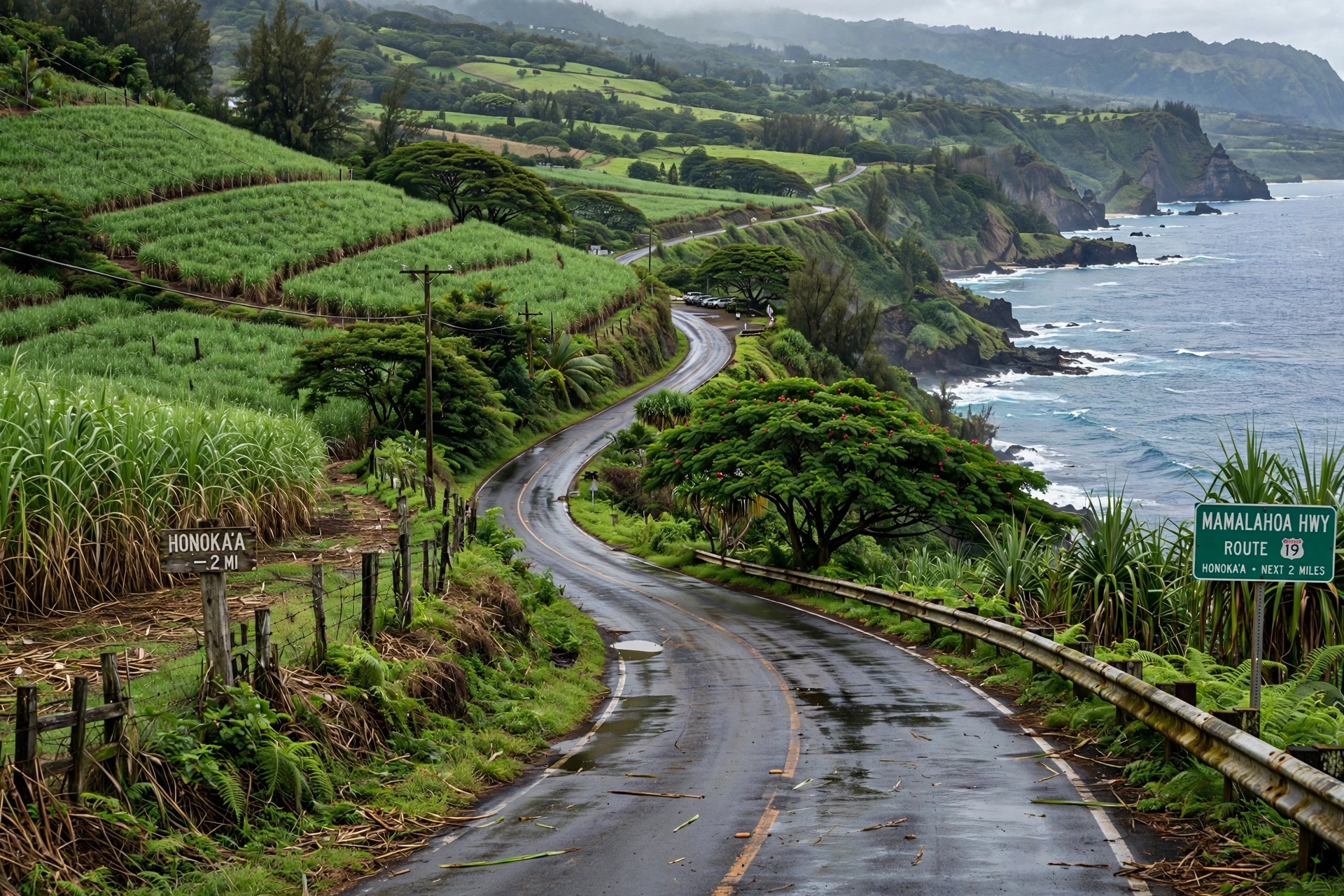
Honokaʻa is reached by the Māmalahoa Highway (Route 19/240) on the Hāmākua Coast. From Hilo, the drive is about 40 miles and takes roughly an hour, passing through the scenic coastline towns of the Hāmākua district. From Kailua-Kona and the Kohala Coast, the route runs through Waimea and along the northern coast, also about an hour depending on your starting point. From Honolulu or other islands, fly into Hilo International Airport (ITO) or Ellison Onizuka Kona International Airport at Keāhole (KOA), then drive.
A rental car is essentially required. Public bus service on the Hāmākua Coast is limited and not practical for sightseeing. Parking in Honokaʻa is easy and free, with street parking along Māmane Street and small lots around town. The highway is well maintained, but the route north of Honokaʻa toward Waipiʻo is winding in places, so drive attentively, especially in rain. Fill your fuel tank before heading to the valley lookout, and carry drinking water. Cell service can be spotty in the valleys and along the more remote stretches of the coast, so download offline maps before you leave town.
Honokaʻa FAQ
Where is Honokaʻa in Hawaiʻi?
Honokaʻa is a town on the Hāmākua Coast of the Big Island, about 40 miles north of Hilo at an elevation of roughly 1,200 feet. It sits along the Māmalahoa Highway and serves as the gateway to Waipiʻo Valley via Highway 240.
What is Honokaʻa known for?
Honokaʻa is known for its historic plantation-era main street (Māmane Street), the vintage Honokaʻa People’s Theatre, Tex Drive-In’s famous malasadas, its paniolo and cattle-country character, and its role as the gateway town to the Waipiʻo Valley lookout.
Can I drive down into Waipiʻo Valley from Honokaʻa?
No. Waipiʻo Valley Road has been closed to visitors since February 2022 under a County of Hawaiʻi emergency rule, and the county keeps renewing the closure. Visitors can reach the valley floor only through a permitted tour operator. The free lookout at the end of Highway 240 is open to everyone.
How much time do I need in Honokaʻa?
Most visitors spend one to three hours walking Māmane Street, stopping at Tex Drive-In, and browsing the shops. Combined with the Waipiʻo Valley lookout and ʻAkaka Falls, the Hāmākua Coast makes a full and satisfying day trip from Hilo or the Kohala Coast.
What are malasadas?
Malasadas are Portuguese-style fried dough, a legacy of the Portuguese immigrants who worked Hawaiʻi’s sugar plantations. Tex Drive-In in Honokaʻa is one of the most famous places to try them, offering filled and unfilled varieties.
Is Honokaʻa worth visiting from Kona?
Yes, as part of a Hāmākua Coast day trip. The drive from Kailua-Kona through Waimea and along the northern coast is scenic, passing ranch country, the Kohala Mountains, and the lush cliffs of the Hāmākua district. Honokaʻa pairs naturally with the Waipiʻo Valley lookout and ʻAkaka Falls for a full day. Leave early to give yourself unhurried time on Māmane Street and a relaxed lunch stop, since the return drive in the late afternoon lets you see the coast in different light.
What does Honokaʻa mean?
Place-name meanings in Hawaiʻi are often layered and debated, and Honokaʻa is no exception. Local sources have offered various interpretations over the years. What is certain is that the town’s name predates the plantation era and belongs to the Hāmākua district’s older Hawaiian landscape.
Where should I stay near Honokaʻa?
Honokaʻa has small inns, bed-and-breakfasts, and vacation rentals. For a wider selection of hotels, Hilo (about 40 miles south) and the Kohala Coast resorts are the main alternatives, both within day-trip distance of the town.
Related Guides
- Big Island Towns: more historic towns across the island of Hawaiʻi
- Hawaiʻi Towns: the statewide guide to notable towns on every island
- Hawaiʻi Waterfalls: ʻAkaka Falls and the island chain’s great cascades
- Where Is the Big Island: the island’s position, regions, and how to get there
- Hawaiʻi Map: find Honokaʻa and plan your route
- Best Time to Visit Hawaiʻi: when to plan your Hāmākua Coast trip
- Hāwī, Hawaiʻi: another historic North Kohala town guide
Honokaʻa does not shout for attention, and that is precisely its value. It is a town where the buildings still show the grain of the plantation century, where a Portuguese pastry is a point of civic pride, and where the road to one of the most beautiful valleys on earth begins. Come for the malasadas and the main street, stay for the deeper sense of what the Hāmākua Coast has been and what it is becoming. A few hours here adds a layer of understanding that the island’s beaches and resorts alone cannot give.