
Hawaiʻi Waterfalls
Hawaiʻi Waterfalls at a Glance
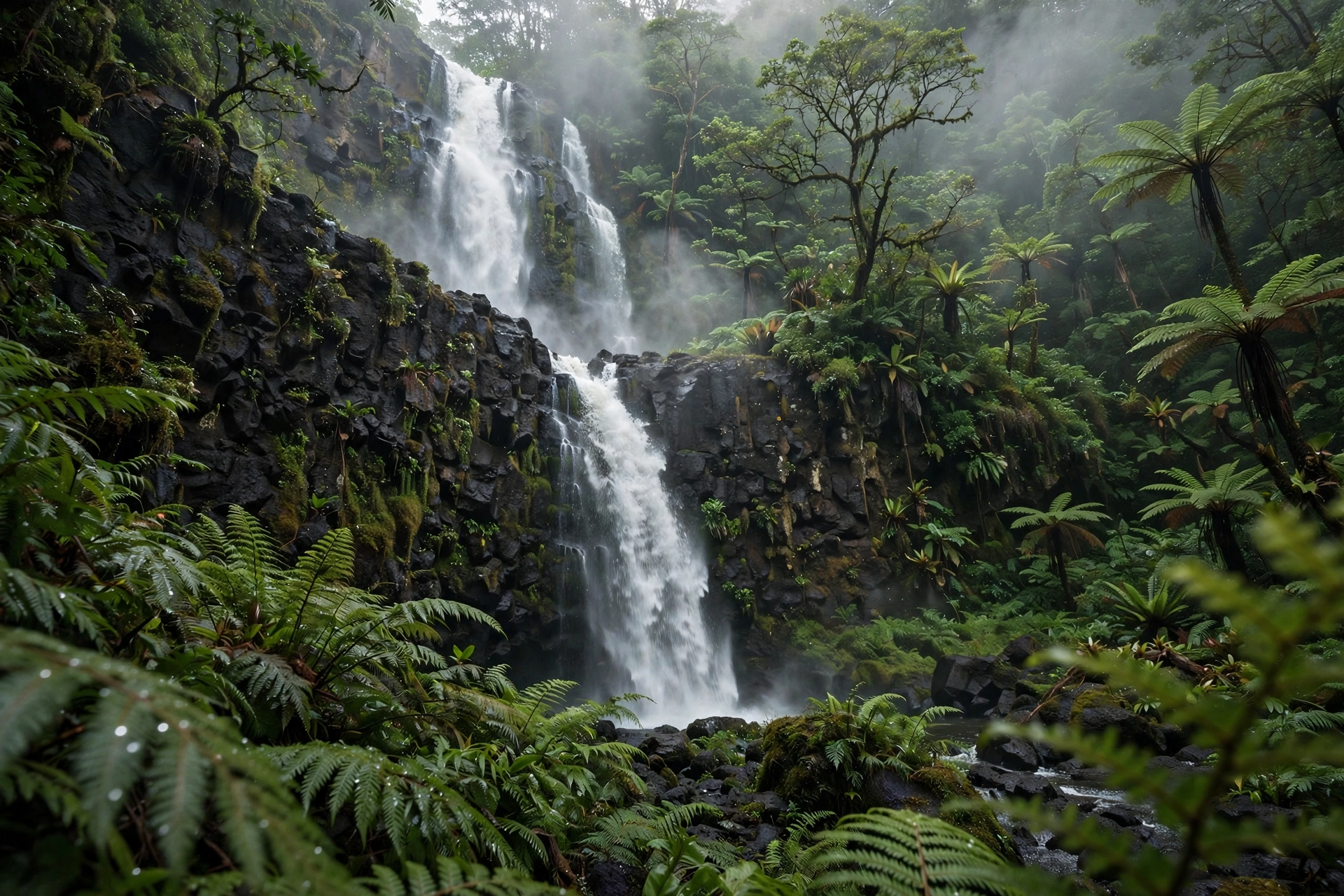
Few places on earth concentrate as much falling water into such a small area as the Hawaiian Islands. Steep volcanic slopes, trade-wind rainfall measured in hundreds of inches a year, and deep erosion-carved valleys have produced hundreds of named waterfalls across the archipelago. Some are roadside overlooks you can enjoy without leaving the car. Others are the tallest waterfalls in the United States, visible only from the sea or the air. This page is the statewide hub for Hawaiʻi waterfalls: an overview of the great falls on every island, honest guidance on which ones you can actually visit, and the safety information every traveler needs before hiking to falling water in Hawaiʻi.
Waterfalls here are not decoration. In traditional Hawaiian culture, wai (fresh water) is among the most sacred resources, and the valleys where the great falls plunge were often sites of royal residence, taro cultivation, and worship. Many of the falls named below carry Hawaiian names that describe their character or their stories. ʻAkaka means a rift or split. Waiānuenue, the Hawaiian name of Rainbow Falls, describes the rainbow that forms in its mist. Understanding that these are culturally significant places, not just photo stops, is the starting point for visiting them well.
It also helps to know how Hawaiʻi waterfalls are fed. Unlike the snowmelt-fed cascades of the mainland, almost every Hawaiian waterfall is rain-fed. Flow can change dramatically between a dry spell and a storm. A falls that is a thin silver thread in September can become a thundering curtain in January. The same rain that makes them beautiful makes them dangerous: the safety section below explains flash floods, rockfall, and the freshwater disease leptospirosis, and it is worth reading before you plan any waterfall hike.
The geography behind the falls is simple enough to grasp and worth knowing. The trade winds blow moist ocean air against the islands’ windward slopes, where the air rises, cools, and drops its moisture as rain, sometimes hundreds of inches a year. Streams gather in high valleys and spill over the rims of eroded volcanic cliffs, which is why the wet windward sides of Kauaʻi, Maui, and the Big Island hold the great concentrations of falls while the dry leeward coasts have almost none. Mount Waiʻaleʻale on Kauaʻi, one of the wettest places on earth, feeds a fan of streams that thread the island’s north and east valleys, and its slopes hold more waterfalls per square mile than anywhere else in the state, most of them reachable only by air.
Finally, a word on honesty, because waterfall marketing in Hawaiʻi is not always honest. Some famous falls sit on private land and cannot be reached on foot. Some can only be seen by helicopter or boat. A few that appear on visitor maps are effectively closed, like Sacred Falls on Oʻahu, which has been off limits since a fatal landslide in 1999. This guide only names real waterfalls, says plainly which ones require a guide, a permit, or an aircraft, and points you to the island-specific pages for full trail and access details.
The Great Waterfalls by Island
The sections below cover the most significant named waterfalls on each island: the ones that define the statewide waterfall experience. Each entry includes the falls you should know by name, with practical notes on access. For trail-by-trail detail, parking, and current conditions, follow the links to the island waterfalls pages.
Big Island Waterfalls
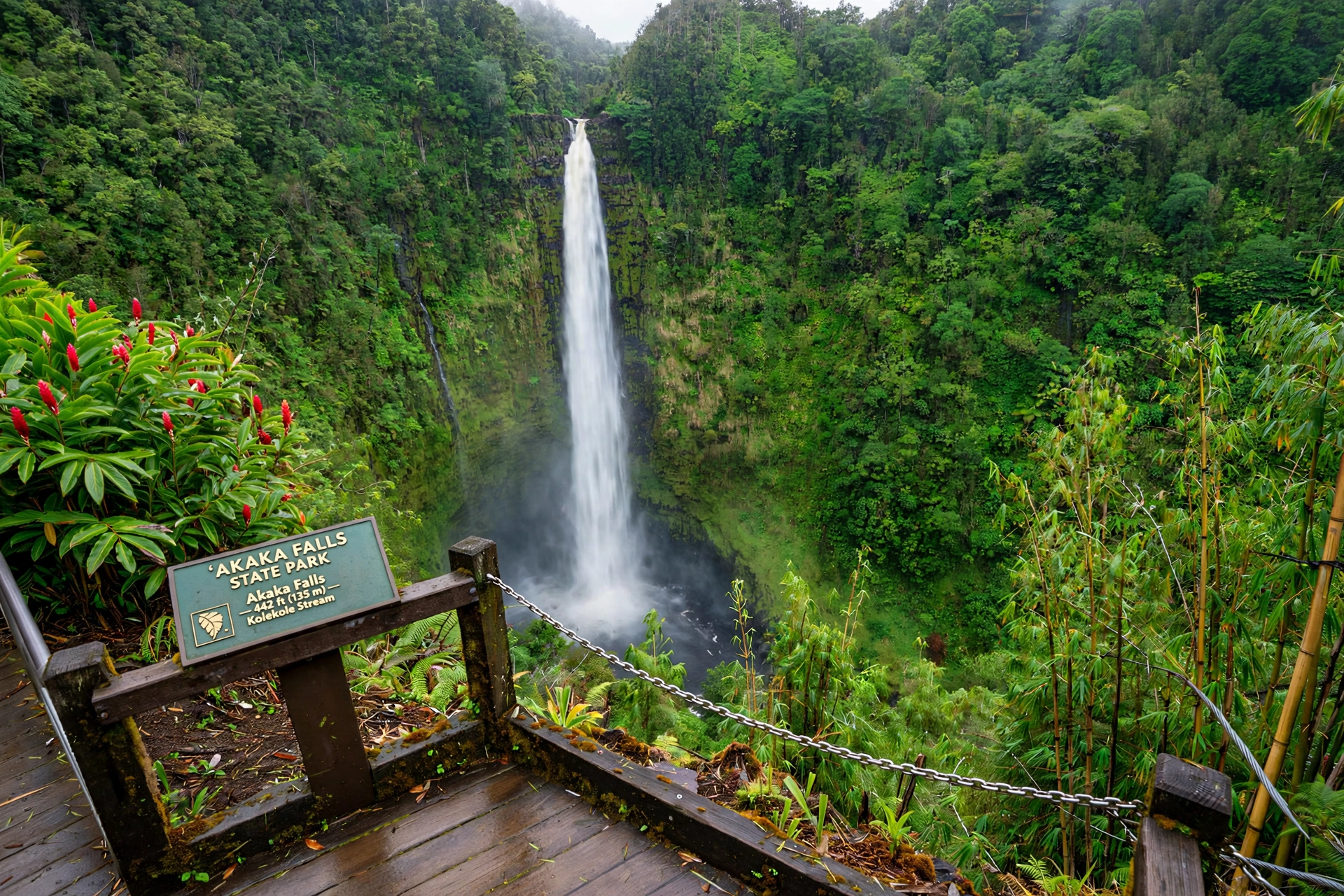
The Island of Hawaiʻi, the Big Island, holds some of the most accessible great waterfalls in the state, thanks to a network of state parks along the Hamakua Coast and near Hilo. ʻAkaka Falls is the centerpiece. At 442 feet, it plunges into a gorge draped in wild orchids and bamboo at ʻAkaka Falls State Park, about 11 miles north of Hilo. A paved 0.4-mile loop trail leads through rainforest to the main overlook, with Kahuna Falls, a 100-foot cascade, visible from the same trail. The path is short enough for families, and the State of Hawaiʻi maintains the park with restrooms, picnic areas, and an entrance fee. Because it is the most visited waterfall in the state, mornings are noticeably quieter.
In Hilo itself, Rainbow Falls, or Waiānuenue, drops 80 feet over a lava cliff in Wailuku River State Park. The name comes from the rainbows that form in the mist on sunny mornings, so early visits pay off. Farther upstream on the Wailuku River, Peʻepeʻe Falls and the swirling lava-rock pools of Boiling Pots are reached by a separate viewing area along the same river. These are viewing falls rather than hiking falls, and the park signage warns against leaving the overlooks, because the river is dangerous.
For scale, the Big Island also has waterfalls you will likely never stand beneath. Hiʻilawe Falls, at about 1,450 feet in two tiers, is one of the tallest waterfalls in all of Hawaiʻi, spilling into Waipiʻo Valley. It is usually seen from the Waipiʻo Valley Lookout rather than visited up close, and its flow can dwindle in dry periods because the stream above is diverted for irrigation. The Kohala and Hāmākua coasts also hold falls like Umauma Falls, a triple-tiered cascade of roughly 300 feet set in a botanical garden property, and Kaluahine, a 620-foot fall listed in the State of Hawaiʻi Data Book. These round out the island’s waterfall portfolio, and the full list is on our Big Island waterfalls page.
Kauaʻi Waterfalls
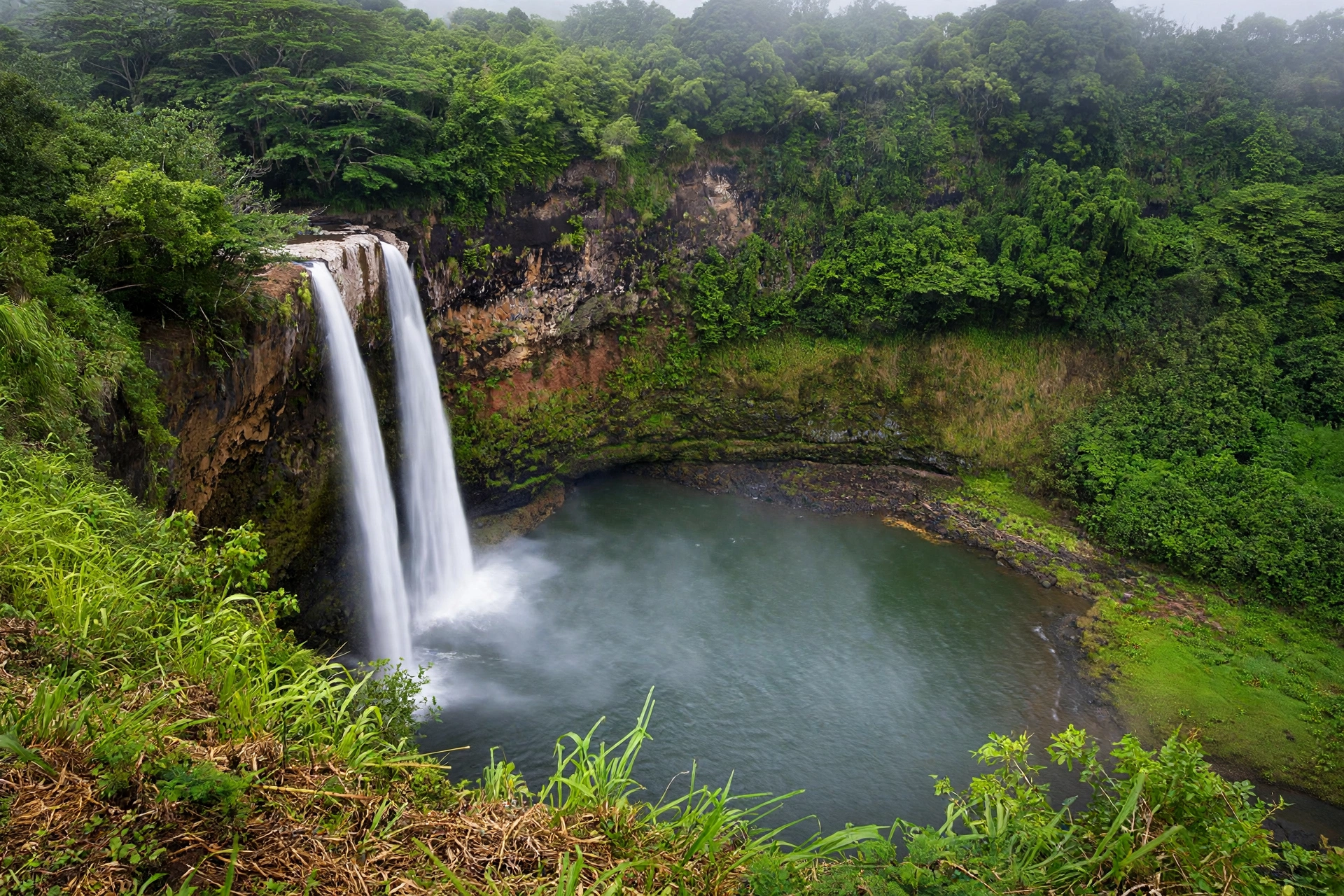
Kauaʻi, the Garden Isle, is arguably the waterfall capital of Hawaiʻi. Its ancient, deeply eroded shield volcano catches enormous rainfall, and falls line its canyons, valleys, and sea cliffs. Wailua Falls, near Līhuʻe, is the island’s most photographed cascade: a twin-tiered drop of nearly 200 feet that you view from a roadside overlook. The trail to the base is not maintained and involves steep, dangerous terrain, so the overlook is the sensible stop. Nearby ʻOpaekaʻa Falls pours 151 feet over basalt into a hidden pool, also viewed from a roadside pullout off Kuamoʻo Road. Both are free to visit and easy to combine in one outing.
The west side of the island holds two of Hawaiʻi’s most dramatic falls. Waipoʻo Falls drops 800 feet in two tiers into Waimea Canyon, the “Grand Canyon of the Pacific.” It is seen from canyon lookouts and from the Canyon Trail that descends into the gorge. Deeper in the wild interior, Mānawaiopuna Falls, widely known as Jurassic Falls after its appearance in the 1993 film Jurassic Park, drops 400 feet into Hanapēpē Valley. It sits on private land and cannot be reached by any public trail; the only access is by helicopter, with permitted landing tours offering the closest views. If a brochure promises a hike to Jurassic Falls, it is not describing this waterfall.
Along the Nāpali Coast, waterfalls spill off the sea cliffs in numbers that change with the rain. Hanakapīʻai Falls, a 300-foot cascade, is the reward at the end of a strenuous 8-mile round-trip hike on the Kalalau Trail, and permits and preparation are required. Dozens of smaller unnamed falls thread the Nāpali valleys, and on a wet day the entire coastline becomes a wall of falling water. The complete Kauaʻi inventory is on our Kauaʻi waterfalls page.
Maui Waterfalls
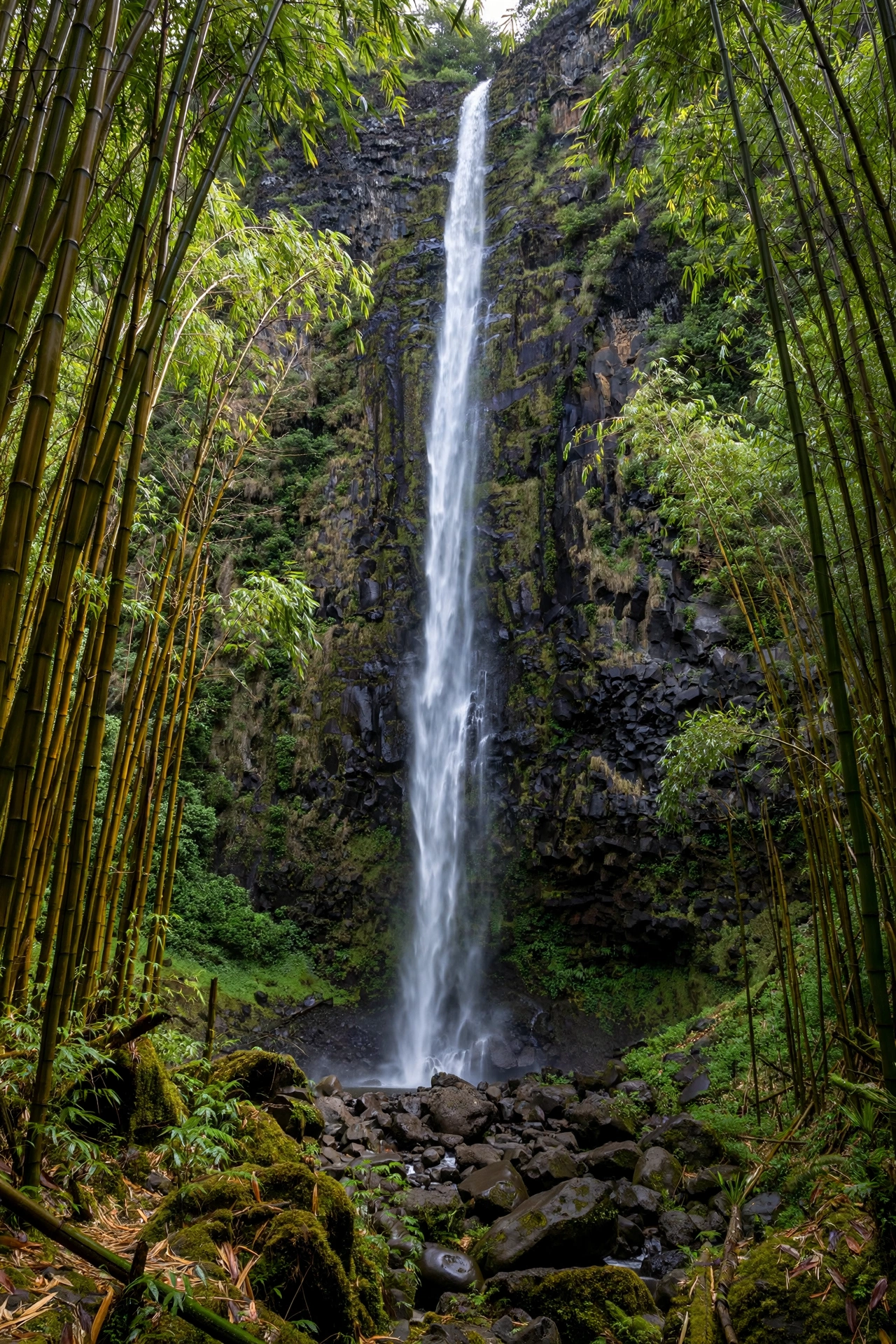
Maui’s waterfalls cluster in two zones: the windward Road to Hāna corridor and the West Maui Mountains. Twin Falls, at Mile Marker 2 on the Hāna Highway, is the first major waterfall stop most visitors reach. The falls sit on Wailele Farm, a family-owned property in Hoʻolawa Valley that opens its land to the public. Several cascades, including the Lower Falls and the Upper Falls, are reached by maintained trails, and the farm stand near the parking area is part of the experience. Parking is paid and limited, so arrive early; rules and fees can change, so check the farm’s current information before you go.
The great hike-to waterfall on Maui is Waimoku Falls. It stands 400 feet tall at the end of the Pipiwai Trail in the Kīpahulu District of Haleakalā National Park. The trail is about 4 miles round trip, passing a giant banyan tree, the 200-foot Makahiku Falls overlook, and a towering bamboo forest before the final boardwalk stretch to the viewing area. The National Park Service prohibits leaving the viewing area at the base because of rockfall danger, and swimming there is not allowed. A park entrance fee applies, and the drive beyond Hāna takes planning.
Along the Hāna Highway itself, a string of roadside and short-trail falls fills out the route: Puohokamoa Falls, the multi-tiered Upper Waikani Falls (often called Three Bears), Puaʻa Kaʻa Falls at the state wayside of the same name, and Alelele Falls near Kīpahulu. In the West Maui Mountains, Honokōhau Falls, at about 1,100 feet in two tiers, is Maui’s tallest waterfall. Like Molokaʻi’s great sea-cliff falls, it sits in an inaccessible valley and is seen only from the air. Our Maui waterfalls page maps every stop in driving order.
Molokaʻi Waterfalls
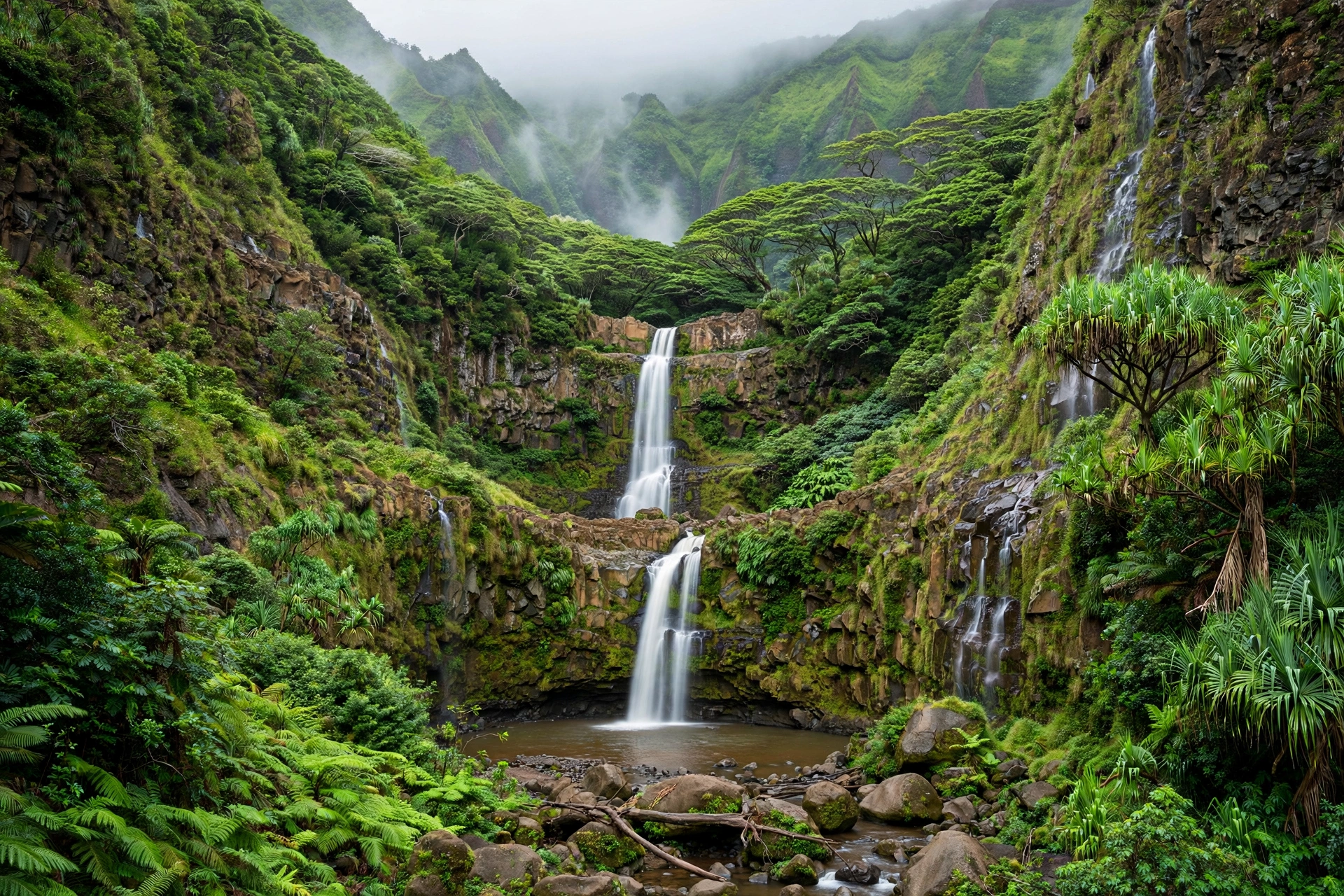
Molokaʻi holds the tallest waterfalls in the United States, and almost none of them can be reached on foot. The northeast sea cliffs, among the tallest sea cliffs in the world, carry a series of immense seasonal falls. Oloʻupena Falls, at 2,953 feet, is the tallest waterfall in the nation, pouring off the cliffs between Pelekunu and Wailau valleys. Nearby Puʻukaʻoku Falls measures about 2,756 feet, and Papalaua Falls, roughly 1,640 feet in five drops, is one of the few in the group that flows year round. All of these are seen from the ocean or from the air; there are no trails to them.
The one great Molokaʻi waterfall you can stand beneath is Moʻoula Falls, a 250-foot double-tiered cascade in Hālawa Valley, with neighboring Hipuapua Falls of similar height. This valley is culturally sacred and the land is private, so the falls are reached only through an authorized guided cultural hike arranged in advance. Independent hiking into the valley past the public beach park is not permitted. The guided walk crosses streams and passes ancient temple sites, and the guides are from families with deep roots in the valley. It is one of the most meaningful waterfall experiences in Hawaiʻi precisely because access is limited and respectful. Details are on our Molokaʻi waterfalls page.
Oʻahu Waterfalls
Oʻahu’s waterfalls are smaller than those of the neighbor islands, but they are the most visited, because most of Hawaiʻi’s travelers stay on this island. Mānoa Falls is the classic: a 150-foot cascade at the back of Mānoa Valley, reached by a 1.6-mile round-trip trail through rainforest. The trail is busy, muddy after rain, and managed by the State of Hawaiʻi; stay on the path and off the rocks at the base. Likeke Falls, off the Old Pali Road, is a smaller cascade on a short hike popular with families.
Oʻahu is also where waterfall safety rules matter most, because the island has several falls that are restricted or closed. Lulumahu Falls sits in the Honolulu watershed and requires a permit from the Honolulu Board of Water Supply; hiking there without one is trespassing. Sacred Falls (Kaliuwaʻa), once the island’s most famous waterfall hike, has been closed to the public since a 1999 landslide killed eight people and injured dozens. The closure is enforced, and entering the closed valley is both illegal and extremely dangerous. For the full list of which Oʻahu falls are open, see our Oʻahu waterfalls page.
Lānaʻi Waterfalls
Lānaʻi is the honest exception in any Hawaiʻi waterfalls guide. The island is comparatively dry, its volcanic profile is older and lower, and it has no named permanent waterfalls. Seasonal runoff can carve brief cascades after heavy rain, but there is no waterfall destination on Lānaʻi. Visitors who come to Lānaʻi for waterfalls will be disappointed; visitors who come for its reefs, shipwreck coast, and quiet towns will not be. Our Lānaʻi waterfalls page explains this plainly so you can plan accordingly.
Hidden and Lesser-Known Falls
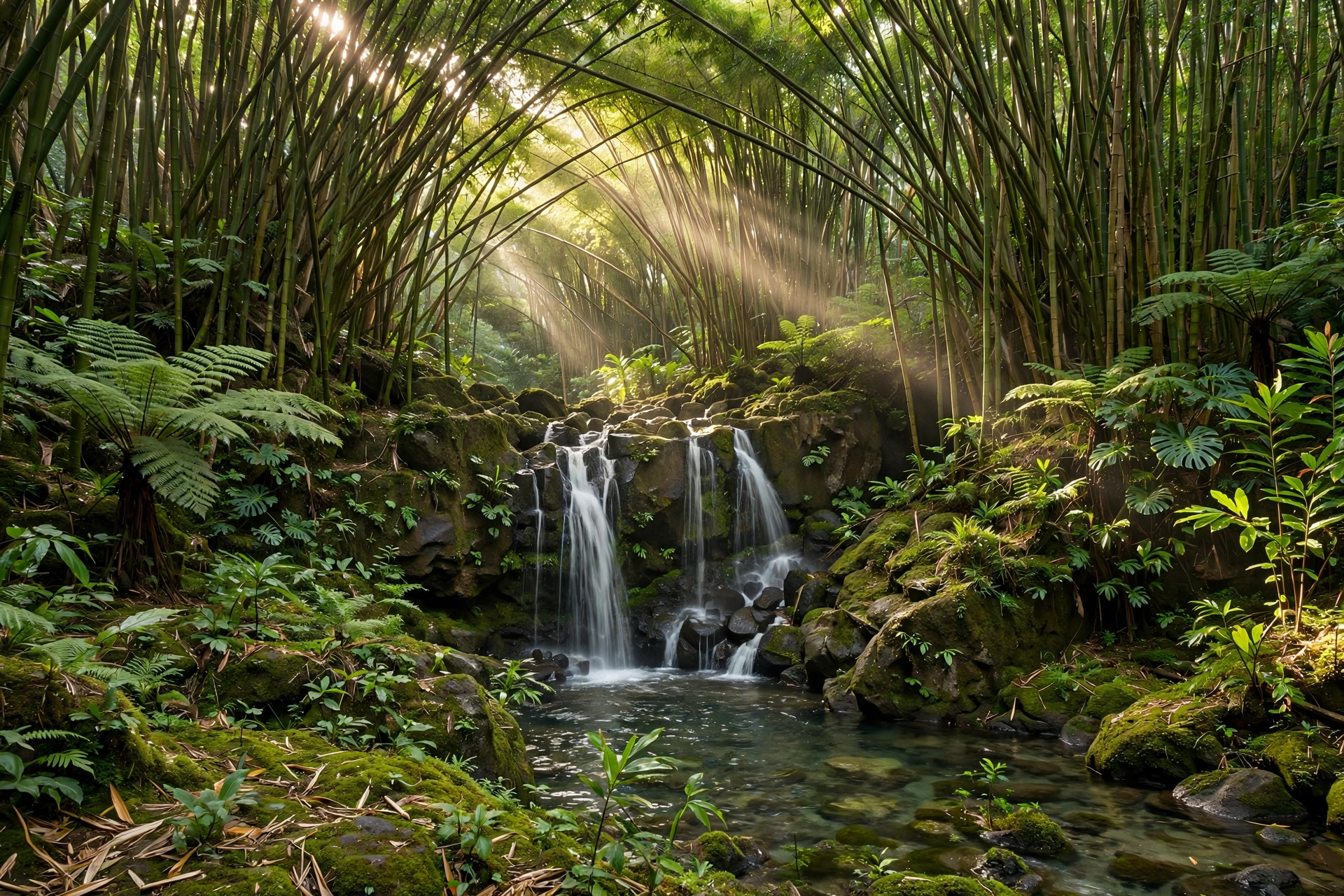
Beyond the famous names, Hawaiʻi holds dozens of real, named, lesser-visited waterfalls. A few worth knowing: on Maui, Alelele Falls near Kīpahulu is reached by a short, rough trail and is often uncrowded. On the Big Island, Kaluahine Falls, a 620-foot cascade on the Hāmākua Coast listed in the State of Hawaiʻi Data Book, rewards those who explore the coast’s gulches. On Kauaʻi, Hoʻopiʻi Falls near Kapaʻa is a two-tiered cascade on a short trail through forest that locals know well. On Oʻahu, Kapena Falls in Nuʻuanu is a small urban cascade reached by a short walk, popular with local families.
There are also the great falls that are “hidden” only because they cannot be reached: Molokaʻi’s Kahiwa Falls, at 1,750 feet, and the Wall of Tears in the West Maui Mountains, a cliff face that can carry more than a dozen simultaneous cascades after heavy rain. These are seen from boats and aircraft, and weather decides whether they appear at all.
One more category deserves a mention: the falls of Mount Waiʻaleʻale itself. The summit plateau on Kauaʻi is among the wettest spots on earth, and its fluted ridges shed countless unnamed cascades into the Blue Hole and the surrounding valleys. Helicopter flights that circle the interior often pass sheets of water with no names at all. They are a reminder that Hawaiʻi’s named waterfalls are only the documented fraction of what is actually falling.
A useful rule for lesser-known falls: if a waterfall appears on no official map, has no named trailhead, and sits behind private property or closed land, treat it as off limits. Hawaiʻi’s waterfall injury record is dominated by exactly these situations, people leaving marked routes to reach falls that were never open to the public.
Waterfall Safety: Flash Floods, Leptospirosis, and Access Rules
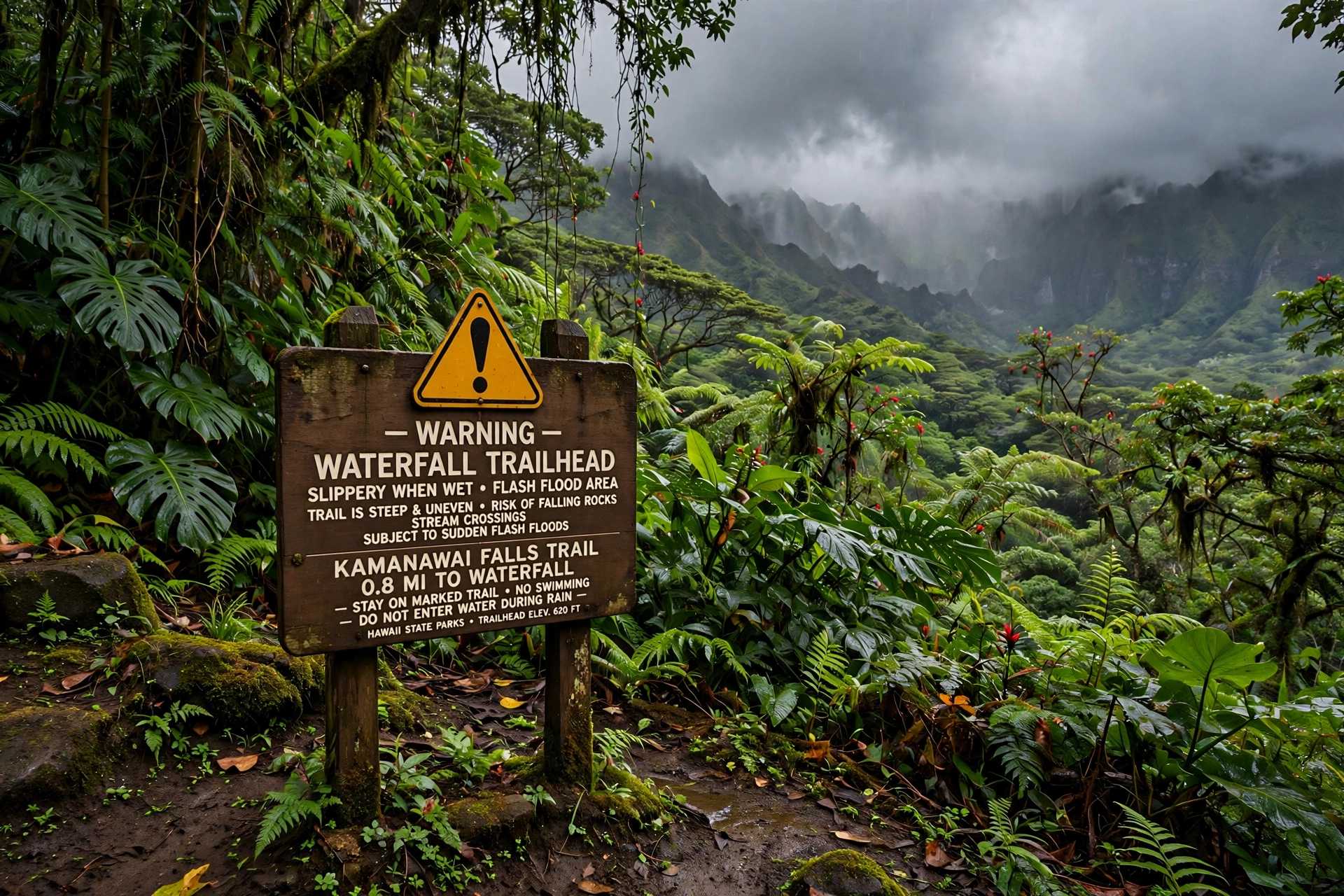
Waterfall country in Hawaiʻi is genuinely hazardous, and the hazards are not always obvious. Understanding them is part of the experience, not a footnote to it.
Flash floods
Most Hawaiian waterfalls are rain-fed, and rain can fall far upstream while the sky above you is blue. Streams can rise from a trickle to a torrent in minutes, and the narrow gulches that make waterfalls beautiful are exactly the terrain where flash floods are deadliest. Never hike a waterfall trail during a flash flood watch or warning, never cross a rising stream, and never swim in a waterfall pool when the water is brown or rising. If water starts rising around you, move to high ground immediately and do not try to cross the stream to get out. The National Weather Service issues flash flood watches and warnings for Hawaiʻi; check them before any waterfall hike, the same way you would check surf before swimming.
Leptospirosis
Leptospirosis is a bacterial disease present in Hawaiʻi’s freshwater streams and waterfall pools. The bacteria come from the urine of infected animals such as rats, mongoose, pigs, and dogs, and they can survive for weeks in fresh water. People become infected through cuts and scrapes, or through the eyes, nose, and mouth. The Hawaiʻi State Department of Health advises against swimming or wading in freshwater streams and ponds, especially with open cuts or sores, and advises against putting your head underwater or swallowing stream water. Symptoms, which can appear from two days to four weeks after exposure, include fever, chills, muscle aches, headache, red eyes, and vomiting, and the illness can become severe without treatment. This does not mean every waterfall pool will make you sick, but it means the postcard image of swimming beneath every cascade is not the medical advice. If you do enter fresh water, cover cuts with waterproof bandages, keep your head above water, and see a doctor promptly if flu-like symptoms develop after freshwater exposure.
Rockfall, slippery rock, and cliff edges
Waterfalls shed rock. Cliffs around cascades are constantly eroding, and falling rocks have caused serious injuries and deaths at sites including Waimoku Falls, where the National Park Service keeps visitors behind a signed viewing area, and Sacred Falls on Oʻahu, which remains closed after the 1999 landslide. Do not climb waterfall faces, do not stand directly beneath tall cascades, and stay behind railings and signs. Wet volcanic rock is extraordinarily slippery; most waterfall trail injuries are simple slips on muddy or algae-coated stone. Wear shoes with real grip, not flip-flops, and use the handrails and boardwalks where they exist.
Private land, permits, and closed areas
Many Hawaiʻi waterfalls sit on private land or in restricted watersheds. The rules are not suggestions. Moʻoula Falls requires an authorized guide. Mānawaiopuna Falls is helicopter-only. Lulumahu Falls requires a Board of Water Supply permit. Sacred Falls is closed by law. Trespassing on private or closed land to reach a waterfall risks fines, rescue bills, and damaged relationships between landowners and the public that can close access for everyone. If a falls has no legal public access, admire it from the legal viewpoint and move on.
Best Time to See Hawaiʻi Waterfalls
Waterfalls are a year-round attraction in Hawaiʻi, but flow follows the rain. The wetter months, roughly November through March, bring the most dramatic flows: this is when roadside falls run full and the great sea-cliff falls of Molokaʻi appear. The trade-off is that the same storms that feed the falls also make trails muddy and raise flash flood risk, so wet-season waterfall hiking demands extra caution and flexible plans.
The drier months, roughly April through October, offer safer hiking conditions and clearer skies, but some falls shrink to thin ribbons, and a few, like Hiʻilawe Falls, can nearly stop flowing when upstream water is diverted. For photography, mornings are best year round: calmer air, softer light, and, at Rainbow Falls, the literal rainbow in the mist that gives the falls its Hawaiian name. If your trip is short and waterfalls are a priority, plan your waterfall days early in the trip and keep them flexible, so you can move them around the weather rather than hiking into a storm.
Photography Tips
Waterfalls are among the most photographed subjects in Hawaiʻi, and a few techniques make a large difference. The classic silky-water effect comes from a slow shutter speed, typically between a quarter of a second and two seconds, which means a tripod or a very steady rock is essential. A circular polarizing filter cuts glare on wet foliage and deepens the greens of the rainforest, and it also reduces reflections on pool surfaces. Shoot in the soft light of morning or on overcast days; harsh midday sun blows out the white water and leaves the forest in deep shadow.
Composition matters more than gear. Include foreground elements like ferns, ti leaves, or basalt boulders to give the falls a sense of scale, since photographs flatten the height of tall cascades. Keep people and railings out of the frame where possible for a timeless image, and never step off the trail or over a barrier for a better angle. At helicopter-only falls like Mānawaiopuna and Oloʻupena, shoot through open helicopter doors with a fast shutter speed to freeze motion, and bring a lens cloth, because rotor wash and mist will coat your glass within seconds.
Frequently Asked Questions
What is the tallest waterfall in Hawaiʻi?
Oloʻupena Falls on Molokaʻi, at 2,953 feet, is the tallest waterfall in Hawaiʻi and in the United States. It can only be seen from the ocean or the air. Among waterfalls reachable by trail, Hiʻilawe Falls on the Big Island, at about 1,450 feet, is the tallest, though it is usually viewed from the Waipiʻo Valley Lookout.
Which Hawaiʻi waterfall is the easiest to visit?
Rainbow Falls in Hilo and ʻAkaka Falls on the Hāmākua Coast are the easiest major waterfalls to visit, with paved paths, parking, and state park facilities. On Oʻahu, Mānoa Falls is the most accessible waterfall hike. On Maui, Twin Falls is the simplest stop, right off the Hāna Highway.
Can you swim in Hawaiʻi waterfall pools?
Sometimes, but with real caveats. The Hawaiʻi State Department of Health advises against swimming in freshwater streams and pools because of leptospirosis, and flash floods can turn a calm pool dangerous in minutes. Some parks prohibit swimming entirely. If you swim, choose calm, clear water on a dry day, keep your head above water, cover any cuts, and never swim during or after heavy rain.
What is Jurassic Falls, and can you hike to it?
Jurassic Falls is the nickname for Mānawaiopuna Falls, a 400-foot cascade in Hanapēpē Valley on Kauaʻi that appeared in the 1993 film Jurassic Park. It sits on private land with no public trail, so it can only be seen by helicopter. There is no legal hike to it.
Why are some Hawaiʻi waterfalls closed?
Waterfalls close for safety and for land rights. Sacred Falls on Oʻahu has been closed since a 1999 landslide killed eight people. Others sit on private land, in protected watersheds, or in culturally sensitive areas. Closed means closed: entering can bring fines and puts rescuers at risk.
Do you need a guide to see Hawaiʻi waterfalls?
Most roadside and state park waterfalls need no guide. The exceptions are falls on private land: Moʻoula Falls in Hālawa Valley requires an authorized guided cultural hike booked in advance, and falls like Mānawaiopuna and Honokōhau are helicopter-only. When a guide is required, there is no legal alternative.
What should you wear to a waterfall hike in Hawaiʻi?
Shoes with strong grip, because wet volcanic rock and mud are the main injury risk. Quick-dry clothing, a rain jacket, insect repellent, and at least a liter of water per person. Bring a dry bag or waterproof case for electronics, since mist and sudden rain are constant near falls.
Are there waterfalls on every Hawaiian island?
Nearly. Kauaʻi, Maui, the Big Island, Molokaʻi, and Oʻahu all have significant named waterfalls. Lānaʻi has no named permanent waterfalls. Even on waterfall-rich islands, the distribution is uneven: the wet windward sides hold most of the falls, while the dry leeward coasts have few or none.
Related Guides
For trail-level detail, directions, parking, and current access rules, continue to the island waterfalls pages:
- Big Island Waterfalls: ʻAkaka Falls, Rainbow Falls, Hiʻilawe Falls, and the Hilo and Hāmākua cascades.
- Kauaʻi Waterfalls: Wailua Falls, ʻOpaekaʻa Falls, Waipoʻo Falls, Mānawaiopuna Falls, and the Nāpali cascades.
- Maui Waterfalls: Twin Falls, Waimoku Falls, and every Road to Hāna stop in driving order.
- Molokaʻi Waterfalls: Moʻoula Falls, Oloʻupena Falls, and the great sea-cliff falls.
- Oʻahu Waterfalls: Mānoa Falls, Likeke Falls, and which falls are open, restricted, or closed.
- Lānaʻi Waterfalls: why the island has no waterfall destinations, and what to see instead.
A Final Word on Falling Water
Hawaiʻi’s waterfalls reward the traveler who plans around them honestly: checking the weather before a hike, respecting the boundary between public land and private land, and accepting that some of the greatest falls in the state are meant to be seen from a lookout, a boat, or the air rather than stood beneath. The islands’ falling water has carved the valleys, fed the taro fields, and carried the stories of these islands for centuries. Visit the accessible falls, admire the remote ones from where they can legally be seen, and leave every trail, pool, and overlook as clean as the rain that made them.