Hawaii Wheelchair Travel Guide: The Wheelchair User’s Manual

This guide is for wheelchair users specifically: the chair flyers, the transfer experts, the people who read “accessible” with professional skepticism. Hawaii can be a magnificent wheelchair destination, but only with wheelchair-specific planning: how your chair flies, how it handles sand and salt, where the beach wheelchairs are, which transfers are real and which are fantasy. The generic accessible-travel advice is elsewhere; this is the operator’s manual.
This is the single complete wheelchair travel guide for Hawaii. It covers flying with your chair, power versus manual in island conditions, beach wheelchair programs, transfers that work, chair maintenance against salt and sand, and the attractions that deliver. If you have been searching for anything about Hawaii wheelchair travel, the answers are all here on this one page.
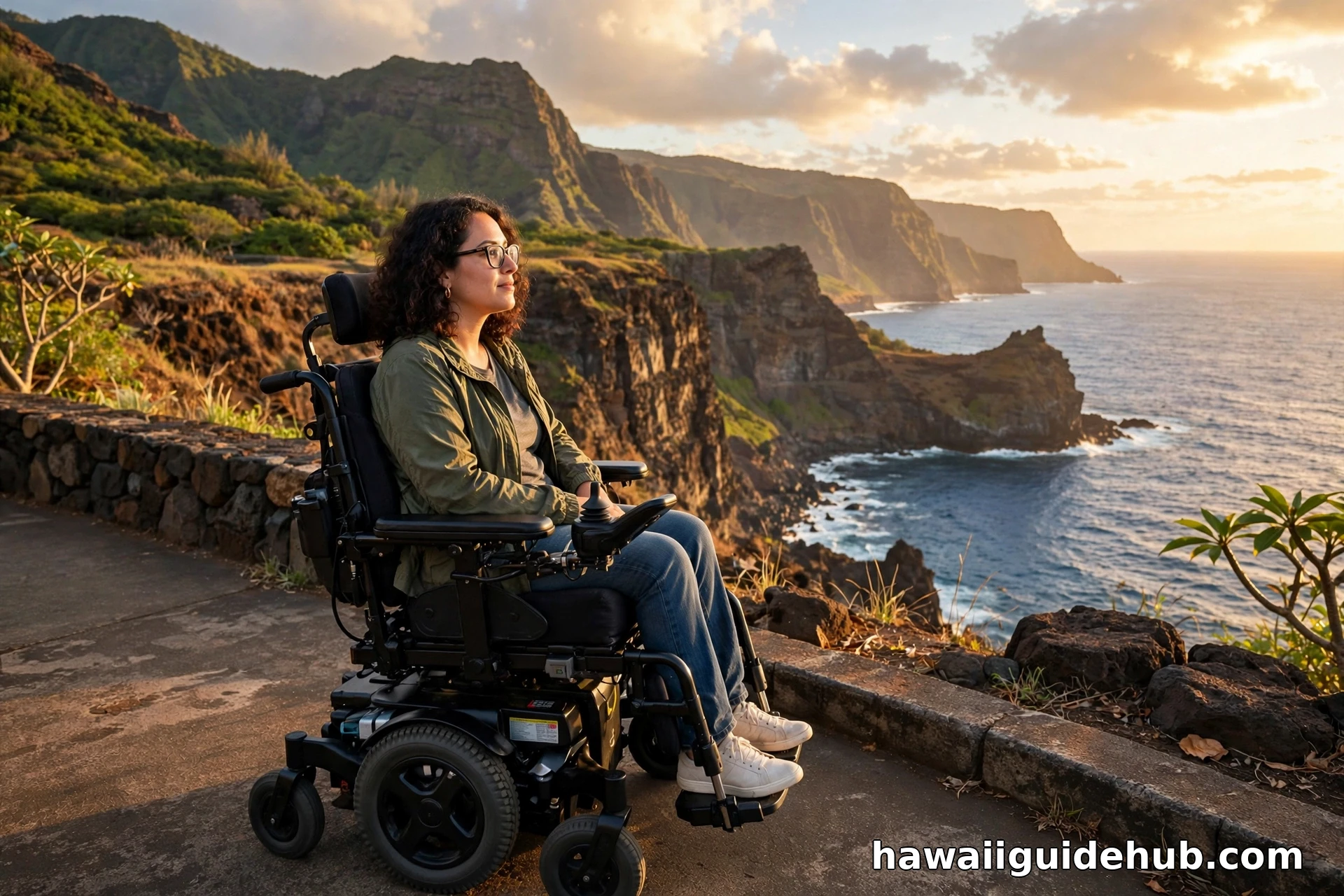
This is the trip, in one frame: a power chair user at a paved coastal overlook, golden light on the cliffs, the whole Pacific horizon hers. No hiking required, no barriers overcome, just the islands’ grandeur delivered to exactly where she is. Hawaii’s best wheelchair moments look like this: not adapted, not alternative, simply magnificent.
Choosing Your Island as a Wheelchair User
The island choice matters more for wheelchair users than for anyone else. Oʻahu is the clear winner for infrastructure: Honolulu’s curb cuts, TheBus’s kneeling fleet, Pearl Harbor’s full access, and the densest concentration of medical supply vendors and accessible vans. Maui’s resort corridors are excellent but the island’s adventures skew rugged. The Big Island offers the volcano park’s accessible highlights but punishes with distance. Kauaʻi is the most beautiful and the least accessible. First-time wheelchair visitors should default to Oʻahu; returning travelers can graduate to the harder islands with experience.
Accessible Van Rentals: Book Early
The accessible van is the linchpin of the independent wheelchair trip, and island inventory is brutally limited. Book the moment flights are confirmed, months ahead in peak season, and confirm twice: once at booking, once the week before. Specify the exact ramp or lift type, the interior dimensions, and whether you will be driving from your chair or transferring. Have a backup plan: a standard rental plus a portable ramp covers some situations, and some tour companies offer lift-equipped private tours that substitute for self-driving on key days.
Cruise Ship Shore Excursions
Hawaii cruises are a wheelchair traveler’s secret weapon: the ship is your accessible hotel that moves between islands, eliminating interisland flights with the chair. In port, book excursions through the cruise line and specify accessibility needs precisely; the line contracts with local operators and knows which ones have lifts. Independent accessible van tours in each port work too. The tenders at some ports are the weak link: confirm tender accessibility for your specific sailing, as it varies by ship and sea conditions.
Daily Logistics: Dining, Restrooms, and Shade
The unglamorous logistics make the trip. Dining: resort restaurants are reliably accessible; food trucks are a terrain lottery, so scout first. Restrooms: know the accessible restroom locations on your route before you need them; beach parks vary, and the good ones are worth routing through. Shade and water: wheelchair users in the sun dehydrate faster and cannot always relocate quickly, so carry more water than you think you need and plan shade breaks. The boring planning is what makes the exciting parts possible.
When Things Go Wrong
Chairs break, especially in Hawaii. Know before you go: the nearest wheelchair repair vendor to your lodging, your travel insurance’s equipment coverage, and the airline’s liability limits for damaged mobility devices. Carry the vendor’s number and your chair’s serial number in your phone. If the chair is damaged in flight, file the claim at the airport before leaving, with your pre-flight photos as evidence. The travelers who recover fastest are the ones who planned for the breakdown before it happened.
The Companion’s Playbook
Companions: your job is facilitation, not management. Learn the chair’s operation before the trip, including the manual release for power chairs. Agree on signals for when help is wanted versus when independence is the point. Take rest days seriously, for yourself too. And advocate: the companion often makes the confirmation calls and asks the hard questions, freeing the traveler to be the traveler. The best companion work is invisible.
Power Chair vs. Manual Chair in Hawaii
The chair you bring shapes the trip. The table below is the honest comparison for island conditions.
| Factor | Power chair | Manual chair |
| Hills & grades | Handles with ease; watch battery drain | Brutal on grades; companion essential |
| Sand | Stuck without beach chair; heavy to push out | Stuck too; transfer to beach chair either way |
| Airline handling | Higher damage risk; battery rules apply | Simpler; fewer parts to break |
| Range anxiety | Real: carry charger, plan distances | None, but shoulder fatigue instead |
| Rain | Electronics hate it; bring covers | Shrugs it off |
| Verdict | Better for independence on pavement | Better for rugged, wet, fly-often trips |
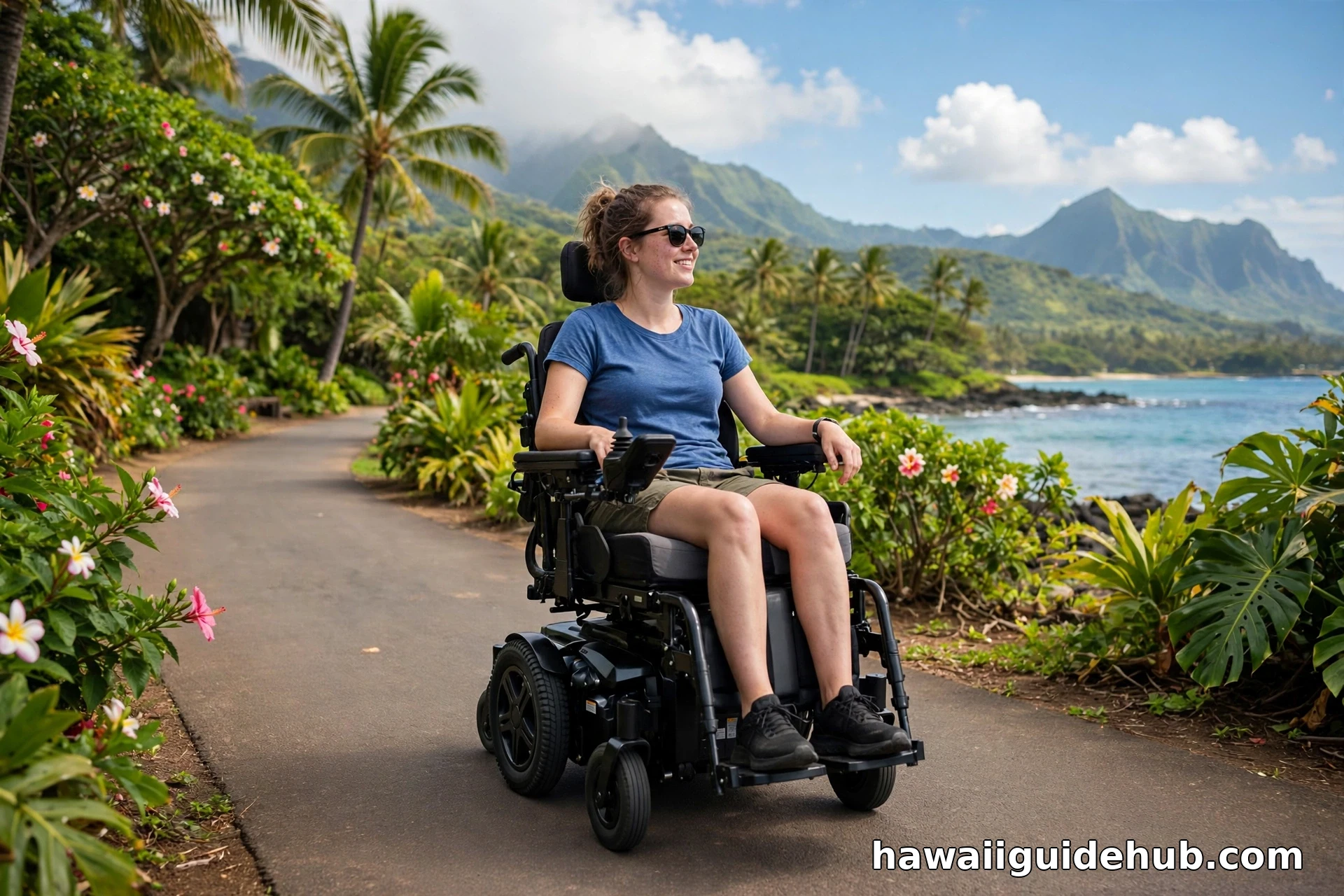
Independence, paved, and perfumed with plumeria: a power chair user rolling a smooth garden path with green mountains and blue ocean ahead. This is the power chair’s Hawaii at its best, the miles of accessible pavement that the islands lay out like a red carpet. Charge the chair, pick the path, and go as far as the battery and the daylight allow.
Flying With Your Chair: The Protocol
Your chair flies in the cargo hold, and the protocol starts 48 hours out: notify the airline, specify the chair type, weight, and dimensions, and for power chairs, the battery type with documentation. Non-spillable batteries are the standard; lithium batteries have watt-hour limits and must be carried in the cabin in most cases. Photograph your chair from every angle before handing it over; remove every detachable part and carry it on. At the gate, you transfer to an aisle chair and your chair is loaded. On arrival, inspect before leaving the jet bridge: damage claims filed later are damage claims denied. The Air Carrier Access Act is your legal backbone; know it before you need it.
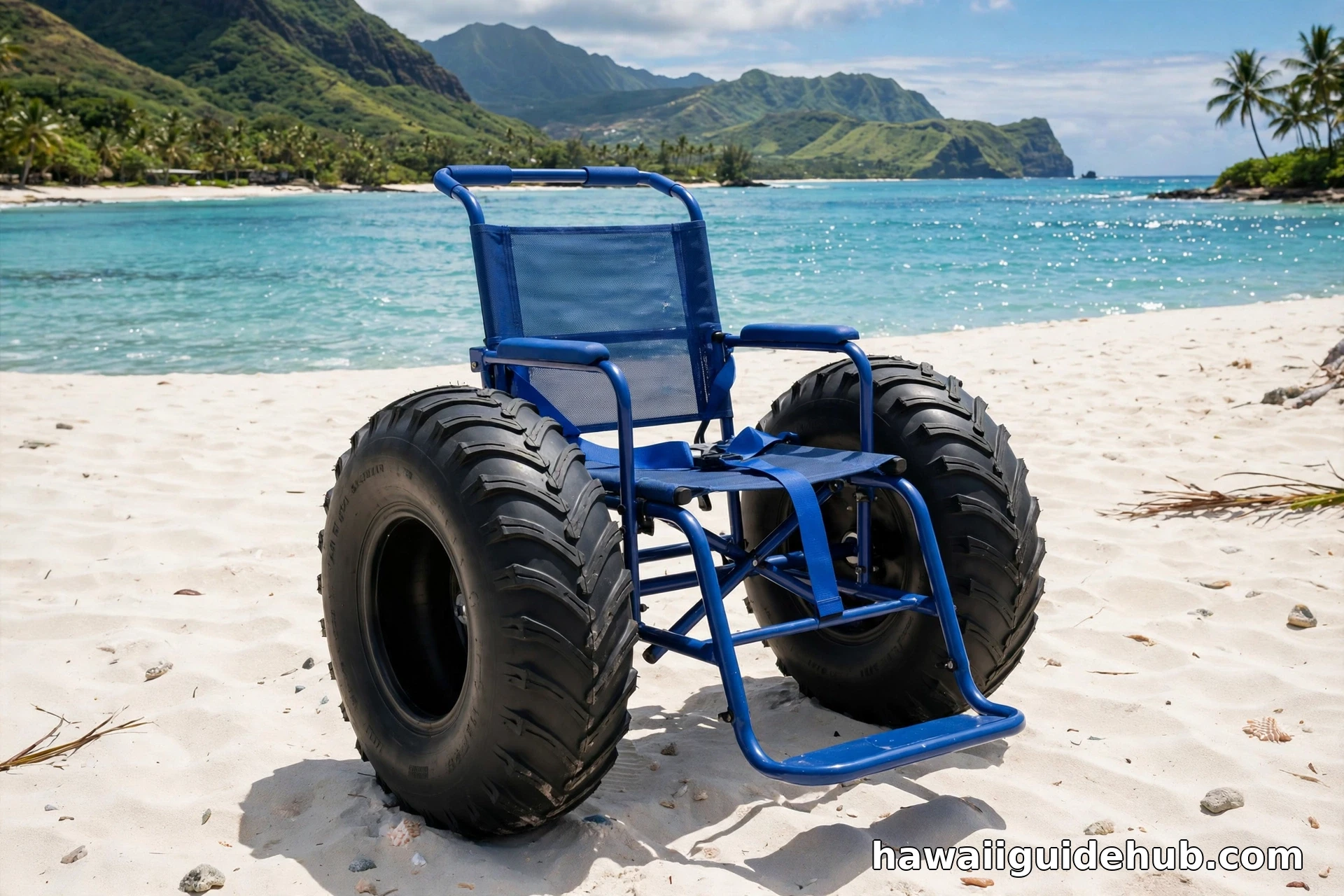
The chariot awaits: a beach wheelchair with balloon tires parked on white sand, turquoise water beyond, green mountains behind. This unassuming device is the difference between watching the beach and being on it, between the parking lot and the water’s edge. Reserve it early, arrive early, and let the balloon tires carry you where your chair cannot go.
Beach Wheelchairs: Your Ticket to the Sand
The beach wheelchair, fat balloon tires that roll over sand and into the surf, is the single most important accessibility device in Hawaii. County parks departments lend them free or cheap at major beach parks: Ala Moana on Oʻahu, Poipu on Kauaʻi, Spencer Beach on the Big Island, and several Maui beaches. Hanauma Bay has two available with advance reservation at no charge. The catch: limited inventory, first-come systems at some locations, and you need a companion to push. Reserve the moment your dates are firm, confirm the week before, and arrive early on the day.
The deeper message of the wheelchair trip to Hawaii is about who the islands are for. The answer, written in the paved coastal paths, the beach wheelchair programs, the helicopter lifts, and the volcano overlooks, is everyone. Not everyone with an asterisk, not everyone with assistance, but everyone, fully and without qualification. The barriers that remain are logistical, not philosophical, and logistics can be planned. The islands have done their part; the planning is yours, and it is worth every phone call.
Transfers: The Honest Assessment
Every activity in Hawaii is a transfer question. Boat tours: some vessels have boarding lifts or level boarding; many require a stepped transfer with crew assistance, which works for some and not others. Helicopter tours: custom chair lifts exist at several operators’ bases, getting you to the seat. Swimming: beach wheelchairs get you to the water’s edge; the water entry is a lift or slide with companion help. Snorkeling from shore: possible with assistance and calm conditions. The rule: describe your exact transfer ability when booking, in concrete terms, and let the operator tell you honestly whether it works. Vague “I’m in a wheelchair” gets vague answers.
Salt, Sand, and Maintenance
Hawaii is hostile to wheelchairs: salt air corrodes, sand invades bearings, and humidity swells everything. Rinse the chair with fresh water after beach days, dry it thoroughly, and lubricate moving parts more often than at home. Bring spare parts for the failure-prone: tires, tubes, bearings, a basic tool kit. Know the local equipment vendor’s number before you need it. Power chair users: keep electronics dry with rain covers, charge nightly without exception, and know that hills and headwinds cut range significantly. The chair is your legs; maintain it like your trip depends on it, because it does.
The Attractions That Deliver
Hawaiʻi Volcanoes National Park’s overlooks and scenic drives, Pearl Harbor’s full complex, the Makapuʻu Lighthouse Trail’s paved mile, Waimea Valley’s waterfall path, the coastal paths of Kāʻanapali and Wailea, and the botanical gardens statewide all deliver the full experience from a chair. These are not consolation prizes; they are among the islands’ finest attractions, full stop. Build the itinerary around them and the trip needs no apology.
For more trip planning, the guide to Hawaiian cultural traditions adds the cultural layer, while responsible travel practices and the guide to Hawaii’s natural environments help you travel well.
Watch: Traveling With a Power Wheelchair
Frequently Asked Questions
Can you fly with a power wheelchair to Hawaii?
Yes. Notify the airline 48 hours ahead, carry battery documentation, photograph the chair before handover, and remove detachable parts to carry on.
Where can you rent a beach wheelchair in Hawaii?
County parks departments lend them at major beach parks on all islands, usually free. Reserve ahead; inventory is limited.
Is a power chair or manual chair better for Hawaii?
Power chairs win for independence on pavement; manual chairs are simpler for flying, rain, and rugged conditions. Many travelers bring the chair they know best.
Can wheelchair users go on boat tours in Hawaii?
Some operators have lifts or level boarding. Confirm the specific vessel when booking; never assume from the company’s general accessibility statement.
How do you protect a wheelchair from salt and sand?
Rinse with fresh water after beach days, dry thoroughly, lubricate often, and bring spare tires, tubes, and a tool kit.
The wheelchair trip to Hawaii is not a diminished trip; it is a specific trip, with its own protocols, its own equipment, and its own rewards. The chair flyers who plan it right get the volcano overlooks, the coastal paths, the beach wheelchairs, the helicopter lifts, the whole blue Pacific. The islands are ready. Bring the chair, bring the plan, and roll out to meet them. The chair got you here; the islands will take it from there, with their paved paths, their balloon tires, their lifts and overlooks, and their long tradition of welcoming every traveler who ever rolled, walked, or sailed into the Pacific in search of exactly this: the moment when the planning ends, the path smooths out, the ocean opens up, and the only thing left to do is be there, fully and completely, in the place you worked so hard to reach. That moment is the whole point of the planning, the calls, the confirmations, the careful packing: it buys you the freedom to simply be in Hawaii, the chair forgotten, the ocean remembered, exactly as it should be. The best accessible trips end the same way the best of all trips end: with the traveler already planning the return, before the first trip has even finished, because the islands got under the skin in the way they always do, for every traveler, in every chair, on every path, under every Pacific sunset that ever made a traveler forget to check the time, which is the truest measure of a trip well taken, in any chair, on any island, under any truly beautiful Hawaiian sky.